
First-time buyer mortgage journey - step-by-step guide from Nachu Finance

Testmonials

Enquiry Form

Get in Touch with Us for Personalized Finance Assistance

Please enable JavaScript in your browser to complete this form.
=

The First-Time Buyer’s Mortgage Journey: A Complete, Practical Guide

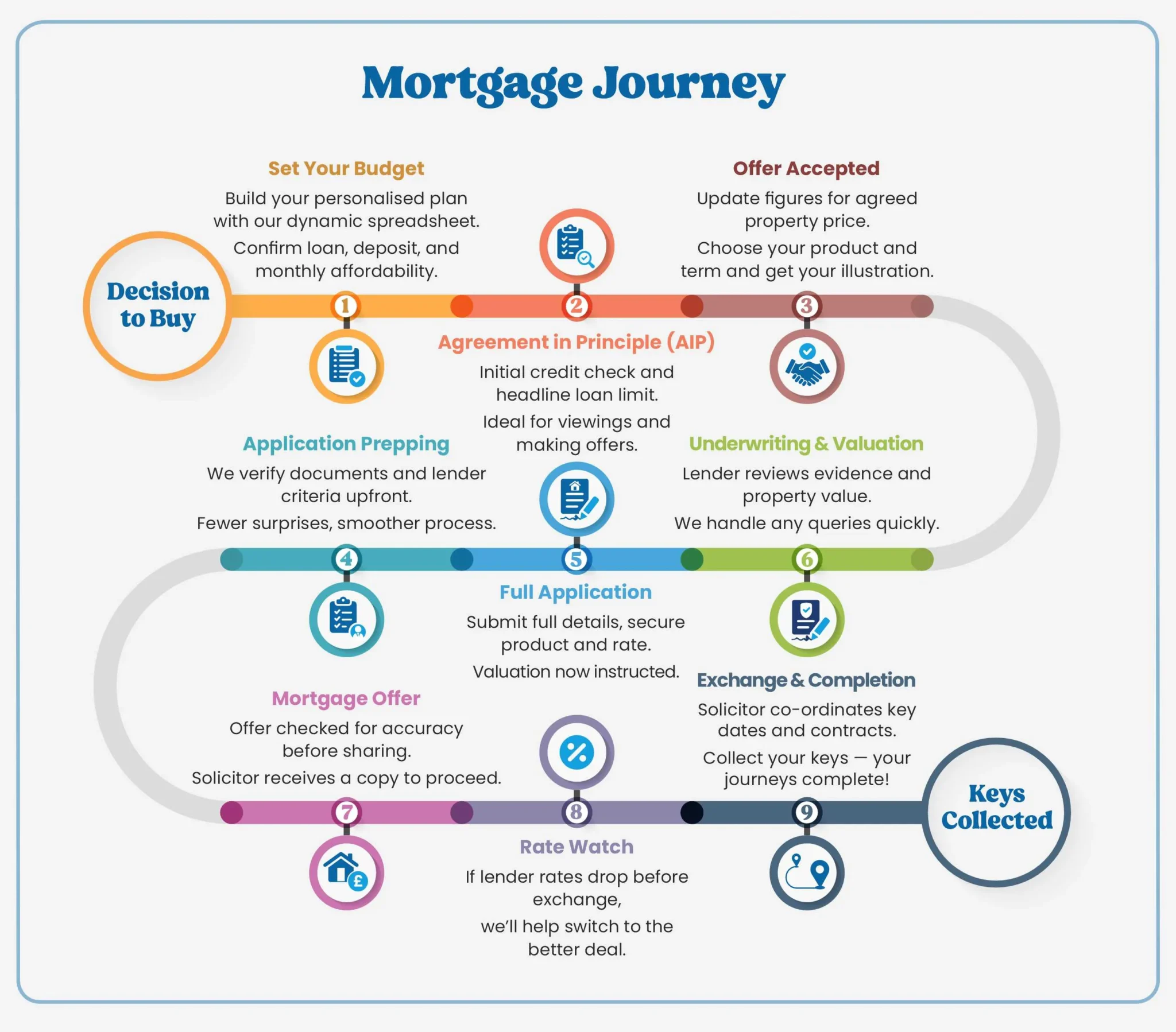
First-time buyer mortgage journey - step-by-step guide from Nachu Finance

Who this is for

If you are buying your first home and want a clear, end-to-end view of what happens, in what order, and why — this guide is for you.

How to read this

This explains the ideal, logical sequence from first thought to mortgage offer and completion support.
In real life, you might join mid-way, skip a step, or loop back — that’s perfectly normal.
Use the anchor links and checklists to dip into the parts you need most.

Before You Start: What “Good Process” Looks Like

  • A clear picture of how much you can borrow, how much deposit you need, and what the total monthly cost could be.
  • An Agreement in Principle ready to show estate agents so your viewing and offer carry weight.
  • A researched product and term only once a property is agreed, not before.
  • A thorough application-prepping stage so there are fewer surprises later.
  • Prompt responses to lender queries and valuation logistics handled early.
  • A final mortgage offer that matches your illustration, checked for errors.
  • Ongoing rate watch right up to exchange if the lender reduces rates.

Scenario Assessment and Game Plan

Goal:
To answer four key questions with confidence:

  1. What is the maximum loan available to you?
  2. What deposit is needed and where will it come from?
  3. What one-off costs are likely at the start?
  4. What will your monthly payments look like under realistic options?

What we capture from you:

  • Employment and income details (including bonuses, overtime, or commissions).
  • If self-employed or a company director — profits, salary, dividends, latest accounts, or SA returns.
  • Credit commitments such as loans, cards, car finance, or student loans.
  • Family situation and foreseeable changes affecting affordability.
  • Deposit source and evidence.
  • Property preferences such as freehold or leasehold, service charges, ground rent, or new-build details.

Our unique approach
We prepare a personalised, dynamic spreadsheet that models:

  • Different property prices and deposits.
  • The impact of term or rate changes.
  • How your affordability and payments shift with each scenario.

This prevents wasted viewings and helps you and your family align on a realistic plan before falling in love with a property outside budget.

Outputs you receive:

  • A clear headline range for purchase price and loan.
  • Estimated upfront costs.
  • Indicative monthly payments under a few realistic setups.
  • A summary of the best-case pathway, subject to standard checks.
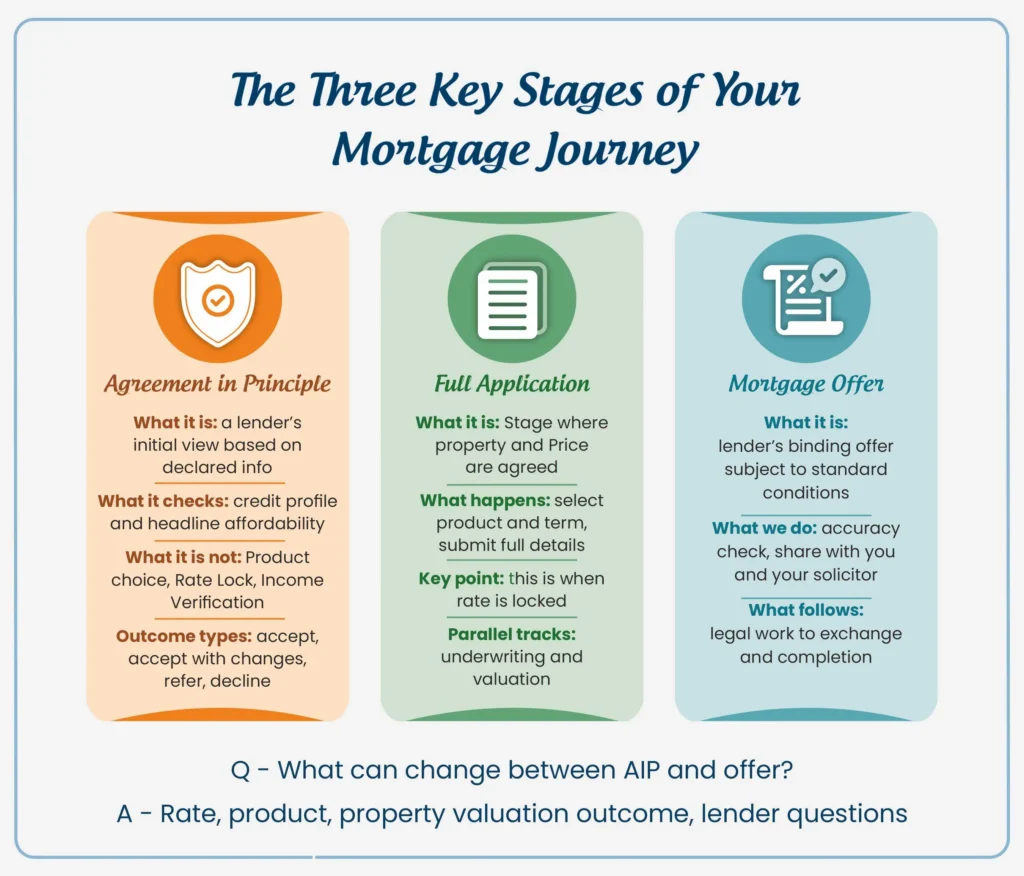
Agreement in Principle: Confidence for Viewings and Offers

What it is:
A lender’s non-binding confirmation that, based on declared information, your credit profile and circumstances appear acceptable for borrowing up to a stated limit and deposit.

What it is not:

  • Not a product choice or rate lock.
  • Not a full underwrite.
  • Does not require you to evidence income or deposit to the lender at that stage.
    (However, we still review these documents upfront to ensure everything aligns before applying.)

Possible outcomes:

  • Accepted for the requested loan and deposit.
  • Accepted but for a lower loan or higher deposit.
  • Referred for manual review.
  • Declined.

Why it matters:
Estate agents often ask for an AIP before viewings or when you make an offer. It demonstrates you’re financially prepared and serious about buying.

Tip:
We usually obtain the AIP at the most conservative deposit level you’re comfortable with. If you later choose to put in a larger deposit, that’s an easy adjustment.

Full Application: Only After Your Offer Is Accepted

When to choose products:
Only after the property and price are agreed. Before that, we show you ranges and examples — not specific products.
Once an offer is accepted, we refresh your spreadsheet and review:

  • Product style (fixed, tracker, discount).
  • Fixed period (two or five years, and whether flexibility is important).
  • Term, affordability, and how it affects long-term cost.
  • Fees and whether adding or paying upfront makes sense.
  • Leasehold and property-type considerations.

The key document you receive:
A detailed Mortgage Illustration that outlines your rate, fees, term, payments, and deposit.
This forms the foundation of the final mortgage offer, assuming there are no material changes.
Application-Prepping: The Extra Work That Saves Time Later

We resolve complexity before submission to minimise delays. Expect us to check lender criteria thoroughly and gather complete supporting evidence up-front, including:

  • ID and address verification.
  • Income documents: latest payslips, P60s for the last two years, and employment letter if required; or SA302s (Tax Calculations), Tax Year Overviews, company accounts, and accountant references for business owners.
  • Bank statements and explanations for unusual transactions.
  • Evidence of all credit commitments and deposit source.
  • Property details (lease, ground rent, new build warranty, etc.)

Why this matters:
It reduces back-and-forth, makes underwriting smoother, and surfaces deal-breakers early when there’s still time to adapt.
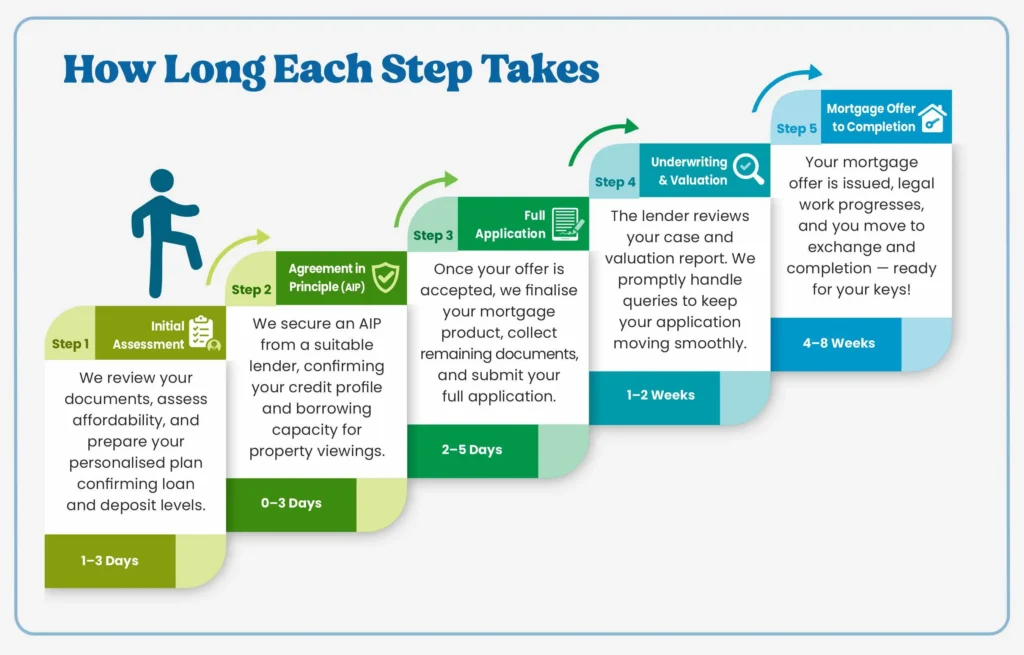
How long each step of the mortgage process typically takes

After Submission: Underwriting and Valuation

Lenders typically run these in parallel, though some prefer to finish underwriting before instructing a valuation, especially in specific or complex cases.

Underwriting — what to expect:

  • The case manager checks that all documents match the application.
  • Queries are common; some cases complete in a single round, while others require several iterations depending on complexity.
  • The lender focuses on identity, affordability, credit conduct, and how your deposit is sourced and evidenced.

Valuation — types, triggers and outcomes:

At this point, the lender instructs a valuation to confirm that the property is suitable security for the mortgage and that its value matches the agreed price.
You may not always see a valuer in person — sometimes it’s done digitally or from outside the property.
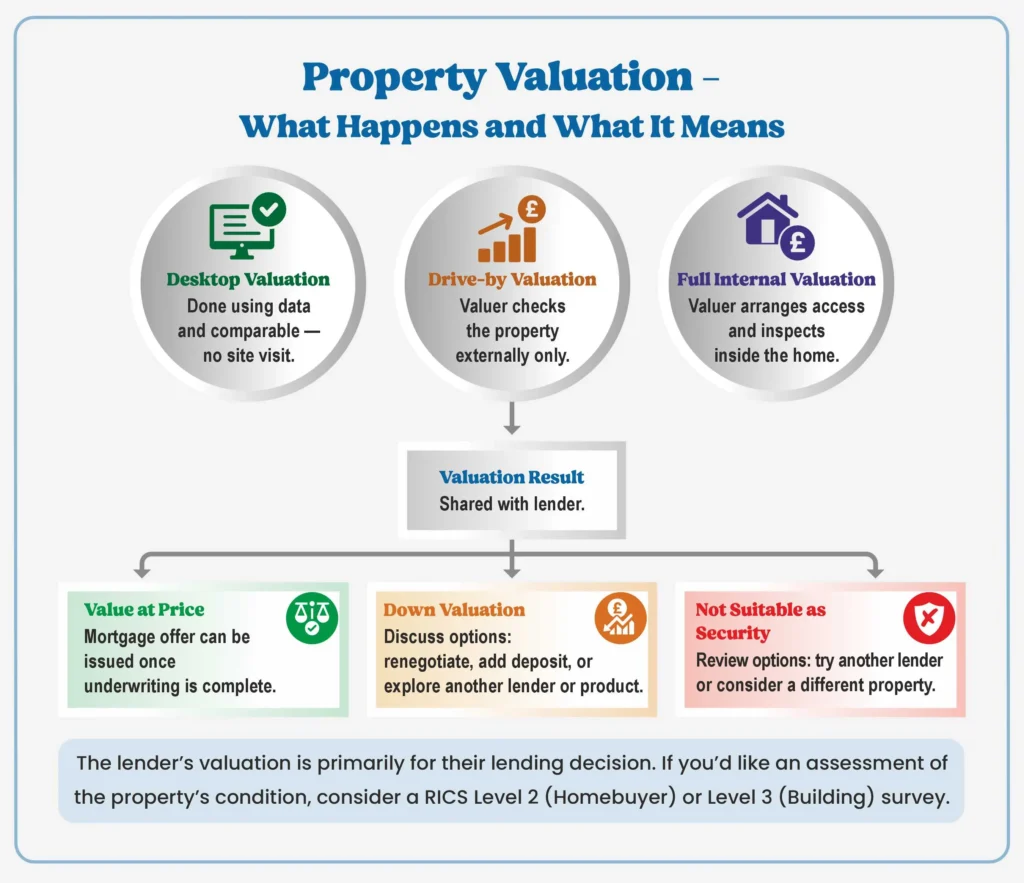
Mortgage valuation types and possible outcomes

The infographic above shows the three main valuation methods and the possible outcomes.
Here’s how to read it in context:

  • If the valuation comes back at the agreed price, the process moves smoothly to mortgage offer.
  • If it’s lower than the purchase price (a “down valuation”), we’ll discuss options — renegotiating the price, increasing your deposit, or exploring alternative lenders.
  • If the property is deemed unsuitable as security, this usually points to structural or legal issues. In such cases, we’ll reassess whether another lender or property is more appropriate.

If you’d like to understand the different types of property surveys and when each is recommended — for example, a RICS Level 2 (Homebuyer) or Level 3 (Building) report — read our detailed guide:
When to Get a Property Survey 

Mortgage Offer: Final Approval Before the Legal Stage

When the lender issues your mortgage offer, we:

  • Review it thoroughly to ensure it matches the illustration and key details.
  • Flag and correct any discrepancies with the lender.
  • Share the confirmed copy with you and your solicitor.
  • Update the estate agent that the offer is in place (without sharing private documents).

From this point, the legal work drives the timeline — searches, enquiries, and exchange.
We remain engaged until completion and monitor for potential rate reductions that may benefit you.

Rate Watch Between Offer and Exchange

If the lender reduces their rate and switching is practical before exchange, we assess whether it’s worthwhile and help you move to the better deal where feasible.

Your Role in Keeping Things Smooth

  • Provide complete documents promptly in the requested format.
  • Keep us updated on any job, income, or deposit changes.
  • Respond quickly to emails or document requests.
  • Facilitate access for surveyors and solicitor ID checks without delay.

What Happens After the Mortgage Offer

Your solicitor now takes the lead — handling searches, enquiries, exchange of contracts, and completion.
We remain available to coordinate lender conditions, monitor rates, and keep all parties aligned.

Next read: Understanding the Conveyancing Process When Buying a Property

Frequently Asked Questions

Yes — we’ll need your solicitor’s details before we submit your full mortgage application.
Having a solicitor in place helps avoid delays once the mortgage offer is issued and ensures your legal work can start promptly.
We’re happy to share a quote from one of the solicitors we work closely with for you to consider — entirely without pressure or obligation.

Yes, most lenders are comfortable with gifted deposits as long as there’s a formal letter confirming it’s a genuine gift, not a loan.
We’ll guide you and your family through what’s required so that the paperwork is exactly as lenders expect.

That’s absolutely fine — just let us know as soon as you can.
A change of job can affect how a lender assesses your application, but not always negatively.
We’ll review the new details, check lender criteria, and help you decide the best way forward without losing momentum.

Often yes, if there’s enough time before exchange and if the lender allows product switches.
We’ll assess whether it makes sense financially and, where worthwhile, help you move to the lower rate so you don’t miss out on potential savings.

It depends on the lender. Some carry out a soft search that doesn’t affect your credit score, while others perform a hard check that appears on your file.
We’ll always choose the most suitable route for your circumstances and discuss the implications before proceeding.

Your rate is locked only when we submit your full mortgage application with the chosen lender and product.
That’s why we don’t rush to select a deal too early — we’ll time it carefully so you can secure the best rate available once your property and price are confirmed.

It’s best to avoid taking on any new credit or making unnecessary credit applications until your property has completed.
Lenders may run additional checks before releasing funds, and new borrowing can affect your affordability assessment or credit score.
If something is essential and doesn’t increase your monthly commitments, that’s usually fine — but always check with us first to be sure.

How We Make Your Mortgage Journey Smoother

At Nachu Finance, we’ve supported hundreds of first-time buyers across a range of scenarios.
Here’s how we add value throughout your mortgage journey:

  • Whole-of-market advice: We assess options from across lenders to find what truly fits your circumstances.
  • Dynamic personalised spreadsheet: Unique to Nachu Finance — helping you visualise how deposit, term, or price changes affect costs.
  • Application-prepping approach: We identify and fix potential issues before submission, saving you time later.
  • Transparent communication: You’ll always know where your case stands, what’s possible, and what’s not.
  • Ongoing support: From rate watch to coordination with solicitors, we stay with you right up to key collection.

Explore more on our Mortgage Services page for detailed insights on first-time buyer, home mover, and specialist mortgage options.

Our Transparency Promise

When Things Don’t Go to Plan

While we’ll do everything possible to make your mortgage journey as straightforward as we can, the truth is that not every application runs exactly to plan.
At times, issues may arise that are outside anyone’s control — whether due to lender processes, valuation outcomes, or solicitor delays.

What we can promise, however, is that we’ll always be in your corner.

We’ll keep you informed, fight your case wherever possible, and work closely with all parties involved to achieve the best possible outcome for you.

Our role is not just to submit your mortgage — it’s to stand by you until your goals are achieved, with transparency, persistence, and care guiding every step.

Ready to Make Your First Home a Reality?

Buying your first home can feel complex — but with Nachu Finance by your side, it doesn’t have to be.
We’ll guide you from that very first calculation through to collecting your keys, ensuring each step is clear, compliant, and stress-free.

Our approach is more than just finding you a mortgage. We help you understand your numbers, prepare your documents, and structure your application so it fits perfectly with your circumstances. You’ll have full visibility at every stage, and confidence that your mortgage is right not only for today but for your long-term plans too.

Contact us today to begin your first-home journey with trusted, whole-of-market advice and genuine personal support.

Picture of About the Author

About the Author

Sekkappan Alagu is the Founder of Nachu Finance Ltd, established in 2006. With an early career in journalism and publishing, he brings clarity and structured thinking to complex financial topics. Through the Nachu Finance Blog and Knowledge Hub, he shares insights drawn from nearly two decades of client advisory experience, helping readers make informed decisions and understand best practices in mortgages, protection and long-term financial planning.

Picture of Business Profile

Business Profile

Nachu Finance Ltd is a directly authorised FCA-regulated firm providing mortgage, insurance and estate planning advice to clients across the UK. The firm takes a holistic approach — considering protection, tax efficiency and long-term planning alongside property finance — maintaining high regulatory standards while keeping advice clear and easy to follow. To learn more about the firm's background and story, visit the About Nachu Finance page.

Essential Steps in Your Home-Buying Journey

Google search results versus professional mortgage advice - Nachu Finance

Testmonials

Enquiry Form

Get in Touch with Us for Personalized Finance Assistance

Please enable JavaScript in your browser to complete this form.
=

Why Professional Opinion Matters More Than a Google or AI Search

Google search results versus professional mortgage advice - Nachu Finance

General Search – The Starting Point

It is quite common for clients to begin their research by checking Google, using AI tools, or speaking to friends who have gone through a similar process. These are all good starting points to understand what is generally possible in the mortgage or property market and to familiarise yourself with key terms and concepts.

However, while Google searches, AI responses, and friendly discussions can help build general awareness, they cannot replace case-specific professional advice that takes into account your personal and financial circumstances.

If you are specifically interested in how advice-driven product selection differs from comparison websites, see our related article:

Why Personalised Mortgage Advice Goes Beyond Comparison Websites

The Limits of Generic Information

The information found through a Google search, an AI summary, or a general discussion with friends is, by nature, generic.It does not take into account:

  • Your income type or employment structure.
  • The property’s ownership model or intended use.
  • The lender’s current criteria.
  • Your residency or credit profile.

An AI answer can feel more tailored than a list of search results, because it responds to the specific question you asked. But it can only work with the information you have given it, and it does not know what you have not thought to mention. In practice, the details that change the outcome are often the ones a client would never think to include.

Mortgage lending, taxation, and property law all have layers of detail that differ from one case to another. What works well for one individual may not be suitable or even possible for another.

Generic search results versus case-specific mortgage advice comparison - Nachu Finance

Names in our case studies have been changed to protect client anonymity.

Ishan planned to use a gifted deposit for his purchase. A quick online search would have told him that lenders are happy to accept gifted deposits as long as the source of funds is evidenced and supported by a donor declaration.

While this is true in many standard residential purchases, Ishan’s purchase:

  • Was being made through a limited company,
  • Involved multiple shareholders, and
  • Related to a non-standard property: a multi-unit block under a single title.

Each of these narrowed the number of lenders available. Those who accept gifted deposits often do not accept multi-unit properties, and vice versa. For Ishan, the gap between what appeared acceptable online and what was actually possible was substantial.

Mr Nathan is a long-standing client and portfolio landlord. His buy-to-let properties form a significant part of his estate, and he wanted a long-term inheritance tax plan that would pass those properties on to his children fairly.

Before our next meeting, he shared details of his portfolio with an AI model and asked how the properties could be divided in an inheritance tax efficient way. After a number of iterations, the model produced a detailed plan. It worked through the property values, the outstanding balances and the remaining equity in each property, and showed how the split would stay equal between the children.

At the end of that plan came a short disclaimer. The model noted that it had not taken capital gains tax or stamp duty into account, and that the plan used direct transfers rather than any trust.

Those two lines carried a great deal of weight. When we worked through the figures for the Nathan family’s actual circumstances, the capital gains tax and stamp duty implications ran into hundreds of thousands of pounds. And because the transfers were direct, the properties would sit in the children’s own names with no protection once they arrived there – including if a child’s marriage were to break down later.

There was a second issue that no summary could have raised. Inheritance tax planning is not something to be started and settled in a single day. It is a long-term exercise, carried out in phases over decades and reviewed as circumstances change. The AI plan addressed the core objective of mitigating inheritance tax, and as a starting point for the conversation it had real value. It was not, and could not be, the plan itself.

Why Online Answers Can Be Skewed

There is one more limitation worth understanding, and it applies to search results and AI answers alike.

People rarely write about the times things went exactly as expected. They write when something went wrong. If someone has a high temperature, takes paracetamol and feels better in two days, they do not post about it. If the temperature persists because something else was going on, that is when it reaches a forum or an article — and that is what the search engine has to draw on.

The same is true in our field. Straightforward cases that complete without incident are rarely discussed online. The exceptions are. So the picture you get can be weighted towards the unusual rather than the typical — which is another reason to check what you find against your own circumstances.

Technology Should Enable Advice, Not Replace It

None of this is an argument against technology. We use it ourselves, a good number of our new enquiries reach us through Google and, increasingly, through AI-assisted searches, and clients who arrive having done their own reading usually have sharper questions and clearer priorities.

Our position is a simple one: let technology enable the advice and research process, not replace it. In an area as personal and as long-term as financial planning, the analysis needs to sit alongside someone who knows your full circumstances and carries responsibility for the recommendation.

Why Professional Advice Holds Greater Weight

Professional opinion is built on understanding not just what the rules say, but how they are applied in practice.
It involves:

  • Interpreting lender and solicitor criteria within the context of your case.
  • Balancing compliance, affordability, and timing.
  • Ensuring that what appears possible in theory is achievable in reality.

A professional adviser also carries regulatory accountability — meaning the guidance you receive must be suitable, compliant, and in your best interests. That level of responsibility does not exist in a Google search, an AI response, or a conversation with friends.

Research Is Useful – Validation Is Essential

Doing your own research is helpful and can make conversations more meaningful. Bringing an AI summary to a meeting is welcome, not unwelcome; it often tells us exactly what matters to you.

But before proceeding with decisions or forming expectations, it is vital to validate that research with a qualified professional. A generic Google answer or AI response can inform you of what is common, but professional advice ensures that what you are planning is achievable and acceptable for your specific situation.

The key takeaway: general searches are a good place to start — professional advice ensures you finish right.

Picture of About the Author

About the Author

Sekkappan Alagu is the Founder of Nachu Finance Ltd, established in 2006. With an early career in journalism and publishing, he brings clarity and structured thinking to complex financial topics. Through the Nachu Finance Blog and Knowledge Hub, he shares insights drawn from nearly two decades of client advisory experience, helping readers make informed decisions and understand best practices in mortgages, protection and long-term financial planning.

Picture of Business Profile

Business Profile

Nachu Finance Ltd is a directly authorised FCA-regulated firm providing mortgage, insurance and estate planning advice to clients across the UK. The firm takes a holistic approach — considering protection, tax efficiency and long-term planning alongside property finance — maintaining high regulatory standards while keeping advice clear and easy to follow. To learn more about the firm's background and story, visit the About Nachu Finance page.

Make Better-Informed Mortgage Decisions

Wooden letter tiles spelling "rent out" versus "sell" on a split blue and yellow background, illustrating the choice homeowners face when moving

Testmonials

Enquiry Form

Get in Touch with Us for Personalized Finance Assistance

Please enable JavaScript in your browser to complete this form.
=

Moving Home: Should You Let Out Your Current Property or Sell It?

Wooden letter tiles spelling "rent out" versus "sell" on a split blue and yellow background, illustrating the choice homeowners face when moving

Unlike a first-time buyer, a homeowner looking to move has an extra decision to make before anything else: what happens to the property you already own?

Broadly, there are two routes.

  1. Retain and let out your current property, and buy the new one as an additional property.
  2. Sell your current property and buy the new one at the same time — which usually means being part of a chain.

Each route has different financial, practical and lifestyle implications. This article sets out both so you can work out which suits your circumstances, and we close with a side-by-side comparison and some common questions.

Option 1: Keep your current property and let it out

Before looking at the numbers, there are two questions to answer honestly. You need a “yes” to both.

Question 1: Do your finances allow it?

When you sell, all of the equity in your current home is released to put towards the next one. When you keep it as a rental, that is not the case.

  • Equity you must leave in the property. As an absolute minimum, lenders expect you to leave 25% equity in the property you are letting out. Depending on the rental income the property can achieve and how the lender stress-tests it, the amount you must leave in may be higher.
  • Additional stamp duty. Buying a new home while keeping your existing one means the purchase is treated as an additional property. The additional-rate surcharge currently stands at 5% on top of the standard rates. See our guide to stamp duty for home movers for how this is calculated.

So the question is whether, after leaving at least 25% equity behind and paying the higher stamp duty, you still have enough to fund the deposit and costs on the new property.

Question 2: Do you have the appetite to be a landlord?

Letting out a property is not simply another investment. It comes with ongoing legal, regulatory and practical responsibilities — and the regulatory bar has been rising steadily over recent years. Two of the most common practical points to plan for: you’ll need landlord insurance (standard buildings insurance doesn’t cover a let property), and the property will need to meet the minimum EPC rating required for rental properties, with the bar expected to rise further. Before committing, read our guide to the responsibilities of being a landlord and be honest about whether you have the time and the mindset for it.

If the answer to both is yes

You are in a strong position. Because you are not relying on a sale to fund your purchase, your new purchase does not fall within a chain, which removes one of the biggest sources of stress and delay in moving home.

The mortgage arrangement you will be using on your current property is technically called a let to buy mortgage — you are letting out your current residential property with a view to buying a new one. This is a well-established arrangement and we cover it in detail in our Let to Buy mortgage guide. Two points worth knowing at this stage:

  • Simultaneous completion. Lenders expect the let to buy remortgage on your current property and the purchase of your new home to complete on the same day, so that you move out of the current property and it becomes available to let.
  • What determines how much you can raise. The current market value of the property and the rental income it can achieve are the two key factors in how much capital a let to buy mortgage can release towards your new home.
  • Consent to let. If you have an existing residential mortgage on the property, you’ll need your lender’s consent to let it out — either as a standalone consent or as part of the let to buy remortgage. Don’t assume this is automatic; check before you commit.

Option 2: Sell your current property and buy the new one

The financial side

Financially, this is the simpler route.

  • All of your equity is released and available for the new purchase.
  • No additional stamp duty is payable, provided you meet HMRC’s conditions and can show you are replacing your main residence.
  • No landlord responsibilities — if being a landlord does not appeal, this route avoids it entirely.

The practical side

The trade-off is that you will be in a chain, and your sale and purchase must progress in step.

  • Completion has to be aligned. You hand over the keys to your buyer on the same day you collect the keys to your new home, and move house that day. Completion day itself can be logistically demanding.
  • Everyone in the chain must be ready. If your buyer has their own sale to complete (a downward chain), or your seller has their own purchase (an upward chain), every party has to reach the same stage before anyone can complete.
  • One end often moves faster than the other. In practice, we regularly see clients who have found the property they want to move to but have no buyer for their own home — or who have a buyer lined up but nowhere to move to.

None of these challenges is insurmountable, and buying and selling at the same time is done successfully every day. But they should be planned for, and there is no option for managing a chain that comes without some disadvantage of its own. See our guide to breaking the chain for the main approaches.

A third route: buy first, sell later

There is a middle path for those whose finances are not dependent on the sale.

If you can fund the new purchase without the proceeds of your current home, can afford the additional 5% stamp duty up front, and would prefer not to be in a chain — but also do not want to keep the current property long term — you can:

  1. Buy your new home first, paying the additional-rate stamp duty.
  2. Sell your current property afterwards.
  3. Reclaim the additional stamp duty from HMRC once the sale completes (subject to the time limit — see the FAQ below).

This suits a specific set of circumstances: finances that are not restricted, and a clear intention to sell rather than let out.

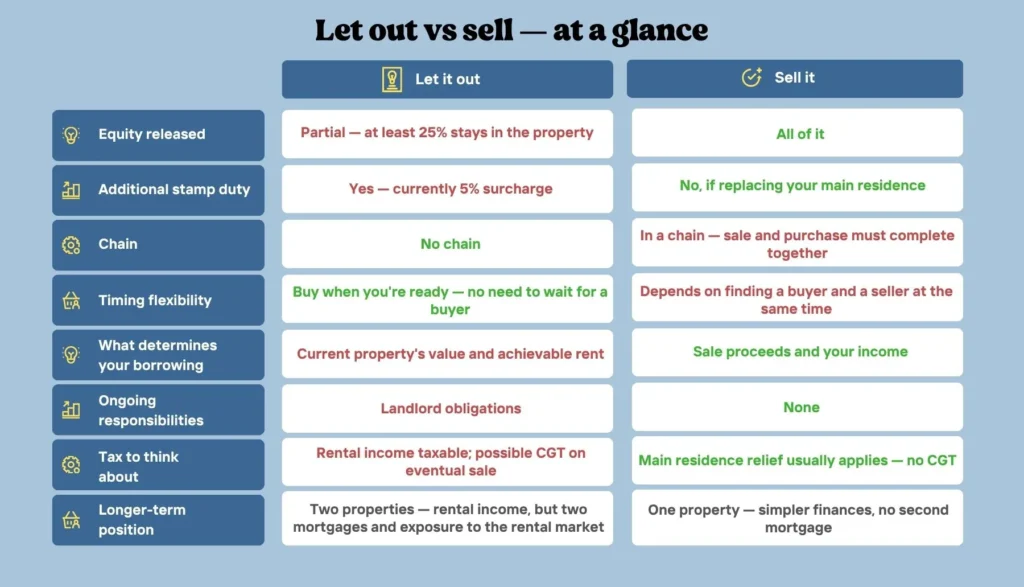
Letting out vs selling: side by side

Infographic comparing letting out versus selling a current property when moving home, across equity released, stamp duty, chain, timing, borrowing, responsibilities, tax and longer-term position

Frequently asked questions

Technically, yes. If you decide to retain the property but would prefer to hold it through a limited company rather than personally, that is an option you can explore. Whether the numbers make sense depends on your circumstances — in particular, moving a property from personal names into a company is treated as a purchase by the company, so stamp duty is payable on the transfer. Our article on transferring a property from personal names to a limited company covers the considerations in detail.

Yes, this is possible, but two timing rules matter.

  • Stamp duty reclaim. If you have paid the additional 5% stamp duty on your new home and want to reclaim it, HMRC requires the sale of your previous main residence to complete within three years of buying the new one.
  • Renters’ Rights Act. Once you have let the property, you cannot serve notice to a tenant on the grounds that you intend to sell within the first 12 months of the tenancy. Plan your timing accordingly — a short let is a minimum one-year commitment in practice. Our Renters’ Rights Act guide explains the position in full.

Being a landlord is entirely achievable, but it is a regulated activity and the government has made it more so over the last few years. If you are prepared to understand the requirements, keep on top of them and manage the property properly, letting out your current home is a perfectly realistic option. Before you commit, make sure you have read the responsibilities of being a landlord, and be confident you have both the time and the attitude to give it — it is an additional ongoing commitment, not a one-off decision.

The two routes are taxed differently. If you let out your current property, the rental income is taxable, and you may face Capital Gains Tax when you eventually sell it. If you sell now instead, main residence relief will usually mean no Capital Gains Tax is due, since you are selling the home you have been living in. Tax treatment depends on individual circumstances, so it’s worth factoring into your decision alongside the financial and practical points above.

Picture of About the Author

About the Author

Sekkappan Alagu is the Founder of Nachu Finance Ltd, established in 2006. With an early career in journalism and publishing, he brings clarity and structured thinking to complex financial topics. Through the Nachu Finance Blog and Knowledge Hub, he shares insights drawn from nearly two decades of client advisory experience, helping readers make informed decisions and understand best practices in mortgages, protection and long-term financial planning.

Picture of Business Profile

Business Profile

Nachu Finance Ltd is a directly authorised FCA-regulated firm providing mortgage, insurance and estate planning advice to clients across the UK. The firm takes a holistic approach — considering protection, tax efficiency and long-term planning alongside property finance — maintaining high regulatory standards while keeping advice clear and easy to follow. To learn more about the firm's background and story, visit the About Nachu Finance page.

Plan Your Move With Confidence

Family walking home to their house — life insurance through work versus your own cover

Testmonials

Enquiry Form

Get in Touch with Us for Personalized Finance Assistance

Please enable JavaScript in your browser to complete this form.
=

I Have Life Insurance Through Work — Is That Enough?

Family walking home to their house — life insurance through work versus your own cover

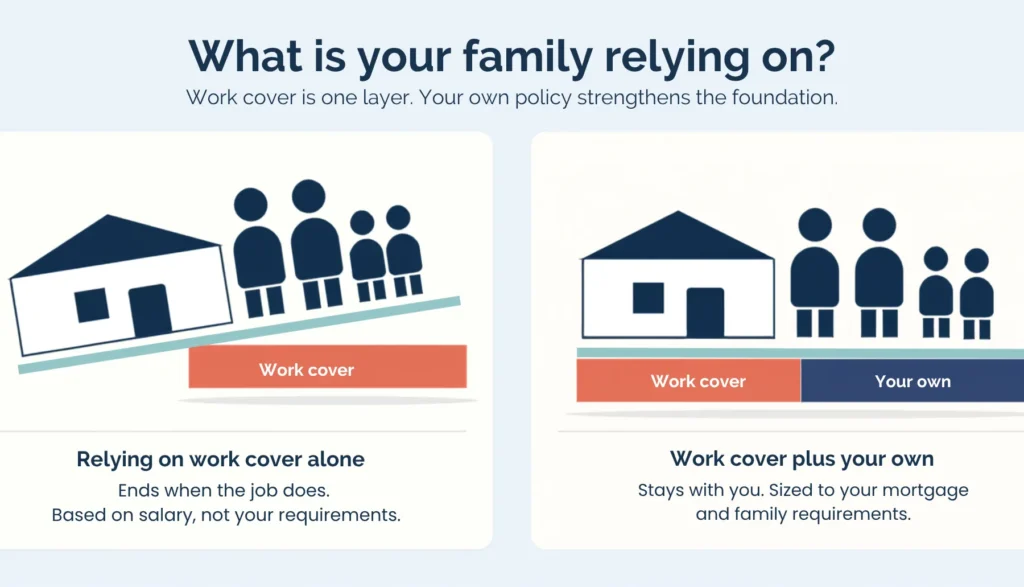
The short answer: Employer life cover — usually called death in service — is a valuable benefit and you should make the most of it. But it is calculated on your salary rather than your family’s needs, it ends the day you leave, and it almost never gets reviewed. The balanced approach is to count it, reduce your own cover accordingly, and never rely on it alone.

“I already have cover through work” is one of the most common things we hear when life insurance comes up during a mortgage. It is a fair point — and often a good benefit. This article explains what death in service does well, where it falls short, and how we combine it with cover of your own so the foundation of your family’s financial plan doesn’t depend on where you happen to work.

First, credit where it’s due

We have never advised a client to ignore or under-use the life cover their employer provides. Death in service has real advantages:

  • Lighter underwriting. Depending on the employer and the provider, group schemes usually involve far less individual health underwriting than a personal policy, which is assessed thoroughly on your own medical history. For anyone whose health would make personal cover expensive or unavailable, work cover can be the most valuable protection they hold. It is worth checking what your own scheme actually does — cover above a certain level is sometimes underwritten individually.
  • Economies of scale. Whether the employer pays or you contribute, group cover is generally cheaper per pound of cover than a personal policy — and smokers in particular benefit, as personal premiums can be significantly higher.
  • It lowers what you need to buy yourself. Every pound of work cover is a pound of personal cover you don’t have to pay for during your working years.

If your employer lets you increase your multiple for a modest contribution, it is usually worth doing. Our point is not “don’t rely on work cover”. It is “don’t rely on it alone”.


Do you know what you actually have?

Here is something we see constantly: clients can tell us to the pound how much personal life cover they took out, but very few can say how many times salary their work scheme pays. That tells you how little attention this benefit gets once the job starts.

Typical death in service pays three to five times salary. Three or four times is the norm; four and five times usually appear where the employee has opted in at extra cost or the employer uses it as a recruitment incentive. It is worth checking your contract or benefits portal today — and worth checking whether the additional items on your payslip are covered, or only your basic pay.

Where employer cover falls short

  1. It is based on your basic salary, not your family’s needs. A multiple of basic pay ignores your mortgage balance, other commitments, how many dependants you have and how old they are. It usually also ignores bonuses, overtime, stock options and any second income — so for many people the real gap between “what work pays out” and “what the family would need” is wider than the headline multiple suggests.

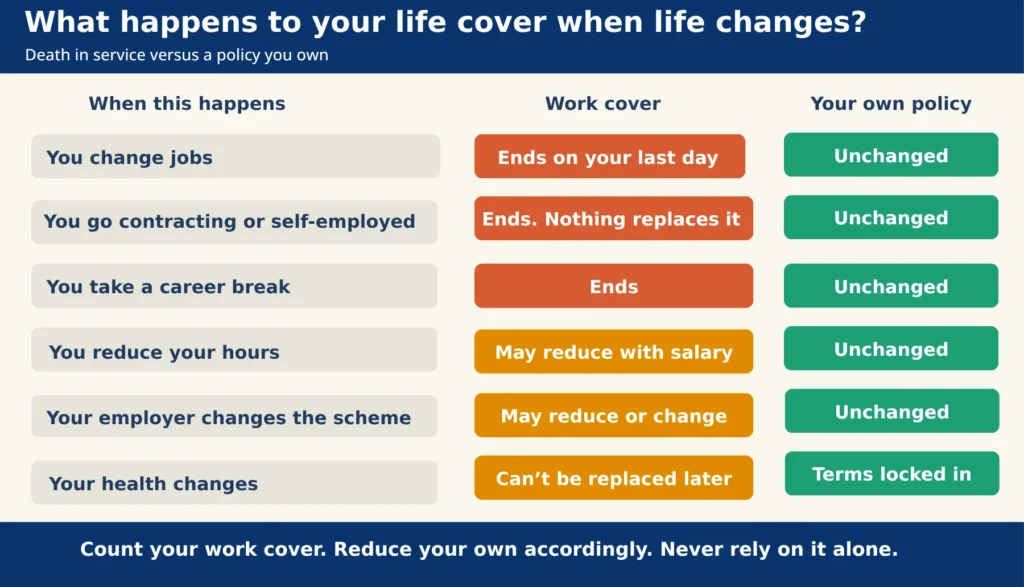
  2. It ends when your employment does. Change jobs, take a career break, reduce your hours, become a contractor or go self-employed and the cover stops. Exactly when it stops varies, so check your scheme’s cessation period or date. If your health has changed in the meantime, replacing it can be expensive or impossible.

  3. You don’t control it. The employer chooses the provider, the multiple and the scheme trust. You can usually nominate beneficiaries, but you cannot choose your own trustees, structure the trust around your estate planning, or adjust it as your family changes. Your employer can also change or reduce the scheme.

  4. It is set on day one and hardly ever reviewed. A personal policy gets reviewed when you buy a property, have a child or remortgage — because we are in touch at those moments. Work cover was decided when you signed your contract and, in our experience, is almost never revisited at the financial junctures that matter.

  5. It doesn’t lock anything in. A personal policy fixes your terms and premium at the point you apply, while you are young and healthy, for the whole term. Work cover gives you nothing to keep if you leave.

Employer cover vs your own cover — at a glance

 Employer death in serviceYour own life cover
How muchFixed multiple of salary, usually basic pay only (typically 3–5×)Sized to your mortgage, commitments and dependants
Who owns itThe employer’s schemeYou
If you leave your jobEnds — timing varies by scheme, check the cessation dateContinues unchanged
UnderwritingGroup basis — usually lighter, and provider-dependent; larger amounts may be underwritten individuallyFully underwritten on your health — cheaper when young and healthy, and terms locked in
Trust and beneficiariesNomination only; scheme trustees decideYou choose the trust, trustees and beneficiaries
Reviewed when life changesRarelyAt every mortgage, remortgage and family milestone
Cost to youFree or low costMonthly premium — reduced by whatever work already provides
Best forA valuable base layer, especially if health limits personal coverThe part of the foundation that stays with you


The balanced approach

Life insurance sits at the base of the financial planning pyramid — everything else you build (savings, investments, pensions) assumes your family can keep the house and their standard of living if you are not there. It is too important to leave dependent on your employer’s payroll.

So our approach is simple:

  • Count what work gives you. We record the multiple and the salary definition, and we treat it as real cover.
  • Reduce your own cover accordingly. There is no sense paying for overlapping cover. Work cover brings your personal premium down.
  • Never let it be the only layer. Your own policy, sized to the mortgage and the family, is the part that moves with you.
Infographic: a house and family resting on work cover alone versus work cover plus a personal life insurance policy

A top-up matters most if you have a residential mortgage, dependent children, or a household that relies heavily on your income. If you are self-employed or a contractor, there is no work layer at all — every part of your protection has to be arranged by you.

How much top-up? There is no formula. We size it to your individual circumstances — mortgage balance, other commitments, dependants and their ages, what work already provides and what you are comfortable paying. That is where personalised advice earns its place over a one-size-fits-all multiple.

Life changes. Work cover doesn’t come with you.

The scenario we see most often is the move from permanent employment to contracting or self-employment — particularly in IT, construction and among medical practitioners, where day-rate or locum work can be significantly more rewarding. The conversation is usually about income and tax. The death in service benefit gets noticed late, if at all.

By the time it does, the client is typically in their forties, may have a medical history that didn’t exist when they started their career, and is now paying full price for cover that could have cost a third as much had it been started at 25 and simply kept. For company directors there is a tax-efficient route — a Relevant Life Plan — but it still has to be arranged, and it is still underwritten on your health at that point.

death-in-service-when-life-changes.png Infographic: what happens to death in service cover versus your own policy when you change jobs, go self-employed, take a career break or your health changes

We saw exactly this with a client who moved to day-rate contracting within a year of buying his home. His death in service ended with the job, and we rebuilt his protection through his own limited company — one of several cases we set out in our
Life Insurance Review  article


The estate planning angle

Because we also handle estate planning and have supported families through probate, we see what happens after a claim — not just at the point of sale. Death in service is usually paid through the employer’s discretionary trust and normally sits outside the estate for inheritance tax, so that is not the issue. Four other things stand out:

  • Adequacy is only tested at the claim. This is the one that catches families out. A sum assured that felt sensible when the mortgage was arranged often turns out not to be enough to replace a breadwinner and let the family carry on as before. The real requirement is far more than the mortgage balance — let alone what an employer provides as a multiple of salary. By the time this becomes clear, nothing can be done about it.
  • Liquidity for inheritance tax. Where IHT is due, it has to be paid before the grant of probate is issued, and within six months of the end of the month of death — yet the estate itself is locked until that grant comes through. A personal policy in trust can provide the cash so the family is not forced to sell, borrow or use their own savings.
  • With your own policy you choose the trust, the trustees and the beneficiaries, and you can update them as children become adults or circumstances change. A work scheme gives you a nomination form, and the trustees decide.
  • A personal policy written in trust pays out on proof of death, without waiting for probate. That money is often needed within weeks, not months.

Readmore:  placing your life insurance under a trust  and  life insurance for inheritance tax planning

Real-life case studies

Names and some details have been changed to protect client confidentiality

Dinesh  was the sole breadwinner for his family, with a son in the middle of his A-levels. When he bought the family home he had four times salary through work and initially felt that was enough. Given the mortgage balance, a dependent child and one income, we recommended an additional level cover of £500,000, written in trust.

He died unexpectedly a few years later. At that point the property was worth around £650,000 with a mortgage of about £425,000. His death in service paid four times his £80,000 basic salary — £320,000 — and the personal policy paid £500,000, immediately and outside the estate. Together, £820,000 cleared the mortgage and left a surplus for the family to replace his lost income.

Two years on, at our next review, his son had started his undergraduate course at a leading UK university. The family had carried on without financial disruption. Had the family relied on the work cover alone, it would not have cleared the mortgage, let alone supported them afterwards. And because the work cover existed, Dinesh had paid for a smaller personal policy than he otherwise would have — the balanced approach, working as intended.

Karthik, 43, had worked in IT for several years on a £72,000 salary with a generous 4.5× death in service — £324,000 of cover. During one of our regular reviews he mentioned an offer to move to a contract at £525 a day, five days a week: comfortably over £120,000 a year. Financially, an obvious move.

What hadn’t featured in his thinking was that the £324,000 would end with his employment. Replacing it with his own policy was quoted at around £96 a month on standard terms. But Karthik had a medical condition that had developed in the previous five or six years, and the best terms available carried a 50% loading — roughly £144 a month. Had he started a policy of his own at 25 and simply kept it, the premium would have been in the region of £30 a month, on standard terms, locked in for life.

He went ahead. The increase in income more than justified the cost. But it was a cost that only existed because the foundation had been left to the employer.

Richard originally held a Relevant Life Plan through his limited company. When he closed the business and moved into employment, his new employer provided death in service equal to four times salary. He wanted the same overall protection as before, with the new work benefit taken into account.

We carried out a full review, cancelled the Relevant Life Plan, and arranged personal cover sized to top up the work benefit to the level he was comfortable with — keeping his premium as low as the work cover allowed. Protection is not static: it should change as your employment does, and it needs an adviser who looks at every source of cover together.

Our Transparency Promise

Full Disclosure, Complete Peace of Mind

The right disclosure, from the start. A life policy is only worth having if it pays out. That depends on the application being accurate. Before we submit anything, we discuss your medical and lifestyle circumstances in detail and carry out a pre-application check so you know the terms you are likely to be offered — no surprises. With most insurers we can share a copy of the completed application with you to confirm every answer before it goes in. It is a little more work now, and it is how we keep the risk of non-disclosure at claim stage as low as it can be.

Let’s look at your cover from every angle

Life insurance is the foundation of any family’s financial plan, and it deserves more care than a benefits form filled in on your first day. At Nachu Finance we help families get on the property ladder and we help them through probate and estate planning — so we see life cover from both ends: what it costs to set up, and what it does when it is needed. And because we stay in touch through every mortgage, remortgage and family milestone, your cover does not sit untouched for twenty years — we keep reviewing it as your mortgage, your income and your family change.

Start your life insurance, or have your existing cover — including what you get through work — reviewed properly, and reviewed again as life moves on. Your first meeting with us is free of charge.

Frequently Asked Questions

For some households, yes. For most with a mortgage and dependants, it isn’t. The test is not the multiple; it is whether the payout would clear the mortgage and replace enough income for the family to carry on. We run that calculation with you and count the work cover in full before recommending anything.

No. Keep it, and increase it if your employer lets you do so cheaply. Your personal policy is sized around it.

It normally ends when your employment ends, though the exact cessation date varies by scheme. Some schemes offer a continuation option, but this is not guaranteed and it is not in your control — it depends on the terms of the employer’s scheme. If you are planning a move to contracting or self-employment, arrange your own cover before you resign, while you are still covered.

Yes. You can hold cover from several sources. When you apply for a personal policy you declare the cover you already have so the insurer can assess the total sensibly.

This is exactly where work cover earns its place — maximise it. We will then research the market for insurers likely to take a favourable view of your circumstances, and be honest with you about the likely terms before you apply. Some cover of your own, even at a modest level, is usually still worth having.

Most schemes are already written under the employer’s discretionary trust, and you complete a nomination form. That usually keeps the payout outside your estate, but you don’t choose the trustees or the terms, and nominations are easily forgotten. A personal policy lets you set the trust up the way your estate plan needs.

Picture of About the Author

About the Author

Sekkappan Alagu is the Founder of Nachu Finance Ltd, established in 2006. With an early career in journalism and publishing, he brings clarity and structured thinking to complex financial topics. Through the Nachu Finance Blog and Knowledge Hub, he shares insights drawn from nearly two decades of client advisory experience, helping readers make informed decisions and understand best practices in mortgages, protection and long-term financial planning.

Picture of Business Profile

Business Profile

Nachu Finance Ltd is a directly authorised FCA-regulated firm providing mortgage, insurance and estate planning advice to clients across the UK. The firm takes a holistic approach — considering protection, tax efficiency and long-term planning alongside property finance — maintaining high regulatory standards while keeping advice clear and easy to follow. To learn more about the firm's background and story, visit the About Nachu Finance page.

Keep building the foundation

Let to buy mortgage explained: keep your current home as a rental and buy a new home

Testmonials

Enquiry Form

Get in Touch with Us for Personalized Finance Assistance

Please enable JavaScript in your browser to complete this form.
=

Let to Buy Mortgage Explained: How It Works & Key Considerations

Let to buy mortgage explained: keep your current home as a rental and buy a new home

A Let to Buy mortgage is when you remortgage your current residential property onto a buy to let mortgage so that you can move into a new residential home without selling your existing one. This structure enables homeowners to keep their current property as an investment, rent it out, and at the same time proceed with the purchase of a new residential property.

What makes Let to Buy slightly different from a standard buy to let remortgage is the connected home move. You are turning your present home into a rental property specifically because you are purchasing and moving into a new residence. This is why lenders treat Let to Buy as a distinct category with its own conditions.

Why a Let to Buy Mortgage Exists

A Let to Buy mortgage is often used when:

  • You wish to keep your existing home as an investment property
  • You need to release equity from the current home to help fund the deposit for your onward purchase
  • You prefer not to sell the property but require a mortgage that allows you to legally let the property out

Once the Let to Buy mortgage completes, the lender expects that you no longer live in that property.

Simultaneous Transactions

A key concept in Let to Buy applications

Most Let to Buy transactions require simultaneous completion between:

  • The Let to Buy remortgage of the existing home
  • The purchase of the new residential property

Lenders expect both to complete together because:

  1. Once they issue a Let to Buy mortgage, you are no longer permitted to occupy the former home.
  2. If you are raising funds from the existing property to help with the new purchase, the purchase cannot complete unless the Let to Buy remortgage completes.
  3. The two transactions are financially and legally dependent on each other, similar to how a sale and purchase work together on the same day.

This simultaneous structure ensures that the equity release, legal change of status, and occupation rules all align within the same completion window.

How simultaneous completion works on a let to buy remortgage and onward purchase

When You Do Not Need a Simultaneous Transaction

A simultaneous completion is not required if you do not need to release funds from your current home for the new purchase. In that case:

  • You may complete the new residential purchase first
  • Move into the new property
  • Prepare the former property to be rented out
  • Then apply for either:
    • A Let to Buy remortgage at a later date, or
    • Obtain consent to let temporarily and switch to a buy to let mortgage later

When you are planning to buy first and rent out the current residential property at a later time you may need to get evidence of the expected rental income from an ARLA recognised letting agent for the purpose of the new mortgage on the property you are going to purchase. This letter would be needed to evidence that rent can offset the mortgage commitment on the current residential mortgage.

What you cannot do is complete the Let to Buy remortgage first, remain living in the property, and delay the residential purchase. The occupation rules do not allow this.

Transferring the Former Residential Property into a Limited Company

An alternative to retaining the former residential property under a Let to Buy structure is to transfer the property into a limited company and then proceed with the new residential purchase separately.

This approach can be suitable in certain circumstances, particularly for clients considering long-term property investment through a company. However, it is not appropriate for everyone and requires careful consideration.

While Capital Gains Tax does not usually apply (subject to conditions being met and only for the period you have occupied the property) when transferring a former main residence due to principal private residence relief, Stamp Duty Land Tax (SDLT) is a key factor. The limited company is treated as a separate buyer, meaning SDLT is calculated on the full market value of the property and will include the additional property stamp duty (higher rate surcharge).

There are also additional costs and practical implications, including:

  • Two legal transactions (sale from personal names and purchase by the company)
  • Two sets of solicitor fees
  • Valuation and mortgage arrangement costs
  • Ongoing company running and compliance expenses

For some clients, particularly those buying a significantly more expensive residential property than the value of their current property, this structure can work well. For others, it may add complexity and cost without delivering sufficient benefit. The decision should always be assessed in the context of personal circumstances, long-term plans, and overall affordability.

You can read more in our detailed article on transferring property from personal name to a limited company,  including the Real life Case Study: A Former Home Becomes a Tax-Efficient Investment, which explores this option in greater depth.

Prakash and Meena

Prakash and Meena lived in a two-bedroom flat that no longer met their growing family’s needs. They found a three-bedroom house they wished to purchase, but they did not want to sell their existing flat as they viewed it as a strong long-term investment.

They required an additional £50,000 from the flat to complete the new purchase.
We arranged:

  • A Let to Buy remortgage with BM Solutions on an interest-only basis, supported by the expected rental income
  • A new residential mortgage with Halifax

Both transactions completed on 12 June.
The solicitor received the Halifax mortgage funds first. On the completion day (12th June), the solicitor:

  • Drew down the BM Solutions Let to Buy mortgage
  • Repaid the existing Santander residential mortgage
  • Used the remaining £50,000 toward the deposit for the new purchase

Because the clients needed the equity release, the simultaneous completion structure worked perfectly.
Had they not required equity from the flat, they could have purchased the new home first and dealt with the remortgage later.

Frequently Asked Questions

The mortgage conditions stipulate that once the Let to Buy mortgage completes and you own your new residential home, you must no longer occupy the former property.
In practice, lenders understand there may be a short transition period to clean, prepare, or repair the property before letting it. The lenders generally allow a reasonable period to prepare the property for letting, but the clear expectation is that the property becomes let-ready as soon as reasonably possible.
It is also in your interest financially to avoid paying two full residential-style mortgages longer than necessary.

Lenders know the property is not yet let.
You can research the likely market rental income using letting agents or online portals.
The lender’s surveyor (valuer) will confirm:

  • The property value
  • The expected rental income

Your mortgage offer will be based on the valuer’s confirmed rental assessment.

Once the Let to Buy mortgage starts, there is effectively no practical difference. The property is treated as a buy to let property.

The differences arise before completion:

  • The property is not yet let
  • There is a connected residential purchase
  • Some lenders have a dedicated product range or slightly different criteria for Let to Buy
  • Some lenders who offer buy to let mortgages may not offer let to buy mortgages and others may have additional conditions that apply for a let to buy mortgage

After completion, it functions the same as any buy to let mortgage.

Yes.
Although buy to let mortgages are generally unregulated, a Let to Buy remortgage is treated as consumer buy to let because the loan relates to a property that was your main residence.
You can still choose interest only or repayment options, but the advice and application fall under regulated mortgage rules.

Yes.
Although residential mortgages are typically repayment-based, lenders are comfortable offering interest only on Let to Buy mortgages, provided it suits your circumstances and the rental income supports the structure.

Legally no, but practically it is strongly recommended.
Using one solicitor avoids:

  • Delays in transferring funds
  • Coordination gaps between the two transactions
  • Increased administrative costs

A single solicitor ensures the simultaneous completion can progress smoothly.

Picture of About the Author

About the Author

Sekkappan Alagu is the Founder of Nachu Finance Ltd, established in 2006. With an early career in journalism and publishing, he brings clarity and structured thinking to complex financial topics. Through the Nachu Finance Blog and Knowledge Hub, he shares insights drawn from nearly two decades of client advisory experience, helping readers make informed decisions and understand best practices in mortgages, protection and long-term financial planning.

Picture of Business Profile

Business Profile

Nachu Finance Ltd is a directly authorised FCA-regulated firm providing mortgage, insurance and estate planning advice to clients across the UK. The firm takes a holistic approach — considering protection, tax efficiency and long-term planning alongside property finance — maintaining high regulatory standards while keeping advice clear and easy to follow. To learn more about the firm's background and story, visit the About Nachu Finance page.

Life insurance review meeting with adviser checking policy documents to keep family cover up to date

Testmonials

Enquiry Form

Get in Touch with Us for Personalized Finance Assistance

Please enable JavaScript in your browser to complete this form.
=

Life Insurance Review: Why You Should Revisit Your Existing Policies

Life insurance review meeting with adviser checking policy documents to keep family cover up to date

Life insurance, critical illness cover, and income protection are essential pillars of family protection. Yet, once policies are in place, many people rarely revisit them.
At Nachu Finance, we believe a periodic review of your existing life insurance can make all the difference — ensuring your cover remains relevant, accessible, and effective when your family needs it most.

Make Sure the Policy Is Accessible

Before anything else, ensure that your family knows what policies you hold, who the providers are, and where to find the documents.

It is surprisingly common for families to be unaware of the details of existing policies. If you find it difficult to locate your documents while everything is going well, imagine how challenging this could be during a crisis.
Keep your policies accessible — ideally in both digital and physical form — and make sure immediate family members or adult children know where to find them.

Place Your Policy Under a Trust

Placing a life insurance policy under a trust ensures that proceeds are paid quickly and tax-efficiently to your chosen beneficiaries.
If your policy isn’t already under a trust, we strongly recommend setting this up.

If it is already under a trust, ensure the trustees’ details are up to date — especially if children have now become adults or if any trustee is no longer suitable to act.

Read more in our related article: Why Your Life Insurance Policy Should Be Placed Under a Trust

Older Policies: Hidden Gems Worth Keeping

Older life insurance plans can often be genuine hidden gems.
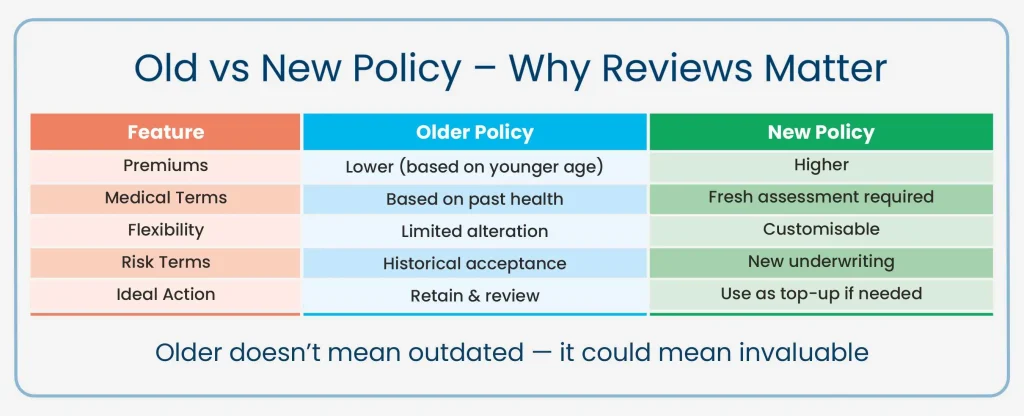
Premiums are based on your age and health at the time you apply, which means policies taken out years ago often benefit from significantly lower, locked-in premiums and medical terms that may no longer be available today.

Before cancelling, altering, or replacing an existing policy, it is essential to seek professional advice. At Nachu Finance, we review older policies with care to ensure they remain relevant to your current needs, and we rarely recommend cancelling them unless there is a clear and meaningful benefit.

Because premiums rise sharply with age, older plans can offer outstanding long-term value compared to arranging cover later in life. Our premium comparison chart by age clearly shows how starting early keeps costs lower for the entire duration of the policy — you can view it here Don’t Just Buy a Home-Protect It Too  for a clearer picture.

Extending or Increasing an Existing Policy

It is natural to wonder whether an existing policy can simply be extended to cover a longer term or increased to a higher amount.
In most cases, insurers will not allow an increase in cover or extension of the term without full medical reassessment, as this changes the original risk profile.

Our approach is to:

  • Keep your existing policy as it is.
  • Add a “top-up” policy for additional cover or a longer term if needed.

This way, you retain the advantages of your older policy while ensuring your family remains fully protected.

Ensuring Your Cover Is Still Relevant

Life events that call for a life insurance review including marriage, a new home, children and a change of employment

Life evolves — so should your insurance.
Events such as marriage, buying a new home, having children, or changes in employment (for instance, moving from employed to self-employed) all affect your protection needs.

A periodic review helps you check whether:

  • The level of cover matches your mortgage balance and family needs.
  • Your term still aligns with your working years.
  • Any employer benefits or other cover overlap with your personal policies.
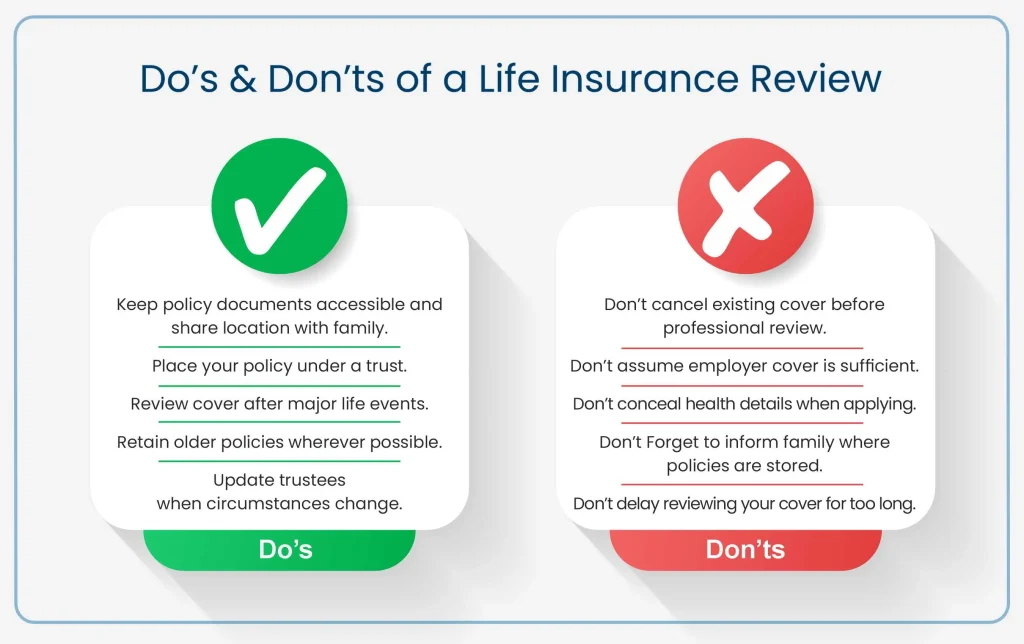
Alt text Dos and don'ts when reviewing an existing life insurance policy

Real-life Case Studies

Here are three real-life examples that show how a life insurance review can make a meaningful difference at different stages of life. Each case has a different outcome, but in every situation the review still proved to be the right and sensible step.

Ishan & Sitara

Ishan bought his first property in 2017 for £320,000 with a £250,000 mortgage. At the time, he took out £250,000 of life cover and £100,000 of critical illness cover in his sole name.

When he returned in 2023, he was now married to Sitara and the couple were buying a new family home for £610,000. During our review, we found that Ishan’s historic policies offered excellent terms and very competitive premiums, which would be hard to replicate today.

We therefore kept both existing policies in place, placed his life cover under a trust, and recommended top-up life cover to match his new financial responsibilities. Since Sitara had no protection at all, we also arranged suitable life and critical illness cover for her.

This is a textbook example of why older plans should not be cancelled automatically. With a review, the couple were able to:

  • retain valuable historic cover
  • place the policy under trust
  • top up protection to match their new life stage
  • ensure both partners were fully covered

Felix & Amy

Felix and Amy came to us in 2021 for a remortgage. They had originally purchased their home in 2015 and arranged their life insurance directly with the insurer at the time.

When we asked for their policy documents, they initially struggled to locate them — a common issue that becomes critical during a claim. After some effort, they shared a copy with us and also made sure their family knew where the documents were safely stored.

Following a full review, we concluded that their existing life and critical illness policies were still appropriate for their current circumstances. No top-up cover was needed, but we placed their existing plans under trust and securely stored copies of their documents in their client folder.

Although no new insurance was taken, the review still delivered meaningful benefits:

  • policy documents were located and securely stored
  • the family now knows exactly where to find them
  • the plans were placed under trust for efficient payout
  • reassurance that their existing cover remains fit for purpose

This case shows how valuable a review can be even when no policy changes are required.

Vivan & Rebecca

Vivan and Rebecca approached us around 11 months after their original life insurance was set up at the time of their property purchase. Both were employed when the policies were first taken out.

Within a year, Vivan had moved from employment into a day-rate contracting role through his own limited company. This meant he no longer received the death-in-service benefit he previously enjoyed from his employer.

During the review, we kept Rebecca’s policies unchanged, as her circumstances remained the same. For Vivan, we recommended restructuring his protection by:

  • cancelling his new-but-still-young personal life cover
  • replacing it with a Relevant Life Plan to benefit from significant tax efficiencies
  • increasing the level of life cover to reflect his new responsibilities and lack of workplace benefits

We also reviewed critical illness cover. Although a higher amount would have been sensible, Vivan decided not to increase it for now due to cost considerations.

This case highlights how a review can help align protection with changing employment circumstances — especially when moving to self-employment or contracting.

The Nachu Finance Way

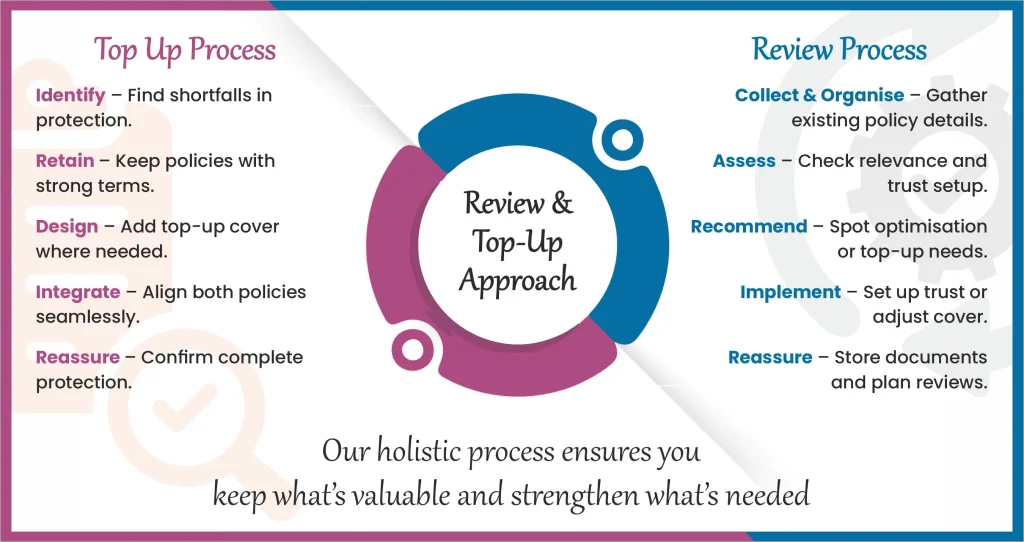
Nachu Finance review and top-up approach keeping the existing life insurance policy and adding top-up cover where needed

At Nachu Finance, we appreciate that older policies can hold immense value.
When we review your existing cover, we:

  • Check if it remains suitable for your current family and financial circumstances.
  • Help optimise it — including setting up or updating the trust.
  • Securely store copies of your policies in your client file, so your family can easily access them in the event of a claim.
  • Review both policies arranged by us and those you arranged elsewhere.

Even if no changes are needed, the reassurance that your policy is still fit for purpose is a valuable outcome in itself.

Frequently Asked Questions

No. The insurer bases its terms on your health and lifestyle at the time of application.
Once the policy is live, there is no obligation to update them about later changes.

Yes. You can replace or add trustees at any time.
We always recommend reviewing the trustees during your periodic insurance review to ensure they are still appropriate and willing to act.

Yes. You can hold multiple policies with different providers.
At application, you must declare any existing cover so the insurer can assess your total cover amount correctly.

Absolutely.
For clients whose policies were arranged through us, claim support is fee-free.
We believe compassionate, expert help at such a crucial time is an essential part of our service.

Yes. Many people keep their older policies because they offer lower premiums and favourable terms, and simply add a top-up policy when their protection needs increase. This is completely normal, and it allows you to retain the benefits of your historic cover while ensuring your overall protection keeps pace with life changes.

Our Transparency Promise

Full Disclosure, Complete Peace of Mind

At Nachu Finance, we insist that all applications are made with full and honest disclosure of health, lifestyle, and smoking status.
We review every detail with you before submission, so the insurer receives accurate information.

We would rather an insurer take extra time to verify your details now than risk a claim being declined later for non-disclosure.
This careful approach protects your family’s peace of mind and ensures that your policy pays out when it matters most.

Let Us Review Your Policy

As holistic advisers, we see life insurance as a core part of family financial planning.
Our transparent, no-pressure approach means we’ll only recommend action when it’s genuinely in your favour.

Reach out to Nachu Finance for a free, transparent review of your existing life insurance.
We’ll give you an honest assessment and, if needed, help you:

  • Place the policy under a trust
  • Adjust or top-up your cover
  • Optimise your family’s protection for today and the years ahead
Picture of About the Author

About the Author

Sekkappan Alagu is the Founder of Nachu Finance Ltd, established in 2006. With an early career in journalism and publishing, he brings clarity and structured thinking to complex financial topics. Through the Nachu Finance Blog and Knowledge Hub, he shares insights drawn from nearly two decades of client advisory experience, helping readers make informed decisions and understand best practices in mortgages, protection and long-term financial planning.

Picture of Business Profile

Business Profile

Nachu Finance Ltd is a directly authorised FCA-regulated firm providing mortgage, insurance and estate planning advice to clients across the UK. The firm takes a holistic approach — considering protection, tax efficiency and long-term planning alongside property finance — maintaining high regulatory standards while keeping advice clear and easy to follow. To learn more about the firm's background and story, visit the About Nachu Finance page.

Continue the Best Practices of Family Protection

EPC rating A to G for property mortgage approval UK - energy efficiency impact on mortgage eligibility

Testmonials

Enquiry Form

Get in Touch with Us for Personalized Finance Assistance

Please enable JavaScript in your browser to complete this form.
=

EPC Ratings and Mortgages: What Buyers and Landlords Need to Know

EPC rating A to G for property mortgage approval UK - energy efficiency impact on mortgage eligibility

When buying or letting out a property  the EPC rating can have a larger impact than expected as it is not just legal compliance. It can influence your mortgage options, ongoing energy costs, and even your long-term returns. Whether you are a first-time buyer, a home mover, or a landlord, understanding how EPC ratings fit into the bigger picture is essential.

When applying for a mortgage, particularly for buy-to-let or investment properties, the Energy Performance Certificate (EPC) is NOT just a formality. It carries financial, regulatory, and environmental importance.

At Nachu Finance, we are not energy advisers, but we do take a holistic approach to mortgage planning, and EPC considerations are an important part of the advice we provide.

What Is an EPC and Why It Matters

An Energy Performance Certificate (EPC) provides an energy efficiency rating for a property on a scale from A (most efficient) to G (least efficient). It is a legal requirement in the UK when:

  • Selling a property
  • Letting out a property

The EPC is valid for 10 years and can be easily checked and downloaded via the government portal: https://www.gov.uk/find-energy-certificate. All you will need is the postcode and door number. There is no cost involved in downloading the EPC certificate.

Minimum EPC Requirements for Buy-to-Let Mortgages

To let out a property, it must have a minimum EPC rating of E. Properties rated F or G cannot legally be rented, and mortgage lenders will typically reject applications for such properties until the EPC is improved.

So, if you’re looking to mortgage a property without a valid or acceptable EPC, this must be addressed before proceeding with the mortgage application.

Confirmed: EPC C Required for All Rentals by October 2030

In January 2026, alongside the Warm Homes Plan, the UK Government confirmed its final policy position on minimum energy standards for the private rented sector. All rental properties in England and Wales must achieve a minimum EPC rating of C from 1 October 2030.

Key points for landlords:

  • Single deadline – the earlier proposal of 2028 for new tenancies has been dropped. One deadline of 1 October 2030 now applies to all tenancies, new and existing. 
  • Cost cap – landlords will be required to spend up to £10,000 per property (or 10% of the property value, if lower) towards reaching EPC C, with exemptions available where the standard still cannot be met. 
  • Early compliance protected – properties achieving an EPC C before 1 October 2029 under the current methodology will remain compliant until that certificate expires.

With the deadline now confirmed, landlords should not wait. Planning improvements early will help spread costs, avoid rushed decisions, and prevent non-compliance penalties down the line.

Green Mortgage Incentives

Many mortgage lenders offer special ‘green’ mortgage products for energy-efficient homes:

  • Properties with an EPC rating of A or B often qualify
  • Some lenders also accept properties with a C rating

These green products may include lower interest rates or cashback offers.  As a part of our process, we always check your property’s EPC rating to see if you’re eligible for these incentives.

How to Obtain or Renew an EPC

Getting a new EPC is straightforward:

  • Cost: Typically, between £40 – £120
  • Timeframe: Surveyor visit required; reports usually available in 1–3 working days
  • Finding a provider: A quick Google search for “EPC assessor near me” or “get an EPC certificate” will give you a list of local accredited providers who can carry out the assessment and issue the certificate.

Improving Your Property’s EPC Rating

Each EPC includes recommendations for energy improvements, including:

  • Insulation upgrades
  • Boiler or heating system improvements
  • Double glazing
  • Renewable energy installations

These improvements not only bring your property in line with regulatory requirements, but also:

  • Reduce tenants’ energy bills
  • Attract environmentally conscious renters
  • Contribute to long-term property value

We actively encourage energy efficiency and can help direct you to trusted resources and professionals, though we don’t directly provide EPC improvement advice.

Our Approach: Mortgage Advice That Looks at the Bigger Picture

While many focus solely on rates and repayments, at Nachu Finance we take a holistic view of your property journey—from suitability and compliance, to long-term value and tenant appeal.

If the property you are considering does not have an EPC or falls short of the requirements, this is an important discussion to have before applying for a mortgage.

Frequently Asked Questions

If an EPC already exists for your property, downloading a copy is free and straightforward. Visit the government portal at https://www.gov.uk/find-energy-certificate, select the property using your postcode and door number, and confirm it is a residential property. The certificate can be viewed and downloaded instantly.

An EPC is valid for 10 years from the date of inspection. The certificate itself carries both the inspection date and the expiry date, so you can check its validity at a glance.

It depends on the type of application:

  • Buy-to-let — yes. All let properties must currently hold a minimum EPC rating of E, rising to a minimum of C from 1 October 2030. Lenders will expect to see a current, valid EPC that meets the letting requirement before approving the application.
  • Residential purchase — the seller or estate agent is legally required to provide a valid EPC, so you should expect to see one at the point of purchase.
  • Residential remortgage — there is no mandatory requirement for a valid EPC. However, we normally ask for a copy to check whether the property qualifies for a green mortgage, available for energy-efficient homes.

Yes — green mortgages are designed to encourage energy-efficient homes, typically offering lower rates or cashback. Depending on the lender, they are available for properties rated A–B, and in some cases A–C. If your property holds one of these ratings, we always check whether the lender we are recommending offers a green product you could benefit from.

Getting a new one is simple. A new EPC typically costs £40–£120, requires a short assessor visit, and the report is usually issued within 1–3 working days. A quick search for “EPC assessor near me” will list local accredited providers who can carry out the assessment and issue the certificate.

Mortgage Planning That Goes Beyond the Basics

If you’re buying or refinancing a property and want mortgage advice that factors in more than just numbers—you’re in the right place. At Nachu Finance, we’ll help ensure every aspect of your mortgage journey is well thought through, including EPC compliance and opportunities for green incentives.

Contact us today to benefit from whole-of-market advice, experience-driven insights, and a tech-savvy, transparent approach.

Picture of About the Author

About the Author

Sekkappan Alagu is the Founder of Nachu Finance Ltd, established in 2006. With an early career in journalism and publishing, he brings clarity and structured thinking to complex financial topics. Through the Nachu Finance Blog and Knowledge Hub, he shares insights drawn from nearly two decades of client advisory experience, helping readers make informed decisions and understand best practices in mortgages, protection and long-term financial planning.

Picture of Business Profile

Business Profile

Nachu Finance Ltd is a directly authorised FCA-regulated firm providing mortgage, insurance and estate planning advice to clients across the UK. The firm takes a holistic approach — considering protection, tax efficiency and long-term planning alongside property finance — maintaining high regulatory standards while keeping advice clear and easy to follow. To learn more about the firm's background and story, visit the About Nachu Finance page.

Continue Building Your Landlord Best Practices

Personal guarantee explained infographic on a chalkboard, outlining why mortgage lenders request a personal guarantee and what it means for borrowers seeking limited company mortgage finance.

Testmonials

Enquiry Form

Get in Touch with Us for Personalized Finance Assistance

Please enable JavaScript in your browser to complete this form.
=

Personal Guarantee for Limited Company Mortgages

When buying a buy-to-let property through a limited company, there are a few additional steps compared to purchasing your personal name.

One of the most important — and often least understood — is the personal guarantee, which we deal with regularly as part of Setting Up and Navigating Limited Company Mortgages .

Personal guarantee explained infographic on a chalkboard, outlining why mortgage lenders request a personal guarantee and what it means for borrowers seeking limited company mortgage finance.

If you’ve already read our guide on limited company mortgages, you’ll know that a limited company is treated as a separate legal entity from the individuals behind it — its directors and shareholders. This separation is one of the key reasons investors choose this structure, particularly for tax efficiency and long-term planning. If you are still deciding whether a limited company is the right structure for you, you may find our guide helpful.

However, this same principle creates a challenge for mortgage lenders.

The mortgage is issued to the limited company, but the lender’s assessment is based on the individuals behind it — their credit profile, income, and overall financial position. In practice, the company is the borrower, but the strength of the application comes from the people running it.

From the lender’s perspective, this creates a gap. If the company is a separate legal entity, how can they ensure that the individuals they have assessed remain accountable if the mortgage is not repaid?

This is where the personal guarantee comes in.

What is a Personal Guarantee?

In simple terms, a personal guarantee is a legal commitment made by the directors and, in some cases, shareholders of a limited company to the mortgage lender.

It confirms that if the company is unable to repay the mortgage, those individuals will step in and take personal responsibility for the debt.

Although the mortgage is in the company’s name, the personal guarantee ensures that the lender ultimately has recourse to the individuals behind it. This requirement applies whether you are purchasing a new asset or transferring an existing property into a limited company .This is why it forms a standard part of almost all limited company buy-to-let mortgages.

Why Lenders Require a Personal Guarantee

In most cases, limited company buy-to-let mortgages are taken out through newly set up Special Purpose Vehicles (SPVs). While this is perfectly acceptable to lenders, a new company will not have any financial track record of its own.

As a result, lenders are not relying on the company’s history when deciding. Instead, they are lending primarily based on the strength of the individuals behind it.

However, because the mortgage is in the name of the limited company, the lender cannot automatically pursue the directors personally if the mortgage is not repaid — unless a personal guarantee is in place.

Without a personal guarantee, the lender’s only recourse in a default would be against the company itself and the property securing the loan.

The personal guarantee provides the additional security of being able to pursue the directors and relevant shareholders personally if required. It ensures that the individuals who were assessed at application stage remain accountable for the borrowing.

It is important to understand that this is standard practice. Personal guarantees are a normal and expected part of limited company buy-to-let mortgages, particularly where the company is newly established.

Getting the structure right from the outset is important, which is why specialist professional advice on property tax decisions matters from the start. This helps ensure the balance between liability protection and long-term tax efficiency is considered before any property purchases are made.

Independent Legal Advice: What It Is and Why It Is Required

Independent legal advice — often referred to as ILA — is a mandatory part of the personal guarantee process.

For a personal guarantee to be legally valid, and for the lender to be protected from any future challenge, each director and relevant shareholder who is signing the guarantee must receive independent legal advice from a qualified solicitor.

The solicitor’s role is to ensure that the individual fully understands what they are signing and the legal implications.

The key word here is independent.

The solicitor providing this advice must be separate from the firm acting on the property purchase. This is because the solicitors handling the purchase are acting for the limited company, whereas the personal guarantee is being given by the individuals behind it. Legally, there are two different parties.

From the lender’s perspective, it is important that this advice is given independently, confirming that the personal guarantee has been properly explained and understood.

As part of this process, the solicitor will talk through the personal guarantee in detail and confirm that the individual understands they are giving a personal commitment for a loan taken out by the company, against a property that is owned in the company’s name — not in their personal name.

They will also verify the identity of the individual signing and will need to review the mortgage offer and the personal guarantee documentation.

Once the advice has been given, the solicitor will witness and countersign the relevant documents and forward the completed set to the solicitors acting on the purchase, so that the transaction can proceed.

It’s worth noting that most firms acting on the purchase will not provide independent legal advice themselves, even if asked. This is because doing so would create a conflict of interest, given that they are acting for the company in the transaction.

It is important to understand that independent legal advice is not a formality. It is a proper legal appointment with real accountability for the solicitor. The individual signing the guarantee is expected to engage with the advice and confirm their understanding, so that there can be no uncertainty about what has been agreed.

The Process Step by Step

The personal guarantee and independent legal advice process follows a clear sequence. While there are a few steps involved, it is generally straightforward when planned in advance.

A 5-step infographic showing the personal guarantee process for limited company mortgages, from mortgage offer and independent legal advice to signing the guarantee and property completion.

The above infographic outlines the five key stages of the personal guarantee process, from receiving a mortgage offer to completing a limited company property purchase.

Step 1 — Identify your ILA solicitor in advance

Not all legal firms offer independent legal advice for personal guarantees, so it is important to identify a solicitor who provides this service before you need them urgently.

We have worked with clients who have successfully used specific firms for this, and we are happy to share those details if helpful. At this stage, it is also sensible to obtain a fee quote so that you know what to expect.

Step 2 — Wait for the mortgage offer

The process cannot begin until the mortgage offer has been issued.

This is because the mortgage offer contains the specific loan details and the personal guarantee documentation. Without these, the solicitor cannot complete the advice or the signing.

While you can identify your solicitor and agree on fees in advance, the formal process can only begin once the offer is in hand.

Step 3 — Provide documents to your ILA solicitor

Once the mortgage offer is issued, you will need to provide your ILA solicitor with the required documents.

This will typically include proof of identity (such as a passport or driving licence), the mortgage offer, the personal guarantee document, and the independent legal advice certificate. The solicitor will confirm exactly what is needed.

Step 4 — Attend the ILA appointment

The appointment itself can be carried out either face to face or virtually, depending on the solicitor and lender (covered in the next section).

During the appointment, the solicitor will talk through the personal guarantee and its implications, confirm that you understand what you are signing, and then complete the signing and witnessing of the documents.

Once completed, the solicitor will forward the countersigned documents to the solicitors acting on the purchase.

Step 5 — Completion

The solicitors handling the purchase will not be able to proceed to exchange and completion until the signed personal guarantee and independent legal advice documents have been received.

This is a hard requirement. Exchange and completion cannot take place without it, so it is important to plan this step in a good time.

Face – to- Face vs Virtual Appointments

Historically, independent legal advice appointments were conducted face to face. In recent years, many solicitors now offer virtual appointments via platforms such as Teams or Zoom, and many lenders are comfortable with this approach.

However, there are a few important points to be aware of.

Before proceeding with a virtual appointment, it is important to confirm that both your ILA solicitor and your mortgage lender will accept a virtually signed personal guarantee and ILA certificate. This should not be assumed, as requirements can vary.

With virtual appointments, documents will typically need to be posted between parties for signing and witnessing. This can add time to the process, particularly where original documents are required.

That said, virtual appointments are now common, and, with the right combination of lender and solicitor, can be both time and cost efficient.

If there is any uncertainty, a face-to-face appointment remains the more straightforward option.

Who Needs to Provide a Personal Guarantee?

In most cases, the mortgage lender will require a personal guarantee from all directors of the limited company.

In addition, majority shareholders who are named on the mortgage application will usually also be required to provide a personal guarantee and receive independent legal advice.

Generally, anyone who is an applicant on the mortgage should expect to provide a personal guarantee. In practice, this typically ranges from one to four individuals.

Minority shareholders who are not part of the mortgage application will generally not be required to sign. However, this can vary depending on the lender, so it is important to confirm this at the application stage.

It is also important to understand that it is not sufficient for just one director to sign on behalf of others. Mortgage lenders require each relevant individual — directors and applicable shareholders — to provide a personal guarantee in their own name. This cannot be combined or delegated.

Does Signing a Personal Guarantee Affect Personal Borrowing Capacity?

This is a question client often have, even if they do not always ask it directly.

The short answer is that a personal guarantee does not typically impact your personal borrowing capacity in a direct way. Most personal credit decisions — including loans, credit cards, and residential mortgages — are based on your individual
credit profile. A personal guarantee on a limited company mortgage does not usually appear as a direct liability in that assessment.

However, there is an indirect point to be aware of.

When applying for further buy-to-let borrowing — whether personally or through a limited company — lenders will take into account the properties held within the limited company as part of your overall portfolio. This is the case regardless of the personal guarantee itself.

In practice, as buy-to-let mortgages are generally structured to be self-funding through rental income, this is usually manageable. However, it is important to understand that the limited company portfolio will be visible to lenders when assessing any future applications.

Cost and Timeframe

Two of the most common questions around personal guarantees and independent legal advice are cost and timing. It is important to understand both, as they form a key part of planning your purchase.

Cost

The cost of independent legal advice varies between solicitors and will depend on whether the appointment is carried out face to face or virtually.

As a guide, fees typically range from £250 to £750 plus VAT per director.

While the process may appear relatively straightforward, the fee reflects the level of responsibility the solicitor is taking on. They are required to verify identity, review documentation, provide formal advice, and retain records of the meeting, and the advice given.

They also carry ongoing legal accountability for this work and may be held liable if the process is later challenged. This is why the cost is charged at this level, even though the appointment itself may be relatively short.

If helpful, you can search for solicitors who offer independent legal advice for personal guarantees. We have also worked with firms that clients have used successfully and are happy to share details on request.

Timeframe

In theory, the process can be completed in a single day once the mortgage offer has been issued and the solicitor has all the required documents.

In practice, it is sensible to allow around two weeks from the date the mortgage offer is received.

This allows time to instruct the solicitor, complete anti-money laundering checks, gather documents, arrange the appointment, and allow for any postal time where documents need to be physically signed.

Recommendation

Plan for around two weeks between receiving the mortgage offer and having the completed personal guarantee and ILA documents with your purchase solicitors. Do not leave this to the last minute. Exchange and completion cannot proceed without it.

Buying a Second Property in the Same Limited Company

A question that often comes up, particularly from more experienced landlords, is whether a personal guarantee needs to be provided again when purchasing an additional property through the same limited company.

In most cases, the answer is yes.

Even where the same directors are buying a second property through the same company, lenders will typically require a fresh personal guarantee for each mortgage they issue.

This is because the personal guarantee is both lender-specific and property-specific. It is tied to that particular lender mortgage on that specific property and does not carry over automatically to any new borrowing.

In practice, it is very rarely possible to avoid providing a personal guarantee for a limited company mortgage. As a general rule, you should expect a personal guarantee to be required for each property purchase made through the limited company.

What Happens if a Director Leaves or is Replaced?

In a limited company mortgage, the directors are effectively the applicants. It is their income, credit profile, and deposit that the lender has assessed when approving the mortgage.

Because of this, changing the directorship of the company mid-term is not straightforward. It is not possible to simply add or remove a director without involving the mortgage lender.

If the directorship or shareholding structure needs to change, the lender must be informed and their consent obtained. In many cases, this may require moving the mortgage to a new lender entirely. The new directors would then go through the full application process, including underwriting, personal guarantees, and independent legal advice.

A helpful way to think about this is to compare it to a standard buy-to-let mortgage. Just as you cannot replace a named applicant in mid-term without going back to the lender, the same principle applies here. The lender’s decision is based on the specific individuals assessed at the time of application.

If a change in directorship is being considered for any reason, it is important to speak to your mortgage broker first to understand the lender’s position before making any changes at Companies House.

Remortgages and Changing Lenders

Personal guarantees are lender specific.

The guarantee provided to one lender when the property is purchased does not transfer to another lender if the mortgage is later remortgaged.

If the mortgage remains with the same lender, a fresh personal guarantee will not usually be required.

However, if the remortgage involves moving to a new lender, the directors will need to provide a new personal guarantee to that lender. This will also require a fresh round of independent legal advice.

This is worth factoring into both the cost and timeline when planning a remortgage to a new lender.

Happy to Help You Navigate Ltd Company Mortgages

Buying through a limited company involves more moving parts than a standard buy-to- let purchase, and the personal guarantee process is just one part of that.

From identifying the right lender, to managing the mortgage offer, to guiding clients through the independent legal advice and personal guarantee requirements, we support the process end to end.

If you are planning a limited company buy-to-let purchase and would like guidance through the process, we are always happy to help.

Frequently Asked Questions

While it can be completed in a single day once all documents are available, we recommend allowing around two weeks from the date the mortgage offer is issued.

If the appointment is virtual, additional time may be required for documents to be posted between parties.

Fees typically range from £250 to £750 plus VAT per director, depending on the solicitor and whether the appointment is face to face or virtual.

The formal process can only begin once the mortgage offer has been issued.

However, you can — and should — identify your ILA solicitor, agree fees, and understand the process in advance. The personal guarantee must be completed before exchange of contracts.

All directors of the limited company, and majority shareholders who are named on the mortgage application.

It is not possible for just one director to sign on behalf of others.

No. The personal guarantee and independent legal advice documents are a condition of the mortgage offer. 

The solicitors acting on the purchase cannot proceed to exchange or completion until these have been received in full.

No. Mortgage lenders require the ILA to be provided by a completely separate firm of solicitors.

Most firms acting on a purchase will not provide ILA themselves due to the conflict of interest this creates.

A personal guarantee is lender-specific and property-specific.

You will typically need to provide a fresh personal guarantee for each property purchased through the limited company.

If you remortgage and remain with the same lender, a new guarantee is not usually required. If you move to a new lender, a fresh guarantee will be needed.

Many solicitors now offer virtual ILA appointments via Teams or Zoom, and many lenders will accept this.

However, it is important to confirm with both your ILA solicitor and your mortgage lender before proceeding, as not all lenders accept virtually signed documents.

Picture of About the Author

About the Author

Sekkappan Alagu is the Founder of Nachu Finance Ltd, established in 2006. With an early career in journalism and publishing, he brings clarity and structured thinking to complex financial topics. Through the Nachu Finance Blog and Knowledge Hub, he shares insights drawn from nearly two decades of client advisory experience, helping readers make informed decisions and understand best practices in mortgages, protection and long-term financial planning.

Picture of Business Profile

Business Profile

Nachu Finance Ltd is a directly authorised FCA-regulated firm providing mortgage, insurance and estate planning advice to clients across the UK. The firm takes a holistic approach — considering protection, tax efficiency and long-term planning alongside property finance — maintaining high regulatory standards while keeping advice clear and easy to follow. To learn more about the firm's background and story, visit the About Nachu Finance page.

Continue Building Your Limited Company Property Strategy

Porting a mortgage explained UK – moving home and transferring your existing mortgage deal with affordability checks and potential early repayment charges.

Testmonials

Enquiry Form

Get in Touch with Us for Personalized Finance Assistance

Please enable JavaScript in your browser to complete this form.
=

Setting Up and Navigating Limited Company Mortgages

Over the past few years, buying buy-to-let property through a limited company has become an increasingly popular route in the UK, largely due to the potential tax efficiencies it can offer. For many investors, this structure provides a more flexible and tax-aware way of managing property income.

However, this article is not about helping you decide whether a limited company is the right route for you. That decision depends on your personal circumstances and is covered in detail in our article on personal name vs limited company ownership.

Instead, this guide is for those who have already made that decision and are ready to move forward. Here, we will walk you through how limited company mortgages work, what needs to be set up, and what you should be aware of before proceeding, so you can move ahead with clarity and confidence.

Property investor reviewing limited company mortgage paperwork for a buy-to-let purchase

Limited Company Buy-to-Let is Only for Investment Properties

A key point to understanding early on is that a limited company buy-to-let structure is designed for investment purposes only, not for personal residential use. The tax advantages associated with this structure apply when the property is rented to tenants. If the intention is to live in the property yourself, using a limited company would not be appropriate.

In practice, buying residential property through a limited company for personal use does not really work. The costs involved — particularly higher stamp duty — and the way the tax rules are structured mean that the benefits of a limited company are effectively lost in this scenario.

There are also some practical restrictions to be aware of. For example, lenders may place limitations on renting the property to immediate family members, especially where the arrangement could be seen as personal use rather than a genuine buy-to-let investment.

Another factor to consider is the Annual Tax on Enveloped Dwellings (ATED). This is an annual tax that can apply to residential properties held within a company structure and was introduced to discourage individuals from holding residential homes in companies for personal use or tax planning purposes. While reliefs are often available for genuine
buy-to-let investments, personally occupying a company-owned property can trigger additional tax charges that would not normally apply to a standard residential purchase, making the structure significantly less tax efficient.

From our experience, limited company mortgages are used almost exclusively for buy- to-let investments. We have not encountered situations where a limited company is used to purchase a property for personal residential use, as this would not align with lender criteria or the intended purpose of the structure.

Broadly speaking, a limited company mortgage is designed for investment properties rather than residential occupations. Once the purpose of the structure is clear, the next step is how the company should be set up for a limited company mortgage.

The Importance of an SPV — Not Your Trading Company

When purchasing a buy-to-let property through a limited company, the company used should typically be set up as a Special Purpose Vehicle (SPV). This is a company created specifically to buy, hold, and manage investment property and nothing else.

This is different from a trading company. A trading company is set up to carry out a particular business activity. For example, an IT contractor running their own limited company, a CIS contractor, a doctor, an accountant, or a retail or wholesale business owner would all be operating through trading companies. These companies have their own business activities and SIC codes, and they are not designed for holding property investments.

While there are a small number of lenders who may consider mortgage applications through a trading company, most lenders expect the borrowing entity to be an SPV. This gives them clarity on what the company is set up to do and makes the application more straightforward from a lending perspective.

From a practical point of view, it also makes sense to keep property assets separate from any trading activity. Mixing the two can create complications for lenders, accountants, and future financial planning, particularly as your portfolio grows.

Setting up a dedicated property company with the correct SIC codes — and keeping it separate from any existing trading business — will give you access to a wider range of lenders and a smoother mortgage process. Once the company structure is clarified, let’s look at how to set up the limited company correctly.

Setting Up the Limited Company

When it comes to setting up a limited company for a buy-to-let purchase, it’s important to understand where our role sits. From a mortgage perspective, we can guide you on what lenders expect. However, the actual company setup should be carried out with the support of a qualified accountant or a professional company formation service.

That said, there are certain requirements that need to be in place from the outset to ensure the company is suitable for a mortgage application.

SIC Codes

From a lender’s perspective, the company should be set up with the correct SIC (Standard Industrial Classification) codes. The two most accepted codes for a property SPV are:

  • 68100 — Buying and selling of own real estate
  • 68209 — Other letting and operating of own or leased real estate

These should be in place when the company is registered, as this is one of the first
things a mortgage adviser and lender will check.

Company Name

You are free to choose any available company name. This can be checked either through your accountant or directly on the Companies House website if you are using an online formation service.

Directors and Shareholders

This is an area that requires careful thought. The structure of directors and shareholders can have a direct impact on the mortgage application, so it’s important to get this right before the company is set up.

In most cases, lenders will expect all directors to be named on the mortgage application. It is possible in some situations for shareholders — including family members and, in certain cases, minor children — to hold shares without being on the mortgage, but this will depend on the lender criteria.

It is best to discuss the structure with both your mortgage adviser and accountant before proceeding. Making changes after the company has been registered can be more complicated.

Online Formation vs Accountant

There are a number of online services that allow you to set up a limited company quickly and at a relatively low cost. These can be useful if you already know exactly how you want the company to structure them.

However, these services do not provide advice. For most clients, working with a qualified accountant is the preferred approach, as they can guide you on the most appropriate structure and handle ongoing compliance requirements.

How Long Does It Take

Once all the details are agreed — including the company name, directors, shareholders, and SIC codes — Companies House will usually register a new limited company within one to three working days.

This is worth noting, as many clients assume that setting up a company will significantly delay their purchase. In practice, it is a relatively quick process.

What Nachu Finance Needs

Before a mortgage application can be submitted, Nachu Finance will need the company to be fully registered, along with the Companies House registration number.This is used to check that the company meets lender criteria.

The company does not need to have been trading for any minimum period. Newly incorporated companies are perfectly acceptable to lenders. Once the company is formed , the next step is opening a business bank account.

The Business Bank Account

When purchasing a property through a limited company, it is essential that the company has its own business bank account. This is not optional. Mortgage lenders will expect mortgage payments to be made from the company’s account, and rental income should also be received into this account as standard practice.

In some cases, lenders may allow a mortgage application to proceed while the bank account is being set up, provided it is in place before completion. Others may require the account to be opened before the application is submitted. It is best to start this process as early as possible once the company has been registered.

Timeframes

Opening a business bank account can take anywhere from a few days to up to a month. This will depend on the bank, how busy they are, and whether they require additional information about the company or its shareholders. For this reason, it is important not to leave this until the last minute.

The business bank account is a key part of the process. It should be treated as a priority from the point the company is set up, to avoid delays later.

Panel-style infographic showing the key steps for setting up a property SPV for a limited company mortgage.

How the Mortgage Application Works

Applying to a limited company mortgage is slightly different to a standard buy-to-let application, but the core process is quite similar.

The mortgage itself is taken out in the name of the limited company. The company is a legal borrower and will own the property. However, the lender assessment is focused on the individuals behind the company — the directors and shareholders.

This means that credit checks, income assessment, source of deposit, and overall background checks are all carried out on the individuals, much like a personal name mortgage application. The company itself is effectively treated as an envelope.

Because of this, lenders are generally comfortable lending to newly set up companies. The company does not need to have any trading history, and even a recently incorporated SPV is acceptable. In practice, what matters far more is the personal
profile of the individuals involved rather than the age of the company.

Lender Landscape

Not all lenders offer buy-to-let mortgages, and among those who do, not all will lend to limited companies. This is still considered a more specialist area.

That said, as limited company structures have become more common, the number of lenders operating in this space has increased, including some high-street names. Each lender has slightly different criteria, so it is important to approach lenders that suit your specific circumstances, company structure, and source of deposit.

Mortgage Rates

Limited company mortgage rates are typically slightly higher than equivalent rates for personal name buy-to-let mortgages.

However, this should not be looked at in isolation. The potential tax advantages of holding property within a limited company may outweigh the slightly higher borrowing costs, depending on your individual situation. The mortgage rate is just one part of the overall decision.

Deposit

In most cases, the minimum deposit for a limited company buy-to-let mortgage is around 25%.

However, the amount a lender is willing to offer is not based purely on the purchase price. Instead, it is driven by rental income stress testing. The expected rental income must comfortably cover the mortgage payments based on the lender’s criteria.

One practical point to be aware of is that, for higher-rate taxpayers, a limited company structure can sometimes allow for a higher level of borrowing for the same rental income compared to buying in personal names. This is due to the way lenders apply stress tests in a company structure.

Personal Guarantees

Although the mortgage is taken in the name of the limited company, most lenders will require the directors to provide a personal guarantee. This is a standard part of a limited company mortgage.

this means that if the company is unable to repay the mortgage, the directors remain personally responsible for the debt.

We cover how personal guarantees work, what they mean, and the legal process involved in more detail in our separate article on personal guarantees for limited company mortgages.

Stamp Duty — Always the Additional Rate

When it comes to stamp duty, there are generally three buyer categories: first-time buyers, home movers, and additional property buyers. Each category is treated differently from a tax perspective, and we cover this in more detail in our guide on Stamp Duty Three Categories

However, when purchasing through a limited company, the position is much more straightforward.

Any property bought through a limited company is automatically treated as an additional property purchase for stamp duty purposes. This means the 5% additional rate applies in all cases.

It is worth emphasising that this rule applies regardless of the circumstances. It does not matter if this is the company’s first ever purchase, and it does not matter what the personal ownership position of the directors is. A common assumption is that a newly formed company making its first purchase might qualify for a lower rate — this is not the case. The moment a property is purchased through a limited company, the additional rate applies automatically.

From a planning perspective, this is a fixed and unavoidable upfront cost. It should be factored into the overall purchase budget from the outset, rather than treated as something that can be optimised or reduced later.

There is, however, one useful point to be aware of. A limited company is treated as a separate legal entity, which means its property ownership does not count towards the personal ownership history of its directors. As a result, if a director does not personally own any property, buying through a limited company will not affect their individual first- time buyer status. If they later go on to purchase a residential property in their own name, they may still qualify as a first-time buyer for stamp duty purposes.

Moving forward, let us discuss if an existing property can be transferred into a limited company.

A common question is whether a property already owned in your personal name can be transferred into a limited company. This is a separate scenario and is not as straightforward as it may initially seem.

Transferring a property into a limited company is treated as a sale and purchase transaction. This means it can trigger capital gains tax on any increase in value since the original purchase, as well as stamp duty — including the additional 5% surcharge — based on the current value of the property. When combined with conveyancing costs on both sides, the overall cost can be significant, which is why this approach is often not straightforward — something we explore in more detail in our article on transferring property to a limited company.

In most cases, this makes transferring a property into a limited company financially unviable.

There are some limited situations where a transfer may be worth considering — for example, where the property was previously a residential home, and there may be scope to reclaim additional stamp duty paid on a subsequent purchase. However, these are exceptions rather than the norm.

A common question, particularly for those looking to build a portfolio, is whether multiple properties can be held within the same limited company.

The answer is yes. If the company has been set up correctly as an SPV, with the appropriate SIC codes and structure in place, additional properties can be purchased and added to the same company over time.

However, some care is needed when doing this. Each new mortgage application will be assessed on its own merits, and the lender will carry out due diligence on both the new purchase and the existing properties already held within the company. It is important to ensure that the terms of any existing mortgages do not create complications for the new application.

It’s also worth noting that once the company is set up and mortgages are in place, making changes to the structure — such as adding or removing directors or shareholders — is not always straightforward.

Using a single limited company to build a property portfolio can work well, but each new purchase should be planned carefully to ensure everything remains aligned from a lender’s perspective. Just like setting up the company, the ongoing responsibilities are equally important.

Owning a buy-to-let property comes with ongoing responsibilities, regardless of whether it is held in personal names or through a limited company. This includes ensuring the property is safe, the tenancy is compliant, and that tenants are managed appropriately.

A more detailed overview of what being a landlord involves can be found in our article on the Realities of Buy-to-Let.

In addition to this, holding property through a limited company brings its own set of responsibilities. This includes annual filings with Companies House, corporation tax returns, ongoing accountancy requirements, and fulfilling your duties as a company director.

These aspects are covered in more detail in our guide on Personal Name vs Limited Company, and it is worth reviewing this to understand the full picture. The next step is to understand the timeframes involved to help you plan more effectively.

One of the most common questions is how long the process takes when buying through a limited company.

The initial decision — whether to buy in personal names or through a limited company — can take time, depending on your circumstances and how quickly you are able to take professional advice. However, once that decision has been made, the practical steps are generally quite straightforward and do not need to take long.

  • Setting up the limited company — once the company name, shareholder structure, directors, and SIC codes are agreed, Companies House will usually register the company within one to three working days.
  • Opening the business bank account — this can take anywhere from a few days to up to a month, depending on the bank and the information required. It is best to start this as soon as the company is registered.
  • Personal guarantee and independent legal advice — once the mortgage offer has been issued, this step typically takes around a week to complete, particularly where the solicitor offers a remote service.

Buying through a limited company involves a few additional steps compared to a personal name purchase. These include setting up the company, opening the business bank account, and completing the personal guarantee process.

None of these steps are particularly time-consuming if they are planned. With the structure and timeframes understood, having the right professional support becomes equally important.

The Professionals You Need Around You

A limited company buy-to-let purchase involves more than one professional and having the right support in place from the outset can make a significant difference.

A mortgage adviser will guide you through the mortgage side of the process — from structuring the application and selecting the right lender, to managing the application itself and helping you understand requirements such as personal guarantees.

A qualified accountant plays an equally important role, ideally before the company is even set up. They will advise on how the company should be structured, including directors, shareholders, and SIC codes, as well as the ongoing tax position, profit extraction, and the longer-term financial picture.

A solicitor will handle the legal side of the purchase. They will also be involved in the personal guarantee process, although the independent legal advice required for the guarantee must be provided by a separate solicitor.

If you have not yet taken tax advice on whether a limited company structure is right for you, this is the stage to do so. The cost of getting the right advice early on is often small compared to the potential cost of making the wrong decision, particularly given how much impact tax can have — as discussed in our article on Why Specialist Advice Matters when it comes to property tax.

From our side, at Nachu Finance, our role is to guide you through the mortgage process, ensure the right lenders are approached, and help coordinate the different elements involved. Where needed, we will also signpost you to the appropriate professionals so that you can move forward with clarity and confidence.

Here to Help with Your Property Investment Journey

Buying through a limited company can be an excellent long-term strategy for the right investor, but it’s important that everything is structured correctly from the outset. The company setup, lender selection, shareholder structure, tax considerations, and mortgage process all need to work together in the right way.

That’s why getting the right advice early on can make a significant difference – At Nachu Finance, we regularly help clients navigate limited company buy-to-let mortgages, from first-time investors setting up their first SPV through to experienced landlords expanding existing portfolios.

If you’re considering buying through a limited company, we’d be happy to help you explore the right approach for your circumstances. Whether you’re still weighing up your options or ready to move forward,the team at Nachu Finance can help you understand your options clearly and guide you through the process step by step.

Frequently Asked Questions

Once the details are agreed — company name, shareholder structure, directors, and SIC codes — Companies House typically registers a new limited company within one to three working days.

This can be done through a qualified accountant, which is the recommended approach, or through an online company formation service if you are already confident in how you want to structure the company. Online services will handle the registration, but they will not advise you on structure, so it is important to take the right advice beforehand.

Yes, this is very common. Many clients only decide to set up a limited company once they have found a suitable property.

Because the registration process is relatively quick, this approach works well. The key point is to ensure the company is correctly set up before the mortgage application is submitted.

No. There is no minimum period for which the company needs to have been in existence before a mortgage application can be made.

Mortgages are available for newly incorporated companies, provided the company has been set up correctly with the appropriate SIC codes, structure, and directors.

Yes, provided it has been set up correctly with the appropriate SIC codes and has the right directors and shareholders in place.

If those elements are not aligned with lenders’ expectations, they would need to be corrected before proceeding.

Yes. Even though the property is being purchased in the company’s name, all due diligence is carried out on the individuals behind it.

This includes credit checks, income assessment, and background checks — much like a standard personal name mortgage application.

The mortgage process itself is broadly similar in timeframe to a personal name buy-to-let.

The additional steps to consider are:

  • Setting up the company (1–3 working days)
  • Opening the business bank account (a few days to up to a month)
  • Completing the personal guarantee and independent legal advice process
    (around one week after mortgage offer)

If these are handled proactively, they should not cause significant delays.

The minimum deposit is typically 25%.

However, the amount you can borrow is based on rental income stress testing rather than just the purchase price.

For higher-rate taxpayers, a limited company structure can sometimes allow a higher borrowing level for the same rental income, due to differences in how lenders apply stress tests.

A personal guarantee is a formal commitment by the directors that if the company cannot repay the mortgage, they will be personally responsible for the debt.

Most lenders require this as a standard condition. Because it creates personal obligations outside the company, lenders will also require independent legal advice before the guarantee is signed.

Yes. All purchases made through a limited company are automatically subject to the additional stamp duty surcharge (currently 5%).

This applies regardless of whether it is the company’s first property and regardless of the personal ownership history of the directors. For a full explanation of how stamp duty works, see our article on Stamp Duty Explained: The Three Buyer Categories.

No. If you do not own any property in your personal name, buying through a limited company does not affect your first-time buyer status.

Because the company is a separate legal entity, its purchases are not counted against your personal ownership history. This means you may still qualify as a first-time buyer if you later purchase a residential property in your own name.

Picture of About the Author

About the Author

Sekkappan Alagu is the Founder of Nachu Finance Ltd, established in 2006. With an early career in journalism and publishing, he brings clarity and structured thinking to complex financial topics. Through the Nachu Finance Blog and Knowledge Hub, he shares insights drawn from nearly two decades of client advisory experience, helping readers make informed decisions and understand best practices in mortgages, protection and long-term financial planning.

Picture of Business Profile

Business Profile

Nachu Finance Ltd is a directly authorised FCA-regulated firm providing mortgage, insurance and estate planning advice to clients across the UK. The firm takes a holistic approach — considering protection, tax efficiency and long-term planning alongside property finance — maintaining high regulatory standards while keeping advice clear and easy to follow. To learn more about the firm's background and story, visit the About Nachu Finance page.

Explore More from Our Knowledge Hub

Landlord reviewing property decisions after the Renters’ Rights changes.

Testmonials

Enquiry Form

Get in Touch with Us for Personalized Finance Assistance

Please enable JavaScript in your browser to complete this form.
=

How Landlords Can Cope with the Renters’ Rights Act

The Renters’ Rights Act changes that came into effect on 1st May have naturally created concern amongst many landlords across the UK. In recent social discussions and conversations with friends, I have increasingly come across this one question: “What should landlords actually do now?”

Landlord reviewing property decisions after the Renters’ Rights changes.

For some, the immediate reaction has been to consider selling properties, transferring properties into limited companies, or even exiting the buy-to-let market altogether. At the same time, it is important to note that the decisions made during periods of uncertainty are often emotionally driven and may not always lead to the best long-term outcome.

That conversation is what prompted me to write this article. The reality is that the current environment undoubtedly presents additional challenges for landlords, but there are still meaningful and practical steps that can help landlords better. In this article, we explore some of the practical steps landlords can take to better navigate the challenges created by changes under the Renters’ Rights Act, while avoiding some common impulsive decisions that may do more harm than good.

Being a Landlord Is a Serious Business

The Renters’ Rights Act introduced significant changes to the UK rental market, particularly around tenant protections, landlord compliance and tenancy reforms. If you would like to understand this in more detail, including what the rules were previously and what has now changed, you can read our detailed guide on the Renters’ Rights Act 2025.

One thing I strongly believe landlords need to recognise is that being a landlord has never been a completely passive investment. Unlike investing in shares, metals or any other forms of assets, owning rental property comes with responsibilities, compliance, regulatory requirements and active involvement. To understand better, check out the Realities of landlords’ responsibilities before the Renters’ Right came into force

If anything, the Renters’ Rights Act 2026 has made it more difficult for non-serious landlords to continue treating buy-to-let as a hands-off investment. Landlords now need to treat their portfolios as a part-time sideline business and dedicate proper time towards staying compliant, organised and active in managing their properties.

Rather than making decisions in a hurry because the environment has become more challenging, this may be the right time for many landlords to make a mindset shift and approach being a landlord more like a proper business or long-term venture. In my opinion, this is the best way to safeguard your future with calm while others rush- Let me tell you why exactly panic selling may not be the right thing to do now.

Why Panic Selling May Not Be the Right Move

One of the first reactions I have heard from landlords recently is: “Maybe it’s time to sell and come out of the market altogether.” While that reaction is understandable, the reality is that the current market conditions are not particularly favourable for selling.

Higher interest rates have reduced buyer demand across many parts of the UK, and at the same time, many landlords are considering selling their properties. This combination can place downward pressure on achievable sale prices. In many cases, landlords may not achieve the value they would have expected a few years ago.

On top of this, property transactions are also taking longer to complete, particularly where buyers or sellers are involved in chains. Delays, uncertainty and collapsed transactions have become increasingly common in the current market.

Selling a property and exiting the buy-to-let market is therefore not always as simple or as financially beneficial as it may initially appear. Before deciding, landlords should carefully consider whether there may be more meaningful ways to strengthen and adapt their portfolio instead.

With all that in mind, here are some of the Important steps that you as a landlord should- and should not be doing to better cope with the Renters’ Rights changes in 2026.

Infographic showing what landlords should and should not do under the Renters’ Rights changes 2026

Reduce Borrowing Where Possible

For well over a decade, the UK operated in a relatively low interest rate environment, and during that period, increasing borrowing often did not feel like a major concern. However, in today’s higher interest rate market, borrowing costs can have a significant impact on the profitability of a buy-to-let property.

One simple step landlords can consider is gradually reducing borrowing wherever possible. Even small overpayments made consistently over time can help soften the impact of rising interest rates and improve cash flow in the long run. We have covered about this in our previous article on Overpaying your mortgage, which can result in long–-term financial benefits.

Many landlords underestimate the impact that even small mortgage reductions can have over the longer term. In the current environment, reducing borrowing and improving cash flow may be far more beneficial than continuing to maximise borrowing. Generally, my standard advice would be to prioritize overpaying your residential mortgage before touching your buy-to-let debt. However, given the current situation, I believe we must make an exception -reducing your buy-to-let borrowing is a tactical move to safeguard the long-term profitability and sustainability of your investment.

Once you have a handle on your borrowing, the next logical step is to ensure your rent income is in line with the market.

Review Whether Your Rent Reflects the Market

One issue I commonly come across is landlords keeping rents significantly below market value because they have a good tenant and do not want to risk losing them. However, having a good tenant should not mean keeping rent significantly below market value, especially when costs and compliance responsibilities continue to increase.

Despite the changes in Renters’ Rights Act, the underlying demand for rental properties across many parts of the UK still remains strong. In most areas, demand continues to outweigh supply, and landlords should feel confident in reviewing rents where necessary.

A sensible approach is to first understand the true market rent for the property through independent research and then factor in a reasonable discount for a good tenant if appropriate. The objective is not to overcharge tenants, but to ensure the property remains sustainable and manageable for the landlord over the long term.

The Renters’ Rights Act does not prevent landlords from charging fair market rent where increases are properly researched and communicated. It would be a best practice to review the rent annually bearing in mind you will need to provide 2 clear months’ notice to the tenants with any rent increase.

Avoid Impulsive Limited Company Transfers

Another reaction I have increasingly seen from landlords is the desire to transfer personally owned properties into limited companies to reduce income tax exposure. While buying future properties through a limited company may sometimes be worth considering, transferring properties that are already personally owned is often far more complicated and expensive than many realise.

Stamp duty, capital gains tax, refinancing costs and legal fees can create significant upfront costs, which in many cases may outweigh the potential tax benefits. For this reason, landlords should avoid making rushed decisions purely in reaction to the recent changes in Renters’ Rights Act. If you are considering this route, feel free to read our article on–Transferring a Property to a Limited Company.

Rebalance and Strengthen Your Portfolio

For landlords with multiple properties, this may be a better time to focus on Rebalancing and strengthening the existing portfolio rather than aggressively expanding further.

In some cases, rebalancing borrowing across properties, reducing higher loan-to-value mortgages or even selectively selling a smaller part of the portfolio to strengthen the overall position may be more beneficial than trying to continue expanding at the same pace.

The current environment rewards stability, strong cash flow and careful planning. Building a more resilient portfolio now may place landlords in a far stronger position over the long term.

Consolidate your Portfolio Before Expanding

Many landlords may have originally planned to continue growing their portfolio over the next few years. However, given the current conditions and the pressures created by the Renters’ Rights Act, this may be a better time to focus on strengthening existing properties rather than expanding too quickly.

Instead of stretching finances further, using available capital to reduce borrowing, improve cash flow and create a stronger foundation may prove far more beneficial over the long term. Expanding at a slower pace is often better than growing too aggressively during uncertain market conditions.

Consider Rent Guarantee Insurance

One area that landlords should not overlook in the current environment is rent guarantee insurance. This is something I have consistently recommended both professionally and personally as an advisor and as a landlord. As tenant protections increase and possession processes potentially become longer or more complex, protecting rental income becomes even more important.

While rent guarantee insurance is an additional cost, it can provide valuable financial protection if a tenant is unable or unwilling to pay rent. In many cases, this can help landlords avoid unnecessary financial pressure and provide greater peace of mind, particularly during periods of uncertainty.

Final Thoughts

The Renters’ Rights Act has undoubtedly created additional challenges for landlords,  but that does not necessarily mean landlords should make rushed or emotionally driven decisions. Panic selling properties or rushing into limited company transfers may not always be the most sensible solution.

Instead, landlords should focus on the practical steps we have discussed: reducing borrowing, proactively optimising mortgage rates, reviewing rental income to reflect the market, rebalancing and consolidating the portfolio, and securing rent guarantee insurance.

The reality is that the rental market is changing, and landlords may now need to take a more structured and proactive approach than before. However, with the right planning and long-term mindset, landlords can continue to manage their property portfolios successfully and confidently under the Renters’ Rights Act.

Frequently Asked Questions

For most landlords, selling in the current market is not the most financially sound decision. Higher interest rates have suppressed buyer demand, and many landlords are considering selling simultaneously — which places further downward pressure on achievable sale prices. Property chains are also taking longer to complete and collapsing more frequently. Before deciding to sell, landlords should explore whether practical steps such as reducing borrowing, reviewing rental income and rebalancing their portfolio could make staying in the market a more viable and rewarding option.

There are several meaningful steps landlords can take. These include reducing buy-to-let borrowing through regular overpayments, ensuring rental income reflects current market rates,rebalancing the portfolio to improve loan-to-value ratios across properties, consolidating the existing portfolio before expanding further, proactively reviewing mortgage rates at each renewal, and taking out rent guarantee insurance to protect rental income. The key is to take a structured, long-term approach rather than making reactive decisions under pressure.

No. The Renters’ Rights Act does not prevent landlords from charging fair market rent. Landlords are entitled to review and increase rent provided the increase is properly researched, reasonable, and communicated correctly to the tenant. The underlying demand for rental properties across the UK continues to outstrip supply in most areas, which means landlords should feel confident in reviewing rents where necessary. A well-researched, market-aligned rent increase — communicated transparently — is fully supported under the Act.

Yes — particularly in the current environment. As tenant protections increase and possession processes become more complex under the Renters’ Rights Act, the financial risk of a tenant being unable or unwilling to pay rent becomes more significant. Rent guarantee insurance provides a financial safety net, covering rental income if a tenant defaults. While it is an additional cost, it offers valuable peace of mind and can protect landlords from serious financial pressure at a time when cash flow is already under strain for many.

Yes — in the current higher interest rate environment, reducing buy-to-let borrowing is one of the most effective steps a landlord can take to improve profitability. Even modest, regular overpayments can have a meaningful cumulative impact over time. Additionally, reducing the mortgage balance — particularly at the point of remortgage when unlimited overpayments are often permitted — can lower the loan-to-value ratio and unlock more competitive rates. Whilst the standard advice is to prioritise paying off a residential mortgage first, where buy-to-let profitability is under pressure, reducing the investment mortgage may be the more sensible exception.

In the current environment, consolidating your existing portfolio is likely to be the more prudent approach before pursuing further expansion. Using available capital to reduce borrowing, improve cash flow and strengthen the financial position of existing properties creates a more resilient foundation. Expanding too aggressively during a period of higher interest rates and increased regulatory pressure can stretch finances and increase risk unnecessarily. A slower, more considered approach to growth — built on a consolidated and stable base — is far more sustainable over the long term.

Rebalancing a buy-to-let portfolio means reviewing the spread of borrowing and equity across your properties and adjusting to create a stronger, more efficient overall position. For example, if one property has a low loan-to-value ratio and strong equity, it may be possible to release some of that equity and use it to reduce the mortgage balance on another property with a higher loan-to-value — improving rates across the portfolio. In some cases, selectively selling one property to release capital and reinvest it to strengthen remaining properties may also be worth considering. The goal is to ensure the portfolio is balanced, financially sound and generating sustainable returns.

Need Professional Guidance Navigating the Renters' Rights Act?

At Nachu Finance, we understand that every landlord’s situation is different. The Renters’ Rights Act has created new challenges, but rushed decisions are not always the best solution.

Our transparent, no-pressure approach means we focus on helping landlords make practical and financially stable long-term decisions based on their individual circumstances.

If you would like support reviewing your borrowings, rental income, rebalancing your portfolio or consolidating before expanding further, feel free to book a free initial consultation with the team at Nachu Finance for a transparent, no-obligation discussion..

Picture of About the Author

About the Author

Sekkappan Alagu is the Founder of Nachu Finance Ltd, established in 2006. With an early career in journalism and publishing, he brings clarity and structured thinking to complex financial topics. Through the Nachu Finance Blog and Knowledge Hub, he shares insights drawn from nearly two decades of client advisory experience, helping readers make informed decisions and understand best practices in mortgages, protection and long-term financial planning.

Picture of Business Profile

Business Profile

Nachu Finance Ltd is a directly authorised FCA-regulated firm providing mortgage, insurance and estate planning advice to clients across the UK. The firm takes a holistic approach — considering protection, tax efficiency and long-term planning alongside property finance — maintaining high regulatory standards while keeping advice clear and easy to follow. To learn more about the firm's background and story, visit the About Nachu Finance page.

You May Also Find These Helpful

Porting a mortgage explained UK – moving home and transferring your existing mortgage deal with affordability checks and potential early repayment charges.

Testmonials

Enquiry Form

Get in Touch with Us for Personalized Finance Assistance

Please enable JavaScript in your browser to complete this form.
=

Porting a Mortgage: Your Options When Moving Home During the Initial Period

Life doesn’t always wait for your mortgage deal to end. 

A job offer in a different city. A school catchment area that changes everything. A growing family that’s outgrown your current home. Sometimes the decision to move is years in the making — and sometimes it arrives with very little notice. 

When a move happens during your mortgage’s initial period, the stakes are higher than simply finding a new property. If you’re tied into a fixed rate, a tracker, or a discounted product, moving without a plan could mean facing early repayment charges that run into thousands of pounds. 

This article takes a close look at what your options actually are — whether you’re planning ahead or navigating a move that wasn’t on the cards when you originally chose your mortgage deal. 

The Starting Point: Understanding What You're Working With

Before weighing up your options, it helps to understand the mechanics behind why moving mid-deal creates a financial consideration in the first place. 

Most competitive mortgage deals — particularly fixed rates — come with an initial period during which the lender offers you a preferential rate in exchange for a degree of commitment. Exit that deal early, and an early repayment charge typically applies. 

How significant that charge is depends on your lender, your loan size, and how far through the initial period you are. For some borrowers, it’s manageable. For others, it’s a number that fundamentally changes the decision.

If you’re unfamiliar with early repayment charges work, it’s worth reading article titled Early Repayment Charges (ERC) – Explained Simply.

Option One: Port Your Mortgage

Porting allows you to carry your existing mortgage deal — your rate, your remaining deal period — across to your new property rather than ending it early. 

This is the route that avoids the early repayment charge and allows continuity. For homeowners sitting on a low fixed rate, particularly in a higher-rate environment, it can preserve a genuine financial advantage that would be lost if they started again from scratch. 

But porting is not automatic. 

Even where a mortgage is described as portable, the lender treats it as a new application. Your income, outgoings, credit profile, and the new property must all meet current affordability and eligibility criteria. If your circumstances have changed since you originally took out the mortgage, approval is not guaranteed. 

Porting retains your rate. It does not bypass the lending process. 

When You're Borrowing More

If your new property requires a larger mortgage than your current balance, the lender will typically port your existing balance at your current rate and provide additional borrowing on a new product at today’s rates. You end up with one mortgage made up of two parts — each carrying a different rate and ending at a different time. 

Day-to-day, this is straightforward: one monthly payment, one lender. The complexity emerges later, when the two deal periods end at different points and you face remortgaging decisions on each separately. Managing multiple products within the same mortgage is something we’ll cover in a dedicated guide — for now, the key point is to go in aware that the structure will need planning.

When You're Borrowing Less

If you’re downsizing and your new mortgage requirement is lower than your current balance, you’ll port the portion you need and repay the rest. The important detail here is that early repayment charges may still apply to the amount you’re repaying — because from the lender’s perspective, you’re exiting that portion of the deal early. 

Some lenders offer allowances or flexibility on this, but it varies and should never be assumed. Check your specific mortgage terms before making decisions.

Option Two: Start Fresh With a New Mortgage

If your mortgage has no early repayment charges, or if you’re close enough to the end of your initial period that the charges are negligible, a clean break is often the simpler and more flexible route. 

This gives you full access to the market, freedom to choose a new lender, and the ability to structure your mortgage entirely around your current circumstances and needs — rather than working around a deal that was designed for a different point in your life. 

For those currently on a rate that’s no longer competitive, a clean break may also make more financial sense even after accounting for any exit charges. The maths is worth doing.

Option Three: It's Not Always Essential to Sell

Keeping Your Current Property Rather Than Selling  

Selling your current home before buying your next one is the default assumption — but it isn’t always the only route. 

Let to Buy 

If you want to hold on to your current property, it’s possible to convert your existing residential mortgage to a let-to-buy mortgage, freeing up your equity to use as a deposit on your next purchase. Your current home becomes an investment property; you move on. This approach suits those who want to retain a property asset, either because the numbers make sense as a rental or because they’re not yet ready to crystallise a sale. 

Transfer to a Limited Company 

For those with a broader property strategy in mind, transferring your current property into a limited company structure is another possibility. This is a more complex route with its own tax and legal considerations, but for some homeowners — particularly those building a portfolio — it’s worth understanding. Considering transferring the current residential property to a ltd company? You would find our article Transferring a Property to a Ltd Company: Does It Really Make Financial Sense? useful.

Stamp Duty Considerations

Whether you’re selling or retaining your current property, the stamp duty position on your next purchase can look different depending on which route you take. Home mover stamp duty rates and the rules around additional dwellings are worth understanding before you commit to an approach. 

We have covered the stamp duty considerations for home movers in detail in our article titled Stamp Duty for Home Movers: How It Works and What to Consider

Planning Ahead: Choosing the Right Mortgage for a Move You Can See Coming

Not every move is a surprise. If there’s a realistic chance you’ll want to move within the next few years — because of a school transition, a career plan, or a property that simply won’t work long-term — the mortgage you choose today can either help or hinder you later. 

Opting for a product with greater flexibility, or one with no early repayment charges, can allow you to make a clean break when the time comes. You’ll likely pay a marginally higher rate for that flexibility, but it can be the more cost-effective choice over the full horizon of the plan. 

Not every move can be anticipated. But where it can, building your mortgage strategy around it is almost always worthwhile.

In Summary

Moving home during a mortgage’s initial period requires more thought than a straightforward purchase — but the options are broader than many homeowners realise. 

Porting can preserve a competitive rate and avoid unnecessary charges. A clean break gives you flexibility and market access. And for those who don’t want to sell, there are legitimate routes to retain the current property while moving forward. 

The right answer depends on your mortgage terms, your circumstances, and your plans. Where there’s any uncertainty, taking advice before committing to a course of action is always the clearer path. 

Frequently Asked Questions

Not necessarily. The new property must meet your lender’s criteria — certain property types, construction methods, or conditions may not be acceptable security. The lender assesses the new property as part of the porting application.

The lender will reassess your full affordability position. If your income has reduced, your outgoings have increased, or your credit profile has changed, porting may not be approved even if your mortgage is technically portable. It’s worth understanding your current position before assuming it will go through.

Most lenders expect the sale and purchase to complete simultaneously. Some will allow a short window between transactions, but this varies significantly. If your chain is complex or a gap looks likely, speak to a broker early — the options available to you depend on your lender’s specific policy.

In most cases, porting avoids the charge on the balance you’re carrying forward. However, if you’re downsizing and repaying part of your mortgage, that portion may still attract a charge. Check your mortgage terms specifically.

You would then need to consider repaying your mortgage and taking out a new one, which would trigger the early repayment charge unless you’re outside the initial period. Understanding this risk in advance is part of why early planning matters.

Yes — if you’re happy to pay any applicable early repayment charge, or if no charges apply, you can take out a new mortgage with any lender. Porting specifically means staying with your current lender and carrying your existing deal forward.

Yes — this is covered section Option 3 it is not always essential to sell. Let to buy is one route; it involves converting your existing mortgage and retaining the property as a rental. Each option has its own implications and is worth exploring with an adviser.

Picture of About the Author

About the Author

Sekkappan Alagu is the Founder of Nachu Finance Ltd, established in 2006. With an early career in journalism and publishing, he brings clarity and structured thinking to complex financial topics. Through the Nachu Finance Blog and Knowledge Hub, he shares insights drawn from nearly two decades of client advisory experience, helping readers make informed decisions and understand best practices in mortgages, protection and long-term financial planning.

Picture of Business Profile

Business Profile

Nachu Finance Ltd is a directly authorised FCA-regulated firm providing mortgage, insurance and estate planning advice to clients across the UK. The firm takes a holistic approach — considering protection, tax efficiency and long-term planning alongside property finance — maintaining high regulatory standards while keeping advice clear and easy to follow. To learn more about the firm's background and story, visit the About Nachu Finance page.

Explore Your Options When Moving or Switching Mortgages

Rental income tax UK with house model and coins spelling TAX – declaring property income correctly to HMRC.

Testmonials

Enquiry Form

Get in Touch with Us for Personalized Finance Assistance

Please enable JavaScript in your browser to complete this form.
=

Are You Reporting Rental Income Correctly? A Common HMRC Mistake Explained

If you deduct your mortgage interest from your rental income before declaring your profit, you are not alone — but you are not compliant. And depending on your income level, the difference can be thousands of pounds. 

This article explains what the rule is, how the mistake happens, and what the correct approach looks like. We are not providing tax advice — we are sharing something we see regularly, because awareness is the first step to getting it right. 

Rental income tax UK with house model and coins spelling TAX – declaring property income correctly to HMRC.

Many landlords unknowingly submit their tax returns incorrectly

Declaring rental income to HMRC is not optional — it is a legal requirement. 

However, one of the most common issues we come across is how rental income is calculated and reported, particularly where landlords submit their own tax returns. 

At Nachu Finance, while we do not provide tax advice, we are required to ensure that rental income is being disclosed correctly under “Profit from Land and Property.” 

This article explains a common but important mistake, how it happens, what the correct approach looks like, and why it matters more than many landlords realise.

A Note Before You Read On

At Nachu Finance, we are a mortgage broker — not tax advisers. We do not provide tax advice, and nothing in this article should be taken as such. 

What we can tell you is what we observe in practice. As part of our compliance process, we are required to ensure that rental income is correctly disclosed when landlords apply for mortgages. Reviewing tax calculations is part of that process — and this particular issue is one we come across more often than you might expect. 

We are sharing it here because we believe informed landlords make better decisions. But awareness of a common mistake is not a substitute for professional, specialist advice tailored to your circumstances. 

Property tax is a specialist area. The rules are detailed, they interact with your wider income position in ways that are not always obvious, and they change. An accountant who specialises in property tax will not only ensure your returns are correct — they will often identify planning opportunities that a general filing approach misses entirely. We have written separately about why specialist advice matters in property tax and what to look for when choosing the right professional. 

If you are unsure whether your tax returns have been structured correctly, speaking with a qualified property tax specialist is always the right first step.

Before April 2017, landlords could deduct mortgage interest directly from rental income and declare the net profit. It was simple and intuitive. 

This changed with the introduction of Section 24 of the Finance Act 2015, which was phased in from 2017 and fully implemented by April 2020. 

Under these rules: 

  • Mortgage interest can no longer be deducted when calculating rental profit
  • Instead, it must be declared separately as a finance cost
  • Tax relief is restricted to the basic rate of 20%, regardless of your tax band 

This is the rule that continues to catch landlords out. 

The Mistake: How It Typically Happens

A common way this is incorrectly reported is: 

  • Rental income received
  • Minus allowable expenses
  • Minus mortgage interest
  • Net figure declared as property profit 

While this may reflect the actual cash position, it does not comply with HMRC rules. 

Mortgage interest should not reduce your property profit. 

What Happens If You Get This Wrong

Incorrect reporting can lead to: 

  • Incorrect tax calculations
  • Underpayment of tax
  • HMRC queries or corrections
  • A distorted view of your total income 

For higher-rate taxpayers, the impact can be particularly significant. 

The Correct Approach: Two Separate Calculations

HMRC requires rental income to be structured in two parts. 

Part 1 — Profit from Land and Property 

  • Rental income
  • Minus allowable expenses (excluding finance costs)
  • This gives the property profit 

Part 2 — Finance Costs 

  • Mortgage interest declared separately
  • Relief applied as a 20% tax credit against your tax bill

These two components serve different purposes and must not be combined. 

A Worked Example: Krishna and Rachel

To illustrate the difference, consider the following: 

  • Rental income: £12,000
  • Allowable expenses: £2,000
  • Mortgage interest: £6,000
  • Ownership split: 50/50 

Incorrect Method 

Rental income: £12,000 
Expenses: £2,000 
Mortgage interest: £6,000 
Declared profit: £4,000 (£2,000 each) 

Correct Method 

Rental income: £12,000 
Expenses: £2,000 
Property profit: £10,000 (£5,000 each) 

Finance costs: £3,000 each 
Tax credit: £600 each (20%) 

A visual representation of the worked example can be found in the infographic below

Rental income tax UK incorrect vs correct HMRC reporting showing mortgage interest rules and allowable expenses.

Key Difference

Under the incorrect method, Rachel reports £2,000 of property income. 

Under the correct method, she reports £5,000. 

Her taxable income is understated by £3,000 under the incorrect approach.

Impact on Tax Position

Higher-Rate Taxpayer (Rachel) 

Salary: £100,000 

Incorrect reporting: total income approximately £102,000 
Correct reporting: total income approximately £105,000 

This difference affects: 

  • Personal allowance tapering above £100,000
  • Overall taxable income
  • Effective tax rate 

Mortgage interest relief remains capped at 20%, regardless of tax band. 

Basic-Rate Taxpayer (Krishna) 

For lower-rate taxpayers, the immediate tax impact may be limited. 

However, the reporting is still incorrect and may create issues if reviewed by HMRC.

Quick Summary

  • Mortgage interest should not be deducted from rental income
  • Rental profit must be calculated before finance costs
  • Finance costs are declared separately
  • Tax relief is limited to 20%
  • Incorrect reporting can understate income and affect tax position

Buy-to-let can be a strong long-term investment, but it is not passive. 

Landlords must manage tax reporting, regulatory compliance, and ongoing obligations. 

These responsibilities have increased significantly over time. You can explore this further in our guide on Responsibilities of a Buy-to-Let Landlord, which outlines the practical and regulatory expectations landlords should be aware of. 

Regulatory standards — including energy efficiency requirements — also play an increasingly important role. Our article on EPC Requirements and Mortgages explains what landlords need to consider in this area.

What We See in Practice

At Nachu Finance, we do not provide tax advice, but we do ensure rental income is properly disclosed as part of our compliance process. 

This typically involves reviewing tax calculations. 

In our experience, this specific issue is far more common where returns are self-submitted, and rarely seen where a qualified accountant has prepared the return.

Final Thought

A reporting method that feels intuitive can quietly understate your income by thousands of pounds. 

At higher income levels, the knock-on effects can be significant. 

Getting this right is not just about compliance. It is about understanding your true financial position and avoiding issues that become far more complex to resolve later.

Frequently Asked Questions

Yes. All rental income must be declared to HMRC, regardless of profit level. 

No. Only allowable expenses can be deducted. Mortgage interest must be declared separately as a finance cost.

No. These rules apply to individual landlords. Limited companies follow different tax rules, including how mortgage interest is treated. You can read more in our guide on Personal Name vs Limited Company Buy-to-Let. 

This is a different scenario entirely and the buy-to-let rules covered in this article do not apply in the same way. 

When you rent out a furnished room in your own home while continuing to live there, HMRC’s Rent a Room Scheme may apply. This allows you to earn up to £7,500 per year from a lodger completely tax-free — and if your income stays below that threshold, there is nothing you need to do at all. You also need to consider mortgage lender consent, the right type of lodger agreement, and updating your home insurance before anyone moves in. 

We have covered all of this in detail — including a worked example and the key steps to do it correctly — in our guide to renting out a spare room in the UK. 

Rental income is usually taxed based on ownership share, which may not always be 50/50. If you own property jointly, the structure matters — our guide on Joint Tenants vs Tenants in Common explains how income is allocated between owners.

You should speak to a qualified accountant. It may be possible to correct previous submissions, and acting early is always advisable.

Picture of About the Author

About the Author

Sekkappan Alagu is the Founder of Nachu Finance Ltd, established in 2006. With an early career in journalism and publishing, he brings clarity and structured thinking to complex financial topics. Through the Nachu Finance Blog and Knowledge Hub, he shares insights drawn from nearly two decades of client advisory experience, helping readers make informed decisions and understand best practices in mortgages, protection and long-term financial planning.

Picture of Business Profile

Business Profile

Nachu Finance Ltd is a directly authorised FCA-regulated firm providing mortgage, insurance and estate planning advice to clients across the UK. The firm takes a holistic approach — considering protection, tax efficiency and long-term planning alongside property finance — maintaining high regulatory standards while keeping advice clear and easy to follow. To learn more about the firm's background and story, visit the About Nachu Finance page.

Strengthen Your Buy-to-Let Strategy