
Testmonials
Enquiry Form
Get in Touch with Us for Personalized Finance Assistance
How Landlords Can Cope with the Renters’ Rights Act
- Date Published : May 25, 2026
The Renters’ Rights Act changes that came into effect on 1st May have naturally created concern amongst many landlords across the UK. In recent social discussions and conversations with friends, I have increasingly come across this one question: “What should landlords actually do now?”

For some, the immediate reaction has been to consider selling properties, transferring properties into limited companies, or even exiting the buy-to-let market altogether. At the same time, it is important to note that the decisions made during periods of uncertainty are often emotionally driven and may not always lead to the best long-term outcome.
That conversation is what prompted me to write this article. The reality is that the current environment undoubtedly presents additional challenges for landlords, but there are still meaningful and practical steps that can help landlords better. In this article, we explore some of the practical steps landlords can take to better navigate the challenges created by changes under the Renters’ Rights Act, while avoiding some common impulsive decisions that may do more harm than good.
Being a Landlord Is a Serious Business
The Renters’ Rights Act introduced significant changes to the UK rental market, particularly around tenant protections, landlord compliance and tenancy reforms. If you would like to understand this in more detail, including what the rules were previously and what has now changed, you can read our detailed guide on the Renters’ Rights Act 2025.
One thing I strongly believe landlords need to recognise is that being a landlord has never been a completely passive investment. Unlike investing in shares, metals or any other forms of assets, owning rental property comes with responsibilities, compliance, regulatory requirements and active involvement. To understand better, check out the Realities of landlords’ responsibilities before the Renters’ Right came into force
If anything, the Renters’ Rights Act 2026 has made it more difficult for non-serious landlords to continue treating buy-to-let as a hands-off investment. Landlords now need to treat their portfolios as a part-time sideline business and dedicate proper time towards staying compliant, organised and active in managing their properties.
Rather than making decisions in a hurry because the environment has become more challenging, this may be the right time for many landlords to make a mindset shift and approach being a landlord more like a proper business or long-term venture. In my opinion, this is the best way to safeguard your future with calm while others rush- Let me tell you why exactly panic selling may not be the right thing to do now.
Why Panic Selling May Not Be the Right Move
One of the first reactions I have heard from landlords recently is: “Maybe it’s time to sell and come out of the market altogether.” While that reaction is understandable, the reality is that the current market conditions are not particularly favourable for selling.
Higher interest rates have reduced buyer demand across many parts of the UK, and at the same time, many landlords are considering selling their properties. This combination can place downward pressure on achievable sale prices. In many cases, landlords may not achieve the value they would have expected a few years ago.
On top of this, property transactions are also taking longer to complete, particularly where buyers or sellers are involved in chains. Delays, uncertainty and collapsed transactions have become increasingly common in the current market.
Selling a property and exiting the buy-to-let market is therefore not always as simple or as financially beneficial as it may initially appear. Before deciding, landlords should carefully consider whether there may be more meaningful ways to strengthen and adapt their portfolio instead.
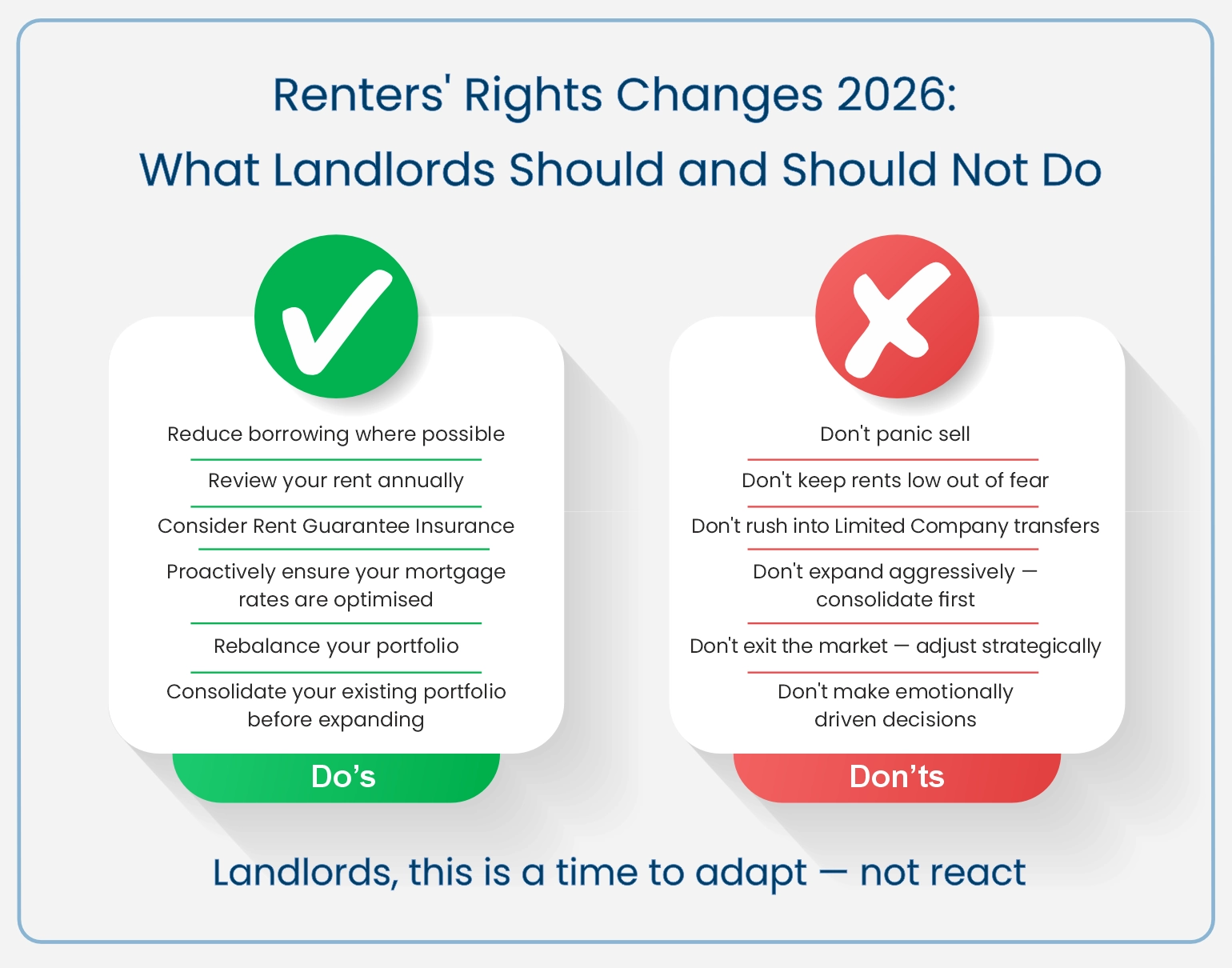
With all that in mind, here are some of the Important steps that you as a landlord should- and should not be doing to better cope with the Renters’ Rights changes in 2026.
Reduce Borrowing Where Possible
For well over a decade, the UK operated in a relatively low interest rate environment, and during that period, increasing borrowing often did not feel like a major concern. However, in today’s higher interest rate market, borrowing costs can have a significant impact on the profitability of a buy-to-let property.
One simple step landlords can consider is gradually reducing borrowing wherever possible. Even small overpayments made consistently over time can help soften the impact of rising interest rates and improve cash flow in the long run. We have covered about this in our previous article on Overpaying your mortgage, which can result in long–-term financial benefits.
Many landlords underestimate the impact that even small mortgage reductions can have over the longer term. In the current environment, reducing borrowing and improving cash flow may be far more beneficial than continuing to maximise borrowing. Generally, my standard advice would be to prioritize overpaying your residential mortgage before touching your buy-to-let debt. However, given the current situation, I believe we must make an exception -reducing your buy-to-let borrowing is a tactical move to safeguard the long-term profitability and sustainability of your investment.
Once you have a handle on your borrowing, the next logical step is to ensure your rent income is in line with the market.
Review Whether Your Rent Reflects the Market
One issue I commonly come across is landlords keeping rents significantly below market value because they have a good tenant and do not want to risk losing them. However, having a good tenant should not mean keeping rent significantly below market value, especially when costs and compliance responsibilities continue to increase.
Despite the changes in Renters’ Rights Act, the underlying demand for rental properties across many parts of the UK still remains strong. In most areas, demand continues to outweigh supply, and landlords should feel confident in reviewing rents where necessary.
A sensible approach is to first understand the true market rent for the property through independent research and then factor in a reasonable discount for a good tenant if appropriate. The objective is not to overcharge tenants, but to ensure the property remains sustainable and manageable for the landlord over the long term.
The Renters’ Rights Act does not prevent landlords from charging fair market rent where increases are properly researched and communicated. It would be a best practice to review the rent annually bearing in mind you will need to provide 2 clear months’ notice to the tenants with any rent increase.
Avoid Impulsive Limited Company Transfers
Another reaction I have increasingly seen from landlords is the desire to transfer personally owned properties into limited companies to reduce income tax exposure. While buying future properties through a limited company may sometimes be worth considering, transferring properties that are already personally owned is often far more complicated and expensive than many realise.
Stamp duty, capital gains tax, refinancing costs and legal fees can create significant upfront costs, which in many cases may outweigh the potential tax benefits. For this reason, landlords should avoid making rushed decisions purely in reaction to the recent changes in Renters’ Rights Act. If you are considering this route, feel free to read our article on–Transferring a Property to a Limited Company.
Rebalance and Strengthen Your Portfolio
For landlords with multiple properties, this may be a better time to focus on Rebalancing and strengthening the existing portfolio rather than aggressively expanding further.
In some cases, rebalancing borrowing across properties, reducing higher loan-to-value mortgages or even selectively selling a smaller part of the portfolio to strengthen the overall position may be more beneficial than trying to continue expanding at the same pace.
The current environment rewards stability, strong cash flow and careful planning. Building a more resilient portfolio now may place landlords in a far stronger position over the long term.
Consolidate your Portfolio Before Expanding
Many landlords may have originally planned to continue growing their portfolio over the next few years. However, given the current conditions and the pressures created by the Renters’ Rights Act, this may be a better time to focus on strengthening existing properties rather than expanding too quickly.
Instead of stretching finances further, using available capital to reduce borrowing, improve cash flow and create a stronger foundation may prove far more beneficial over the long term. Expanding at a slower pace is often better than growing too aggressively during uncertain market conditions.
Consider Rent Guarantee Insurance
One area that landlords should not overlook in the current environment is rent guarantee insurance. This is something I have consistently recommended both professionally and personally as an advisor and as a landlord. As tenant protections increase and possession processes potentially become longer or more complex, protecting rental income becomes even more important.
While rent guarantee insurance is an additional cost, it can provide valuable financial protection if a tenant is unable or unwilling to pay rent. In many cases, this can help landlords avoid unnecessary financial pressure and provide greater peace of mind, particularly during periods of uncertainty.
Final Thoughts
The Renters’ Rights Act has undoubtedly created additional challenges for landlords, but that does not necessarily mean landlords should make rushed or emotionally driven decisions. Panic selling properties or rushing into limited company transfers may not always be the most sensible solution.
Instead, landlords should focus on the practical steps we have discussed: reducing borrowing, proactively optimising mortgage rates, reviewing rental income to reflect the market, rebalancing and consolidating the portfolio, and securing rent guarantee insurance.
The reality is that the rental market is changing, and landlords may now need to take a more structured and proactive approach than before. However, with the right planning and long-term mindset, landlords can continue to manage their property portfolios successfully and confidently under the Renters’ Rights Act.
Frequently Asked Questions
For most landlords, selling in the current market is not the most financially sound decision. Higher interest rates have suppressed buyer demand, and many landlords are considering selling simultaneously — which places further downward pressure on achievable sale prices. Property chains are also taking longer to complete and collapsing more frequently. Before deciding to sell, landlords should explore whether practical steps such as reducing borrowing, reviewing rental income and rebalancing their portfolio could make staying in the market a more viable and rewarding option.
There are several meaningful steps landlords can take. These include reducing buy-to-let borrowing through regular overpayments, ensuring rental income reflects current market rates,rebalancing the portfolio to improve loan-to-value ratios across properties, consolidating the existing portfolio before expanding further, proactively reviewing mortgage rates at each renewal, and taking out rent guarantee insurance to protect rental income. The key is to take a structured, long-term approach rather than making reactive decisions under pressure.
No. The Renters’ Rights Act does not prevent landlords from charging fair market rent. Landlords are entitled to review and increase rent provided the increase is properly researched, reasonable, and communicated correctly to the tenant. The underlying demand for rental properties across the UK continues to outstrip supply in most areas, which means landlords should feel confident in reviewing rents where necessary. A well-researched, market-aligned rent increase — communicated transparently — is fully supported under the Act.
Yes — particularly in the current environment. As tenant protections increase and possession processes become more complex under the Renters’ Rights Act, the financial risk of a tenant being unable or unwilling to pay rent becomes more significant. Rent guarantee insurance provides a financial safety net, covering rental income if a tenant defaults. While it is an additional cost, it offers valuable peace of mind and can protect landlords from serious financial pressure at a time when cash flow is already under strain for many.
Yes — in the current higher interest rate environment, reducing buy-to-let borrowing is one of the most effective steps a landlord can take to improve profitability. Even modest, regular overpayments can have a meaningful cumulative impact over time. Additionally, reducing the mortgage balance — particularly at the point of remortgage when unlimited overpayments are often permitted — can lower the loan-to-value ratio and unlock more competitive rates. Whilst the standard advice is to prioritise paying off a residential mortgage first, where buy-to-let profitability is under pressure, reducing the investment mortgage may be the more sensible exception.
In the current environment, consolidating your existing portfolio is likely to be the more prudent approach before pursuing further expansion. Using available capital to reduce borrowing, improve cash flow and strengthen the financial position of existing properties creates a more resilient foundation. Expanding too aggressively during a period of higher interest rates and increased regulatory pressure can stretch finances and increase risk unnecessarily. A slower, more considered approach to growth — built on a consolidated and stable base — is far more sustainable over the long term.
Rebalancing a buy-to-let portfolio means reviewing the spread of borrowing and equity across your properties and adjusting to create a stronger, more efficient overall position. For example, if one property has a low loan-to-value ratio and strong equity, it may be possible to release some of that equity and use it to reduce the mortgage balance on another property with a higher loan-to-value — improving rates across the portfolio. In some cases, selectively selling one property to release capital and reinvest it to strengthen remaining properties may also be worth considering. The goal is to ensure the portfolio is balanced, financially sound and generating sustainable returns.
Need Professional Guidance Navigating the Renters' Rights Act?
At Nachu Finance, we understand that every landlord’s situation is different. The Renters’ Rights Act has created new challenges, but rushed decisions are not always the best solution.
Our transparent, no-pressure approach means we focus on helping landlords make practical and financially stable long-term decisions based on their individual circumstances.
If you would like support reviewing your borrowings, rental income, rebalancing your portfolio or consolidating before expanding further, feel free to book a free initial consultation with the team at Nachu Finance for a transparent, no-obligation discussion..

About the Author
Sekkappan Alagu is the Founder of Nachu Finance Ltd, established in 2006. With an early career in journalism and publishing, he brings clarity and structured thinking to complex financial topics. Through the Nachu Finance Blog and Knowledge Hub, he shares insights drawn from nearly two decades of client advisory experience, helping readers make informed decisions and understand best practices in mortgages, protection and long-term financial planning.

Business Profile
Nachu Finance Ltd is a directly authorised FCA-regulated firm providing mortgage, insurance and estate planning advice to clients across the UK. The firm takes a holistic approach — considering protection, tax efficiency and long-term planning alongside property finance — maintaining high regulatory standards while keeping advice clear and easy to follow. To learn more about the firm's background and story, visit the About Nachu Finance page.
You May Also Find These Helpful