
Married couple holding a house key together, illustrating joint home ownership in the UK

Testmonials

Enquiry Form

Get in Touch with Us for Personalized Finance Assistance

Please enable JavaScript in your browser to complete this form.
=

Why Married Couples Should Purchase Their Home in Joint Names

Most couples don’t realise that how you own your home can affect your tax, your estate, and even your legal rights if your relationship breaks down. Getting this right from the start can save you significant time, money, and stress.

Married couple holding a house key together, illustrating joint home ownership in the UK

Many clients wonder whether they should purchase a property in joint names, especially if they can afford it in a single name or if one partner does not have an earned income. Some mistakenly believe there are advantages to purchasing a property in a single name. 

This article explores why joint ownership is almost always the better choice and debunks some of the most common myths along the way.

Why Joint Ownership Is Usually the Right Approach

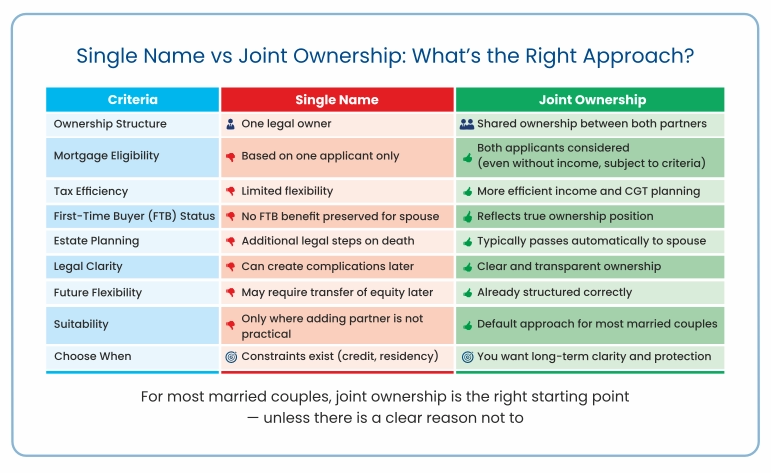
For married couples purchasing a residential home, joint ownership is usually the best option. As a mortgage adviser and estate planner, I recommend starting with this as the default position. 

All individuals listed on the property title must also be on the mortgage. If a couple decides to purchase the property jointly, both must be named on the mortgage. If there are challenges in adding a partner to the mortgage — such as a poor credit history or visa restrictions — we explore alternatives together. 

Only in cases where it is truly impractical to add a partner should purchasing in a single name be considered. Even then, we advise creating a clear action plan to add the partner to the mortgage when their circumstances improve. 

Single vs joint ownership UK property comparison – infographic showing mortgage eligibility, tax efficiency and legal differences for married couples.

A Lack of Income Is Not a Barrier

Some clients mistakenly believe that if their partner is a homemaker or currently without an income, they cannot be added to the mortgage. This is incorrect. 

It is possible to add an applicant without an income, provided they meet other criteria such as age, credit profile, and the right to live in the UK. Do not assume income is a barrier without first speaking to an adviser.

The First-Time Buyer (FTB) Misconception

A common misbelief is that purchasing a home in one partner’s name preserves the other’s First-Time Buyer status for future property purchases. This is not correct. 

Under UK homeownership rules and HMRC’s stamp duty regulations, if one spouse owns a property, the other is automatically considered a homeowner. This means they would not qualify for First-Time Buyer Stamp Duty Relief, and any future property purchase made without selling the first home would be treated as an additional property, incurring higher stamp duty rates. 

Married couples should not assume they can benefit from First-Time Buyer advantages by purchasing in a single name. HMRC does not allow it. 

Estate Planning and Taxation Considerations

If a married couple purchases a property in a single name, additional legal steps are required in the event of the owner’s death. As estate planners, we have encountered cases where a deceased homeowner — despite being married with dependent children — held the property solely in their name due to poor or absent advice. This created unnecessary complications for the surviving spouse. 

Had the property been purchased in joint names, it would have automatically transferred to the surviving spouse under survivorship rules, provided the property is owned as joint tenants (the default for married couples owning joint properties). 

From a tax perspective, joint ownership also offers greater flexibility: 

  • Income tax: Rental income can be split between both owners if the property is later converted to a buy-to-let, potentially reducing the overall liability. 
  • Capital Gains Tax (CGT): If the property is sold after a period as a buy-to-let, both partners can utilise their individual CGT allowances, offering more efficient tax planning.

What If the Relationship Ends?

Unfortunately, relationships sometimes break down. In such cases, the courts assess various factors when dividing assets. A marital home registered in one spouse’s name does not necessarily grant them greater rights over the property — the other partner may still have a legal claim. 

Joint ownership simply makes this process cleaner and more transparent from the outset.

Non-Matrimonial Assets: An Exception Worth Noting

This guidance applies to a residential home purchased by a married couple as their primary residence. If one partner owned a property before the marriage and it is not used as the couple’s primary residence, joint ownership is not necessarily the best option. 

Each case should be assessed individually with professional guidance.

Already Own Your Home in a Single Name? Here’s What to Do Next

If you have already purchased your home in a single name, it is not too late to put this right. Adding your partner’s name to both the title and the mortgage is achievable, and doing so sooner rather than later is strongly advisable. 

The most practical opportunity to make this change is at the point of remortgage — typically when your current fixed rate is coming to an end. This allows you to review your mortgage and update the ownership at the same time. 

There are two common routes: 

  • At the end of your fixed-rate period: 
    This is the ideal time to apply for a joint mortgage and update ownership through a Transfer of Equity. You can explore this in more detail in our Remortgage Advice guide.
  • During an existing mortgage term: 
    If you are mid-term, it is still possible to add your partner. This requires lender consent alongside a Transfer of Equity completed by a solicitor — explained further in our Transfer of Equity guide.

Our recommendation: do not wait for the “perfect moment”. The best time to correct ownership is your next remortgage review.

Making the Right Choice

While some may believe there are advantages to purchasing a property in a single name, the reality is that joint ownership offers significant benefits across estate planning, taxation, and legal clarity. 

Purchasing a property is one of the most important financial decisions you will make, and poor advice at this stage can be costly for years to come. 

At Nachu Finance, we take pride in offering transparent and holistic advice, built on nearly two decades of client experience. Whether you are buying now or looking to correct an existing ownership structure, we are here to guide you every step of the way.

Picture of About the Author

About the Author

Sekkappan Alagu is the Founder of Nachu Finance Ltd, established in 2006. With an early career in journalism and publishing, he brings clarity and structured thinking to complex financial topics. Through the Nachu Finance Blog and Knowledge Hub, he shares insights drawn from nearly two decades of client advisory experience, helping readers make informed decisions and understand best practices in mortgages, protection and long-term financial planning.

Picture of Business Profile

Business Profile

Nachu Finance Ltd is a directly authorised FCA-regulated firm providing mortgage, insurance and estate planning advice to clients across the UK. The firm takes a holistic approach — considering protection, tax efficiency and long-term planning alongside property finance — maintaining high regulatory standards while keeping advice clear and easy to follow. To learn more about the firm's background and story, visit the About Nachu Finance page.

Continue Improving Your Mortgage Strategy

SA302 tax calculation UK example for mortgage application – sample HMRC tax return showing income, property profits and total taxable income.

Testmonials

Enquiry Form

Get in Touch with Us for Personalized Finance Assistance

Please enable JavaScript in your browser to complete this form.
=

Tax Calculations (SA302): What They Are and Why They Matter for Your Mortgage

You’re applying for a mortgage. You’re self-employed, a company director, or you own a buy-to-let property. In many respects, that is a proud position to be in — you’ve taken the initiative, accepted the risk, and gone further than most. But when it comes to evidencing your income for a mortgage, this is also where things can get complicated. We believe knowledge is power. If you know exactly what documents are needed and why, the process becomes far less daunting. This article is written for people who are going the extra mile — and want to make sure their mortgage application reflects that. 

SA302 tax calculation UK example for mortgage application – sample HMRC tax return showing income, property profits and total taxable income.

What Is a Tax Calculation (SA302)?

A Tax Calculation is a summary document produced once your Self Assessment tax return has been submitted to HMRC. 

It pulls together all your income sources — from employment, property, dividends, and more — calculates the tax due, and sets out the payment schedule. The result is a concise, standardised document, usually one or two pages long, that gives lenders a clear and consistent view of your financial position. 

This standardisation is precisely why lenders rely on it. Whatever your income mix, the format stays the same. 

Please refer to the sample Tax Calculation image in this article to help you identify what the document looks like before you begin gathering your paperwork.

When and Why Is It Required?

A Tax Calculation becomes essential whenever your income is not purely from PAYE employment. This includes: 

  • Self-employed individuals — sole traders and partners
  • Limited company directors receiving salary and dividends
  • Landlords with property held in their personal name 

Even in cases where rental income isn’t being used to support your borrowing, there is a compliance dimension that matters. As regulated mortgage advisers, we have a professional responsibility to confirm that income has been correctly declared to HMRC — not just that it exists. If you receive rental income from a property held in your personal name, you are required to declare it under the heading “profit from UK land and property” on your Self Assessment. We will need to see the Tax Calculation confirming this, regardless of whether that income is being used in your affordability assessment. 

You can read more about this in our article on declaring rental income correctly, which explains both the reporting requirements and the consequences of non-disclosure.

Understanding the Dates — Where Most Applicants Get Caught Out

Timing is one of the most important — and most misunderstood — aspects of Tax Calculations. 

The UK tax year runs from 6 April to 5 April the following year. HMRC allows you until 31 January to submit your tax return for the year just ended. That sounds generous. But lenders apply a different rule. 

Most lenders expect your Tax Calculation to be no more than 18 months old. 

This creates a gap that regularly catches applicants off guard. Here’s how it plays out in practice:

Tax Year HMRC Submission Deadline Lender 18-Month Cut-Off
6 Apr 2024 – 5 Apr 2025 31 January 2026 October 2026
6 Apr 2025 – 5 Apr 2026 31 January 2027 October 2027
6 Apr 2026 – 5 Apr 2027 31 January 2028 October 2028

The years above are used to illustrate the pattern — the same principle applies to every tax year going forward. 

Here is the practical problem: if you are applying for a mortgage in, say, October 2027, most lenders will expect to see the Tax Calculation for the year ending 5 April 2027. But under HMRC rules, you have until 31 January 2028 to submit that return. You could be fully compliant with HMRC and still fall outside what lenders will accept. 

The practical takeaway: if a mortgage is on the horizon, submit your tax return well ahead of the January deadline. It keeps your options open across a wider range of lenders and avoids a situation where your documents are technically current but commercially too old.

Tax Calculation vs Tax Return — A Common Misunderstanding

It is very common for clients to arrive with their tax return, assuming this is what lenders need. In practice, lenders do not accept tax returns as proof of income — and there is a clear reason for that.

Document Purpose Typical Length
Tax Return Detailed submission to HMRC for reporting purposes 15–20 pages
Tax Calculation (SA302) Concise summary of income sources and tax due 1–2 pages

The tax return contains the detail. The Tax Calculation provides the standardised summary lenders can work with. Submitting the wrong document is one of the most common causes of avoidable delays — and something easily avoided with a little preparation.

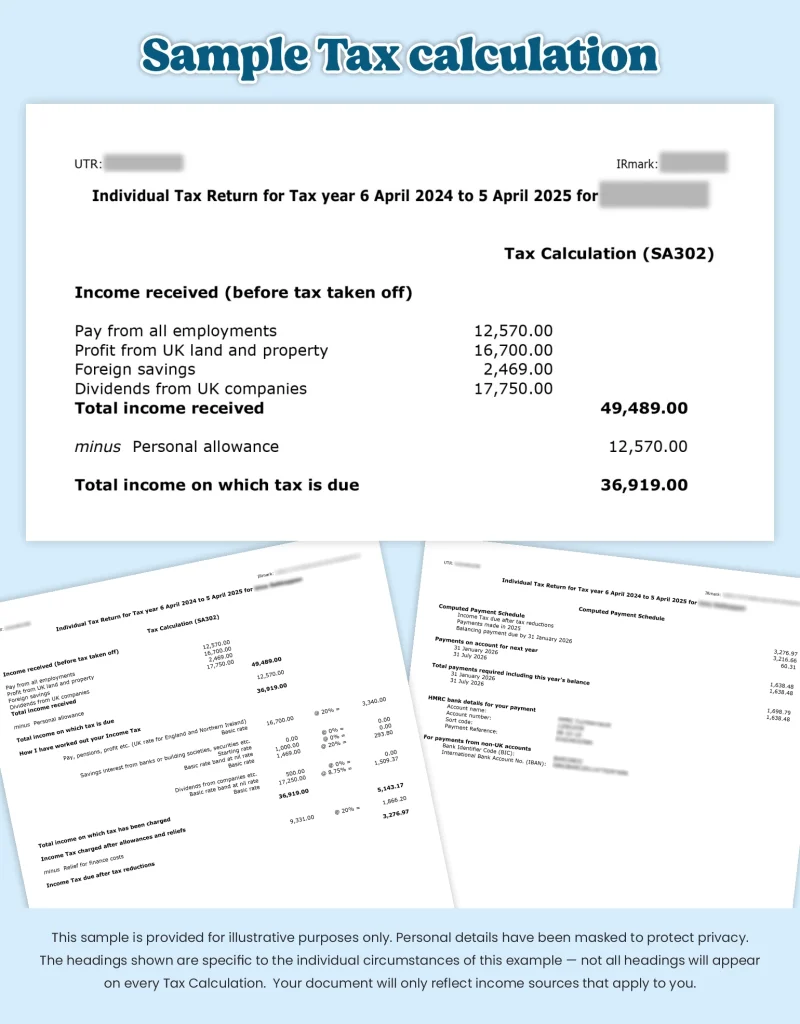
Sample Tax Calculation

This is an example of what a Tax Calculation looks like when produced following submission of a Self Assessment tax return. 

As you can see, the document runs to two pages and sets out the income sources, the tax due, and the payment schedule. Personal details have been removed for privacy. 

The headings shown reflect the circumstances of the individual in this example. Your own Tax Calculation will only display income sources relevant to you — your document may look slightly different. 

Sample SA302 tax calculation UK showing income breakdown, rental property income and total taxable income for mortgage affordability assessment.

The Role of the Tax Year Overview

Alongside the Tax Calculation, lenders will also request a Tax Year Overview (TYO). 

Where the Tax Calculation shows how much tax is due, the Tax Year Overview confirms whether that tax has actually been paid — and whether any balance remains outstanding. Lenders use both documents together to ensure consistency. The figures must align, and any outstanding liabilities need to be resolved before a mortgage application can progress. 

For a full explanation of what the Tax Year Overview is, how to download it correctly, and the common mistakes to avoid, please see our dedicated guide: Tax Year Overview: What It Is and Why It Matters for Your Mortgage. 

How Many Years Are Needed?

Most lenders will ask for two years of Tax Calculations and matching Tax Year Overviews, with the most recent year falling within the 18-month rule. 

In some cases, where the previous year’s documents are not available, lenders may accept the most recent year alone by exception — but this is not standard and will depend on individual lender policy. 

As a matter of best practice, we routinely ask clients for three years where they are available. If your income in one of the last two years was lower than usual — perhaps due to a difficult trading period, a gap in contracts, or a change in how you drew income from your company — having a third year allows us to put a business case to the lender on your behalf. It gives us the evidence to show the broader picture and argue your corner where a straight two-year view might not tell the full story. 

If you are going to the effort of gathering these documents and three years are available to you, we would always recommend collecting all three. It costs nothing extra and may prove valuable.

A Tax Calculation will only display headings that are relevant to your personal circumstances. Not every applicant will see every heading — the document is tailored to your income sources for that year. 

The sample Tax Calculation in this article shows a combination of employment income, rental income, foreign savings, and dividends — along with a relief for finance costs. This is a good illustration of how multiple income streams appear on a single document. 

Below is an overview of the most common headings and how lenders typically treat each one:

HMRC HeadingWhat It RepresentsMortgage Relevance
Pay from all employmentsSalary from an employer, or director’s salary from your own limited companyUsed alongside payslips and P60. For limited company directors, lenders use the figure shown here rather than payslips.
Profit from UK land and propertyGross rental income from personally held propertyRequired for compliance and, where used for affordability, assessed after the relief for finance costs has been deducted.
Foreign savingsInterest received from overseas savings or accountsTreatment varies by lender — most lenders will not consider this.
Dividends from UK companiesDividends received from shares in a UK limited companyUsed alongside employment income for director/shareholder applicants. Most lenders combine salary and dividends to calculate total income.
Relief for finance costsMortgage interest and allowable financial costs on rental propertiesThis is not income — it is a tax relief applied as a deduction. Lenders will reduce the rental income figure accordingly.
Total income receivedCombined figure across all income sources before allowancesThe starting point lenders work from before applying their own income calculations.
Total income on which tax is dueIncome remaining after the personal allowance has been deductedConfirms the taxable position — lenders cross-reference this against the Tax Year Overview.

Your Tax Calculation will only show the headings that apply to you. The table above reflects the headings shown on the sample document and is illustrative of what a Tax Calculation may include — your own document may show different headings depending on your circumstances.

In most cases, obtaining your Tax Calculation is straightforward once you know where to look. 

  1. From your accountantIf you use an accountant, they will usually provide this aftersubmitting your return. It is often included in the year-end documents sent to you as standard — check any emails, portal communications, or post received when your accounts were finalised. The Tax Calculation is most likely to be there. 
  2. From your HMRC online accountIf yousubmit your own returns, you can access your Tax Calculation directly through your HMRC Personal Tax Account. It may require some navigation, but the document will be available there. 

A common trap: the Tax Year Summary When navigating your HMRC online account, you may come across a document called a Tax Year Summary. This is not the same as a Tax Calculation and is not accepted by mortgage lenders as proof of income. The Tax Year Summary is a general overview of taxes paid — it does not show the breakdown of income sources in the format lenders require. Please refer to the sample Tax Calculation image in this article to confirm you have the correct document before submitting it. 

An important note for those whose returns were filed through commercial software If your tax return was submitted by an accountant using their own commercial software — rather than directly through the HMRC website — you will not be able to download your Tax Calculation from the HMRC portal, even if you have full access to your HMRC online account. This is one of the most common points of confusion we encounter. In this situation, go directly to your accountant as the first step — not HMRC. 

  1. Directly from HMRCIf neither of the above options is available, you can request your Tax Calculation directly from HMRC by telephone. This will take longer and may involve a wait, but itremains a reliable fallback. 

If you request by telephone: keep the covering letter When HMRC sends your Tax Calculation following a phone request, it will be accompanied by a covering letter confirming your name, address, and date of issue. Lenders will require both the Tax Calculation and the covering letter together — do not submit one without the other. And if you are calling HMRC for your Tax Calculation, use the same call to request your Tax Year Overviews at the same time. It will save you a second wait. 

Key Takeaways

A Tax Calculation is not just another form to track down. It is central to how lenders understand your income when you are self-employed, a director, or a landlord. 

  • Know which document you need — the Tax Calculation (SA302), not the tax return or tax summary
  • Be aware of the 18-month lender rule and how it interacts with HMRC’s January deadline
  • Collect two years as standard, three where available
  • Always pair your Tax Calculation with the matching Tax Year Overview
  • If in doubt about what you are looking at, refer to the sample image in this article 

The earlier you prepare, the fewer surprises you will encounter later. 

This article forms part of our Knowledge Hub series on mortgage documentation. You may also find our guide on Tax Year Overviews useful — it covers the companion document lenders always request alongside the Tax Calculation.

Frequently Asked Questions

If your income includes any element of self-employment, dividends, or rental income — or if we need to confirm that rental income has been correctly declared to HMRC — then a Tax Calculation is unavoidable. We cannot substitute it with a tax return, a tax summary, or a Tax Year Overview alone. We need the Tax Calculation and the corresponding Tax Year Overview together.

Yes — in almost all cases, lenders require both documents together. The Tax Calculation shows your income and tax liability; the Tax Year Overview confirms whether that tax has been paid. Lenders cross-reference the two and the figures must match exactly. Providing one without the other will result in follow-up requests, so it is best to have both ready from the outset.

Some lenders may consider documents up to around 21 months old, but your options will be more limited. If your latest Tax Calculation and Tax Year Overview fall between 18 and 21 months old, it is still worth speaking to us — there are lenders who will consider this by exception. But if you are planning ahead, filing early is always the better approach.

Whoever submitted your tax return — whether that is your accountant or a commercial software provider — should be able to produce it. If you are struggling to locate it, you can request it directly from HMRC. This takes time, but it is an important document and worth pursuing. When you do call, ask for your Tax Year Overviews at the same time so you are not waiting twice.

If you are simply switching to a new rate with your existing lender at the end of your initial period, and not borrowing any additional funds, a full income assessment is usually not required at that stage. However, for remortgages to a new lender or for any additional borrowing, income documents will be needed.

Yes. If you own a buy-to-let property in your personal name, you are required to declare the rental income to HMRC under the heading “profit from UK land and property.” As mortgage advisers, we have a professional obligation to confirm this has been done correctly — even where that income is not being used to support your affordability assessment. Where rental income is being used as part of your application, lenders will assess it after the relief for finance costs has been applied, which is why how it appears on your Tax Calculation matters. Please see our article on declaring rental income correctly for a full explanation of the reporting requirements.

Picture of About the Author

About the Author

Sekkappan Alagu is the Founder of Nachu Finance Ltd, established in 2006. With an early career in journalism and publishing, he brings clarity and structured thinking to complex financial topics. Through the Nachu Finance Blog and Knowledge Hub, he shares insights drawn from nearly two decades of client advisory experience, helping readers make informed decisions and understand best practices in mortgages, protection and long-term financial planning.

Picture of Business Profile

Business Profile

Nachu Finance Ltd is a directly authorised FCA-regulated firm providing mortgage, insurance and estate planning advice to clients across the UK. The firm takes a holistic approach — considering protection, tax efficiency and long-term planning alongside property finance — maintaining high regulatory standards while keeping advice clear and easy to follow. To learn more about the firm's background and story, visit the About Nachu Finance page.

Strengthen Your Mortgage Application Knowledge

Renting Out a Spare Room: How to Do It the Right Way

Renting out a spare room is a practical way for homeowners to improve their monthly cash flow while continuing to live in their main residence. It is fully legal and increasingly common in areas where both property values and rental demand are high.
However, it is important to understand the rules around mortgage consent, tax obligations, insurance conditions and the type of agreement you must use before taking in a lodger.

To bring this to life, consider the example of Manjula, a young accounting professional who purchased a two bedroom flat early in her career. Once she completed the purchase and moved in, she began thinking about the potential of renting out her spare room. Although she did not rely on this income for day to day expenses, she recognised it as an opportunity to enhance her cash flow. Being from a financial background, she wanted to ensure she did everything correctly and complied with all legal and regulatory requirements.
This article outlines the key steps she needed to take and what every homeowner should consider.

Can You Rent Out a Spare Room in the UK?

Yes, you can. Renting out a furnished room in your own home is allowed, provided you continue living in the property as your main residence. When done correctly, it is a simple and effective way to earn additional income.

Mortgage Lender Consent

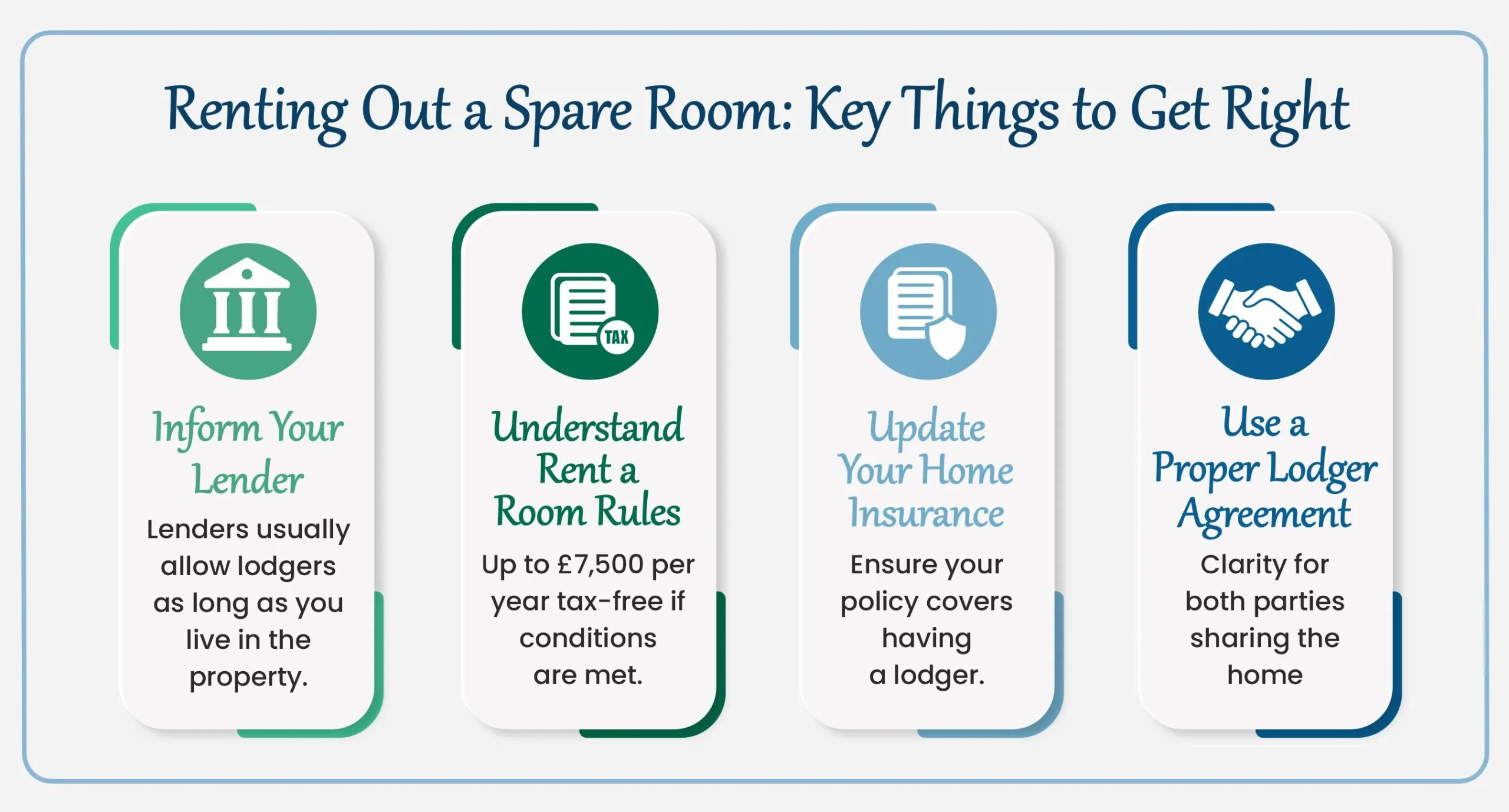
Most mortgage lenders, including major high street names, are typically comfortable with a homeowner taking in a lodger.
Some lenders require notification, while others require formal consent. The requirement usually appears in the mortgage offer or the lending criteria.

From our experience advising clients, we have not encountered a case where a lender refused permission for a lodger. If you are planning to rely on lodger income before you complete your purchase, it is best to tell us early so we can place you with a lender who is fully supportive of this arrangement.

Renting out a spare room key steps infographic

HMRC Rent a Room Scheme

If you take in a lodger, the Rent a Room Scheme may apply to you. This is HMRC’s specific tax allowance for homeowners who let out furnished accommodation in their main home.

The scheme allows you to earn up to £7,500 per year tax-free. If the income is shared with someone else, the threshold is £3,750.

If your income from the lodger is below your threshold, the exemption is automatic and you do not need to do anything.
If you earn above the threshold, you must complete a tax return and can either opt into the scheme to claim the allowance, or opt out and record your income and expenses in the usual way.

For full details, HMRC guidance is available at:
https://www.gov.uk/rent-room-in-your-home/the-rent-a-room-scheme

Lodger Agreement

Because you will continue living in the property and sharing accommodation with the lodger, a lodger agreement is required rather than a standard tenancy agreement.
This agreement provides clarity for both parties on expectations, access, notice periods and house rules. Although less formal than a tenancy, documenting the arrangement properly helps prevent misunderstandings.

Home Insurance Considerations

Your home insurance provider must be informed before a lodger moves in.
If you own a freehold house, both your buildings and contents insurer need to be notified.
If you own a leasehold flat, buildings insurance is usually arranged by the freeholder or management company, but you must still update your contents insurer.

Failing to disclose a lodger could invalidate future claims, so it is essential to check this before renting out the room.


In Summary

Renting out a spare room can be a straightforward and rewarding way to supplement your income, provided it is done correctly. Ensuring lender consent, meeting HMRC requirements, updating your insurance and using the right agreement will help you stay compliant and avoid future issues. With a little preparation, taking in a lodger can be a simple and efficient way to make the most of your home while maintaining full control and peace of mind.

Frequently Asked Questions

Generally, mortgage lenders will not use lodger income for affordability assessments.
It is not considered stable enough from a lender’s perspective, so it cannot be relied upon to support borrowing.

A lender may ask questions during a remortgage to satisfy themselves that everything is in order, but in our experience it is very unlikely to lead to a decline. The lodger’s income will not be used for affordability, but lenders are usually comfortable as long as the arrangement is compliant and correctly disclosed.

Yes, you can rent out more than one room, and all the rules mentioned in this guide continue to apply, including lender notification, HMRC obligations and updating your home insurance.
However, you must be careful not to fall into the House in Multiple Occupation (HMO) category. If you have three or more unrelated lodgers, the property may be classed as an HMO. In that case, additional legal and safety requirements apply, including fire safety standards, gas safety compliance and, in many areas, the need for an HMO licence from the local council.

This article applies only to situations where you continue living in the property and rent out a spare room while it remains your main residence.
If you intend to move out completely and let the whole property, the rules are very different. You may need consent to let from your lender or a full buy to let mortgage.
For this scenario, please refer to our detailed blog on renting out a former residential property, where we explain the steps involved, lender requirements and compliance points.

Picture of About the Author

About the Author

Sekkappan Alagu is the Founder of Nachu Finance Ltd, established in 2006. With an early career in journalism and publishing, he brings clarity and structured thinking to complex financial topics. Through the Nachu Finance Blog and Knowledge Hub, he shares insights drawn from nearly two decades of client advisory experience, helping readers make informed decisions and understand best practices in mortgages, protection and long-term financial planning.

Picture of Business Profile

Business Profile

Nachu Finance Ltd is a directly authorised FCA-regulated firm providing mortgage, insurance and estate planning advice to clients across the UK. The firm takes a holistic approach — considering protection, tax efficiency and long-term planning alongside property finance — maintaining high regulatory standards while keeping advice clear and easy to follow. To learn more about the firm's background and story, visit the About Nachu Finance page.

Buying a Home Today With the Intention to Letting It Out in the Future

Resi Home Today B2L Tomorrow

A Financial Insight for First-Time Buyers Planning Ahead

Many first-time buyers choose a property that meets their current needs, knowing that life will evolve in the years ahead. It is quite common for young professionals like Arjun, an IT consultant working in Central London, to buy a one-bed flat close to work today and then, as their family grows, keep this first home as an investment property while moving into a larger place.

If this is something you are considering, it helps to understand what to think about now, at the point of purchase, so that you are well-placed to rent out the property later without unnecessary complications.

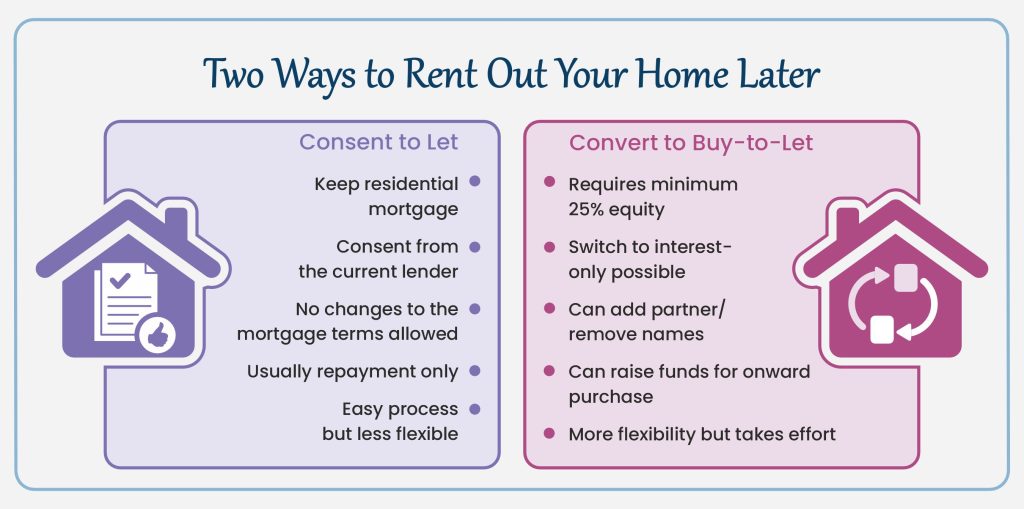
Two Ways to Let Out Your Home in the Future

Two Ways to Let Out Your Home in the Future

When the time comes to let out your current home, there are two broad routes.
Both are commonly used and each has its own advantages depending on your long-term plans.

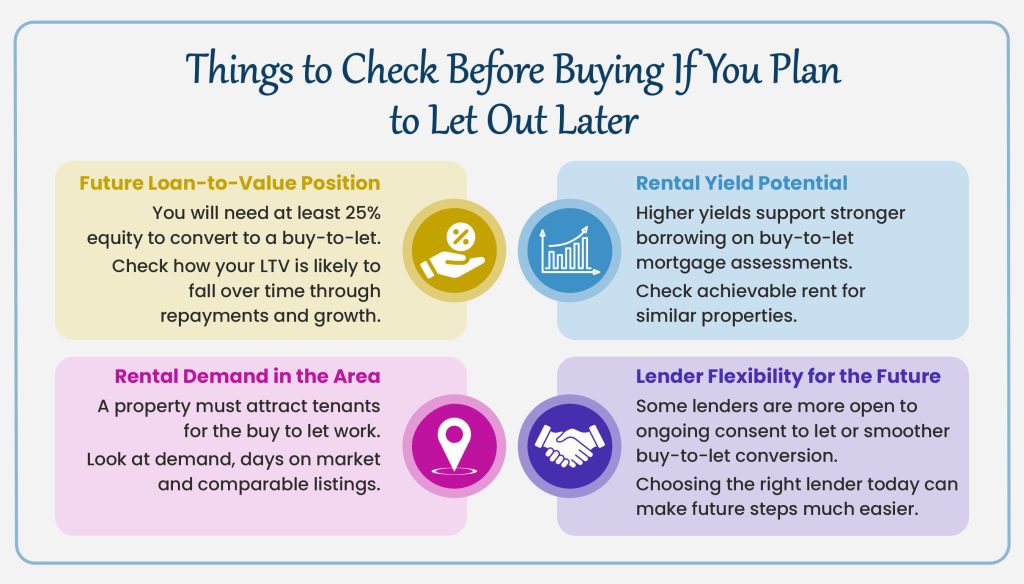
Understanding Rental Demand

Some properties make excellent homes but less successful rental investments.
Areas with strong local employment, transport links, and amenities typically see steady rental demand, while certain high-end or larger properties may attract fewer tenants.

If you are buying with the intention to let out later, it is worth spending a little time assessing the area’s rental activity. This can save you surprises in the future.

Things to Check Before Buying If You Plan - Resi to B2L Later Info 2

Staying With Your Residential Mortgage and Requesting “Consent to Let”

This option keeps things simple. You continue with your existing residential mortgage and inform the lender that your circumstances have changed. You ask for permission to let out the property, and if the lender agrees, you receive what is known as consent to let.

You do not change the mortgage type.
You do not remortgage.
You do not alter any other aspect of the mortgage apart from the usage.

Some lenders such as NatWest and Santander are known for being flexible and may allow consent to let on an ongoing basis, even when your fixed rate ends. They may also allow you to choose new products while keeping that permission active.

Other lenders, including Halifax and Virgin Money, tend to grant consent for a much shorter period, often one to two years. Once this period ends, they may expect you to formally convert the mortgage to a buy-to-let product or move to another lender.

Why this approach appeals:
It avoids the hassle of remortgaging and allows you to rent out the property without breaching any contract terms.

What to keep in mind:
Since you are technically still on a residential mortgage, you usually cannot:

Consent to let is ideal if you want a simple and temporary arrangement.

Converting the Mortgage to a Buy-to-Let

The second route is to formally convert the residential mortgage into a buy-to-let mortgage. This tends to offer more flexibility and is usually preferred if you want a long-term investment setup.

A key requirement for buy-to-let mortgages is having at least 25% equity.
This means the mortgage must be no more than 75% of the property value.
Even if you bought with a 10% deposit, you may naturally reach this level over time due to capital repayments and property price growth.

If you fall short of the 75% loan-to-value threshold, lenders may ask you to reduce the mortgage balance when converting. This can be done by contributing additional funds.

You can read further about Loan to values here

Thinking Ahead: Will the Rental Income Work?

Buy-to-let lenders assess affordability based mainly on rental income.
It helps to look up the likely rental value of similar properties in the area.

The rental yield gives a useful early indication.
It is calculated as:

Annual rent ÷ property value × 100.

A stronger yield (for instance a 6% yield) makes it easier to borrow the amount you need on a buy-to-let mortgage.
A weaker yield (for instance a 4% yield) may mean the loan amount has to be lower or supported by your personal income.
There are ways to structure this, especially for basic-rate taxpayers or applicants with surplus income, but it is good to be aware of this early on.

You can understand further about rental yield here

Considering Lender Appetite from the Start

If you already know there is a good chance you may let out your home one day, the choice of lender for your initial residential mortgage can make a real difference.

Some lenders:

Others may be more restrictive or may expect a formal conversion sooner.

Selecting a lender that naturally aligns with future rental plans helps keep your options open.

When Your Move Involves Buying a New Home at the Same Time

If you decide to let out your current home and buy your next home in one go, this becomes something known as a let-to-buy arrangement.

This is slightly different from a straightforward buy-to-let remortgage because it is designed specifically to support your onward residential purchase. You can read more about Let to buy mortgages here

Conclusion

For first-time buyers like Arjun, planning a few steps ahead can make the future transition from homeowner to landlord much smoother.
If you intend to keep your first home as an investment later, it is worth considering:

With the right preparation, your first home can become a stepping stone to longer-term financial planning and investment.

Frequently Asked Questions

Yes. Every residential mortgage includes a clause requiring you to seek consent before letting out the property. Renting without permission would breach the mortgage contract.

Most lenders will consider it, but each has their own criteria, conditions, and limits. They must also be satisfied that the property was genuinely purchased to live in, not as a disguised buy-to-let.

Once the lender has granted consent and the property is actually rented out, most lenders will assess it similarly to a buy-to-let. The rental income can usually offset the mortgage payments, though each lender’s affordability method differs slightly.

The above blog is more to do with letting out the property entirely and you moving to a different accommodation. If you would like to understand more about continuing to live in the property but rent out a spare room then refer to our separate blog article titled Renting Out a Spare Room: How to Do It the Right Way

Picture of About the Author

About the Author

Sekkappan Alagu is the Founder of Nachu Finance Ltd, established in 2006. With an early career in journalism and publishing, he brings clarity and structured thinking to complex financial topics. Through the Nachu Finance Blog and Knowledge Hub, he shares insights drawn from nearly two decades of client advisory experience, helping readers make informed decisions and understand best practices in mortgages, protection and long-term financial planning.

Picture of Business Profile

Business Profile

Nachu Finance Ltd is a directly authorised FCA-regulated firm providing mortgage, insurance and estate planning advice to clients across the UK. The firm takes a holistic approach — considering protection, tax efficiency and long-term planning alongside property finance — maintaining high regulatory standards while keeping advice clear and easy to follow. To learn more about the firm's background and story, visit the About Nachu Finance page.

Why Professional Opinion Matters More Than a Google Search

Google Search Vs Expert Opinion
General Search – The Starting Point

It is quite common for clients to begin their research by checking Google, using AI tools, or speaking to friends who have gone through a similar process. These are all good starting points to understand what is generally possible in the mortgage or property market and to familiarise yourself with key terms and concepts.

However, while Google searches, AI responses, and friendly discussions can help build general awareness, they cannot replace case-specific professional advice that takes into account your personal and financial circumstances.

If you are specifically interested in how advice-driven product selection differs from comparison websites, see our related article:

Why Personalised Mortgage Advice Goes Beyond Comparision Website

The Limits of Generic Information

The information found through a Google search or a general discussion with friends is, by nature, generic.
It does not take into account:

  • Your income type or employment structure.
  • The property’s ownership model or intended use.
  • The lender’s current criteria.
  • Your residency or credit profile.

Mortgage lending, taxation, and property law all have layers of detail that differ from one case to another. What works well for one individual may not be suitable or even possible for another.

     

Consider the use of a gifted deposit.
A quick online search might state that lenders are happy to accept gifted deposits as long as the source of funds is evidenced and supported by a donor declaration.

While this is true in many standard residential purchases, the outcome changes significantly when the purchase:

  • Is made through a limited company,
  • Involves multiple shareholders, or
  • Relates to a non-standard property such as a multi-unit block under a single title.

In such cases, the number of lenders available is very limited. Those who accept gifted deposits often do not accept multi-unit properties, and vice versa. The difference between what appears acceptable online and what is actually possible in your case can therefore be substantial.

Why Professional Advice Holds Greater Weight
Professional opinion is built on understanding not just what the rules say, but how they are applied in practice.
It involves:
  • Interpreting lender and solicitor criteria within the context of your case.
  • Balancing compliance, affordability, and timing.
  • Ensuring that what appears possible in theory is achievable in reality.

A professional adviser also carries regulatory accountability — meaning the guidance you receive must be suitable, compliant, and in your best interests. That level of responsibility does not exist in a Google search, an AI response, or a conversation with friends.

Research Is Useful – Validation Is Essential
Doing your own research is helpful and can make conversations more meaningful. But before proceeding with decisions or forming expectations, it is vital to validate that research with a qualified professional.
 
A generic Google answer or AI response can inform you of what is common, but professional advice ensures that what you are planning is achievable and acceptable for your specific situation.
 
The key takeaway: general searches are a good place to start — professional advice ensures you finish right.

Picture of About the Author

About the Author

Sekkappan Alagu is the Founder of Nachu Finance Ltd, established in 2006. With an early career in journalism and publishing, he brings clarity and structured thinking to complex financial topics. Through the Nachu Finance Blog and Knowledge Hub, he shares insights drawn from nearly two decades of client advisory experience, helping readers make informed decisions and understand best practices in mortgages, protection and long-term financial planning.

Picture of Business Profile

Business Profile

Nachu Finance Ltd is a directly authorised FCA-regulated firm providing mortgage, insurance and estate planning advice to clients across the UK. The firm takes a holistic approach — considering protection, tax efficiency and long-term planning alongside property finance — maintaining high regulatory standards while keeping advice clear and easy to follow. To learn more about the firm's background and story, visit the About Nachu Finance page.


Why Personalised Mortgage Advice Goes Beyond Comparison Websites

Headline mortgage rate vs personal advice comparison – personalised mortgage advice versus comparison websites.

In today’s digital world, it’s natural to turn to comparison websites to check mortgage rates.
They’re easy to use and give a quick overview of what’s available in the market.
But when it comes to actually getting a mortgage — and making sure it’s suitable, affordable, and achievable — what you see on a comparison site is only half the story.
That’s where the value of personalised advice comes in.

Comparison Websites – A Good Starting Point, But That’s All

Comparison websites are a great starting point for research. They help you understand the general range of rates in the market.
However, what they show are generic products, often filtered only by loan amount, property value, and type of mortgage.

What they don’t take into account are your personal details that actually determine whether you can access that rate, such as:

     ⦁ How you earn your income – employed, self-employed, or on a contract
     ⦁ The stability and type of your income – salary, dividends, day rates, or multiple income sources
     ⦁ Your credit profile and existing commitments
     ⦁ Source of deposit – personal savings, gift, or from overseas
     ⦁ Your residency status or visa type
     ⦁ Type and condition of the property
     ⦁ Whether you are buying in personal name or through a Ltd company

Each of these factors can significantly alter which lenders are willing to offer you a mortgage — and at what rate.

What Personalised Advice Brings to the Table

With personalised advice, the focus shifts from finding a rate to understanding your situation in full.

An adviser takes time to understand your circumstances and objectives before recommending any product

They review the entire market (not just one lender panel or an online list) and select options that are:

     ⦁ Available to you, based on your profile
     ⦁ Suitable for your needs and plans
     ⦁ Compliant with lender and regulatory requirements
     ⦁ Timed correctly, reflecting how long each rate is valid and when you plan to complete

Every rate shared through personalised advice is one that the adviser is confident you are both eligible for and comfortable with — taking into account your affordability, goals, and any foreseeable changes ahead
commitment.

Rates Move Fast – Timing and Monitoring Matter

Mortgage rates in the UK can be volatile and may change even within a single day.
A rate displayed online might already be withdrawn or replaced by the time you apply.
With personalised advice, an adviser will typically:

     ⦁ Track market movements daily
     ⦁ Re-check rates right up to the point of exchange or completion for purchases
     ⦁ Revisit options close to your renewal date in remortgages or product transfers
     ⦁ Recommend switching to a lower rate, if one becomes available before completion and it suits your circumstances

This level of monitoring helps ensure that the mortgage product you proceed with remains competitive and appropriate right up to the point you lock it in.

Accountability and Responsibility in Advice

One of the most important distinctions between taking personalised advice and using a comparison website lies in accountability.

When you rely on online listings, no one takes responsibility for whether the information shown is accurate, up to date, or suitable for your circumstances. The choice — and any resulting outcome — rests entirely with you.

By contrast, when you receive regulated mortgage advice, the adviser takes full responsibility for the recommendation made. This includes assessing your income, commitments, and future plans to ensure the advice is both appropriate and compliant.

Every recommendation is backed by professional due diligence, regulatory oversight, and the adviser’s Professional Indemnity Insurance, which provides an additional layer of protection and reassurance for clients.

This accountability — combined with ongoing rate monitoring and suitability checks — is what truly differentiates advice from comparison.

The Value of Trust and Expertise

Personalised mortgage advice is not about selling a rate; it is about guiding someone towards the right mortgage solution for their circumstances.There is no incentive for an adviser to withhold a cheaper rate if it is truly suitable — the entire purpose of regulated advice is to find the option that best fits the client’s needs.

The advice process goes far beyond comparing numbers. It involves making sure the application is positioned correctly, the product aligns with future plans, and the overall journey remains clear and manageable.

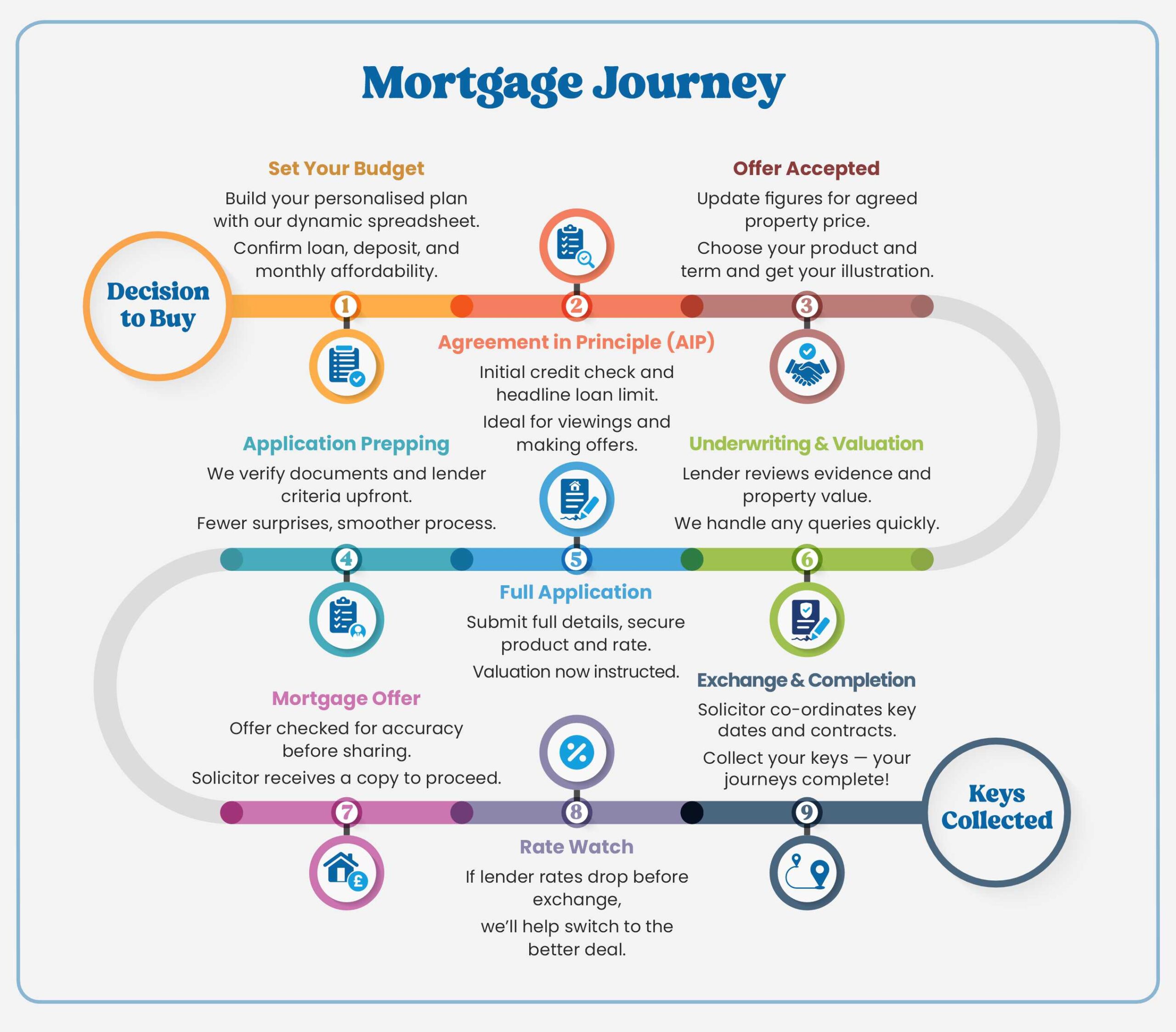
Securing a mortgage is a journey rather than a single-step process, and understanding how the various stages fit together can make the experience far smoother. You can read more about the typical steps in the process The First-Time Buyer’s Mortgage Journey: A Complete, Practical Guide

In Summary

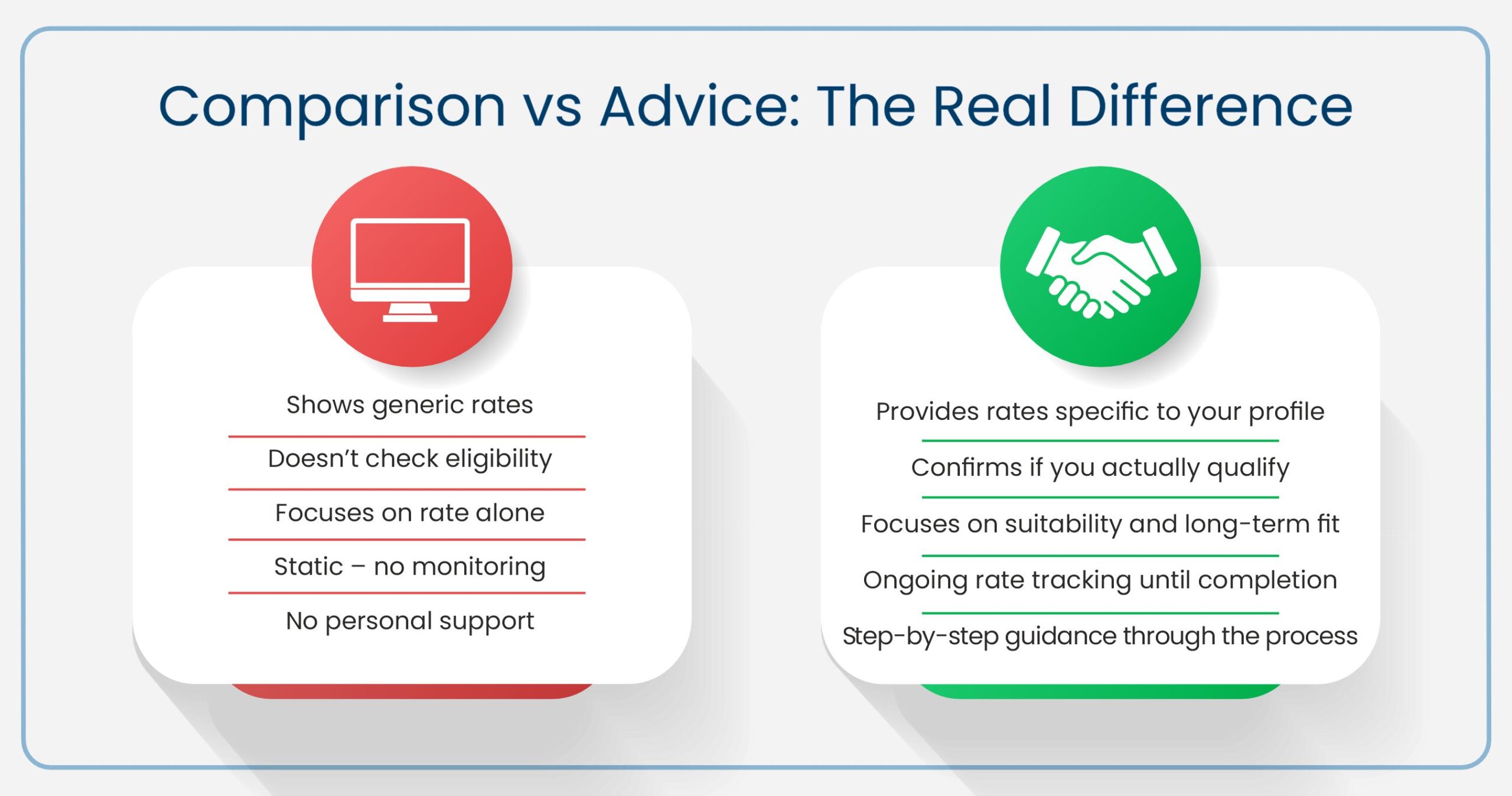
Comparison vs Advice-The Real Difference

While comparison websites provide a quick snapshot of available mortgage rates, they rarely show the full picture. Personal advice goes several steps further — checking eligibility, assessing suitability, and guiding you through the entire process until completion. The difference isn’t just in the rate, but in the reliability and responsibility behind it.

A Balanced Perspective

There’s nothing wrong with browsing comparison websites — they can be a useful way to familiarise yourself with the market and get a sense of the available options.
However, it’s important to remember that what appears online is a general snapshot, not a tailored recommendation.

When you work with an experienced, independent mortgage adviser, the focus is not just on the rate itself but on eligibility, suitability, timing, and long-term implications.The process involves careful assessment, documentation, and monitoring — ensuring that the final mortgage solution genuinely fits your individual circumstances and future plans.

Good decisions rely on clarity and context, not on headline rates alone.

Picture of About the Author

About the Author

Sekkappan Alagu is the Founder of Nachu Finance Ltd, established in 2006. With an early career in journalism and publishing, he brings clarity and structured thinking to complex financial topics. Through the Nachu Finance Blog and Knowledge Hub, he shares insights drawn from nearly two decades of client advisory experience, helping readers make informed decisions and understand best practices in mortgages, protection and long-term financial planning.

Picture of Business Profile

Business Profile

Nachu Finance Ltd is a directly authorised FCA-regulated firm providing mortgage, insurance and estate planning advice to clients across the UK. The firm takes a holistic approach — considering protection, tax efficiency and long-term planning alongside property finance — maintaining high regulatory standards while keeping advice clear and easy to follow. To learn more about the firm's background and story, visit the About Nachu Finance page.
The First-Time Buyer’s Mortgage Journey: A Complete, Practical Guide

Mortgage Process - Main Image
Who this is for

If you are buying your first home and want a clear, end-to-end view of what happens, in what order, and why — this guide is for you.

How to read this

This explains the ideal, logical sequence from first thought to mortgage offer and completion support.
In real life, you might join mid-way, skip a step, or loop back — that’s perfectly normal.
Use the anchor links and checklists to dip into the parts you need most.

Before You Start: What “Good Process” Looks Like
  • A clear picture of how much you can borrow, how much deposit you need, and what the total monthly cost could be.
  • An Agreement in Principle ready to show estate agents so your viewing and offer carry weight.
  • A researched product and term only once a property is agreed, not before.
  • A thorough application-prepping stage so there are fewer surprises later.
  • Prompt responses to lender queries and valuation logistics handled early.
  • A final mortgage offer that matches your illustration, checked for errors.
  • Ongoing rate watch right up to exchange if the lender reduces rates.

Scenario Assessment and Game Plan
Goal:
To answer four key questions with confidence:
  • What is the maximum loan available to you?
  • What deposit is needed and where will it come from?
  • What one-off costs are likely at the start?
  • What will your monthly payments look like under realistic options?

What we capture from you:

  • Employment and income details (including bonuses, overtime, or commissions).
  • If self-employed or a company director — profits, salary, dividends, latest accounts, or SA returns.
  • Credit commitments such as loans, cards, car finance, or student loans.
  • Family situation and foreseeable changes affecting affordability.
  • Deposit source and evidence.
  • Property preferences such as freehold or leasehold, service charges, ground rent, or new-build details.

Our unique approach

We prepare a personalised, dynamic spreadsheet that models:

  • Different property prices and deposits.
  • The impact of term or rate changes.
  • How your affordability and payments shift with each scenario.

This prevents wasted viewings and helps you and your family align on a realistic plan before falling in love with a property outside budget.

Outputs you receive:

  • A clear headline range for purchase price and loan.
  • Estimated upfront costs.
  • Indicative monthly payments under a few realistic setups.
  • A summary of the best-case pathway, subject to standard checks.

Mortgage Journey

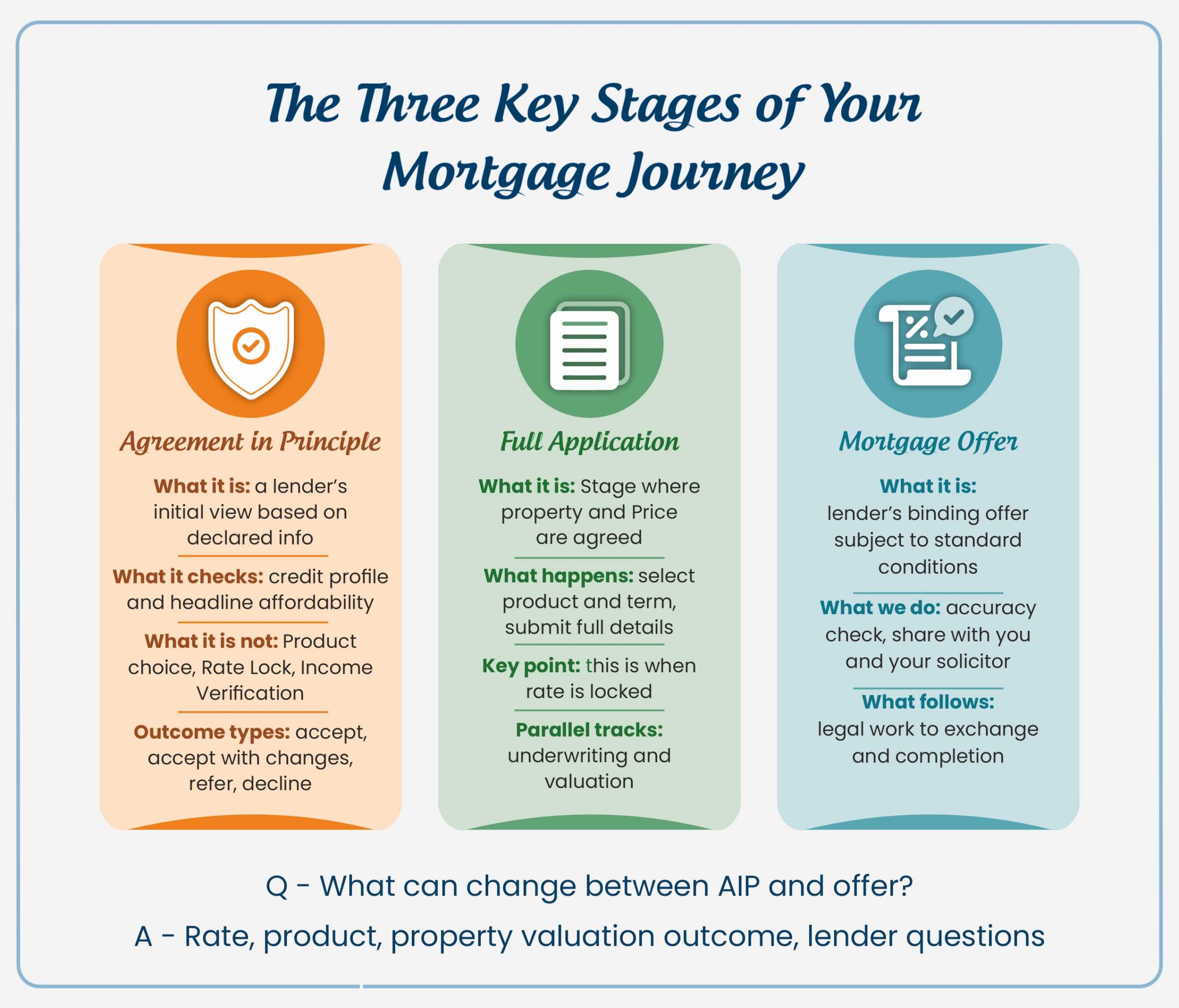
Agreement in Principle: Confidence for Viewings and Offers
What it is:

A lender’s non-binding confirmation that, based on declared information, your credit profile and circumstances appear acceptable for borrowing up to a stated limit and deposit.

What it is not:

  • Not a product choice or rate lock.
  • Not a full underwrite.
  • Does not require you to evidence income or deposit to the lender at that stage.

Possible outcomes:

  • Accepted for the requested loan and deposit.
  • Accepted but for a lower loan or higher deposit.
  • Referred for manual review.
  • Declined.

Why it matters:

Estate agents often ask for an AIP before viewings or when you make an offer. It demonstrates you’re financially prepared and serious about buying.

Tip:

We usually obtain the AIP at the most conservative deposit level you’re comfortable with. If you later choose to put in a larger deposit, that’s an easy adjustment.

Full Application: Only After Your Offer Is Accepted
When to choose products:

Only after the property and price are agreed. Before that, we show you ranges and examples — not specific products.
Once an offer is accepted, we refresh your spreadsheet and review:

  • Product style (fixed, tracker, discount).
  • Fixed period (two or five years, and whether flexibility is important).
  • Term, affordability, and how it affects long-term cost.
  • Fees and whether adding or paying upfront makes sense.
  • Leasehold and property-type considerations.

The key document you receive:

A detailed Mortgage Illustration that outlines your rate, fees, term, payments, and deposit.
This forms the foundation of the final mortgage offer, assuming there are no material changes.

The key document you receive

Application-Prepping: The Extra Work That Saves Time Later
We resolve complexity before submission to minimise delays. Expect us to check lender criteria thoroughly and gather complete supporting evidence up-front, including:
  • ID and address verification.
  • Income documents: latest payslips, P60s for the last two years, and employment letter if required; or SA302s (Tax Calculations), Tax Year Overviews, company accounts, and accountant references for business owners.
  • Bank statements and explanations for unusual transactions.
  • Evidence of all credit commitments and deposit source.
  • Property details (lease, ground rent, new build warranty, etc.)

Why this matters:

It reduces back-and-forth, makes underwriting smoother, and surfaces deal-breakers early when there’s still time to adapt.

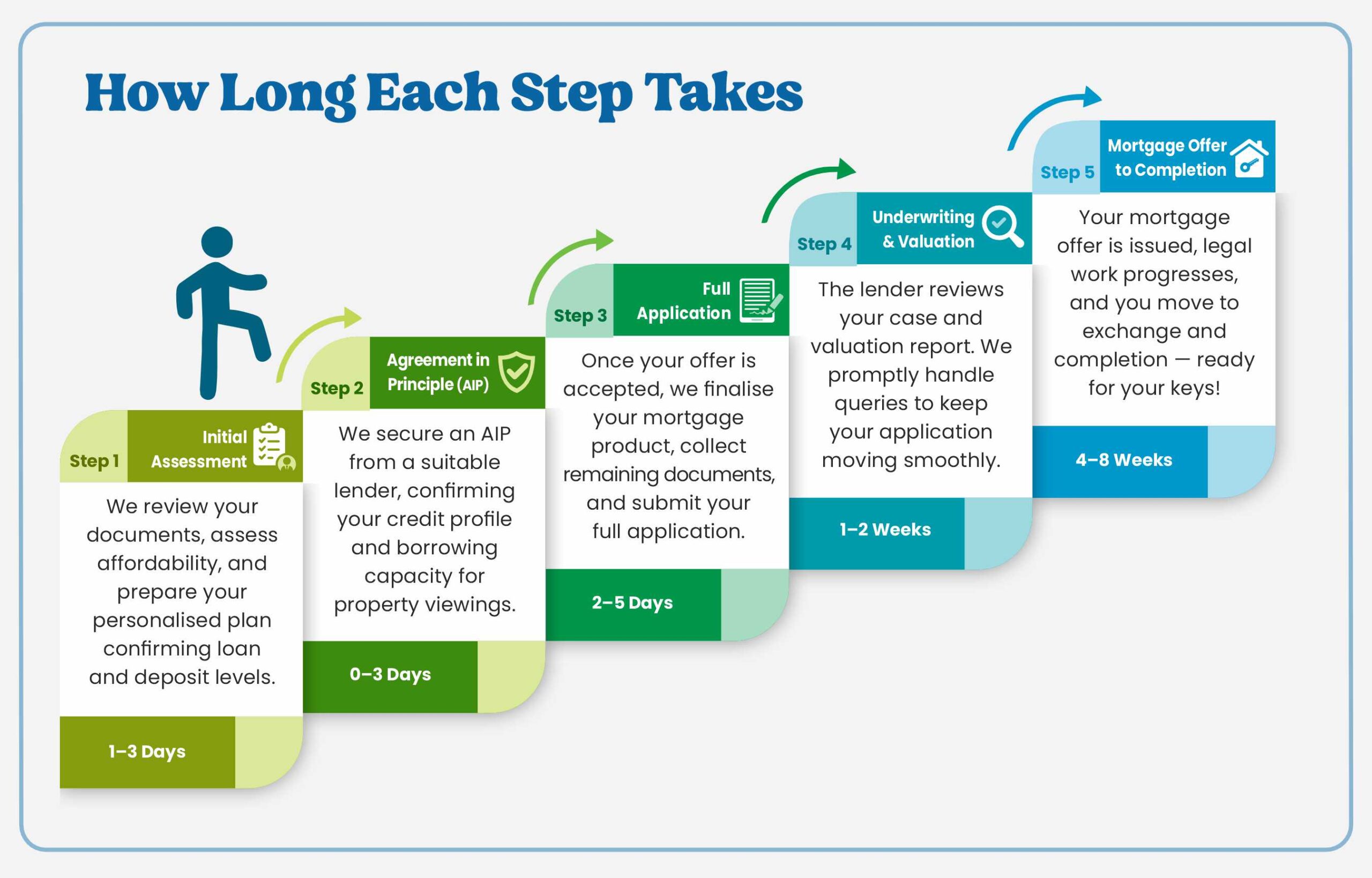
How Long Each Step Takes

After Submission: Underwriting and Valuation
Lenders typically run these in parallel, though some prefer to finish underwriting before instructing a valuation, especially in specific or complex cases.
Underwriting — what to expect:
  • The case manager checks that all documents match the application.
  • Queries are common; some cases complete in a single round, while others require several iterations depending on complexity.
  • The lender focuses on identity, affordability, credit conduct, and how your deposit is sourced and evidenced.

Valuation — types, triggers and outcomes:

At this point, the lender instructs a valuation to confirm that the property is suitable security for the mortgage and that its value matches the agreed price.
You may not always see a valuer in person — sometimes it’s done digitally or from outside the property.

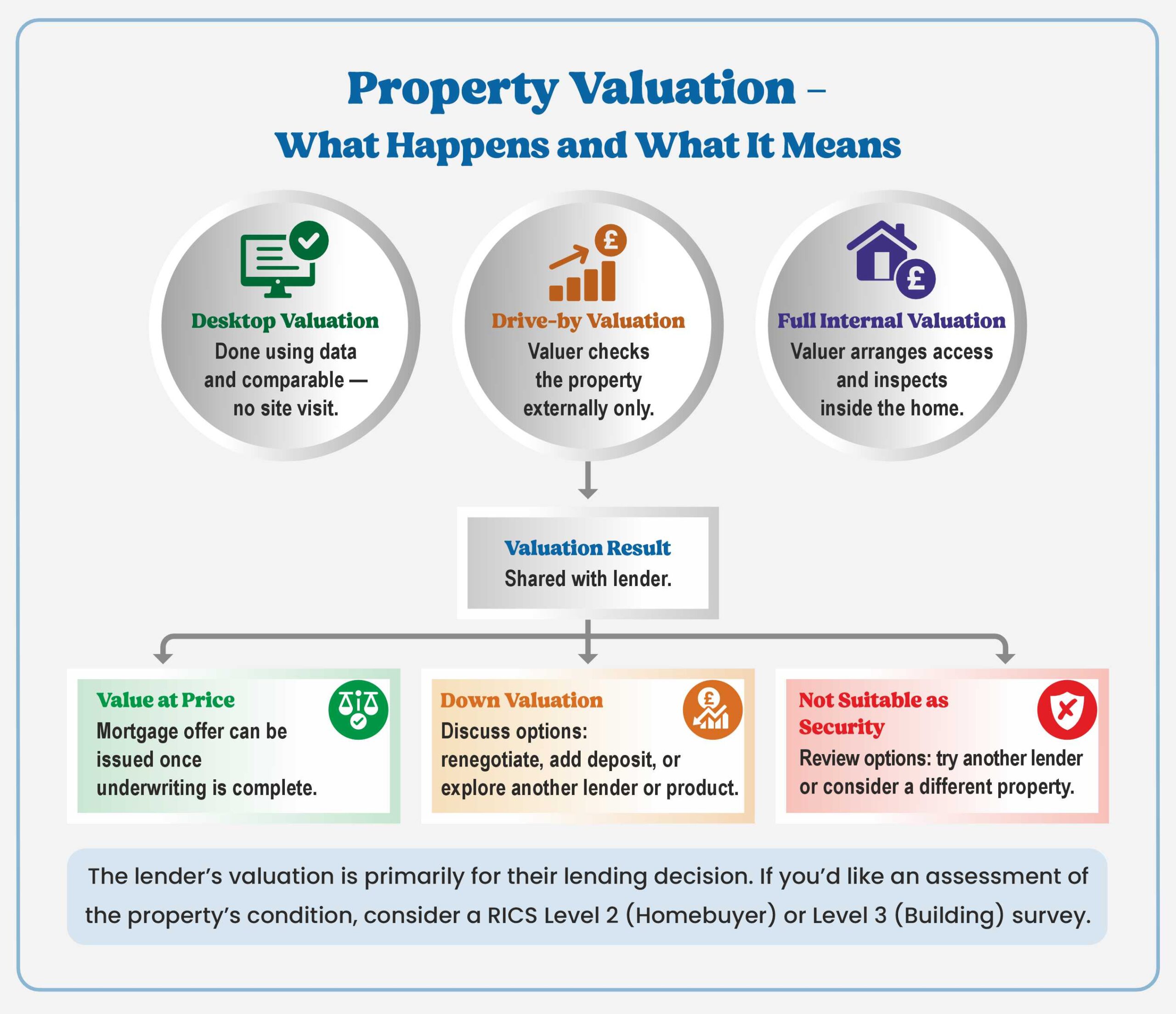
Property Valuation

The infographic above shows the three main valuation methods and the possible outcomes.
Here’s how to read it in context:

  • If the valuation comes back at the agreed price, the process moves smoothly to mortgage offer.
  • If it’s lower than the purchase price (a “down valuation”), we’ll discuss options — renegotiating the price, increasing your deposit, or exploring alternative lenders.
  • If the property is deemed unsuitable as security, this usually points to structural or legal issues. In such cases, we’ll reassess whether another lender or property is more appropriate.

If you’d like to understand the different types of property surveys and when each is recommended — for example, a RICS Level 2 (Homebuyer) or Level 3 (Building) report — read our detailed guide:When to Get a Property Survey

Mortgage Offer: Final Approval Before the Legal Stage
When the lender issues your mortgage offer, we:
  • Review it thoroughly to ensure it matches the illustration and key details.
  • Flag and correct any discrepancies with the lender.
  • Share the confirmed copy with you and your solicitor.
  • Update the estate agent that the offer is in place (without sharing private documents).

From this point, the legal work drives the timeline — searches, enquiries, and exchange.
We remain engaged until completion and monitor for potential rate reductions that may benefit you.

Rate Watch Between Offer and Exchange
If the lender reduces their rate and switching is practical before exchange, we assess whether it’s worthwhile and help you move to the better deal where feasible.

Your Role in Keeping Things Smooth
  • Provide complete documents promptly in the requested format.
  • Keep us updated on any job, income, or deposit changes.
  • Respond quickly to emails or document requests.
  • Facilitate access for surveyors and solicitor ID checks without delay.

What Happens After the Mortgage Offer
Your solicitor now takes the lead — handling searches, enquiries, exchange of contracts, and completion.
We remain available to coordinate lender conditions, monitor rates, and keep all parties aligned.

Frequently Asked Questions

Yes — we’ll need your solicitor’s details before we submit your full mortgage application.
Having a solicitor in place helps avoid delays once the mortgage offer is issued and ensures your legal work can start promptly.
We’re happy to share a quote from one of the solicitors we work closely with for you to consider — entirely without pressure or obligation.

Yes, most lenders are comfortable with gifted deposits as long as there’s a formal letter confirming it’s a genuine gift, not a loan.
We’ll guide you and your family through what’s required so that the paperwork is exactly as lenders expect.

That’s absolutely fine — just let us know as soon as you can.
A change of job can affect how a lender assesses your application, but not always negatively.
We’ll review the new details, check lender criteria, and help you decide the best way forward without losing momentum.

Often yes, if there’s enough time before exchange and if the lender allows product switches.
We’ll assess whether it makes sense financially and, where worthwhile, help you move to the lower rate so you don’t miss out on potential savings.

It depends on the lender. Some carry out a soft search that doesn’t affect your credit score, while others perform a hard check that appears on your file.
We’ll always choose the most suitable route for your circumstances and discuss the implications before proceeding.

Your rate is locked only when we submit your full mortgage application with the chosen lender and product.
That’s why we don’t rush to select a deal too early — we’ll time it carefully so you can secure the best rate available once your property and price are confirmed.

It’s best to avoid taking on any new credit or making unnecessary credit applications until your property has completed.
Lenders may run additional checks before releasing funds, and new borrowing can affect your affordability assessment or credit score.
If something is essential and doesn’t increase your monthly commitments, that’s usually fine — but always check with us first to be sure.

How We Make Your Mortgage Journey Smoother
At Nachu Finance, we’ve supported hundreds of first-time buyers across a range of scenarios.
Here’s how we add value throughout your mortgage journey:
  • Whole-of-market advice: We assess options from across lenders to find what truly fits your circumstances.
  • Dynamic personalised spreadsheet: Unique to Nachu Finance — helping you visualise how deposit, term, or price changes affect costs.
  • Application-prepping approach: We identify and fix potential issues before submission, saving you time later.
  • Transparent communication: You’ll always know where your case stands, what’s possible, and what’s not.
  • Ongoing support: From rate watch to coordination with solicitors, we stay with you right up to key collection.

Explore more on our Mortgage Services  page for detailed insights on first-time buyer, home mover, and specialist mortgage options.

Our Transparency Promise

When Things Don’t Go to Plan

While we’ll do everything possible to make your mortgage journey as straightforward as we can, the truth is that not every application runs exactly to plan.
At times, issues may arise that are outside anyone’s control — whether due to lender processes, valuation outcomes, or solicitor delays.
What we can promise, however, is that we’ll always be in your corner.

We’ll keep you informed, fight your case wherever possible, and work closely with all parties involved to achieve the best possible outcome for you.

Our role is not just to submit your mortgage — it’s to stand by you until your goals are achieved, with transparency, persistence, and care guiding every step.

Ready to Make Your First Home a Reality?

Buying your first home can feel complex — but with Nachu Finance by your side, it doesn’t have to be.
We’ll guide you from that very first calculation through to collecting your keys, ensuring each step is clear, compliant, and stress-free.

Our approach is more than just finding you a mortgage. We help you understand your numbers, prepare your documents, and structure your application so it fits perfectly with your circumstances. You’ll have full visibility at every stage, and confidence that your mortgage is right not only for today but for your long-term plans too.

Contact us today to begin your first-home journey with trusted, whole-of-market advice and genuine personal support.

Picture of About the Author

About the Author

Sekkappan Alagu is the Founder of Nachu Finance Ltd, established in 2006. With an early career in journalism and publishing, he brings clarity and structured thinking to complex financial topics. Through the Nachu Finance Blog and Knowledge Hub, he shares insights drawn from nearly two decades of client advisory experience, helping readers make informed decisions and understand best practices in mortgages, protection and long-term financial planning.

Picture of Business Profile

Business Profile

Nachu Finance Ltd is a directly authorised FCA-regulated firm providing mortgage, insurance and estate planning advice to clients across the UK. The firm takes a holistic approach — considering protection, tax efficiency and long-term planning alongside property finance — maintaining high regulatory standards while keeping advice clear and easy to follow. To learn more about the firm's background and story, visit the About Nachu Finance page.

The Conveyancing Process: An In-Depth Step-by-Step Guide for Homebuyers

The Conveyancing Process: An In-Depth Step by Step Guide For Homebuyers

Buying a home is one of the biggest milestones in life. Once your offer is accepted, the legal work that transfers the property into your name begins. This process is called conveyancing.

Conveyancing can feel complex, but understanding what happens at each stage — and why — makes it easier to manage expectations, avoid delays, and plan your move with confidence.

This guide takes you through the process in detail, from instructing a solicitor through to getting your keys, including what you will need to do, common delays, and how to protect yourself when transferring large sums of money.

 
Starting the Conveyancing Process

Your solicitor can only begin once a few essential steps are complete.

From you

  • Formal instruction: You confirm in writing that you want them to act for you, providing details such as property address, agreed price, and the names of all buyers. Once this is received, the solicitor opens a new file for your transaction.
  • ID checks: Every buyer must complete ID checks. Increasingly, this is done through secure apps rather than just copies of passport and utility bills. If you are receiving a gifted deposit, the donor’s ID is also required.
  • Client questionnaire: This detailed form collects information such as your National Insurance number, employment, buyer status (first-time buyer, home mover, additional properties), property details, bank account details for refunds and balances, and the source of your deposit. Many firms now collect this through an online portal.
  • Money on account: Typically £300 to £500, used to pay for searches and other disbursements on your behalf. This is not an extra fee; it is drawn against actual costs.

From the agent and seller

  • Memorandum of Sale: Provided by the estate agent, this confirms the deal, agreed conditions, and the details of both solicitors. It is the document that connects the buyer’s and seller’s solicitors.
  • Draft contract pack: Sent by the seller’s solicitor to your solicitor. It includes the draft contract, title documents, Property Information Form, Fixtures and Fittings Form, and any relevant leasehold information if the property is not freehold.

Your solicitor can properly begin the conveyancing only once all of the above are in place.

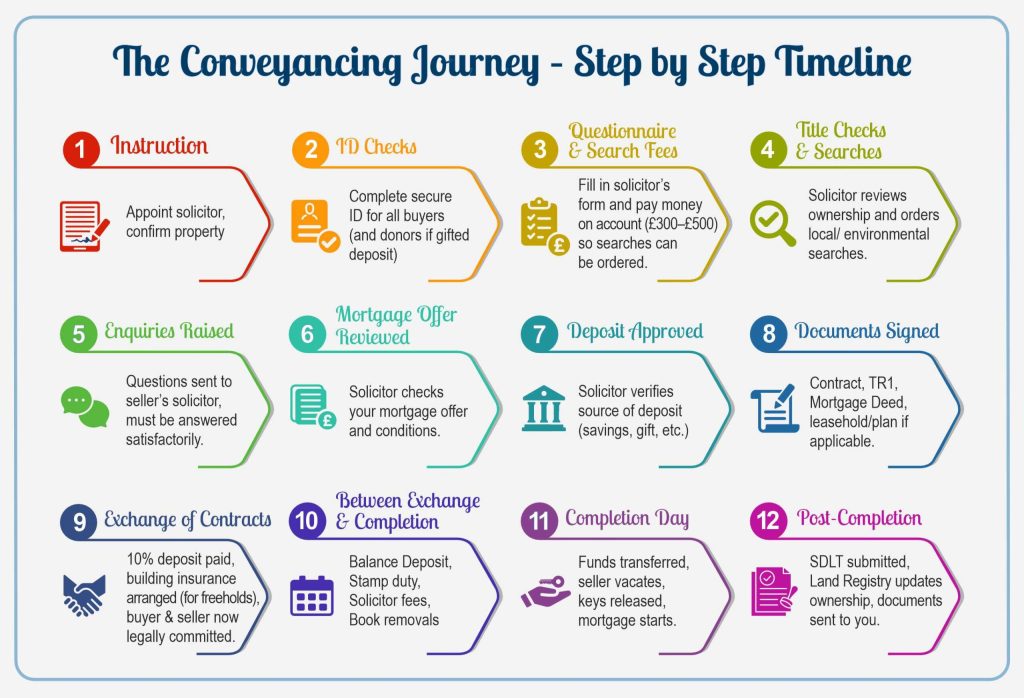
The Conveyancing Journey – Step by Step Timeline

What Happens During Due Diligence

This is the solicitor’s core legal work and is designed to protect both you and your mortgage lender.

  • Title investigation: Your solicitor reviews the property’s legal title, ensuring it matches what you think you are buying and is acceptable to your lender. They check for restrictions, covenants, rights of way, and other issues. You will usually receive a Report on Title summarising the findings.
  • Searches: Local authority, environmental, drainage and water, and other location-specific searches are ordered. These can take one to four weeks to come back and are often the longest single dependency.
  • Enquiries: Based on the title, searches, and the seller’s forms, your solicitor raises queries with the seller’s solicitor. Importantly, it is not enough for replies simply to arrive — they must be satisfactory. If not, further clarification is sought.
  • Mortgage offer: Once your mortgage offer arrives, your solicitor checks it carefully, explains conditions to you, and ensures it fits the property being purchased.
  • Deposit checks: The source of your deposit is verified. Non-standard sources such as gifts or business funds are reported to the lender.

Only once the title is approved, searches are back, enquiries are satisfactorily answered, the mortgage offer is in, and the deposit source is cleared, will your solicitor be ready to recommend exchange.

Extra Steps for Leasehold Properties

Leasehold purchases involve additional checks and often take longer.

  • Management pack: Your solicitor must obtain a pack from the freeholder and management company, covering service charges, ground rent, building insurance, consents, and any planned works. The seller usually pays for this pack
  • Payment status: Confirmation that the seller is up to date with service charges and ground rent is required.
  • Timing: Freeholders and management companies are rarely quick to respond, which explains why leasehold transactions often extend to ten to thirteen weeks.
  • Insurance: For flats, building insurance is usually held for the entire block by the management company, not by individual owners.

Documents You Will Need to Sign
 

Before exchange, your solicitor will send you a set of documents to sign.

  • Contract: Signed by all buyers confirming you agree to the purchase. Usually, this does not need to be witnessed.
  • Transfer (TR1): This Land Registry document transfers ownership from seller to buyer. It must be witnessed by an independent adult. The witness:
    • Cannot be related to you
    • Cannot live at the same address
    • Must be over 18
    • Can witness for both buyers, but must sign against each name separately.
  • Mortgage Deed: Gives your lender a legal charge over the property. Must also be signed and witnessed under the same rules.
  • Leasehold forms and plan acknowledgement: If buying leasehold, you may be asked to sign to confirm your understanding of the property boundaries. Some solicitors also require a signature on the plan documents to confirm you know exactly which property within a development is being purchased.

We can witness signatures in our office if needed.

Your solicitor will also request the deposit for exchange at this point. Usually this is 10 percent of the purchase price, but alternative arrangements can sometimes be agreed.

Exchange of Contracts
Exchange is the legal milestone where buyer and seller are bound to complete.
  • Contracts are normally signed by you in advance and are then formally dated by the solicitors on the day of exchange.
  • The exchange date is often coordinated through the estate agent, who keeps both sides aligned.
  • At exchange, you pay the deposit (usually 10%).

Important:

  • At exchange, you do not get the keys.
  • The seller still occupies the property.
  • You are not yet making mortgage payments.

Exchange is about creating the legal commitment to complete on the agreed date.

Between Exchange and Completion
Once contracts are exchanged and a completion date is fixed, you can confidently plan your move.
  • Book packers and removals.
  • Order furniture, flooring, or appliances.
  • Give notice to your current landlord if renting.

Balance deposit example

If your overall deposit is 25 percent, you will normally pay 10 percent at exchange. The remaining 15 percent is then transferred just before completion, along with Stamp Duty and fees.

New builds

Unlike standard properties, new builds often exchange before the property is fully complete. In these cases, completion depends not only on the property being finished but also on receiving sign-offs from building control and warranty providers. This means the completion date may not be fixed at the point of exchange.

Completion Day
Completion is the day ownership transfers and you receive the keys.
  • Your solicitor will request your mortgage funds from the lender the day before completion.
  • You provide any balance deposit, Stamp Duty Land Tax, and solicitor’s fees.
  • Once the seller’s solicitor confirms receipt of all monies, they authorise the estate agent to release the keys.

When does the seller vacate?

In most cases, the seller vacates the property on completion day, sometimes the day before. Keys are usually available from the estate agent once funds clear.

When do mortgage payments start?

Only after completion. No mortgage interest is charged and no repayments are due before this point.

After Completion
Although the keys are now in your hand, your solicitor still has work to do:
  • Paying any Stamp Duty Land Tax due to HMRC.
  • Registering your ownership at HM Land Registry.
  • Registering your lender’s charge over the property.
  • Sending you final confirmation and updated title documents.

These steps happen in the background after you have moved in.

How Long Does It Take
Timescales vary, but realistic averages are:
  • Freehold homes: three to eight weeks from instruction to exchange.
  • Leasehold homes: ten to thirteen weeks due to management company delays.

A sensible expectation is six to eight weeks for a freehold and ten to thirteen weeks for a leasehold.

Exchange and completion can sometimes happen on the same day if everyone agrees and logistics allow. More commonly, there is a gap of a week or more.

Paying Your Solicitor Safely
Safe Payments to Your Solicitor
 

Large sums are transferred during conveyancing, which unfortunately attracts fraud attempts. Always follow best practice:

  • Verify bank details securely: Solicitors do not change bank details mid-transaction. Treat any message claiming otherwise as suspicious and phone the firm using a verified number.
  • Use telegraphic transfer: Online banking often has daily limits. Telegraphic transfers carry a fee but are faster and safer for large amounts.
  • Funds must come from your account: Solicitors will only accept funds from the buyer’s own account.
    • Gifts from family should be paid into your account first.
    • If using business funds, transfer them to your personal account before sending to your solicitor.

Keep transfers to as few payments as possible and always confirm receipt.

Buyer’s Checklist
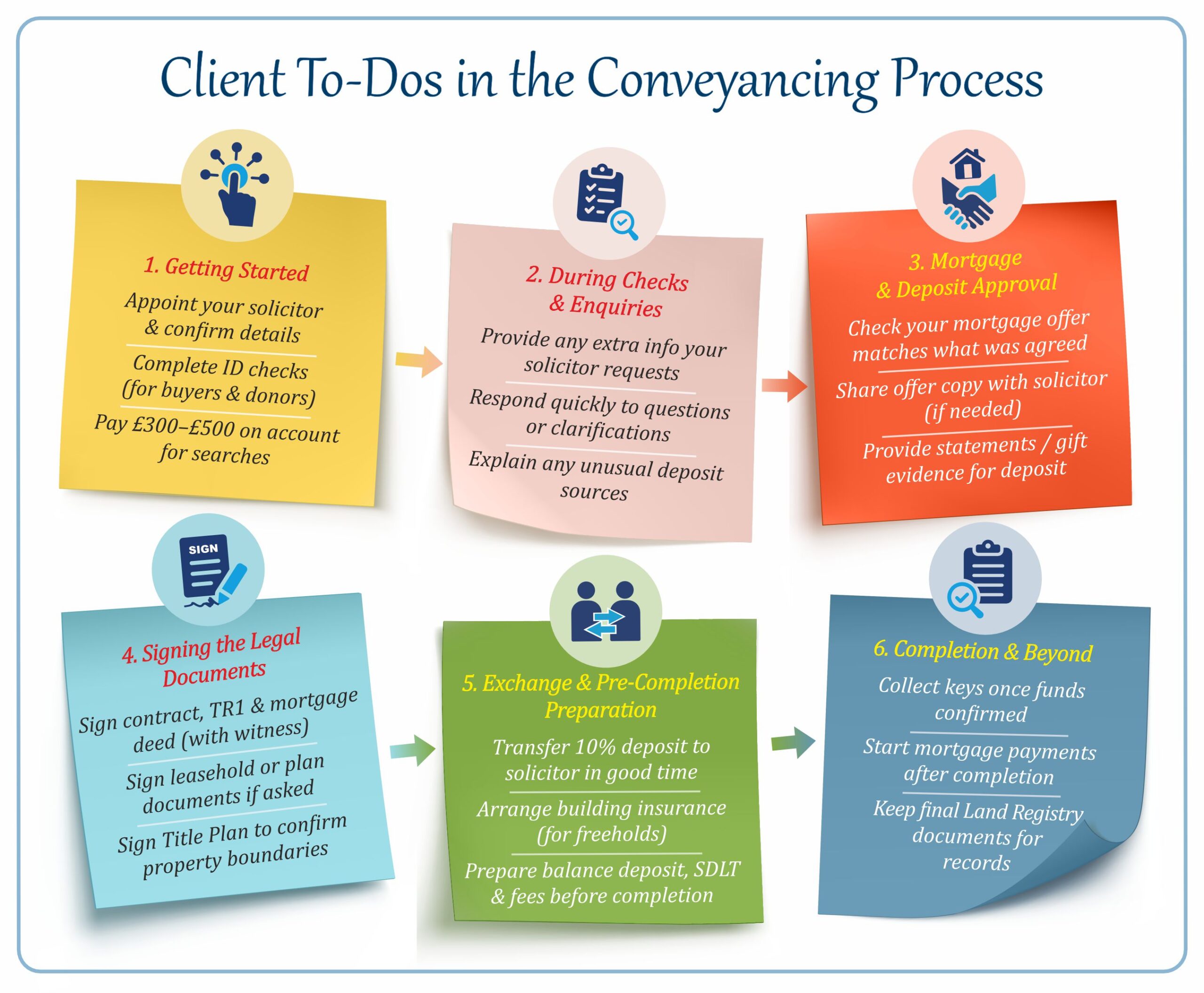
Client To-Dos in the Conveyancing Process
  • Instruct solicitor, provide full details, and complete ID checks.
  • Return the client questionnaire promptly.
  • Pay money on account to enable searches.
  • Gather deposit evidence (including gift paperwork).
  • Look out for document packs to sign and arrange a proper witness.
  • Be ready to pay the 10 percent deposit at exchange.
  • Plan for the balance deposit, SDLT, and fees at completion.
  • Coordinate exchange and completion dates through your estate agent.
  • Verify solicitor bank details and plan how you’ll transfer funds.
  • Book removals once the completion date is fixed.

Frequently Asked Questions

No. You sign the contract earlier. On the day of exchange, solicitors date and formally exchange contracts.

After completion. No interest or repayments are due before then.

Yes, if all parties agree, though it’s less common where there is a chain.

Because your solicitor must obtain and check information from freeholders and management companies, who often take time to respond.

An independent adult over 18, not related to you and not living at your address. Friends, colleagues, or neighbours are ideal.

Our Transparency Promise

The Process Is Less Than Desirable

Buying a property in England involves one of the lengthiest legal processes in the world — and unfortunately, it’s widely recognised that the current system is not fit for purpose. Even the Government has acknowledged that the numerous steps, layers of checks, and dependency on multiple parties can lead to severe delays. These delays affect not only home movers but also the wider economy.

Given this complex and long-drawn process, it’s also fair to acknowledge that solicitors are often managing a large number of cases at the same time. As a result, they may not always be as responsive as you might hope. This is not necessarily a reflection of a lack of effort or interest, but rather the reality of their workload and the volume of communication involved in property transactions. Expect some delays in reaching them or hearing back, and try to plan around this to avoid unnecessary frustration.

For now, this is the system we must all work within. Until improvements are made, the best approach as a buyer is to prepare yourself for a process that can take time and make sure you do everything within your control promptly and accurately.

While it can feel like a long journey, the end result is absolutely worth it — that unforgettable day when you finally complete and collect the keys to your new home. We believe that being mentally prepared, well-informed, and fully supported makes all the difference in turning this complex process into a smoother and more satisfying experience.

How Nachu Finance Can Help During the Conveyancing Process

At Nachu Finance, we don’t stop once your mortgage offer is in place — we stay actively involved while the legal work happens.

When you instruct solicitors we work with regularly, the process often feels smoother because we already have established communication and trust. Our role includes:

  • Coordinating and following up with the solicitors to keep your case moving.
  • Sharing key documents and information you’ve already provided to us, so you don’t have to repeat yourself.
  • Chasing updates and clarifying progress, then keeping you informed in plain language.
  • Helping with forms and signatures, including acting as a witness where appropriate for certain documents.
  • Offering reassurance and explanations — helping you understand what’s happening and why each step matters.

We’ll be honest — liaising with solicitors and managing timelines is one of the more time-consuming parts of what we do, but it’s also one of the most satisfying. Buying a home is a major milestone, and we take pride in being alongside you throughout this important, and sometimes daunting, journey.

Picture of About the Author

About the Author

Sekkappan Alagu is the Founder of Nachu Finance Ltd, established in 2006. With an early career in journalism and publishing, he brings clarity and structured thinking to complex financial topics. Through the Nachu Finance Blog and Knowledge Hub, he shares insights drawn from nearly two decades of client advisory experience, helping readers make informed decisions and understand best practices in mortgages, protection and long-term financial planning.

Picture of Business Profile

Business Profile

Nachu Finance Ltd is a directly authorised FCA-regulated firm providing mortgage, insurance and estate planning advice to clients across the UK. The firm takes a holistic approach — considering protection, tax efficiency and long-term planning alongside property finance — maintaining high regulatory standards while keeping advice clear and easy to follow. To learn more about the firm's background and story, visit the About Nachu Finance page.

When and Why to Get a Property Survey – Beyond the Mortgage Valuation

Know the Real Condition of your future home

Would you spend £500 to avoid a £10,000 mistake?


That’s the kind of risk property surveys are designed to manage. While a mortgage valuation checks if a home is suitable for lending, a survey digs deeper into the property itself — helping buyers make confident, informed decisions.

This article explains the difference between a mortgage valuation and an independent survey, outlines the options available, and explores when it makes most sense to get one. We also look at how surveys can affect real purchase decisions, including two case studies from our clients.
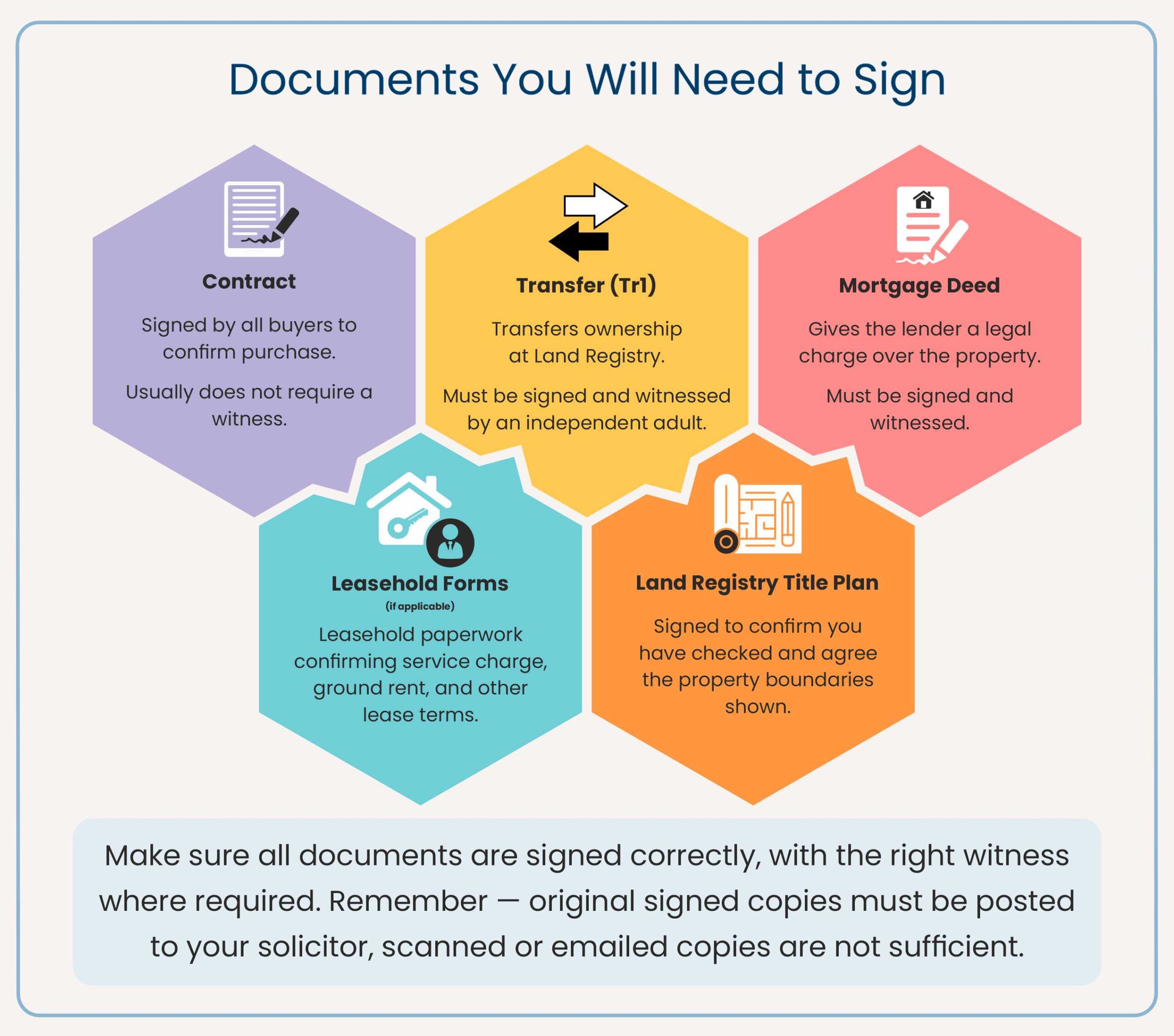
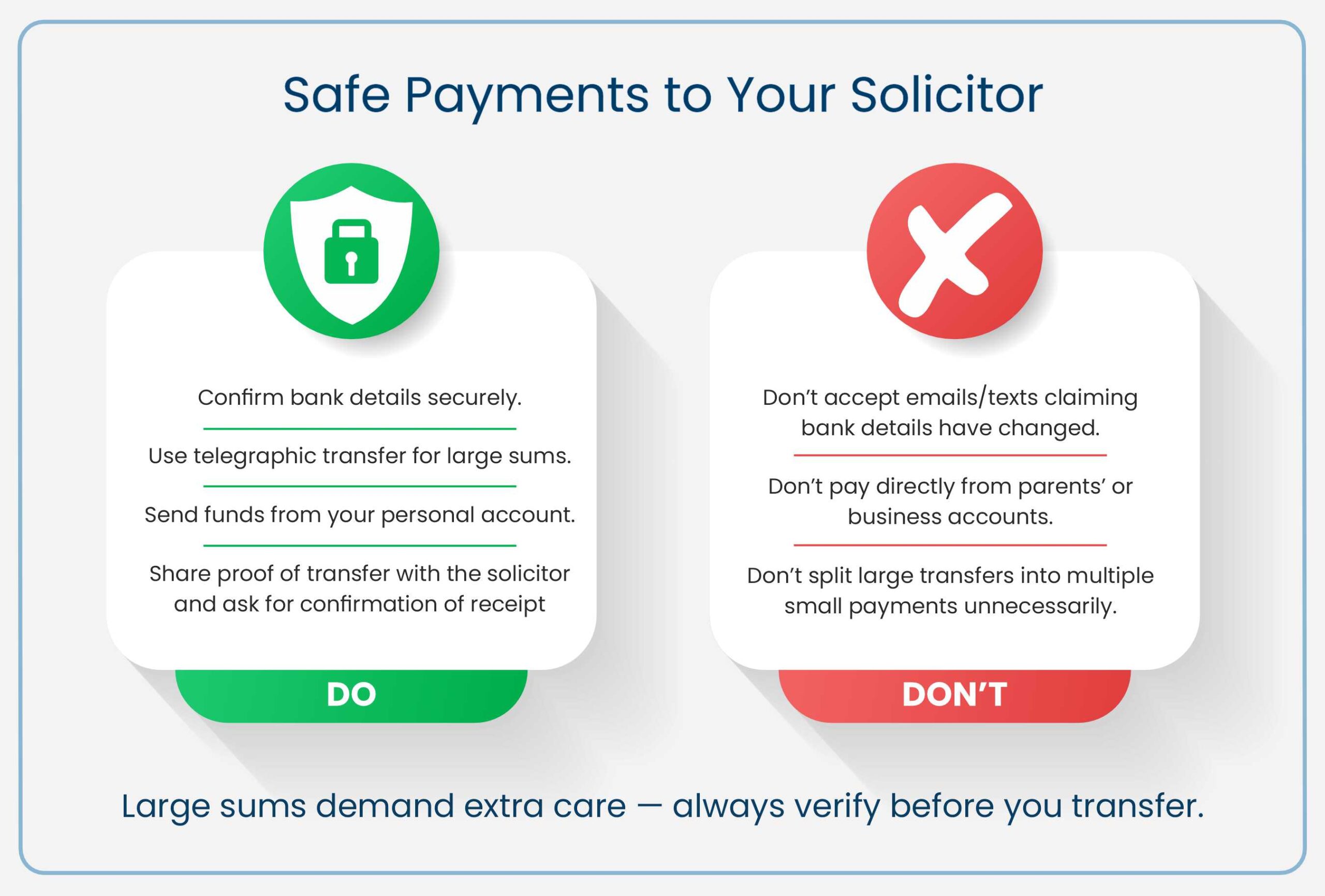
Continue reading

Tax Year Overview: What It Is, Why It Matters for Your Mortgage, and How to Download It

Tax year overview UK for mortgage applications – ensuring tax documents and SA302 are accurate for lender affordability checks.

When applying for a mortgage, especially as a self-employed individual or landlord, one document that often causes confusion is the Tax Year Overview (TYO). Many clients aren’t aware of what this document is, how it differs from the tax calculation, or how to download it correctly from the HMRC website.

Let’s clear up the confusion and walk you through what a Tax Year Overview is, when it’s required, and how to avoid common mistakes when submitting it.

Continue reading

Transfer of Equity: Mortgage Implications, Costs, Tax & Legal Process Explained

Add or remove a name from property ownership illustration with family under house – property title change and joint ownership guidance.

Transfer of Equity (TofE)is the legal process of changing the ownership of a property by adding or removing names from the title. Unlike a sale and purchase transaction, at least one of the existing owners continues to remain on the title. While the actual legal work is carried out by a solicitor, mortgage advisers like us often get involved—because the names on the mortgage must reflect the updated ownership. This article explores the key aspects of a Transfer of Equity and when it might be relevant.

Continue reading