
House-shaped keyring hanging from a front door lock beside the text: Your step-by-step guide to the conveyancing process

Testmonials

Enquiry Form

Get in Touch with Us for Personalized Finance Assistance

Please enable JavaScript in your browser to complete this form.
=

The Conveyancing Process: An In-Depth Step-by-Step Guide For Homebuyers

House-shaped keyring hanging from a front door lock beside the text: Your step-by-step guide to the conveyancing process

Buying a home is one of the biggest milestones in life. Once your offer is accepted, the legal work that transfers the property into your name begins. This process is called conveyancing.

Conveyancing can feel complex, but understanding what happens at each stage — and why — makes it easier to manage expectations, avoid delays, and plan your move with confidence.

This guide takes you through the process in detail, from instructing a solicitor through to getting your keys, including what you will need to do, common delays, and how to protect yourself when transferring large sums of money.

Starting the Conveyancing Process

Your solicitor can only begin once a few essential steps are complete.

From you

  • Formal instruction: You confirm in writing that you want them to act for you, providing details such as property address, agreed price, and the names of all buyers. Once this is received, the solicitor opens a new file for your transaction.
  • ID checks: Every buyer must complete ID checks. Increasingly, this is done through secure apps rather than just copies of passport and utility bills. If you are receiving a gifted deposit, the donor’s ID is also required.
  • Client questionnaire: This detailed form collects information such as your National Insurance number, employment, buyer status (first-time buyer, home mover, additional properties), property details, bank account details for refunds and balances, and the source of your deposit. Many firms now collect this through an online portal.
  • Money on account: Typically £300 to £500, used to pay for searches and other disbursements on your behalf. This is not an extra fee; it is drawn against actual costs.

From the agent and seller

  • Memorandum of Sale: Provided by the estate agent, this confirms the deal, agreed conditions, and the details of both solicitors. It is the document that connects the buyer’s and seller’s solicitors.
  • Draft contract pack: Sent by the seller’s solicitor to your solicitor. It includes the draft contract, title documents, Property Information Form, Fixtures and Fittings Form, and any relevant leasehold information if the property is not freehold.

Your solicitor can properly begin the conveyancing only once all of the above are in place.
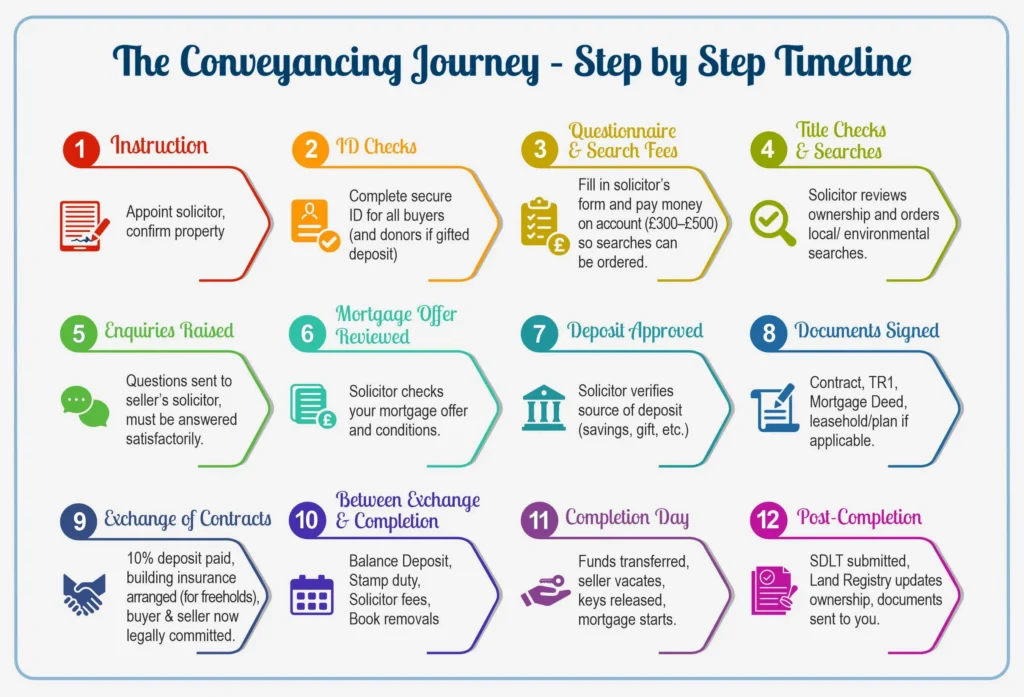
Infographic showing the 12 steps of the conveyancing process, from instruction and ID checks to exchange, completion day and post-completion

What Happens During Due Diligence

This is the solicitor’s core legal work and is designed to protect both you and your mortgage lender.

  • Title investigation: Your solicitor reviews the property’s legal title, ensuring it matches what you think you are buying and is acceptable to your lender. They check for restrictions, covenants, rights of way, and other issues. You will usually receive a Report on Title summarising the findings.
  • Searches: Local authority, environmental, drainage and water, and other location-specific searches are ordered. These can take one to four weeks to come back and are often the longest single dependency.
  • Enquiries: Based on the title, searches, and the seller’s forms, your solicitor raises queries with the seller’s solicitor. Importantly, it is not enough for replies simply to arrive — they must be satisfactory. If not, further clarification is sought.
  • Mortgage offer: Once your mortgage offer arrives, your solicitor checks it carefully, explains conditions to you, and ensures it fits the property being purchased.
  • Deposit checks: The source of your deposit is verified. Non-standard sources such as gifts or business funds are reported to the lender.

Only once the title is approved, searches are back, enquiries are satisfactorily answered, the mortgage offer is in, and the deposit source is cleared, will your solicitor be ready to recommend exchange.


Extra Steps for Leasehold Properties

Leasehold purchases involve additional checks and often take longer.

  • Management pack: Your solicitor must obtain a pack from the freeholder and management company, covering service charges, ground rent, building insurance, consents, and any planned works. The seller usually pays for this pack.
  • Payment status: Confirmation that the seller is up to date with service charges and ground rent is required.
  • Timing: Freeholders and management companies are rarely quick to respond, which explains why leasehold transactions often extend to ten to thirteen weeks.
  • Insurance: For flats, building insurance is usually held for the entire block by the management company, not by individual owners.

Documents You Will Need to Sign
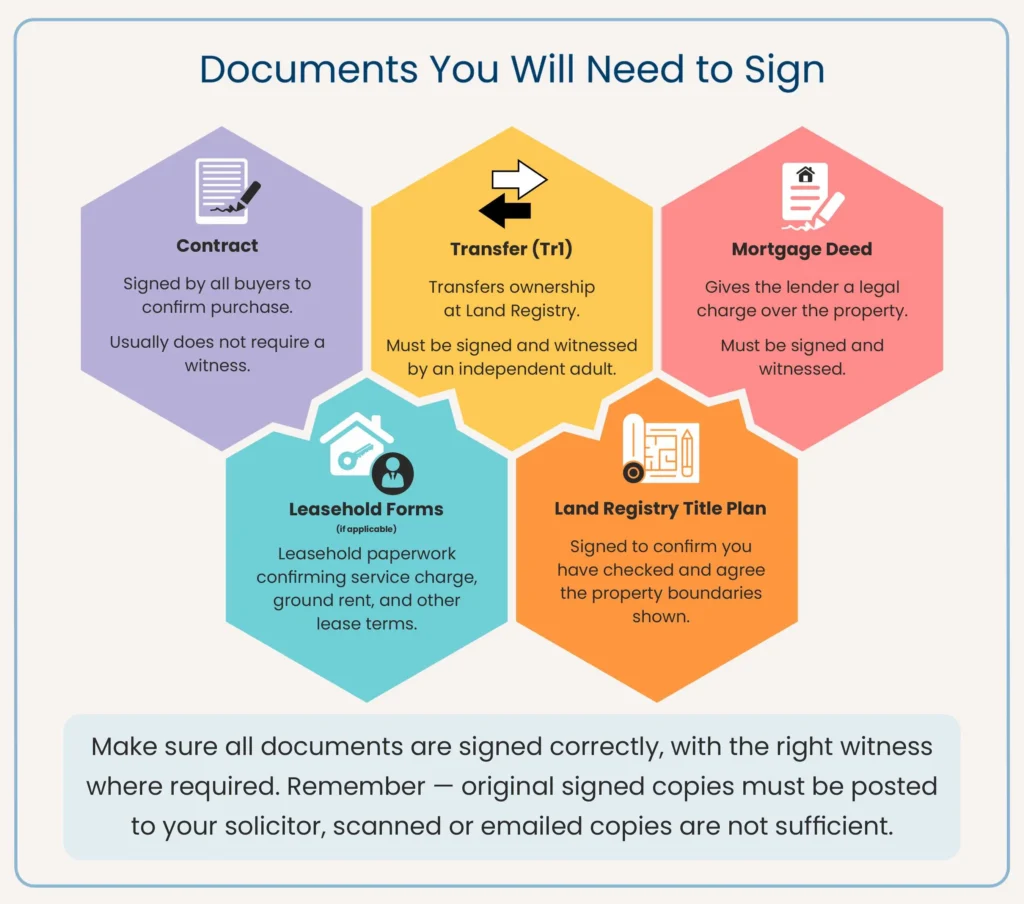
Infographic of the documents a buyer signs during conveyancing: contract, TR1 transfer, mortgage deed, leasehold forms and title plan

Before exchange, your solicitor will send you a set of documents to sign.

  • Contract: Signed by all buyers confirming you agree to the purchase. Usually, this does not need to be witnessed.
  • Transfer (TR1): This Land Registry document transfers ownership from seller to buyer. It must be witnessed by an independent adult. The witness:
    • Cannot be related to you
    • Cannot live at the same address
    • Must be over 18
    • Can witness for both buyers, but must sign against each name separately.
  • Mortgage Deed: Gives your lender a legal charge over the property. Must also be signed and witnessed under the same rules.
  • Leasehold forms and plan acknowledgement: If buying leasehold, you may be asked to sign to confirm your understanding of the property boundaries. Some solicitors also require a signature on the plan documents to confirm you know exactly which property within a development is being purchased.

We can witness signatures in our office if needed.

Your solicitor will also request the deposit for exchange at this point. Usually this is 10 percent of the purchase price, but alternative arrangements can sometimes be agreed.

Exchange of Contracts

Exchange is the legal milestone where buyer and seller are bound to complete.

  • Contracts are normally signed by you in advance and are then formally dated by the solicitors on the day of exchange.
  • The exchange date is often coordinated through the estate agent, who keeps both sides aligned.
  • At exchange, you pay the deposit (usually 10%).

Important:

  • At exchange, you do not get the keys.
  • The seller still occupies the property.
  • You are not yet making mortgage payments.

Exchange is about creating the legal commitment to complete on the agreed date.

Between Exchange and Completion

Once contracts are exchanged and a completion date is fixed, you can confidently plan your move.

  • Book packers and removals.
  • Order furniture, flooring, or appliances.
  • Give notice to your current landlord if renting.

Balance deposit example
If your overall deposit is 25 percent, you will normally pay 10 percent at exchange. The remaining 15 percent is then transferred just before completion, along with Stamp Duty and fees.

New builds
Unlike standard properties, new builds often exchange before the property is fully complete. In these cases, completion depends not only on the property being finished but also on receiving sign-offs from building control and warranty providers. This means the completion date may not be fixed at the point of exchange.

Completion Day

Completion is the day ownership transfers and you receive the keys.

  • Your solicitor will request your mortgage funds from the lender the day before completion.
  • You provide any balance deposit, Stamp Duty Land Tax, and solicitor’s fees.
  • Once the seller’s solicitor confirms receipt of all monies, they authorise the estate agent to release the keys.

When does the seller vacate?
In most cases, the seller vacates the property on completion day, sometimes the day before. Keys are usually available from the estate agent once funds clear.

When do mortgage payments start?
Only after completion. No mortgage interest is charged and no repayments are due before this point.

After Completion

Although the keys are now in your hand, your solicitor still has work to do:

  • Paying any Stamp Duty Land Tax due to HMRC.
  • Registering your ownership at HM Land Registry.
  • Registering your lender’s charge over the property.
  • Sending you final confirmation and updated title documents.

These steps happen in the background after you have moved in.

How Long Does It Take

Timescales vary, but realistic averages are:

  • Freehold homes: three to eight weeks from instruction to exchange.
  • Leasehold homes: ten to thirteen weeks due to management company delays.

A sensible expectation is six to eight weeks for a freehold and ten to thirteen weeks for a leasehold.

Exchange and completion can sometimes happen on the same day if everyone agrees and logistics allow. More commonly, there is a gap of a week or more.

Paying Your Solicitor Safely
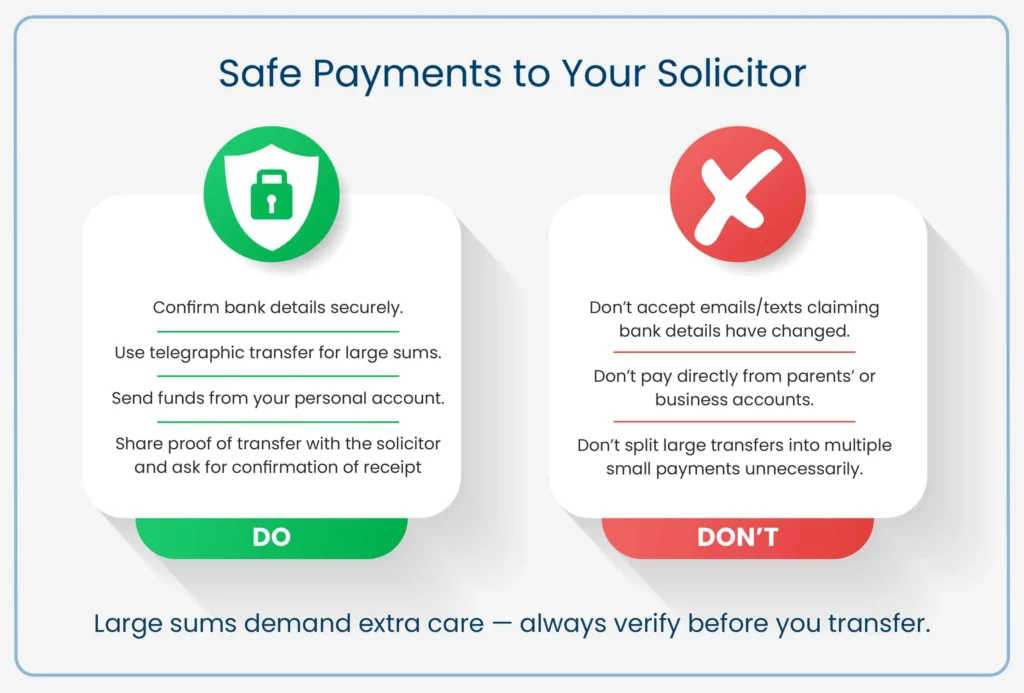
Large sums are transferred during conveyancing, which unfortunately attracts fraud attempts. Always follow best practice:

  • Verify bank details securely: Solicitors do not change bank details mid-transaction. Treat any message claiming otherwise as suspicious and phone the firm using a verified number.
  • Use telegraphic transfer: Online banking often has daily limits. Telegraphic transfers carry a fee but are faster and safer for large amounts.
  • Funds must come from your account: Solicitors will only accept funds from the buyer’s own account.
    • Gifts from family should be paid into your account first.
    • If using business funds, transfer them to your personal account before sending to your solicitor.

Keep transfers to as few payments as possible and always confirm receipt.

Buyer’s Checklist
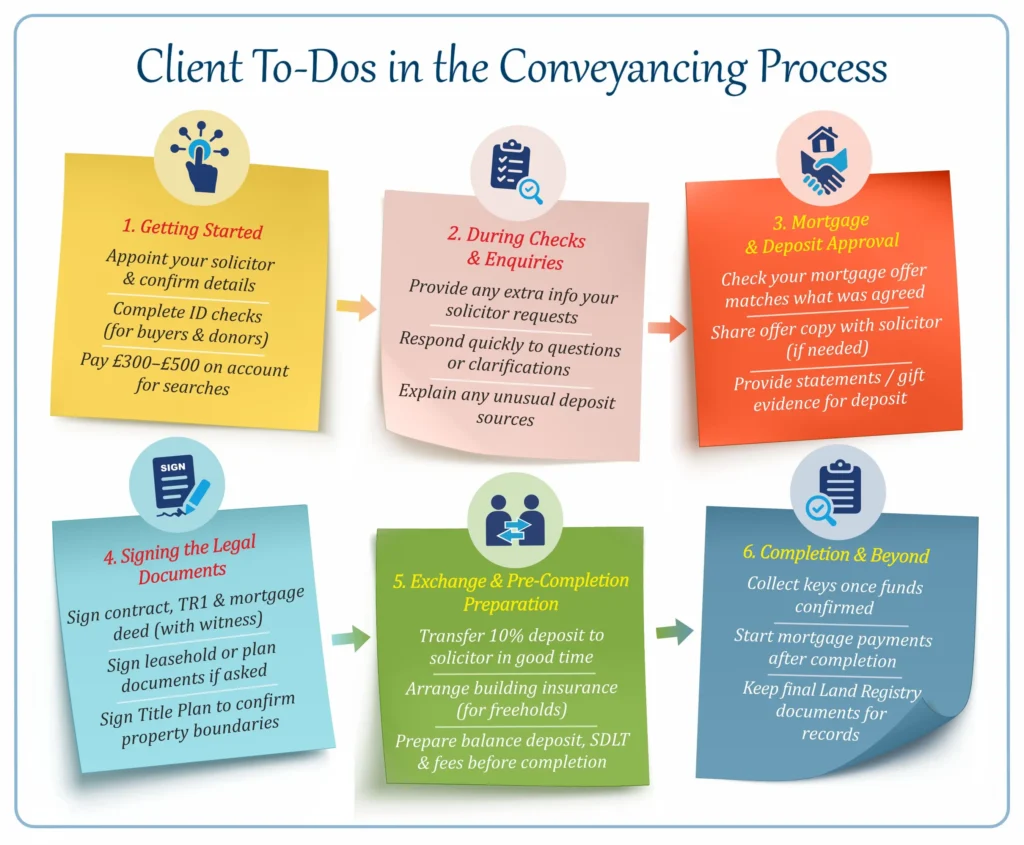
Infographic of six buyer to-do stages in conveyancing, from getting started to completion and beyond
  • Instruct solicitor, provide full details, and complete ID checks.
  • Return the client questionnaire promptly.
  • Pay money on account to enable searches.
  • Gather deposit evidence (including gift paperwork).
  • Look out for document packs to sign and arrange a proper witness.
  • Be ready to pay the 10 percent deposit at exchange.
  • Plan for the balance deposit, SDLT, and fees at completion.
  • Coordinate exchange and completion dates through your estate agent.
  • Verify solicitor bank details and plan how you’ll transfer funds.
  • Book removals once the completion date is fixed.

Frequently Asked Questions

No. You sign the contract earlier. On the day of exchange, solicitors date and formally exchange contracts.

After completion. No interest or repayments are due before then.

Yes, if all parties agree, though it’s less common where there is a chain.

Because your solicitor must obtain and check information from freeholders and management companies, who often take time to respond.

An independent adult over 18, not related to you and not living at your address. Friends, colleagues, or neighbours are ideal.

Our Transparency Promise

The Process Is Less Than Desirable

Buying a property in England involves one of the lengthiest legal processes in the world — and unfortunately, it’s widely recognised that the current system is not fit for purpose. Even the Government has acknowledged that the numerous steps, layers of checks, and dependency on multiple parties can lead to severe delays. These delays affect not only home movers but also the wider economy.

Given this complex and long-drawn process, it’s also fair to acknowledge that solicitors are often managing a large number of cases at the same time. As a result, they may not always be as responsive as you might hope. This is not necessarily a reflection of a lack of effort or interest, but rather the reality of their workload and the volume of communication involved in property transactions. Expect some delays in reaching them or hearing back, and try to plan around this to avoid unnecessary frustration.

For now, this is the system we must all work within. Until improvements are made, the best approach as a buyer is to prepare yourself for a process that can take time and make sure you do everything within your control promptly and accurately.

While it can feel like a long journey, the end result is absolutely worth it — that unforgettable day when you finally complete and collect the keys to your new home. We believe that being mentally prepared, well-informed, and fully supported makes all the difference in turning this complex process into a smoother and more satisfying experience.

How Nachu Finance Can Help During the Conveyancing Process

At Nachu Finance, we don’t stop once your mortgage offer is in place — we stay actively involved while the legal work happens.

When you instruct solicitors we work with regularly, the process often feels smoother because we already have established communication and trust. Our role includes:

  • Coordinating and following up with the solicitors to keep your case moving.
  • Sharing key documents and information you’ve already provided to us, so you don’t have to repeat yourself.
  • Chasing updates and clarifying progress, then keeping you informed in plain language.
  • Helping with forms and signatures, including acting as a witness where appropriate for certain documents.
  • Offering reassurance and explanations — helping you understand what’s happening and why each step matters.

We’ll be honest — liaising with solicitors and managing timelines is one of the more time-consuming parts of what we do, but it’s also one of the most satisfying. Buying a home is a major milestone, and we take pride in being alongside you throughout this important, and sometimes daunting, journey.

Picture of About the Author

About the Author

Sekkappan Alagu is the Founder of Nachu Finance Ltd, established in 2006. With an early career in journalism and publishing, he brings clarity and structured thinking to complex financial topics. Through the Nachu Finance Blog and Knowledge Hub, he shares insights drawn from nearly two decades of client advisory experience, helping readers make informed decisions and understand best practices in mortgages, protection and long-term financial planning.

Picture of Business Profile

Business Profile

Nachu Finance Ltd is a directly authorised FCA-regulated firm providing mortgage, insurance and estate planning advice to clients across the UK. The firm takes a holistic approach — considering protection, tax efficiency and long-term planning alongside property finance — maintaining high regulatory standards while keeping advice clear and easy to follow. To learn more about the firm's background and story, visit the About Nachu Finance page.

Next Steps in Your Home-Buying Journey

Chalk drawing of a family under a house roof with a plus icon on one side and a minus icon on the other

Testmonials

Enquiry Form

Get in Touch with Us for Personalized Finance Assistance

Please enable JavaScript in your browser to complete this form.
=

Transfer of Equity: Mortgage Implications, Costs, Tax & Legal Process Explained

Chalk drawing of a family under a house roof with a plus icon on one side and a minus icon on the other

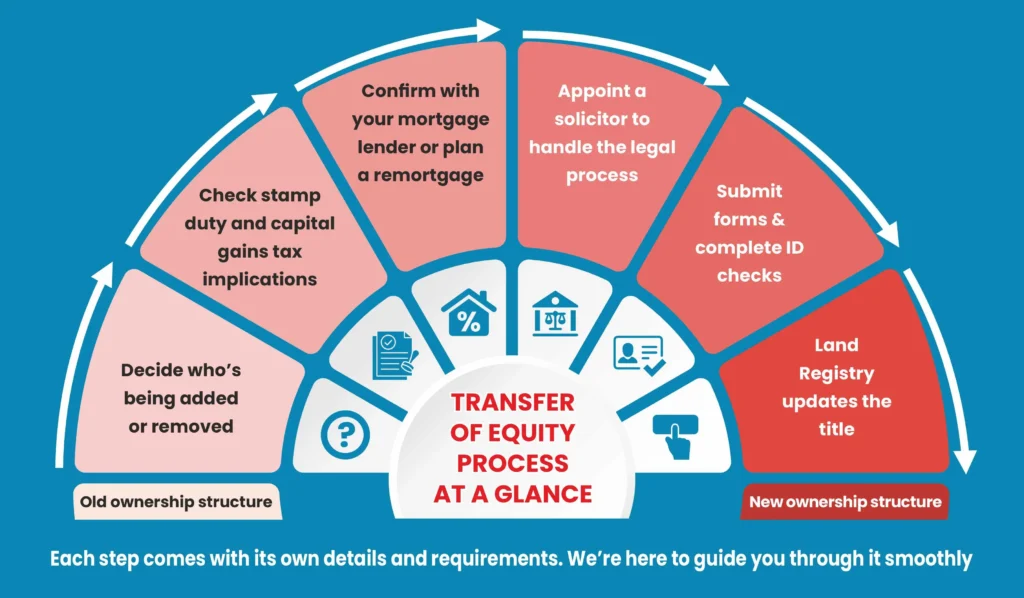
Transfer of Equity (TofE) is the legal process of changing the ownership of a property by adding or removing names from the title. Unlike a sale and purchase transaction, at least one of the existing owners continues to remain on the title. While the actual legal work is carried out by a solicitor, mortgage advisers like us often get involved—because the names on the mortgage must reflect the updated ownership. This article explores the key aspects of a Transfer of Equity and when it might be relevant.

Updating the Names in the Mortgage

It’s essential that the names on the mortgage align with the proposed ownership structure. Before instructing a solicitor to begin the transfer, it’s important to ensure that the mortgage lender is comfortable with the new arrangement.

Dealing with the Mortgage Lender

A remortgage can be an ideal opportunity to update the ownership. The new mortgage application will be in the correct names, and the solicitor managing the remortgage will also carry out the Transfer of Equity.

However, if you’re not remortgaging—and are tied into your current deal with Early Repayment Charges (ERCs)—you’ll need to approach your existing lender. Most lenders have a process for handling this, which typically involves:

  • Completing application forms
  • Providing supporting documents
  • Paying an administration fee
  • Passing affordability and credit assessments

Once approved, the lender issues consent for the name change.

Solicitors Required

Whether done with a remortgage or separately, a solicitor is always required for a Transfer of Equity.

  • If done alongside a remortgage, the lender may cover basic legal costs, and you’ll only pay an additional fee for the transfer of equity.
  • If done without a remortgage, you’ll need to appoint and pay a solicitor directly. They will usually require the lender’s consent before starting.

Costs for the Process

  • With a remortgage: £200–£350 + VAT (additional to any remortgage legal costs, which the lender may cover)
  • Without a remortgage: £400–£750 + VAT (standalone legal cost)

Land Registry Update

Just like a property sale or purchase, the change in ownership must be recorded at the Land Registry.

At Nachu Finance, we recommend all clients sign up for the Land Registry Property Alert Service. This free service will notify you when updates are made—such as after a Transfer of Equity. Not signed up yet? Read our blog post about why this is a valuable safeguard.

Time Frame

Six-step transfer of equity process: decide who is added or removed, check tax, confirm with lender, appoint solicitor, submit forms and ID, Land Registry updates title
  • With a remortgage: Add 2–4 weeks for the transfer process. Start at least 8–10 weeks before your fixed rate ends.
  • Without a remortgage: Typically, 2–5 weeks, depending on how quickly the lender provides consent.
  • Mortgage-free properties: No lender involvement means the process is often more straightforward and flexible in timing.

Transfer of Equity for Mortgage-Free Properties

No lender consent is required, making this process simpler. Appoint a solicitor to complete the work when convenient. The costs and time frame are similar to doing a transfer without a remortgage, minus the lender involvement

Stamp Duty

Stamp duty may apply, as a Transfer of Equity is treated as a part-purchase.

Example:

Satish bought a property in 2020 for £400,000. In 2025, he adds his wife Rekha. The property is now worth £480,000 and has a mortgage balance of £320,000. Rekha is not paying Satish for her share.

Her ‘consideration’ is 50% of the mortgage = £160,000. Stamp duty will be calculated on this amount, based on prevailing rates.

Additional Property Stamp Duty

This is a complex and case-specific area. While the default is that the 5% additional property surcharge applies (if the added party owns another property), each situation must be assessed on its own merit. Seek advice before proceeding to avoid unexpected liabilities.

Capital Gains Tax (CGT)

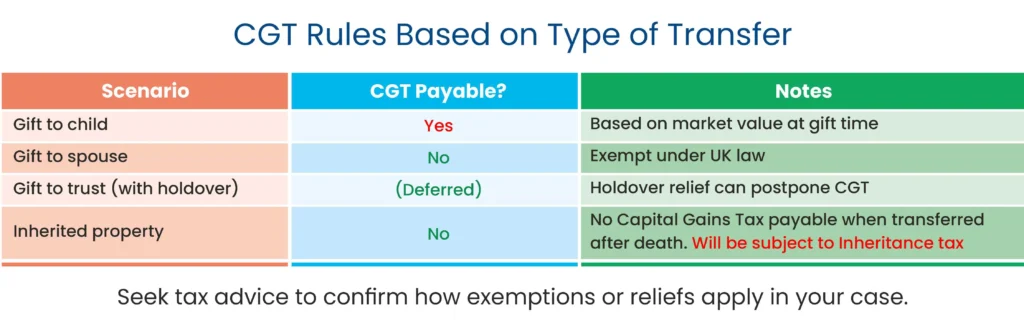
CGT is triggered because the outgoing party is effectively selling a share of the property.

Example:

Ganesh bought a buy-to-let in 2000 for £120,000. In 2025, he adds his daughter Nila. Property value is now £500,000.
Ganesh is deemed to have sold 50% of the gain = (£500,000 – £120,000) ÷ 2 = £190,000. He must report and pay CGT based on the rules in effect at that time.

Common Scenarios

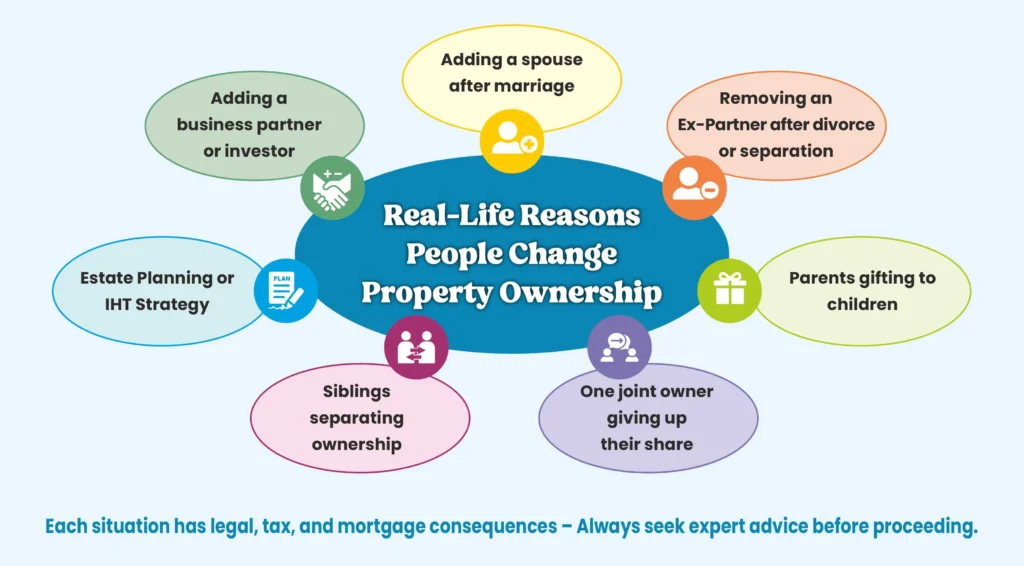
Diagram of seven reasons for changing property ownership, including adding a spouse, removing an ex-partner, gifting to children and estate planning

Transfer of Equity commonly applies in the following situations:

  1. Adding a spouse or partner
  2. Gifting a share to children
  3. Removing an ex- partner after divorce/separation
  4. One joint owner giving up their share
  5. Siblings wishing to split ownership

Type of Joint Ownership

When owning a property jointly, it’s important to choose the right ownership type:
Feature Joint Tenants Tenants in Common
Ownership share Equal ownership Ownership can be unequal
On death Right of survivorship (goes to the other owner) Passes through the owner’s will
Use case Common for couples Common for tax planning or where contributions are unequal

This decision can have real implications, especially in life-changing events like death or separation. For example, if one partner passes away, Joint Tenancy ensures the other automatically inherits the full ownership—regardless of the will. In contrast, Tenants in Common allows each owner to pass their share to someone else via their will, which may be useful in estate planning, particularly for second marriages or when children from previous relationships are involved.

If you’re going through a separation, or considering adding/removing a family member, it’s vital to get advice on the right type of ownership—not just for legal accuracy, but also to protect long-term interests.

Should Married Couples Keep the Property in a Single Name?

In general, we recommend joint ownership for married couples. While there may be exceptions, joint names provide both legal and financial security.

We’ve discussed this topic in more detail here

How Can Nachu Finance Help?

While the Transfer of Equity is ultimately completed by a solicitor, the mortgage aspect often brings us into the process—and this is where we add real value.

  • We assess the impact on your mortgage and help structure the new mortgage accordingly if you’re remortgaging.
  • If you’re staying with the same lender, we can advise you on how best to approach them, what documentation may be required, and what to expect from the assessment.
  • For clients unsure if they should proceed, we’re happy to have an exploratory discussion and explain the mortgage implications before involving solicitors.
  • We help you plan the timing—especially important if you’re approaching the end of a fixed rate.
  • We collaborate with solicitors and can refer you to a reliable conveyancer if needed.

With almost two decades of experience, and a client-first, transparent approach, we support your decisions and help ensure the transfer is processed smoothly—avoiding delays or surprises on the mortgage side.

Our Transparency Promise

We don’t provide generic answers—only advice that fits your unique situation.

We believe that understanding the full picture is key. That’s why we avoid giving generic advice on whether a Transfer of Equity is suitable. We insist on understanding your specific circumstances before making any recommendations—whether it’s the mortgage structure, the ownership pattern, or the tax implications.

We won’t rush you into decisions. We’re here to offer clarity, set expectations, and work in your best interest—even if that means recommending you hold off or take advice elsewhere first.

Ready to Discuss a Transfer of Equity?

Whether you’re adding a partner, removing an ex partner, planning for the future, or making a gift to children, Nachu Finance can help you explore the right way to structure the mortgage aspect of your Transfer of Equity.

With almost two decades of experience, a transparent approach, and client-first advice, we’re here to guide you through the process—step by step.

Contact us today for an initial discussion. Let’s make sure your mortgage reflects your plans and protects your interests.

Picture of About the Author

About the Author

Sekkappan Alagu is the Founder of Nachu Finance Ltd, established in 2006. With an early career in journalism and publishing, he brings clarity and structured thinking to complex financial topics. Through the Nachu Finance Blog and Knowledge Hub, he shares insights drawn from nearly two decades of client advisory experience, helping readers make informed decisions and understand best practices in mortgages, protection and long-term financial planning.

Picture of Business Profile

Business Profile

Nachu Finance Ltd is a directly authorised FCA-regulated firm providing mortgage, insurance and estate planning advice to clients across the UK. The firm takes a holistic approach — considering protection, tax efficiency and long-term planning alongside property finance — maintaining high regulatory standards while keeping advice clear and easy to follow. To learn more about the firm's background and story, visit the About Nachu Finance page.

Understanding Property Ownership and Future Planning

Model house with a red door and grey roof beneath the words Your First Home Today, Your Investment Property Tomorrow

Testmonials

Enquiry Form

Get in Touch with Us for Personalized Finance Assistance

Please enable JavaScript in your browser to complete this form.
=

Buying a Home Today With the Intention to Letting It Out in the Future

Model house with a red door and grey roof beneath the words Your First Home Today, Your Investment Property Tomorrow

A Financial Insight for First-Time Buyers Planning Ahead

Many first-time buyers choose a property that meets their current needs, knowing that life will evolve in the years ahead. It is quite common for young professionals like Arjun, an IT consultant working in Central London, to buy a one-bed flat close to work today and then, as their family grows, keep this first home as an investment property while moving into a larger place.

If this is something you are considering, it helps to understand what to think about now, at the point of purchase, so that you are well-placed to rent out the property later without unnecessary complications.

Two Ways to Let Out Your Home in the Future

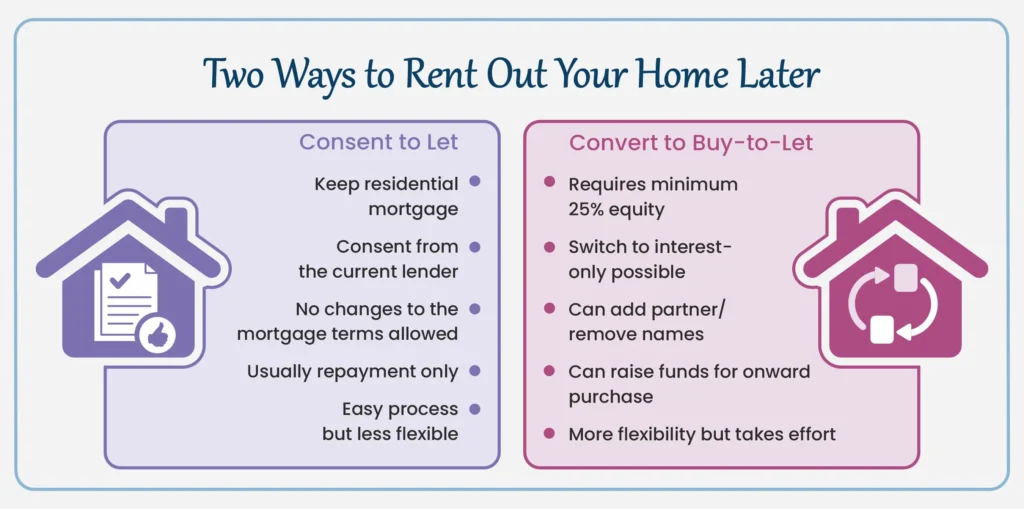
Comparison of consent to let and converting to buy-to-let, covering equity, interest-only options, changing names on the mortgage and raising funds

When the time comes to let out your current home, there are two broad routes.
Both are commonly used and each has its own advantages depending on your long-term plans.

Staying With Your Residential Mortgage and Requesting “Consent to Let”

This option keeps things simple. You continue with your existing residential mortgage and inform the lender that your circumstances have changed. You ask for permission to let out the property, and if the lender agrees, you receive what is known as consent to let.

You do not change the mortgage type.
You do not remortgage.
You do not alter any other aspect of the mortgage apart from the usage.

Some lenders such as NatWest and Santander are known for being flexible and may allow consent to let on an ongoing basis, even when your fixed rate ends. They may also allow you to choose new products while keeping that permission active.

Other lenders, including Halifax and Virgin Money, tend to grant consent for a much shorter period, often one to two years. Once this period ends, they may expect you to formally convert the mortgage to a buy-to-let product or move to another lender.

Why this approach appeals:
It avoids the hassle of remortgaging and allows you to rent out the property without breaching any contract terms.

What to keep in mind:
Since you are technically still on a residential mortgage, you usually cannot:

  • Switch the mortgage to interest-only
  • Borrow additional funds
  • Add or remove names from the mortgage

Consent to let is ideal if you want a simple and temporary arrangement.

Converting the Mortgage to a Buy-to-Let

The second route is to formally convert the residential mortgage into a buy-to-let mortgage. This tends to offer more flexibility and is usually preferred if you want a long-term investment setup.

A key requirement for buy-to-let mortgages is having at least 25% equity.
This means the mortgage must be no more than 75% of the property value.
Even if you bought with a 10% deposit, you may naturally reach this level over time due to capital repayments and property price growth.

If you fall short of the 75% loan-to-value threshold, lenders may ask you to reduce the mortgage balance when converting. This can be done by contributing additional funds.

You can read further about Loan to values here

Thinking Ahead: Will the Rental Income Work?

Buy-to-let lenders assess affordability based mainly on rental income.
It helps to look up the likely rental value of similar properties in the area.

The rental yield gives a useful early indication.
It is calculated as:

Annual rent ÷ property value × 100.

A stronger yield (for instance a 6% yield) makes it easier to borrow the amount you need on a buy-to-let mortgage.
A weaker yield (for instance a 4% yield) may mean the loan amount has to be lower or supported by your personal income.
There are ways to structure this, especially for basic-rate taxpayers or applicants with surplus income, but it is good to be aware of this early on.

You can understand further about rental yield here

Understanding Rental Demand

Some properties make excellent homes but less successful rental investments.
Areas with strong local employment, transport links, and amenities typically see steady rental demand, while certain high-end or larger properties may attract fewer tenants.

If you are buying with the intention to let out later, it is worth spending a little time assessing the area’s rental activity. This can save you surprises in the future.

Four checks before buying: future loan-to-value, rental yield, local rental demand and lender flexibility

Considering Lender Appetite from the Start

If you already know there is a good chance you may let out your home one day, the choice of lender for your initial residential mortgage can make a real difference.

Some lenders:

  • Offer ongoing consent to let
  • Are more flexible when switching to buy-to-let
  • Do not charge a premium for having a property on consent to let

Others may be more restrictive or may expect a formal conversion sooner.

Selecting a lender that naturally aligns with future rental plans helps keep your options open.

When Your Move Involves Buying a New Home at the Same Time

If you decide to let out your current home and buy your next home in one go, this becomes something known as a let-to-buy arrangement.

This is slightly different from a straightforward buy-to-let remortgage because it is designed specifically to support your onward residential purchase. You can read more about Let to buy mortgages here

Conclusion

For first-time buyers like Arjun, planning a few steps ahead can make the future transition from homeowner to landlord much smoother.
If you intend to keep your first home as an investment later, it is worth considering:

  • How your loan-to-value might look when the time comes
  • Whether the rental income is likely to support a buy-to-let mortgage
  • The level of rental demand in the area
  • How flexible your chosen lender is when it comes to consent to let or future buy-to-let conversion

With the right preparation, your first home can become a stepping stone to longer-term financial planning and investment

Frequently Asked Questions

Yes. Every residential mortgage includes a clause requiring you to seek consent before letting out the property. Renting without permission would breach the mortgage contract.

Most lenders will consider it, but each has their own criteria, conditions, and limits. They must also be satisfied that the property was genuinely purchased to live in, not as a disguised buy-to-let.

Once the lender has granted consent and the property is actually rented out, most lenders will assess it similarly to a buy-to-let. The rental income can usually offset the mortgage payments, though each lender’s affordability method differs slightly.

The above blog is more to do with letting out the property entirely and you moving to a different accommodation. If you would like to understand more about continuing to live in the property but rent out a spare room  then refer to our separate blog article titled Renting Out a Spare Room: How to Do It the Right Way

Picture of About the Author

About the Author

Sekkappan Alagu is the Founder of Nachu Finance Ltd, established in 2006. With an early career in journalism and publishing, he brings clarity and structured thinking to complex financial topics. Through the Nachu Finance Blog and Knowledge Hub, he shares insights drawn from nearly two decades of client advisory experience, helping readers make informed decisions and understand best practices in mortgages, protection and long-term financial planning.

Picture of Business Profile

Business Profile

Nachu Finance Ltd is a directly authorised FCA-regulated firm providing mortgage, insurance and estate planning advice to clients across the UK. The firm takes a holistic approach — considering protection, tax efficiency and long-term planning alongside property finance — maintaining high regulatory standards while keeping advice clear and easy to follow. To learn more about the firm's background and story, visit the About Nachu Finance page.

Explore Your Next Steps in Property Investment

Hands gesturing over a model house, keys and a contract on a desk during a property discussion

Testmonials

Enquiry Form

Get in Touch with Us for Personalized Finance Assistance

Please enable JavaScript in your browser to complete this form.
=

Transferring a Property to a Ltd Company: Does It Really Make Financial Sense?

Hands gesturing over a model house, keys and a contract on a desk during a property discussion

Structuring your buy-to-let portfolio under a Limited Company has become an increasingly popular strategy for landlords. But while this setup can offer clear tax advantages for new purchases, it’s not always suitable when transferring properties already held in personal names—unless the property was once your own residence.

This article walks through how Ltd company mortgages work, who they suit best, when transferring properties makes sense, and the key traps to avoid.

Why Are More Landlords Choosing Ltd Company Mortgages?

Buy-to-let mortgage interest relief restrictions introduced in recent years have pushed many landlords—especially higher rate taxpayers—to consider purchasing properties through a limited company. Some of the key benefits include:

  • Full mortgage interest tax relief available against rental income for Ltd companies
  • Corporation tax rates typically lower than individual higher rate tax bands
  • More efficient profit retention, especially for those not needing to draw all profits personally
  • Potential inheritance tax planning benefits when combined with the use of Trusts and careful structuring

Who Might a Ltd Company Buy-to-Let Be Right For?

A Limited Company structure tends to suit landlords who:

  • Are higher or additional rate taxpayers
  • Plan to build or grow a property portfolio over time
  • Have a trading business generating surplus profits and wish to diversify into property in a tax-efficient manner
  • Want to retain profits within the company to reinvest rather than drawing income personally

It’s worth noting that Ltd company mortgages often have slightly higher interest rates and fees compared to personal name buy-to-let mortgages. So the overall benefits depend on your personal tax position and investment strategy.


Important Ownership Rule: Ltd Company Buy-to-Lets Must Be Let Out

Buy-to-let properties held under a Ltd company must be let to a third party at arm’s length (i.e. someone unrelated to you, with no personal or family connection, and on standard market terms). They are not intended for personal use or occupation by family members.

Even short-term or rent-free use by relatives can lead to serious tax implications, including disqualification from allowable deductions and potential issues with HMRC.

What if you plan to live in the property?

While it is technically possible to live in a property owned by a Ltd company, this structure becomes financially unviable due to two major tax consequences:

  • The Stamp Duty Land Tax (SDLT) jumps to 15% of the property’s full value (not just the 5% surcharge)
  • You may also become liable for the Annual Tax on Enveloped Dwellings (ATED), a yearly charge applied to residential properties held by companies

These penalties are significant and are specifically designed to deter individuals from using Ltd companies to hold personal residences.

Don’t get caught out inadvertently—Ltd company property ownership is strictly for genuine rental purposes only.

Tax Advice is Essential

While Ltd company ownership has advantages, it’s not one-size-fits-all. Before setting up a company or purchasing under one, it’s crucial to seek professional tax advice.

Your adviser should look at:

  • Your current and projected income tax position
  • Exit strategy and plans to access profits
  • Long-term inheritance tax planning
  • Implications for Capital Gains Tax (CGT) and Stamp Duty Land Tax (SDLT) if you already own property

Stamp Duty: A Common Misconception

One of the most frequent misunderstandings we come across is:

“It’s the first property in the company, so the additional stamp duty doesn’t apply.”

This is incorrect.

  • All purchases by Ltd companies are subject to the higher rate stamp duty surcharge—currently 5% on top of the standard SDLT rates, regardless of whether it is the company’s first property or not.
  • This applies even if the directors or shareholders do not own any properties personally.

Why Transferring Existing Properties May Not Make Sense

While new buy-to-let purchases may benefit from being held in a Ltd company, transferring existing properties from personal names to a Ltd company often triggers high upfront costs:

Key Costs to Consider:

  • Capital Gains Tax (CGT) on any gains made during personal ownership
  • Stamp Duty Land Tax (SDLT) payable by the company at the higher 5% surcharge
  • Legal and conveyancing costs for both the sale from personal names and purchase by the company
  • Mortgage implications, as most lenders will require a full remortgage under Ltd company terms

These costs can be significant—and in many cases, outweigh the long-term tax savings.

Transfers of Mortgage-Free Properties

Even where the property is owned outright and no money changes hands, the transfer is still treated as a market value transaction by HMRC.

That means:

  • CGT is calculated based on the current market value of the property
  • SDLT is still payable by the Ltd company at the full market value, including the 5% surcharge
  • Both sale and purchase will require full legal representation and conveyancing

Unless additional tax reliefs or planning advantages apply, mortgage-free transfers to a Ltd company are generally not tax-efficient and need to be considered carefully.

When a Transfer Might Still Be Worth Considering

There are a few exceptions where transferring a property from personal ownership to a Ltd company may be more favourable.

Transferring a Former Residential Property While Buying a New Home

If the property being transferred:

  • Was your former main residence, and
  • You are planning to purchase a new residential home

…then a correctly timed transfer might make sense.

Here’s why:

  • Private Residence Relief may reduce or eliminate CGT liability on the transfer, depending on how long you lived in the property during your ownership
  • The transfer may help you avoid the 5% additional SDLT surcharge on the new property you are buying, provided it happens within the current 3-year window for replacing a main residence

This dual benefit can offset the SDLT payable on the Ltd company transfer—but only where the reliefs apply and the timeline is carefully managed. It is essential to take advice before proceeding, as this is a narrowly defined window that not all clients will qualify for.

What We Bring to the Table

Whether you’re exploring the Ltd company route for your next buy-to-let purchase or considering if transferring an existing property makes sense, we’re here to guide you through the options.

At Nachu Finance, we take the time to:

  • Understand your personal tax position and property goals
  • Explain how ownership structure impacts lending, tax, and long-term planning
  • Liaise with accountants and solicitors where needed to ensure all angles are covered
  • Offer flexible, tech-savvy support with honest, jargon-free guidance

We’re not here to just secure a mortgage—we’re here to help you structure your investment the right way.

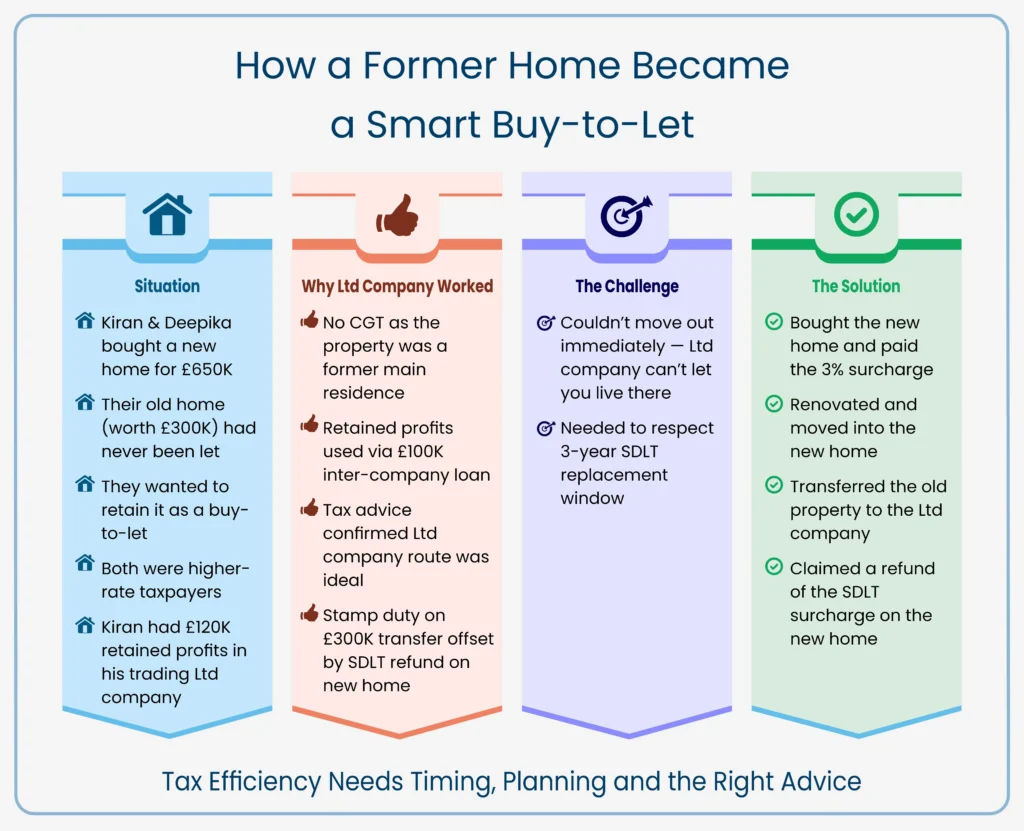
Kiran and Deepika were in the process of purchasing a new residential property in 2024, priced at £650,000. At the time, the additional stamp duty surcharge was still 3%, just before it increased to 5%. Both were higher-rate taxpayers, and they had carefully planned their next move with tax efficiency in mind.

Their existing property—valued at £300,000—had never been let out and had always been Kiran’s primary residence. While they had no intention of selling it, they also didn’t want to hold it personally as a buy-to-let due to the tax inefficiencies.

Kiran, an IT contractor, had £120,000 in retained profits in his trading Ltd company. After consulting with their accountant, it was clear that using a Ltd company structure for the buy-to-let was the right option for their circumstances.

As part of the transaction, £100,000 of the retained profits was used towards the property purchase, structured as an inter-company loan from the trading business to the new property investment company. This helped minimise personal capital outlay and allowed tax-efficient use of existing funds.

Four-column infographic showing the situation, why a Ltd company worked, the timing challenge and the solution in the Kiran and Deepika case study

Why the Transfer Made Sense:

  • As it was a former residential property, no Capital Gains Tax was payable at the point of transfer
  • Stamp duty would apply on the transfer to the Ltd company—but that cost could be offset by avoiding the 3% additional SDLT on their new residential purchase
  • The purchase did not rely on extracting funds from the former property, allowing for smooth structuring
  • Their accountant confirmed that the Ltd company structure aligned with their long-term plans

However, there was one challenge: the timing.

To reclaim the additional 3% SDLT paid on their new home, they would need to complete the transfer of their old home to the Ltd company within the 3-year replacement window. But at the time of purchasing the new property, Kiran and Deepika were not ready to move out of the former home.

Since Ltd company-held properties cannot be occupied by the shareholders or their family, even temporarily, the advice was as follows:

  1. Complete the purchase of the new residential property first, paying the 3% additional SDLT up front
  2. Carry out the necessary works and fully move into the new home
  3. Then transfer the former residence to the Ltd company once it was fully vacated
  4. Finally, submit a claim for refund of the additional SDLT paid on the new purchase—since it now qualified as a genuine replacement of their main residence

This careful sequencing allowed them to remain compliant while still achieving the long-term goal: retaining their former home as a rental property under the Ltd company in a tax-efficient way.

Our Transparency Promise

We’ll Tell You When It’s Not Worth It

We’re often asked whether it’s a good idea to transfer a property into a Ltd company. In truth, the answer depends entirely on your circumstances—and in many cases, it may not be the right move.

Our role is to:

  • Clearly explain both the potential benefits and the costs involved
  • Highlight when the numbers don’t add up
  • Avoid recommending changes just for the sake of complexity or sales

We take pride in giving advice that’s aligned with your best interests, even when that means recommending you not proceed with a transfer.

Ready for Clarity and Confidence?

Whether you’re a first-time landlord or looking to restructure an existing portfolio, we’re confident we can help you move forward with clarity.

Contact us and take your first step to joining the several happy Nachu Finance clients.

With our experience, whole-of-market service, and client-first approach, we’re always willing to go the extra mile.

And with flexible, tech-savvy options for appointments and document sharing, reaching out & doing business with us is easier than you think.

Picture of About the Author

About the Author

Sekkappan Alagu is the Founder of Nachu Finance Ltd, established in 2006. With an early career in journalism and publishing, he brings clarity and structured thinking to complex financial topics. Through the Nachu Finance Blog and Knowledge Hub, he shares insights drawn from nearly two decades of client advisory experience, helping readers make informed decisions and understand best practices in mortgages, protection and long-term financial planning.

Picture of Business Profile

Business Profile

Nachu Finance Ltd is a directly authorised FCA-regulated firm providing mortgage, insurance and estate planning advice to clients across the UK. The firm takes a holistic approach — considering protection, tax efficiency and long-term planning alongside property finance — maintaining high regulatory standards while keeping advice clear and easy to follow. To learn more about the firm's background and story, visit the About Nachu Finance page.

Further Reading: Planning Your Property Investment Strategy

Hand stopping falling wooden blocks to protect a stack of coins

Testmonials

Enquiry Form

Get in Touch with Us for Personalized Finance Assistance

Please enable JavaScript in your browser to complete this form.
=

Why You Should Consider Placing Your Life Insurance Under a Trust

Hand stopping falling wooden blocks to protect a stack of coins

Let’s talk about life insurance. You’ve probably already taken the important step of getting a policy to protect your loved ones, but have you thought about the benefits of placing it under a trust? If not, don’t worry—you’re not alone! Many people aren’t aware of this option, but it can make a world of difference when it comes to ensuring your family gets the most out of your policy. Here’s why you might want to consider it:

Makes Claiming a Breeze

We all know life insurance is there to support your family after you’re gone, but wouldn’t it be great if they could get that support quickly and without hassle? By putting your policy under a trust, you’ve already sorted out ownership details ahead of time. This means that when the time comes, your loved ones only need to provide proof of your passing to claim the proceeds—no drawn-out legal processes required. This could mean your family gets the funds they need much faster, sometimes months sooner! Quick access to these funds can help cover immediate costs, like funeral expenses, or simply provide a financial cushion during a tough time.

Keep More Money in Your Family’s Pocket (And Out of the Taxman’s!)

Let’s face it—nobody likes taxes, especially when they reduce the inheritance you’ve worked hard to build for your loved ones. In the UK, for example, estates valued over a certain threshold can face an inheritance tax of up to 40%! Normally, life insurance payouts would be counted as part of your estate and could be subject to this hefty tax. But here’s the good news: if your policy is under a trust, the payout is usually kept outside your estate, which can save your family a big chunk of money.

And even if your estate still has to pay some inheritance tax, the payout from the trust can be a helpful way to cover that bill upfront—giving your family one less thing to worry about during an already difficult time.

You Decide Who Gets What—No Surprises!

One of the best things about setting up a trust for your life insurance is the control it gives you. You get to decide exactly who benefits from your policy and can even choose trusted individuals (called trustees) to make sure everything is managed according to your wishes. This means there’s no room for misunderstandings or disputes—just peace of mind knowing that your intentions will be honoured.

Simple, Straightforward, and Usually Free

If the word “trust” makes you think of complicated legal processes and high costs, think again! Setting up a trust for your life insurance policy is often much simpler than people expect. Most insurance companies offer a variety of trusts tailored to different needs, and setting one up typically involves just a few straightforward steps—selecting the trust type, naming your beneficiaries and trustees, and getting the necessary signatures. Best of all, this process is usually free and can be done for both new and existing policies.

The Bottom Line

Taking out life insurance is a smart move for anyone looking to provide financial security for their loved ones. But why not take it a step further? By placing your life insurance under a trust, you’re not just protecting your family—you’re making sure they have easy access to the funds, keeping more of your money in their pockets, and ensuring your wishes are followed to the letter. It’s a simple step that can make a big difference, so why not consider it?

Picture of About the Author

About the Author

Sekkappan Alagu is the Founder of Nachu Finance Ltd, established in 2006. With an early career in journalism and publishing, he brings clarity and structured thinking to complex financial topics. Through the Nachu Finance Blog and Knowledge Hub, he shares insights drawn from nearly two decades of client advisory experience, helping readers make informed decisions and understand best practices in mortgages, protection and long-term financial planning.

Picture of Business Profile

Business Profile

Nachu Finance Ltd is a directly authorised FCA-regulated firm providing mortgage, insurance and estate planning advice to clients across the UK. The firm takes a holistic approach — considering protection, tax efficiency and long-term planning alongside property finance — maintaining high regulatory standards while keeping advice clear and easy to follow. To learn more about the firm's background and story, visit the About Nachu Finance page.

Continue the Best Practices of Family Protection

Chalkboard with the title Arrangement Fees: What They Are and How They Really Work

Testmonials

Enquiry Form

Get in Touch with Us for Personalized Finance Assistance

Please enable JavaScript in your browser to complete this form.
=

Arrangement Fees: What They Are and How They Really Work

Chalkboard with the title Arrangement Fees: What They Are and How They Really Work

Is 4% with a £1,000 arrangement fee better than 4.10% with no fee?

It is a question we are asked often, and the honest answer is: it depends. Depending on the loan, the difference between two deals like these can be hundreds or even thousands of pounds, and the cheaper one is not always the one you would expect.

This article explains how arrangement fees work, how much they can be and how to work out which deal is cheaper, using four real cases. It also covers adding the fee to the loan and why we usually do.

What is an arrangement fee?

An arrangement fee, sometimes called a product fee, is a one-off charge made by the lender for a particular mortgage product. It is attached to the specific interest rate and product you choose, so the same lender can charge different fees on different rates.

Lenders use the fee to balance their profit against the interest rate they offer. A higher arrangement fee usually allows a lower interest rate, while a lower or zero fee usually comes with a higher rate. This is why lenders very commonly offer several versions of the same product, for example a 2-year fixed rate, each with a different fee and rate.

That makes comparing them less obvious than picking the lowest fee or the lowest rate. The sections below explain how arrangement fees vary, how to work out the cheapest deal and how the fee can be added to the loan.

How much can an arrangement fee be?

Arrangement fees vary widely. The ones we see most often are:

  • No arrangement fee: some lenders have products with no fee at all.
  • Around £500: often £495 or £499.
  • Around £1,000: often £995 or £999.
  • Other fixed fees: such as £1,499 or £1,999.
  • A percentage of the loan: such as 1% or 2%.

Percentage fees are more common on buy-to-let mortgages, where up to 3% is common. Some specialist buy-to-let products carry much higher fees of 5% or 7%, which on a £300,000 loan would be £15,000 or £21,000.

These products are usually used where a client needs a higher loan and a lower interest rate helps the loan pass the lender’s rental stress test. The lender cannot give up its margin on the rate, so it takes a higher fee instead. Such a product can have a role to play, as Case 4 below shows, but care should be taken to be fully aware of what is being agreed.

Understanding the cheapest deal: total to pay

When you compare products, either within one lender or between lenders, the best way to find the cheaper deal is to work out the total to pay over the period you are comparing, usually the initial fixed period.

Total to pay is the interest paid over that period plus the arrangement fee. If the fee is added to the loan, the interest charged on the fee is included too. The product with the lowest total to pay is the cheaper deal over that period.

This is why the lowest fee, or the lowest rate, is not always the cheapest option. A flat fee costs the same whatever the loan size, but a rate saving is worth more on a larger loan. A 0.25% lower rate saves about £1,035 a year on £414,000, but only about £294 a year on £117,682.

Generally speaking:

  • Larger loans are often better off with a higher arrangement fee and a lower interest rate.
  • Smaller loans are often better off with a lower or no arrangement fee.

The worked examples below show how this plays out.

Worked examples

These four examples are based on real cases, with the details anonymised. Rates are those that were available at the time and are for illustration only. In each case the fee was added to the loan, so interest on it is included.

Total to pay is calculated on an interest-only basis: the interest on the full loan over the period, plus the arrangement fee. We compare on this basis because the true cost of borrowing is the interest and the fees. On a repayment mortgage, part of each payment repays capital, which reduces what you owe rather than costing you anything, so a higher monthly payment is a cashflow matter, not an extra cost. The interest actually charged will be a little lower as the balance falls, but every product is compared on the same basis.

Case 1: Residential purchase, £414,000. The higher fee was cheaper

Two 2-year fixed rates, one with no fee and one with a £999 fee.
Option 1: no fee Option 2: £999 fee
Rate 5.35% 5.10%
Arrangement fee £0 £999 (added to loan)
Interest over 2 years £44,298 £42,330
Arrangement fee £0 £999
Total to pay over 2 years £44,298 ✕ £43,329 ✓
Saving compared to Option 1 — £969
On a loan of this size, the lower rate saves more than the fee costs, so the product with the fee is cheaper by £969 over the 2 years.

Case 2: Residential product transfer, £117,682. Almost no difference

Two 5-year fixed rates, one with a £999 fee and one with no fee.
Option 1: £999 fee Option 2: no fee
Rate 5.14% 5.35%
Arrangement fee £999 (added to loan) £0
Monthly payment £738.18 £746.20
Interest over 5 years £30,501 £31,480
Arrangement fee £999 £0
Total to pay over 5 years £31,500 £31,480
Difference — £20 cheaper
Over 5 years the two came out within £20 of each other, so there was no clear winner on the numbers. The client preferred the lower monthly payment, which was £8.02 less, and the convenience of adding the fee to the loan, so went with the £999-fee product. When the numbers are this close, the choice can reasonably come down to what suits the client.

Case 3: Buy-to-let product transfer, £140,769. No fee was cheaper

Two 5-year fixed rates with the same lender, one with a £1,999 fee and one with no fee. Buy-to-let payments are interest only.
Option 1: £1,999 fee Option 2: no fee
Rate 5.23% 5.38%
Arrangement fee £1,999 (added to loan) £0
Monthly payment (interest only) £622.23 £631.11
Interest over 5 years £37,334 £37,867
Arrangement fee £1,999 £0
Total to pay over 5 years £39,333 ✕ £37,867 ✓
Saving compared to Option 1 — £1,466
The lower rate saved only £8.88 a month, about £533 over 5 years, which was far less than the fee and the interest on it. On a smaller loan, the product with no fee was cheaper by £1,466.

Case 4: Buy-to-let remortgage, £308,000. The cheapest was not the one that worked

Two 5-year fixed rates, one with a £1,499 fee and one with a 3% fee. The rent achieved on the property was £1,900 a month.
Option 1: £1,499 fee Option 2: 3% fee
Rate 5.39% 4.94%
Arrangement fee £1,499 (added to loan) £9,240 (added to loan)
Monthly payment (interest only) £1,390.17 £1,305.97
Interest over 5 years £83,410 £78,358
Arrangement fee £1,499 £9,240
Total to pay over 5 years £84,909 ✓ £87,598 ✕
Cheaper by £2,689 —
Rent needed to meet the lender’s affordability test £2,015.74 £1,893.66
Loan affordable on rent of £1,900 ✕ ✓
The £1,499-fee product was cheaper by £2,689 over 5 years. However, the loan was affordable on the rent only with the 3% fee product, because its lower rate brought the rent needed down below the £1,900 achieved. So despite being more expensive overall, the 3% fee product was the one that made sense for the client, as it was the only way to reach the loan amount required.

The four cases at a glance

Case Loan Products compared Cheapest on total to pay Difference What decided it
Residential purchase £414,000 No fee (5.35%) v £999 fee (5.10%) £999 fee £969 Rate saving outweighed the fee on a larger loan
Residential product transfer £117,682 £999 fee (5.14%) v no fee (5.35%) No fee, by a small margin £20 Almost level, so a lower monthly payment and convenience decided it
Buy-to-let product transfer £140,769 £1,999 fee (5.23%) v no fee (5.38%) No fee £1,466 On a smaller loan the fee outweighed the rate saving
Buy-to-let remortgage £308,000 £1,499 fee (5.39%) v 3% fee (4.94%) £1,499 fee £2,689 Only the 3% fee product made the loan affordable

Adding the arrangement fee to the loan

In most cases the arrangement fee can be added to the loan, but this is not guaranteed. Two things can prevent it:

  • Affordability: if the maximum loan the lender will offer does not leave room for the fee, it cannot be added.
  • Loan to value: some lenders do not allow the loan, including the fee, to go above their loan-to-value limit.

In practice we see the fee added very often, but it should not be assumed.

When the fee is added to the loan, interest is charged on it as well, at the rate you have chosen. It is not interest-free, which is why the interest on the fee is included in the total to pay figures above.

Why adding the fee to the loan is logistically easier

Our approach is to add the arrangement fee to the loan and, if needed, pay it off after completion.

Adding the fee to the loan is the practical, logistically easier route. There is no fee to pay upfront. If the loan does not go ahead, or the product has to change to one with a different arrangement fee, nothing has been paid that needs sorting out, and the change is simpler to make.

The fee still attracts interest while it sits in the loan. If you would rather avoid that, you can pay the fee off once the loan has gone live, subject to the lender’s overpayment terms. At that point the loan is live and there can be no further change to the product, so the fee can be paid off with certainty. Even if you would rather not carry the fee in the loan, this is often the easier way to handle it.

Six pinned notes summarising arrangement fees, including how rates and fees trade off and why total cost over the initial period matters

Frequently Asked Questions

No. Clients have asked us whether the arrangement fee a lender charges has anything to do with the procuration fee the lender pays to advisers. There is no link. Whether a product has an arrangement fee or not, the procuration fee paid to the adviser usually remains unchanged.

No. A product with no arrangement fee is not always the cheapest. It depends on the loan amount and on the other options available. In Case 1 and Case 4 the product with the higher fee was cheaper over the period, while in Case 3 the product with no fee was. Working out the total cost over the period you are comparing is the way to tell.

Picture of About the Author

About the Author

Sekkappan Alagu is the Founder of Nachu Finance Ltd, established in 2006. With an early career in journalism and publishing, he brings clarity and structured thinking to complex financial topics. Through the Nachu Finance Blog and Knowledge Hub, he shares insights drawn from nearly two decades of client advisory experience, helping readers make informed decisions and understand best practices in mortgages, protection and long-term financial planning.

Picture of Business Profile

Business Profile

Nachu Finance Ltd is a directly authorised FCA-regulated firm providing mortgage, insurance and estate planning advice to clients across the UK. The firm takes a holistic approach — considering protection, tax efficiency and long-term planning alongside property finance — maintaining high regulatory standards while keeping advice clear and easy to follow. To learn more about the firm's background and story, visit the About Nachu Finance page.

Understanding the True Cost of Your Mortgage

Interest rate percentage graphic with the heading Base Rate vs Your Mortgage Rate

Testmonials

Enquiry Form

Get in Touch with Us for Personalized Finance Assistance

Please enable JavaScript in your browser to complete this form.
=

Base Rate vs Your Mortgage Rate: Should You Wait for the Bank of England?

Interest rate percentage graphic with the heading Base Rate vs Your Mortgage Rate

We are often asked whether you should wait for the next Bank of England decision before choosing a mortgage rate. It is an understandable question, because the base rate sounds like the number that sets everything. The answer depends on the type of mortgage you want. For a fixed rate, the Bank of England base rate has no direct impact on the rate you are offered, so waiting for the meeting is rarely worthwhile. If you are on a tracker, or on a discount or standard variable rate product, the base rate matters more. This guide explains the difference, with the upcoming meeting dates and the history of the base rate.

What the Bank of England Base Rate Does and Doesn't Affect

The base rate is the Bank of England’s main tool for keeping inflation under control. It influences what banks pay to borrow, but it is only one input into mortgage pricing.

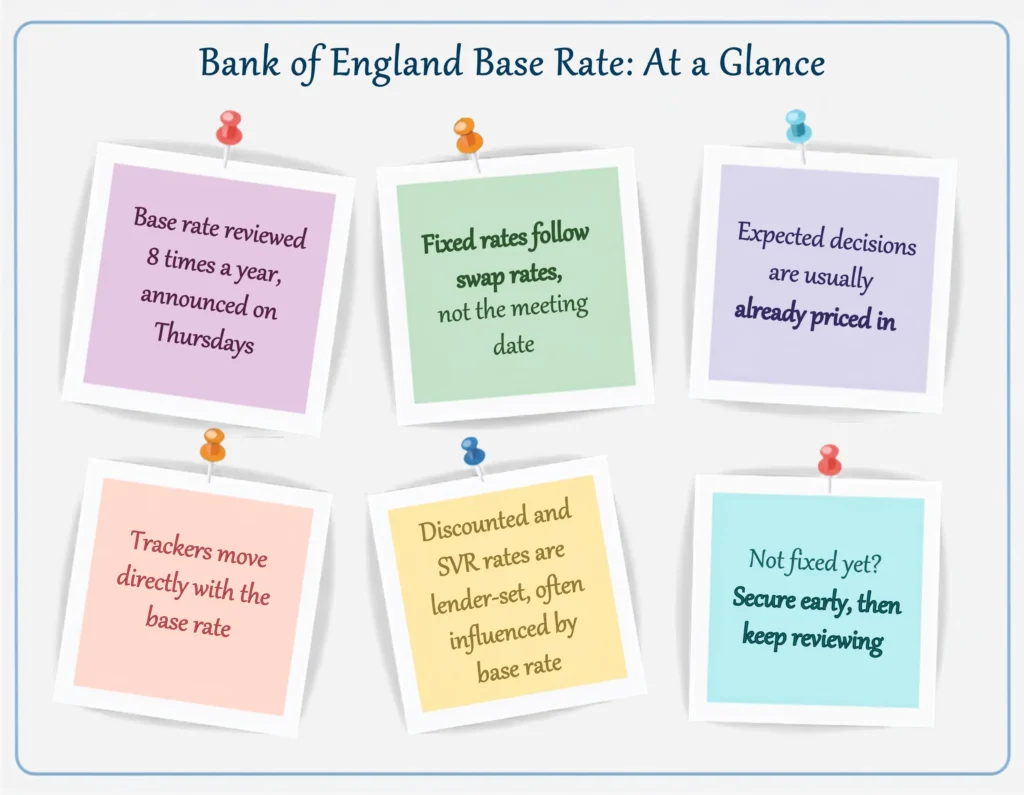
  • Fixed rates: no direct impact. Lenders price these from swap rates, not from the base rate itself.
  • Trackers: a direct link. Your rate moves with the base rate, usually at a set margin above it.
  • Discount and standard variable rate (SVR) products: the base rate can have an impact, but it is not guaranteed. These rates are set by the lender, who may or may not follow a change, and may not pass on a cut in full.

If you are on a tracker, or may move to one, the meeting dates matter. If you are choosing a fixed initial rate, the next meeting is rarely the right trigger.

Why Fixed Rates Follow Swap Rates, Not the Meeting

Lenders fund fixed-rate mortgages using swap rates, which reflect the wholesale cost of fixed-rate money for banks. A swap rate follows market sentiment and the outlook for the wider economy, so it can move before, or independently of, a Bank of England decision. By the time a decision is announced, the expected outcome has usually already been priced in. A surprise can still move fixed rates, but that cannot be predicted, so timing your decision around the date rarely helps.

For the full explanation, read Swap Rates Explained: What They Are and How They Influence Your Fixed Rate.

Historic Bank of England Rates in Our Experience

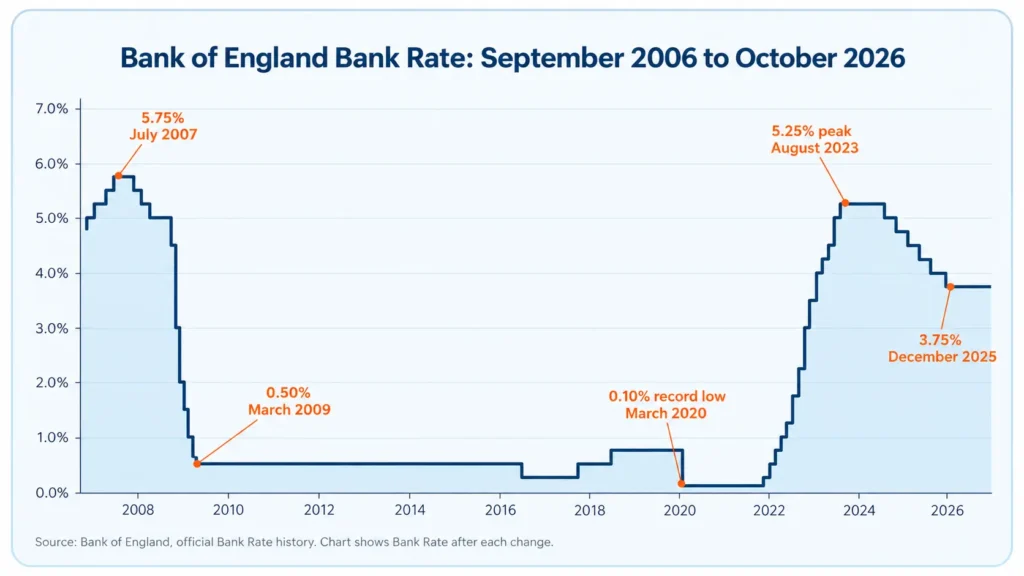
Since 26 September 2006, when Nachu Finance began advising, Bank Rate has moved through several very different phases:

  • 2006 to 2007: rose from 4.75% to 5.75% (July 2007).
  • 2008 to 2009: cut sharply to 0.50% by March 2009 during the financial crisis.
  • 2009 to 2016: held at 0.50% for over seven years, then cut to 0.25% in August 2016.
  • 2017 to 2020: small rises to 0.75%, then cut to a record low of 0.10% in March 2020.
  • 2021 to 2023: rapid rises from 0.25% in December 2021 to 5.25% in August 2023.
  • 2024 to 2025: gradual cuts to 3.75% in December 2025.
  • 2026: held at 3.75%.
Step chart of Bank of England Bank Rate from September 2006 to October 2026, showing the 2007 high, the fall to 0.50% in 2009, the 0.10% low in 2020 and the rise to 5.25% in 2023

Bank of England Meetings

The Bank of England’s Monetary Policy Committee (MPC) meets eight times a year. Decisions are announced on a Thursday at 12 noon UK time, alongside the minutes.

Current Bank Rate: 3.75%

Upcoming Meetings
Announcement dateDay
5 November 2026Thursday
17 December 2026Thursday
4 February 2027Thursday
18 March 2027Thursday
29 April 2027Thursday
17 June 2027Thursday

Source: Bank of England, upcoming MPC dates. Dates are as published and may change.

What You Can Do: Secure Early and Keep Reviewing

For most people choosing a fixed rate, the better approach is to secure a rate early and keep reviewing it until it goes live. Many lenders let you secure a new rate three to six months before your current rate ends, depending on the lender.

  • Purchases and remortgages: in most cases you can switch to a better product if one appears, up until shortly before the new rate goes live. The cut-off varies by lender.
  • Product transfers: the same principle applies with your current lender, again with a lender-specific cut-off.
  • Many lenders allow more than one change, including switching between products, for example from a two-year tracker to a five-year fixed rate.
  • If you wait and rates rise, you could miss today’s rates. Securing a rate and reviewing it limits that risk, though it depends on the lender’s terms.

To see how this works in practice, read our product transfer case study, where a client’s rate was reviewed and switched several times before it went live. By doing just this, the client moved from 4.83% to 4.08% and saved £4,770 in interest over the two-year fixed term.

Six pinned notes summarising the base rate: reviewed eight times a year on Thursdays, fixed rates follow swap rates, expected decisions priced in, trackers move directly, discount and SVR rates lender-set, secure early and keep reviewing

Don't Leave Your Rate Unwatched

Waiting for the meeting won’t change your fixed rate. Watching the market will. We track rates for you from the day you secure yours until it goes live, and only switch when it works in your favour. Contact us today.

Frequently Asked Questions

Eight times a year, announced on a Thursday at 12 noon. The upcoming dates are usually published in advance by the Bank of England.

Not directly. Fixed rates follow swap rates, which already reflect expected changes. If you are already fixed, nothing changes until your deal ends.

Usually not. Expected outcomes are normally priced in, and waiting risks missing today’s rates.

Your rate moves with the base rate, so your payments change after a rise or a cut. There is usually a lead time before tracker rates are adjusted, and your lender will normally notify you to confirm the change and the effective date.

No. Each lender decides whether and how to adjust its own SVR, so a change is not automatic. In many cases, though, a base rate move may have some impact.

In most cases, up to shortly before the new rate goes live, depending on the lender. But once the new rate has gone live, this may no longer be possible, as Early Repayment Charges (ERCs) will usually apply.

Picture of About the Author

About the Author

Sekkappan Alagu is the Founder of Nachu Finance Ltd, established in 2006. With an early career in journalism and publishing, he brings clarity and structured thinking to complex financial topics. Through the Nachu Finance Blog and Knowledge Hub, he shares insights drawn from nearly two decades of client advisory experience, helping readers make informed decisions and understand best practices in mortgages, protection and long-term financial planning.

Picture of Business Profile

Business Profile

Nachu Finance Ltd is a directly authorised FCA-regulated firm providing mortgage, insurance and estate planning advice to clients across the UK. The firm takes a holistic approach — considering protection, tax efficiency and long-term planning alongside property finance — maintaining high regulatory standards while keeping advice clear and easy to follow. To learn more about the firm's background and story, visit the About Nachu Finance page.

Useful Next Reads

Chalkboard with the heading Swap Rates and the sub-heading What They Are and How They Influence Your Fixed Rate

Testmonials

Enquiry Form

Get in Touch with Us for Personalized Finance Assistance

Please enable JavaScript in your browser to complete this form.
=

Swap Rates Explained: What They Are and How They Influence Your Fixed Rate

Chalkboard with the heading Swap Rates and the sub-heading What They Are and How They Influence Your Fixed Rate

When you take out a fixed-rate mortgage, one figure matters more than most people realise: the swap rate. The Bank of England base rate is far better known, but swap rates, which are rarely talked about, have a big impact on the fixed rate you are offered.

This article takes a closer look at swap rates: what they are, how lenders use them to price fixed rates, how they move with the wider economy, and what you can do about it.

What is a swap rate?

A swap rate is the price at which banks can lock in their borrowing costs for a fixed period. Lenders fund mortgages from sources whose cost moves over time. When they offer you a rate that is fixed for two or five years, they need certainty on their own costs for the same period. They get it through a “swap”, a contract with another institution that exchanges a variable cost for a fixed one.

The fixed rate on that contract is the swap rate. In effect, it is the wholesale cost price of fixed-rate money for the bank.

There is a swap rate for each term: one year, two years, three years, five years, ten years and so on. A two-year fixed mortgage is priced off the two-year swap rate, a five-year fixed off the five-year swap rate.

How lenders turn a swap rate into your mortgage rate

Lenders start with the swap rate for the term and then add their own costs and margin. The rate you see on a product is broadly

Swap rate + lender’s margin = fixed mortgage rate

The first step is the swap rate, which is driven by the market. The lender then adds its own margin. That margin is a complex decision in itself: each lender sets it based on the risk of the individual proposition, the type of mortgage, the loan-to-value, the level of competition and other factors. It is beyond the scope of this article. It is also why two lenders can price the same product differently on the same day.

A simple illustration. The 1.25% margin below is purely an example, as margins vary by lender and by mortgage. The figures are for explanation only, not current market rates:

  • Five-year swap rate: 3.50%
  • Lender’s margin: 1.25%
  • Resulting five-year fixed rate: 4.75%

If the five-year swap rate rises by 0.30%, lenders will typically raise their five-year fixed rates by a similar amount, often within days. If swap rates fall, rates tend to follow down, though lenders may reprice more slowly on the way down than on the way up.

Swap rates are not a household statistic. They are published in only a few places, mainly used by banks and the wider financial industry, which is why most borrowers never see them.

Swap rates vs the Bank of England base rate

The two are often mixed up, but they work very differently.

Bank of England base rate Swap rate
Who sets it The Bank of England’s Monetary Policy Committee The financial markets, through trading
What it reflects The Bank’s decision on today’s policy rate What the market expects rates, inflation and the economy to do over the coming years
How often it changes At scheduled meetings, roughly every six weeks Daily, sometimes within the day
Mortgages it affects most Tracker mortgages, and to a degree discount and standard variable rate products Fixed-rate mortgages
How visible it is Widely reported Rarely published outside the industry

If you are on a tracker, your rate moves with the base rate, so base rate decisions matter to you directly. If you are on a discount or standard variable rate, your lender sets the rate, but base rate moves often influence it. For a fixed rate, the base rate matters indirectly, because market expectations of future base rate moves are already built into swap rates.

That last point is why a base rate announcement often changes little. By the decision date, the market has usually priced in what is expected, and lenders have already adjusted their fixed rates. Our article on why the base rate decision date is not as important as it seems covers this from the borrower’s side.

What moves swap rates, and why they are hard to predict

Swap rates reflect the market’s collective view of where the economy is heading. The main influences are:

  • Interest rate expectations: if investors expect the base rate to stay higher for longer, swap rates rise, even if the base rate itself has not changed.
  • Inflation outlook: higher expected inflation generally pushes swap rates up.
  • Economic data and sentiment: growth, employment and government finances all shift expectations.
  • Global events: decisions by other central banks and international developments can move UK swap rates.

No single institution, or group of institutions, controls this. Swap rates behave much like the stock market, moving with the market’s view, which can change quickly. That is why even professionals cannot reliably predict where they will go next, and why trying to time a mortgage decision around them is a gamble.

How swap rates move with the wider economy

Swap rates as at 14 October 2026

TermSwap rate
2-year4.65%
3-year4.79%
5-year4.81%

Swap rates are set by the market, so they respond to what is happening in the wider economy. The five-year swap rate, the benchmark for five-year fixed mortgages, shows how far and how fast they can move.

How the five-year swap rate has moved

Period5-year swap rateWhat was happening
20211.03%Historically low rates
Autumn 20224.81%After the September 2022 “mini-budget”, a level similar to today’s
October 20253.82%This time last year
February 20263.55%Before the conflict in the Middle East, the lowest level since mid-2022
October 20264.81%After the war in Iran began on 28 February 2026

These moves came from how markets reacted to wider events: a fiscal announcement at home in 2022 and a conflict overseas in 2026. Lenders adjusted their fixed rates in response. Over the past year alone, the five-year swap rate has risen from 3.82% to 4.81%. That is why swap rates, and therefore fixed rates, can change quickly and without warning.

What you can do in volatile times

If swap rates cannot be predicted, and they feed straight into fixed rates, the practical answer is to secure a rate as early as you are able to, rather than wait for a better one.

When you can secure a rate

  • Remortgage or product transfer: usually three to six months before your current rate ends, depending on the lender and whether you are staying or moving.
  • Purchase: once you have found a property and can submit a full mortgage application with your chosen rate.

Why this works

Securing early protects you if swap rates, and therefore fixed rates, rise. And you do not give up the chance of a better deal: in most cases you can keep monitoring rates and switch to a lower one, or a different product.

The point of no return

You can keep monitoring rates, and move to a lower rate if one appears, for a limited time:

  • Remortgage or product transfer: usually up to two weeks before your current rate ends.
  • Purchase: until you are close to completing the mortgage.

Once the new rate starts, it is locked in and that flexibility ends. Until then, you can keep reviewing it.

In practice, that means:

  1. Start the process early rather than in the final weeks of your current deal.
  2. Secure the best available rate when you can.
  3. Keep checking rates until the cut-off, and switch if a better option appears.
  4. Review your choice of term (two, three or five years) with the bigger picture in mind, not just today’s headline rate.

This is also where ongoing monitoring helps. A comparison website shows a snapshot on one day. Someone has to keep watching after you apply, and with an adviser that is part of the service.

See it in action: a real product transfer

One of our product transfer clients secured a 2-year fixed rate of 4.83% in May 2024. Over the following months, as rates fluctuated, we tracked the lender’s rate changes on their behalf. Each time a better deal became available, we switched them, and each switch needed only a quick confirmation from the client. They moved five times, from 4.83% down to 4.08%.

On a mortgage of £318,000, that saved the client £4,770 in interest over the 2-year fixed term. Had they gone direct to the lender, they would have been locked in at the initial rate. If you would like to see the full story, read the case study.

Swap rates at a glance

Six pinned notes summarising how swap rates, lender margins and the base rate affect fixed and tracker mortgages

Securing a rate in an uncertain market

Swap rates are set by the market, and no adviser can change what they do. We can’t promise to overcome the impact of a difficult market, but we will help you find the best options available in the conditions at the time. That includes when to secure a rate and how to keep reviewing it until your new deal starts.

If your initial rate ends in the next six months, or you are planning a purchase, it is worth starting the conversation now. We offer a free initial consultation to talk through your options and timing.

Frequently Asked Questions

The wholesale cost of fixed-rate money for a bank over a set period. Lenders add their margin to it to arrive at the fixed rate they offer you.

No. The base rate is set by the Bank of England. Swap rates are set by the market and reflect expectations of where rates, inflation and the economy are heading.

Because swap rates move daily with market expectations, and lenders adjust fixed rates in response, whether or not the base rate has changed.

They are published in a few places, but they are mainly used by banks and are not easy for borrowers to interpret. Lender rate changes are a more practical signal, and an adviser monitors these for you.

Nobody can reliably predict swap rates. Securing a rate early protects you against rises, and in most cases you can still switch to a lower rate before the new deal starts.

Not directly. A tracker follows the Bank of England base rate.

Picture of About the Author

About the Author

Sekkappan Alagu is the Founder of Nachu Finance Ltd, established in 2006. With an early career in journalism and publishing, he brings clarity and structured thinking to complex financial topics. Through the Nachu Finance Blog and Knowledge Hub, he shares insights drawn from nearly two decades of client advisory experience, helping readers make informed decisions and understand best practices in mortgages, protection and long-term financial planning.

Picture of Business Profile

Business Profile

Nachu Finance Ltd is a directly authorised FCA-regulated firm providing mortgage, insurance and estate planning advice to clients across the UK. The firm takes a holistic approach — considering protection, tax efficiency and long-term planning alongside property finance — maintaining high regulatory standards while keeping advice clear and easy to follow. To learn more about the firm's background and story, visit the About Nachu Finance page.

Useful Next Reads.

Three-stage timeline showing a property survey is too early at offer accepted, ideal once the mortgage offer is in place and too late just before exchange

Testmonials

Enquiry Form

Get in Touch with Us for Personalized Finance Assistance

Please enable JavaScript in your browser to complete this form.
=

When and Why to Get a Property Survey – Beyond the Mortgage Valuation

Three-stage timeline showing a property survey is too early at offer accepted, ideal once the mortgage offer is in place and too late just before exchange

Would you spend £500 to avoid a £10,000 mistake?

That’s the kind of risk property surveys are designed to manage. While a mortgage valuation checks if a home is suitable for lending, a survey digs deeper into the property itself — helping buyers make confident, informed decisions.

This article explains the difference between a mortgage valuation and an independent survey, outlines the options available, and explores when it makes most sense to get one. We also look at how surveys can affect real purchase decisions, including two case studies from our clients.

The Mortgage Valuation – For the Lender, Not for You

Every mortgage lender will instruct a valuation before offering a mortgage. The purpose is limited to:

  • Confirming the property is worth the agreed purchase price.
  • Checking it is suitable security for lending.

The lender’s concern is simple: if the property had to be repossessed, would it sell easily? This valuation is written for the lender’s benefit, not yours. It does not comment on the condition of the roof, electrics, plumbing, or potential repair costs.

Why Buyers Commission Their Own Survey

As a buyer, it’s sensible to want more reassurance. A private survey can:

  • Highlight structural issues or hidden defects.
  • Help you budget for repairs and improvements.
  • Provide evidence to renegotiate the purchase price.
  • Give peace of mind before making such a large financial commitment.

Timing Is Key

Three-stage timeline showing a property survey is too early at offer accepted, ideal once the mortgage offer is in place and too late just before exchange

We often see buyers keen to order a survey as soon as their offer is accepted. At Nachu Finance, our advice is usually to wait — but not too long.

  • Too early: Commissioning a survey before the mortgage offer or before solicitors have progressed can mean wasting £500–£1,000 if the purchase collapses.
  • Too late: Leaving it until just before exchange means you may not have time to renegotiate or withdraw if serious issues emerge.

Best timing: Once the mortgage offer is in place and legal checks are progressing, but still with enough time to act on the findings.

Think of it as a mid-transaction step — not too early, not too late.

Be Prepared

When commissioning a survey, it’s important to set realistic expectations.

  • Older properties will show wear and tear. A detailed report is likely to highlight age-related issues, and it’s rare for a survey to declare that everything is perfect. This doesn’t necessarily mean the property is a poor choice — just that maintenance will be part of ownership.
  • Not all sellers will negotiate. While some buyers successfully use survey findings to reduce the price, others find sellers unwilling to budge. Sellers may argue that the property’s age and condition have already been factored into the agreed price.

Think of the survey less as a bargaining tool and more as peace of mind — a way to understand exactly what you’re buying, plan for repairs, and proceed with confidence

Types of Property Survey

Survey Level Best For What It Includes Typical Cost
Level 1
(Condition Report)
Newer, standard homes in good condition Basic overview of construction and condition, highlights urgent defects, risks, or legal issues From a few hundred pounds
Level 2
(HomeBuyer Report)
Conventional properties in reasonable condition More detail on defects and maintenance; two versions: survey only or survey + valuation (includes market value & rebuild cost) £500–£700
Level 3
(Building Survey)
Older, larger, unusual, altered, or run-down properties; also if planning major works Most comprehensive – in-depth analysis, repair advice, timelines, and consequences of not acting £700–£1,000+

Summary

  • Level 1 = reassurance for newer, standard homes.
  • Level 2 = detailed check, suitable for most buyers.
  • Level 3 = full structural insight, essential for older or complex properties.

Whatever the level, always use a RICS-accredited surveyor to ensure the report meets professional standards. You can find approved firms at ricsfirms.com.

Special Case: New Build Properties

For new build homes, the situation is different. These properties usually come with a 10-year new build warranty, which covers structural defects. Since everything is brand new, a full structural survey is often unnecessary.

What can be useful is a snagging survey. This is carried out once the property is complete and checks for smaller defects or finishing issues — often called “snagging items.” These need to be reported within the developer’s defect liability period so that they are fixed at no cost to you. While optional, a snagging survey provides extra reassurance that the build quality has been independently checked.

Felix’s full Building Survey revealed several urgent repairs, with the cost of immediate works estimated at around £12,000. Using this report as evidence, Felix negotiated with the seller via the estate agent and secured a £6,000 reduction in the purchase price. This allowed him to proceed with confidence, knowing he had funds available to cover the essential repairs.

Alfred and Eva had already received their mortgage offer, but when they commissioned a full survey, several red flags were raised. The report highlighted serious issues with the conservatory and concerns over the electrical, gas and heating systems, which lacked up-to-date safety certification. Faced with the likelihood of costly repairs and ongoing risks, they chose to walk away from the purchase and later found another property that passed its survey without major issues.

How to Find a Surveyor

When arranging your own survey, always ensure the professional is RICS-qualified. There’s no single surveyor we recommend, as our clients buy across the UK. Instead:

  • Search for RICS-accredited firms in your area: www.ricsfirms.com
  • Compare quotes, reviews, and timescales.
  • Choose someone you feel comfortable with.

Frequently Asked Questions

Yes — even well-presented homes can hide issues such as damp, poor wiring, or structural weaknesses that aren’t visible at first glance.

No, a survey isn’t mandatory. The lender’s valuation is compulsory for the mortgage, but a survey is your choice. It’s strongly recommended to protect your investment.

Not usually. A private survey is for your use only. The lender relies on their own valuation unless you explicitly choose to share the report.

{“type”:”elementor”,”siteurl”:”https://nachufinance.co.uk/wp-json/”,”elements”:[{“id”:”1074679″,”elType”:”widget”,”isInner”:false,”isLocked”:false,”settings”:{“title”:”How to Find a Surveyor”,”title_color”:”#222222″,”typography_typography”:”custom”,”typography_font_family”:”Poppins”,”typography_font_size”:{“unit”:”px”,”size”:20,”sizes”:[]},”typography_font_weight”:”600″,”typography_line_height”:{“unit”:”px”,”size”:24,”sizes”:[]},”_margin”:{“unit”:”px”,”top”:”0″,”right”:”0″,”bottom”:”0″,”left”:”0″,”isLinked”:false},”_padding”:{“unit”:”px”,”top”:”0″,”right”:”0″,”bottom”:”0″,”left”:”0″,”isLinked”:false},”link”:{“url”:””,”is_external”:””,”nofollow”:””,”custom_attributes”:””},”size”:”default”,”header_size”:”h2″,”align”:””,”align_tablet”:””,”align_mobile”:””,”typography_font_size_tablet”:{“unit”:”px”,”size”:””,”sizes”:[]},”typography_font_size_mobile”:{“unit”:”px”,”size”:””,”sizes”:[]},”typography_text_transform”:””,”typography_font_style”:””,”typography_text_decoration”:””,”typography_line_height_tablet”:{“unit”:”em”,”size”:””,”sizes”:[]},”typography_line_height_mobile”:{“unit”:”em”,”size”:””,”sizes”:[]},”typography_letter_spacing”:{“unit”:”px”,”size”:””,”sizes”:[]},”typography_letter_spacing_tablet”:{“unit”:”px”,”size”:””,”sizes”:[]},”typography_letter_spacing_mobile”:{“unit”:”px”,”size”:””,”sizes”:[]},”typography_word_spacing”:{“unit”:”px”,”size”:””,”sizes”:[]},”typography_word_spacing_tablet”:{“unit”:”em”,”size”:””,”sizes”:[]},”typography_word_spacing_mobile”:{“unit”:”em”,”size”:””,”sizes”:[]},”text_stroke_text_stroke_type”:””,”text_stroke_text_stroke”:{“unit”:”px”,”size”:””,”sizes”:[]},”text_stroke_text_stroke_tablet”:{“unit”:”px”,”size”:””,”sizes”:[]},”text_stroke_text_stroke_mobile”:{“unit”:”px”,”size”:””,”sizes”:[]},”text_stroke_stroke_color”:”#000″,”text_shadow_text_shadow_type”:””,”text_shadow_text_shadow”:{“horizontal”:0,”vertical”:0,”blur”:10,”color”:”rgba(0,0,0,0.3)”},”blend_mode”:””,”title_hover_color”:””,”title_hover_color_transition_duration”:{“unit”:”s”,”size”:””,”sizes”:[]},”_title”:””,”_margin_tablet”:{“unit”:”px”,”top”:””,”right”:””,”bottom”:””,”left”:””,”isLinked”:true},”_margin_mobile”:{“unit”:”px”,”top”:””,”right”:””,”bottom”:””,”left”:””,”isLinked”:true},”_padding_tablet”:{“unit”:”px”,”top”:””,”right”:””,”bottom”:””,”left”:””,”isLinked”:true},”_padding_mobile”:{“unit”:”px”,”top”:””,”right”:””,”bottom”:””,”left”:””,”isLinked”:true},”_element_width”:””,”_element_width_tablet”:””,”_element_width_mobile”:””,”_element_custom_width”:{“unit”:”%”,”size”:””,”sizes”:[]},”_element_custom_width_tablet”:{“unit”:”px”,”size”:””,”sizes”:[]},”_element_custom_width_mobile”:{“unit”:”px”,”size”:””,”sizes”:[]},”_grid_column”:””,”_grid_column_tablet”:””,”_grid_column_mobile”:””,”_grid_column_custom”:””,”_grid_column_custom_tablet”:””,”_grid_column_custom_mobile”:””,”_grid_row”:””,”_grid_row_tablet”:””,”_grid_row_mobile”:””,”_grid_row_custom”:””,”_grid_row_custom_tablet”:””,”_grid_row_custom_mobile”:””,”_flex_align_self”:””,”_flex_align_self_tablet”:””,”_flex_align_self_mobile”:””,”_flex_order”:””,”_flex_order_tablet”:””,”_flex_order_mobile”:””,”_flex_order_custom”:””,”_flex_order_custom_tablet”:””,”_flex_order_custom_mobile”:””,”_flex_size”:””,”_flex_size_tablet”:””,”_flex_size_mobile”:””,”_flex_grow”:1,”_flex_grow_tablet”:””,”_flex_grow_mobile”:””,”_flex_shrink”:1,”_flex_shrink_tablet”:””,”_flex_shrink_mobile”:””,”_element_vertical_align”:””,”_element_vertical_align_tablet”:””,”_element_vertical_align_mobile”:””,”_position”:””,”_offset_orientation_h”:”start”,”_offset_x”:{“unit”:”px”,”size”:0,”sizes”:[]},”_offset_x_tablet”:{“unit”:”px”,”size”:””,”sizes”:[]},”_offset_x_mobile”:{“unit”:”px”,”size”:””,”sizes”:[]},”_offset_x_end”:{“unit”:”px”,”size”:0,”sizes”:[]},”_offset_x_end_tablet”:{“unit”:”px”,”size”:””,”sizes”:[]},”_offset_x_end_mobile”:{“unit”:”px”,”size”:””,”sizes”:[]},”_offset_orientation_v”:”start”,”_offset_y”:{“unit”:”px”,”size”:0,”sizes”:[]},”_offset_y_tablet”:{“unit”:”px”,”size”:””,”sizes”:[]},”_offset_y_mobile”:{“unit”:”px”,”size”:””,”sizes”:[]},”_offset_y_end”:{“unit”:”px”,”size”:0,”sizes”:[]},”_offset_y_end_tablet”:{“unit”:”px”,”size”:””,”sizes”:[]},”_offset_y_end_mobile”:{“unit”:”px”,”size”:””,”sizes”:[]},”_z_index”:””,”_z_index_tablet”:””,”_z_index_mobile”:””,”_element_id”:””,”_css_classes”:””,”e_display_conditions”:””,”_element_cache”:””,”motion_fx_motion_fx_scrolling”:””,”motion_fx_translateY_effect”:””,”motion_fx_translateY_direction”:””,”motion_fx_translateY_speed”:{“unit”:”px”,”size”:4,”sizes”:[]},”motion_fx_translateY_affectedRange”:{“unit”:”%”,”size”:””,”sizes”:{“start”:0,”end”:100}},”motion_fx_translateX_effect”:””,”motion_fx_translateX_direction”:””,”motion_fx_translateX_speed”:{“unit”:”px”,”size”:4,”sizes”:[]},”motion_fx_translateX_affectedRange”:{“unit”:”%”,”size”:””,”sizes”:{“start”:0,”end”:100}},”motion_fx_opacity_effect”:””,”motion_fx_opacity_direction”:”out-in”,”motion_fx_opacity_level”:{“unit”:”px”,”size”:10,”sizes”:[]},”motion_fx_opacity_range”:{“unit”:”%”,”size”:””,”sizes”:{“start”:20,”end”:80}},”motion_fx_blur_effect”:””,”motion_fx_blur_direction”:”out-in”,”motion_fx_blur_level”:{“unit”:”px”,”size”:7,”sizes”:[]},”motion_fx_blur_range”:{“unit”:”%”,”size”:””,”sizes”:{“start”:20,”end”:80}},”motion_fx_rotateZ_effect”:””,”motion_fx_rotateZ_direction”:””,”motion_fx_rotateZ_speed”:{“unit”:”px”,”size”:1,”sizes”:[]},”motion_fx_rotateZ_affectedRange”:{“unit”:”%”,”size”:””,”sizes”:{“start”:0,”end”:100}},”motion_fx_scale_effect”:””,”motion_fx_scale_direction”:”out-in”,”motion_fx_scale_speed”:{“unit”:”px”,”size”:4,”sizes”:[]},”motion_fx_scale_range”:{“unit”:”%”,”size”:””,”sizes”:{“start”:20,”end”:80}},”motion_fx_transform_origin_x”:”center”,”motion_fx_transform_origin_y”:”center”,”motion_fx_devices”:[“desktop”,”tablet”,”mobile”],”motion_fx_range”:””,”motion_fx_motion_fx_mouse”:””,”motion_fx_mouseTrack_effect”:””,”motion_fx_mouseTrack_direction”:””,”motion_fx_mouseTrack_speed”:{“unit”:”px”,”size”:1,”sizes”:[]},”motion_fx_tilt_effect”:””,”motion_fx_tilt_direction”:””,”motion_fx_tilt_speed”:{“unit”:”px”,”size”:4,”sizes”:[]},”handle_motion_fx_asset_loading”:””,”sticky”:””,”sticky_on”:[“desktop”,”tablet”,”mobile”],”sticky_offset”:0,”sticky_offset_tablet”:””,”sticky_offset_mobile”:””,”sticky_effects_offset”:0,”sticky_effects_offset_tablet”:””,”sticky_effects_offset_mobile”:””,”sticky_anchor_link_offset”:0,”sticky_anchor_link_offset_tablet”:””,”sticky_anchor_link_offset_mobile”:””,”sticky_parent”:””,”_animation”:””,”_animation_tablet”:””,”_animation_mobile”:””,”animation_duration”:””,”_animation_delay”:””,”_transform_rotate_popover”:””,”_transform_rotateZ_effect”:{“unit”:”px”,”size”:””,”sizes”:[]},”_transform_rotateZ_effect_tablet”:{“unit”:”deg”,”size”:””,”sizes”:[]},”_transform_rotateZ_effect_mobile”:{“unit”:”deg”,”size”:””,”sizes”:[]},”_transform_rotate_3d”:””,”_transform_rotateX_effect”:{“unit”:”px”,”size”:””,”sizes”:[]},”_transform_rotateX_effect_tablet”:{“unit”:”deg”,”size”:””,”sizes”:[]},”_transform_rotateX_effect_mobile”:{“unit”:”deg”,”size”:””,”sizes”:[]},”_transform_rotateY_effect”:{“unit”:”px”,”size”:””,”sizes”:[]},”_transform_rotateY_effect_tablet”:{“unit”:”deg”,”size”:””,”sizes”:[]},”_transform_rotateY_effect_mobile”:{“unit”:”deg”,”size”:””,”sizes”:[]},”_transform_perspective_effect”:{“unit”:”px”,”size”:””,”sizes”:[]},”_transform_perspective_effect_tablet”:{“unit”:”px”,”size”:””,”sizes”:[]},”_transform_perspective_effect_mobile”:{“unit”:”px”,”size”:””,”sizes”:[]},”_transform_translate_popover”:””,”_transform_translateX_effect”:{“unit”:”px”,”size”:””,”sizes”:[]},”_transform_translateX_effect_tablet”:{“unit”:”px”,”size”:””,”sizes”:[]},”_transform_translateX_effect_mobile”:{“unit”:”px”,”size”:””,”sizes”:[]},”_transform_translateY_effect”:{“unit”:”px”,”size”:””,”sizes”:[]},”_transform_translateY_effect_tablet”:{“unit”:”px”,”size”:””,”sizes”:[]},”_transform_translateY_effect_mobile”:{“unit”:”px”,”size”:””,”sizes”:[]},”_transform_scale_popover”:””,”_transform_keep_proportions”:”yes”,”_transform_scale_effect”:{“unit”:”px”,”size”:””,”sizes”:[]},”_transform_scale_effect_tablet”:{“unit”:”px”,”size”:””,”sizes”:[]},”_transform_scale_effect_mobile”:{“unit”:”px”,”size”:””,”sizes”:[]},”_transform_scaleX_effect”:{“unit”:”px”,”size”:””,”sizes”:[]},”_transform_scaleX_effect_tablet”:{“unit”:”px”,”size”:””,”sizes”:[]},”_transform_scaleX_effect_mobile”:{“unit”:”px”,”size”:””,”sizes”:[]},”_transform_scaleY_effect”:{“unit”:”px”,”size”:””,”sizes”:[]},”_transform_scaleY_effect_tablet”:{“unit”:”px”,”size”:””,”sizes”:[]},”_transform_scaleY_effect_mobile”:{“unit”:”px”,”size”:””,”sizes”:[]},”_transform_skew_popover”:””,”_transform_skewX_effect”:{“unit”:”px”,”size”:””,”sizes”:[]},”_transform_skewX_effect_tablet”:{“unit”:”deg”,”size”:””,”sizes”:[]},”_transform_skewX_effect_mobile”:{“unit”:”deg”,”size”:””,”sizes”:[]},”_transform_skewY_effect”:{“unit”:”px”,”size”:””,”sizes”:[]},”_transform_skewY_effect_tablet”:{“unit”:”deg”,”size”:””,”sizes”:[]},”_transform_skewY_effect_mobile”:{“unit”:”deg”,”size”:””,”sizes”:[]},”_transform_flipX_effect”:””,”_transform_flipY_effect”:””,”_transform_rotate_popover_hover”:””,”_transform_rotateZ_effect_hover”:{“unit”:”px”,”size”:””,”sizes”:[]},”_transform_rotateZ_effect_hover_tablet”:{“unit”:”deg”,”size”:””,”sizes”:[]},”_transform_rotateZ_effect_hover_mobile”:{“unit”:”deg”,”size”:””,”sizes”:[]},”_transform_rotate_3d_hover”:””,”_transform_rotateX_effect_hover”:{“unit”:”px”,”size”:””,”sizes”:[]},”_transform_rotateX_effect_hover_tablet”:{“unit”:”deg”,”size”:””,”sizes”:[]},”_transform_rotateX_effect_hover_mobile”:{“unit”:”deg”,”size”:””,”sizes”:[]},”_transform_rotateY_effect_hover”:{“unit”:”px”,”size”:””,”sizes”:[]},”_transform_rotateY_effect_hover_tablet”:{“unit”:”deg”,”size”:””,”sizes”:[]},”_transform_rotateY_effect_hover_mobile”:{“unit”:”deg”,”size”:””,”sizes”:[]},”_transform_perspective_effect_hover”:{“unit”:”px”,”size”:””,”sizes”:[]},”_transform_perspective_effect_hover_tablet”:{“unit”:”px”,”size”:””,”sizes”:[]},”_transform_perspective_effect_hover_mobile”:{“unit”:”px”,”size”:””,”sizes”:[]},”_transform_translate_popover_hover”:””,”_transform_translateX_effect_hover”:{“unit”:”px”,”size”:””,”sizes”:[]},”_transform_translateX_effect_hover_tablet”:{“unit”:”px”,”size”:””,”sizes”:[]},”_transform_translateX_effect_hover_mobile”:{“unit”:”px”,”size”:””,”sizes”:[]},”_transform_translateY_effect_hover”:{“unit”:”px”,”size”:””,”sizes”:[]},”_transform_translateY_effect_hover_tablet”:{“unit”:”px”,”size”:””,”sizes”:[]},”_transform_translateY_effect_hover_mobile”:{“unit”:”px”,”size”:””,”sizes”:[]},”_transform_scale_popover_hover”:””,”_transform_keep_proportions_hover”:”yes”,”_transform_scale_effect_hover”:{“unit”:”px”,”size”:””,”sizes”:[]},”_transform_scale_effect_hover_tablet”:{“unit”:”px”,”size”:””,”sizes”:[]},”_transform_scale_effect_hover_mobile”:{“unit”:”px”,”size”:””,”sizes”:[]},”_transform_scaleX_effect_hover”:{“unit”:”px”,”size”:””,”sizes”:[]},”_transform_scaleX_effect_hover_tablet”:{“unit”:”px”,”size”:””,”sizes”:[]},”_transform_scaleX_effect_hover_mobile”:{“unit”:”px”,”size”:””,”sizes”:[]},”_transform_scaleY_effect_hover”:{“unit”:”px”,”size”:””,”sizes”:[]},”_transform_scaleY_effect_hover_tablet”:{“unit”:”px”,”size”:””,”sizes”:[]},”_transform_scaleY_effect_hover_mobile”:{“unit”:”px”,”size”:””,”sizes”:[]},”_transform_skew_popover_hover”:””,”_transform_skewX_effect_hover”:{“unit”:”px”,”size”:””,”sizes”:[]},”_transform_skewX_effect_hover_tablet”:{“unit”:”deg”,”size”:””,”sizes”:[]},”_transform_skewX_effect_hover_mobile”:{“unit”:”deg”,”size”:””,”sizes”:[]},”_transform_skewY_effect_hover”:{“unit”:”px”,”size”:””,”sizes”:[]},”_transform_skewY_effect_hover_tablet”:{“unit”:”deg”,”size”:””,”sizes”:[]},”_transform_skewY_effect_hover_mobile”:{“unit”:”deg”,”size”:””,”sizes”:[]},”_transform_flipX_effect_hover”:””,”_transform_flipY_effect_hover”:””,”_transform_transition_hover”:{“unit”:”px”,”size”:””,”sizes”:[]},”motion_fx_transform_x_anchor_point”:””,”motion_fx_transform_x_anchor_point_tablet”:””,”motion_fx_transform_x_anchor_point_mobile”:””,”motion_fx_transform_y_anchor_point”:””,”motion_fx_transform_y_anchor_point_tablet”:””,”motion_fx_transform_y_anchor_point_mobile”:””,”_background_background”:””,”_background_color”:””,”_background_color_stop”:{“unit”:”%”,”size”:0,”sizes”:[]},”_background_color_stop_tablet”:{“unit”:”%”},”_background_color_stop_mobile”:{“unit”:”%”},”_background_color_b”:”#f2295b”,”_background_color_b_stop”:{“unit”:”%”,”size”:100,”sizes”:[]},”_background_color_b_stop_tablet”:{“unit”:”%”},”_background_color_b_stop_mobile”:{“unit”:”%”},”_background_gradient_type”:”linear”,”_background_gradient_angle”:{“unit”:”deg”,”size”:180,”sizes”:[]},”_background_gradient_angle_tablet”:{“unit”:”deg”},”_background_gradient_angle_mobile”:{“unit”:”deg”},”_background_gradient_position”:”center center”,”_background_gradient_position_tablet”:””,”_background_gradient_position_mobile”:””,”_background_image”:{“url”:””,”id”:””,”size”:””},”_background_image_tablet”:{“url”:””,”id”:””,”size”:””},”_background_image_mobile”:{“url”:””,”id”:””,”size”:””},”_background_position”:””,”_background_position_tablet”:””,”_background_position_mobile”:””,”_background_xpos”:{“unit”:”px”,”size”:0,”sizes”:[]},”_background_xpos_tablet”:{“unit”:”px”,”size”:0,”sizes”:[]},”_background_xpos_mobile”:{“unit”:”px”,”size”:0,”sizes”:[]},”_background_ypos”:{“unit”:”px”,”size”:0,”sizes”:[]},”_background_ypos_tablet”:{“unit”:”px”,”size”:0,”sizes”:[]},”_background_ypos_mobile”:{“unit”:”px”,”size”:0,”sizes”:[]},”_background_attachment”:””,”_background_repeat”:””,”_background_repeat_tablet”:””,”_background_repeat_mobile”:””,”_background_size”:””,”_background_size_tablet”:””,”_background_size_mobile”:””,”_background_bg_width”:{“unit”:”%”,”size”:100,”sizes”:[]},”_background_bg_width_tablet”:{“unit”:”px”,”size”:””,”sizes”:[]},”_background_bg_width_mobile”:{“unit”:”px”,”size”:””,”sizes”:[]},”_background_video_link”:””,”_background_video_start”:””,”_background_video_end”:””,”_background_play_once”:””,”_background_play_on_mobile”:””,”_background_privacy_mode”:””,”_background_video_fallback”:{“url”:””,”id”:””,”size”:””},”_background_slideshow_gallery”:[],”_background_slideshow_loop”:”yes”,”_background_slideshow_slide_duration”:5000,”_background_slideshow_slide_transition”:”fade”,”_background_slideshow_transition_duration”:500,”_background_slideshow_background_size”:””,”_background_slideshow_background_size_tablet”:””,”_background_slideshow_background_size_mobile”:””,”_background_slideshow_background_position”:””,”_background_slideshow_background_position_tablet”:””,”_background_slideshow_background_position_mobile”:””,”_background_slideshow_lazyload”:””,”_background_slideshow_ken_burns”:””,”_background_slideshow_ken_burns_zoom_direction”:”in”,”_background_hover_background”:””,”_background_hover_color”:””,”_background_hover_color_stop”:{“unit”:”%”,”size”:0,”sizes”:[]},”_background_hover_color_stop_tablet”:{“unit”:”%”},”_background_hover_color_stop_mobile”:{“unit”:”%”},”_background_hover_color_b”:”#f2295b”,”_background_hover_color_b_stop”:{“unit”:”%”,”size”:100,”sizes”:[]},”_background_hover_color_b_stop_tablet”:{“unit”:”%”},”_background_hover_color_b_stop_mobile”:{“unit”:”%”},”_background_hover_gradient_type”:”linear”,”_background_hover_gradient_angle”:{“unit”:”deg”,”size”:180,”sizes”:[]},”_background_hover_gradient_angle_tablet”:{“unit”:”deg”},”_background_hover_gradient_angle_mobile”:{“unit”:”deg”},”_background_hover_gradient_position”:”center center”,”_background_hover_gradient_position_tablet”:””,”_background_hover_gradient_position_mobile”:””,”_background_hover_image”:{“url”:””,”id”:””,”size”:””},”_background_hover_image_tablet”:{“url”:””,”id”:””,”size”:””},”_background_hover_image_mobile”:{“url”:””,”id”:””,”size”:””},”_background_hover_position”:””,”_background_hover_position_tablet”:””,”_background_hover_position_mobile”:””,”_background_hover_xpos”:{“unit”:”px”,”size”:0,”sizes”:[]},”_background_hover_xpos_tablet”:{“unit”:”px”,”size”:0,”sizes”:[]},”_background_hover_xpos_mobile”:{“unit”:”px”,”size”:0,”sizes”:[]},”_background_hover_ypos”:{“unit”:”px”,”size”:0,”sizes”:[]},”_background_hover_ypos_tablet”:{“unit”:”px”,”size”:0,”sizes”:[]},”_background_hover_ypos_mobile”:{“unit”:”px”,”size”:0,”sizes”:[]},”_background_hover_attachment”:””,”_background_hover_repeat”:””,”_background_hover_repeat_tablet”:””,”_background_hover_repeat_mobile”:””,”_background_hover_size”:””,”_background_hover_size_tablet”:””,”_background_hover_size_mobile”:””,”_background_hover_bg_width”:{“unit”:”%”,”size”:100,”sizes”:[]},”_background_hover_bg_width_tablet”:{“unit”:”px”,”size”:””,”sizes”:[]},”_background_hover_bg_width_mobile”:{“unit”:”px”,”size”:””,”sizes”:[]},”_background_hover_video_link”:””,”_background_hover_video_start”:””,”_background_hover_video_end”:””,”_background_hover_play_once”:””,”_background_hover_play_on_mobile”:””,”_background_hover_privacy_mode”:””,”_background_hover_video_fallback”:{“url”:””,”id”:””,”size”:””},”_background_hover_slideshow_gallery”:[],”_background_hover_slideshow_loop”:”yes”,”_background_hover_slideshow_slide_duration”:5000,”_background_hover_slideshow_slide_transition”:”fade”,”_background_hover_slideshow_transition_duration”:500,”_background_hover_slideshow_background_size”:””,”_background_hover_slideshow_background_size_tablet”:””,”_background_hover_slideshow_background_size_mobile”:””,”_background_hover_slideshow_background_position”:””,”_background_hover_slideshow_background_position_tablet”:””,”_background_hover_slideshow_background_position_mobile”:””,”_background_hover_slideshow_lazyload”:””,”_background_hover_slideshow_ken_burns”:””,”_background_hover_slideshow_ken_burns_zoom_direction”:”in”,”_background_hover_transition”:{“unit”:”px”,”size”:””,”sizes”:[]},”_border_border”:””,”_border_width”:{“unit”:”px”,”top”:””,”right”:””,”bottom”:””,”left”:””,”isLinked”:true},”_border_width_tablet”:{“unit”:”px”,”top”:””,”right”:””,”bottom”:””,”left”:””,”isLinked”:true},”_border_width_mobile”:{“unit”:”px”,”top”:””,”right”:””,”bottom”:””,”left”:””,”isLinked”:true},”_border_color”:””,”_border_radius”:{“unit”:”px”,”top”:””,”right”:””,”bottom”:””,”left”:””,”isLinked”:true},”_border_radius_tablet”:{“unit”:”px”,”top”:””,”right”:””,”bottom”:””,”left”:””,”isLinked”:true},”_border_radius_mobile”:{“unit”:”px”,”top”:””,”right”:””,”bottom”:””,”left”:””,”isLinked”:true},”_box_shadow_box_shadow_type”:””,”_box_shadow_box_shadow”:{“horizontal”:0,”vertical”:0,”blur”:10,”spread”:0,”color”:”rgba(0,0,0,0.5)”},”_box_shadow_box_shadow_position”:” “,”_border_hover_border”:””,”_border_hover_width”:{“unit”:”px”,”top”:””,”right”:””,”bottom”:””,”left”:””,”isLinked”:true},”_border_hover_width_tablet”:{“unit”:”px”,”top”:””,”right”:””,”bottom”:””,”left”:””,”isLinked”:true},”_border_hover_width_mobile”:{“unit”:”px”,”top”:””,”right”:””,”bottom”:””,”left”:””,”isLinked”:true},”_border_hover_color”:””,”_border_radius_hover”:{“unit”:”px”,”top”:””,”right”:””,”bottom”:””,”left”:””,”isLinked”:true},”_border_radius_hover_tablet”:{“unit”:”px”,”top”:””,”right”:””,”bottom”:””,”left”:””,”isLinked”:true},”_border_radius_hover_mobile”:{“unit”:”px”,”top”:””,”right”:””,”bottom”:””,”left”:””,”isLinked”:true},”_box_shadow_hover_box_shadow_type”:””,”_box_shadow_hover_box_shadow”:{“horizontal”:0,”vertical”:0,”blur”:10,”spread”:0,”color”:”rgba(0,0,0,0.5)”},”_box_shadow_hover_box_shadow_position”:” “,”_border_hover_transition”:{“unit”:”px”,”size”:””,”sizes”:[]},”_mask_switch”:””,”_mask_shape”:”circle”,”_mask_image”:{“url”:””,”id”:””,”size”:””},”_mask_image_tablet”:{“url”:””,”id”:””,”size”:””},”_mask_image_mobile”:{“url”:””,”id”:””,”size”:””},”_mask_size”:”contain”,”_mask_size_tablet”:””,”_mask_size_mobile”:””,”_mask_size_scale”:{“unit”:”%”,”size”:100,”sizes”:[]},”_mask_size_scale_tablet”:{“unit”:”px”,”size”:””,”sizes”:[]},”_mask_size_scale_mobile”:{“unit”:”px”,”size”:””,”sizes”:[]},”_mask_position”:”center center”,”_mask_position_tablet”:””,”_mask_position_mobile”:””,”_mask_position_x”:{“unit”:”%”,”size”:0,”sizes”:[]},”_mask_position_x_tablet”:{“unit”:”px”,”size”:””,”sizes”:[]},”_mask_position_x_mobile”:{“unit”:”px”,”size”:””,”sizes”:[]},”_mask_position_y”:{“unit”:”%”,”size”:0,”sizes”:[]},”_mask_position_y_tablet”:{“unit”:”px”,”size”:””,”sizes”:[]},”_mask_position_y_mobile”:{“unit”:”px”,”size”:””,”sizes”:[]},”_mask_repeat”:”no-repeat”,”_mask_repeat_tablet”:””,”_mask_repeat_mobile”:””,”hide_desktop”:””,”hide_tablet”:””,”hide_mobile”:””,”_attributes”:””,”custom_css”:””},”defaultEditSettings”:{“defaultEditRoute”:”content”},”interactions”:{},”elements”:[],”widgetType”:”heading”,”htmlCache”:””,”editSettings”:{“defaultEditRoute”:”content”,”panel”:{“activeTab”:”content”,”activeSection”:”section_title”}}},{“id”:”1aad907″,”elType”:”widget”,”isInner”:false,”isLocked”:false,”settings”:{“width”:{“unit”:”px”,”size”:50,”sizes”:[]},”text”:”Divider”,”weight”:{“unit”:”px”,”size”:5,”sizes”:[]},”gap”:{“unit”:”px”,”size”:””,”sizes”:[]},”_margin”:{“unit”:”px”,”top”:”-5″,”right”:”2″,”bottom”:”0″,”left”:”0″,”isLinked”:false},”_padding”:{“unit”:”px”,”top”:”0″,”right”:”0″,”bottom”:”0″,”left”:”0″,”isLinked”:false},”_background_color”:”#18BA60″,”_element_custom_width”:{“unit”:”px”,”size”:50,”sizes”:[]},”align”:”left”,”__globals__”:{“color”:”globals/colors?id=accent”},”style”:”solid”,”separator_type”:”pattern”,”pattern_spacing_flag”:”no-spacing”,”pattern_round_flag”:”bg-round”,”width_tablet”:{“unit”:”%”,”size”:””,”sizes”:[]},”width_mobile”:{“unit”:”%”,”size”:””,”sizes”:[]},”align_tablet”:””,”align_mobile”:””,”look”:”line”,”html_tag”:”span”,”icon”:{“value”:”fas fa-star”,”library”:”fa-solid”},”color”:”#000″,”pattern_height”:{“unit”:”px”,”size”:20,”sizes”:[]},”pattern_size”:{“unit”:”px”,”size”:20,”sizes”:[]},”gap_tablet”:{“unit”:”px”,”size”:””,”sizes”:[]},”gap_mobile”:{“unit”:”px”,”size”:””,”sizes”:[]},”text_color”:””,”typography_typography”:””,”typography_font_family”:””,”typography_font_size”:{“unit”:”px”,”size”:””,”sizes”:[]},”typography_font_size_tablet”:{“unit”:”px”,”size”:””,”sizes”:[]},”typography_font_size_mobile”:{“unit”:”px”,”size”:””,”sizes”:[]},”typography_font_weight”:””,”typography_text_transform”:””,”typography_font_style”:””,”typography_text_decoration”:””,”typography_line_height”:{“unit”:”px”,”size”:””,”sizes”:[]},”typography_line_height_tablet”:{“unit”:”em”,”size”:””,”sizes”:[]},”typography_line_height_mobile”:{“unit”:”em”,”size”:””,”sizes”:[]},”typography_letter_spacing”:{“unit”:”px”,”size”:””,”sizes”:[]},”typography_letter_spacing_tablet”:{“unit”:”px”,”size”:””,”sizes”:[]},”typography_letter_spacing_mobile”:{“unit”:”px”,”size”:””,”sizes”:[]},”typography_word_spacing”:{“unit”:”px”,”size”:””,”sizes”:[]},”typography_word_spacing_tablet”:{“unit”:”em”,”size”:””,”sizes”:[]},”typography_word_spacing_mobile”:{“unit”:”em”,”size”:””,”sizes”:[]},”text_stroke_text_stroke_type”:””,”text_stroke_text_stroke”:{“unit”:”px”,”size”:””,”sizes”:[]},”text_stroke_text_stroke_tablet”:{“unit”:”px”,”size”:””,”sizes”:[]},”text_stroke_text_stroke_mobile”:{“unit”:”px”,”size”:””,”sizes”:[]},”text_stroke_stroke_color”:”#000″,”text_align”:”center”,”text_spacing”:{“unit”:”px”,”size”:””,”sizes”:[]},”text_spacing_tablet”:{“unit”:”px”,”size”:””,”sizes”:[]},”text_spacing_mobile”:{“unit”:”px”,”size”:””,”sizes”:[]},”icon_view”:”default”,”icon_size”:{“unit”:”px”,”size”:””,”sizes”:[]},”icon_size_tablet”:{“unit”:”px”,”size”:””,”sizes”:[]},”icon_size_mobile”:{“unit”:”px”,”size”:””,”sizes”:[]},”icon_padding”:{“unit”:”px”,”size”:””,”sizes”:[]},”primary_color”:””,”secondary_color”:””,”icon_align”:”center”,”icon_spacing”:{“unit”:”px”,”size”:””,”sizes”:[]},”icon_spacing_tablet”:{“unit”:”px”,”size”:””,”sizes”:[]},”icon_spacing_mobile”:{“unit”:”px”,”size”:””,”sizes”:[]},”rotate”:{“unit”:”deg”,”size”:””,”sizes”:[]},”rotate_tablet”:{“unit”:”deg”,”size”:””,”sizes”:[]},”rotate_mobile”:{“unit”:”deg”,”size”:””,”sizes”:[]},”icon_border_width”:{“unit”:”px”,”size”:””,”sizes”:[]},”border_radius”:{“unit”:”px”,”size”:””,”sizes”:[]},”_title”:””,”_margin_tablet”:{“unit”:”px”,”top”:””,”right”:””,”bottom”:””,”left”:””,”isLinked”:true},”_margin_mobile”:{“unit”:”px”,”top”:””,”right”:””,”bottom”:””,”left”:””,”isLinked”:true},”_padding_tablet”:{“unit”:”px”,”top”:””,”right”:””,”bottom”:””,”left”:””,”isLinked”:true},”_padding_mobile”:{“unit”:”px”,”top”:””,”right”:””,”bottom”:””,”left”:””,”isLinked”:true},”_element_width”:””,”_element_width_tablet”:””,”_element_width_mobile”:””,”_element_custom_width_tablet”:{“unit”:”px”,”size”:””,”sizes”:[]},”_element_custom_width_mobile”:{“unit”:”px”,”size”:””,”sizes”:[]},”_grid_column”:””,”_grid_column_tablet”:””,”_grid_column_mobile”:””,”_grid_column_custom”:””,”_grid_column_custom_tablet”:””,”_grid_column_custom_mobile”:””,”_grid_row”:””,”_grid_row_tablet”:””,”_grid_row_mobile”:””,”_grid_row_custom”:””,”_grid_row_custom_tablet”:””,”_grid_row_custom_mobile”:””,”_flex_align_self”:””,”_flex_align_self_tablet”:””,”_flex_align_self_mobile”:””,”_flex_order”:””,”_flex_order_tablet”:””,”_flex_order_mobile”:””,”_flex_order_custom”:””,”_flex_order_custom_tablet”:””,”_flex_order_custom_mobile”:””,”_flex_size”:””,”_flex_size_tablet”:””,”_flex_size_mobile”:””,”_flex_grow”:1,”_flex_grow_tablet”:””,”_flex_grow_mobile”:””,”_flex_shrink”:1,”_flex_shrink_tablet”:””,”_flex_shrink_mobile”:””,”_element_vertical_align”:””,”_element_vertical_align_tablet”:””,”_element_vertical_align_mobile”:””,”_position”:””,”_offset_orientation_h”:”start”,”_offset_x”:{“unit”:”px”,”size”:0,”sizes”:[]},”_offset_x_tablet”:{“unit”:”px”,”size”:””,”sizes”:[]},”_offset_x_mobile”:{“unit”:”px”,”size”:””,”sizes”:[]},”_offset_x_end”:{“unit”:”px”,”size”:0,”sizes”:[]},”_offset_x_end_tablet”:{“unit”:”px”,”size”:””,”sizes”:[]},”_offset_x_end_mobile”:{“unit”:”px”,”size”:””,”sizes”:[]},”_offset_orientation_v”:”start”,”_offset_y”:{“unit”:”px”,”size”:0,”sizes”:[]},”_offset_y_tablet”:{“unit”:”px”,”size”:””,”sizes”:[]},”_offset_y_mobile”:{“unit”:”px”,”size”:””,”sizes”:[]},”_offset_y_end”:{“unit”:”px”,”size”:0,”sizes”:[]},”_offset_y_end_tablet”:{“unit”:”px”,”size”:””,”sizes”:[]},”_offset_y_end_mobile”:{“unit”:”px”,”size”:””,”sizes”:[]},”_z_index”:””,”_z_index_tablet”:””,”_z_index_mobile”:””,”_element_id”:””,”_css_classes”:””,”e_display_conditions”:””,”_element_cache”:””,”motion_fx_motion_fx_scrolling”:””,”motion_fx_translateY_effect”:””,”motion_fx_translateY_direction”:””,”motion_fx_translateY_speed”:{“unit”:”px”,”size”:4,”sizes”:[]},”motion_fx_translateY_affectedRange”:{“unit”:”%”,”size”:””,”sizes”:{“start”:0,”end”:100}},”motion_fx_translateX_effect”:””,”motion_fx_translateX_direction”:””,”motion_fx_translateX_speed”:{“unit”:”px”,”size”:4,”sizes”:[]},”motion_fx_translateX_affectedRange”:{“unit”:”%”,”size”:””,”sizes”:{“start”:0,”end”:100}},”motion_fx_opacity_effect”:””,”motion_fx_opacity_direction”:”out-in”,”motion_fx_opacity_level”:{“unit”:”px”,”size”:10,”sizes”:[]},”motion_fx_opacity_range”:{“unit”:”%”,”size”:””,”sizes”:{“start”:20,”end”:80}},”motion_fx_blur_effect”:””,”motion_fx_blur_direction”:”out-in”,”motion_fx_blur_level”:{“unit”:”px”,”size”:7,”sizes”:[]},”motion_fx_blur_range”:{“unit”:”%”,”size”:””,”sizes”:{“start”:20,”end”:80}},”motion_fx_rotateZ_effect”:””,”motion_fx_rotateZ_direction”:””,”motion_fx_rotateZ_speed”:{“unit”:”px”,”size”:1,”sizes”:[]},”motion_fx_rotateZ_affectedRange”:{“unit”:”%”,”size”:””,”sizes”:{“start”:0,”end”:100}},”motion_fx_scale_effect”:””,”motion_fx_scale_direction”:”out-in”,”motion_fx_scale_speed”:{“unit”:”px”,”size”:4,”sizes”:[]},”motion_fx_scale_range”:{“unit”:”%”,”size”:””,”sizes”:{“start”:20,”end”:80}},”motion_fx_transform_origin_x”:”center”,”motion_fx_transform_origin_y”:”center”,”motion_fx_devices”:[“desktop”,”tablet”,”mobile”],”motion_fx_range”:””,”motion_fx_motion_fx_mouse”:””,”motion_fx_mouseTrack_effect”:””,”motion_fx_mouseTrack_direction”:””,”motion_fx_mouseTrack_speed”:{“unit”:”px”,”size”:1,”sizes”:[]},”motion_fx_tilt_effect”:””,”motion_fx_tilt_direction”:””,”motion_fx_tilt_speed”:{“unit”:”px”,”size”:4,”sizes”:[]},”handle_motion_fx_asset_loading”:””,”sticky”:””,”sticky_on”:[“desktop”,”tablet”,”mobile”],”sticky_offset”:0,”sticky_offset_tablet”:””,”sticky_offset_mobile”:””,”sticky_effects_offset”:0,”sticky_effects_offset_tablet”:””,”sticky_effects_offset_mobile”:””,”sticky_anchor_link_offset”:0,”sticky_anchor_link_offset_tablet”:””,”sticky_anchor_link_offset_mobile”:””,”sticky_parent”:””,”_animation”:””,”_animation_tablet”:””,”_animation_mobile”:””,”animation_duration”:””,”_animation_delay”:””,”_transform_rotate_popover”:””,”_transform_rotateZ_effect”:{“unit”:”px”,”size”:””,”sizes”:[]},”_transform_rotateZ_effect_tablet”:{“unit”:”deg”,”size”:””,”sizes”:[]},”_transform_rotateZ_effect_mobile”:{“unit”:”deg”,”size”:””,”sizes”:[]},”_transform_rotate_3d”:””,”_transform_rotateX_effect”:{“unit”:”px”,”size”:””,”sizes”:[]},”_transform_rotateX_effect_tablet”:{“unit”:”deg”,”size”:””,”sizes”:[]},”_transform_rotateX_effect_mobile”:{“unit”:”deg”,”size”:””,”sizes”:[]},”_transform_rotateY_effect”:{“unit”:”px”,”size”:””,”sizes”:[]},”_transform_rotateY_effect_tablet”:{“unit”:”deg”,”size”:””,”sizes”:[]},”_transform_rotateY_effect_mobile”:{“unit”:”deg”,”size”:””,”sizes”:[]},”_transform_perspective_effect”:{“unit”:”px”,”size”:””,”sizes”:[]},”_transform_perspective_effect_tablet”:{“unit”:”px”,”size”:””,”sizes”:[]},”_transform_perspective_effect_mobile”:{“unit”:”px”,”size”:””,”sizes”:[]},”_transform_translate_popover”:””,”_transform_translateX_effect”:{“unit”:”px”,”size”:””,”sizes”:[]},”_transform_translateX_effect_tablet”:{“unit”:”px”,”size”:””,”sizes”:[]},”_transform_translateX_effect_mobile”:{“unit”:”px”,”size”:””,”sizes”:[]},”_transform_translateY_effect”:{“unit”:”px”,”size”:””,”sizes”:[]},”_transform_translateY_effect_tablet”:{“unit”:”px”,”size”:””,”sizes”:[]},”_transform_translateY_effect_mobile”:{“unit”:”px”,”size”:””,”sizes”:[]},”_transform_scale_popover”:””,”_transform_keep_proportions”:”yes”,”_transform_scale_effect”:{“unit”:”px”,”size”:””,”sizes”:[]},”_transform_scale_effect_tablet”:{“unit”:”px”,”size”:””,”sizes”:[]},”_transform_scale_effect_mobile”:{“unit”:”px”,”size”:””,”sizes”:[]},”_transform_scaleX_effect”:{“unit”:”px”,”size”:””,”sizes”:[]},”_transform_scaleX_effect_tablet”:{“unit”:”px”,”size”:””,”sizes”:[]},”_transform_scaleX_effect_mobile”:{“unit”:”px”,”size”:””,”sizes”:[]},”_transform_scaleY_effect”:{“unit”:”px”,”size”:””,”sizes”:[]},”_transform_scaleY_effect_tablet”:{“unit”:”px”,”size”:””,”sizes”:[]},”_transform_scaleY_effect_mobile”:{“unit”:”px”,”size”:””,”sizes”:[]},”_transform_skew_popover”:””,”_transform_skewX_effect”:{“unit”:”px”,”size”:””,”sizes”:[]},”_transform_skewX_effect_tablet”:{“unit”:”deg”,”size”:””,”sizes”:[]},”_transform_skewX_effect_mobile”:{“unit”:”deg”,”size”:””,”sizes”:[]},”_transform_skewY_effect”:{“unit”:”px”,”size”:””,”sizes”:[]},”_transform_skewY_effect_tablet”:{“unit”:”deg”,”size”:””,”sizes”:[]},”_transform_skewY_effect_mobile”:{“unit”:”deg”,”size”:””,”sizes”:[]},”_transform_flipX_effect”:””,”_transform_flipY_effect”:””,”_transform_rotate_popover_hover”:””,”_transform_rotateZ_effect_hover”:{“unit”:”px”,”size”:””,”sizes”:[]},”_transform_rotateZ_effect_hover_tablet”:{“unit”:”deg”,”size”:””,”sizes”:[]},”_transform_rotateZ_effect_hover_mobile”:{“unit”:”deg”,”size”:””,”sizes”:[]},”_transform_rotate_3d_hover”:””,”_transform_rotateX_effect_hover”:{“unit”:”px”,”size”:””,”sizes”:[]},”_transform_rotateX_effect_hover_tablet”:{“unit”:”deg”,”size”:””,”sizes”:[]},”_transform_rotateX_effect_hover_mobile”:{“unit”:”deg”,”size”:””,”sizes”:[]},”_transform_rotateY_effect_hover”:{“unit”:”px”,”size”:””,”sizes”:[]},”_transform_rotateY_effect_hover_tablet”:{“unit”:”deg”,”size”:””,”sizes”:[]},”_transform_rotateY_effect_hover_mobile”:{“unit”:”deg”,”size”:””,”sizes”:[]},”_transform_perspective_effect_hover”:{“unit”:”px”,”size”:””,”sizes”:[]},”_transform_perspective_effect_hover_tablet”:{“unit”:”px”,”size”:””,”sizes”:[]},”_transform_perspective_effect_hover_mobile”:{“unit”:”px”,”size”:””,”sizes”:[]},”_transform_translate_popover_hover”:””,”_transform_translateX_effect_hover”:{“unit”:”px”,”size”:””,”sizes”:[]},”_transform_translateX_effect_hover_tablet”:{“unit”:”px”,”size”:””,”sizes”:[]},”_transform_translateX_effect_hover_mobile”:{“unit”:”px”,”size”:””,”sizes”:[]},”_transform_translateY_effect_hover”:{“unit”:”px”,”size”:””,”sizes”:[]},”_transform_translateY_effect_hover_tablet”:{“unit”:”px”,”size”:””,”sizes”:[]},”_transform_translateY_effect_hover_mobile”:{“unit”:”px”,”size”:””,”sizes”:[]},”_transform_scale_popover_hover”:””,”_transform_keep_proportions_hover”:”yes”,”_transform_scale_effect_hover”:{“unit”:”px”,”size”:””,”sizes”:[]},”_transform_scale_effect_hover_tablet”:{“unit”:”px”,”size”:””,”sizes”:[]},”_transform_scale_effect_hover_mobile”:{“unit”:”px”,”size”:””,”sizes”:[]},”_transform_scaleX_effect_hover”:{“unit”:”px”,”size”:””,”sizes”:[]},”_transform_scaleX_effect_hover_tablet”:{“unit”:”px”,”size”:””,”sizes”:[]},”_transform_scaleX_effect_hover_mobile”:{“unit”:”px”,”size”:””,”sizes”:[]},”_transform_scaleY_effect_hover”:{“unit”:”px”,”size”:””,”sizes”:[]},”_transform_scaleY_effect_hover_tablet”:{“unit”:”px”,”size”:””,”sizes”:[]},”_transform_scaleY_effect_hover_mobile”:{“unit”:”px”,”size”:””,”sizes”:[]},”_transform_skew_popover_hover”:””,”_transform_skewX_effect_hover”:{“unit”:”px”,”size”:””,”sizes”:[]},”_transform_skewX_effect_hover_tablet”:{“unit”:”deg”,”size”:””,”sizes”:[]},”_transform_skewX_effect_hover_mobile”:{“unit”:”deg”,”size”:””,”sizes”:[]},”_transform_skewY_effect_hover”:{“unit”:”px”,”size”:””,”sizes”:[]},”_transform_skewY_effect_hover_tablet”:{“unit”:”deg”,”size”:””,”sizes”:[]},”_transform_skewY_effect_hover_mobile”:{“unit”:”deg”,”size”:””,”sizes”:[]},”_transform_flipX_effect_hover”:””,”_transform_flipY_effect_hover”:””,”_transform_transition_hover”:{“unit”:”px”,”size”:””,”sizes”:[]},”motion_fx_transform_x_anchor_point”:””,”motion_fx_transform_x_anchor_point_tablet”:””,”motion_fx_transform_x_anchor_point_mobile”:””,”motion_fx_transform_y_anchor_point”:””,”motion_fx_transform_y_anchor_point_tablet”:””,”motion_fx_transform_y_anchor_point_mobile”:””,”_background_background”:””,”_background_color_stop”:{“unit”:”%”,”size”:0,”sizes”:[]},”_background_color_stop_tablet”:{“unit”:”%”},”_background_color_stop_mobile”:{“unit”:”%”},”_background_color_b”:”#f2295b”,”_background_color_b_stop”:{“unit”:”%”,”size”:100,”sizes”:[]},”_background_color_b_stop_tablet”:{“unit”:”%”},”_background_color_b_stop_mobile”:{“unit”:”%”},”_background_gradient_type”:”linear”,”_background_gradient_angle”:{“unit”:”deg”,”size”:180,”sizes”:[]},”_background_gradient_angle_tablet”:{“unit”:”deg”},”_background_gradient_angle_mobile”:{“unit”:”deg”},”_background_gradient_position”:”center center”,”_background_gradient_position_tablet”:””,”_background_gradient_position_mobile”:””,”_background_image”:{“url”:””,”id”:””,”size”:””},”_background_image_tablet”:{“url”:””,”id”:””,”size”:””},”_background_image_mobile”:{“url”:””,”id”:””,”size”:””},”_background_position”:””,”_background_position_tablet”:””,”_background_position_mobile”:””,”_background_xpos”:{“unit”:”px”,”size”:0,”sizes”:[]},”_background_xpos_tablet”:{“unit”:”px”,”size”:0,”sizes”:[]},”_background_xpos_mobile”:{“unit”:”px”,”size”:0,”sizes”:[]},”_background_ypos”:{“unit”:”px”,”size”:0,”sizes”:[]},”_background_ypos_tablet”:{“unit”:”px”,”size”:0,”sizes”:[]},”_background_ypos_mobile”:{“unit”:”px”,”size”:0,”sizes”:[]},”_background_attachment”:””,”_background_repeat”:””,”_background_repeat_tablet”:””,”_background_repeat_mobile”:””,”_background_size”:””,”_background_size_tablet”:””,”_background_size_mobile”:””,”_background_bg_width”:{“unit”:”%”,”size”:100,”sizes”:[]},”_background_bg_width_tablet”:{“unit”:”px”,”size”:””,”sizes”:[]},”_background_bg_width_mobile”:{“unit”:”px”,”size”:””,”sizes”:[]},”_background_video_link”:””,”_background_video_start”:””,”_background_video_end”:””,”_background_play_once”:””,”_background_play_on_mobile”:””,”_background_privacy_mode”:””,”_background_video_fallback”:{“url”:””,”id”:””,”size”:””},”_background_slideshow_gallery”:[],”_background_slideshow_loop”:”yes”,”_background_slideshow_slide_duration”:5000,”_background_slideshow_slide_transition”:”fade”,”_background_slideshow_transition_duration”:500,”_background_slideshow_background_size”:””,”_background_slideshow_background_size_tablet”:””,”_background_slideshow_background_size_mobile”:””,”_background_slideshow_background_position”:””,”_background_slideshow_background_position_tablet”:””,”_background_slideshow_background_position_mobile”:””,”_background_slideshow_lazyload”:””,”_background_slideshow_ken_burns”:””,”_background_slideshow_ken_burns_zoom_direction”:”in”,”_background_hover_background”:””,”_background_hover_color”:””,”_background_hover_color_stop”:{“unit”:”%”,”size”:0,”sizes”:[]},”_background_hover_color_stop_tablet”:{“unit”:”%”},”_background_hover_color_stop_mobile”:{“unit”:”%”},”_background_hover_color_b”:”#f2295b”,”_background_hover_color_b_stop”:{“unit”:”%”,”size”:100,”sizes”:[]},”_background_hover_color_b_stop_tablet”:{“unit”:”%”},”_background_hover_color_b_stop_mobile”:{“unit”:”%”},”_background_hover_gradient_type”:”linear”,”_background_hover_gradient_angle”:{“unit”:”deg”,”size”:180,”sizes”:[]},”_background_hover_gradient_angle_tablet”:{“unit”:”deg”},”_background_hover_gradient_angle_mobile”:{“unit”:”deg”},”_background_hover_gradient_position”:”center center”,”_background_hover_gradient_position_tablet”:””,”_background_hover_gradient_position_mobile”:””,”_background_hover_image”:{“url”:””,”id”:””,”size”:””},”_background_hover_image_tablet”:{“url”:””,”id”:””,”size”:””},”_background_hover_image_mobile”:{“url”:””,”id”:””,”size”:””},”_background_hover_position”:””,”_background_hover_position_tablet”:””,”_background_hover_position_mobile”:””,”_background_hover_xpos”:{“unit”:”px”,”size”:0,”sizes”:[]},”_background_hover_xpos_tablet”:{“unit”:”px”,”size”:0,”sizes”:[]},”_background_hover_xpos_mobile”:{“unit”:”px”,”size”:0,”sizes”:[]},”_background_hover_ypos”:{“unit”:”px”,”size”:0,”sizes”:[]},”_background_hover_ypos_tablet”:{“unit”:”px”,”size”:0,”sizes”:[]},”_background_hover_ypos_mobile”:{“unit”:”px”,”size”:0,”sizes”:[]},”_background_hover_attachment”:””,”_background_hover_repeat”:””,”_background_hover_repeat_tablet”:””,”_background_hover_repeat_mobile”:””,”_background_hover_size”:””,”_background_hover_size_tablet”:””,”_background_hover_size_mobile”:””,”_background_hover_bg_width”:{“unit”:”%”,”size”:100,”sizes”:[]},”_background_hover_bg_width_tablet”:{“unit”:”px”,”size”:””,”sizes”:[]},”_background_hover_bg_width_mobile”:{“unit”:”px”,”size”:””,”sizes”:[]},”_background_hover_video_link”:””,”_background_hover_video_start”:””,”_background_hover_video_end”:””,”_background_hover_play_once”:””,”_background_hover_play_on_mobile”:””,”_background_hover_privacy_mode”:””,”_background_hover_video_fallback”:{“url”:””,”id”:””,”size”:””},”_background_hover_slideshow_gallery”:[],”_background_hover_slideshow_loop”:”yes”,”_background_hover_slideshow_slide_duration”:5000,”_background_hover_slideshow_slide_transition”:”fade”,”_background_hover_slideshow_transition_duration”:500,”_background_hover_slideshow_background_size”:””,”_background_hover_slideshow_background_size_tablet”:””,”_background_hover_slideshow_background_size_mobile”:””,”_background_hover_slideshow_background_position”:””,”_background_hover_slideshow_background_position_tablet”:””,”_background_hover_slideshow_background_position_mobile”:””,”_background_hover_slideshow_lazyload”:””,”_background_hover_slideshow_ken_burns”:””,”_background_hover_slideshow_ken_burns_zoom_direction”:”in”,”_background_hover_transition”:{“unit”:”px”,”size”:””,”sizes”:[]},”_border_border”:””,”_border_width”:{“unit”:”px”,”top”:””,”right”:””,”bottom”:””,”left”:””,”isLinked”:true},”_border_width_tablet”:{“unit”:”px”,”top”:””,”right”:””,”bottom”:””,”left”:””,”isLinked”:true},”_border_width_mobile”:{“unit”:”px”,”top”:””,”right”:””,”bottom”:””,”left”:””,”isLinked”:true},”_border_color”:””,”_border_radius”:{“unit”:”px”,”top”:””,”right”:””,”bottom”:””,”left”:””,”isLinked”:true},”_border_radius_tablet”:{“unit”:”px”,”top”:””,”right”:””,”bottom”:””,”left”:””,”isLinked”:true},”_border_radius_mobile”:{“unit”:”px”,”top”:””,”right”:””,”bottom”:””,”left”:””,”isLinked”:true},”_box_shadow_box_shadow_type”:””,”_box_shadow_box_shadow”:{“horizontal”:0,”vertical”:0,”blur”:10,”spread”:0,”color”:”rgba(0,0,0,0.5)”},”_box_shadow_box_shadow_position”:” “,”_border_hover_border”:””,”_border_hover_width”:{“unit”:”px”,”top”:””,”right”:””,”bottom”:””,”left”:””,”isLinked”:true},”_border_hover_width_tablet”:{“unit”:”px”,”top”:””,”right”:””,”bottom”:””,”left”:””,”isLinked”:true},”_border_hover_width_mobile”:{“unit”:”px”,”top”:””,”right”:””,”bottom”:””,”left”:””,”isLinked”:true},”_border_hover_color”:””,”_border_radius_hover”:{“unit”:”px”,”top”:””,”right”:””,”bottom”:””,”left”:””,”isLinked”:true},”_border_radius_hover_tablet”:{“unit”:”px”,”top”:””,”right”:””,”bottom”:””,”left”:””,”isLinked”:true},”_border_radius_hover_mobile”:{“unit”:”px”,”top”:””,”right”:””,”bottom”:””,”left”:””,”isLinked”:true},”_box_shadow_hover_box_shadow_type”:””,”_box_shadow_hover_box_shadow”:{“horizontal”:0,”vertical”:0,”blur”:10,”spread”:0,”color”:”rgba(0,0,0,0.5)”},”_box_shadow_hover_box_shadow_position”:” “,”_border_hover_transition”:{“unit”:”px”,”size”:””,”sizes”:[]},”_mask_switch”:””,”_mask_shape”:”circle”,”_mask_image”:{“url”:””,”id”:””,”size”:””},”_mask_image_tablet”:{“url”:””,”id”:””,”size”:””},”_mask_image_mobile”:{“url”:””,”id”:””,”size”:””},”_mask_size”:”contain”,”_mask_size_tablet”:””,”_mask_size_mobile”:””,”_mask_size_scale”:{“unit”:”%”,”size”:100,”sizes”:[]},”_mask_size_scale_tablet”:{“unit”:”px”,”size”:””,”sizes”:[]},”_mask_size_scale_mobile”:{“unit”:”px”,”size”:””,”sizes”:[]},”_mask_position”:”center center”,”_mask_position_tablet”:””,”_mask_position_mobile”:””,”_mask_position_x”:{“unit”:”%”,”size”:0,”sizes”:[]},”_mask_position_x_tablet”:{“unit”:”px”,”size”:””,”sizes”:[]},”_mask_position_x_mobile”:{“unit”:”px”,”size”:””,”sizes”:[]},”_mask_position_y”:{“unit”:”%”,”size”:0,”sizes”:[]},”_mask_position_y_tablet”:{“unit”:”px”,”size”:””,”sizes”:[]},”_mask_position_y_mobile”:{“unit”:”px”,”size”:””,”sizes”:[]},”_mask_repeat”:”no-repeat”,”_mask_repeat_tablet”:””,”_mask_repeat_mobile”:””,”hide_desktop”:””,”hide_tablet”:””,”hide_mobile”:””,”_attributes”:””,”custom_css”:””},”defaultEditSettings”:{“defaultEditRoute”:”content”},”interactions”:{},”elements”:[],”widgetType”:”divider”,”htmlCache”:”\t\t<div class=\”elementor-widget-container\”>\n\t\t\t\t\t\t\t<div class=\”elementor-divider\”>\n\t\t\t<span class=\”elementor-divider-separator\”>\n\t\t\t\t\t\t</span>\n\t\t</div>\n\t\t\t\t\t\t</div>\n\t\t”,”editSettings”:{“defaultEditRoute”:”content”}},{“id”:”c735dd4″,”elType”:”widget”,”isInner”:false,”isLocked”:false,”settings”:{“editor”:”<p>When arranging your own survey, always ensure the professional is <strong>RICS-qualified</strong>. There’s no single surveyor we recommend, as our clients buy across the UK. Instead:</p><ul><li>Search for RICS-accredited firms in your area: <span style=\”color: #0000ff;\”><strong><a style=\”color: #0000ff;\” href=\”https://www.ricsfirms.com/\”>www.ricsfirms.com</a></strong></span></li><li>Compare quotes, reviews, and timescales.</li><li>Choose someone you feel comfortable with.</li></ul>”,”text_color”:”#231F20″,”drop_cap”:””,”text_columns”:””,”text_columns_tablet”:””,”text_columns_mobile”:””,”column_gap”:{“unit”:”px”,”size”:””,”sizes”:[]},”column_gap_tablet”:{“unit”:”px”,”size”:””,”sizes”:[]},”column_gap_mobile”:{“unit”:”px”,”size”:””,”sizes”:[]},”align”:””,”align_tablet”:””,”align_mobile”:””,”typography_typography”:””,”typography_font_family”:””,”typography_font_size”:{“unit”:”px”,”size”:””,”sizes”:[]},”typography_font_size_tablet”:{“unit”:”px”,”size”:””,”sizes”:[]},”typography_font_size_mobile”:{“unit”:”px”,”size”:””,”sizes”:[]},”typography_font_weight”:””,”typography_text_transform”:””,”typography_font_style”:””,”typography_text_decoration”:””,”typography_line_height”:{“unit”:”px”,”size”:””,”sizes”:[]},”typography_line_height_tablet”:{“unit”:”em”,”size”:””,”sizes”:[]},”typography_line_height_mobile”:{“unit”:”em”,”size”:””,”sizes”:[]},”typography_letter_spacing”:{“unit”:”px”,”size”:””,”sizes”:[]},”typography_letter_spacing_tablet”:{“unit”:”px”,”size”:””,”sizes”:[]},”typography_letter_spacing_mobile”:{“unit”:”px”,”size”:””,”sizes”:[]},”typography_word_spacing”:{“unit”:”px”,”size”:””,”sizes”:[]},”typography_word_spacing_tablet”:{“unit”:”em”,”size”:””,”sizes”:[]},”typography_word_spacing_mobile”:{“unit”:”em”,”size”:””,”sizes”:[]},”text_shadow_text_shadow_type”:””,”text_shadow_text_shadow”:{“horizontal”:0,”vertical”:0,”blur”:10,”color”:”rgba(0,0,0,0.3)”},”paragraph_spacing”:{“unit”:”px”,”size”:””,”sizes”:[]},”paragraph_spacing_tablet”:{“unit”:”px”,”size”:””,”sizes”:[]},”paragraph_spacing_mobile”:{“unit”:”px”,”size”:””,”sizes”:[]},”link_color”:””,”link_hover_color”:””,”link_hover_color_transition_duration”:{“unit”:”s”,”size”:””,”sizes”:[]},”drop_cap_view”:”default”,”drop_cap_primary_color”:””,”drop_cap_secondary_color”:””,”drop_cap_shadow_text_shadow_type”:””,”drop_cap_shadow_text_shadow”:{“horizontal”:0,”vertical”:0,”blur”:10,”color”:”rgba(0,0,0,0.3)”},”drop_cap_size”:{“unit”:”px”,”size”:5,”sizes”:[]},”drop_cap_space”:{“unit”:”px”,”size”:10,”sizes”:[]},”drop_cap_border_radius”:{“unit”:”%”,”size”:””,”sizes”:[]},”drop_cap_border_width”:{“unit”:”px”,”top”:””,”right”:””,”bottom”:””,”left”:””,”isLinked”:true},”drop_cap_typography_typography”:””,”drop_cap_typography_font_family”:””,”drop_cap_typography_font_size”:{“unit”:”px”,”size”:””,”sizes”:[]},”drop_cap_typography_font_size_tablet”:{“unit”:”px”,”size”:””,”sizes”:[]},”drop_cap_typography_font_size_mobile”:{“unit”:”px”,”size”:””,”sizes”:[]},”drop_cap_typography_font_weight”:””,”drop_cap_typography_text_transform”:””,”drop_cap_typography_font_style”:””,”drop_cap_typography_text_decoration”:””,”drop_cap_typography_line_height”:{“unit”:”px”,”size”:””,”sizes”:[]},”drop_cap_typography_line_height_tablet”:{“unit”:”em”,”size”:””,”sizes”:[]},”drop_cap_typography_line_height_mobile”:{“unit”:”em”,”size”:””,”sizes”:[]},”drop_cap_typography_word_spacing”:{“unit”:”px”,”size”:””,”sizes”:[]},”drop_cap_typography_word_spacing_tablet”:{“unit”:”em”,”size”:””,”sizes”:[]},”drop_cap_typography_word_spacing_mobile”:{“unit”:”em”,”size”:””,”sizes”:[]},”_title”:””,”_margin”:{“unit”:”px”,”top”:””,”right”:””,”bottom”:””,”left”:””,”isLinked”:true},”_margin_tablet”:{“unit”:”px”,”top”:””,”right”:””,”bottom”:””,”left”:””,”isLinked”:true},”_margin_mobile”:{“unit”:”px”,”top”:””,”right”:””,”bottom”:””,”left”:””,”isLinked”:true},”_padding”:{“unit”:”px”,”top”:””,”right”:””,”bottom”:””,”left”:””,”isLinked”:true},”_padding_tablet”:{“unit”:”px”,”top”:””,”right”:””,”bottom”:””,”left”:””,”isLinked”:true},”_padding_mobile”:{“unit”:”px”,”top”:””,”right”:””,”bottom”:””,”left”:””,”isLinked”:true},”_element_width”:””,”_element_width_tablet”:””,”_element_width_mobile”:””,”_element_custom_width”:{“unit”:”%”,”size”:””,”sizes”:[]},”_element_custom_width_tablet”:{“unit”:”px”,”size”:””,”sizes”:[]},”_element_custom_width_mobile”:{“unit”:”px”,”size”:””,”sizes”:[]},”_grid_column”:””,”_grid_column_tablet”:””,”_grid_column_mobile”:””,”_grid_column_custom”:””,”_grid_column_custom_tablet”:””,”_grid_column_custom_mobile”:””,”_grid_row”:””,”_grid_row_tablet”:””,”_grid_row_mobile”:””,”_grid_row_custom”:””,”_grid_row_custom_tablet”:””,”_grid_row_custom_mobile”:””,”_flex_align_self”:””,”_flex_align_self_tablet”:””,”_flex_align_self_mobile”:””,”_flex_order”:””,”_flex_order_tablet”:””,”_flex_order_mobile”:””,”_flex_order_custom”:””,”_flex_order_custom_tablet”:””,”_flex_order_custom_mobile”:””,”_flex_size”:””,”_flex_size_tablet”:””,”_flex_size_mobile”:””,”_flex_grow”:1,”_flex_grow_tablet”:””,”_flex_grow_mobile”:””,”_flex_shrink”:1,”_flex_shrink_tablet”:””,”_flex_shrink_mobile”:””,”_element_vertical_align”:””,”_element_vertical_align_tablet”:””,”_element_vertical_align_mobile”:””,”_position”:””,”_offset_orientation_h”:”start”,”_offset_x”:{“unit”:”px”,”size”:0,”sizes”:[]},”_offset_x_tablet”:{“unit”:”px”,”size”:””,”sizes”:[]},”_offset_x_mobile”:{“unit”:”px”,”size”:””,”sizes”:[]},”_offset_x_end”:{“unit”:”px”,”size”:0,”sizes”:[]},”_offset_x_end_tablet”:{“unit”:”px”,”size”:””,”sizes”:[]},”_offset_x_end_mobile”:{“unit”:”px”,”size”:””,”sizes”:[]},”_offset_orientation_v”:”start”,”_offset_y”:{“unit”:”px”,”size”:0,”sizes”:[]},”_offset_y_tablet”:{“unit”:”px”,”size”:””,”sizes”:[]},”_offset_y_mobile”:{“unit”:”px”,”size”:””,”sizes”:[]},”_offset_y_end”:{“unit”:”px”,”size”:0,”sizes”:[]},”_offset_y_end_tablet”:{“unit”:”px”,”size”:””,”sizes”:[]},”_offset_y_end_mobile”:{“unit”:”px”,”size”:””,”sizes”:[]},”_z_index”:””,”_z_index_tablet”:””,”_z_index_mobile”:””,”_element_id”:””,”_css_classes”:””,”e_display_conditions”:””,”_element_cache”:””,”motion_fx_motion_fx_scrolling”:””,”motion_fx_translateY_effect”:””,”motion_fx_translateY_direction”:””,”motion_fx_translateY_speed”:{“unit”:”px”,”size”:4,”sizes”:[]},”motion_fx_translateY_affectedRange”:{“unit”:”%”,”size”:””,”sizes”:{“start”:0,”end”:100}},”motion_fx_translateX_effect”:””,”motion_fx_translateX_direction”:””,”motion_fx_translateX_speed”:{“unit”:”px”,”size”:4,”sizes”:[]},”motion_fx_translateX_affectedRange”:{“unit”:”%”,”size”:””,”sizes”:{“start”:0,”end”:100}},”motion_fx_opacity_effect”:””,”motion_fx_opacity_direction”:”out-in”,”motion_fx_opacity_level”:{“unit”:”px”,”size”:10,”sizes”:[]},”motion_fx_opacity_range”:{“unit”:”%”,”size”:””,”sizes”:{“start”:20,”end”:80}},”motion_fx_blur_effect”:””,”motion_fx_blur_direction”:”out-in”,”motion_fx_blur_level”:{“unit”:”px”,”size”:7,”sizes”:[]},”motion_fx_blur_range”:{“unit”:”%”,”size”:””,”sizes”:{“start”:20,”end”:80}},”motion_fx_rotateZ_effect”:””,”motion_fx_rotateZ_direction”:””,”motion_fx_rotateZ_speed”:{“unit”:”px”,”size”:1,”sizes”:[]},”motion_fx_rotateZ_affectedRange”:{“unit”:”%”,”size”:””,”sizes”:{“start”:0,”end”:100}},”motion_fx_scale_effect”:””,”motion_fx_scale_direction”:”out-in”,”motion_fx_scale_speed”:{“unit”:”px”,”size”:4,”sizes”:[]},”motion_fx_scale_range”:{“unit”:”%”,”size”:””,”sizes”:{“start”:20,”end”:80}},”motion_fx_transform_origin_x”:”center”,”motion_fx_transform_origin_y”:”center”,”motion_fx_devices”:[“desktop”,”tablet”,”mobile”],”motion_fx_range”:””,”motion_fx_motion_fx_mouse”:””,”motion_fx_mouseTrack_effect”:””,”motion_fx_mouseTrack_direction”:””,”motion_fx_mouseTrack_speed”:{“unit”:”px”,”size”:1,”sizes”:[]},”motion_fx_tilt_effect”:””,”motion_fx_tilt_direction”:””,”motion_fx_tilt_speed”:{“unit”:”px”,”size”:4,”sizes”:[]},”handle_motion_fx_asset_loading”:””,”sticky”:””,”sticky_on”:[“desktop”,”tablet”,”mobile”],”sticky_offset”:0,”sticky_offset_tablet”:””,”sticky_offset_mobile”:””,”sticky_effects_offset”:0,”sticky_effects_offset_tablet”:””,”sticky_effects_offset_mobile”:””,”sticky_anchor_link_offset”:0,”sticky_anchor_link_offset_tablet”:””,”sticky_anchor_link_offset_mobile”:””,”sticky_parent”:””,”_animation”:””,”_animation_tablet”:””,”_animation_mobile”:””,”animation_duration”:””,”_animation_delay”:””,”_transform_rotate_popover”:””,”_transform_rotateZ_effect”:{“unit”:”px”,”size”:””,”sizes”:[]},”_transform_rotateZ_effect_tablet”:{“unit”:”deg”,”size”:””,”sizes”:[]},”_transform_rotateZ_effect_mobile”:{“unit”:”deg”,”size”:””,”sizes”:[]},”_transform_rotate_3d”:””,”_transform_rotateX_effect”:{“unit”:”px”,”size”:””,”sizes”:[]},”_transform_rotateX_effect_tablet”:{“unit”:”deg”,”size”:””,”sizes”:[]},”_transform_rotateX_effect_mobile”:{“unit”:”deg”,”size”:””,”sizes”:[]},”_transform_rotateY_effect”:{“unit”:”px”,”size”:””,”sizes”:[]},”_transform_rotateY_effect_tablet”:{“unit”:”deg”,”size”:””,”sizes”:[]},”_transform_rotateY_effect_mobile”:{“unit”:”deg”,”size”:””,”sizes”:[]},”_transform_perspective_effect”:{“unit”:”px”,”size”:””,”sizes”:[]},”_transform_perspective_effect_tablet”:{“unit”:”px”,”size”:””,”sizes”:[]},”_transform_perspective_effect_mobile”:{“unit”:”px”,”size”:””,”sizes”:[]},”_transform_translate_popover”:””,”_transform_translateX_effect”:{“unit”:”px”,”size”:””,”sizes”:[]},”_transform_translateX_effect_tablet”:{“unit”:”px”,”size”:””,”sizes”:[]},”_transform_translateX_effect_mobile”:{“unit”:”px”,”size”:””,”sizes”:[]},”_transform_translateY_effect”:{“unit”:”px”,”size”:””,”sizes”:[]},”_transform_translateY_effect_tablet”:{“unit”:”px”,”size”:””,”sizes”:[]},”_transform_translateY_effect_mobile”:{“unit”:”px”,”size”:””,”sizes”:[]},”_transform_scale_popover”:””,”_transform_keep_proportions”:”yes”,”_transform_scale_effect”:{“unit”:”px”,”size”:””,”sizes”:[]},”_transform_scale_effect_tablet”:{“unit”:”px”,”size”:””,”sizes”:[]},”_transform_scale_effect_mobile”:{“unit”:”px”,”size”:””,”sizes”:[]},”_transform_scaleX_effect”:{“unit”:”px”,”size”:””,”sizes”:[]},”_transform_scaleX_effect_tablet”:{“unit”:”px”,”size”:””,”sizes”:[]},”_transform_scaleX_effect_mobile”:{“unit”:”px”,”size”:””,”sizes”:[]},”_transform_scaleY_effect”:{“unit”:”px”,”size”:””,”sizes”:[]},”_transform_scaleY_effect_tablet”:{“unit”:”px”,”size”:””,”sizes”:[]},”_transform_scaleY_effect_mobile”:{“unit”:”px”,”size”:””,”sizes”:[]},”_transform_skew_popover”:””,”_transform_skewX_effect”:{“unit”:”px”,”size”:””,”sizes”:[]},”_transform_skewX_effect_tablet”:{“unit”:”deg”,”size”:””,”sizes”:[]},”_transform_skewX_effect_mobile”:{“unit”:”deg”,”size”:””,”sizes”:[]},”_transform_skewY_effect”:{“unit”:”px”,”size”:””,”sizes”:[]},”_transform_skewY_effect_tablet”:{“unit”:”deg”,”size”:””,”sizes”:[]},”_transform_skewY_effect_mobile”:{“unit”:”deg”,”size”:””,”sizes”:[]},”_transform_flipX_effect”:””,”_transform_flipY_effect”:””,”_transform_rotate_popover_hover”:””,”_transform_rotateZ_effect_hover”:{“unit”:”px”,”size”:””,”sizes”:[]},”_transform_rotateZ_effect_hover_tablet”:{“unit”:”deg”,”size”:””,”sizes”:[]},”_transform_rotateZ_effect_hover_mobile”:{“unit”:”deg”,”size”:””,”sizes”:[]},”_transform_rotate_3d_hover”:””,”_transform_rotateX_effect_hover”:{“unit”:”px”,”size”:””,”sizes”:[]},”_transform_rotateX_effect_hover_tablet”:{“unit”:”deg”,”size”:””,”sizes”:[]},”_transform_rotateX_effect_hover_mobile”:{“unit”:”deg”,”size”:””,”sizes”:[]},”_transform_rotateY_effect_hover”:{“unit”:”px”,”size”:””,”sizes”:[]},”_transform_rotateY_effect_hover_tablet”:{“unit”:”deg”,”size”:””,”sizes”:[]},”_transform_rotateY_effect_hover_mobile”:{“unit”:”deg”,”size”:””,”sizes”:[]},”_transform_perspective_effect_hover”:{“unit”:”px”,”size”:””,”sizes”:[]},”_transform_perspective_effect_hover_tablet”:{“unit”:”px”,”size”:””,”sizes”:[]},”_transform_perspective_effect_hover_mobile”:{“unit”:”px”,”size”:””,”sizes”:[]},”_transform_translate_popover_hover”:””,”_transform_translateX_effect_hover”:{“unit”:”px”,”size”:””,”sizes”:[]},”_transform_translateX_effect_hover_tablet”:{“unit”:”px”,”size”:””,”sizes”:[]},”_transform_translateX_effect_hover_mobile”:{“unit”:”px”,”size”:””,”sizes”:[]},”_transform_translateY_effect_hover”:{“unit”:”px”,”size”:””,”sizes”:[]},”_transform_translateY_effect_hover_tablet”:{“unit”:”px”,”size”:””,”sizes”:[]},”_transform_translateY_effect_hover_mobile”:{“unit”:”px”,”size”:””,”sizes”:[]},”_transform_scale_popover_hover”:””,”_transform_keep_proportions_hover”:”yes”,”_transform_scale_effect_hover”:{“unit”:”px”,”size”:””,”sizes”:[]},”_transform_scale_effect_hover_tablet”:{“unit”:”px”,”size”:””,”sizes”:[]},”_transform_scale_effect_hover_mobile”:{“unit”:”px”,”size”:””,”sizes”:[]},”_transform_scaleX_effect_hover”:{“unit”:”px”,”size”:””,”sizes”:[]},”_transform_scaleX_effect_hover_tablet”:{“unit”:”px”,”size”:””,”sizes”:[]},”_transform_scaleX_effect_hover_mobile”:{“unit”:”px”,”size”:””,”sizes”:[]},”_transform_scaleY_effect_hover”:{“unit”:”px”,”size”:””,”sizes”:[]},”_transform_scaleY_effect_hover_tablet”:{“unit”:”px”,”size”:””,”sizes”:[]},”_transform_scaleY_effect_hover_mobile”:{“unit”:”px”,”size”:””,”sizes”:[]},”_transform_skew_popover_hover”:””,”_transform_skewX_effect_hover”:{“unit”:”px”,”size”:””,”sizes”:[]},”_transform_skewX_effect_hover_tablet”:{“unit”:”deg”,”size”:””,”sizes”:[]},”_transform_skewX_effect_hover_mobile”:{“unit”:”deg”,”size”:””,”sizes”:[]},”_transform_skewY_effect_hover”:{“unit”:”px”,”size”:””,”sizes”:[]},”_transform_skewY_effect_hover_tablet”:{“unit”:”deg”,”size”:””,”sizes”:[]},”_transform_skewY_effect_hover_mobile”:{“unit”:”deg”,”size”:””,”sizes”:[]},”_transform_flipX_effect_hover”:””,”_transform_flipY_effect_hover”:””,”_transform_transition_hover”:{“unit”:”px”,”size”:””,”sizes”:[]},”motion_fx_transform_x_anchor_point”:””,”motion_fx_transform_x_anchor_point_tablet”:””,”motion_fx_transform_x_anchor_point_mobile”:””,”motion_fx_transform_y_anchor_point”:””,”motion_fx_transform_y_anchor_point_tablet”:””,”motion_fx_transform_y_anchor_point_mobile”:””,”_background_background”:””,”_background_color”:””,”_background_color_stop”:{“unit”:”%”,”size”:0,”sizes”:[]},”_background_color_stop_tablet”:{“unit”:”%”},”_background_color_stop_mobile”:{“unit”:”%”},”_background_color_b”:”#f2295b”,”_background_color_b_stop”:{“unit”:”%”,”size”:100,”sizes”:[]},”_background_color_b_stop_tablet”:{“unit”:”%”},”_background_color_b_stop_mobile”:{“unit”:”%”},”_background_gradient_type”:”linear”,”_background_gradient_angle”:{“unit”:”deg”,”size”:180,”sizes”:[]},”_background_gradient_angle_tablet”:{“unit”:”deg”},”_background_gradient_angle_mobile”:{“unit”:”deg”},”_background_gradient_position”:”center center”,”_background_gradient_position_tablet”:””,”_background_gradient_position_mobile”:””,”_background_image”:{“url”:””,”id”:””,”size”:””},”_background_image_tablet”:{“url”:””,”id”:””,”size”:””},”_background_image_mobile”:{“url”:””,”id”:””,”size”:””},”_background_position”:””,”_background_position_tablet”:””,”_background_position_mobile”:””,”_background_xpos”:{“unit”:”px”,”size”:0,”sizes”:[]},”_background_xpos_tablet”:{“unit”:”px”,”size”:0,”sizes”:[]},”_background_xpos_mobile”:{“unit”:”px”,”size”:0,”sizes”:[]},”_background_ypos”:{“unit”:”px”,”size”:0,”sizes”:[]},”_background_ypos_tablet”:{“unit”:”px”,”size”:0,”sizes”:[]},”_background_ypos_mobile”:{“unit”:”px”,”size”:0,”sizes”:[]},”_background_attachment”:””,”_background_repeat”:””,”_background_repeat_tablet”:””,”_background_repeat_mobile”:””,”_background_size”:””,”_background_size_tablet”:””,”_background_size_mobile”:””,”_background_bg_width”:{“unit”:”%”,”size”:100,”sizes”:[]},”_background_bg_width_tablet”:{“unit”:”px”,”size”:””,”sizes”:[]},”_background_bg_width_mobile”:{“unit”:”px”,”size”:””,”sizes”:[]},”_background_video_link”:””,”_background_video_start”:””,”_background_video_end”:””,”_background_play_once”:””,”_background_play_on_mobile”:””,”_background_privacy_mode”:””,”_background_video_fallback”:{“url”:””,”id”:””,”size”:””},”_background_slideshow_gallery”:[],”_background_slideshow_loop”:”yes”,”_background_slideshow_slide_duration”:5000,”_background_slideshow_slide_transition”:”fade”,”_background_slideshow_transition_duration”:500,”_background_slideshow_background_size”:””,”_background_slideshow_background_size_tablet”:””,”_background_slideshow_background_size_mobile”:””,”_background_slideshow_background_position”:””,”_background_slideshow_background_position_tablet”:””,”_background_slideshow_background_position_mobile”:””,”_background_slideshow_lazyload”:””,”_background_slideshow_ken_burns”:””,”_background_slideshow_ken_burns_zoom_direction”:”in”,”_background_hover_background”:””,”_background_hover_color”:””,”_background_hover_color_stop”:{“unit”:”%”,”size”:0,”sizes”:[]},”_background_hover_color_stop_tablet”:{“unit”:”%”},”_background_hover_color_stop_mobile”:{“unit”:”%”},”_background_hover_color_b”:”#f2295b”,”_background_hover_color_b_stop”:{“unit”:”%”,”size”:100,”sizes”:[]},”_background_hover_color_b_stop_tablet”:{“unit”:”%”},”_background_hover_color_b_stop_mobile”:{“unit”:”%”},”_background_hover_gradient_type”:”linear”,”_background_hover_gradient_angle”:{“unit”:”deg”,”size”:180,”sizes”:[]},”_background_hover_gradient_angle_tablet”:{“unit”:”deg”},”_background_hover_gradient_angle_mobile”:{“unit”:”deg”},”_background_hover_gradient_position”:”center center”,”_background_hover_gradient_position_tablet”:””,”_background_hover_gradient_position_mobile”:””,”_background_hover_image”:{“url”:””,”id”:””,”size”:””},”_background_hover_image_tablet”:{“url”:””,”id”:””,”size”:””},”_background_hover_image_mobile”:{“url”:””,”id”:””,”size”:””},”_background_hover_position”:””,”_background_hover_position_tablet”:””,”_background_hover_position_mobile”:””,”_background_hover_xpos”:{“unit”:”px”,”size”:0,”sizes”:[]},”_background_hover_xpos_tablet”:{“unit”:”px”,”size”:0,”sizes”:[]},”_background_hover_xpos_mobile”:{“unit”:”px”,”size”:0,”sizes”:[]},”_background_hover_ypos”:{“unit”:”px”,”size”:0,”sizes”:[]},”_background_hover_ypos_tablet”:{“unit”:”px”,”size”:0,”sizes”:[]},”_background_hover_ypos_mobile”:{“unit”:”px”,”size”:0,”sizes”:[]},”_background_hover_attachment”:””,”_background_hover_repeat”:””,”_background_hover_repeat_tablet”:””,”_background_hover_repeat_mobile”:””,”_background_hover_size”:””,”_background_hover_size_tablet”:””,”_background_hover_size_mobile”:””,”_background_hover_bg_width”:{“unit”:”%”,”size”:100,”sizes”:[]},”_background_hover_bg_width_tablet”:{“unit”:”px”,”size”:””,”sizes”:[]},”_background_hover_bg_width_mobile”:{“unit”:”px”,”size”:””,”sizes”:[]},”_background_hover_video_link”:””,”_background_hover_video_start”:””,”_background_hover_video_end”:””,”_background_hover_play_once”:””,”_background_hover_play_on_mobile”:””,”_background_hover_privacy_mode”:””,”_background_hover_video_fallback”:{“url”:””,”id”:””,”size”:””},”_background_hover_slideshow_gallery”:[],”_background_hover_slideshow_loop”:”yes”,”_background_hover_slideshow_slide_duration”:5000,”_background_hover_slideshow_slide_transition”:”fade”,”_background_hover_slideshow_transition_duration”:500,”_background_hover_slideshow_background_size”:””,”_background_hover_slideshow_background_size_tablet”:””,”_background_hover_slideshow_background_size_mobile”:””,”_background_hover_slideshow_background_position”:””,”_background_hover_slideshow_background_position_tablet”:””,”_background_hover_slideshow_background_position_mobile”:””,”_background_hover_slideshow_lazyload”:””,”_background_hover_slideshow_ken_burns”:””,”_background_hover_slideshow_ken_burns_zoom_direction”:”in”,”_background_hover_transition”:{“unit”:”px”,”size”:””,”sizes”:[]},”_border_border”:””,”_border_width”:{“unit”:”px”,”top”:””,”right”:””,”bottom”:””,”left”:””,”isLinked”:true},”_border_width_tablet”:{“unit”:”px”,”top”:””,”right”:””,”bottom”:””,”left”:””,”isLinked”:true},”_border_width_mobile”:{“unit”:”px”,”top”:””,”right”:””,”bottom”:””,”left”:””,”isLinked”:true},”_border_color”:””,”_border_radius”:{“unit”:”px”,”top”:””,”right”:””,”bottom”:””,”left”:””,”isLinked”:true},”_border_radius_tablet”:{“unit”:”px”,”top”:””,”right”:””,”bottom”:””,”left”:””,”isLinked”:true},”_border_radius_mobile”:{“unit”:”px”,”top”:””,”right”:””,”bottom”:””,”left”:””,”isLinked”:true},”_box_shadow_box_shadow_type”:””,”_box_shadow_box_shadow”:{“horizontal”:0,”vertical”:0,”blur”:10,”spread”:0,”color”:”rgba(0,0,0,0.5)”},”_box_shadow_box_shadow_position”:” “,”_border_hover_border”:””,”_border_hover_width”:{“unit”:”px”,”top”:””,”right”:””,”bottom”:””,”left”:””,”isLinked”:true},”_border_hover_width_tablet”:{“unit”:”px”,”top”:””,”right”:””,”bottom”:””,”left”:””,”isLinked”:true},”_border_hover_width_mobile”:{“unit”:”px”,”top”:””,”right”:””,”bottom”:””,”left”:””,”isLinked”:true},”_border_hover_color”:””,”_border_radius_hover”:{“unit”:”px”,”top”:””,”right”:””,”bottom”:””,”left”:””,”isLinked”:true},”_border_radius_hover_tablet”:{“unit”:”px”,”top”:””,”right”:””,”bottom”:””,”left”:””,”isLinked”:true},”_border_radius_hover_mobile”:{“unit”:”px”,”top”:””,”right”:””,”bottom”:””,”left”:””,”isLinked”:true},”_box_shadow_hover_box_shadow_type”:””,”_box_shadow_hover_box_shadow”:{“horizontal”:0,”vertical”:0,”blur”:10,”spread”:0,”color”:”rgba(0,0,0,0.5)”},”_box_shadow_hover_box_shadow_position”:” “,”_border_hover_transition”:{“unit”:”px”,”size”:””,”sizes”:[]},”_mask_switch”:””,”_mask_shape”:”circle”,”_mask_image”:{“url”:””,”id”:””,”size”:””},”_mask_image_tablet”:{“url”:””,”id”:””,”size”:””},”_mask_image_mobile”:{“url”:””,”id”:””,”size”:””},”_mask_size”:”contain”,”_mask_size_tablet”:””,”_mask_size_mobile”:””,”_mask_size_scale”:{“unit”:”%”,”size”:100,”sizes”:[]},”_mask_size_scale_tablet”:{“unit”:”px”,”size”:””,”sizes”:[]},”_mask_size_scale_mobile”:{“unit”:”px”,”size”:””,”sizes”:[]},”_mask_position”:”center center”,”_mask_position_tablet”:””,”_mask_position_mobile”:””,”_mask_position_x”:{“unit”:”%”,”size”:0,”sizes”:[]},”_mask_position_x_tablet”:{“unit”:”px”,”size”:””,”sizes”:[]},”_mask_position_x_mobile”:{“unit”:”px”,”size”:””,”sizes”:[]},”_mask_position_y”:{“unit”:”%”,”size”:0,”sizes”:[]},”_mask_position_y_tablet”:{“unit”:”px”,”size”:””,”sizes”:[]},”_mask_position_y_mobile”:{“unit”:”px”,”size”:””,”sizes”:[]},”_mask_repeat”:”no-repeat”,”_mask_repeat_tablet”:””,”_mask_repeat_mobile”:””,”hide_desktop”:””,”hide_tablet”:””,”hide_mobile”:””,”_attributes”:””,”custom_css”:””},”defaultEditSettings”:{“defaultEditRoute”:”content”},”interactions”:{},”elements”:[],”widgetType”:”text-editor”,”htmlCache”:”\t\t<div class=\”elementor-widget-container\”>\n\t\t\t\t\t\t\t\t\t\t<div class=\”elementor-text-editor elementor-clearfix elementor-inline-editing\” data-elementor-setting-key=\”editor\” data-elementor-inline-editing-toolbar=\”advanced\”>\n\t\t\t\t<p>When arranging your own survey, always ensure the professional is <strong>RICS-qualified</strong>. There’s no single surveyor we recommend, as our clients buy across the UK. Instead:</p><ul><li>Search for RICS-accredited firms in your area: <span style=\”color: #0000ff;\”><strong><a style=\”color: #0000ff;\” href=\”https://www.ricsfirms.com/\”>www.ricsfirms.com</a></strong></span></li><li>Compare quotes, reviews, and timescales.</li><li>Choose someone you feel comfortable with.</li></ul>\t\t\t\t\t</div>\n\t\t\t\t\t\t\t\t</div>\n\t\t”,”editSettings”:{“defaultEditRoute”:”content”,”panel”:{“activeTab”:”content”,”activeSection”:”section_editor”}}}]}You can use the findings to renegotiate the price, ask the seller to fix issues, or — if the problems are too significant — decide to walk away.You can use the findings to renegotiate the price, ask the seller to fix issues, or — if the problems are too significant — decide to walk away.You can use the findings to renegotiate the price, ask the seller to fix issues, or — if the problems are too significant — decide to walk away.

Making the Right Call on Surveys

The mortgage valuation protects the lender — but it doesn’t protect you. Commissioning your own survey is about safeguarding your investment and avoiding expensive surprises.

Our advice is simple:

  • Understand the difference between a lender’s valuation and a survey.
  • Time your survey for the middle of the transaction.
  • Choose the right type of survey for your property.
  • For new builds, consider a snagging survey instead.

At Nachu Finance, we’ll guide you through every step of the mortgage journey — including when and how to arrange a survey — so you can move forward with confidence.

Make Every Step Count

A property survey can be the difference between a confident purchase and an expensive mistake. Whether it helps you renegotiate, gives peace of mind, or signals it’s time to walk away, it’s a crucial part of the buying journey.

At Nachu Finance, we don’t just arrange mortgages — we guide you through the wider process, including when and how to commission a survey. Our aim is to make sure you have the right information at the right time, so you can move forward without doubts.

Contact us today to discuss your property purchase — and take your next step with clarity and confidence.

Picture of About the Author

About the Author

Sekkappan Alagu is the Founder of Nachu Finance Ltd, established in 2006. With an early career in journalism and publishing, he brings clarity and structured thinking to complex financial topics. Through the Nachu Finance Blog and Knowledge Hub, he shares insights drawn from nearly two decades of client advisory experience, helping readers make informed decisions and understand best practices in mortgages, protection and long-term financial planning.

Picture of Business Profile

Business Profile

Nachu Finance Ltd is a directly authorised FCA-regulated firm providing mortgage, insurance and estate planning advice to clients across the UK. The firm takes a holistic approach — considering protection, tax efficiency and long-term planning alongside property finance — maintaining high regulatory standards while keeping advice clear and easy to follow. To learn more about the firm's background and story, visit the About Nachu Finance page.

Further Reading Section

Two doors labelled Personal Name and Limited Company

Testmonials

Enquiry Form

Get in Touch with Us for Personalized Finance Assistance

Please enable JavaScript in your browser to complete this form.
=

Buying a Buy-to-Let Property – Personal Name vs Limited Company Ownership

Two doors labelled Personal Name and Limited Company

A very common question from clients looking to invest in a buy-to-let property is whether it is better to purchase in a personal name or through a limited company.

The short answer is: there is no one-size-fits-all solution. The best structure depends on your individual circumstances, tax position, and long-term objectives. In this article, we’ll explore the broad considerations for each route – but before diving into the comparison, there are a couple of important points to clarify.

Before Anything Else – Understand the Responsibilities of Being a Landlord

Owning property as an investment is not the same as investing in stocks, bonds, or commodities. A buy-to-let comes with legal, financial, and moral responsibilities. These include ensuring the property is safe, compliant with regulations, and that tenants are treated fairly.

Before weighing up ownership structures, make sure you fully understand what being a landlord entails. Otherwise, you risk facing unwelcome surprises after completing your purchase.

👉 We’ve written a detailed article on this topic: The Realities of Buy-to-Let – What Every Landlord Needs to Know.

Personal Name Ownership – The Simpler Option

Buying a buy-to-let in your personal name is generally:

  • Simpler to set up and manage – no need to create and maintain a company structure.
  • Lower cost – ongoing compliance, accounting, and administration are minimal compared with a company.
  • Access to cheaper mortgage rates – lenders usually offer more competitive rates for personally owned properties.

The downside: personal ownership is often less tax efficient. Rental profits are taxed at your marginal income tax rate, and high earners can feel the impact of reduced mortgage interest tax relief.


Limited Company Ownership – The Tax-Efficient Route

Using a limited company (commonly set up as a Special Purpose Vehicle or “SPV”) has its advantages:

  • Tax efficiency – profits are subject to corporation tax, which may be more favourable depending on your income bracket.
  • Flexibility for reinvestment – easier to reinvest profits into future property purchases without incurring personal tax first.
  • Long-term planning – can allow for more efficient inheritance and capital gains planning.

The trade-offs include:

  • Setup and running costs – accountancy fees, compliance charges, bank fees, and Companies House filing obligations.
  • Mortgage considerations – limited company mortgage rates are usually higher than personal ones.
  • Director responsibilities – you will need to act as a director and comply with company law.
  • Personal guarantees – lenders typically require directors to give personal guarantees when borrowing through a limited company.

At a Glance – How Personal Name and Limited Company Ownership Compare

To help summarise the key differences, the infographic below provides a quick visual comparison of both routes.

Table comparing personal name and limited company buy-to-let ownership

Important Distinction – Buying New vs Transferring Existing

This article focuses on the decision when purchasing a new buy-to-let property.

Transferring an existing personally owned property into a limited company is a separate subject. Such transfers often trigger stamp duty and capital gains tax, and can be expensive unless there is a strong reason.

👉 For more detail on this specific scenario, see: Transferring Property into a Limited Company.

When Might a Personal Name Make More Sense?

  • You are a basic rate taxpayer or have no other income.
  • You are buying a one-off buy-to-let rather than building a portfolio.
  • You want a simpler, lower-cost route with less paperwork and compliance.
  • You prefer access to lower mortgage interest rates.

When Might a Limited Company Make More Sense?

  • You are a higher rate or additional rate taxpayer.
  • You already run a trading limited company and have significant retained profits you wish to reinvest.
  • You are building a portfolio of buy-to-lets and plan to treat property as a serious long-term business.
  • You want more flexibility for tax planning and inheritance planning.

Additional responsibilities with a limited company include:

Below is a summary of the additional responsibilities landlords must meet when using a limited company structure.

  • Annual filings with Companies House (confirmation statements, statutory accounts).
  • Corporation tax returns and ongoing accountancy costs.
  • Acting as a director/shareholder and ensuring compliance with company law.

Personal guarantees: even if the mortgage is in the limited company’s name, most lenders will require the directors to personally guarantee the loan. This means that if the company defaults, your personal assets may still be at risk.

Long-Term Objectives and Exit Strategy

Your end goal should influence the decision. For example:

  • If you plan to sell the property and cash out the gains, your tax route may look different in personal names versus a company.
  • If your plan is to retain and pass on the property, limited companies can sometimes help with inheritance planning and structuring shares.
  • If your plan is simply to earn rental income during retirement, personal names may be simpler and more cost-effective.

Choosing the right structure depends on a combination of factors. The infographic below outlines the key elements that typically influence what works best for each client

Circular diagram of factors influencing the choice of ownership structure

Real-Life Case Studies

The decision between purchasing a buy-to-let property in personal names or through a limited company depends heavily on each client’s individual circumstances.
Below are two real examples that highlight how different factors can lead to entirely different ownership structures, yet both outcomes were appropriate and efficient for the clients involved.

Balaji is a full-time NHS doctor and a higher-rate taxpayer. Nila is a homemaker with no personal income, and her long-term plan is to continue in this role. The couple received an inheritance from Nila’s parents and wanted to invest part of it into a single buy-to-let property located close to their main home. Their intention was simply to hold one additional property for future family needs, rather than building a wider portfolio or running a property business.

Given their objectives, their tax positions and the source of deposit, the couple sought tax advice and considered both ownership routes.
The outcome was clear: purchasing in personal names suited their circumstances best.

To reflect the origin of the deposit and to ensure the rental income was taxed more efficiently, they chose to own the property as tenants in common with unequal shares — 90 percent for Nila and 10 percent for Balaji.

This structure aligned with their financial objectives, long-term plans and family considerations.

For readers who wish to understand the difference between joint tenancy and tenants in common, we have explained this in detail here:
https://nachufinance.co.uk/joint-tenancy-vs-tenants-in-common/

Sai and Devi are married, both higher-rate taxpayers and both expecting to remain in well-paid full-time roles. Sai is an IT contractor operating through his own trading limited company, which had accumulated around £140,000 in retained profits. Their long-term aim was to build a small property portfolio over the years.

Because they were already higher-rate taxpayers and the deposit was coming from retained profits within a trading company, purchasing in personal names would have meant drawing funds as dividends and incurring additional personal tax.

After discussing their situation with their accountant and taking specialist tax advice, they decided that purchasing through a new limited company (SPV) was the more efficient and future-proof structure.
This allowed them to deploy the retained profits more effectively and positioned them better for expanding their property portfolio over time.

The two examples above demonstrate situations where one structure clearly made more sense than the other.
However, in many real-life scenarios, clients present a mix of factors — some favouring personal ownership and others favouring a limited-company route.

In such cases, the decision is not straightforward.
It often requires weighing up long-term objectives, tax considerations, deposit sources, income levels, portfolio intentions and administrative responsibilities before arriving at an informed and balanced choice.

Every client’s circumstances are different, and the most suitable structure is the one that aligns with their overall financial picture and future plans.

Our Transparency Promise

Multiple Professionals Are Involved in Getting This Right

Choosing whether to hold a buy-to-let property in your personal name or through a limited company is not a decision made in isolation.
Before finalising your route, you will usually need input from more than one professional:

  • A mortgage adviser to explain lending rules, interest-rate differences, and structuring requirements.
  • A qualified tax adviser to confirm how each option affects your personal tax position, long-term plans, and future liabilities.

While we can guide you on how each structure works from a property-finance perspective, we are not tax advisers, and tax planning sits outside the scope of mortgage advice.
Given the long-term consequences of choosing the wrong structure, we strongly recommend seeking independent, specialist tax advice before arriving at a final decision.

For more details on why specialist advice is crucial in these scenarios, see our article on
Specialist Property Tax Advice: https://nachufinance.co.uk/tag/specialist-property-tax-advice/

Our goal is to ensure you make a well-informed decision, and that all relevant professionals are involved where needed.

How Nachu Finance Supports Your Buy-to-Let Journey

Five-step process for planning a buy-to-let, from landlord duties to review

At Nachu Finance, our role is to guide you through every stage of your buy-to-let planning with clarity and structure.

We start by ensuring you fully understand what it means to be a landlord, then help you compare the practical differences between personal ownership and using a limited company.

Where a tax specialist’s input is needed, we point you in the right direction so your decision is made with complete confidence.

Once the structure is clear, we help you position the mortgage application correctly and follow through with the paperwork, lender requirements and timelines. As your plans evolve, we continue to review your approach so your strategy remains aligned with your long-term goals.

Ready to Explore Which Structure Works Best for You?

At Nachu Finance, we understand that buying an investment property is a long-term commitment, and getting the structure right at the outset can make a meaningful difference over time. We are always happy to have an initial conversation, understand your goals and personal circumstances, and outline the available options in a clear and transparent way.

Where required, we can also refer you to experienced tax specialists so you receive the right guidance from all relevant professionals.

If you are planning a purchase, weighing up your options, or would simply like to talk through the considerations, feel free to reach out. We will be glad to guide you and support you at every stage.

Frequently Asked Questions

No, not all lenders offer mortgages to limited companies. However, more and more lenders—including well-known high-street names such as Birmingham Midshires, Coventry Building Society and The Mortgage Works—are now active in this space.
It is fair to say the choice is still more limited compared with personal-name mortgages, but as limited-company structures become more popular with landlords, the number of lenders willing to lend to SPVs continues to grow.
Criteria and flexibility vary significantly between lenders, so understanding who supports what structure is important before finalising your route.

Generally speaking, yes.
Limited-company mortgage rates tend to be slightly higher than equivalent products in personal names.
However, the interest rate should not be looked at in isolation.
A limited company can offer potential tax advantages and reinvestment benefits which, depending on your circumstances, may outweigh the slightly higher cost of borrowing.
The decision should therefore be based on the overall position and long-term outcomes, not the rate alone.

Yes, you can.
The limited company simply acts as the legal “envelope” for the mortgage. All due diligence—identity checks, credit checks, income verification, deposit evidence and background assessments—is still performed on you as the applicants.
Because of this, lenders are generally comfortable with:

  • a newly incorporated SPV, or
  • a company that will be set up shortly before the mortgage application is submitted.

A new company is not a negative point and does not reduce your chances of obtaining a mortgage.

In most cases, yes.
Although the property is owned by the limited company, lenders usually require all directors and shareholders to provide a personal guarantee.
This means you remain personally responsible if the limited company fails to meet the mortgage obligations.
Additionally, lenders often require you to take independent legal advice before signing the personal-guarantee documents, because the guarantee creates obligations separate from the company.

Often yes, but the way you structure this makes a significant difference.
If the property is purchased in your personal name, you would first need to withdraw the funds from the trading company and pay any tax due on the withdrawal (for example, dividend tax). Only then can the funds be used as your personal deposit.
However, if the property is purchased through a limited company SPV, there may be more efficient options, such as:

  • inter-company loans, or
  • structuring the SPV as a subsidiary of your trading company.

These options can avoid unnecessary tax leakage and allow efficient use of retained profits. Because the tax implications vary widely, this is an area where specialist tax advice is strongly recommended.

Generally speaking, no. Only a small number of lenders accept gifted deposits under a limited-company structure

Most lenders do not permit gifted deposits when buying through a limited company.
Gifted deposits are far more commonly accepted for:

  • residential property purchases, and
  • buy-to-let purchases in personal names.

If using a gifted deposit forms part of your plan, it is essential to confirm lender acceptance before progressing too far.

In theory, yes — but in practice, most lenders prefer not to lend to active trading companies.
Only a handful of lenders will consider a mortgage where the borrowing entity is a trading business, and the choice of products is very limited.
Setting up a separate Special Purpose Vehicle (SPV) specifically for property investment generally:

  • keeps borrowing cleaner,
  • simplifies lender due diligence,
  • avoids mixing trading activity with property assets, and
  • ensures a wider choice of lenders and mortgage products.

Yes, it is possible and you should consider.
Whether you are a first-time landlord or an experienced investor, the considerations remain the same:

  • your tax position,
  • your long-term investment plans,
  • the source of your deposit,
  • your comfort with administrative responsibility, and
  • whether you intend to build a portfolio.

Being a first-time landlord does not restrict you from using a limited company; it simply means the need to understand both options clearly is even more important.

In many cases, yes.
Some lenders do allow both adult and minor children to hold shares in a property SPV.
However, every lender applies its own criteria regarding:

  • acceptable ages,
  • maximum shareholding percentages, and
  • any responsibilities or limitations placed on younger shareholders.

If involving your children forms part of your long-term strategy, this should be discussed at the outset so that a suitable lender can be identified.

A limited company, on its own, is not an inheritance-tax or succession-planning solution.
While shareholding allows some flexibility in how interests are held or transferred, this does not automatically reduce inheritance tax or solve estate-planning needs.

Inheritance Tax planning is a separate and specialist area, and decisions about property ownership should be reviewed together to get the full picture.

If you buy a buy-to-let in your personal name, then when you go on to buy your residential property, it will be treated as an additional property, and the 5% additional stamp duty will apply. You will not be considered a first-time buyer.
If you buy the buy-to-let through a limited company, your personal first-time buyer status is not affected, provided you do not personally own any property.

Yes.
Regardless of whether this is the company’s first property or whether the company has only just been formed, the 5% additional stamp duty surcharge automatically applies to all limited-company residential property purchases.

In practice, no.
The tax rules — including ATED (Annual Tax on Enveloped Dwellings) — and higher stamp duty make it uneconomical for an individual to buy their own home through a limited company.

In addition, mortgage lenders do not offer residential mortgages to limited companies for owner-occupied properties.
For these reasons, a limited-company structure is used only for buy-to-let properties, not residential homes for personal occupation.

Picture of About the Author

About the Author

Sekkappan Alagu is the Founder of Nachu Finance Ltd, established in 2006. With an early career in journalism and publishing, he brings clarity and structured thinking to complex financial topics. Through the Nachu Finance Blog and Knowledge Hub, he shares insights drawn from nearly two decades of client advisory experience, helping readers make informed decisions and understand best practices in mortgages, protection and long-term financial planning.

Picture of Business Profile

Business Profile

Nachu Finance Ltd is a directly authorised FCA-regulated firm providing mortgage, insurance and estate planning advice to clients across the UK. The firm takes a holistic approach — considering protection, tax efficiency and long-term planning alongside property finance — maintaining high regulatory standards while keeping advice clear and easy to follow. To learn more about the firm's background and story, visit the About Nachu Finance page.

Continue the Best Practices of Family Protection

Tax Year Overview and SA302 documents used to verify income for a UK mortgage application

Testmonials

Enquiry Form

Get in Touch with Us for Personalized Finance Assistance

Please enable JavaScript in your browser to complete this form.
=

Tax Year Overview: What It Is, Why It Matters for Your Mortgage, and How to Download It

Tax Year Overview and SA302 documents used to verify income for a UK mortgage application

When applying for a mortgage, especially as a self-employed individual or landlord, one document that often causes confusion is the Tax Year Overview (TYO). Many clients aren’t aware of what this document is, how it differs from the tax calculation, or how to download it correctly from the HMRC website.

Let’s clear up the confusion and walk you through what a Tax Year Overview is, when it’s required, and how to avoid common mistakes when submitting it.

What Is a Tax Year Overview?

A Tax Year Overview is a one-page document issued by HMRC confirming your income tax position for a specific tax year. It shows:

  • The amount of tax due
  • The payments made towards that tax
  • Any interest, penalties, or surcharges
  • Whether the tax has been fully paid as of the download date

This is not the same as a Tax Calculation (previously known as the SA302), which shows how HMRC calculated your income and tax owed based on your Self Assessment. Lenders typically require both documents to cross-verify the income and payment details.

When Is It Required?

This document is typically required by mortgage lenders to verify income for applicants who:

  • Are self-employed and submit Self-Assessment tax returns (this includes sole traders, partners, and Ltd company directors or shareholders)
  • Receive rental income under the “income from land and property” heading

In these cases, the TYO must match exactly with the figures shown in the corresponding tax calculation (SA302).

Why Lenders Need It

Lenders use the Tax Year Overview to cross-check the income tax amount declared in the tax calculation. If the two documents don’t match to the penny, they will be rejected, potentially delaying your mortgage application.

How to Get Your Tax Year Overview

You have three options to obtain your TYO:

  1. From Your Accountant – Your accountant can usually provide this quickly.
  2. Call HMRC – You can request HMRC to post it, but this takes time and isn’t ideal for future use.
  3. Download Directly from HMRC Online – Recommended for speed and ongoing access.

Steps to Download from HMRC Website

  1. Go to: https://www.gov.uk/log-in-register-hmrc-online-services
  2. Log in or register
  3. Select ‘Self Assessment’
  4. Under ‘Previously Filed Returns’, click ‘View your tax year overview’
  5. Select the relevant tax year and click ‘Go’
  6. Click ‘Print your tax year overview’ and choose ‘Save as PDF’
  7. Save the document and share it as needed

Common Mistakes to Avoid

  1. Not refreshing the page by clicking ‘Go’ after selecting the year
  2. Providing mismatched years between tax calculation and TYO
  3. Submitting TYOs that show unpaid taxes or interest
  4. Differences in figures between TYO and tax calculation

How Recent Should the Tax Year Overview Be?

While HMRC allows you to submit your Self Assessment for the previous tax year ending 5th April by the following 31st January, lenders often expect more up-to-date documents.

HMRC Deadline: For the tax year ending 5th April 2026, HMRC allows submissions until 31st January 2027.

Lender Expectations: Most lenders will only accept income documents that are no more than 18 months old. This means:

  1. If you are applying for a mortgage in December 2026, the tax documents for the year ending 5th April 2025 may already be too old.
  2. Instead, lenders will expect to see documents for the tax year ending 5th April 2026.

If you are planning to apply for a mortgage between October and January, it is advisable to:

  1. Submit your tax return sooner than the HMRC deadline
  2. Ensure that both the Tax Calculation and Tax Year Overview reflect the most recent tax year

This consideration is especially important for self-employed applicants and landlords. Lender expectations during this period may exceed HMRC’s timeline, and being proactive helps prevent unnecessary delays or rejections.

From 6th April 2026, Making Tax Digital for Income Tax applies to sole traders and landlords with qualifying income over £50,000. The threshold falls to £30,000 from April 2027 and £20,000 from April 2028.

Under Making Tax Digital, you keep digital records and send quarterly updates to HMRC using compatible software. After the end of the tax year, you complete and submit your tax return through compatible software. The 31st January tax return and payment deadline continues to apply.

For mortgage applications being made now, the documents lenders ask for still come from the existing Self Assessment process, because 2026/27 is the first tax year under the new system. HMRC has not yet confirmed whether the Tax Calculation or Tax Year Overview will change once Making Tax Digital returns start coming through, and lenders may update their requirements as it beds in.

Quick Checklist for Mortgage-Suitable Tax Documents

Checklist of seven tax document requirements lenders expect from self-employed mortgage applicants
  1. Tax Calculation (SA302) downloaded from HMRC or your accountant
  2. Matching Tax Year Overview for the same year
  3. Figures on both documents match exactly to the penny
  4. Documents cover the most recent 2 tax years
  5. No outstanding payments showing on the Tax Year Overview
  6. Documents are less than 18 months old at the time of application
  7. You’ve pressed ‘Go’ before downloading from HMRC (to refresh the year selected)

Sample Tax Year Overview

Example of an HMRC Tax Year Overview showing tax due, payments made and the remaining balance

Frequently Asked Questions

No, the Tax Year Overview confirms payments made to HMRC, whereas the SA302 shows your income and tax liability as calculated.

No. Lenders typically require both the Tax Calculation and the Tax Year Overview for cross-verification.

Lenders expect the figures on both documents to match, so a mismatch needs resolving before your application goes in. In our experience, this usually happens when the tax return has been amended after the Tax Calculation was produced, leaving you with an earlier version. Ask your accountant for the latest Tax Calculation, which will normally match your Tax Year Overview.

You’ll need to make the payment and re-download the updated Tax Year Overview before it will be accepted by most lenders.

 HMRC advises that you cannot print your Tax Calculation or Tax Year Overview until 72 hours after submitting your tax return. If you are planning a mortgage application, file early enough to allow for this and, where possible, make sure any tax due has been paid so the overview does not show an outstanding balance.

Need Help Getting It Right?

At Nachu Finance, we understand that navigating the mortgage process—especially as a self-employed individual or landlord—can feel complex and overwhelming. That’s why we go beyond simply ticking boxes. We work closely with you to ensure your documents are accurate, up to date, and fully aligned with what lenders expect.

From helping you retrieve the right Tax Year Overview and Tax Calculation, to advising on how to present your income clearly, we’re here to make the process smoother and more transparent. Whether you’re preparing for your first mortgage or a remortgage, our advice is always tailored to your unique situation.

Get in touch today and let us help you submit with confidence

Picture of About the Author

About the Author

Sekkappan Alagu is the Founder of Nachu Finance Ltd, established in 2006. With an early career in journalism and publishing, he brings clarity and structured thinking to complex financial topics. Through the Nachu Finance Blog and Knowledge Hub, he shares insights drawn from nearly two decades of client advisory experience, helping readers make informed decisions and understand best practices in mortgages, protection and long-term financial planning.

Picture of Business Profile

Business Profile

Nachu Finance Ltd is a directly authorised FCA-regulated firm providing mortgage, insurance and estate planning advice to clients across the UK. The firm takes a holistic approach — considering protection, tax efficiency and long-term planning alongside property finance — maintaining high regulatory standards while keeping advice clear and easy to follow. To learn more about the firm's background and story, visit the About Nachu Finance page.

Strengthen Your Mortgage Application Preparation

House keys passed between two hands, illustrating Capital Gains Tax on gifting property

Testmonials

Enquiry Form

Get in Touch with Us for Personalized Finance Assistance

Please enable JavaScript in your browser to complete this form.
=

Understanding Capital Gains Tax When Gifting or Inheriting Property

House keys passed between two hands, illustrating Capital Gains Tax on gifting property

Capital Gains Tax (CGT) is payable to HMRC on the gain made when disposing of an asset, including property. However, it’s not just sales that are classed as a disposal—gifting a property can also trigger CGT.

In this article, we explore the implications of gifting a property either fully or partially, how it differs from inherited property, and what happens when property is placed into a trust. We also look at Stamp Duty considerations and share a real-life case study involving a family who transferred property between siblings.

CGT on Property That Is Not Your Main Home

Capital Gains Tax (CGT) in the UK applies to properties that are not used as your primary residence, such as:

  • Buy-to-let properties
  • Second homes
  • Holiday homes

As of 6 April 2025, CGT rates on residential property are:

  • 18% for basic rate taxpayers
  • 24% for higher or additional rate taxpayers

CGT on a Previously Residential Property

If a property has been used as your main home for part of its ownership and rented out for the rest, you may qualify for partial relief. The CGT will be proportionate, with a deduction for the time the property was your primary residence.

Gifting Property to Family – Key Principles

Even though no money changes hands, gifting a property is treated by HMRC as if it were sold at market value. That means CGT is still assessed on the gain.

Example: Gifting a Property to a Child

Let us suppose Grace purchased a buy-to-let property in 2010 for £320,000. In 2025, she decides to gift it to her daughter without taking any payment. If the property is now worth £550,000, then the gain of £230,000 (before costs and allowances) is still subject to CGT.

If Grace chooses to gift only 50% of the property, then CGT will be due on half the gain—£115,000 in this case.

CGT is based on market value at the time of the gift, not the original purchase price or amount received.

Example: Gifting to a Spouse

Let us suppose Harrison bought a buy-to-let property in 2015 for £250,000. In 2025, after marrying Thea, he transfers 50% of the property to her. The property is now worth £400,000.

Ordinarily, this £150,000 gain would make half the gain (£75,000) taxable. However, transfers between spouses or civil partners are exempt from CGT, so no tax is payable here.

Table comparing Capital Gains Tax treatment of gifts to children, spouses, trusts and inheritance

Valuation When Gifting to Family

When property is gifted to a close relative, there’s no actual sale to determine an open-market value. To avoid disputes or challenges from HMRC, we recommend obtaining a formal valuation from a RICS-approved surveyor—that is, a member of the Royal Institution of Chartered Surveyors, the globally recognised professional body for land, property, and construction standards. A RICS valuation provides credible evidence of the property’s market value at the time of the gift and offers stronger protection if ever reviewed by HMRC.

This offers:

  • Credible evidence if HMRC questions the valuation
  • Peace of mind for both parties
  • Stronger protection than using an estate agent or mortgage lender’s estimate

Transferring Property into a Lifetime Trust

When transferring an investment property to a lifetime trust, it’s possible to defer CGT using holdover relief. This does not exempt the tax but postpones it.

Example: Using Holdover Relief

Let us suppose Dinesh and Gayathri bought a buy-to-let in 2000 for £200,000. In 2015, when it was valued at £500,000, they placed it into a Family Holdover Gift Trust, deferring the gain.


In 2025, the trust sells the property for £700,000. CGT is payable on the full gain of £500,000 (from £200,000 to £700,000), because the deferred gain is carried forward.

If they had instead paid the CGT in 2015 on the £300,000 gain, the 2025 sale would only attract tax on the £200,000 increase since then.

Holdover relief defers the CGT—it doesn’t erase it.

👉 You can read more here: Transferring Property to a Lifetime Trust – Full Guide

Capital Gains Tax on Inherited Property

It’s important to understand that Capital Gains Tax (CGT) does not apply when a property is passed on through inheritance. When the owner passes away, any unrealised gains effectively die with them. Instead, Inheritance Tax (IHT) may apply to the estate based on the total value of the deceased’s assets, including the property.

Example: Inheriting vs Gifting During Lifetime

Let us suppose Dinesh and Gayathri owned a buy-to-let property purchased for £200,000 in 2000. In 2025, the property is worth £700,000. If they had not gifted the property during their lifetime (either directly or via a trust) and instead passed it to their son Ashwin via their Will:

  • No CGT would be payable on the £500,000 gain (£700K – £200K)
  • The property would be revalued to £700,000 as part of probate
  • IHT may be payable on the £700,000, depending on the size of the estate
  • When Ashwin eventually sells the property, his base cost for CGT purposes will be £700,000

In summary: CGT liability is wiped out on death, and the beneficiary gets a “stepped-up” value for CGT purposes. The tax exposure shifts from CGT to IHT.

Real Life Case Study – CGT when gifting the property with mortgage

Nathan’s family owned three properties jointly between a brother and sister. They lived in one and rented the other two.

In 2024, the sister decided to move into one of the rental properties. The arrangement involved:

  • Remortgaging the main residence in the brother’s sole name, with the sister gifting her share
  • Remortgaging one buy-to-let in the sister’s name, with the brother gifting his share
  • No changes to the third property

Outcome:

  • The main residence was exempt from CGT due to principal residence relief (you do not have to pay capital gains tax on any profit if it has been your only or main home throughout the entire period of ownership.)
  • The buy-to-let property being gifted to the sister triggered CGT on the brother’s gain
  • Stamp Duty applied on both properties, calculated at 50% of the outstanding mortgage balance

Stamp Duty Land Tax (SDLT) on Gifts

While this topic deserves its own article, here’s a brief summary:

  • No SDLT is usually payable if the property is mortgage-free when gifted
  • If the property is mortgaged, the SDLT is based on the proportion of the outstanding mortgage transferred

Example: Gift with Mortgage

Let us suppose Alex owns a property worth £400,000 and gifts 50% to his daughter Melissa in 2025. If the mortgage at that time is £200,000, the consideration for SDLT purposes is £100,000 (50% of the mortgage). SDLT would then apply on this amount.

Final Thoughts

Gifting property is often part of long-term financial or inheritance planning, but the CGT implications can be significant—even when no money is exchanged.

Whether you’re:

  • Gifting to a child or spouse
  • Transferring to a trust
  • Inheriting or dealing with property between siblings

…understanding CGT and SDLT is essential.

At Nachu Finance, we help clients navigate these decisions with transparency and clarity. While we do not offer tax advice ourselves, we work closely with tax professionals and estate planning experts to guide you to the right solution.

Plan Smart, Gift Wisely

At Nachu Finance, we understand that gifting or inheriting property is rarely just a tax decision—it’s a family decision, a financial decision, and often, a legacy decision.

That’s why we offer holistic, well-rounded advice that considers:

  • How best to structure a property gift or inheritance from a tax and mortgage perspective
  • Whether to gift during your lifetime or leave assets through your Will
  • The impact on your broader financial plans, including protection, lending, and estate strategy

With the experience of guiding clients through these complex choices for almost two decades, a transparent, client-first approach, and access to trusted tax and legal professionals, we go beyond the transaction to help you do what’s best for your family—now and in the future.

Thinking about gifting property? Let’s explore the right way to do it.

Picture of About the Author

About the Author

Sekkappan Alagu is the Founder of Nachu Finance Ltd, established in 2006. With an early career in journalism and publishing, he brings clarity and structured thinking to complex financial topics. Through the Nachu Finance Blog and Knowledge Hub, he shares insights drawn from nearly two decades of client advisory experience, helping readers make informed decisions and understand best practices in mortgages, protection and long-term financial planning.

Picture of Business Profile

Business Profile

Nachu Finance Ltd is a directly authorised FCA-regulated firm providing mortgage, insurance and estate planning advice to clients across the UK. The firm takes a holistic approach — considering protection, tax efficiency and long-term planning alongside property finance — maintaining high regulatory standards while keeping advice clear and easy to follow. To learn more about the firm's background and story, visit the About Nachu Finance page.

Planning Property Ownership with the Future in Mind