
Testmonials
Enquiry Form
Get in Touch with Us for Personalized Finance Assistance
Is Insurance Mandatory When Taking Out a Mortgage?
- Date Published :
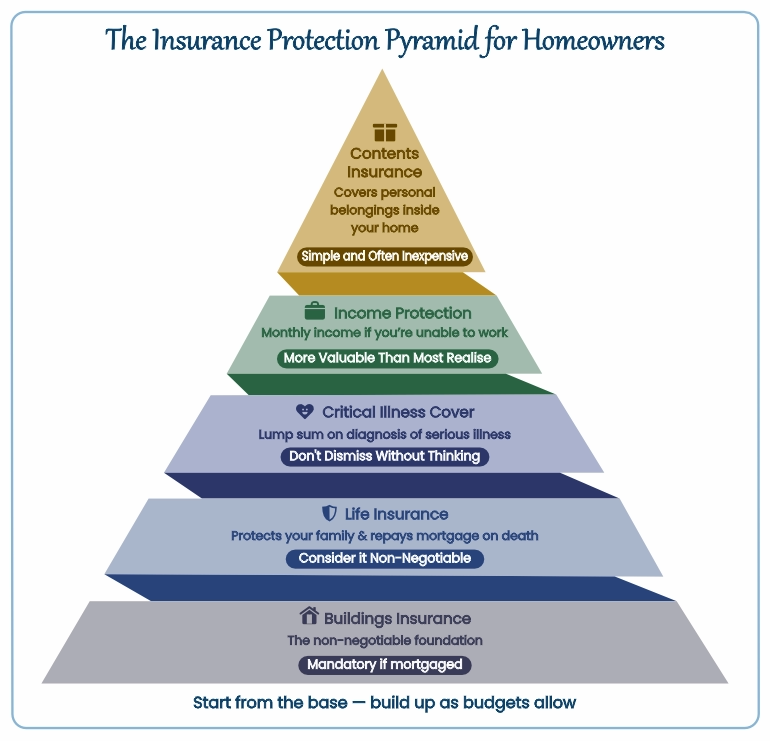
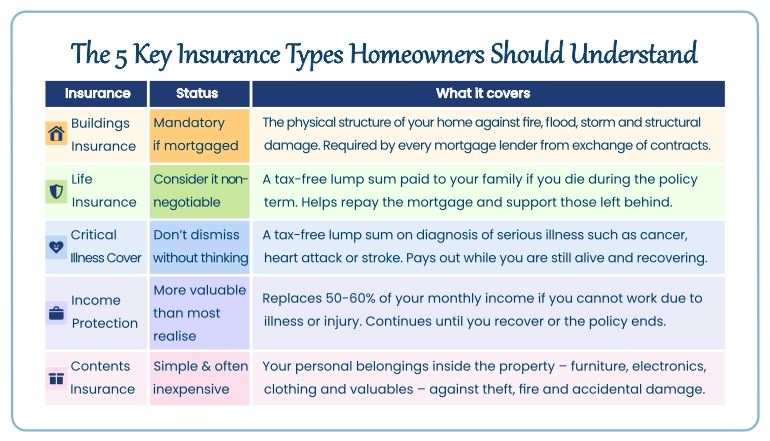
The short answer: Only one type of insurance is a legal requirement when you take out a mortgage — buildings insurance. Everything else is optional. That said, several types of protection are strongly worth considering, because they are designed to protect your family financially if something unexpected happens. Read on for a plain-English guide to each one.

Buildings Insurance — Mandatory if Mortgaged
If you are buying a property with a mortgage, buildings insurance is not optional — it is a condition of the mortgage itself.
The reason is straightforward: the property is the security against which the lender has provided the loan. If it were seriously damaged or destroyed by fire, flood, storm, or structural failure, the lender needs to know it can be repaired or rebuilt. Buildings insurance protects that security.
You will need to have this in place from exchange of contracts, and it must be maintained for the entire duration of the mortgage. This is the one insurance on this list that is a contractual requirement.
In practice, exchange of contracts cannot proceed without buildings insurance being confirmed — and it is one of the most common last-minute scrambles we see clients go through. Solicitors will not exchange until it is in place, and arranging it in a hurry at that stage adds unnecessary stress to what is already a busy and important day. Arranging buildings insurance early — ideally as soon as your mortgage offer is confirmed — avoids this entirely and is one less thing to worry about when exchange day arrives.
Life Insurance — Consider it Non-Negotiable
Life insurance pays a lump sum, free of income tax, to your family if you die during the policy term. It is not a legal requirement, but it is the protection product most worth prioritising when you take on a mortgage.
Without it, a surviving partner or family member could be left responsible for a large outstanding mortgage at an already devastating time. Life cover can help repay the remaining mortgage, support dependants financially, and reduce the burden on those left behind.
The best time to start is now — not later. Taking on a mortgage is the natural moment to review your protection needs. Up until this point, many people have no significant financial commitments. The moment a mortgage is in place, that changes — and the question of what happens to the surviving family if something unexpected occurs becomes very real.
In our experience, clients who put this off at the time of their mortgage — with every intention of coming back to it — rarely do. Life gets busy, a house move takes over, and protection quietly falls to the bottom of the list. Even taking a modest first step is far better than having no cover in place at all.
There is also a practical reason to act early: life insurance premiums are based on your age and health at the point of application. The younger and healthier you are when you start, the lower your premiums are likely to be — and those premiums are then locked in for the duration of the policy. As health conditions can emerge at any stage of life, delaying can mean paying more, facing exclusions, or in some cases finding cover more difficult to arrange.
We cover the timing of life insurance — including why starting early in the mortgage process matters — in detail in our dedicated article: Don’t Just Buy a Home — Protect It Too →
If you already have life cover through your employer, it is worth understanding what that does and does not cover — see the FAQ below.
If you already have an existing policy, it is worth asking whether it still reflects your current circumstances — a new mortgage, a growing family, or a change in income can all mean your existing cover needs revisiting. Read our guide to reviewing your life insurance →
Critical Illness Cover — Don't Dismiss Without Thinking
Critical illness cover pays a lump sum, free of income tax, if you are diagnosed with a serious condition such as cancer, heart attack, stroke, or major organ failure.
The key difference from life insurance is simple: you do not have to die to make a claim. Many people survive serious illness today — but the months of recovery, reduced ability to work, and loss of income can put enormous pressure on a household. Critical illness cover is designed to ease that pressure.
It tends to cost more than life insurance, so it may not be achievable at the level you would ideally want within every budget. Rather than ruling it out entirely, it is worth a conversation about what level of cover is realistic — even a modest amount can make a meaningful difference when it is needed most. Some policies also include automatic cover for dependent children at no additional cost.
Income Protection — More Valuable Than Most Realise
Income protection pays you a regular monthly income if you cannot work due to illness or injury. Think of it as replacing your salary while you recover.
Your mortgage does not pause because you are unwell. Statutory sick pay is limited, and employer sick pay often runs out faster than people expect. Income protection fills that gap.
Most policies replace around 50 to 60 percent of your income, and you choose how long to wait before payments begin — typically four, eight, or thirteen weeks. The longer the waiting period, the lower the monthly cost. This flexibility makes it more achievable for a wider range of budgets.
It is particularly worth considering if you are self-employed, a contractor, or the main earner in your household — where the consequences of being unable to work are felt most sharply. If this describes you, the question is less whether you need it and more whether you can afford not to have it.
Contents Insurance — Simple and Often Inexpensive
Contents insurance covers your personal belongings — furniture, electronics, clothing, and personal items — against theft, fire, and accidental damage. Mortgage lenders have no requirement for this, so it is entirely your decision. It is particularly worth considering if you are concerned about the risk of burglary or have expensive personal items such as jewellery, electronics, or valuables. Many people combine it with their buildings insurance, which is often convenient and cost-effective.
A Note on Getting the Balance Right
Choosing the right protection is a balancing act. The goal is never to take the most comprehensive policy regardless of cost — nor is it to skip cover entirely to keep outgoings low. Both extremes carry risk.
What matters is arriving at a level of cover that would genuinely make a difference if it were ever needed, at a premium that remains affordable month after month. That balance looks different for every household, and working through it carefully is something we do with every client.
Frequently Asked Questions
If you are purchasing a leasehold flat, buildings insurance is commonly arranged by the freeholder or managing agent and included within your service charge. It is worth confirming this at an early stage — ideally before exchange of contracts — so you are not duplicating cover or left uninsured. Always ask your solicitor or managing agent to confirm what is included.
There are several types of life cover, and the right one depends on your mortgage type and personal circumstances.
Level cover — the payout amount stays the same throughout the policy term. This is often used where the aim is to provide a lump sum for the family beyond just clearing the mortgage.
Decreasing cover — the level of cover reduces over time, broadly in line with a repayment mortgage balance. Because the cover reduces, it is generally the most cost-effective option for those whose primary goal is to ensure the mortgage is repaid.
Increasing cover — the cover grows gradually over time, usually linked to inflation. This helps ensure the real value of the payout does not erode over a long policy term.
Policies can also be arranged on a single life basis — covering one person — or a joint life basis, which covers two people under one policy and typically pays out on the first death. Your adviser can help you identify which structure makes most sense for your household.
Employer life insurance — often called death-in-service — is a valuable benefit, but it comes with limitations. You do not own the policy, the payout amount is typically a fixed multiple of salary rather than based on your mortgage or family needs, and the cover ends the moment you leave that employer. We always take workplace cover into account, but we generally recommend having your own policy as well — one that you own, that reflects your actual circumstances, and that stays with you regardless of where you work.
Not necessarily, but it is worth reviewing. If your existing policy was arranged before your current mortgage, it may not reflect the outstanding balance, your current income, or changes in your family situation. Taking on a new mortgage is one of the most common triggers for a policy review. Find out more about reviewing your existing cover →
This is one of the most common things we hear — and one of the most important to address honestly. Technically yes, but in practice it rarely happens. Once a mortgage completes, the focus shifts entirely to the house move, settling in, and managing the new financial commitments. Protection quietly moves to the back burner.
We recommend starting the conversation as soon as the mortgage application is submitted. Some insurers require GP reports or medical tests before they can confirm terms, and this process takes time. Starting early means you can have everything agreed and ready to begin from completion — and if you need to delay the policy start date for any reason, most insurers will accommodate this. Leaving it until after completion makes the whole process harder and more likely to be forgotten altogether.
It is natural to feel that serious illness is something that happens to other people. But the statistics suggest otherwise — around one in two people in the UK will be diagnosed with cancer at some point in their lifetime, and heart disease and stroke remain among the leading causes of working-age illness.
The question worth sitting with is not “will this happen to me?” — it is “if it did happen, what would the financial impact look like for my household?” Could your family maintain the mortgage payments if you were unable to work for six months? A year? Longer? Critical illness cover exists precisely for that scenario — not to predict misfortune, but to make sure that if it arrives, your family has financial breathing space while you focus on recovery.
Employer sick pay is a valuable benefit, but it is worth understanding exactly what it provides before assuming it is enough. Most employers offer full pay for a limited period — commonly one to three months — followed by statutory sick pay, which is currently a little over £100 per week. For someone with a mortgage, household bills, and a family to support, that gap can become serious very quickly.
It is also worth asking: what happens if you change jobs, become self-employed, or your employer’s sick pay policy changes? Income protection is yours — it is not tied to where you work, and it does not disappear when your circumstances change. A moment spent thinking through “what would our finances look like if I couldn’t work for six months?” is often all it takes to understand why this cover exists. It is not about expecting the worst — it is about making sure the worst does not become a financial crisis on top of everything else.
For many people, yes — and it is something that is often overlooked. Placing a life insurance policy under a trust means the payout goes directly to your chosen beneficiaries without forming part of your estate. This can avoid delays through probate and, in some cases, reduce inheritance tax liability. It is a straightforward step that costs nothing extra and can make a significant difference to how quickly and efficiently your family receives the money. Learn more about placing life insurance under a trust →

About the Author
Sekkappan Alagu is the Founder of Nachu Finance Ltd, established in 2006. With an early career in journalism and publishing, he brings clarity and structured thinking to complex financial topics. Through the Nachu Finance Blog and Knowledge Hub, he shares insights drawn from nearly two decades of client advisory experience, helping readers make informed decisions and understand best practices in mortgages, protection and long-term financial planning.

Business Profile
Nachu Finance Ltd is a directly authorised FCA-regulated firm providing mortgage, insurance and estate planning advice to clients across the UK. The firm takes a holistic approach — considering protection, tax efficiency and long-term planning alongside property finance — maintaining high regulatory standards while keeping advice clear and easy to follow. To learn more about the firm's background and story, visit the About Nachu Finance page.
Continue Strengthening Your Financial Protection