

Testmonials
Enquiry Form
Get in Touch with Us for Personalized Finance Assistance
I Have Life Insurance Through Work — Is That Enough?
- Date Published : September 10, 2026

The short answer: Employer life cover — usually called death in service — is a valuable benefit and you should make the most of it. But it is calculated on your salary rather than your family’s needs, it ends the day you leave, and it almost never gets reviewed. The balanced approach is to count it, reduce your own cover accordingly, and never rely on it alone.
“I already have cover through work” is one of the most common things we hear when life insurance comes up during a mortgage. It is a fair point — and often a good benefit. This article explains what death in service does well, where it falls short, and how we combine it with cover of your own so the foundation of your family’s financial plan doesn’t depend on where you happen to work.
First, credit where it’s due
We have never advised a client to ignore or under-use the life cover their employer provides. Death in service has real advantages:
- Lighter underwriting. Depending on the employer and the provider, group schemes usually involve far less individual health underwriting than a personal policy, which is assessed thoroughly on your own medical history. For anyone whose health would make personal cover expensive or unavailable, work cover can be the most valuable protection they hold. It is worth checking what your own scheme actually does — cover above a certain level is sometimes underwritten individually.
- Economies of scale. Whether the employer pays or you contribute, group cover is generally cheaper per pound of cover than a personal policy — and smokers in particular benefit, as personal premiums can be significantly higher.
- It lowers what you need to buy yourself. Every pound of work cover is a pound of personal cover you don’t have to pay for during your working years.
If your employer lets you increase your multiple for a modest contribution, it is usually worth doing. Our point is not “don’t rely on work cover”. It is “don’t rely on it alone”.
Do you know what you actually have?
Here is something we see constantly: clients can tell us to the pound how much personal life cover they took out, but very few can say how many times salary their work scheme pays. That tells you how little attention this benefit gets once the job starts.
Typical death in service pays three to five times salary. Three or four times is the norm; four and five times usually appear where the employee has opted in at extra cost or the employer uses it as a recruitment incentive. It is worth checking your contract or benefits portal today — and worth checking whether the additional items on your payslip are covered, or only your basic pay.
Where employer cover falls short
- It is based on your basic salary, not your family’s needs. A multiple of basic pay ignores your mortgage balance, other commitments, how many dependants you have and how old they are. It usually also ignores bonuses, overtime, stock options and any second income — so for many people the real gap between “what work pays out” and “what the family would need” is wider than the headline multiple suggests.
- It ends when your employment does. Change jobs, take a career break, reduce your hours, become a contractor or go self-employed and the cover stops. Exactly when it stops varies, so check your scheme’s cessation period or date. If your health has changed in the meantime, replacing it can be expensive or impossible.
- You don’t control it. The employer chooses the provider, the multiple and the scheme trust. You can usually nominate beneficiaries, but you cannot choose your own trustees, structure the trust around your estate planning, or adjust it as your family changes. Your employer can also change or reduce the scheme.
- It is set on day one and hardly ever reviewed. A personal policy gets reviewed when you buy a property, have a child or remortgage — because we are in touch at those moments. Work cover was decided when you signed your contract and, in our experience, is almost never revisited at the financial junctures that matter.
- It doesn’t lock anything in. A personal policy fixes your terms and premium at the point you apply, while you are young and healthy, for the whole term. Work cover gives you nothing to keep if you leave.
Employer cover vs your own cover — at a glance
| Employer death in service | Your own life cover | |
|---|---|---|
| How much | Fixed multiple of salary, usually basic pay only (typically 3–5×) | Sized to your mortgage, commitments and dependants |
| Who owns it | The employer’s scheme | You |
| If you leave your job | Ends — timing varies by scheme, check the cessation date | Continues unchanged |
| Underwriting | Group basis — usually lighter, and provider-dependent; larger amounts may be underwritten individually | Fully underwritten on your health — cheaper when young and healthy, and terms locked in |
| Trust and beneficiaries | Nomination only; scheme trustees decide | You choose the trust, trustees and beneficiaries |
| Reviewed when life changes | Rarely | At every mortgage, remortgage and family milestone |
| Cost to you | Free or low cost | Monthly premium — reduced by whatever work already provides |
| Best for | A valuable base layer, especially if health limits personal cover | The part of the foundation that stays with you |
The balanced approach
Life insurance sits at the base of the financial planning pyramid — everything else you build (savings, investments, pensions) assumes your family can keep the house and their standard of living if you are not there. It is too important to leave dependent on your employer’s payroll.
So our approach is simple:
- Count what work gives you. We record the multiple and the salary definition, and we treat it as real cover.
- Reduce your own cover accordingly. There is no sense paying for overlapping cover. Work cover brings your personal premium down.
- Never let it be the only layer. Your own policy, sized to the mortgage and the family, is the part that moves with you.
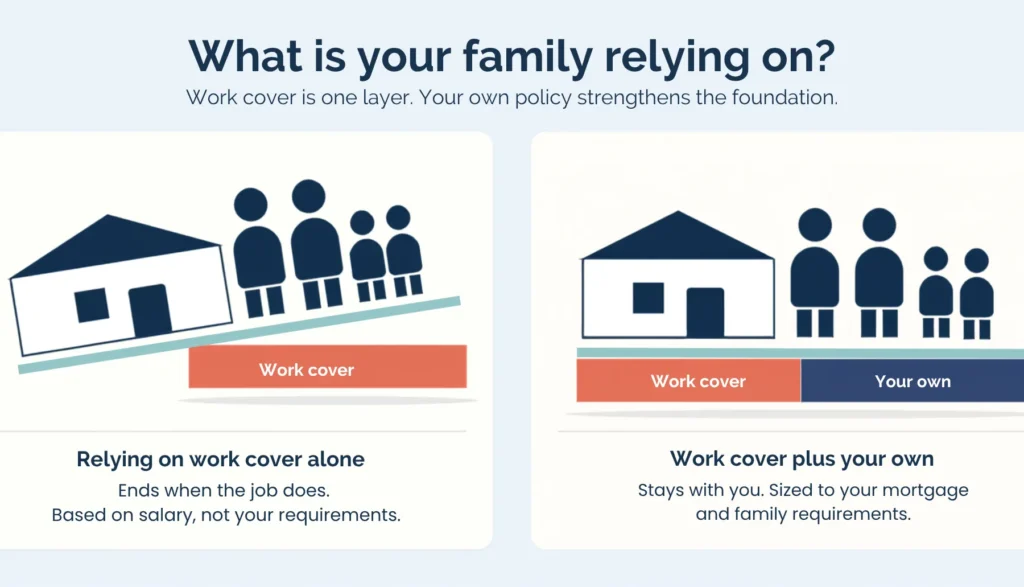
A top-up matters most if you have a residential mortgage, dependent children, or a household that relies heavily on your income. If you are self-employed or a contractor, there is no work layer at all — every part of your protection has to be arranged by you.
How much top-up? There is no formula. We size it to your individual circumstances — mortgage balance, other commitments, dependants and their ages, what work already provides and what you are comfortable paying. That is where personalised advice earns its place over a one-size-fits-all multiple.
Life changes. Work cover doesn’t come with you.
The scenario we see most often is the move from permanent employment to contracting or self-employment — particularly in IT, construction and among medical practitioners, where day-rate or locum work can be significantly more rewarding. The conversation is usually about income and tax. The death in service benefit gets noticed late, if at all.
By the time it does, the client is typically in their forties, may have a medical history that didn’t exist when they started their career, and is now paying full price for cover that could have cost a third as much had it been started at 25 and simply kept. For company directors there is a tax-efficient route — a Relevant Life Plan — but it still has to be arranged, and it is still underwritten on your health at that point.
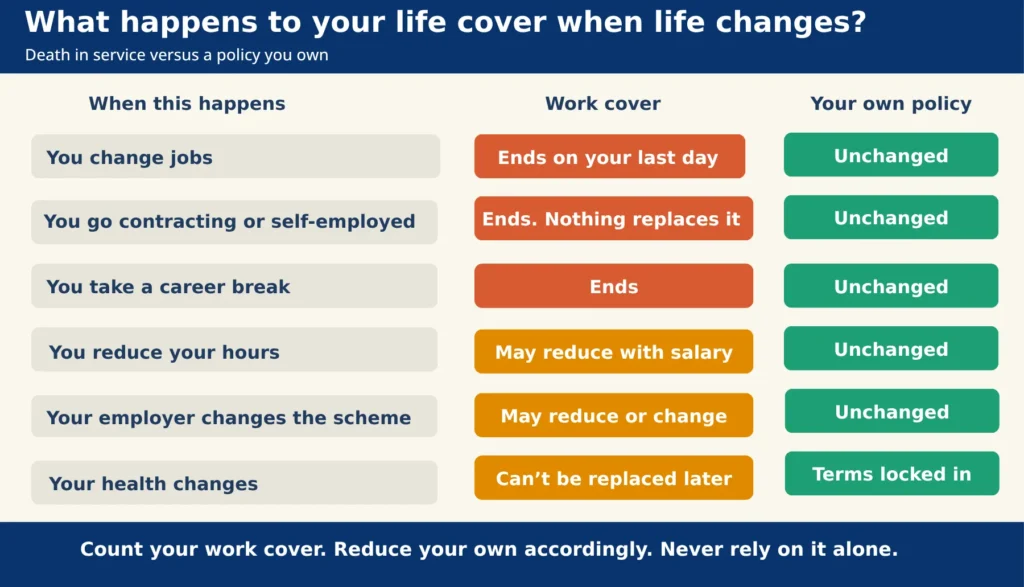
We saw exactly this with a client who moved to day-rate contracting within a year of buying his home. His death in service ended with the job, and we rebuilt his protection through his own limited company — one of several cases we set out in our
Life Insurance Review article
The estate planning angle
Because we also handle estate planning and have supported families through probate, we see what happens after a claim — not just at the point of sale. Death in service is usually paid through the employer’s discretionary trust and normally sits outside the estate for inheritance tax, so that is not the issue. Four other things stand out:
- Adequacy is only tested at the claim. This is the one that catches families out. A sum assured that felt sensible when the mortgage was arranged often turns out not to be enough to replace a breadwinner and let the family carry on as before. The real requirement is far more than the mortgage balance — let alone what an employer provides as a multiple of salary. By the time this becomes clear, nothing can be done about it.
- Liquidity for inheritance tax. Where IHT is due, it has to be paid before the grant of probate is issued, and within six months of the end of the month of death — yet the estate itself is locked until that grant comes through. A personal policy in trust can provide the cash so the family is not forced to sell, borrow or use their own savings.
- With your own policy you choose the trust, the trustees and the beneficiaries, and you can update them as children become adults or circumstances change. A work scheme gives you a nomination form, and the trustees decide.
- A personal policy written in trust pays out on proof of death, without waiting for probate. That money is often needed within weeks, not months.
Readmore: placing your life insurance under a trust and life insurance for inheritance tax planning
Real-life case studies
Names and some details have been changed to protect client confidentiality
Dinesh was the sole breadwinner for his family, with a son in the middle of his A-levels. When he bought the family home he had four times salary through work and initially felt that was enough. Given the mortgage balance, a dependent child and one income, we recommended an additional level cover of £500,000, written in trust.
He died unexpectedly a few years later. At that point the property was worth around £650,000 with a mortgage of about £425,000. His death in service paid four times his £80,000 basic salary — £320,000 — and the personal policy paid £500,000, immediately and outside the estate. Together, £820,000 cleared the mortgage and left a surplus for the family to replace his lost income.
Two years on, at our next review, his son had started his undergraduate course at a leading UK university. The family had carried on without financial disruption. Had the family relied on the work cover alone, it would not have cleared the mortgage, let alone supported them afterwards. And because the work cover existed, Dinesh had paid for a smaller personal policy than he otherwise would have — the balanced approach, working as intended.
Karthik, 43, had worked in IT for several years on a £72,000 salary with a generous 4.5× death in service — £324,000 of cover. During one of our regular reviews he mentioned an offer to move to a contract at £525 a day, five days a week: comfortably over £120,000 a year. Financially, an obvious move.
What hadn’t featured in his thinking was that the £324,000 would end with his employment. Replacing it with his own policy was quoted at around £96 a month on standard terms. But Karthik had a medical condition that had developed in the previous five or six years, and the best terms available carried a 50% loading — roughly £144 a month. Had he started a policy of his own at 25 and simply kept it, the premium would have been in the region of £30 a month, on standard terms, locked in for life.
He went ahead. The increase in income more than justified the cost. But it was a cost that only existed because the foundation had been left to the employer.
Richard originally held a Relevant Life Plan through his limited company. When he closed the business and moved into employment, his new employer provided death in service equal to four times salary. He wanted the same overall protection as before, with the new work benefit taken into account.
We carried out a full review, cancelled the Relevant Life Plan, and arranged personal cover sized to top up the work benefit to the level he was comfortable with — keeping his premium as low as the work cover allowed. Protection is not static: it should change as your employment does, and it needs an adviser who looks at every source of cover together.
Our Transparency Promise
Full Disclosure, Complete Peace of Mind
The right disclosure, from the start. A life policy is only worth having if it pays out. That depends on the application being accurate. Before we submit anything, we discuss your medical and lifestyle circumstances in detail and carry out a pre-application check so you know the terms you are likely to be offered — no surprises. With most insurers we can share a copy of the completed application with you to confirm every answer before it goes in. It is a little more work now, and it is how we keep the risk of non-disclosure at claim stage as low as it can be.
Let’s look at your cover from every angle
Life insurance is the foundation of any family’s financial plan, and it deserves more care than a benefits form filled in on your first day. At Nachu Finance we help families get on the property ladder and we help them through probate and estate planning — so we see life cover from both ends: what it costs to set up, and what it does when it is needed. And because we stay in touch through every mortgage, remortgage and family milestone, your cover does not sit untouched for twenty years — we keep reviewing it as your mortgage, your income and your family change.
Start your life insurance, or have your existing cover — including what you get through work — reviewed properly, and reviewed again as life moves on. Your first meeting with us is free of charge.
Frequently Asked Questions
For some households, yes. For most with a mortgage and dependants, it isn’t. The test is not the multiple; it is whether the payout would clear the mortgage and replace enough income for the family to carry on. We run that calculation with you and count the work cover in full before recommending anything.
No. Keep it, and increase it if your employer lets you do so cheaply. Your personal policy is sized around it.
It normally ends when your employment ends, though the exact cessation date varies by scheme. Some schemes offer a continuation option, but this is not guaranteed and it is not in your control — it depends on the terms of the employer’s scheme. If you are planning a move to contracting or self-employment, arrange your own cover before you resign, while you are still covered.
Yes. You can hold cover from several sources. When you apply for a personal policy you declare the cover you already have so the insurer can assess the total sensibly.
This is exactly where work cover earns its place — maximise it. We will then research the market for insurers likely to take a favourable view of your circumstances, and be honest with you about the likely terms before you apply. Some cover of your own, even at a modest level, is usually still worth having.
Most schemes are already written under the employer’s discretionary trust, and you complete a nomination form. That usually keeps the payout outside your estate, but you don’t choose the trustees or the terms, and nominations are easily forgotten. A personal policy lets you set the trust up the way your estate plan needs.

About the Author
Sekkappan Alagu is the Founder of Nachu Finance Ltd, established in 2006. With an early career in journalism and publishing, he brings clarity and structured thinking to complex financial topics. Through the Nachu Finance Blog and Knowledge Hub, he shares insights drawn from nearly two decades of client advisory experience, helping readers make informed decisions and understand best practices in mortgages, protection and long-term financial planning.

Business Profile
Nachu Finance Ltd is a directly authorised FCA-regulated firm providing mortgage, insurance and estate planning advice to clients across the UK. The firm takes a holistic approach — considering protection, tax efficiency and long-term planning alongside property finance — maintaining high regulatory standards while keeping advice clear and easy to follow. To learn more about the firm's background and story, visit the About Nachu Finance page.
Keep building the foundation