
Two doors labelled Personal Name and Limited Company

Testmonials

Enquiry Form

Get in Touch with Us for Personalized Finance Assistance

Please enable JavaScript in your browser to complete this form.
=

Buying a Buy-to-Let Property – Personal Name vs Limited Company Ownership

Two doors labelled Personal Name and Limited Company

A very common question from clients looking to invest in a buy-to-let property is whether it is better to purchase in a personal name or through a limited company.

The short answer is: there is no one-size-fits-all solution. The best structure depends on your individual circumstances, tax position, and long-term objectives. In this article, we’ll explore the broad considerations for each route – but before diving into the comparison, there are a couple of important points to clarify.

Before Anything Else – Understand the Responsibilities of Being a Landlord

Owning property as an investment is not the same as investing in stocks, bonds, or commodities. A buy-to-let comes with legal, financial, and moral responsibilities. These include ensuring the property is safe, compliant with regulations, and that tenants are treated fairly.

Before weighing up ownership structures, make sure you fully understand what being a landlord entails. Otherwise, you risk facing unwelcome surprises after completing your purchase.

👉 We’ve written a detailed article on this topic: The Realities of Buy-to-Let – What Every Landlord Needs to Know.

Personal Name Ownership – The Simpler Option

Buying a buy-to-let in your personal name is generally:

  • Simpler to set up and manage – no need to create and maintain a company structure.
  • Lower cost – ongoing compliance, accounting, and administration are minimal compared with a company.
  • Access to cheaper mortgage rates – lenders usually offer more competitive rates for personally owned properties.

The downside: personal ownership is often less tax efficient. Rental profits are taxed at your marginal income tax rate, and high earners can feel the impact of reduced mortgage interest tax relief.


Limited Company Ownership – The Tax-Efficient Route

Using a limited company (commonly set up as a Special Purpose Vehicle or “SPV”) has its advantages:

  • Tax efficiency – profits are subject to corporation tax, which may be more favourable depending on your income bracket.
  • Flexibility for reinvestment – easier to reinvest profits into future property purchases without incurring personal tax first.
  • Long-term planning – can allow for more efficient inheritance and capital gains planning.

The trade-offs include:

  • Setup and running costs – accountancy fees, compliance charges, bank fees, and Companies House filing obligations.
  • Mortgage considerations – limited company mortgage rates are usually higher than personal ones.
  • Director responsibilities – you will need to act as a director and comply with company law.
  • Personal guarantees – lenders typically require directors to give personal guarantees when borrowing through a limited company.

At a Glance – How Personal Name and Limited Company Ownership Compare

To help summarise the key differences, the infographic below provides a quick visual comparison of both routes.
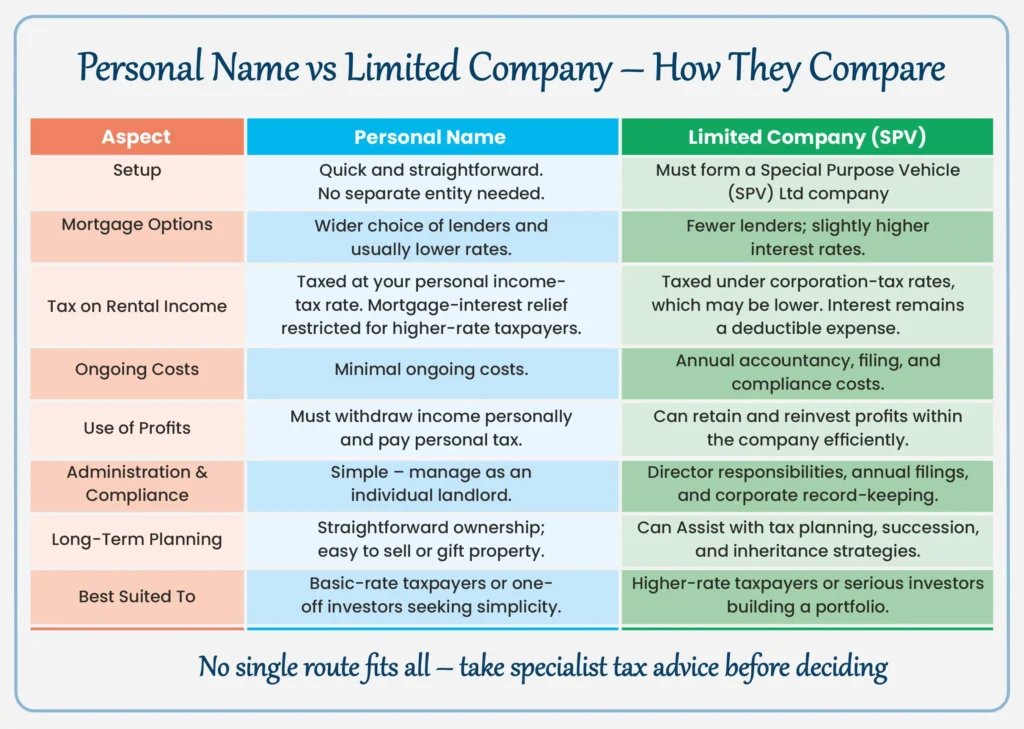
Table comparing personal name and limited company buy-to-let ownership

Important Distinction – Buying New vs Transferring Existing

This article focuses on the decision when purchasing a new buy-to-let property.

Transferring an existing personally owned property into a limited company is a separate subject. Such transfers often trigger stamp duty and capital gains tax, and can be expensive unless there is a strong reason.

👉 For more detail on this specific scenario, see: Transferring Property into a Limited Company.

When Might a Personal Name Make More Sense?

  • You are a basic rate taxpayer or have no other income.
  • You are buying a one-off buy-to-let rather than building a portfolio.
  • You want a simpler, lower-cost route with less paperwork and compliance.
  • You prefer access to lower mortgage interest rates.

When Might a Limited Company Make More Sense?

  • You are a higher rate or additional rate taxpayer.
  • You already run a trading limited company and have significant retained profits you wish to reinvest.
  • You are building a portfolio of buy-to-lets and plan to treat property as a serious long-term business.
  • You want more flexibility for tax planning and inheritance planning.

Additional responsibilities with a limited company include:

Below is a summary of the additional responsibilities landlords must meet when using a limited company structure.
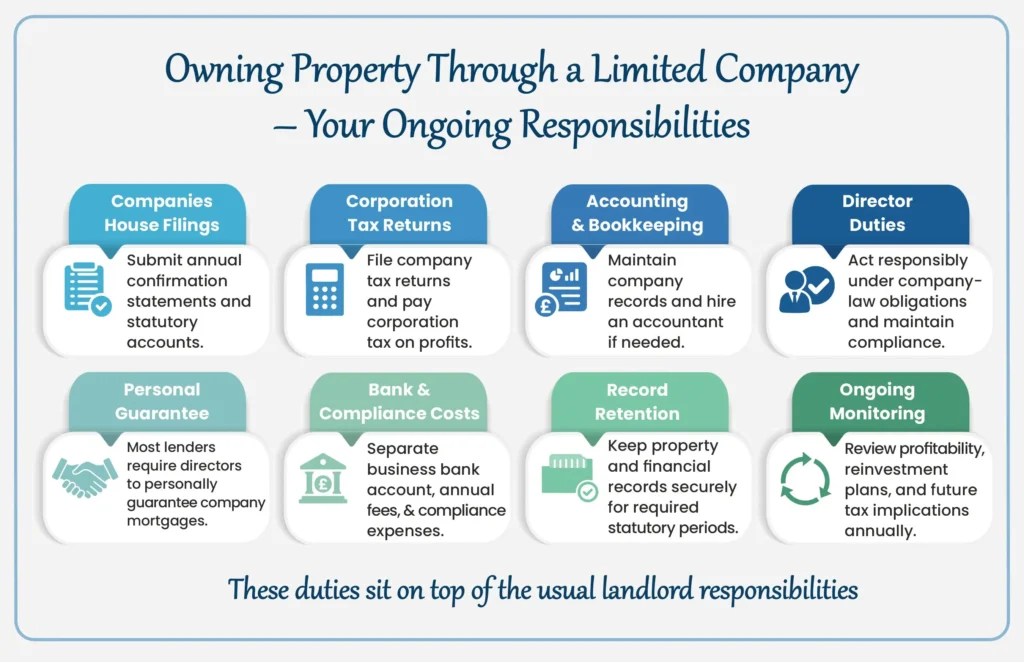
  • Annual filings with Companies House (confirmation statements, statutory accounts).
  • Corporation tax returns and ongoing accountancy costs.
  • Acting as a director/shareholder and ensuring compliance with company law.

Personal guarantees: even if the mortgage is in the limited company’s name, most lenders will require the directors to personally guarantee the loan. This means that if the company defaults, your personal assets may still be at risk.

Long-Term Objectives and Exit Strategy

Your end goal should influence the decision. For example:

  • If you plan to sell the property and cash out the gains, your tax route may look different in personal names versus a company.
  • If your plan is to retain and pass on the property, limited companies can sometimes help with inheritance planning and structuring shares.
  • If your plan is simply to earn rental income during retirement, personal names may be simpler and more cost-effective.

Choosing the right structure depends on a combination of factors. The infographic below outlines the key elements that typically influence what works best for each client
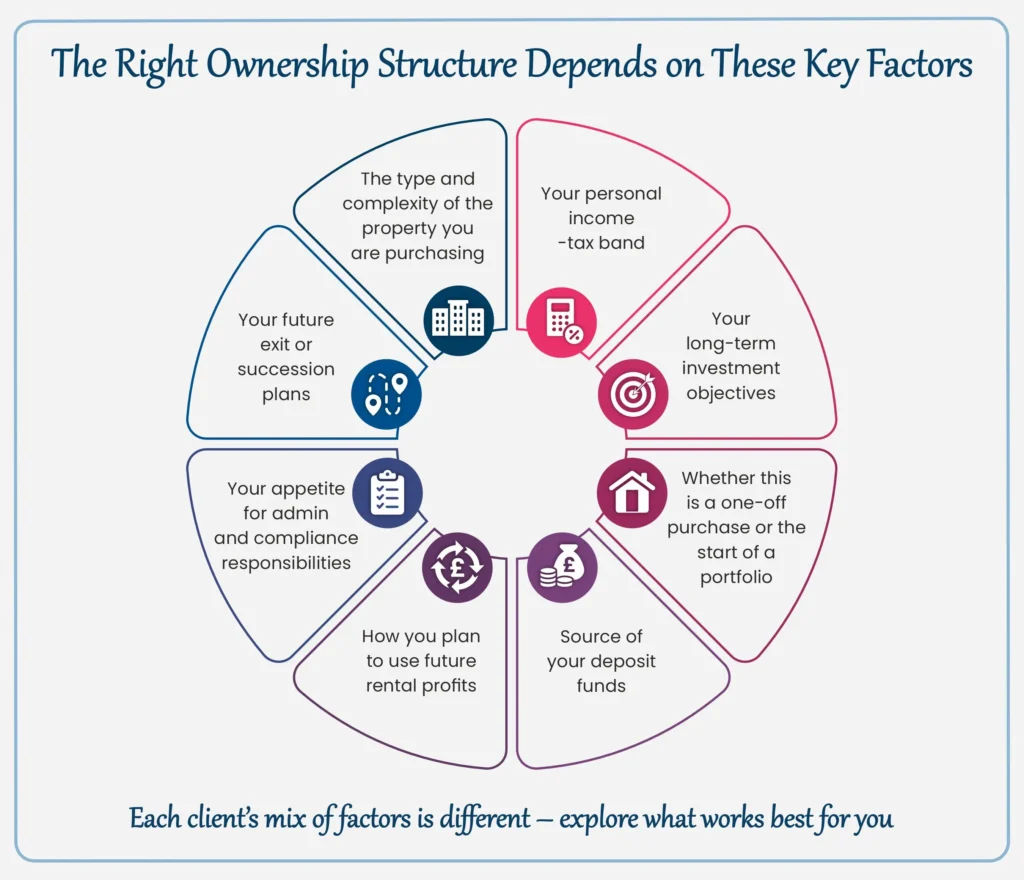
Circular diagram of factors influencing the choice of ownership structure

Real-Life Case Studies

The decision between purchasing a buy-to-let property in personal names or through a limited company depends heavily on each client’s individual circumstances.
Below are two real examples that highlight how different factors can lead to entirely different ownership structures, yet both outcomes were appropriate and efficient for the clients involved.

Balaji is a full-time NHS doctor and a higher-rate taxpayer. Nila is a homemaker with no personal income, and her long-term plan is to continue in this role. The couple received an inheritance from Nila’s parents and wanted to invest part of it into a single buy-to-let property located close to their main home. Their intention was simply to hold one additional property for future family needs, rather than building a wider portfolio or running a property business.

Given their objectives, their tax positions and the source of deposit, the couple sought tax advice and considered both ownership routes.
The outcome was clear: purchasing in personal names suited their circumstances best.

To reflect the origin of the deposit and to ensure the rental income was taxed more efficiently, they chose to own the property as tenants in common with unequal shares — 90 percent for Nila and 10 percent for Balaji.

This structure aligned with their financial objectives, long-term plans and family considerations.

For readers who wish to understand the difference between joint tenancy and tenants in common, we have explained this in detail here:
https://nachufinance.co.uk/joint-tenancy-vs-tenants-in-common/

Sai and Devi are married, both higher-rate taxpayers and both expecting to remain in well-paid full-time roles. Sai is an IT contractor operating through his own trading limited company, which had accumulated around £140,000 in retained profits. Their long-term aim was to build a small property portfolio over the years.

Because they were already higher-rate taxpayers and the deposit was coming from retained profits within a trading company, purchasing in personal names would have meant drawing funds as dividends and incurring additional personal tax.

After discussing their situation with their accountant and taking specialist tax advice, they decided that purchasing through a new limited company (SPV) was the more efficient and future-proof structure.
This allowed them to deploy the retained profits more effectively and positioned them better for expanding their property portfolio over time.

The two examples above demonstrate situations where one structure clearly made more sense than the other.
However, in many real-life scenarios, clients present a mix of factors — some favouring personal ownership and others favouring a limited-company route.

In such cases, the decision is not straightforward.
It often requires weighing up long-term objectives, tax considerations, deposit sources, income levels, portfolio intentions and administrative responsibilities before arriving at an informed and balanced choice.

Every client’s circumstances are different, and the most suitable structure is the one that aligns with their overall financial picture and future plans.

Our Transparency Promise

Multiple Professionals Are Involved in Getting This Right

Choosing whether to hold a buy-to-let property in your personal name or through a limited company is not a decision made in isolation.
Before finalising your route, you will usually need input from more than one professional:

  • A mortgage adviser to explain lending rules, interest-rate differences, and structuring requirements.
  • A qualified tax adviser to confirm how each option affects your personal tax position, long-term plans, and future liabilities.

While we can guide you on how each structure works from a property-finance perspective, we are not tax advisers, and tax planning sits outside the scope of mortgage advice.
Given the long-term consequences of choosing the wrong structure, we strongly recommend seeking independent, specialist tax advice before arriving at a final decision.

For more details on why specialist advice is crucial in these scenarios, see our article on
Specialist Property Tax Advice: https://nachufinance.co.uk/tag/specialist-property-tax-advice/

Our goal is to ensure you make a well-informed decision, and that all relevant professionals are involved where needed.

How Nachu Finance Supports Your Buy-to-Let Journey
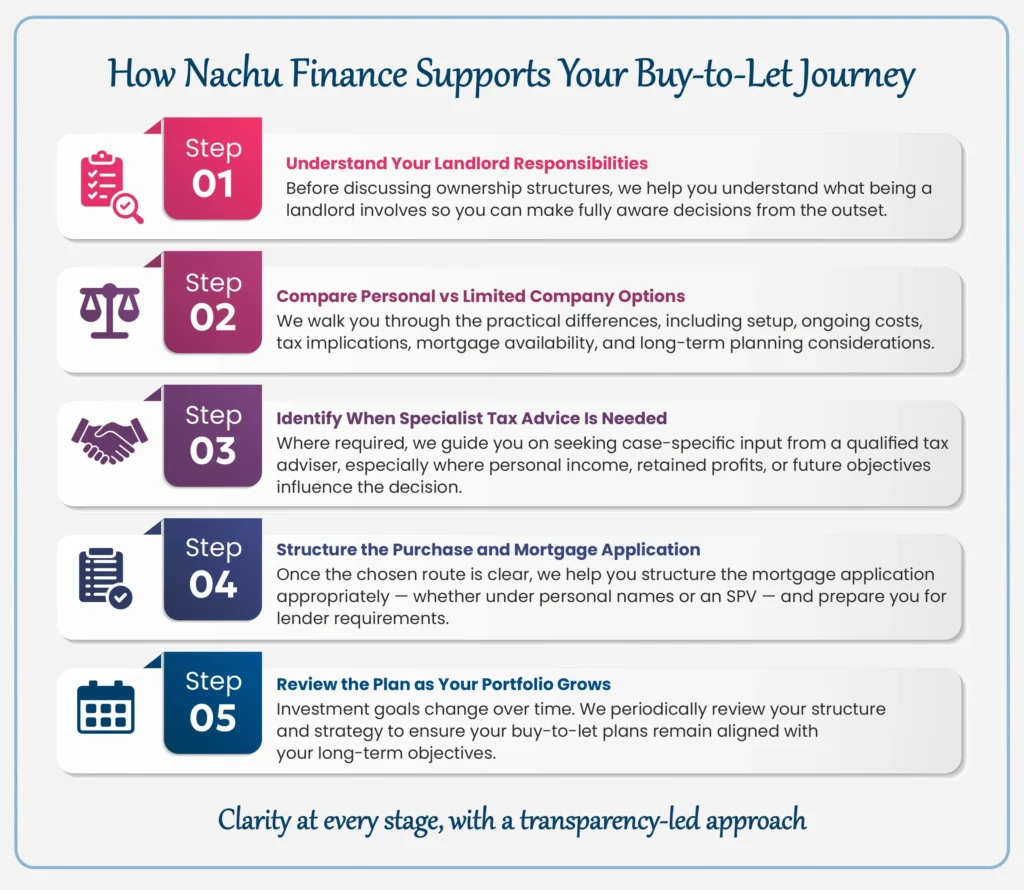
Five-step process for planning a buy-to-let, from landlord duties to review

At Nachu Finance, our role is to guide you through every stage of your buy-to-let planning with clarity and structure.

We start by ensuring you fully understand what it means to be a landlord, then help you compare the practical differences between personal ownership and using a limited company.

Where a tax specialist’s input is needed, we point you in the right direction so your decision is made with complete confidence.

Once the structure is clear, we help you position the mortgage application correctly and follow through with the paperwork, lender requirements and timelines. As your plans evolve, we continue to review your approach so your strategy remains aligned with your long-term goals.

Ready to Explore Which Structure Works Best for You?

At Nachu Finance, we understand that buying an investment property is a long-term commitment, and getting the structure right at the outset can make a meaningful difference over time. We are always happy to have an initial conversation, understand your goals and personal circumstances, and outline the available options in a clear and transparent way.

Where required, we can also refer you to experienced tax specialists so you receive the right guidance from all relevant professionals.

If you are planning a purchase, weighing up your options, or would simply like to talk through the considerations, feel free to reach out. We will be glad to guide you and support you at every stage.

Frequently Asked Questions

No, not all lenders offer mortgages to limited companies. However, more and more lenders—including well-known high-street names such as Birmingham Midshires, Coventry Building Society and The Mortgage Works—are now active in this space.
It is fair to say the choice is still more limited compared with personal-name mortgages, but as limited-company structures become more popular with landlords, the number of lenders willing to lend to SPVs continues to grow.
Criteria and flexibility vary significantly between lenders, so understanding who supports what structure is important before finalising your route.

Generally speaking, yes.
Limited-company mortgage rates tend to be slightly higher than equivalent products in personal names.
However, the interest rate should not be looked at in isolation.
A limited company can offer potential tax advantages and reinvestment benefits which, depending on your circumstances, may outweigh the slightly higher cost of borrowing.
The decision should therefore be based on the overall position and long-term outcomes, not the rate alone.

Yes, you can.
The limited company simply acts as the legal “envelope” for the mortgage. All due diligence—identity checks, credit checks, income verification, deposit evidence and background assessments—is still performed on you as the applicants.
Because of this, lenders are generally comfortable with:

  • a newly incorporated SPV, or
  • a company that will be set up shortly before the mortgage application is submitted.

A new company is not a negative point and does not reduce your chances of obtaining a mortgage.

In most cases, yes.
Although the property is owned by the limited company, lenders usually require all directors and shareholders to provide a personal guarantee.
This means you remain personally responsible if the limited company fails to meet the mortgage obligations.
Additionally, lenders often require you to take independent legal advice before signing the personal-guarantee documents, because the guarantee creates obligations separate from the company.

Often yes, but the way you structure this makes a significant difference.
If the property is purchased in your personal name, you would first need to withdraw the funds from the trading company and pay any tax due on the withdrawal (for example, dividend tax). Only then can the funds be used as your personal deposit.
However, if the property is purchased through a limited company SPV, there may be more efficient options, such as:

  • inter-company loans, or
  • structuring the SPV as a subsidiary of your trading company.

These options can avoid unnecessary tax leakage and allow efficient use of retained profits. Because the tax implications vary widely, this is an area where specialist tax advice is strongly recommended.

Generally speaking, no. Only a small number of lenders accept gifted deposits under a limited-company structure

Most lenders do not permit gifted deposits when buying through a limited company.
Gifted deposits are far more commonly accepted for:

  • residential property purchases, and
  • buy-to-let purchases in personal names.

If using a gifted deposit forms part of your plan, it is essential to confirm lender acceptance before progressing too far.

In theory, yes — but in practice, most lenders prefer not to lend to active trading companies.
Only a handful of lenders will consider a mortgage where the borrowing entity is a trading business, and the choice of products is very limited.
Setting up a separate Special Purpose Vehicle (SPV) specifically for property investment generally:

  • keeps borrowing cleaner,
  • simplifies lender due diligence,
  • avoids mixing trading activity with property assets, and
  • ensures a wider choice of lenders and mortgage products.

Yes, it is possible and you should consider.
Whether you are a first-time landlord or an experienced investor, the considerations remain the same:

  • your tax position,
  • your long-term investment plans,
  • the source of your deposit,
  • your comfort with administrative responsibility, and
  • whether you intend to build a portfolio.

Being a first-time landlord does not restrict you from using a limited company; it simply means the need to understand both options clearly is even more important.

In many cases, yes.
Some lenders do allow both adult and minor children to hold shares in a property SPV.
However, every lender applies its own criteria regarding:

  • acceptable ages,
  • maximum shareholding percentages, and
  • any responsibilities or limitations placed on younger shareholders.

If involving your children forms part of your long-term strategy, this should be discussed at the outset so that a suitable lender can be identified.

A limited company, on its own, is not an inheritance-tax or succession-planning solution.
While shareholding allows some flexibility in how interests are held or transferred, this does not automatically reduce inheritance tax or solve estate-planning needs.

Inheritance Tax planning is a separate and specialist area, and decisions about property ownership should be reviewed together to get the full picture.

If you buy a buy-to-let in your personal name, then when you go on to buy your residential property, it will be treated as an additional property, and the 5% additional stamp duty will apply. You will not be considered a first-time buyer.
If you buy the buy-to-let through a limited company, your personal first-time buyer status is not affected, provided you do not personally own any property.

Yes.
Regardless of whether this is the company’s first property or whether the company has only just been formed, the 5% additional stamp duty surcharge automatically applies to all limited-company residential property purchases.

In practice, no.
The tax rules — including ATED (Annual Tax on Enveloped Dwellings) — and higher stamp duty make it uneconomical for an individual to buy their own home through a limited company.

In addition, mortgage lenders do not offer residential mortgages to limited companies for owner-occupied properties.
For these reasons, a limited-company structure is used only for buy-to-let properties, not residential homes for personal occupation.

Picture of About the Author

About the Author

Sekkappan Alagu is the Founder of Nachu Finance Ltd, established in 2006. With an early career in journalism and publishing, he brings clarity and structured thinking to complex financial topics. Through the Nachu Finance Blog and Knowledge Hub, he shares insights drawn from nearly two decades of client advisory experience, helping readers make informed decisions and understand best practices in mortgages, protection and long-term financial planning.

Picture of Business Profile

Business Profile

Nachu Finance Ltd is a directly authorised FCA-regulated firm providing mortgage, insurance and estate planning advice to clients across the UK. The firm takes a holistic approach — considering protection, tax efficiency and long-term planning alongside property finance — maintaining high regulatory standards while keeping advice clear and easy to follow. To learn more about the firm's background and story, visit the About Nachu Finance page.

Continue the Best Practices of Family Protection

Family walking home to their house — life insurance through work versus your own cover

Testmonials

Enquiry Form

Get in Touch with Us for Personalized Finance Assistance

Please enable JavaScript in your browser to complete this form.
=

I Have Life Insurance Through Work — Is That Enough?

Family walking home to their house — life insurance through work versus your own cover

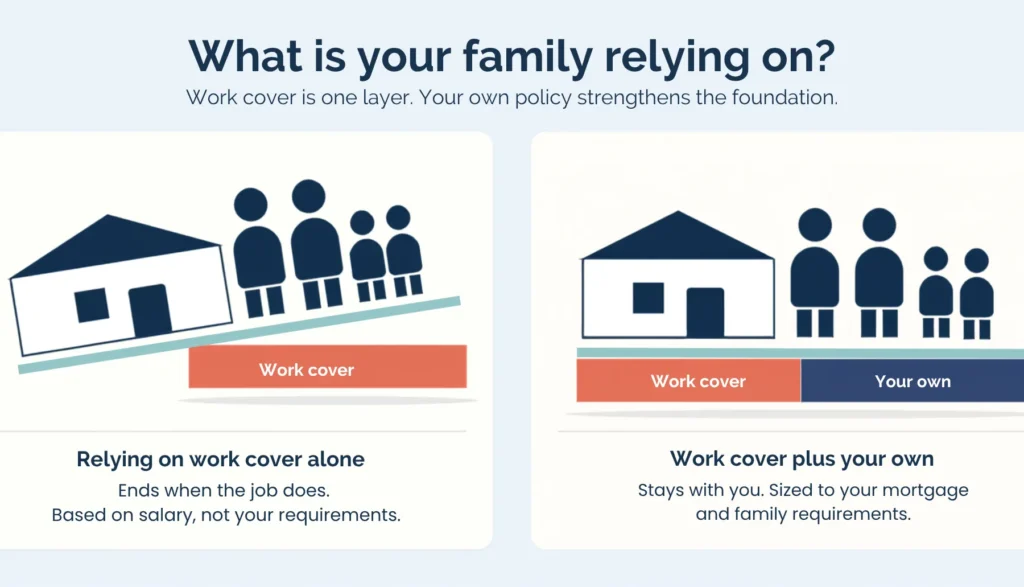
The short answer: Employer life cover — usually called death in service — is a valuable benefit and you should make the most of it. But it is calculated on your salary rather than your family’s needs, it ends the day you leave, and it almost never gets reviewed. The balanced approach is to count it, reduce your own cover accordingly, and never rely on it alone.

“I already have cover through work” is one of the most common things we hear when life insurance comes up during a mortgage. It is a fair point — and often a good benefit. This article explains what death in service does well, where it falls short, and how we combine it with cover of your own so the foundation of your family’s financial plan doesn’t depend on where you happen to work.

First, credit where it’s due

We have never advised a client to ignore or under-use the life cover their employer provides. Death in service has real advantages:

  • Lighter underwriting. Depending on the employer and the provider, group schemes usually involve far less individual health underwriting than a personal policy, which is assessed thoroughly on your own medical history. For anyone whose health would make personal cover expensive or unavailable, work cover can be the most valuable protection they hold. It is worth checking what your own scheme actually does — cover above a certain level is sometimes underwritten individually.
  • Economies of scale. Whether the employer pays or you contribute, group cover is generally cheaper per pound of cover than a personal policy — and smokers in particular benefit, as personal premiums can be significantly higher.
  • It lowers what you need to buy yourself. Every pound of work cover is a pound of personal cover you don’t have to pay for during your working years.

If your employer lets you increase your multiple for a modest contribution, it is usually worth doing. Our point is not “don’t rely on work cover”. It is “don’t rely on it alone”.


Do you know what you actually have?

Here is something we see constantly: clients can tell us to the pound how much personal life cover they took out, but very few can say how many times salary their work scheme pays. That tells you how little attention this benefit gets once the job starts.

Typical death in service pays three to five times salary. Three or four times is the norm; four and five times usually appear where the employee has opted in at extra cost or the employer uses it as a recruitment incentive. It is worth checking your contract or benefits portal today — and worth checking whether the additional items on your payslip are covered, or only your basic pay.

Where employer cover falls short

  1. It is based on your basic salary, not your family’s needs. A multiple of basic pay ignores your mortgage balance, other commitments, how many dependants you have and how old they are. It usually also ignores bonuses, overtime, stock options and any second income — so for many people the real gap between “what work pays out” and “what the family would need” is wider than the headline multiple suggests.

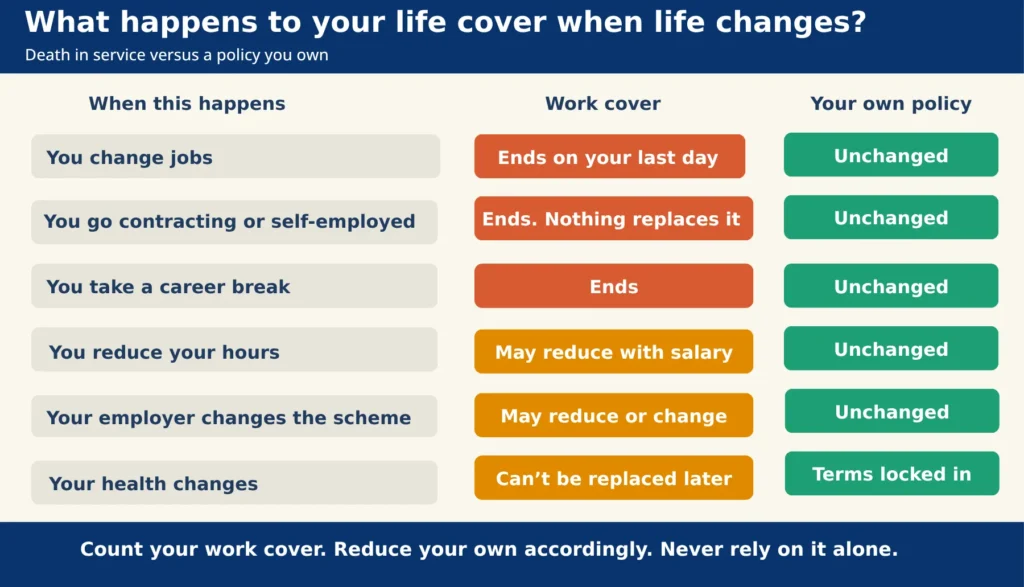
  2. It ends when your employment does. Change jobs, take a career break, reduce your hours, become a contractor or go self-employed and the cover stops. Exactly when it stops varies, so check your scheme’s cessation period or date. If your health has changed in the meantime, replacing it can be expensive or impossible.

  3. You don’t control it. The employer chooses the provider, the multiple and the scheme trust. You can usually nominate beneficiaries, but you cannot choose your own trustees, structure the trust around your estate planning, or adjust it as your family changes. Your employer can also change or reduce the scheme.

  4. It is set on day one and hardly ever reviewed. A personal policy gets reviewed when you buy a property, have a child or remortgage — because we are in touch at those moments. Work cover was decided when you signed your contract and, in our experience, is almost never revisited at the financial junctures that matter.

  5. It doesn’t lock anything in. A personal policy fixes your terms and premium at the point you apply, while you are young and healthy, for the whole term. Work cover gives you nothing to keep if you leave.

Employer cover vs your own cover — at a glance

 Employer death in serviceYour own life cover
How muchFixed multiple of salary, usually basic pay only (typically 3–5×)Sized to your mortgage, commitments and dependants
Who owns itThe employer’s schemeYou
If you leave your jobEnds — timing varies by scheme, check the cessation dateContinues unchanged
UnderwritingGroup basis — usually lighter, and provider-dependent; larger amounts may be underwritten individuallyFully underwritten on your health — cheaper when young and healthy, and terms locked in
Trust and beneficiariesNomination only; scheme trustees decideYou choose the trust, trustees and beneficiaries
Reviewed when life changesRarelyAt every mortgage, remortgage and family milestone
Cost to youFree or low costMonthly premium — reduced by whatever work already provides
Best forA valuable base layer, especially if health limits personal coverThe part of the foundation that stays with you


The balanced approach

Life insurance sits at the base of the financial planning pyramid — everything else you build (savings, investments, pensions) assumes your family can keep the house and their standard of living if you are not there. It is too important to leave dependent on your employer’s payroll.

So our approach is simple:

  • Count what work gives you. We record the multiple and the salary definition, and we treat it as real cover.
  • Reduce your own cover accordingly. There is no sense paying for overlapping cover. Work cover brings your personal premium down.
  • Never let it be the only layer. Your own policy, sized to the mortgage and the family, is the part that moves with you.
Infographic: a house and family resting on work cover alone versus work cover plus a personal life insurance policy

A top-up matters most if you have a residential mortgage, dependent children, or a household that relies heavily on your income. If you are self-employed or a contractor, there is no work layer at all — every part of your protection has to be arranged by you.

How much top-up? There is no formula. We size it to your individual circumstances — mortgage balance, other commitments, dependants and their ages, what work already provides and what you are comfortable paying. That is where personalised advice earns its place over a one-size-fits-all multiple.

Life changes. Work cover doesn’t come with you.

The scenario we see most often is the move from permanent employment to contracting or self-employment — particularly in IT, construction and among medical practitioners, where day-rate or locum work can be significantly more rewarding. The conversation is usually about income and tax. The death in service benefit gets noticed late, if at all.

By the time it does, the client is typically in their forties, may have a medical history that didn’t exist when they started their career, and is now paying full price for cover that could have cost a third as much had it been started at 25 and simply kept. For company directors there is a tax-efficient route — a Relevant Life Plan — but it still has to be arranged, and it is still underwritten on your health at that point.

death-in-service-when-life-changes.png Infographic: what happens to death in service cover versus your own policy when you change jobs, go self-employed, take a career break or your health changes

We saw exactly this with a client who moved to day-rate contracting within a year of buying his home. His death in service ended with the job, and we rebuilt his protection through his own limited company — one of several cases we set out in our
Life Insurance Review  article


The estate planning angle

Because we also handle estate planning and have supported families through probate, we see what happens after a claim — not just at the point of sale. Death in service is usually paid through the employer’s discretionary trust and normally sits outside the estate for inheritance tax, so that is not the issue. Four other things stand out:

  • Adequacy is only tested at the claim. This is the one that catches families out. A sum assured that felt sensible when the mortgage was arranged often turns out not to be enough to replace a breadwinner and let the family carry on as before. The real requirement is far more than the mortgage balance — let alone what an employer provides as a multiple of salary. By the time this becomes clear, nothing can be done about it.
  • Liquidity for inheritance tax. Where IHT is due, it has to be paid before the grant of probate is issued, and within six months of the end of the month of death — yet the estate itself is locked until that grant comes through. A personal policy in trust can provide the cash so the family is not forced to sell, borrow or use their own savings.
  • With your own policy you choose the trust, the trustees and the beneficiaries, and you can update them as children become adults or circumstances change. A work scheme gives you a nomination form, and the trustees decide.
  • A personal policy written in trust pays out on proof of death, without waiting for probate. That money is often needed within weeks, not months.

Readmore:  placing your life insurance under a trust  and  life insurance for inheritance tax planning

Real-life case studies

Names and some details have been changed to protect client confidentiality

Dinesh  was the sole breadwinner for his family, with a son in the middle of his A-levels. When he bought the family home he had four times salary through work and initially felt that was enough. Given the mortgage balance, a dependent child and one income, we recommended an additional level cover of £500,000, written in trust.

He died unexpectedly a few years later. At that point the property was worth around £650,000 with a mortgage of about £425,000. His death in service paid four times his £80,000 basic salary — £320,000 — and the personal policy paid £500,000, immediately and outside the estate. Together, £820,000 cleared the mortgage and left a surplus for the family to replace his lost income.

Two years on, at our next review, his son had started his undergraduate course at a leading UK university. The family had carried on without financial disruption. Had the family relied on the work cover alone, it would not have cleared the mortgage, let alone supported them afterwards. And because the work cover existed, Dinesh had paid for a smaller personal policy than he otherwise would have — the balanced approach, working as intended.

Karthik, 43, had worked in IT for several years on a £72,000 salary with a generous 4.5× death in service — £324,000 of cover. During one of our regular reviews he mentioned an offer to move to a contract at £525 a day, five days a week: comfortably over £120,000 a year. Financially, an obvious move.

What hadn’t featured in his thinking was that the £324,000 would end with his employment. Replacing it with his own policy was quoted at around £96 a month on standard terms. But Karthik had a medical condition that had developed in the previous five or six years, and the best terms available carried a 50% loading — roughly £144 a month. Had he started a policy of his own at 25 and simply kept it, the premium would have been in the region of £30 a month, on standard terms, locked in for life.

He went ahead. The increase in income more than justified the cost. But it was a cost that only existed because the foundation had been left to the employer.

Richard originally held a Relevant Life Plan through his limited company. When he closed the business and moved into employment, his new employer provided death in service equal to four times salary. He wanted the same overall protection as before, with the new work benefit taken into account.

We carried out a full review, cancelled the Relevant Life Plan, and arranged personal cover sized to top up the work benefit to the level he was comfortable with — keeping his premium as low as the work cover allowed. Protection is not static: it should change as your employment does, and it needs an adviser who looks at every source of cover together.

Our Transparency Promise

Full Disclosure, Complete Peace of Mind

The right disclosure, from the start. A life policy is only worth having if it pays out. That depends on the application being accurate. Before we submit anything, we discuss your medical and lifestyle circumstances in detail and carry out a pre-application check so you know the terms you are likely to be offered — no surprises. With most insurers we can share a copy of the completed application with you to confirm every answer before it goes in. It is a little more work now, and it is how we keep the risk of non-disclosure at claim stage as low as it can be.

Let’s look at your cover from every angle

Life insurance is the foundation of any family’s financial plan, and it deserves more care than a benefits form filled in on your first day. At Nachu Finance we help families get on the property ladder and we help them through probate and estate planning — so we see life cover from both ends: what it costs to set up, and what it does when it is needed. And because we stay in touch through every mortgage, remortgage and family milestone, your cover does not sit untouched for twenty years — we keep reviewing it as your mortgage, your income and your family change.

Start your life insurance, or have your existing cover — including what you get through work — reviewed properly, and reviewed again as life moves on. Your first meeting with us is free of charge.

Frequently Asked Questions

For some households, yes. For most with a mortgage and dependants, it isn’t. The test is not the multiple; it is whether the payout would clear the mortgage and replace enough income for the family to carry on. We run that calculation with you and count the work cover in full before recommending anything.

No. Keep it, and increase it if your employer lets you do so cheaply. Your personal policy is sized around it.

It normally ends when your employment ends, though the exact cessation date varies by scheme. Some schemes offer a continuation option, but this is not guaranteed and it is not in your control — it depends on the terms of the employer’s scheme. If you are planning a move to contracting or self-employment, arrange your own cover before you resign, while you are still covered.

Yes. You can hold cover from several sources. When you apply for a personal policy you declare the cover you already have so the insurer can assess the total sensibly.

This is exactly where work cover earns its place — maximise it. We will then research the market for insurers likely to take a favourable view of your circumstances, and be honest with you about the likely terms before you apply. Some cover of your own, even at a modest level, is usually still worth having.

Most schemes are already written under the employer’s discretionary trust, and you complete a nomination form. That usually keeps the payout outside your estate, but you don’t choose the trustees or the terms, and nominations are easily forgotten. A personal policy lets you set the trust up the way your estate plan needs.

Picture of About the Author

About the Author

Sekkappan Alagu is the Founder of Nachu Finance Ltd, established in 2006. With an early career in journalism and publishing, he brings clarity and structured thinking to complex financial topics. Through the Nachu Finance Blog and Knowledge Hub, he shares insights drawn from nearly two decades of client advisory experience, helping readers make informed decisions and understand best practices in mortgages, protection and long-term financial planning.

Picture of Business Profile

Business Profile

Nachu Finance Ltd is a directly authorised FCA-regulated firm providing mortgage, insurance and estate planning advice to clients across the UK. The firm takes a holistic approach — considering protection, tax efficiency and long-term planning alongside property finance — maintaining high regulatory standards while keeping advice clear and easy to follow. To learn more about the firm's background and story, visit the About Nachu Finance page.

Keep building the foundation

Life insurance review meeting with adviser checking policy documents to keep family cover up to date

Testmonials

Enquiry Form

Get in Touch with Us for Personalized Finance Assistance

Please enable JavaScript in your browser to complete this form.
=

Life Insurance Review: Why You Should Revisit Your Existing Policies

Life insurance review meeting with adviser checking policy documents to keep family cover up to date

Life insurance, critical illness cover, and income protection are essential pillars of family protection. Yet, once policies are in place, many people rarely revisit them.
At Nachu Finance, we believe a periodic review of your existing life insurance can make all the difference — ensuring your cover remains relevant, accessible, and effective when your family needs it most.

Make Sure the Policy Is Accessible

Before anything else, ensure that your family knows what policies you hold, who the providers are, and where to find the documents.

It is surprisingly common for families to be unaware of the details of existing policies. If you find it difficult to locate your documents while everything is going well, imagine how challenging this could be during a crisis.
Keep your policies accessible — ideally in both digital and physical form — and make sure immediate family members or adult children know where to find them.

Place Your Policy Under a Trust

Placing a life insurance policy under a trust ensures that proceeds are paid quickly and tax-efficiently to your chosen beneficiaries.
If your policy isn’t already under a trust, we strongly recommend setting this up.

If it is already under a trust, ensure the trustees’ details are up to date — especially if children have now become adults or if any trustee is no longer suitable to act.

Read more in our related article: Why Your Life Insurance Policy Should Be Placed Under a Trust

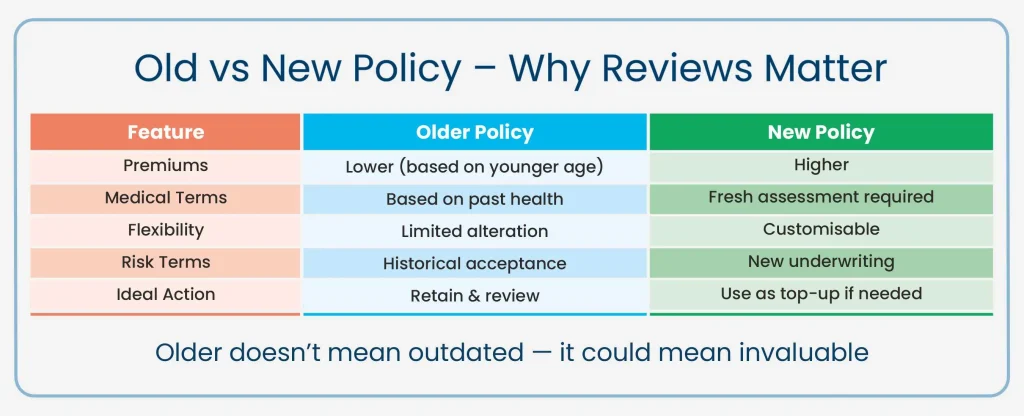
Older Policies: Hidden Gems Worth Keeping

Older life insurance plans can often be genuine hidden gems.
Premiums are based on your age and health at the time you apply, which means policies taken out years ago often benefit from significantly lower, locked-in premiums and medical terms that may no longer be available today.

Before cancelling, altering, or replacing an existing policy, it is essential to seek professional advice. At Nachu Finance, we review older policies with care to ensure they remain relevant to your current needs, and we rarely recommend cancelling them unless there is a clear and meaningful benefit.

Because premiums rise sharply with age, older plans can offer outstanding long-term value compared to arranging cover later in life. Our premium comparison chart by age clearly shows how starting early keeps costs lower for the entire duration of the policy — you can view it here Don’t Just Buy a Home-Protect It Too  for a clearer picture.

Extending or Increasing an Existing Policy

It is natural to wonder whether an existing policy can simply be extended to cover a longer term or increased to a higher amount.
In most cases, insurers will not allow an increase in cover or extension of the term without full medical reassessment, as this changes the original risk profile.

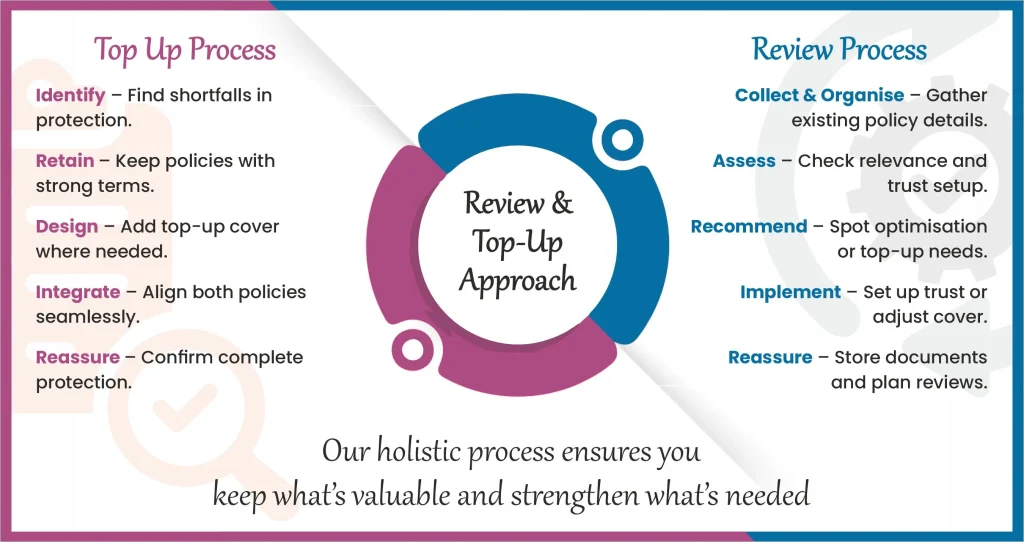
Our approach is to:

  • Keep your existing policy as it is.
  • Add a “top-up” policy for additional cover or a longer term if needed.

This way, you retain the advantages of your older policy while ensuring your family remains fully protected.

Ensuring Your Cover Is Still Relevant

Life events that call for a life insurance review including marriage, a new home, children and a change of employment

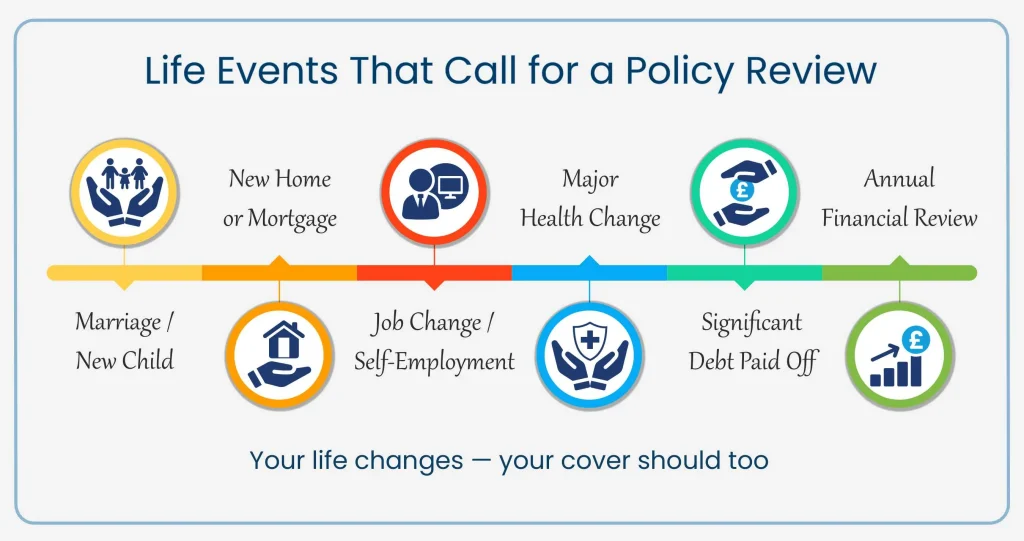
Life evolves — so should your insurance.
Events such as marriage, buying a new home, having children, or changes in employment (for instance, moving from employed to self-employed) all affect your protection needs.

A periodic review helps you check whether:

  • The level of cover matches your mortgage balance and family needs.
  • Your term still aligns with your working years.
  • Any employer benefits or other cover overlap with your personal policies.
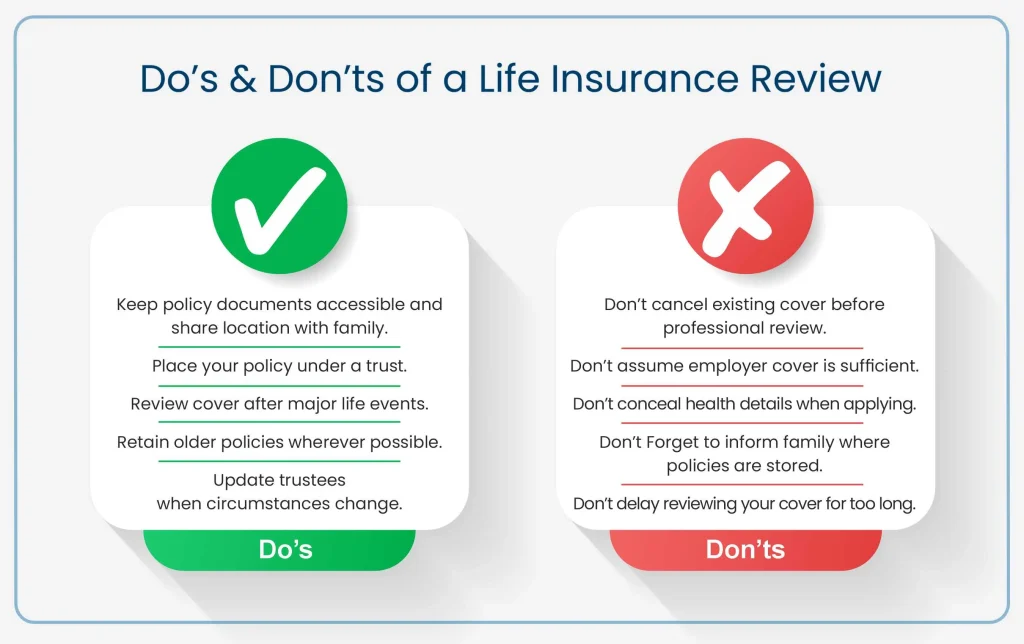
Alt text Dos and don'ts when reviewing an existing life insurance policy

Real-life Case Studies

Here are three real-life examples that show how a life insurance review can make a meaningful difference at different stages of life. Each case has a different outcome, but in every situation the review still proved to be the right and sensible step.

Ishan & Sitara

Ishan bought his first property in 2017 for £320,000 with a £250,000 mortgage. At the time, he took out £250,000 of life cover and £100,000 of critical illness cover in his sole name.

When he returned in 2023, he was now married to Sitara and the couple were buying a new family home for £610,000. During our review, we found that Ishan’s historic policies offered excellent terms and very competitive premiums, which would be hard to replicate today.

We therefore kept both existing policies in place, placed his life cover under a trust, and recommended top-up life cover to match his new financial responsibilities. Since Sitara had no protection at all, we also arranged suitable life and critical illness cover for her.

This is a textbook example of why older plans should not be cancelled automatically. With a review, the couple were able to:

  • retain valuable historic cover
  • place the policy under trust
  • top up protection to match their new life stage
  • ensure both partners were fully covered

Felix & Amy

Felix and Amy came to us in 2021 for a remortgage. They had originally purchased their home in 2015 and arranged their life insurance directly with the insurer at the time.

When we asked for their policy documents, they initially struggled to locate them — a common issue that becomes critical during a claim. After some effort, they shared a copy with us and also made sure their family knew where the documents were safely stored.

Following a full review, we concluded that their existing life and critical illness policies were still appropriate for their current circumstances. No top-up cover was needed, but we placed their existing plans under trust and securely stored copies of their documents in their client folder.

Although no new insurance was taken, the review still delivered meaningful benefits:

  • policy documents were located and securely stored
  • the family now knows exactly where to find them
  • the plans were placed under trust for efficient payout
  • reassurance that their existing cover remains fit for purpose

This case shows how valuable a review can be even when no policy changes are required.

Vivan & Rebecca

Vivan and Rebecca approached us around 11 months after their original life insurance was set up at the time of their property purchase. Both were employed when the policies were first taken out.

Within a year, Vivan had moved from employment into a day-rate contracting role through his own limited company. This meant he no longer received the death-in-service benefit he previously enjoyed from his employer.

During the review, we kept Rebecca’s policies unchanged, as her circumstances remained the same. For Vivan, we recommended restructuring his protection by:

  • cancelling his new-but-still-young personal life cover
  • replacing it with a Relevant Life Plan to benefit from significant tax efficiencies
  • increasing the level of life cover to reflect his new responsibilities and lack of workplace benefits

We also reviewed critical illness cover. Although a higher amount would have been sensible, Vivan decided not to increase it for now due to cost considerations.

This case highlights how a review can help align protection with changing employment circumstances — especially when moving to self-employment or contracting.

The Nachu Finance Way

Nachu Finance review and top-up approach keeping the existing life insurance policy and adding top-up cover where needed

At Nachu Finance, we appreciate that older policies can hold immense value.
When we review your existing cover, we:

  • Check if it remains suitable for your current family and financial circumstances.
  • Help optimise it — including setting up or updating the trust.
  • Securely store copies of your policies in your client file, so your family can easily access them in the event of a claim.
  • Review both policies arranged by us and those you arranged elsewhere.

Even if no changes are needed, the reassurance that your policy is still fit for purpose is a valuable outcome in itself.

Frequently Asked Questions

No. The insurer bases its terms on your health and lifestyle at the time of application.
Once the policy is live, there is no obligation to update them about later changes.

Yes. You can replace or add trustees at any time.
We always recommend reviewing the trustees during your periodic insurance review to ensure they are still appropriate and willing to act.

Yes. You can hold multiple policies with different providers.
At application, you must declare any existing cover so the insurer can assess your total cover amount correctly.

Absolutely.
For clients whose policies were arranged through us, claim support is fee-free.
We believe compassionate, expert help at such a crucial time is an essential part of our service.

Yes. Many people keep their older policies because they offer lower premiums and favourable terms, and simply add a top-up policy when their protection needs increase. This is completely normal, and it allows you to retain the benefits of your historic cover while ensuring your overall protection keeps pace with life changes.

Our Transparency Promise

Full Disclosure, Complete Peace of Mind

At Nachu Finance, we insist that all applications are made with full and honest disclosure of health, lifestyle, and smoking status.
We review every detail with you before submission, so the insurer receives accurate information.

We would rather an insurer take extra time to verify your details now than risk a claim being declined later for non-disclosure.
This careful approach protects your family’s peace of mind and ensures that your policy pays out when it matters most.

Let Us Review Your Policy

As holistic advisers, we see life insurance as a core part of family financial planning.
Our transparent, no-pressure approach means we’ll only recommend action when it’s genuinely in your favour.

Reach out to Nachu Finance for a free, transparent review of your existing life insurance.
We’ll give you an honest assessment and, if needed, help you:

  • Place the policy under a trust
  • Adjust or top-up your cover
  • Optimise your family’s protection for today and the years ahead
Picture of About the Author

About the Author

Sekkappan Alagu is the Founder of Nachu Finance Ltd, established in 2006. With an early career in journalism and publishing, he brings clarity and structured thinking to complex financial topics. Through the Nachu Finance Blog and Knowledge Hub, he shares insights drawn from nearly two decades of client advisory experience, helping readers make informed decisions and understand best practices in mortgages, protection and long-term financial planning.

Picture of Business Profile

Business Profile

Nachu Finance Ltd is a directly authorised FCA-regulated firm providing mortgage, insurance and estate planning advice to clients across the UK. The firm takes a holistic approach — considering protection, tax efficiency and long-term planning alongside property finance — maintaining high regulatory standards while keeping advice clear and easy to follow. To learn more about the firm's background and story, visit the About Nachu Finance page.

Continue the Best Practices of Family Protection

Why You Should Consider Placing Your Life Insurance Under a Trust

Life insurance policy document and trust concept illustration – placing life insurance in a trust to protect assets, reduce inheritance tax and control beneficiary payouts.

Let’s talk about life insurance. You’ve probably already taken the important step of getting a policy to protect your loved ones, but have you thought about the benefits of placing it under a trust? If not, don’t worry—you’re not alone! Many people aren’t aware of this option, but it can make a world of difference when it comes to ensuring your family gets the most out of your policy. Here’s why you might want to consider it:

Makes Claiming a Breeze

We all know life insurance is there to support your family after you’re gone, but wouldn’t it be great if they could get that support quickly and without hassle? By putting your policy under a trust, you’ve already sorted out ownership details ahead of time. This means that when the time comes, your loved ones only need to provide proof of your passing to claim the proceeds—no drawn-out legal processes required. This could mean your family gets the funds they need much faster, sometimes months sooner! Quick access to these funds can help cover immediate costs, like funeral expenses, or simply provide a financial cushion during a tough time.

Keep More Money in Your Family’s Pocket (And Out of the Taxman’s!)

Let’s face it—nobody likes taxes, especially when they reduce the inheritance you’ve worked hard to build for your loved ones. In the UK, for example, estates valued over a certain threshold can face an inheritance tax of up to 40%! Normally, life insurance payouts would be counted as part of your estate and could be subject to this hefty tax. But here’s the good news: if your policy is under a trust, the payout is usually kept outside your estate, which can save your family a big chunk of money.

And even if your estate still has to pay some inheritance tax, the payout from the trust can be a helpful way to cover that bill upfront—giving your family one less thing to worry about during an already difficult time.

You Decide Who Gets What—No Surprises!

One of the best things about setting up a trust for your life insurance is the control it gives you. You get to decide exactly who benefits from your policy and can even choose trusted individuals (called trustees) to make sure everything is managed according to your wishes. This means there’s no room for misunderstandings or disputes—just peace of mind knowing that your intentions will be honoured.

Simple, Straightforward, and Usually Free

If the word “trust” makes you think of complicated legal processes and high costs, think again! Setting up a trust for your life insurance policy is often much simpler than people expect. Most insurance companies offer a variety of trusts tailored to different needs, and setting one up typically involves just a few straightforward steps—selecting the trust type, naming your beneficiaries and trustees, and getting the necessary signatures. Best of all, this process is usually free and can be done for both new and existing policies.

The Bottom Line

Taking out life insurance is a smart move for anyone looking to provide financial security for their loved ones. But why not take it a step further? By placing your life insurance under a trust, you’re not just protecting your family—you’re making sure they have easy access to the funds, keeping more of your money in their pockets, and ensuring your wishes are followed to the letter. It’s a simple step that can make a big difference, so why not consider it?

Picture of About the Author

About the Author

Sekkappan Alagu is the Founder of Nachu Finance Ltd, established in 2006. With an early career in journalism and publishing, he brings clarity and structured thinking to complex financial topics. Through the Nachu Finance Blog and Knowledge Hub, he shares insights drawn from nearly two decades of client advisory experience, helping readers make informed decisions and understand best practices in mortgages, protection and long-term financial planning.

Picture of Business Profile

Business Profile

Nachu Finance Ltd is a directly authorised FCA-regulated firm providing mortgage, insurance and estate planning advice to clients across the UK. The firm takes a holistic approach — considering protection, tax efficiency and long-term planning alongside property finance — maintaining high regulatory standards while keeping advice clear and easy to follow. To learn more about the firm's background and story, visit the About Nachu Finance page.