
Stamp duty for home movers UK with removal van outside house – understanding SDLT costs when moving home.

Testmonials

Enquiry Form

Get in Touch with Us for Personalized Finance Assistance

Please enable JavaScript in your browser to complete this form.
=

Stamp Duty for Home Movers: How It Works and What to Consider

You’ve found your next home. You’ve accepted an offer on your current one. Then someone mentions stamp duty — and suddenly there’s a number on the table that nobody warned you about. 

For most people moving home, stamp duty is straightforward. But miss one detail — the wrong property sold, a deadline not met, or an assumption about the rules — and the cost can run into tens of thousands of pounds. 

This guide explains how stamp duty works for home movers, what qualifies you, how timing affects what you pay, and how refunds apply in practice. 

Stamp duty for home movers UK with removal van outside house – understanding SDLT costs when moving home.

Are You a Home Mover? What That Actually Means for Stamp Duty

Stamp duty broadly applies to buyers in three ways: first-time buyers (who may receive relief), home movers (standard rates), and additional property buyers (who pay a surcharge). 

If you’re moving from one home to another, you would expect to fall into the home mover category. However, that classification is not automatic. 

To qualify as a home mover, you must sell your current main residence and replace it with a new one. Simply selling any property you own is not enough. 

If you’d like a broader overview of how stamp duty applies across all buyer types, you can read our detailed guide on stamp duty explained — the three buyer categories. 

The property you sell must be your actual main home — not a buy-to-let, second home, or investment property. However, in practice, determining what counts as a “main residence” is not always straightforward. 

If you live in only one property, that will generally be your main residence. Where more than one property is involved, HMRC looks at the overall facts and circumstances to determine which one qualifies. This is not something you can nominate — it is based on objective evidence. 

Factors that may be considered include where your family lives, where children go to school, your place of work, where you are registered to vote, and which address is used for day-to-day living such as correspondence, council tax, and healthcare registration. No single factor is decisive — the overall picture is what matters. 

It is also important to note that simply occupying a property for a short period does not automatically make it your main residence. There needs to be a degree of permanence and expectation of continuity. 

When replacing a main residence, HMRC applies two tests. The property being sold must genuinely have been your main residence at some point, and the property being purchased must be intended to become your main residence at the time of purchase, even if occupation happens shortly afterwards. 

As these rules are based on HMRC guidance and applied to the specific facts of each case, determining what qualifies as a main residence can become complex, particularly where multiple properties or changing living arrangements are involved. For full detail, you can refer directly to HMRC’s guidance on this topic: 
https://www.gov.uk/hmrc-internal-manuals/stamp-duty-land-tax-manual/sdltm09812 

Where there is any uncertainty, it is advisable to seek guidance from a qualified tax professional to ensure the correct treatment. 

Understanding the 36-Month Rule

The 36-month rule is central to how stamp duty works for home movers when your sale and purchase do not happen at the same time. If you buy first, you must sell your previous main residence within 36 months of completing on your new purchase — the clock starts at completion, not at exchange or when you move in. If you sell first and then buy, there is no equivalent 36-month requirement. The rule only applies in one direction.

The Three Scenarios: Buy and Sell Timing Matters

In practice, there are three possible ways a home move can happen, and stamp duty treatment depends on which scenario applies. 

If your sale and purchase complete at the same time — typically as part of a property chain — you are treated as a home mover immediately, meaning only standard stamp duty rates apply and no surcharge is payable. However, being in a chain can introduce practical challenges around timing and dependency on other transactions. This is explored further in our article on options for breaking a property chain. 

If you sell your current home before buying your next one, the position remains straightforward from a stamp duty perspective. You will be treated as a home mover at the point of purchase, with no surcharge payable. However, this may involve additional practical considerations such as temporary accommodation or multiple moves. 

If you buy your new home before selling your existing one, you will temporarily own two properties. In this situation, HMRC treats you as an additional property buyer, meaning you will pay standard stamp duty plus the additional surcharge, which is currently 5% (increased from 3% in November 2024). You will then have 36 months to sell your previous main residence, after which you can claim a refund of the surcharge, provided all conditions are met. 

Worked Examples: How This Works in Practice

To bring this to life, the following two case studies illustrate how stamp duty applies in practice where the new home is purchased before the existing one is sold. In both scenarios, the additional stamp duty is paid upfront and later reclaimed once the previous main residence is disposed of within the permitted timeframe.

Case Study 1: Typical Home Mover (Simple Scenario)

Alex and Olivia (names changed) were living in a two-bedroom flat and decided to move to a three-bedroom house. The new property was purchased for £465,000 in September 2025, while their previous flat, valued at £240,000, was sold five months later in February 2026. 

At the point of purchase, they owned two properties and therefore paid both the standard stamp duty and the additional surcharge. The standard stamp duty on the purchase was £13,250, and they also paid an additional £23,250, representing 5% of the £465,000 purchase price. 

Once their previous main residence was sold within the required timeframe, they successfully claimed back the £23,250 additional stamp duty from HMRC. This meant their final net stamp duty cost remained at £13,250. 

This example illustrates a straightforward buy-first scenario where the additional stamp duty is a temporary cost. Provided the timelines are met and the correct property is sold, the final outcome reflects standard home mover treatment. 

Case Study 2: Higher Value and More Complex Scenario

Steve and Priya (names changed) owned multiple properties, including their main residence, and chose to purchase a new home valued at £2,000,000 in 2022 before selling their existing one. At the time, they paid standard stamp duty of £153,750 along with an additional 3% surcharge of £60,000. 

Following the purchase, they later transferred their former main residence into a limited company structure. For stamp duty purposes, this transfer was treated as a disposal, which meant the conditions for replacing their main residence were satisfied and the £60,000 surcharge was successfully reclaimed. 

As explored further in our article on transferring property from personal name to a limited company, this type of approach can work in certain scenarios but requires careful planning. The key point is that stamp duty treatment is driven by ownership — not how the property is used. 

Checklist: Getting It Right as a Home Mover

To ensure the correct stamp duty treatment, it is important to confirm which property qualifies as your main residence and to ensure that this is the property being sold. You should carefully track the 36-month timeline, keeping a clear record of both purchase and sale completion dates. 

Where multiple properties are involved, understanding your ownership structure becomes particularly important. If a refund is due, it should be claimed promptly once the relevant transaction has completed. In more complex situations, including those involving company ownership or unclear residence status, seeking professional advice is strongly recommended. 

The infographic below will provide an overview of the steps involved
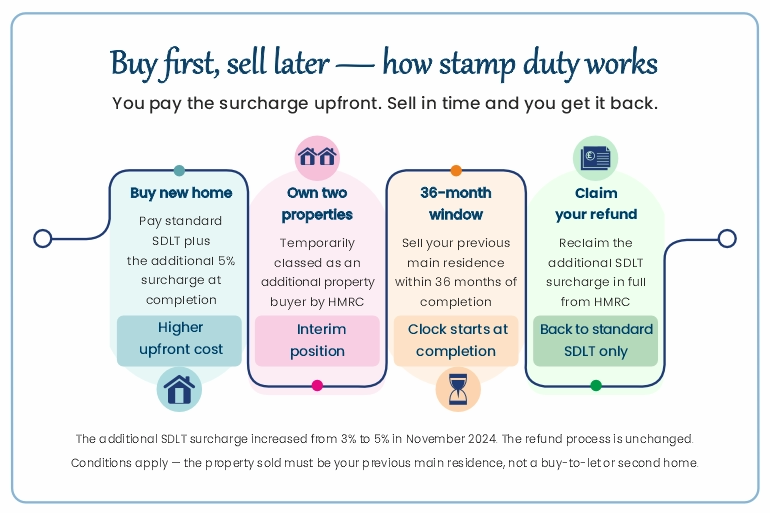
Stamp duty buy first sell later process UK showing 36-month window and surcharge refund rules for home movers.

Key Takeaways

You must replace your main residence, not simply sell any property you own. The timing of your transactions directly affects how stamp duty is applied, and the 36-month rule plays a critical role in determining whether a refund is available. Ownership — rather than usage — is what ultimately determines treatment. While many straightforward cases can be managed directly, more complex situations require careful planning and professional advice. 

Important Disclaimer

This article is for informational purposes only and does not constitute tax advice. It is designed to explain how stamp duty works in practical scenarios and to share illustrative examples. You should always carry out your own due diligence and consult a qualified tax professional before proceeding with any property transaction. 

Frequently Asked Questions

No. Stamp duty treatment is determined by ownership rather than usage. Whether the property is rented out, occupied by a family member, or left vacant does not affect eligibility. The key consideration is whether the property remains in your name. 

In certain circumstances, yes. If the property is transferred from your personal name to a limited company, ownership moves to a separate legal entity, which can count as a disposal for stamp duty purposes and allow a refund to be claimed. However, this must be assessed carefully, as the company itself may incur stamp duty on acquisition. As discussed in our article on transferring property from personal name to a limited company, this strategy is not always appropriate and depends on the wider tax position. 

If ownership of the property is transferred out of your name to a family member, this can be treated as a disposal for stamp duty purposes, meaning you may be able to claim a refund of the additional stamp duty paid. However, transferring property in this way brings wider tax and legal implications, including potential capital gains tax and inheritance tax considerations. It is important to take professional advice before proceeding. 

Where multiple properties are owned, HMRC applies specific rules to determine which one qualifies as your main residence. This is not always straightforward, particularly where more than one property is used at different times. In such situations, referring to HMRC guidance and seeking professional advice is recommended to ensure the correct treatment. 

Picture of About the Author

About the Author

Sekkappan Alagu is the Founder of Nachu Finance Ltd, established in 2006. With an early career in journalism and publishing, he brings clarity and structured thinking to complex financial topics. Through the Nachu Finance Blog and Knowledge Hub, he shares insights drawn from nearly two decades of client advisory experience, helping readers make informed decisions and understand best practices in mortgages, protection and long-term financial planning.

Picture of Business Profile

Business Profile

Nachu Finance Ltd is a directly authorised FCA-regulated firm providing mortgage, insurance and estate planning advice to clients across the UK. The firm takes a holistic approach — considering protection, tax efficiency and long-term planning alongside property finance — maintaining high regulatory standards while keeping advice clear and easy to follow. To learn more about the firm's background and story, visit the About Nachu Finance page.

Continue Strengthening Your Financial Understanding
Person holding a British passport with text saying valid only with your signature

Testmonials

Enquiry Form

Get in Touch with Us for Personalized Finance Assistance

Please enable JavaScript in your browser to complete this form.
=

Why You Must Sign Your British Passport Immediately

Person holding a British passport with text saying valid only with your signature

Your British passport is more than just a travel document-it’s a key form of identification. However, it is not valid until signed. Ensuring your passport is signed as soon as you receive it is essential for its validity, not just for travel but also for everyday identification purposes.

Why Signing Is Crucial

HM Passport Office specifies that an unsigned passport cannot be used for any purpose, including travel or official ID checks. Whether you’re opening a bank account, completing ID checks for a mortgage, or working with solicitors, your passport must have a signature to be considered valid.
As financial advisers, we can only accept signed passports when verifying your identity. The same applies to solicitors and mortgage lenders who will require a signed passport to complete ID checks. Without your signature, your passport will be rejected during these crucial processes.

Your Signature: The Official ID

The signature in your passport isn’t just a formality—it’s the official record of your signature. It will be referenced in numerous legal and financial situations, from signing contracts to verifying your identity. Ensuring it’s signed correctly is a simple step to avoid complications later.

How to Sign Your Passport

The process is straightforward but must be done carefully. Follow the official guidance from HM Passport Office to ensure your signature is valid and correctly positioned.

Your signature must be placed in the correct section of the passport. Refer to the example below to ensure it is properly completed.

UK passport identity page showing where to sign with X sign here highlighted

Best Practice

To avoid any inconvenience:

Taking a few moments to sign your passport now can save you significant hassle later. Don’t let an unsigned passport delay important processes like securing your dream home or completing financial transactions.

Let us know if you need expert guidance on financial matters or mortgage advice-Nachu Finance is here to support you every step of the way!

Picture of About the Author

About the Author

Sekkappan Alagu is the Founder of Nachu Finance Ltd, established in 2006. With an early career in journalism and publishing, he brings clarity and structured thinking to complex financial topics. Through the Nachu Finance Blog and Knowledge Hub, he shares insights drawn from nearly two decades of client advisory experience, helping readers make informed decisions and understand best practices in mortgages, protection and long-term financial planning.

Picture of Business Profile

Business Profile

Nachu Finance Ltd is a directly authorised FCA-regulated firm providing mortgage, insurance and estate planning advice to clients across the UK. The firm takes a holistic approach — considering protection, tax efficiency and long-term planning alongside property finance — maintaining high regulatory standards while keeping advice clear and easy to follow. To learn more about the firm's background and story, visit the About Nachu Finance page.

Other Useful Best Practices

Testmonials

Enquiry Form

Get in Touch with Us for Personalized Finance Assistance

Please enable JavaScript in your browser to complete this form.
=

Is Insurance Mandatory When Taking Out a Mortgage?

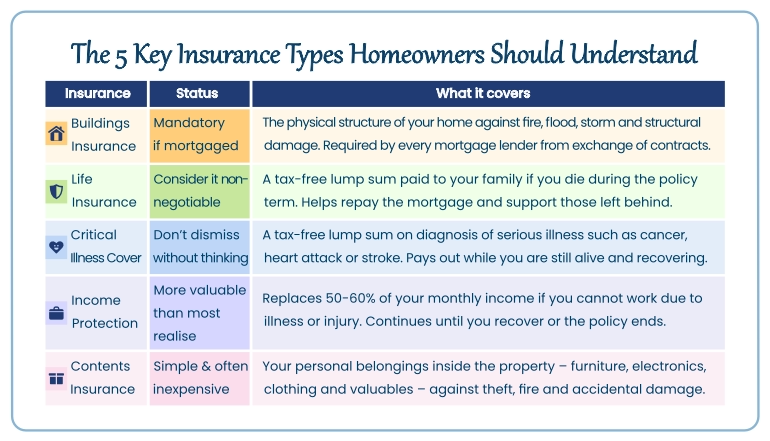
The short answer: Only one type of insurance is a legal requirement when you take out a mortgage — buildings insurance. Everything else is optional. That said, several types of protection are strongly worth considering, because they are designed to protect your family financially if something unexpected happens. Read on for a plain-English guide to each one. 

Is insurance mandatory for a mortgage UK – couple looking at open door representing mortgage protection and insurance decisions.

Buildings Insurance — Mandatory if Mortgaged

If you are buying a property with a mortgage, buildings insurance is not optional — it is a condition of the mortgage itself. 

The reason is straightforward: the property is the security against which the lender has provided the loan. If it were seriously damaged or destroyed by fire, flood, storm, or structural failure, the lender needs to know it can be repaired or rebuilt. Buildings insurance protects that security. 

You will need to have this in place from exchange of contracts, and it must be maintained for the entire duration of the mortgage. This is the one insurance on this list that is a contractual requirement.  

In practice, exchange of contracts cannot proceed without buildings insurance being confirmed — and it is one of the most common last-minute scrambles we see clients go through. Solicitors will not exchange until it is in place, and arranging it in a hurry at that stage adds unnecessary stress to what is already a busy and important day. Arranging buildings insurance early — ideally as soon as your mortgage offer is confirmed — avoids this entirely and is one less thing to worry about when exchange day arrives. 

Life Insurance — Consider it Non-Negotiable

Life insurance pays a lump sum, free of income tax, to your family if you die during the policy term. It is not a legal requirement, but it is the protection product most worth prioritising when you take on a mortgage. 

Without it, a surviving partner or family member could be left responsible for a large outstanding mortgage at an already devastating time. Life cover can help repay the remaining mortgage, support dependants financially, and reduce the burden on those left behind. 

The best time to start is now — not later. Taking on a mortgage is the natural moment to review your protection needs. Up until this point, many people have no significant financial commitments. The moment a mortgage is in place, that changes — and the question of what happens to the surviving family if something unexpected occurs becomes very real. 

In our experience, clients who put this off at the time of their mortgage — with every intention of coming back to it — rarely do. Life gets busy, a house move takes over, and protection quietly falls to the bottom of the list. Even taking a modest first step is far better than having no cover in place at all. 

There is also a practical reason to act early: life insurance premiums are based on your age and health at the point of application. The younger and healthier you are when you start, the lower your premiums are likely to be — and those premiums are then locked in for the duration of the policy. As health conditions can emerge at any stage of life, delaying can mean paying more, facing exclusions, or in some cases finding cover more difficult to arrange. 

We cover the timing of life insurance — including why starting early in the mortgage process matters — in detail in our dedicated article: Don’t Just Buy a Home — Protect It Too → 

If you already have life cover through your employer, it is worth understanding what that does and does not cover — see the FAQ below. 

If you already have an existing policy, it is worth asking whether it still reflects your current circumstances — a new mortgage, a growing family, or a change in income can all mean your existing cover needs revisiting. Read our guide to reviewing your life insurance → 

Mortgage insurance protection pyramid showing buildings insurance, life cover, critical illness and income protection for homeowners.

Critical Illness Cover — Don't Dismiss Without Thinking

Critical illness cover pays a lump sum, free of income tax, if you are diagnosed with a serious condition such as cancer, heart attack, stroke, or major organ failure. 

The key difference from life insurance is simple: you do not have to die to make a claim. Many people survive serious illness today — but the months of recovery, reduced ability to work, and loss of income can put enormous pressure on a household. Critical illness cover is designed to ease that pressure. 

It tends to cost more than life insurance, so it may not be achievable at the level you would ideally want within every budget. Rather than ruling it out entirely, it is worth a conversation about what level of cover is realistic — even a modest amount can make a meaningful difference when it is needed most. Some policies also include automatic cover for dependent children at no additional cost.

Income Protection — More Valuable Than Most Realise

Income protection pays you a regular monthly income if you cannot work due to illness or injury. Think of it as replacing your salary while you recover. 

Your mortgage does not pause because you are unwell. Statutory sick pay is limited, and employer sick pay often runs out faster than people expect. Income protection fills that gap. 

Most policies replace around 50 to 60 percent of your income, and you choose how long to wait before payments begin — typically four, eight, or thirteen weeks. The longer the waiting period, the lower the monthly cost. This flexibility makes it more achievable for a wider range of budgets. 

It is particularly worth considering if you are self-employed, a contractor, or the main earner in your household — where the consequences of being unable to work are felt most sharply. If this describes you, the question is less whether you need it and more whether you can afford not to have it. 

Contents Insurance — Simple and Often Inexpensive

Contents insurance covers your personal belongings — furniture, electronics, clothing, and personal items — against theft, fire, and accidental damage. Mortgage lenders have no requirement for this, so it is entirely your decision. It is particularly worth considering if you are concerned about the risk of burglary or have expensive personal items such as jewellery, electronics, or valuables. Many people combine it with their buildings insurance, which is often convenient and cost-effective. 

A Note on Getting the Balance Right

Choosing the right protection is a balancing act. The goal is never to take the most comprehensive policy regardless of cost — nor is it to skip cover entirely to keep outgoings low. Both extremes carry risk. 

What matters is arriving at a level of cover that would genuinely make a difference if it were ever needed, at a premium that remains affordable month after month. That balance looks different for every household, and working through it carefully is something we do with every client. 

Table comparing buildings insurance, life insurance, critical illness cover, income protection, and contents insurance with explanations of what each covers

Frequently Asked Questions

If you are purchasing a leasehold flat, buildings insurance is commonly arranged by the freeholder or managing agent and included within your service charge. It is worth confirming this at an early stage — ideally before exchange of contracts — so you are not duplicating cover or left uninsured. Always ask your solicitor or managing agent to confirm what is included. 

There are several types of life cover, and the right one depends on your mortgage type and personal circumstances. 

Level cover — the payout amount stays the same throughout the policy term. This is often used where the aim is to provide a lump sum for the family beyond just clearing the mortgage. 

Decreasing cover — the level of cover reduces over time, broadly in line with a repayment mortgage balance. Because the cover reduces, it is generally the most cost-effective option for those whose primary goal is to ensure the mortgage is repaid. 

Increasing cover — the cover grows gradually over time, usually linked to inflation. This helps ensure the real value of the payout does not erode over a long policy term. 

Policies can also be arranged on a single life basis — covering one person — or a joint life basis, which covers two people under one policy and typically pays out on the first death. Your adviser can help you identify which structure makes most sense for your household. 

Employer life insurance — often called death-in-service — is a valuable benefit, but it comes with limitations. You do not own the policy, the payout amount is typically a fixed multiple of salary rather than based on your mortgage or family needs, and the cover ends the moment you leave that employer. We always take workplace cover into account, but we generally recommend having your own policy as well — one that you own, that reflects your actual circumstances, and that stays with you regardless of where you work. 

Not necessarily, but it is worth reviewing. If your existing policy was arranged before your current mortgage, it may not reflect the outstanding balance, your current income, or changes in your family situation. Taking on a new mortgage is one of the most common triggers for a policy review. Find out more about reviewing your existing cover → 

This is one of the most common things we hear — and one of the most important to address honestly. Technically yes, but in practice it rarely happens. Once a mortgage completes, the focus shifts entirely to the house move, settling in, and managing the new financial commitments. Protection quietly moves to the back burner. 

We recommend starting the conversation as soon as the mortgage application is submitted. Some insurers require GP reports or medical tests before they can confirm terms, and this process takes time. Starting early means you can have everything agreed and ready to begin from completion — and if you need to delay the policy start date for any reason, most insurers will accommodate this. Leaving it until after completion makes the whole process harder and more likely to be forgotten altogether. 

It is natural to feel that serious illness is something that happens to other people. But the statistics suggest otherwise — around one in two people in the UK will be diagnosed with cancer at some point in their lifetime, and heart disease and stroke remain among the leading causes of working-age illness. 

The question worth sitting with is not “will this happen to me?” — it is “if it did happen, what would the financial impact look like for my household?” Could your family maintain the mortgage payments if you were unable to work for six months? A year? Longer? Critical illness cover exists precisely for that scenario — not to predict misfortune, but to make sure that if it arrives, your family has financial breathing space while you focus on recovery. 

Employer sick pay is a valuable benefit, but it is worth understanding exactly what it provides before assuming it is enough. Most employers offer full pay for a limited period — commonly one to three months — followed by statutory sick pay, which is currently a little over £100 per week. For someone with a mortgage, household bills, and a family to support, that gap can become serious very quickly. 

It is also worth asking: what happens if you change jobs, become self-employed, or your employer’s sick pay policy changes? Income protection is yours — it is not tied to where you work, and it does not disappear when your circumstances change. A moment spent thinking through “what would our finances look like if I couldn’t work for six months?” is often all it takes to understand why this cover exists. It is not about expecting the worst — it is about making sure the worst does not become a financial crisis on top of everything else. 

For many people, yes — and it is something that is often overlooked. Placing a life insurance policy under a trust means the payout goes directly to your chosen beneficiaries without forming part of your estate. This can avoid delays through probate and, in some cases, reduce inheritance tax liability. It is a straightforward step that costs nothing extra and can make a significant difference to how quickly and efficiently your family receives the money. Learn more about placing life insurance under a trust →

It can, and this is an area where many clients are surprised by how useful it can be. A life insurance policy written specifically for inheritance tax purposes can provide a lump sum to cover a potential tax liability, so your family does not have to sell assets — including the family home — to meet an HMRC bill. Read our guide to life insurance and inheritance tax planning → 
Picture of About the Author

About the Author

Sekkappan Alagu is the Founder of Nachu Finance Ltd, established in 2006. With an early career in journalism and publishing, he brings clarity and structured thinking to complex financial topics. Through the Nachu Finance Blog and Knowledge Hub, he shares insights drawn from nearly two decades of client advisory experience, helping readers make informed decisions and understand best practices in mortgages, protection and long-term financial planning.

Picture of Business Profile

Business Profile

Nachu Finance Ltd is a directly authorised FCA-regulated firm providing mortgage, insurance and estate planning advice to clients across the UK. The firm takes a holistic approach — considering protection, tax efficiency and long-term planning alongside property finance — maintaining high regulatory standards while keeping advice clear and easy to follow. To learn more about the firm's background and story, visit the About Nachu Finance page.

Continue Strengthening Your Financial Protection

Neon fraud alert sign — register free for Land Registry property alerts to protect against property fraud

Testmonials

Enquiry Form

Get in Touch with Us for Personalized Finance Assistance

Please enable JavaScript in your browser to complete this form.
=

Protect Your Property: Register for Free Land Registry Property Alerts

Property fraud is one of the most serious financial crimes homeowners face — and in many cases, victims don’t realise what has happened until significant damage is done. The bigger the asset, the greater the incentive for fraudsters. Your home or investment property could be targeted for title fraud, unauthorised mortgage applications, or ownership transfers made without your knowledge. The good news is that HM Land Registry offers a free, easy-to-use tool that keeps you informed of any significant activity against your property title — giving you the power to act before it’s too late.

Neon fraud alert sign — register free for Land Registry property alerts to protect against property fraud

Understanding HM Land Registry

HM Land Registry, established in 1862, is the government body responsible for registering land and property ownership across England and Wales. Beyond recording who owns what, it also maintains an up-to-date record of any loans secured against a property, including:
  • First charge — the mortgage used to purchase the property
  • Second charge and subsequent charges — any secured loans taken out after purchase
Any time there is a change in ownership or loan provider, the Land Registry must be updated. This applies to a wide range of transactions, including remortgaging your property, selling or transferring ownership, repaying or switching a secured loan, and taking out a new mortgage on a mortgage-free property. Keeping track of these updates is essential to preventing fraud — and this is precisely where the Property Alert Service becomes invaluable.

What Is the Property Alert Service?

The Land Registry’s Property Alert Service is a free notification tool that monitors activity on registered properties and alerts you by email whenever a significant change is applied or attempted. Whether you own one home or manage a property portfolio, you can register up to 10 properties per email address.

Once registered, you will be notified whenever key activities occur — such as an application to change ownership, a new charge being added, or an official search being submitted. If you receive an unexpected alert, you can report it directly to HM Land Registry for investigation.

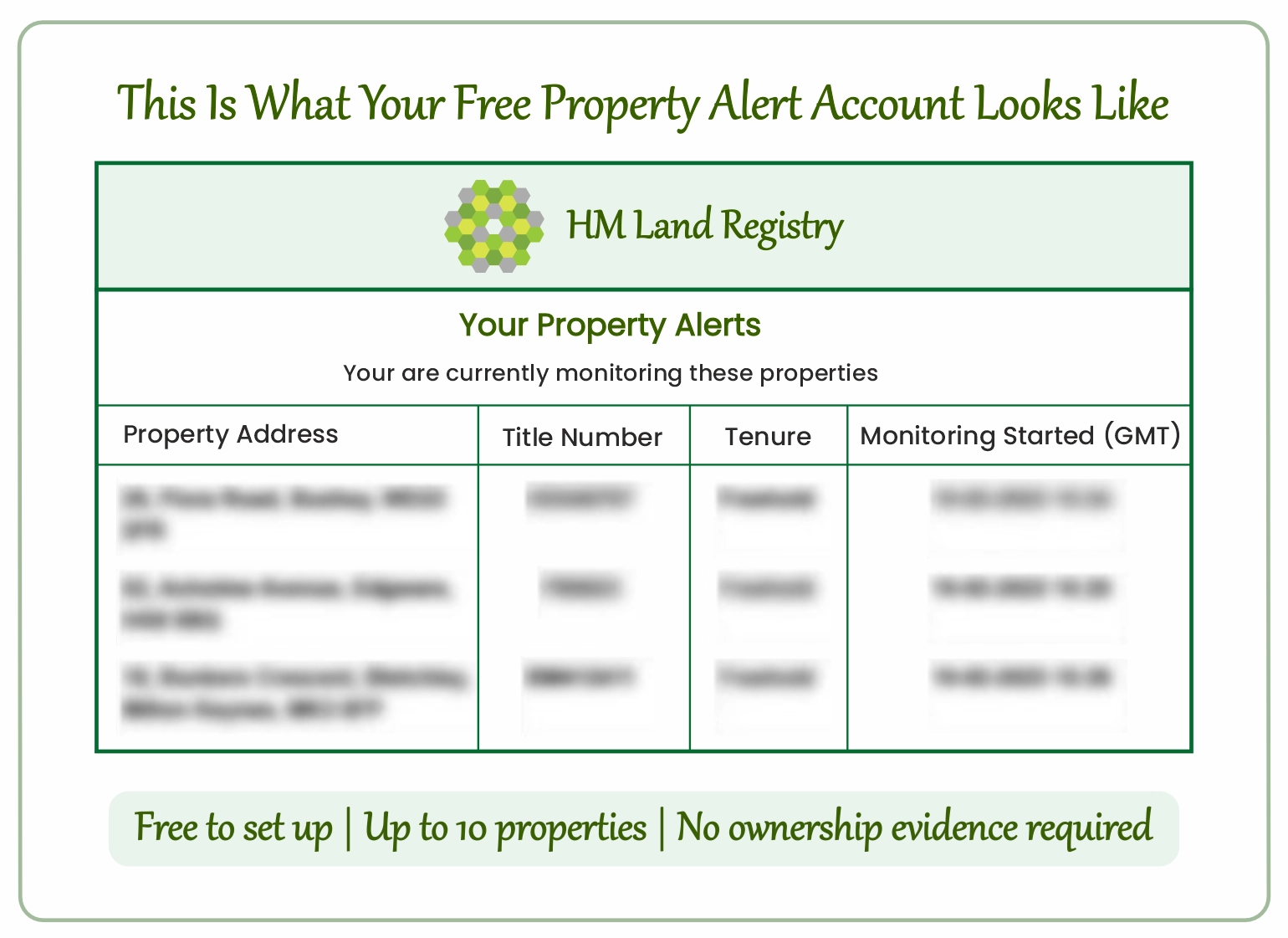
See below what your registered account dashboard will look like once you have set up your free property alerts:

Screenshot of an HM Land Registry property alert account
dashboard showing monitored properties with title number,
tenure and monitoring start date

Why You Should Register Now

There is no cost, no complex process, and no reason to delay. Registering takes under five minutes and requires minimal personal information — just your email address and the property address you wish to monitor. You do not even need to be the legal owner to register an alert, making it ideal for:
  • Homeowners wanting peace of mind on their primary residence
  • Landlords monitoring buy-to-let or investment properties — whether held personally or through a limited company
  • Family members keeping an eye on an elderly relative’s home
  • Executors or attorneys managing property on behalf of others
For landlords considering their ownership structure, it is worth noting that the alert service works equally well for buy-to-let properties held in a limited company as it does for personally owned properties. Regardless of how the title is held, you can register and receive alerts.

Useful to Know Before You Register

✔  Only the property address is required — no title number needed (it will be shown once registered)

✔  You can monitor up to 10 properties per email address

✔  Multiple people can register alerts for the same property

✔  New build properties can only be registered after the first purchase is completed and recorded

✔  Limited company-owned properties can be monitored

✔  You do not need to be the legal owner to register

✔  Notifications include official searches and applications related to the property

Take Action Today

Registering for Land Registry Property Alerts is one of the simplest and most effective steps you can take to protect your property from fraud. Whether you are a first-time homeowner or an experienced investor, staying informed about any changes to your property title gives you peace of mind and the ability to act swiftly when it matters most. Get started today at propertyalert.landregistry.gov.uk — it is free, straightforward, and takes just minutes.

How Nachu Finance Can Help

At Nachu Finance, we support clients at every stage of the property ownership journey — from securing the right mortgage to planning the long-term management and transfer of property assets. If you have questions about mortgage options or want to understand how estate planning can protect your property for future generations, our team is here to help. Get in touch today and we will be delighted to find the right solution for your needs.
Picture of About the Author

About the Author

Sekkappan Alagu is the Founder of Nachu Finance Ltd, established in 2006. With an early career in journalism and publishing, he brings clarity and structured thinking to complex financial topics. Through the Nachu Finance Blog and Knowledge Hub, he shares insights drawn from nearly two decades of client advisory experience, helping readers make informed decisions and understand best practices in mortgages, protection and long-term financial planning.

Picture of Business Profile

Business Profile

Nachu Finance Ltd is a directly authorised FCA-regulated firm providing mortgage, insurance and estate planning advice to clients across the UK. The firm takes a holistic approach — considering protection, tax efficiency and long-term planning alongside property finance — maintaining high regulatory standards while keeping advice clear and easy to follow. To learn more about the firm's background and story, visit the About Nachu Finance page.

Steps to Protect Your Property and Finances

Early Repayment Charges (ERC)

Testmonials

Enquiry Form

Get in Touch with Us for Personalized Finance Assistance

Please enable JavaScript in your browser to complete this form.
=

Early Repayment Charges (ERC) – Explained Simply

Early repayment charges ERC explained on chalkboard – mortgage exit fees and penalties for repaying early UK.

An Early Repayment Charge (ERC) is a charge payable to the lender if you repay, reduce, or switch your mortgage during the initial term of your mortgage product.

In simple terms, it is a penalty for exiting or reducing the mortgage earlier than agreed during the initial term.

When Does an Early Repayment Charge Apply?

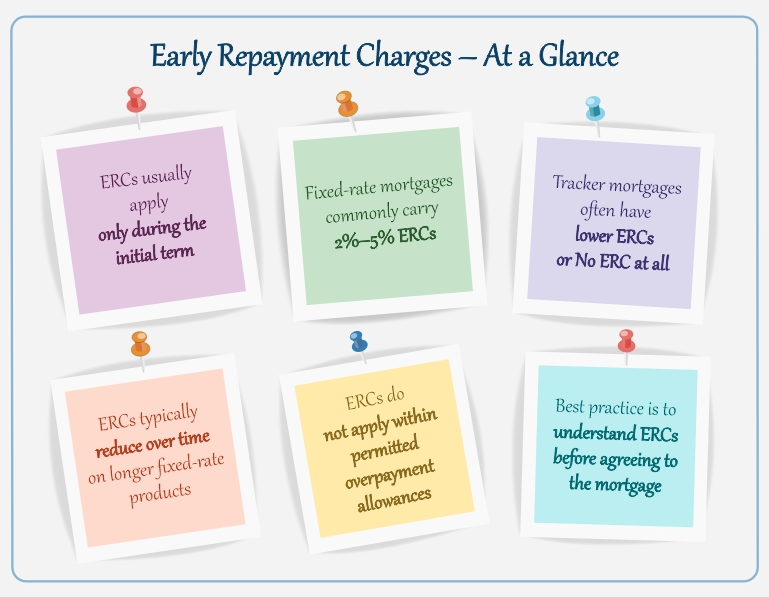
ERCs usually apply only during the initial term of the mortgage. Once the initial term ends, you are typically free to:

During the initial term, lenders generally allow limited overpayments each year without triggering an ERC. If you exceed this allowance, an ERC may become payable on the excess amount.

Is There a Standard ERC?

No.
There is no fixed or standard ERC across lenders.

Early repayment charges vary based on:

This is why ERCs should always be reviewed alongside interest rates, arrangement fees, and monthly payments when choosing a mortgage.

Typical ERC Structures by Product Type

Two-Year Fixed Rate Mortgages​

Common structures include:

The exact structure depends on the lender and product.

Five-Year Fixed Rate Mortgages

Five-year fixed products often carry higher ERCs, reflecting the longer commitment. Common examples include:

Some products use a sliding scale, while others apply a flat rate for the full period.

Tracker Mortgages

Tracker mortgages tend to be more flexible:

This flexibility is one reason trackers can be attractive where future changes are expected, but ERCs should still be checked carefully.

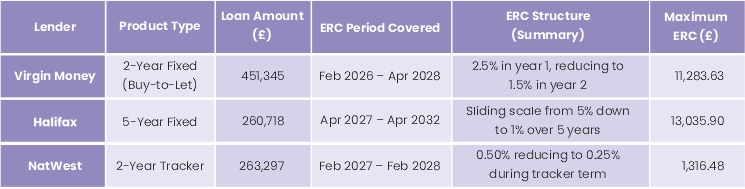
Examples of Early Repayment Charges (ERC) – Summary Table

Mortgage ERC comparison table UK lenders Virgin Money Halifax NatWest

Why ERCs Matter When Choosing a Mortgage

Early repayment charges are not just a technical detail. They can have a significant financial impact if:

ERCs should always be assessed at the point of application, not as an afterthought.

Key Takeaway

An Early Repayment Charge is a normal part of many mortgage products, but it must be understood and accepted upfront. The right ERC structure depends on your plans, flexibility needs, and risk appetite.

Picture of About the Author

About the Author

Sekkappan Alagu is the Founder of Nachu Finance Ltd, established in 2006. With an early career in journalism and publishing, he brings clarity and structured thinking to complex financial topics. Through the Nachu Finance Blog and Knowledge Hub, he shares insights drawn from nearly two decades of client advisory experience, helping readers make informed decisions and understand best practices in mortgages, protection and long-term financial planning.

Picture of Business Profile

Business Profile

Nachu Finance Ltd is a directly authorised FCA-regulated firm providing mortgage, insurance and estate planning advice to clients across the UK. The firm takes a holistic approach — considering protection, tax efficiency and long-term planning alongside property finance — maintaining high regulatory standards while keeping advice clear and easy to follow. To learn more about the firm's background and story, visit the About Nachu Finance page.

Explore Your Mortgage Options with Greater Clarity

Loan to value (LTV) explained on chalkboard – understanding mortgage LTV ratios, equity and borrowing levels.

Testmonials

Enquiry Form

Get in Touch with Us for Personalized Finance Assistance

Please enable JavaScript in your browser to complete this form.
=

Loan to Value and Equity Explained

Loan to value (LTV) explained on chalkboard – understanding mortgage LTV ratios, equity and borrowing levels.

A clear guide for homebuyers, covering purchase and remortgage scenarios

Loan to Value, often written as LTV, is one of the most common terms you will hear when discussing mortgages. Understanding it makes the rest of the mortgage process feel far more straightforward, as it helps you see clearly how much of the property is funded by the lender and how much is truly yours.

Below is a simple breakdown of the concepts of Loan to Value and Equity, how they are calculated, and why they matter.

What Does Loan to Value Mean?

Loan to Value represents the mortgage loan as a percentage of the property value.

If a property is worth £400,000 and the mortgage you need is £300,000, then:

300,000 ÷ 400,000 × 100 = 75% LTV

This means the lender is financing 75% of the property, and the remaining 25% represents your share. This share is your equity.

What Is Equity?

Equity is the portion of the property you own outright.

In pound terms:
Equity = Property value minus loan amount

In percentage terms:
Equity percent = 100 minus loan to value

Loan to Value and equity will always add up to 100%.

When buying a property equity would often be the deposit you put into the property.

Equity can come from various sources. It may be your own savings, a gifted deposit, a discount (such as Right to Buy), or equity gained over time through mortgage repayments and property value growth.

Why Loan to Value Matters

Mortgage lenders assess risk based on LTV. A higher LTV means the buyer is putting in a smaller share, therefore the lender is taking on a larger portion of the risk.

For example, if someone buys at 95% LTV and property prices fall by 10%, they could fall into negative equity. Lenders therefore tend to offer better interest rates to clients with a lower loan to value.

LTV also influences lending criteria. For example, a lender may cap the maximum LTV at 75% for certain types of applications. Lower LTV usually means better product availability and more competitive pricing.

Common LTV Bandings

 Most lenders group their rates into LTV bandings. Although these vary slightly, the typical structure looks like this:

In the current market, the minimum deposit required for residential mortgages is usually 5%, meaning the highest LTV available tends to be 95%.

These bandings are used for pricing. Your exact deposit can be any figure that suits you, but the interest rate you receive will be based on the LTV band your case falls into.

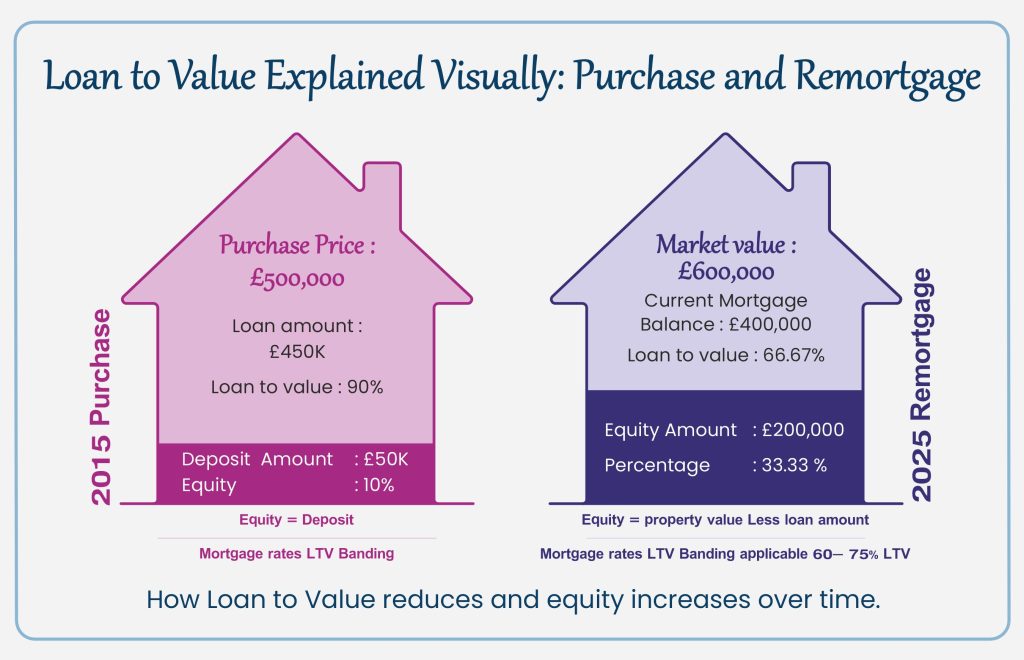
Loan to Value Explained Visually

How LTV Works When Buying a Property

During a purchase, LTV is based on the deposit you put down.

Example:

Property price: £500,000
Deposit: £50,000
Loan amount: £450,000

LTV = 450,000 ÷ 500,000 × 100 = 90%
Equity = 10%

This applies even when the deposit is gifted. The key point is that the loan amount is lower, which reduces the LTV.

How LTV Works on a Remortgage

When remortgaging, there is no new deposit. Instead, equity comes from:

Example:

Original purchase mortgage: £450,000
Ten years later, mortgage reduced to: £400,000
New property value: £600,000

LTV = 400,000 ÷ 600,000 × 100 = 66.67%

Equity is the remaining 33.33 percent, which is a combination of your repayments and market growth.

This is why many clients see their LTV improve over time, opening the door to better interest rates.

Equity does not always have to be savings.

In cases such as Right to Buy or family concessionary purchases, a discount can count as the deposit.

Example:

Right to Buy property value: £300,000
Right to Buy discount: £75,000
Mortgage required: £225,000

LTV = 225,000 ÷ 300,000 × 100 = 75%
Equity = 25%
Deposit provided physically by buyer = £0

The discount itself is treated as equity, helping the client meet mortgage criteria without having to save a deposit.

Similarly, in a family concessionary purchase where a parent sells a property to a child at below market value, the difference between the market value and the purchase price is often treated as gifted equity.

Frequently Asked Questions About Loan to Value

No. As a homebuyer, you are free to put down any deposit amount that suits your circumstances. The deposit does not have to be a neat rounded percentage such as exactly 10, 15 or 25% of the purchase price.

Loan to Value and equity percentages are calculated based on the deposit you put down, not the other way around.

For example, if you are buying a property worth £400,000, you do not need to restrict yourself to a £40,000 deposit (10%), £60,000 deposit (15%) or £100,000 deposit (25 percent). If you have £50,000 available, you can put down that amount as your deposit.

In this case:
Property price: £400,000
Deposit: £50,000
Loan: £350,000

LTV = 350,000 ÷ 400,000 × 100 = 87.5%

This would usually fall into the 85 to 90 %LTV band when it comes to selecting the interest rates. So while your deposit can be any amount, the product and interest rate offered will be based on the LTV banding into which your case falls.

This depends on whether it is a purchase or a remortgage.

  • For a remortgage, the LTV is always based on the current market value of the property and the current mortgage balance. There is no purchase price involved at this stage.
  • For a purchase, things are slightly different. In most straightforward cases, the purchase price and the market value are the same. However, there are situations where they may differ. For example:
    • A buyer might pay more than the current market value because the property is in a very desirable location or is particularly convenient for them.
    • A property might be bought below market value, for example at auction or in a distressed sale.

In these scenarios, lenders will usually calculate the LTV using the lower of the purchase price and the current market value.

So at the point of purchase, the LTV is typically:

Loan amount ÷ lower of (purchase price or current market value) × 100

This lower-of-the-two approach does not apply on a remortgage, because at that stage there is no new purchase price, only a current market value.

Bringing It All Together

Loan to Value and equity are two sides of the same concept. Together, they help determine:

Once you understand these basics, interpreting mortgage products and criteria becomes much easier. The explanations and examples above are designed to give a clear, everyday understanding of how LTV works at purchase, at remortgage, and in special situations such as Right to Buy or concessionary purchases.
This knowledge hub article is intended simply to help you make sense of one of the most frequently used terms in mortgages.

Picture of About the Author

About the Author

Sekkappan Alagu is the Founder of Nachu Finance Ltd, established in 2006. With an early career in journalism and publishing, he brings clarity and structured thinking to complex financial topics. Through the Nachu Finance Blog and Knowledge Hub, he shares insights drawn from nearly two decades of client advisory experience, helping readers make informed decisions and understand best practices in mortgages, protection and long-term financial planning.

Picture of Business Profile

Business Profile

Nachu Finance Ltd is a directly authorised FCA-regulated firm providing mortgage, insurance and estate planning advice to clients across the UK. The firm takes a holistic approach — considering protection, tax efficiency and long-term planning alongside property finance — maintaining high regulatory standards while keeping advice clear and easy to follow. To learn more about the firm's background and story, visit the About Nachu Finance page.

Building Confidence in Your Mortgage Decisions