
Life Insurance Review: Why You Should Revisit Your Existing Policies

Life insurance review meeting with advisor showing policy document – ensuring family cover is current and financially secure.

Life insurance, critical illness cover, and income protection are essential pillars of family protection. Yet, once policies are in place, many people rarely revisit them.
At Nachu Finance, we believe a periodic review of your existing life insurance can make all the difference — ensuring your cover remains relevant, accessible, and effective when your family needs it most.

Make Sure the Policy Is Accessible

Before anything else, ensure that your family knows what policies you hold, who the providers are, and where to find the documents.

It is surprisingly common for families to be unaware of the details of existing policies. If you find it difficult to locate your documents while everything is going well, imagine how challenging this could be during a crisis.
Keep your policies accessible — ideally in both digital and physical form — and make sure immediate family members or adult children know where to find them.

Place Your Policy Under a Trust

Placing a life insurance policy under a trust ensures that proceeds are paid quickly and tax-efficiently to your chosen beneficiaries.
If your policy isn’t already under a trust, we strongly recommend setting this up.

If it is already under a trust, ensure the trustees’ details are up to date — especially if children have now become adults or if any trustee is no longer suitable to act.

Read more in our related article: Why Your Life Insurance Policy Should Be Placed Under a Trust

Older Policies: Hidden Gems Worth Keeping


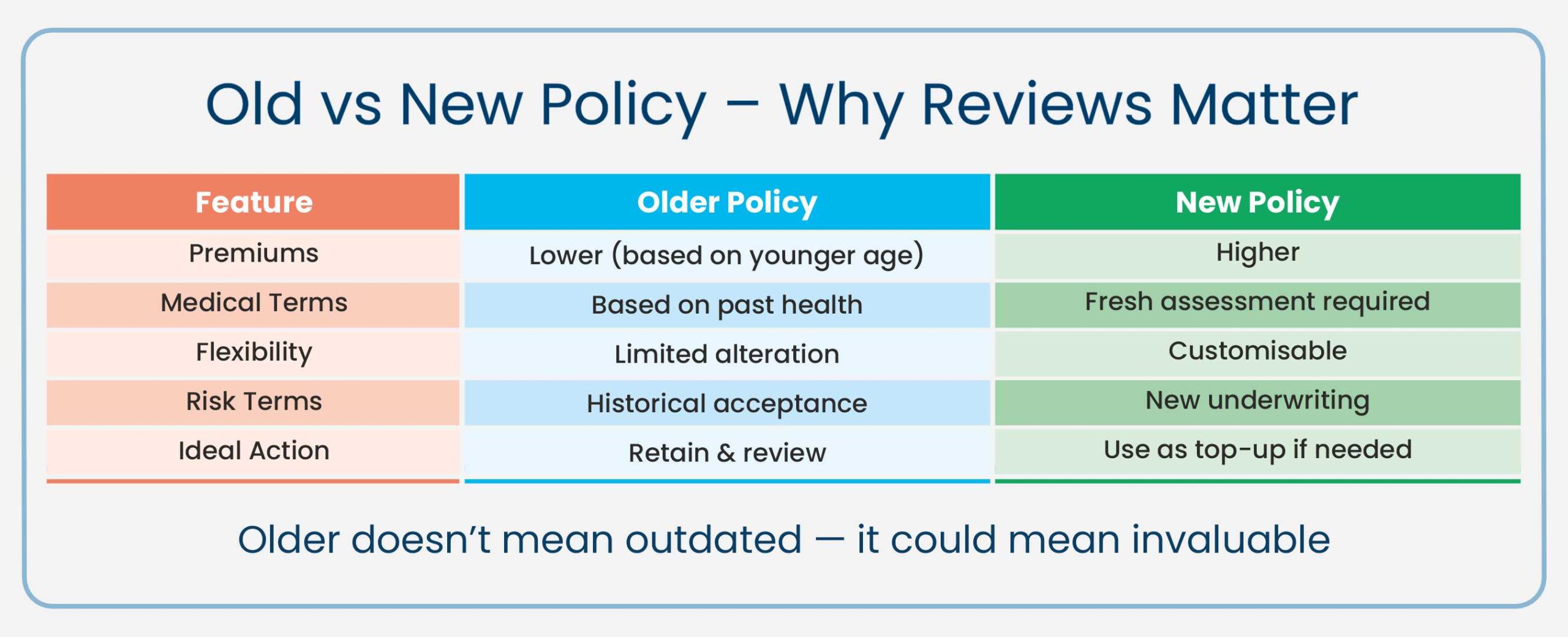
Older life insurance plans can often be genuine hidden gems.
Premiums are based on your age and health at the time you apply, which means policies taken out years ago often benefit from significantly lower, locked-in premiums and medical terms that may no longer be available today.

Before cancelling, altering, or replacing an existing policy, it is essential to seek professional advice. At Nachu Finance, we review older policies with care to ensure they remain relevant to your current needs, and we rarely recommend cancelling them unless there is a clear and meaningful benefit.

Because premiums rise sharply with age, older plans can offer outstanding long-term value compared to arranging cover later in life. Our premium comparison chart by age clearly shows how starting early keeps costs lower for the entire duration of the policy — you can view it Don’t Just Buy a Home-Protect It Too for a clearer picture.
Extending or Increasing an Existing Policy

It is natural to wonder whether an existing policy can simply be extended to cover a longer term or increased to a higher amount.
In most cases, insurers will not allow an increase in cover or extension of the term without full medical reassessment, as this changes the original risk profile.

Our approach is to:

  • Keep your existing policy as it is.
  • Add a “top-up” policy for additional cover or a longer term if needed.

This way, you retain the advantages of your older policy while ensuring your family remains fully protected.

Ensuring Your Cover Is Still Relevant
 
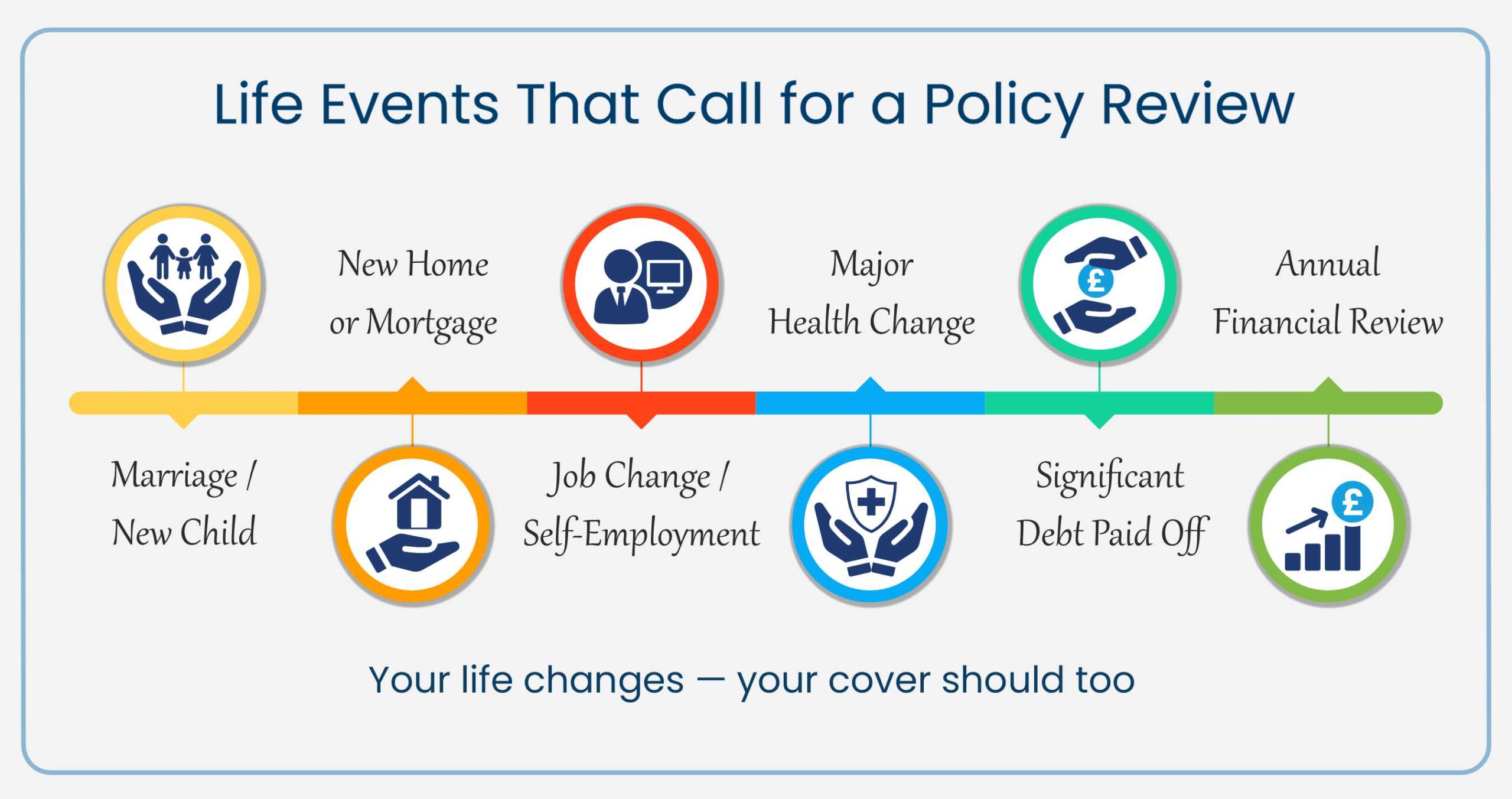
Life Insurance Review - Life Events call for Review
 

Life evolves — so should your insurance.
Events such as marriage, buying a new home, having children, or changes in employment (for instance, moving from employed to self-employed) all affect your protection needs.

A periodic review helps you check whether:

  • The level of cover matches your mortgage balance and family needs.
  • Your term still aligns with your working years.
  • Any employer benefits or other cover overlap with your personal policies.
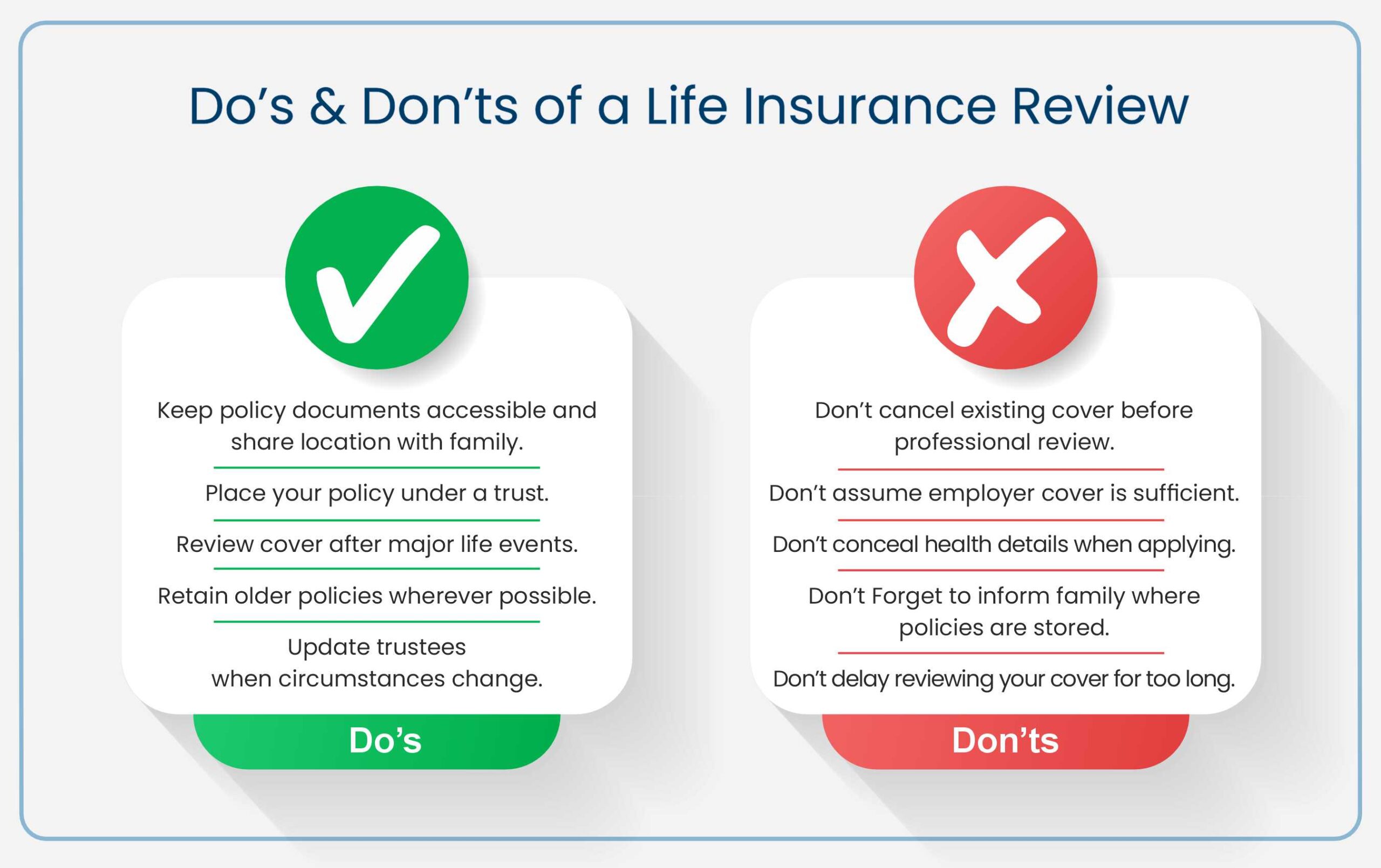
Life Insurance Review - Do's & Dont's


Real life Case Studies

Here are three real-life examples that show how a life insurance review can make a meaningful difference at different stages of life. Each case has a different outcome, but in every situation the review still proved to be the right and sensible step.

Ishan & Sitara

Ishan bought his first property in 2017 for £320,000 with a £250,000 mortgage. At the time, he took out £250,000 of life cover and £100,000 of critical illness cover in his sole name.

When he returned in 2023, he was now married to Sitara and the couple were buying a new family home for £610,000. During our review, we found that Ishan’s historic policies offered excellent terms and very competitive premiums, which would be hard to replicate today.

We therefore kept both existing policies in place, placed his life cover under a trust, and recommended top-up life cover to match his new financial responsibilities. Since Sitara had no protection at all, we also arranged suitable life and critical illness cover for her.

This is a textbook example of why older plans should not be cancelled automatically. With a review, the couple were able to:

  • retain valuable historic cover
  • place the policy under trust
  • top up protection to match their new life stage
  • ensure both partners were fully covered

Felix & Amy

Felix and Amy came to us in 2021 for a remortgage. They had originally purchased their home in 2015 and arranged their life insurance directly with the insurer at the time.

When we asked for their policy documents, they initially struggled to locate them — a common issue that becomes critical during a claim. After some effort, they shared a copy with us and also made sure their family knew where the documents were safely stored.

Following a full review, we concluded that their existing life and critical illness policies were still appropriate for their current circumstances. No top-up cover was needed, but we placed their existing plans under trust and securely stored copies of their documents in their client folder.

Although no new insurance was taken, the review still delivered meaningful benefits:

  • policy documents were located and securely stored
  • the family now knows exactly where to find them
  • the plans were placed under trust for efficient payout
  • reassurance that their existing cover remains fit for purpose

This case shows how valuable a review can be even when no policy changes are required.

Vivan & Rebecca

Vivan and Rebecca approached us around 11 months after their original life insurance was set up at the time of their property purchase. Both were employed when the policies were first taken out.

Within a year, Vivan had moved from employment into a day-rate contracting role through his own limited company. This meant he no longer received the death-in-service benefit he previously enjoyed from his employer.

During the review, we kept Rebecca’s policies unchanged, as her circumstances remained the same. For Vivan, we recommended restructuring his protection by:

  • cancelling his new-but-still-young personal life cover
  • replacing it with a Relevant Life Plan to benefit from significant tax efficiencies
  • increasing the level of life cover to reflect his new responsibilities and lack of workplace benefits

We also reviewed critical illness cover. Although a higher amount would have been sensible, Vivan decided not to increase it for now due to cost considerations.

This case highlights how a review can help align protection with changing employment circumstances — especially when moving to self-employment or contracting.

The Nachu Finance Way
 
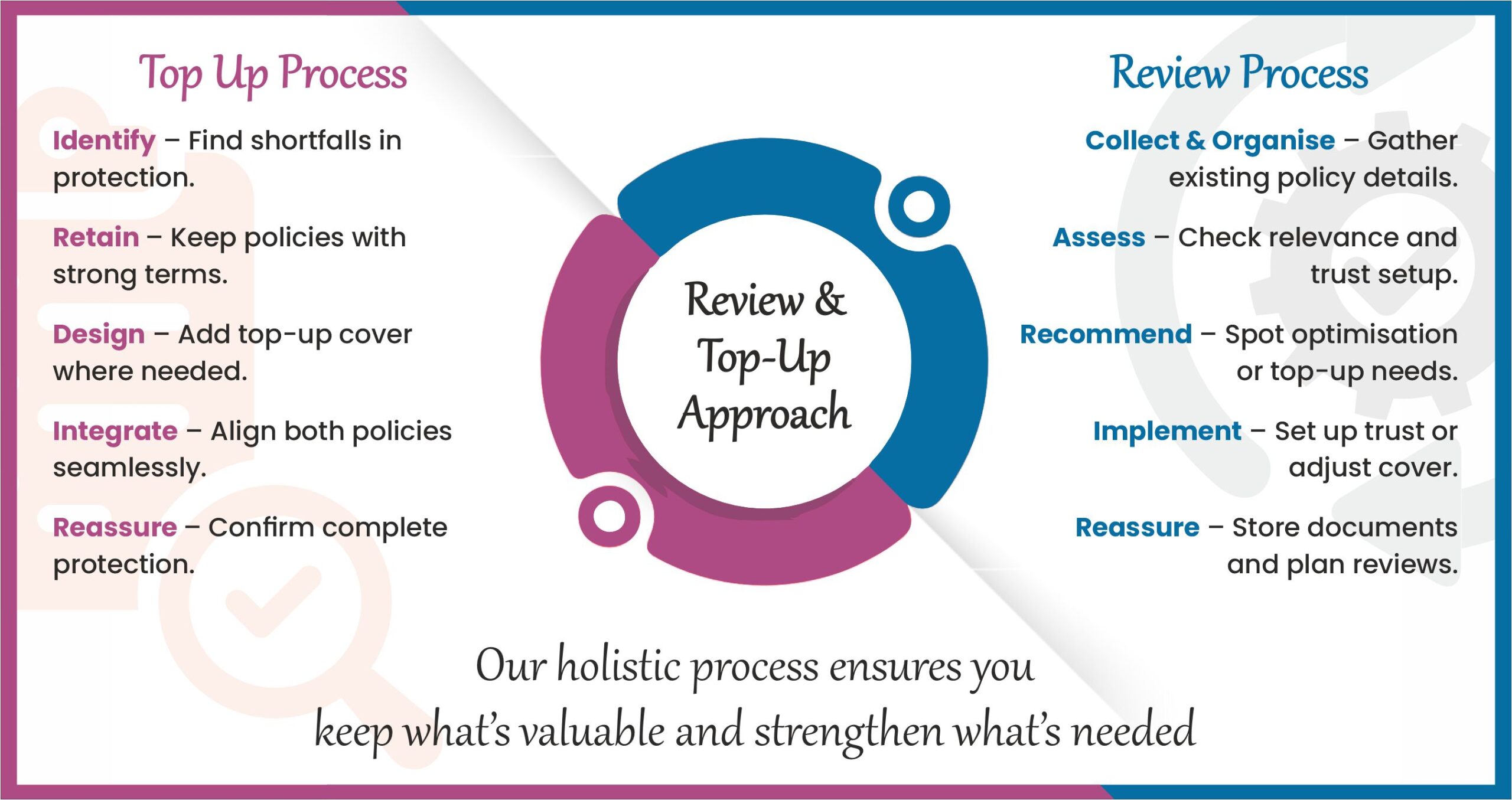
Review & Top-Up Approach
 

At Nachu Finance, we appreciate that older policies can hold immense value.
When we review your existing cover, we:

  • Check if it remains suitable for your current family and financial circumstances.
  • Help optimise it — including setting up or updating the trust.
  • Securely store copies of your policies in your client file, so your family can easily access them in the event of a claim.
  • Review both policies arranged by us and those you arranged elsewhere.

Even if no changes are needed, the reassurance that your policy is still fit for purpose is a valuable outcome in itself.


Frequently Asked Questions

No. The insurer bases its terms on your health and lifestyle at the time of application.
Once the policy is live, there is no obligation to update them about later changes.

Yes. You can replace or add trustees at any time.
We always recommend reviewing the trustees during your periodic insurance review to ensure they are still appropriate and willing to act.

Yes. You can hold multiple policies with different providers.
At application, you must declare any existing cover so the insurer can assess your total cover amount correctly.

Absolutely.
For clients whose policies were arranged through us, claim support is fee-free.
We believe compassionate, expert help at such a crucial time is an essential part of our service.

Yes. Many people keep their older policies because they offer lower premiums and favourable terms, and simply add a top-up policy when their protection needs increase. This is completely normal, and it allows you to retain the benefits of your historic cover while ensuring your overall protection keeps pace with life changes.

Our Transparency Promise

Full Disclosure, Complete Peace of Mind

At Nachu Finance, we insist that all applications are made with full and honest disclosure of health, lifestyle, and smoking status.

We review every detail with you before submission, so the insurer receives accurate information.

We would rather an insurer take extra time to verify your details now than risk a claim being declined later for non-disclosure.
This careful approach protects your family’s peace of mind and ensures that your policy pays out when it matters most.

Let Us Review Your Policy

As holistic advisers, we see life insurance as a core part of family financial planning.
Our transparent, no-pressure approach means we’ll only recommend action when it’s genuinely in your favour.

Reach out to Nachu Finance for a free, transparent review of your existing life insurance.
We’ll give you an honest assessment and, if needed, help you:

  • Place the policy under a trust
  • Adjust or top-up your cover
  • Optimise your family’s protection for today and the years ahead
Picture of About the Author

About the Author

Sekkappan Alagu is the Founder of Nachu Finance Ltd, established in 2006. With an early career in journalism and publishing, he brings clarity and structured thinking to complex financial topics. Through the Nachu Finance Blog and Knowledge Hub, he shares insights drawn from nearly two decades of client advisory experience, helping readers make informed decisions and understand best practices in mortgages, protection and long-term financial planning.

Picture of Business Profile

Business Profile

Nachu Finance Ltd is a directly authorised FCA-regulated firm providing mortgage, insurance and estate planning advice to clients across the UK. The firm takes a holistic approach — considering protection, tax efficiency and long-term planning alongside property finance — maintaining high regulatory standards while keeping advice clear and easy to follow. To learn more about the firm's background and story, visit the About Nachu Finance page.

How does a Trust Actually Help Protect the Assets

House protected under glass dome – asset protection and estate planning concept for safeguarding property and inheritance.

A trust is an incredibly useful tool in estate planning, offering numerous benefits-one of the most significant being its ability to protect assets from potential risks. While the idea of a relatively straightforward setup providing such robust protection may seem too good to be true, it’s a proven and effective strategy. In this article, we’ll explore how a trust provides this protection, supported by real-life case studies to help illustrate its impact.

Continue reading

Why You Should Consider Placing Your Life Insurance Under a Trust

Life insurance policy document and trust concept illustration – placing life insurance in a trust to protect assets, reduce inheritance tax and control beneficiary payouts.

Key Requirements for UK Landlords

To help you stay on the right track, here’s a handy list of the key requirements every UK landlord should be aware of:

  1. Annual Gas Safety Checks
    • Every year, you need to have a Gas Safe registered engineer check all gas appliances, fittings, and flues in your rental property.
    • This is to ensure everything is safe and up to standard. Once the check is complete, provide your tenants with a copy of the gas safety certificate within 28 days.
    • It’s a simple step that keeps everyone safe and sound!

  2. Electrical Installation Condition Report (EICR)
    • To ensure electrical safety, an EICR must be carried out by a qualified electrician every five years.
    • The report checks that all electrical installations are safe, and any issues found must be fixed promptly.
    • Don’t forget to share the report with your tenants and the local council if they ask for it.

  3. Energy Performance Certificate (EPC)
    • Your property needs a valid EPC with a minimum rating of ‘E’ before you can rent it out.
    • The EPC, which is valid for ten years, provides an energy efficiency rating for the property.
    • Make sure to give a copy to prospective tenants at the start of their tenancy.

  4. ‘Right to Rent’ Checks
    • Before renting to new tenants, you must check their immigration status to ensure they have the right to live in the UK.
    • This involves reviewing and copying documents that prove their right to rent.
    • Keep these records for the duration of the tenancy and for at least one year afterward to stay compliant.

  5. Landlord Licensing
    • Some local councils in the UK have Selective Licensing Schemes, meaning you may need to get a license before renting out your property.
    • Licensing conditions can vary, so check with your local council to see what’s required in your area.
    • Failure to obtain a license can lead to fines, so it’s worth getting this sorted.

  6. Maintaining a Habitable Property
    • Under the Homes (Fitness for Human Habitation) Act, your property must be fit for living, which includes proper heating, ventilation, sanitation, and structural integrity.
    • Keeping your property in good shape not only keeps your tenants happy but also prevents potential legal issues.

  7. Fire Safety Regulations
    • Fire safety is a top priority! Make sure you have working smoke alarms on each floor and carbon monoxide alarms in any room with a solid fuel-burning appliance.
    • Regularly check and maintain these alarms to keep everyone safe and compliant with the Smoke and Carbon Monoxide Alarm Regulations.

  8. Overcrowding and HMO Rules
    • If your property is rented to three or more people who aren’t from the same household (forming a ‘House in Multiple Occupation’ or HMO), there are additional regulations to follow.
    • HMOs require a specific license, and there are strict rules regarding room sizes, fire safety measures, and facilities.
    • Overcrowding is also a concern; make sure your property has enough space for the number of occupants to avoid fines and ensure tenant safety.

  9. Providing a Written Tenancy Agreement
    • Always provide a clear, written tenancy agreement that outlines the terms of the rental, including rent, payment schedules, and tenancy length.
    • This helps prevent misunderstandings and provides a solid foundation for resolving any disputes.

  10. Deposit Protection
    • If you take a deposit from your tenants, it must be protected in a government-approved Tenancy Deposit Protection (TDP) scheme.
    • Provide your tenants with information about how their deposit is protected within 30 days of receiving it.
    • This step is crucial to avoid disputes and maintain good relationships with your tenants.

The Role of Letting Agents: Who’s Really Responsible?

Many landlords hire letting agents to help manage their properties, which can be a great way to lighten the load. Letting agents can handle tasks like tenant screening, rent collection, and property maintenance. However, it’s essential to remember that even if you use a letting agent, you, as the landlord, are ultimately responsible for ensuring that all legal obligations are met. If a letting agent fails to comply with regulations, it’s still the landlord who could face fines or legal action. So, make sure to stay involved and keep an eye on compliance to protect your investment.

Staying Proactive and Informed

Given the complexities and constant changes in rental regulations, landlords should adopt a proactive approach to property management. This means regularly reviewing legal requirements, staying updated with any new legislation, and conducting routine property inspections. Engaging with professionals, like property managers, solicitors, or letting agents, can provide valuable support in navigating the regulatory landscape. By doing so, you can ensure your property complies with all requirements, protect your investment, and maintain positive relationships with your tenants.

In Summary

While buy-to-let investments can be financially rewarding, they come with a set of responsibilities that cannot be ignored. By staying on top of the legal requirements and maintaining high standards of property management, landlords can avoid pitfalls like fines, legal trouble, and reputational damage. Remember, being a landlord is more than just a financial investment—it’s about creating a safe and welcoming home for your tenants. So, take a proactive approach, keep up with regulations, and you’ll be well on your way to a successful and hassle-free experience in the rental market.


Transparent Communication

We maintain open, honest communication throughout the entire process, ensuring you’re informed and involved every step of the way.

Picture of About the Author

About the Author

Sekkappan Alagu is the Founder of Nachu Finance Ltd, established in 2006. With an early career in journalism and publishing, he brings clarity and structured thinking to complex financial topics. Through the Nachu Finance Blog and Knowledge Hub, he shares insights drawn from nearly two decades of client advisory experience, helping readers make informed decisions and understand best practices in mortgages, protection and long-term financial planning.

Picture of Business Profile

Business Profile

Nachu Finance Ltd is a directly authorised FCA-regulated firm providing mortgage, insurance and estate planning advice to clients across the UK. The firm takes a holistic approach — considering protection, tax efficiency and long-term planning alongside property finance — maintaining high regulatory standards while keeping advice clear and easy to follow. To learn more about the firm's background and story, visit the About Nachu Finance page.