
Testmonials
Enquiry Form
Get in Touch with Us for Personalized Finance Assistance
Setting Up and Navigating Limited Company Mortgages
- Date Published :
Over the past few years, buying buy-to-let property through a limited company has become an increasingly popular route in the UK, largely due to the potential tax efficiencies it can offer. For many investors, this structure provides a more flexible and tax-aware way of managing property income.
However, this article is not about helping you decide whether a limited company is the right route for you. That decision depends on your personal circumstances and is covered in detail in our article on personal name vs limited company ownership.
Instead, this guide is for those who have already made that decision and are ready to move forward. Here, we will walk you through how limited company mortgages work, what needs to be set up, and what you should be aware of before proceeding, so you can move ahead with clarity and confidence.

Limited Company Buy-to-Let is Only for Investment Properties
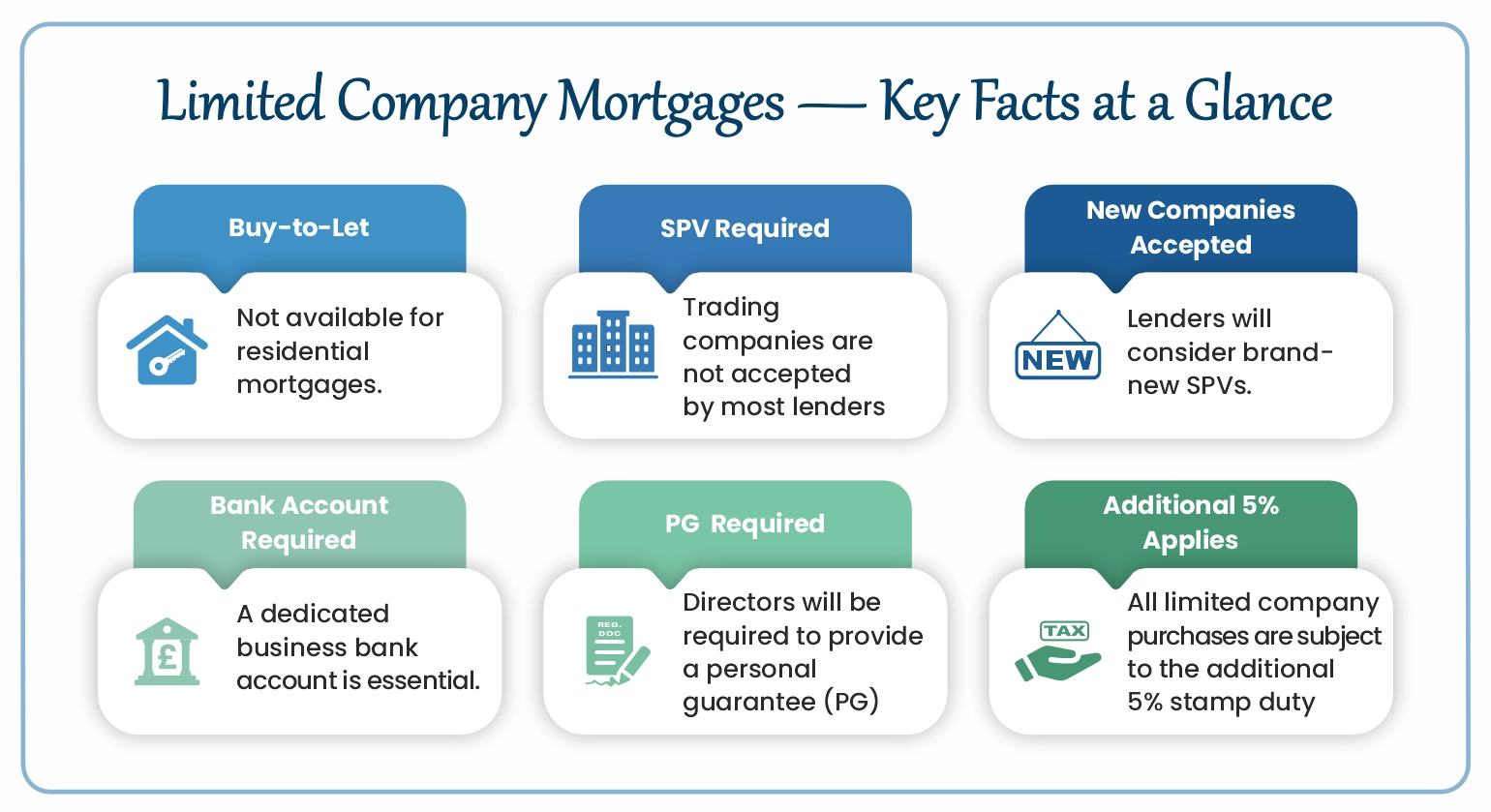
A key point to understanding early on is that a limited company buy-to-let structure is designed for investment purposes only, not for personal residential use. The tax advantages associated with this structure apply when the property is rented to tenants. If the intention is to live in the property yourself, using a limited company would not be appropriate.
In practice, buying residential property through a limited company for personal use does not really work. The costs involved — particularly higher stamp duty — and the way the tax rules are structured mean that the benefits of a limited company are effectively lost in this scenario.
There are also some practical restrictions to be aware of. For example, lenders may place limitations on renting the property to immediate family members, especially where the arrangement could be seen as personal use rather than a genuine buy-to-let investment.
Another factor to consider is the Annual Tax on Enveloped Dwellings (ATED). This is an annual tax that can apply to residential properties held within a company structure and was introduced to discourage individuals from holding residential homes in companies for personal use or tax planning purposes. While reliefs are often available for genuine
buy-to-let investments, personally occupying a company-owned property can trigger additional tax charges that would not normally apply to a standard residential purchase, making the structure significantly less tax efficient.
From our experience, limited company mortgages are used almost exclusively for buy- to-let investments. We have not encountered situations where a limited company is used to purchase a property for personal residential use, as this would not align with lender criteria or the intended purpose of the structure.
Broadly speaking, a limited company mortgage is designed for investment properties rather than residential occupations. Once the purpose of the structure is clear, the next step is how the company should be set up for a limited company mortgage.
The Importance of an SPV — Not Your Trading Company
When purchasing a buy-to-let property through a limited company, the company used should typically be set up as a Special Purpose Vehicle (SPV). This is a company created specifically to buy, hold, and manage investment property and nothing else.
This is different from a trading company. A trading company is set up to carry out a particular business activity. For example, an IT contractor running their own limited company, a CIS contractor, a doctor, an accountant, or a retail or wholesale business owner would all be operating through trading companies. These companies have their own business activities and SIC codes, and they are not designed for holding property investments.
While there are a small number of lenders who may consider mortgage applications through a trading company, most lenders expect the borrowing entity to be an SPV. This gives them clarity on what the company is set up to do and makes the application more straightforward from a lending perspective.
From a practical point of view, it also makes sense to keep property assets separate from any trading activity. Mixing the two can create complications for lenders, accountants, and future financial planning, particularly as your portfolio grows.
Setting up a dedicated property company with the correct SIC codes — and keeping it separate from any existing trading business — will give you access to a wider range of lenders and a smoother mortgage process. Once the company structure is clarified, let’s look at how to set up the limited company correctly.
Setting Up the Limited Company
When it comes to setting up a limited company for a buy-to-let purchase, it’s important to understand where our role sits. From a mortgage perspective, we can guide you on what lenders expect. However, the actual company setup should be carried out with the support of a qualified accountant or a professional company formation service.
That said, there are certain requirements that need to be in place from the outset to ensure the company is suitable for a mortgage application.
SIC Codes
From a lender’s perspective, the company should be set up with the correct SIC (Standard Industrial Classification) codes. The two most accepted codes for a property SPV are:
- 68100 — Buying and selling of own real estate
- 68209 — Other letting and operating of own or leased real estate
These should be in place when the company is registered, as this is one of the first
things a mortgage adviser and lender will check.
Company Name
You are free to choose any available company name. This can be checked either through your accountant or directly on the Companies House website if you are using an online formation service.
Directors and Shareholders
This is an area that requires careful thought. The structure of directors and shareholders can have a direct impact on the mortgage application, so it’s important to get this right before the company is set up.
In most cases, lenders will expect all directors to be named on the mortgage application. It is possible in some situations for shareholders — including family members and, in certain cases, minor children — to hold shares without being on the mortgage, but this will depend on the lender criteria.
It is best to discuss the structure with both your mortgage adviser and accountant before proceeding. Making changes after the company has been registered can be more complicated.
Online Formation vs Accountant
There are a number of online services that allow you to set up a limited company quickly and at a relatively low cost. These can be useful if you already know exactly how you want the company to structure them.
However, these services do not provide advice. For most clients, working with a qualified accountant is the preferred approach, as they can guide you on the most appropriate structure and handle ongoing compliance requirements.
How Long Does It Take
Once all the details are agreed — including the company name, directors, shareholders, and SIC codes — Companies House will usually register a new limited company within one to three working days.
This is worth noting, as many clients assume that setting up a company will significantly delay their purchase. In practice, it is a relatively quick process.
What Nachu Finance Needs
Before a mortgage application can be submitted, Nachu Finance will need the company to be fully registered, along with the Companies House registration number.This is used to check that the company meets lender criteria.
The company does not need to have been trading for any minimum period. Newly incorporated companies are perfectly acceptable to lenders. Once the company is formed , the next step is opening a business bank account.
The Business Bank Account
When purchasing a property through a limited company, it is essential that the company has its own business bank account. This is not optional. Mortgage lenders will expect mortgage payments to be made from the company’s account, and rental income should also be received into this account as standard practice.
In some cases, lenders may allow a mortgage application to proceed while the bank account is being set up, provided it is in place before completion. Others may require the account to be opened before the application is submitted. It is best to start this process as early as possible once the company has been registered.
Timeframes
Opening a business bank account can take anywhere from a few days to up to a month. This will depend on the bank, how busy they are, and whether they require additional information about the company or its shareholders. For this reason, it is important not to leave this until the last minute.
The business bank account is a key part of the process. It should be treated as a priority from the point the company is set up, to avoid delays later.
How the Mortgage Application Works
Applying to a limited company mortgage is slightly different to a standard buy-to-let application, but the core process is quite similar.
The mortgage itself is taken out in the name of the limited company. The company is a legal borrower and will own the property. However, the lender assessment is focused on the individuals behind the company — the directors and shareholders.
This means that credit checks, income assessment, source of deposit, and overall background checks are all carried out on the individuals, much like a personal name mortgage application. The company itself is effectively treated as an envelope.
Because of this, lenders are generally comfortable lending to newly set up companies. The company does not need to have any trading history, and even a recently incorporated SPV is acceptable. In practice, what matters far more is the personal
profile of the individuals involved rather than the age of the company.
Lender Landscape
Not all lenders offer buy-to-let mortgages, and among those who do, not all will lend to limited companies. This is still considered a more specialist area.
That said, as limited company structures have become more common, the number of lenders operating in this space has increased, including some high-street names. Each lender has slightly different criteria, so it is important to approach lenders that suit your specific circumstances, company structure, and source of deposit.
Mortgage Rates
Limited company mortgage rates are typically slightly higher than equivalent rates for personal name buy-to-let mortgages.
However, this should not be looked at in isolation. The potential tax advantages of holding property within a limited company may outweigh the slightly higher borrowing costs, depending on your individual situation. The mortgage rate is just one part of the overall decision.
Deposit
In most cases, the minimum deposit for a limited company buy-to-let mortgage is around 25%.
However, the amount a lender is willing to offer is not based purely on the purchase price. Instead, it is driven by rental income stress testing. The expected rental income must comfortably cover the mortgage payments based on the lender’s criteria.
One practical point to be aware of is that, for higher-rate taxpayers, a limited company structure can sometimes allow for a higher level of borrowing for the same rental income compared to buying in personal names. This is due to the way lenders apply stress tests in a company structure.
Personal Guarantees
Although the mortgage is taken in the name of the limited company, most lenders will require the directors to provide a personal guarantee. This is a standard part of a limited company mortgage.
this means that if the company is unable to repay the mortgage, the directors remain personally responsible for the debt.
We cover how personal guarantees work, what they mean, and the legal process involved in more detail in our separate article on personal guarantees for limited company mortgages.
Stamp Duty — Always the Additional Rate
When it comes to stamp duty, there are generally three buyer categories: first-time buyers, home movers, and additional property buyers. Each category is treated differently from a tax perspective, and we cover this in more detail in our guide on Stamp Duty Three Categories
However, when purchasing through a limited company, the position is much more straightforward.
Any property bought through a limited company is automatically treated as an additional property purchase for stamp duty purposes. This means the 5% additional rate applies in all cases.
It is worth emphasising that this rule applies regardless of the circumstances. It does not matter if this is the company’s first ever purchase, and it does not matter what the personal ownership position of the directors is. A common assumption is that a newly formed company making its first purchase might qualify for a lower rate — this is not the case. The moment a property is purchased through a limited company, the additional rate applies automatically.
From a planning perspective, this is a fixed and unavoidable upfront cost. It should be factored into the overall purchase budget from the outset, rather than treated as something that can be optimised or reduced later.
There is, however, one useful point to be aware of. A limited company is treated as a separate legal entity, which means its property ownership does not count towards the personal ownership history of its directors. As a result, if a director does not personally own any property, buying through a limited company will not affect their individual first- time buyer status. If they later go on to purchase a residential property in their own name, they may still qualify as a first-time buyer for stamp duty purposes.
Moving forward, let us discuss if an existing property can be transferred into a limited company.
A common question is whether a property already owned in your personal name can be transferred into a limited company. This is a separate scenario and is not as straightforward as it may initially seem.
Transferring a property into a limited company is treated as a sale and purchase transaction. This means it can trigger capital gains tax on any increase in value since the original purchase, as well as stamp duty — including the additional 5% surcharge — based on the current value of the property. When combined with conveyancing costs on both sides, the overall cost can be significant, which is why this approach is often not straightforward — something we explore in more detail in our article on transferring property to a limited company.
In most cases, this makes transferring a property into a limited company financially unviable.
There are some limited situations where a transfer may be worth considering — for example, where the property was previously a residential home, and there may be scope to reclaim additional stamp duty paid on a subsequent purchase. However, these are exceptions rather than the norm.
A common question, particularly for those looking to build a portfolio, is whether multiple properties can be held within the same limited company.
The answer is yes. If the company has been set up correctly as an SPV, with the appropriate SIC codes and structure in place, additional properties can be purchased and added to the same company over time.
However, some care is needed when doing this. Each new mortgage application will be assessed on its own merits, and the lender will carry out due diligence on both the new purchase and the existing properties already held within the company. It is important to ensure that the terms of any existing mortgages do not create complications for the new application.
It’s also worth noting that once the company is set up and mortgages are in place, making changes to the structure — such as adding or removing directors or shareholders — is not always straightforward.
Using a single limited company to build a property portfolio can work well, but each new purchase should be planned carefully to ensure everything remains aligned from a lender’s perspective. Just like setting up the company, the ongoing responsibilities are equally important.
Owning a buy-to-let property comes with ongoing responsibilities, regardless of whether it is held in personal names or through a limited company. This includes ensuring the property is safe, the tenancy is compliant, and that tenants are managed appropriately.
A more detailed overview of what being a landlord involves can be found in our article on the Realities of Buy-to-Let.
In addition to this, holding property through a limited company brings its own set of responsibilities. This includes annual filings with Companies House, corporation tax returns, ongoing accountancy requirements, and fulfilling your duties as a company director.
These aspects are covered in more detail in our guide on Personal Name vs Limited Company, and it is worth reviewing this to understand the full picture. The next step is to understand the timeframes involved to help you plan more effectively.
One of the most common questions is how long the process takes when buying through a limited company.
The initial decision — whether to buy in personal names or through a limited company — can take time, depending on your circumstances and how quickly you are able to take professional advice. However, once that decision has been made, the practical steps are generally quite straightforward and do not need to take long.
- Setting up the limited company — once the company name, shareholder structure, directors, and SIC codes are agreed, Companies House will usually register the company within one to three working days.
- Opening the business bank account — this can take anywhere from a few days to up to a month, depending on the bank and the information required. It is best to start this as soon as the company is registered.
- Personal guarantee and independent legal advice — once the mortgage offer has been issued, this step typically takes around a week to complete, particularly where the solicitor offers a remote service.
Buying through a limited company involves a few additional steps compared to a personal name purchase. These include setting up the company, opening the business bank account, and completing the personal guarantee process.
None of these steps are particularly time-consuming if they are planned. With the structure and timeframes understood, having the right professional support becomes equally important.
The Professionals You Need Around You
A limited company buy-to-let purchase involves more than one professional and having the right support in place from the outset can make a significant difference.
A mortgage adviser will guide you through the mortgage side of the process — from structuring the application and selecting the right lender, to managing the application itself and helping you understand requirements such as personal guarantees.
A qualified accountant plays an equally important role, ideally before the company is even set up. They will advise on how the company should be structured, including directors, shareholders, and SIC codes, as well as the ongoing tax position, profit extraction, and the longer-term financial picture.
A solicitor will handle the legal side of the purchase. They will also be involved in the personal guarantee process, although the independent legal advice required for the guarantee must be provided by a separate solicitor.
If you have not yet taken tax advice on whether a limited company structure is right for you, this is the stage to do so. The cost of getting the right advice early on is often small compared to the potential cost of making the wrong decision, particularly given how much impact tax can have — as discussed in our article on Why Specialist Advice Matters when it comes to property tax.
From our side, at Nachu Finance, our role is to guide you through the mortgage process, ensure the right lenders are approached, and help coordinate the different elements involved. Where needed, we will also signpost you to the appropriate professionals so that you can move forward with clarity and confidence.
Here to Help with Your Property Investment Journey
Buying through a limited company can be an excellent long-term strategy for the right investor, but it’s important that everything is structured correctly from the outset. The company setup, lender selection, shareholder structure, tax considerations, and mortgage process all need to work together in the right way.
That’s why getting the right advice early on can make a significant difference – At Nachu Finance, we regularly help clients navigate limited company buy-to-let mortgages, from first-time investors setting up their first SPV through to experienced landlords expanding existing portfolios.
If you’re considering buying through a limited company, we’d be happy to help you explore the right approach for your circumstances. Whether you’re still weighing up your options or ready to move forward,the team at Nachu Finance can help you understand your options clearly and guide you through the process step by step.
Frequently Asked Questions
Once the details are agreed — company name, shareholder structure, directors, and SIC codes — Companies House typically registers a new limited company within one to three working days.
This can be done through a qualified accountant, which is the recommended approach, or through an online company formation service if you are already confident in how you want to structure the company. Online services will handle the registration, but they will not advise you on structure, so it is important to take the right advice beforehand.
Yes, this is very common. Many clients only decide to set up a limited company once they have found a suitable property.
Because the registration process is relatively quick, this approach works well. The key point is to ensure the company is correctly set up before the mortgage application is submitted.
No. There is no minimum period for which the company needs to have been in existence before a mortgage application can be made.
Mortgages are available for newly incorporated companies, provided the company has been set up correctly with the appropriate SIC codes, structure, and directors.
Yes, provided it has been set up correctly with the appropriate SIC codes and has the right directors and shareholders in place.
If those elements are not aligned with lenders’ expectations, they would need to be corrected before proceeding.
Yes. Even though the property is being purchased in the company’s name, all due diligence is carried out on the individuals behind it.
This includes credit checks, income assessment, and background checks — much like a standard personal name mortgage application.
The mortgage process itself is broadly similar in timeframe to a personal name buy-to-let.
The additional steps to consider are:
- Setting up the company (1–3 working days)
- Opening the business bank account (a few days to up to a month)
- Completing the personal guarantee and independent legal advice process
(around one week after mortgage offer)
If these are handled proactively, they should not cause significant delays.
The minimum deposit is typically 25%.
However, the amount you can borrow is based on rental income stress testing rather than just the purchase price.
For higher-rate taxpayers, a limited company structure can sometimes allow a higher borrowing level for the same rental income, due to differences in how lenders apply stress tests.
A personal guarantee is a formal commitment by the directors that if the company cannot repay the mortgage, they will be personally responsible for the debt.
Most lenders require this as a standard condition. Because it creates personal obligations outside the company, lenders will also require independent legal advice before the guarantee is signed.
Yes. All purchases made through a limited company are automatically subject to the additional stamp duty surcharge (currently 5%).
This applies regardless of whether it is the company’s first property and regardless of the personal ownership history of the directors. For a full explanation of how stamp duty works, see our article on Stamp Duty Explained: The Three Buyer Categories.
No. If you do not own any property in your personal name, buying through a limited company does not affect your first-time buyer status.
Because the company is a separate legal entity, its purchases are not counted against your personal ownership history. This means you may still qualify as a first-time buyer if you later purchase a residential property in your own name.

About the Author
Sekkappan Alagu is the Founder of Nachu Finance Ltd, established in 2006. With an early career in journalism and publishing, he brings clarity and structured thinking to complex financial topics. Through the Nachu Finance Blog and Knowledge Hub, he shares insights drawn from nearly two decades of client advisory experience, helping readers make informed decisions and understand best practices in mortgages, protection and long-term financial planning.

Business Profile
Nachu Finance Ltd is a directly authorised FCA-regulated firm providing mortgage, insurance and estate planning advice to clients across the UK. The firm takes a holistic approach — considering protection, tax efficiency and long-term planning alongside property finance — maintaining high regulatory standards while keeping advice clear and easy to follow. To learn more about the firm's background and story, visit the About Nachu Finance page.
Explore More from Our Knowledge Hub