SA302 tax calculation UK example for mortgage application – sample HMRC tax return showing income, property profits and total taxable income.

Testmonials

Enquiry Form

Get in Touch with Us for Personalized Finance Assistance

Please enable JavaScript in your browser to complete this form.
=

Tax Calculations (SA302): What They Are and Why They Matter for Your Mortgage

You’re applying for a mortgage. You’re self-employed, a company director, or you own a buy-to-let property. In many respects, that is a proud position to be in — you’ve taken the initiative, accepted the risk, and gone further than most. But when it comes to evidencing your income for a mortgage, this is also where things can get complicated. We believe knowledge is power. If you know exactly what documents are needed and why, the process becomes far less daunting. This article is written for people who are going the extra mile — and want to make sure their mortgage application reflects that. 

SA302 tax calculation UK example for mortgage application – sample HMRC tax return showing income, property profits and total taxable income.

What Is a Tax Calculation (SA302)?

A Tax Calculation is a summary document produced once your Self Assessment tax return has been submitted to HMRC. 

It pulls together all your income sources — from employment, property, dividends, and more — calculates the tax due, and sets out the payment schedule. The result is a concise, standardised document, usually one or two pages long, that gives lenders a clear and consistent view of your financial position. 

This standardisation is precisely why lenders rely on it. Whatever your income mix, the format stays the same. 

Please refer to the sample Tax Calculation image in this article to help you identify what the document looks like before you begin gathering your paperwork.

When and Why Is It Required?

A Tax Calculation becomes essential whenever your income is not purely from PAYE employment. This includes: 

  • Self-employed individuals — sole traders and partners
  • Limited company directors receiving salary and dividends
  • Landlords with property held in their personal name 

Even in cases where rental income isn’t being used to support your borrowing, there is a compliance dimension that matters. As regulated mortgage advisers, we have a professional responsibility to confirm that income has been correctly declared to HMRC — not just that it exists. If you receive rental income from a property held in your personal name, you are required to declare it under the heading “profit from UK land and property” on your Self Assessment. We will need to see the Tax Calculation confirming this, regardless of whether that income is being used in your affordability assessment. 

You can read more about this in our article on declaring rental income correctly, which explains both the reporting requirements and the consequences of non-disclosure.

Understanding the Dates — Where Most Applicants Get Caught Out

Timing is one of the most important — and most misunderstood — aspects of Tax Calculations. 

The UK tax year runs from 6 April to 5 April the following year. HMRC allows you until 31 January to submit your tax return for the year just ended. That sounds generous. But lenders apply a different rule. 

Most lenders expect your Tax Calculation to be no more than 18 months old. 

This creates a gap that regularly catches applicants off guard. Here’s how it plays out in practice:

Tax Year HMRC Submission Deadline Lender 18-Month Cut-Off
6 Apr 2024 – 5 Apr 2025 31 January 2026 October 2026
6 Apr 2025 – 5 Apr 2026 31 January 2027 October 2027
6 Apr 2026 – 5 Apr 2027 31 January 2028 October 2028

The years above are used to illustrate the pattern — the same principle applies to every tax year going forward. 

Here is the practical problem: if you are applying for a mortgage in, say, October 2027, most lenders will expect to see the Tax Calculation for the year ending 5 April 2027. But under HMRC rules, you have until 31 January 2028 to submit that return. You could be fully compliant with HMRC and still fall outside what lenders will accept. 

The practical takeaway: if a mortgage is on the horizon, submit your tax return well ahead of the January deadline. It keeps your options open across a wider range of lenders and avoids a situation where your documents are technically current but commercially too old.

Tax Calculation vs Tax Return — A Common Misunderstanding

It is very common for clients to arrive with their tax return, assuming this is what lenders need. In practice, lenders do not accept tax returns as proof of income — and there is a clear reason for that.

Document Purpose Typical Length
Tax Return Detailed submission to HMRC for reporting purposes 15–20 pages
Tax Calculation (SA302) Concise summary of income sources and tax due 1–2 pages

The tax return contains the detail. The Tax Calculation provides the standardised summary lenders can work with. Submitting the wrong document is one of the most common causes of avoidable delays — and something easily avoided with a little preparation.

Sample Tax Calculation

This is an example of what a Tax Calculation looks like when produced following submission of a Self Assessment tax return. 

As you can see, the document runs to two pages and sets out the income sources, the tax due, and the payment schedule. Personal details have been removed for privacy. 

The headings shown reflect the circumstances of the individual in this example. Your own Tax Calculation will only display income sources relevant to you — your document may look slightly different. 
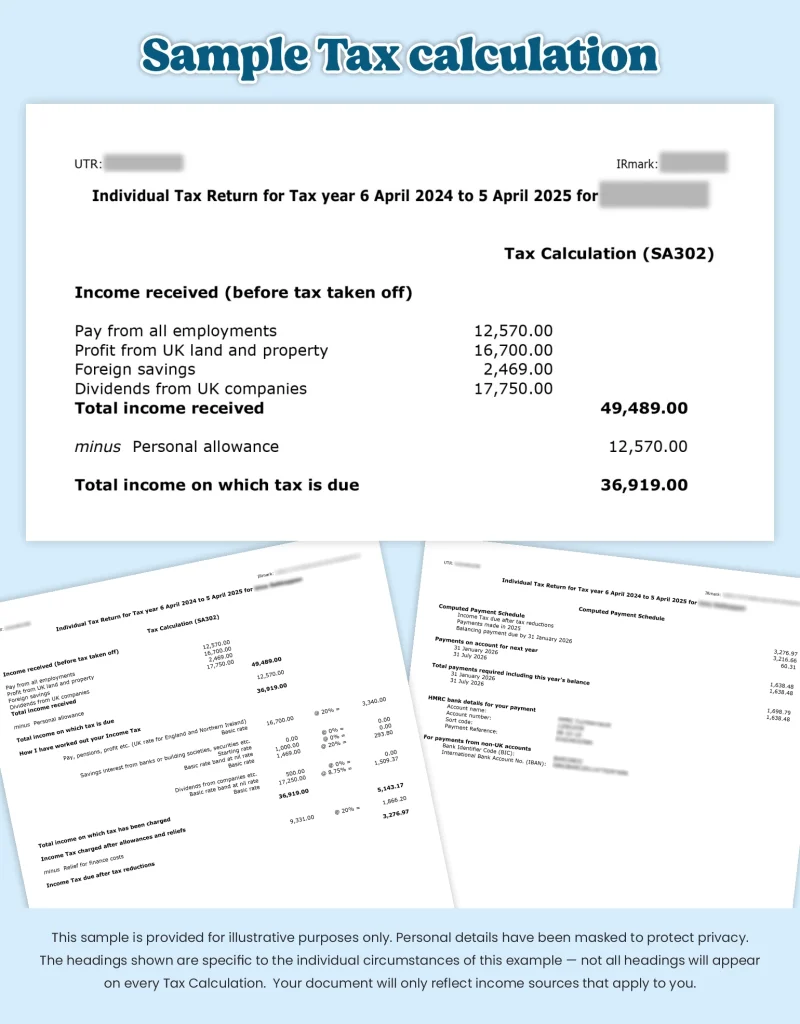
Sample SA302 tax calculation UK showing income breakdown, rental property income and total taxable income for mortgage affordability assessment.

The Role of the Tax Year Overview

Alongside the Tax Calculation, lenders will also request a Tax Year Overview (TYO). 

Where the Tax Calculation shows how much tax is due, the Tax Year Overview confirms whether that tax has actually been paid — and whether any balance remains outstanding. Lenders use both documents together to ensure consistency. The figures must align, and any outstanding liabilities need to be resolved before a mortgage application can progress. 

For a full explanation of what the Tax Year Overview is, how to download it correctly, and the common mistakes to avoid, please see our dedicated guide: Tax Year Overview: What It Is and Why It Matters for Your Mortgage. 

How Many Years Are Needed?

Most lenders will ask for two years of Tax Calculations and matching Tax Year Overviews, with the most recent year falling within the 18-month rule. 

In some cases, where the previous year’s documents are not available, lenders may accept the most recent year alone by exception — but this is not standard and will depend on individual lender policy. 

As a matter of best practice, we routinely ask clients for three years where they are available. If your income in one of the last two years was lower than usual — perhaps due to a difficult trading period, a gap in contracts, or a change in how you drew income from your company — having a third year allows us to put a business case to the lender on your behalf. It gives us the evidence to show the broader picture and argue your corner where a straight two-year view might not tell the full story. 

If you are going to the effort of gathering these documents and three years are available to you, we would always recommend collecting all three. It costs nothing extra and may prove valuable.

A Tax Calculation will only display headings that are relevant to your personal circumstances. Not every applicant will see every heading — the document is tailored to your income sources for that year. 

The sample Tax Calculation in this article shows a combination of employment income, rental income, foreign savings, and dividends — along with a relief for finance costs. This is a good illustration of how multiple income streams appear on a single document. 

Below is an overview of the most common headings and how lenders typically treat each one:

HMRC HeadingWhat It RepresentsMortgage Relevance
Pay from all employmentsSalary from an employer, or director’s salary from your own limited companyUsed alongside payslips and P60. For limited company directors, lenders use the figure shown here rather than payslips.
Profit from UK land and propertyGross rental income from personally held propertyRequired for compliance and, where used for affordability, assessed after the relief for finance costs has been deducted.
Foreign savingsInterest received from overseas savings or accountsTreatment varies by lender — most lenders will not consider this.
Dividends from UK companiesDividends received from shares in a UK limited companyUsed alongside employment income for director/shareholder applicants. Most lenders combine salary and dividends to calculate total income.
Relief for finance costsMortgage interest and allowable financial costs on rental propertiesThis is not income — it is a tax relief applied as a deduction. Lenders will reduce the rental income figure accordingly.
Total income receivedCombined figure across all income sources before allowancesThe starting point lenders work from before applying their own income calculations.
Total income on which tax is dueIncome remaining after the personal allowance has been deductedConfirms the taxable position — lenders cross-reference this against the Tax Year Overview.

Your Tax Calculation will only show the headings that apply to you. The table above reflects the headings shown on the sample document and is illustrative of what a Tax Calculation may include — your own document may show different headings depending on your circumstances.

In most cases, obtaining your Tax Calculation is straightforward once you know where to look. 

  1. From your accountantIf you use an accountant, they will usually provide this aftersubmitting your return. It is often included in the year-end documents sent to you as standard — check any emails, portal communications, or post received when your accounts were finalised. The Tax Calculation is most likely to be there. 
  2. From your HMRC online accountIf yousubmit your own returns, you can access your Tax Calculation directly through your HMRC Personal Tax Account. It may require some navigation, but the document will be available there. 

A common trap: the Tax Year Summary When navigating your HMRC online account, you may come across a document called a Tax Year Summary. This is not the same as a Tax Calculation and is not accepted by mortgage lenders as proof of income. The Tax Year Summary is a general overview of taxes paid — it does not show the breakdown of income sources in the format lenders require. Please refer to the sample Tax Calculation image in this article to confirm you have the correct document before submitting it. 

An important note for those whose returns were filed through commercial software If your tax return was submitted by an accountant using their own commercial software — rather than directly through the HMRC website — you will not be able to download your Tax Calculation from the HMRC portal, even if you have full access to your HMRC online account. This is one of the most common points of confusion we encounter. In this situation, go directly to your accountant as the first step — not HMRC. 

  1. Directly from HMRCIf neither of the above options is available, you can request your Tax Calculation directly from HMRC by telephone. This will take longer and may involve a wait, but itremains a reliable fallback. 

If you request by telephone: keep the covering letter When HMRC sends your Tax Calculation following a phone request, it will be accompanied by a covering letter confirming your name, address, and date of issue. Lenders will require both the Tax Calculation and the covering letter together — do not submit one without the other. And if you are calling HMRC for your Tax Calculation, use the same call to request your Tax Year Overviews at the same time. It will save you a second wait. 

Key Takeaways

A Tax Calculation is not just another form to track down. It is central to how lenders understand your income when you are self-employed, a director, or a landlord. 

  • Know which document you need — the Tax Calculation (SA302), not the tax return or tax summary
  • Be aware of the 18-month lender rule and how it interacts with HMRC’s January deadline
  • Collect two years as standard, three where available
  • Always pair your Tax Calculation with the matching Tax Year Overview
  • If in doubt about what you are looking at, refer to the sample image in this article 

The earlier you prepare, the fewer surprises you will encounter later. 

This article forms part of our Knowledge Hub series on mortgage documentation. You may also find our guide on Tax Year Overviews useful — it covers the companion document lenders always request alongside the Tax Calculation.

Frequently Asked Questions

If your income includes any element of self-employment, dividends, or rental income — or if we need to confirm that rental income has been correctly declared to HMRC — then a Tax Calculation is unavoidable. We cannot substitute it with a tax return, a tax summary, or a Tax Year Overview alone. We need the Tax Calculation and the corresponding Tax Year Overview together.

Yes — in almost all cases, lenders require both documents together. The Tax Calculation shows your income and tax liability; the Tax Year Overview confirms whether that tax has been paid. Lenders cross-reference the two and the figures must match exactly. Providing one without the other will result in follow-up requests, so it is best to have both ready from the outset.

Some lenders may consider documents up to around 21 months old, but your options will be more limited. If your latest Tax Calculation and Tax Year Overview fall between 18 and 21 months old, it is still worth speaking to us — there are lenders who will consider this by exception. But if you are planning ahead, filing early is always the better approach.

Whoever submitted your tax return — whether that is your accountant or a commercial software provider — should be able to produce it. If you are struggling to locate it, you can request it directly from HMRC. This takes time, but it is an important document and worth pursuing. When you do call, ask for your Tax Year Overviews at the same time so you are not waiting twice.

If you are simply switching to a new rate with your existing lender at the end of your initial period, and not borrowing any additional funds, a full income assessment is usually not required at that stage. However, for remortgages to a new lender or for any additional borrowing, income documents will be needed.

Yes. If you own a buy-to-let property in your personal name, you are required to declare the rental income to HMRC under the heading “profit from UK land and property.” As mortgage advisers, we have a professional obligation to confirm this has been done correctly — even where that income is not being used to support your affordability assessment. Where rental income is being used as part of your application, lenders will assess it after the relief for finance costs has been applied, which is why how it appears on your Tax Calculation matters. Please see our article on declaring rental income correctly for a full explanation of the reporting requirements.

Picture of About the Author

About the Author

Sekkappan Alagu is the Founder of Nachu Finance Ltd, established in 2006. With an early career in journalism and publishing, he brings clarity and structured thinking to complex financial topics. Through the Nachu Finance Blog and Knowledge Hub, he shares insights drawn from nearly two decades of client advisory experience, helping readers make informed decisions and understand best practices in mortgages, protection and long-term financial planning.

Picture of Business Profile

Business Profile

Nachu Finance Ltd is a directly authorised FCA-regulated firm providing mortgage, insurance and estate planning advice to clients across the UK. The firm takes a holistic approach — considering protection, tax efficiency and long-term planning alongside property finance — maintaining high regulatory standards while keeping advice clear and easy to follow. To learn more about the firm's background and story, visit the About Nachu Finance page.

Strengthen Your Mortgage Application Knowledge

Stamp duty for home movers UK with removal van outside house – understanding SDLT costs when moving home.

Testmonials

Enquiry Form

Get in Touch with Us for Personalized Finance Assistance

Please enable JavaScript in your browser to complete this form.
=

Stamp Duty for Home Movers: How It Works and What to Consider

You’ve found your next home. You’ve accepted an offer on your current one. Then someone mentions stamp duty — and suddenly there’s a number on the table that nobody warned you about. 

For most people moving home, stamp duty is straightforward. But miss one detail — the wrong property sold, a deadline not met, or an assumption about the rules — and the cost can run into tens of thousands of pounds. 

This guide explains how stamp duty works for home movers, what qualifies you, how timing affects what you pay, and how refunds apply in practice. 

Stamp duty for home movers UK with removal van outside house – understanding SDLT costs when moving home.

Are You a Home Mover? What That Actually Means for Stamp Duty

Stamp duty broadly applies to buyers in three ways: first-time buyers (who may receive relief), home movers (standard rates), and additional property buyers (who pay a surcharge). 

If you’re moving from one home to another, you would expect to fall into the home mover category. However, that classification is not automatic. 

To qualify as a home mover, you must sell your current main residence and replace it with a new one. Simply selling any property you own is not enough. 

If you’d like a broader overview of how stamp duty applies across all buyer types, you can read our detailed guide on stamp duty explained — the three buyer categories. 

The property you sell must be your actual main home — not a buy-to-let, second home, or investment property. However, in practice, determining what counts as a “main residence” is not always straightforward. 

If you live in only one property, that will generally be your main residence. Where more than one property is involved, HMRC looks at the overall facts and circumstances to determine which one qualifies. This is not something you can nominate — it is based on objective evidence. 

Factors that may be considered include where your family lives, where children go to school, your place of work, where you are registered to vote, and which address is used for day-to-day living such as correspondence, council tax, and healthcare registration. No single factor is decisive — the overall picture is what matters. 

It is also important to note that simply occupying a property for a short period does not automatically make it your main residence. There needs to be a degree of permanence and expectation of continuity. 

When replacing a main residence, HMRC applies two tests. The property being sold must genuinely have been your main residence at some point, and the property being purchased must be intended to become your main residence at the time of purchase, even if occupation happens shortly afterwards. 

As these rules are based on HMRC guidance and applied to the specific facts of each case, determining what qualifies as a main residence can become complex, particularly where multiple properties or changing living arrangements are involved. For full detail, you can refer directly to HMRC’s guidance on this topic: 
https://www.gov.uk/hmrc-internal-manuals/stamp-duty-land-tax-manual/sdltm09812 

Where there is any uncertainty, it is advisable to seek guidance from a qualified tax professional to ensure the correct treatment. 

Understanding the 36-Month Rule

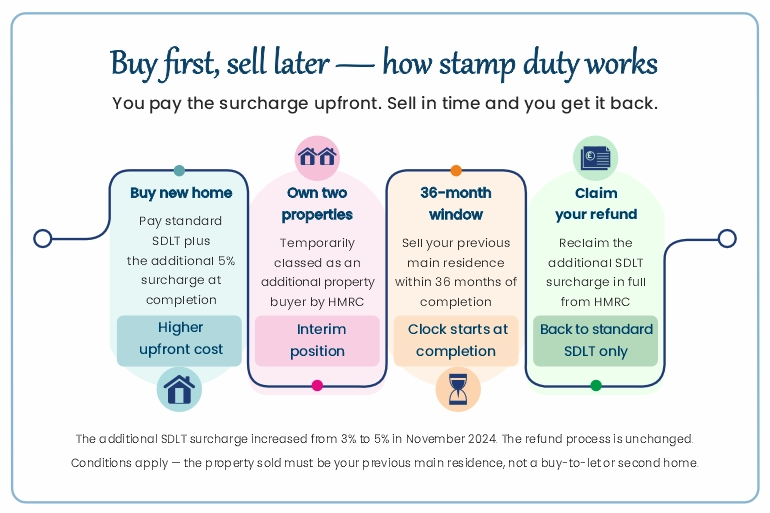
The 36-month rule is central to how stamp duty works for home movers when your sale and purchase do not happen at the same time. If you buy first, you must sell your previous main residence within 36 months of completing on your new purchase — the clock starts at completion, not at exchange or when you move in. If you sell first and then buy, there is no equivalent 36-month requirement. The rule only applies in one direction.

The Three Scenarios: Buy and Sell Timing Matters

In practice, there are three possible ways a home move can happen, and stamp duty treatment depends on which scenario applies. 

If your sale and purchase complete at the same time — typically as part of a property chain — you are treated as a home mover immediately, meaning only standard stamp duty rates apply and no surcharge is payable. However, being in a chain can introduce practical challenges around timing and dependency on other transactions. This is explored further in our article on options for breaking a property chain. 

If you sell your current home before buying your next one, the position remains straightforward from a stamp duty perspective. You will be treated as a home mover at the point of purchase, with no surcharge payable. However, this may involve additional practical considerations such as temporary accommodation or multiple moves. 

If you buy your new home before selling your existing one, you will temporarily own two properties. In this situation, HMRC treats you as an additional property buyer, meaning you will pay standard stamp duty plus the additional surcharge, which is currently 5% (increased from 3% in November 2024). You will then have 36 months to sell your previous main residence, after which you can claim a refund of the surcharge, provided all conditions are met. 

Worked Examples: How This Works in Practice

To bring this to life, the following two case studies illustrate how stamp duty applies in practice where the new home is purchased before the existing one is sold. In both scenarios, the additional stamp duty is paid upfront and later reclaimed once the previous main residence is disposed of within the permitted timeframe.

Case Study 1: Typical Home Mover (Simple Scenario)

Alex and Olivia (names changed) were living in a two-bedroom flat and decided to move to a three-bedroom house. The new property was purchased for £465,000 in September 2025, while their previous flat, valued at £240,000, was sold five months later in February 2026. 

At the point of purchase, they owned two properties and therefore paid both the standard stamp duty and the additional surcharge. The standard stamp duty on the purchase was £13,250, and they also paid an additional £23,250, representing 5% of the £465,000 purchase price. 

Once their previous main residence was sold within the required timeframe, they successfully claimed back the £23,250 additional stamp duty from HMRC. This meant their final net stamp duty cost remained at £13,250. 

This example illustrates a straightforward buy-first scenario where the additional stamp duty is a temporary cost. Provided the timelines are met and the correct property is sold, the final outcome reflects standard home mover treatment. 

Case Study 2: Higher Value and More Complex Scenario

Steve and Priya (names changed) owned multiple properties, including their main residence, and chose to purchase a new home valued at £2,000,000 in 2022 before selling their existing one. At the time, they paid standard stamp duty of £153,750 along with an additional 3% surcharge of £60,000. 

Following the purchase, they later transferred their former main residence into a limited company structure. For stamp duty purposes, this transfer was treated as a disposal, which meant the conditions for replacing their main residence were satisfied and the £60,000 surcharge was successfully reclaimed. 

As explored further in our article on transferring property from personal name to a limited company, this type of approach can work in certain scenarios but requires careful planning. The key point is that stamp duty treatment is driven by ownership — not how the property is used. 

Checklist: Getting It Right as a Home Mover

To ensure the correct stamp duty treatment, it is important to confirm which property qualifies as your main residence and to ensure that this is the property being sold. You should carefully track the 36-month timeline, keeping a clear record of both purchase and sale completion dates. 

Where multiple properties are involved, understanding your ownership structure becomes particularly important. If a refund is due, it should be claimed promptly once the relevant transaction has completed. In more complex situations, including those involving company ownership or unclear residence status, seeking professional advice is strongly recommended. 

The infographic below will provide an overview of the steps involved

Stamp duty buy first sell later process UK showing 36-month window and surcharge refund rules for home movers.

Key Takeaways

You must replace your main residence, not simply sell any property you own. The timing of your transactions directly affects how stamp duty is applied, and the 36-month rule plays a critical role in determining whether a refund is available. Ownership — rather than usage — is what ultimately determines treatment. While many straightforward cases can be managed directly, more complex situations require careful planning and professional advice. 

Important Disclaimer

This article is for informational purposes only and does not constitute tax advice. It is designed to explain how stamp duty works in practical scenarios and to share illustrative examples. You should always carry out your own due diligence and consult a qualified tax professional before proceeding with any property transaction. 

Frequently Asked Questions

No. Stamp duty treatment is determined by ownership rather than usage. Whether the property is rented out, occupied by a family member, or left vacant does not affect eligibility. The key consideration is whether the property remains in your name. 

In certain circumstances, yes. If the property is transferred from your personal name to a limited company, ownership moves to a separate legal entity, which can count as a disposal for stamp duty purposes and allow a refund to be claimed. However, this must be assessed carefully, as the company itself may incur stamp duty on acquisition. As discussed in our article on transferring property from personal name to a limited companythis strategy is not always appropriate and depends on the wider tax position. 

If ownership of the property is transferred out of your name to a family member, this can be treated as a disposal for stamp duty purposes, meaning you may be able to claim a refund of the additional stamp duty paid. However, transferring property in this way brings wider tax and legal implications, including potential capital gains tax and inheritance tax considerations. It is important to take professional advice before proceeding. 

Where multiple properties are owned, HMRC applies specific rules to determine which one qualifies as your main residence. This is not always straightforward, particularly where more than one property is used at different times. In such situations, referring to HMRC guidance and seeking professional advice is recommended to ensure the correct treatment. 

Picture of About the Author

About the Author

Sekkappan Alagu is the Founder of Nachu Finance Ltd, established in 2006. With an early career in journalism and publishing, he brings clarity and structured thinking to complex financial topics. Through the Nachu Finance Blog and Knowledge Hub, he shares insights drawn from nearly two decades of client advisory experience, helping readers make informed decisions and understand best practices in mortgages, protection and long-term financial planning.
Picture of Business Profile

Business Profile

Nachu Finance Ltd is a directly authorised FCA-regulated firm providing mortgage, insurance and estate planning advice to clients across the UK. The firm takes a holistic approach — considering protection, tax efficiency and long-term planning alongside property finance — maintaining high regulatory standards while keeping advice clear and easy to follow. To learn more about the firm's background and story, visit the About Nachu Finance page.

Continue Strengthening Your Financial Understanding

Buying a Home Today With the Intention to Letting It Out in the Future

Resi Home Today B2L Tomorrow

A Financial Insight for First-Time Buyers Planning Ahead

Many first-time buyers choose a property that meets their current needs, knowing that life will evolve in the years ahead. It is quite common for young professionals like Arjun, an IT consultant working in Central London, to buy a one-bed flat close to work today and then, as their family grows, keep this first home as an investment property while moving into a larger place.

If this is something you are considering, it helps to understand what to think about now, at the point of purchase, so that you are well-placed to rent out the property later without unnecessary complications.

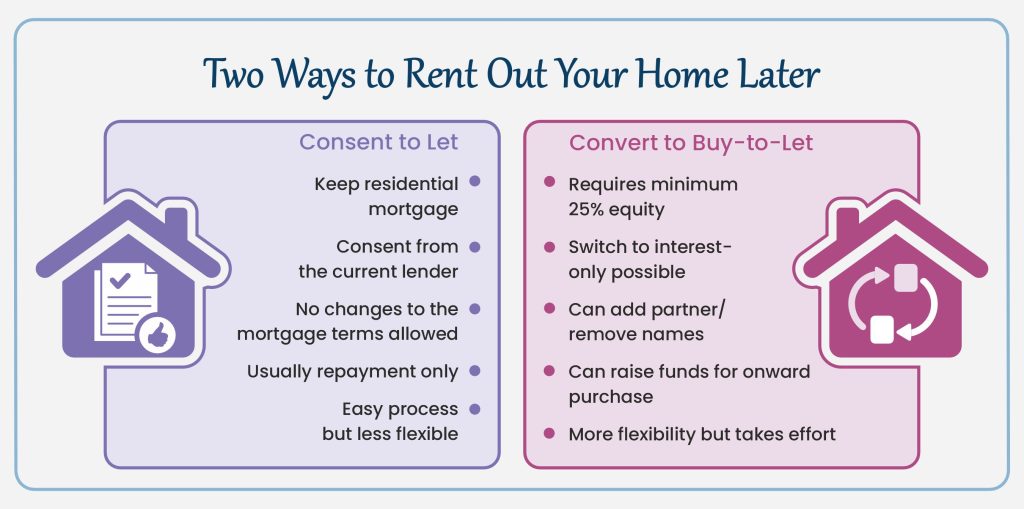
Two Ways to Let Out Your Home in the Future

Two Ways to Let Out Your Home in the Future

When the time comes to let out your current home, there are two broad routes.
Both are commonly used and each has its own advantages depending on your long-term plans.

Understanding Rental Demand

Some properties make excellent homes but less successful rental investments.
Areas with strong local employment, transport links, and amenities typically see steady rental demand, while certain high-end or larger properties may attract fewer tenants.

If you are buying with the intention to let out later, it is worth spending a little time assessing the area’s rental activity. This can save you surprises in the future.

Things to Check Before Buying If You Plan - Resi to B2L Later Info 2

Staying With Your Residential Mortgage and Requesting “Consent to Let”

This option keeps things simple. You continue with your existing residential mortgage and inform the lender that your circumstances have changed. You ask for permission to let out the property, and if the lender agrees, you receive what is known as consent to let.

You do not change the mortgage type.
You do not remortgage.
You do not alter any other aspect of the mortgage apart from the usage.

Some lenders such as NatWest and Santander are known for being flexible and may allow consent to let on an ongoing basis, even when your fixed rate ends. They may also allow you to choose new products while keeping that permission active.

Other lenders, including Halifax and Virgin Money, tend to grant consent for a much shorter period, often one to two years. Once this period ends, they may expect you to formally convert the mortgage to a buy-to-let product or move to another lender.

Why this approach appeals:
It avoids the hassle of remortgaging and allows you to rent out the property without breaching any contract terms.

What to keep in mind:
Since you are technically still on a residential mortgage, you usually cannot:

Consent to let is ideal if you want a simple and temporary arrangement.

Converting the Mortgage to a Buy-to-Let

The second route is to formally convert the residential mortgage into a buy-to-let mortgage. This tends to offer more flexibility and is usually preferred if you want a long-term investment setup.

A key requirement for buy-to-let mortgages is having at least 25% equity.
This means the mortgage must be no more than 75% of the property value.
Even if you bought with a 10% deposit, you may naturally reach this level over time due to capital repayments and property price growth.

If you fall short of the 75% loan-to-value threshold, lenders may ask you to reduce the mortgage balance when converting. This can be done by contributing additional funds.

You can read further about Loan to values here

Thinking Ahead: Will the Rental Income Work?

Buy-to-let lenders assess affordability based mainly on rental income.
It helps to look up the likely rental value of similar properties in the area.

The rental yield gives a useful early indication.
It is calculated as:

Annual rent ÷ property value × 100.

A stronger yield (for instance a 6% yield) makes it easier to borrow the amount you need on a buy-to-let mortgage.
A weaker yield (for instance a 4% yield) may mean the loan amount has to be lower or supported by your personal income.
There are ways to structure this, especially for basic-rate taxpayers or applicants with surplus income, but it is good to be aware of this early on.

You can understand further about rental yield here

Considering Lender Appetite from the Start

If you already know there is a good chance you may let out your home one day, the choice of lender for your initial residential mortgage can make a real difference.

Some lenders:

Others may be more restrictive or may expect a formal conversion sooner.

Selecting a lender that naturally aligns with future rental plans helps keep your options open.

When Your Move Involves Buying a New Home at the Same Time

If you decide to let out your current home and buy your next home in one go, this becomes something known as a let-to-buy arrangement.

This is slightly different from a straightforward buy-to-let remortgage because it is designed specifically to support your onward residential purchase. You can read more about Let to buy mortgages here

Conclusion

For first-time buyers like Arjun, planning a few steps ahead can make the future transition from homeowner to landlord much smoother.
If you intend to keep your first home as an investment later, it is worth considering:

With the right preparation, your first home can become a stepping stone to longer-term financial planning and investment.

Frequently Asked Questions

Yes. Every residential mortgage includes a clause requiring you to seek consent before letting out the property. Renting without permission would breach the mortgage contract.

Most lenders will consider it, but each has their own criteria, conditions, and limits. They must also be satisfied that the property was genuinely purchased to live in, not as a disguised buy-to-let.

Once the lender has granted consent and the property is actually rented out, most lenders will assess it similarly to a buy-to-let. The rental income can usually offset the mortgage payments, though each lender’s affordability method differs slightly.

The above blog is more to do with letting out the property entirely and you moving to a different accommodation. If you would like to understand more about continuing to live in the property but rent out a spare room then refer to our separate blog article titled Renting Out a Spare Room: How to Do It the Right Way

Picture of About the Author

About the Author

Sekkappan Alagu is the Founder of Nachu Finance Ltd, established in 2006. With an early career in journalism and publishing, he brings clarity and structured thinking to complex financial topics. Through the Nachu Finance Blog and Knowledge Hub, he shares insights drawn from nearly two decades of client advisory experience, helping readers make informed decisions and understand best practices in mortgages, protection and long-term financial planning.

Picture of Business Profile

Business Profile

Nachu Finance Ltd is a directly authorised FCA-regulated firm providing mortgage, insurance and estate planning advice to clients across the UK. The firm takes a holistic approach — considering protection, tax efficiency and long-term planning alongside property finance — maintaining high regulatory standards while keeping advice clear and easy to follow. To learn more about the firm's background and story, visit the About Nachu Finance page.

Renters’ Rights Act 2025: What UK Landlords Need to Know and Do Now

Renters Rights Act 2025 UK landlord guide with keys handover – new rental laws and tenant rights changes.

The long-awaited Renters’ Rights Act became law on 27 October 2025, marking the most significant change to the private rental market in decades.

This reform has been discussed for years, and now that it’s official, every landlord — from those with one rental property to experienced portfolio investors — needs to understand what has changed and how to adapt.

At Nachu Finance, we’ve always emphasised that property investment is not a passive activity. It requires time, care, and compliance — closer to running a small business than simply holding an investment. With the new rules now in force, landlords who treat their property portfolio with professionalism will continue to do well.

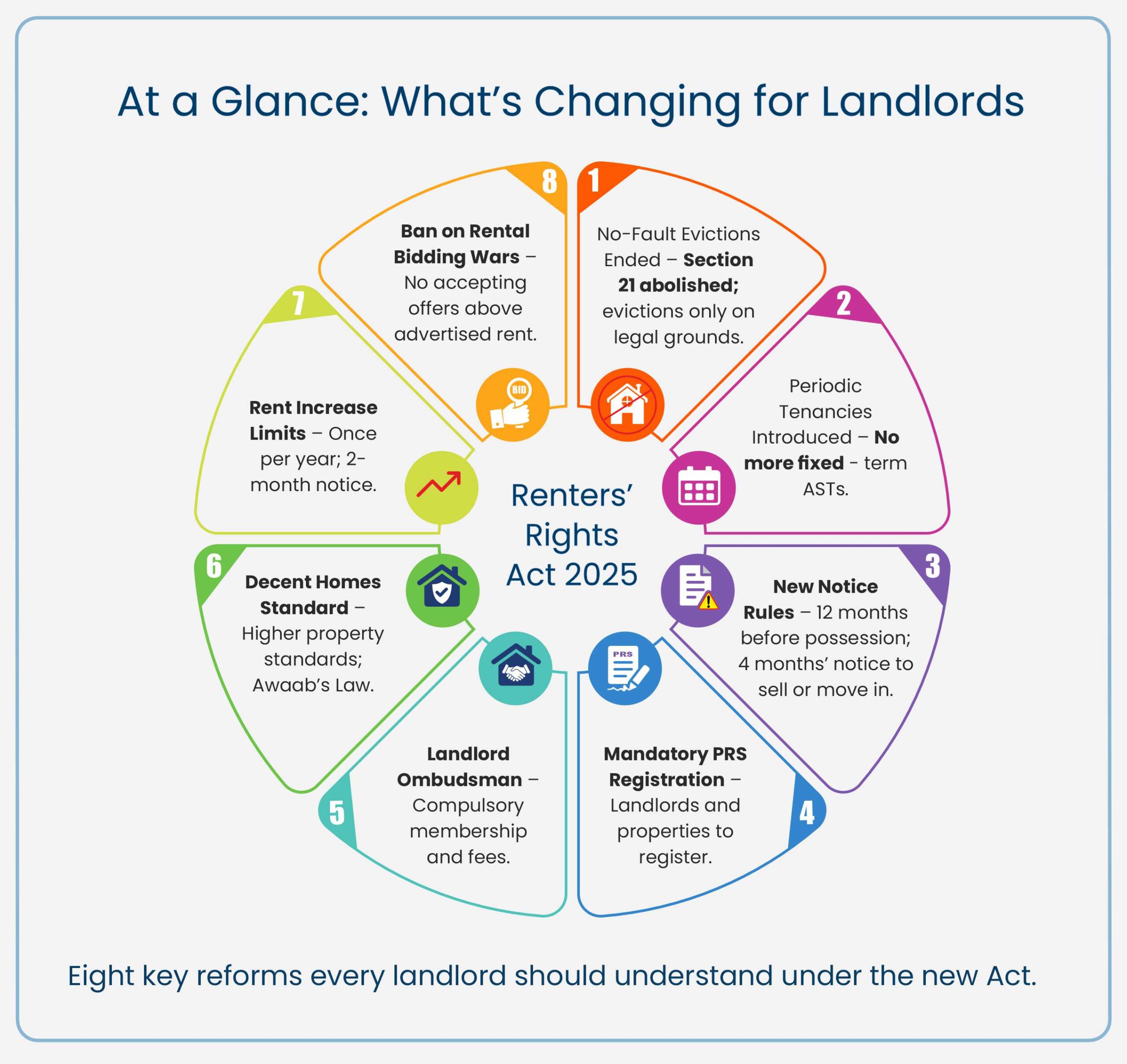
Eight Key Forms - Renters Right Act 2025

The Renters’ Rights Act 2025 has introduced sweeping reforms to improve tenant protections and raise housing standards. Here’s what this means for landlords:

  1. End of Section 21 Evictions: The familiar “no-fault eviction” has been abolished. Landlords must now use Section 8 and demonstrate valid reasons such as rent arrears, anti-social behaviour, or the need to sell or move back in.
  2. All Tenancies Become Periodic: Fixed-term Assured Shorthold Tenancies (ASTs) are gone. Every tenancy automatically rolls month to month, giving tenants flexibility to leave with two months’ notice, and landlords can only end tenancies on specific grounds.
  3. New Possession Rules: Landlords can still regain possession to sell or move in, but only after 12 months and with four months’ notice.
  4. Mandatory Registration: Both landlords and their properties must be registered on the new Private Rented Sector (PRS) Database before being marketed or let.
  5. Landlord Ombudsman Scheme: All landlords must join a new redress scheme, paying annual fees. The ombudsman can require remedial action or compensation where complaints are upheld.
  6. Decent Homes Standard: This applies to all private rentals for the first time. Properties must be safe, warm, and free from hazards such as damp or mould.
  7. Rent Increase Rules: Rent can only be increased once per year, with at least two months’ notice. Tenants can challenge increases at a tribunal.
  8. Ban on Rental Bidding Wars: Landlords cannot advertise a rent and then accept higher bids.

For professional landlords who already maintain their properties well, these changes will mainly mean formalising existing good practices rather than reinventing the wheel.

Understanding the New Tenancy Landscape
The shift to periodic tenancies is perhaps the most significant change.
Landlords can no longer rely on fixed end dates to regain possession, which makes tenant selection, documentation, and ongoing communication more critical than ever.

While eviction rules have tightened, landlords still retain rights where genuine reasons exist — such as rent arrears, breach of tenancy, or the need to sell.
This means thorough record-keeping and prompt action will now carry even greater importance.

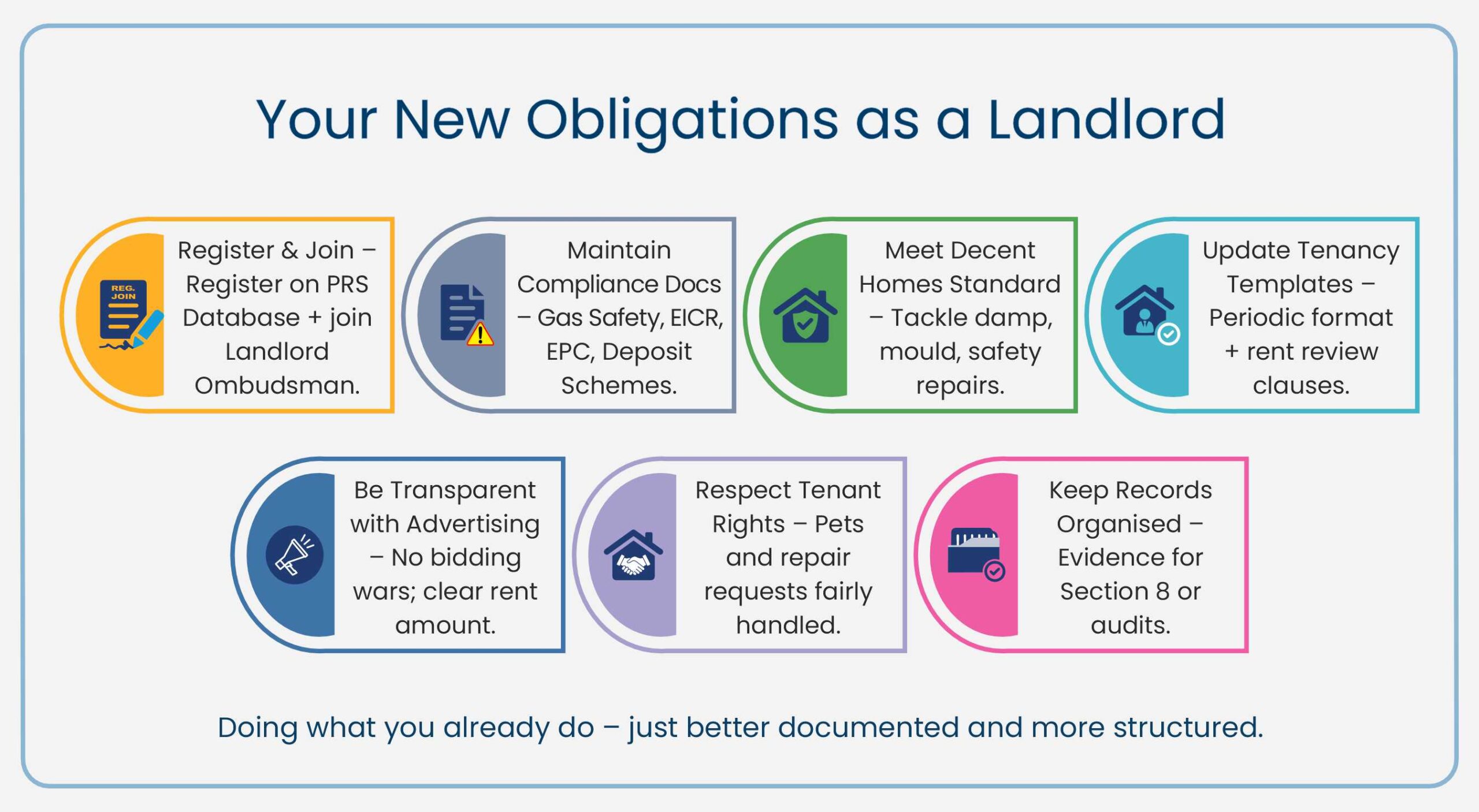
7 Checklists - Renters Right Act 2025

With mandatory registration, higher property standards, and new complaint-handling procedures, landlords must now operate with stronger systems and checks.

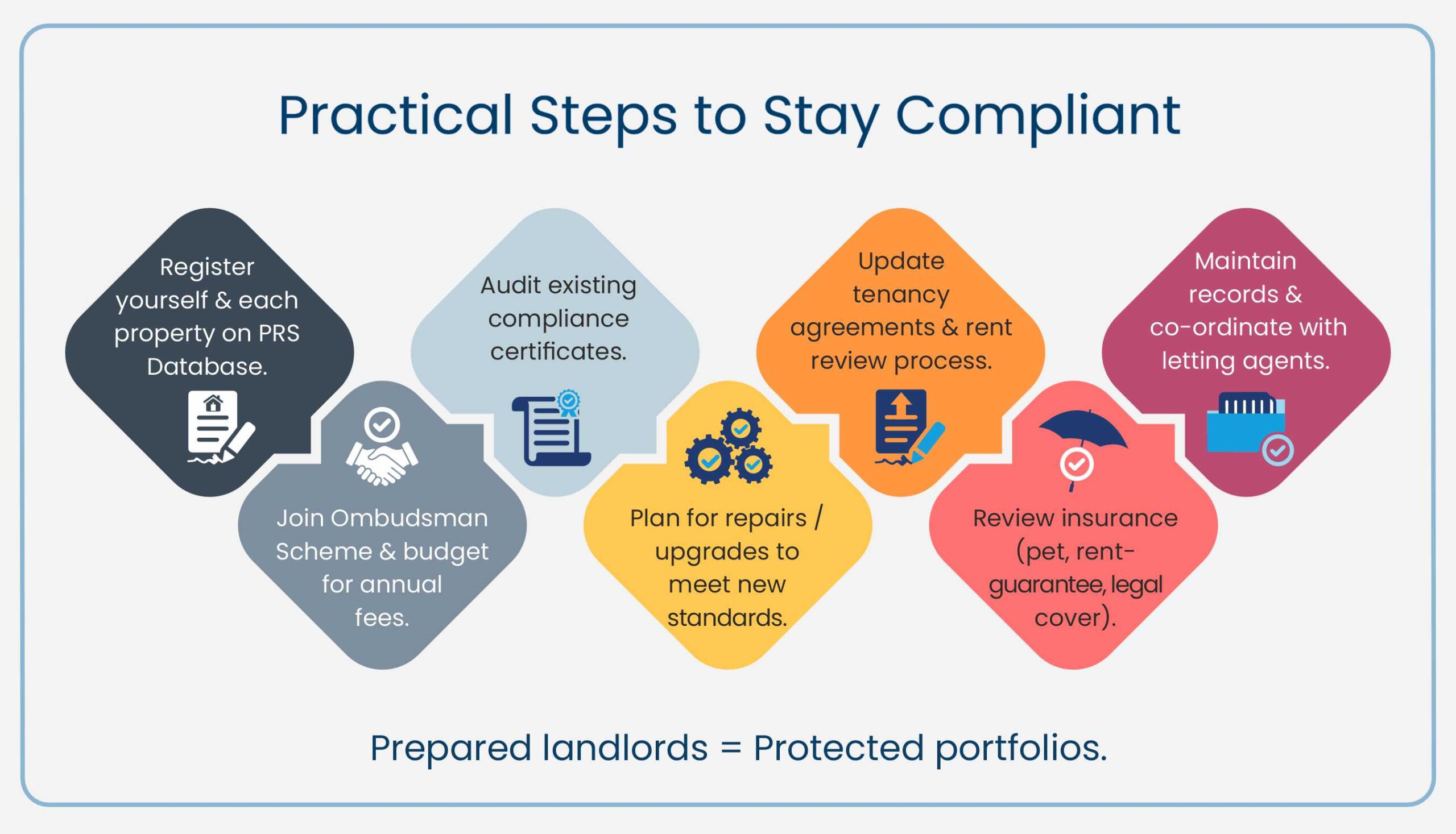
  • Register both yourself and each property on the PRS Database once the portal is available.
  • Join the Landlord Ombudsman Scheme and budget for the annual fee.
  • Keep compliance documents up to date — Gas Safety, EICR, EPC, deposit protection, and right-to-rent checks.
  • Address any issues such as damp, mould, or faulty wiring proactively.
  • Update tenancy agreements to reflect periodic terms and rent increase rules.
  • Ensure your advertising is transparent, with a clearly stated rent figure.
  • Maintain proper records for inspections or future possession claims.

Most experienced landlords will already be doing much of this. The difference now is that compliance will be monitored more closely, and the penalties for neglecting it are higher.

What Landlords Should Do Now

The Renters’ Rights Act may sound complex, but the path forward is clear.
Every landlord — whether you let out one property or manage several — can start by reviewing three key areas:

  1. Registration and Documentation: Get ready for PRS and Ombudsman registration, and make sure every compliance certificate is current.
  2. Property Condition and Maintenance: Plan works early to meet the new Decent Homes Standard.
  3. Process and Planning: Build a system for reminders, record-keeping, and communication with tenants.

The infographic below summarises these into a simple step-by-step plan to help you stay ahead.

Coordinate with your letting agent or managing agent to ensure they’re up to date with the new regulations and compliance requirements.

The best way to approach the new legislation is with preparation, not panic.
Here’s a practical way forward:

  • Audit your portfolio: Check every property for safety and compliance.
  • Plan maintenance budgets: Bring older properties up to the Decent Homes Standard.
  • Review insurance cover: Especially rent guarantee, legal expenses, and pet-related damage.
  • Set reminders: Use systems or spreadsheets to track renewal dates for safety certificates.
  • Coordinate with your letting agent or managing agent to ensure they’re up to date with the new regulations and compliance requirements.
  • Join a landlord body: Organisations such as the NRLA provide valuable updates and guidance.

For landlords who already manage their properties professionally, the new Act simply means documenting more of what you already do.

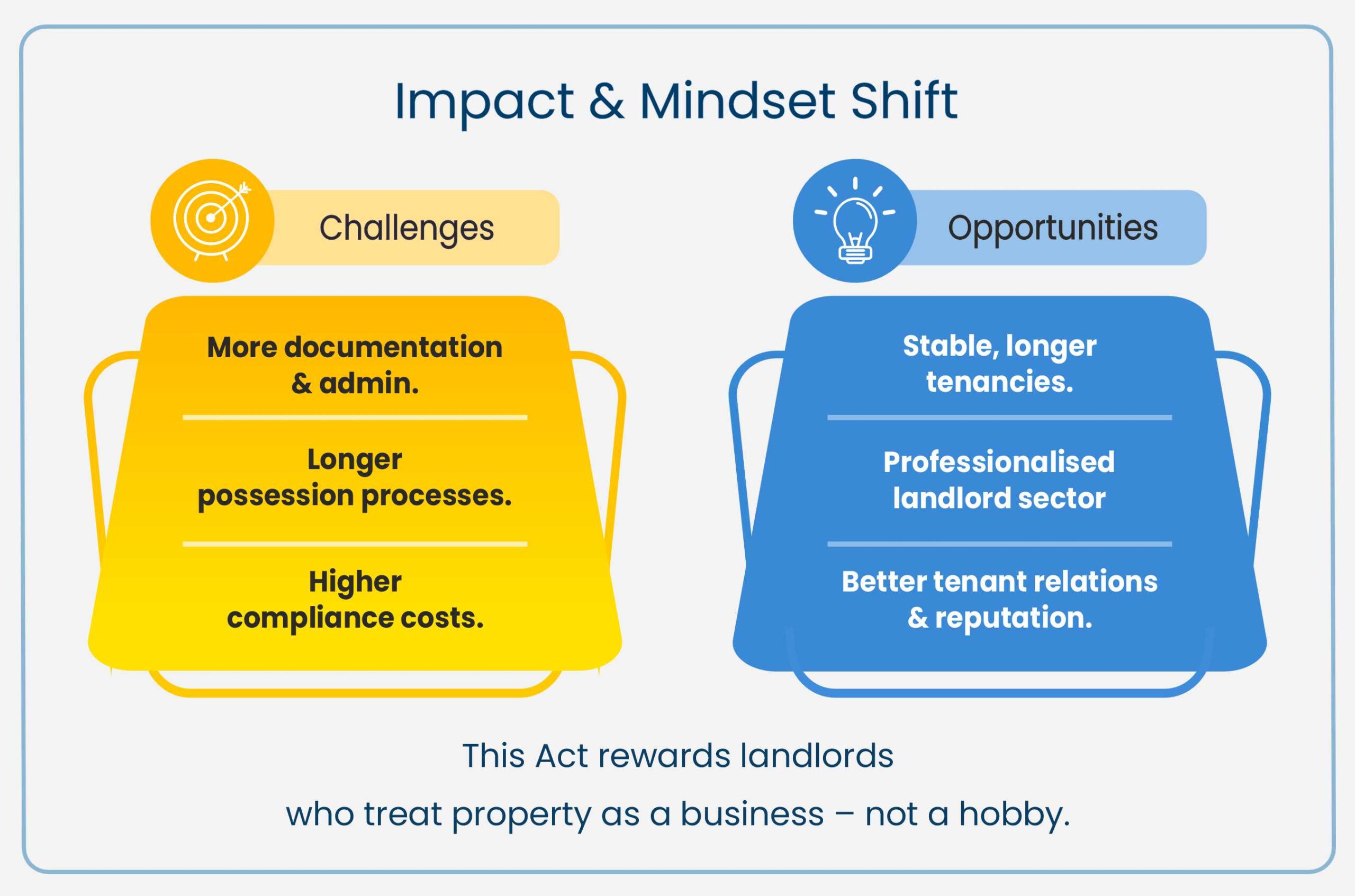
Challenges & Opportunities -Renters Right Act 2025

It’s understandable that these changes might feel like additional burden, but they also mark a positive step toward a more transparent and professional rental sector.

While some landlords may decide this isn’t for them, those who continue with structure, diligence, and care will find greater stability in the long run.

The goal now should be to strengthen your systems, review your processes, and stay informed — not to step back from property altogether.

The Renters’ Rights Act may bring higher expectations and more oversight, but it also brings clarity and consistency.
For responsible landlords, this is an opportunity to stand out for doing things right — maintaining well-kept homes, fair treatment, and strong compliance.

With a little extra care and organisation, you can continue to thrive in this new landscape and provide homes you’re proud to let.

Picture of About the Author

About the Author

Sekkappan Alagu is the Founder of Nachu Finance Ltd, established in 2006. With an early career in journalism and publishing, he brings clarity and structured thinking to complex financial topics. Through the Nachu Finance Blog and Knowledge Hub, he shares insights drawn from nearly two decades of client advisory experience, helping readers make informed decisions and understand best practices in mortgages, protection and long-term financial planning.

Picture of Business Profile

Business Profile

Nachu Finance Ltd is a directly authorised FCA-regulated firm providing mortgage, insurance and estate planning advice to clients across the UK. The firm takes a holistic approach — considering protection, tax efficiency and long-term planning alongside property finance — maintaining high regulatory standards while keeping advice clear and easy to follow. To learn more about the firm's background and story, visit the About Nachu Finance page.

Tax Year Overview: What It Is, Why It Matters for Your Mortgage, and How to Download It

Tax year overview UK for mortgage applications – ensuring tax documents and SA302 are accurate for lender affordability checks.

When applying for a mortgage, especially as a self-employed individual or landlord, one document that often causes confusion is the Tax Year Overview (TYO). Many clients aren’t aware of what this document is, how it differs from the tax calculation, or how to download it correctly from the HMRC website.

Let’s clear up the confusion and walk you through what a Tax Year Overview is, when it’s required, and how to avoid common mistakes when submitting it.

Continue reading

Transfer of Equity: Mortgage Implications, Costs, Tax & Legal Process Explained

Add or remove a name from property ownership illustration with family under house – property title change and joint ownership guidance.

Transfer of Equity (TofE)is the legal process of changing the ownership of a property by adding or removing names from the title. Unlike a sale and purchase transaction, at least one of the existing owners continues to remain on the title. While the actual legal work is carried out by a solicitor, mortgage advisers like us often get involved—because the names on the mortgage must reflect the updated ownership. This article explores the key aspects of a Transfer of Equity and when it might be relevant.

Continue reading

Mortgage Deposit Source & Evidence – What Lenders Expect

Is Your Deposit

When buying a property with a mortgage, it’s easy to focus on rates, monthly payments, or loan sizes—but your deposit source and the evidence behind it can make or break your application. This often-overlooked detail has become increasingly important with tighter anti-money laundering checks and lender scrutiny. In this article, we explain what lenders and solicitors need to see, which sources are acceptable, and how you can avoid delays by getting it right from the start.

Acceptable Sources of Deposit

This is the most straightforward and widely accepted source. Whether saved in the UK or in your personal accounts abroad, lenders will assess the plausibility of your savings by reviewing your income, outgoings, dependants, and duration of savings.

For example:

Money held in ISAs, investment portfolios, individual company shares, or from company share save schemes can all be used as a deposit source, provided you can show ownership and sale proceeds. Lenders may request valuation reports, sale transaction records, or account statements showing the transfer of funds into your account.

If you already own a property and are raising funds through a remortgage, this is usually acceptable, especially for buy-to-let purchases or onward residential moves. You’ll need to provide the remortgage offer, completion statement, and proof that the funds are available or have been transferred.

Gifts from close family—typically parents, grandparents, or siblings—are widely accepted. However, each lender has their own criteria. Gifts from extended family (like uncles, aunts, or cousins) are accepted by some lenders but not all, so lender selection becomes key.

Lenders will check:

A common source, particularly for home movers. If the sale and purchase are simultaneous, evidence is straightforward. But if the sale occurred earlier, lenders will require full documentation—such as the solicitor’s completion statement and bank statements showing the deposit funds received from the sale.

Funds generated from the sale of cars, jewellery, businesses, or similar are accepted with appropriate evidence. You will need to show:

If you have previously loaned money to someone and they’re now repaying you, this can be accepted as part of your deposit—provided you have clear documentation showing the original transfer and the repayment. Lenders will typically look to verify key details such as the names involved, the amount originally loaned, and the amount being returned to ensure the funds are genuinely yours. Id documents, proof of funds and a loan repayment letter will be required.

Some property developers offer financial incentives, such as cash contributions towards your deposit. These are generally acceptable, subject to each lender’s specific criteria. However, it’s important to note that most lenders cap the allowable developer contribution at a maximum of 5% of the purchase price. Anything beyond this may be deducted from the purchase price for lending purposes or may not be accepted at all.

Lenders will also assess how the incentive is structured—whether it’s a straightforward cash contribution, a discount on price, or a package (e.g. paying stamp duty or legal fees)—and treat each case accordingly.

Sources That Are Typically Not Accepted


While some sources may occasionally be accepted under special circumstances, the following are generally not viewed favourably:

Lenders typically do not accept borrowed money as a deposit, as this affects affordability and introduces repayment risk. Some exceptions exist (e.g. inter-family loans on specific terms), but these are rare and require full disclosure.

Most lenders do not accept gifts from friends, viewing them as potential undisclosed loans rather than true gifts.

Large cash deposits raise red flags for anti-money laundering checks. These are scrutinised heavily, and unless there’s a verifiable paper trail, they are best avoided during your deposit-building phase.

Due to the difficulty in verifying the origin and movement of funds in crypto wallets, most lenders do not accept deposits that were held or generated through cryptocurrency—even if the money has since been converted into a standard bank account.

Even if the deposit source is normally acceptable, it may be rejected without appropriate documentation to support it. It’s not just the lender who needs to be satisfied—the solicitor handling the purchase is also responsible for verifying the legitimacy of the funds under anti-money laundering regulations. If the evidence is incomplete or unclear, the solicitor may refuse to proceed, even if the lender has initially accepted the deposit in principle.

Understanding Your Deposit

Myth: “If It’s Been in My Account for a Long Time, I Don’t Need to Prove It”

A common misconception is that if funds have been sitting in your bank account for a long time, you don’t need to show the source. This is not true. Regardless of how long the money has been in your account, lenders and solicitors will still ask for evidence of its origin.

Our Recommended Approach: Be Upfront and Honest

At Nachu Finance, we strongly recommend a transparent approach when it comes to your deposit. If the source is genuine—even if slightly unusual—it’s often easier to present it honestly than attempt to frame it as something more ‘standard’.

Our role is to:

This may mean a bit more admin early on, but it ensures fewer delays and surprises later.

Why Lenders and Solicitors Require Deposit Evidence

Lenders and solicitors are bound by anti-money laundering (AML) regulations. Often, solicitors request even more detailed documentation than lenders to fulfil their legal obligations. This is standard and should not be a cause for concern.

Use of Technology in Evidence Collection

Some solicitors now use third-party apps and digital tools to collect and verify documents more efficiently. This doesn’t change the need for documentation—it just streamlines the process for both parties.

Estate Agents May Ask Too

Increasingly, estate agents also request evidence of deposit before taking a property off the market. This is to ensure buyers are credible and to meet their own AML compliance obligations.

Best to Avoid Multiple Transfers

We often see cases where clients move money between their own bank accounts multiple times before the funds settle in the final deposit account. While this isn’t necessarily a problem for lenders or solicitors, it does mean more paperwork.

If your deposit has passed through several accounts—for example, from Account A to B, then C, then D, before ending up in Account E—be prepared to provide bank statements for all five accounts. Each transfer must be clearly documented to establish a full trail of funds.

To make things simpler:

This helps reduce delays and makes it easier for everyone involved in the mortgage and legal process to verify your deposit source.

Common Documents Required to Prove Your Deposit

The documents required will depend on the source of the funds, but here’s a general guide based on what lenders and solicitors typically ask for:

Mortgage deposit checklist showing acceptable sources, gifted deposits, sale of assets, and loan repayment requirements with supporting documents and tips.

How Nachu Finance Can Help

We can’t make an unacceptable source of deposit magically become acceptable—but we can help you find a lender who will work with your circumstances.

Over the years, we’ve built long-standing relationships with a wide range of mortgage lenders. This allows us to understand which lenders are more likely to accept specific deposit sources that others may decline.

Our client-first approach means we always deal with this important aspect of the mortgage process upfront. By understanding your deposit position early and matching you with the right lender, we help avoid unnecessary delays or disappointments later.

Back in 2013, Rishi, a first-time buyer earning a basic salary of £74,000 plus an annual bonus of over £10,000, was keen to purchase his first home priced at £250,000. While affordability for the mortgage wasn’t an issue, the main challenge was the deposit—he didn’t have enough saved.

To bridge the shortfall, Rishi was willing to take out a personal loan. However, using a loan as a source of deposit is typically not accepted by most mortgage lenders, as it impacts both affordability and risk perception.

At Nachu Finance, we reviewed the case carefully. Given that the overall affordability remained strong even after accounting for the personal loan repayments, we approached one of our trusted high street lenders—known to consider such scenarios on a case-by-case basis. After discussing the application directly with our relationship manager at the bank and presenting the full picture transparently, the mortgage offer was issued without delay.

We also advised the solicitors upfront about the arrangement and confirmed that the lender had approved the use of a personal loan for the deposit. The purchase completed smoothly, without any last-minute hurdles.

Since then, we’ve successfully supported many clients in similar situations—where the source of deposit may not be straightforward, but the case is genuine, and the affordability checks out. With the right guidance and lender selection, even cases that don’t fit the standard mould can be placed confidently.

Our Transparency Promise

At Nachu Finance, our transparency promise means we leave no stone unturned at the outset. This includes a thorough due diligence process—where reviewing your deposit source and ensuring the evidence stands up to scrutiny is a central part.

Yes, we are on your side. But we are also realistic about what lenders and solicitors will require. That’s why we prefer to examine the deposit documentation in detail at the beginning, so we’re ready with the right explanations or supporting documents if queries arise.

So please don’t take it the wrong way if we request detailed paperwork early on—it’s all in your best interest and helps avoid issues further down the line.

Ready to Secure the Right Mortgage for Your Situation?

If there’s a way to place your case, we will find it.

At Nachu Finance, we pride ourselves on understanding each client’s unique situation. If your deposit source is acceptable to even a small number of lenders, we’ll identify them and present your case in the best possible light.

Whether your deposit is coming from multiple sources, overseas accounts, or less common routes, we’ll help you gather the right documentation and guide you every step of the way.

Contact us today for honest, experienced, and lender-aware mortgage advice that doesn’t shy away from the details.

Picture of About the Author

About the Author

Sekkappan Alagu is the Founder of Nachu Finance Ltd, established in 2006. With an early career in journalism and publishing, he brings clarity and structured thinking to complex financial topics. Through the Nachu Finance Blog and Knowledge Hub, he shares insights drawn from nearly two decades of client advisory experience, helping readers make informed decisions and understand best practices in mortgages, protection and long-term financial planning.

Picture of Business Profile

Business Profile

Nachu Finance Ltd is a directly authorised FCA-regulated firm providing mortgage, insurance and estate planning advice to clients across the UK. The firm takes a holistic approach — considering protection, tax efficiency and long-term planning alongside property finance — maintaining high regulatory standards while keeping advice clear and easy to follow. To learn more about the firm's background and story, visit the About Nachu Finance page.

Understanding Capital Gains Tax When Gifting or Inheriting Property

Capital Gains Tax - Property Gifting

Capital Gains Tax (CGT) is payable to HMRC on the gain made when disposing of an asset, including property. However, it’s not just sales that are classed as a disposal-gifting a property can also trigger CGT.
In this article, we explore the implications of gifting a property either fully or partially, how it differs from inherited property, and what happens when property is placed into a trust. We also look at Stamp Duty considerations and share a real-life case study involving a family who transferred property between siblings.

Continue reading

Overpaying into a Mortgage – Residential or Buy-to-Let?

Residential vs buy-to-let mortgage overpayments sign on brick houses – comparing overpayment strategies for property investors and homeowners.

When clients ask about overpaying their buy-to-let mortgage, I often challenge them to consider whether overpaying the residential mortgage might be a better financial move.

If you have both types of mortgages, it’s important to look beyond the surface. While reducing any debt is a positive step, I firmly believe that – in most cases – overpaying the residential mortgage should be prioritised. Here’s why.

Continue reading

Stay One Step Ahead: Register for Free Land Registry Property Alerts

Land Registry property alert fraud warning – register for free UK property alerts to protect your home from title fraud.

When it comes to property-related fraud, the stakes are high-after all, the bigger the asset, the greater the motivation for fraudsters. However, a simple yet effective step to protect yourself is registering for Land Registry Property Alerts, a free service that helps you monitor activity related to your property title.

Continue reading

First Mortgage Payment Explained: Why It’s Higher and How to Prepare

New house purchase, mortgage schedule reminder or real estate payment day, silver house keyring with calculator on white clean calendar

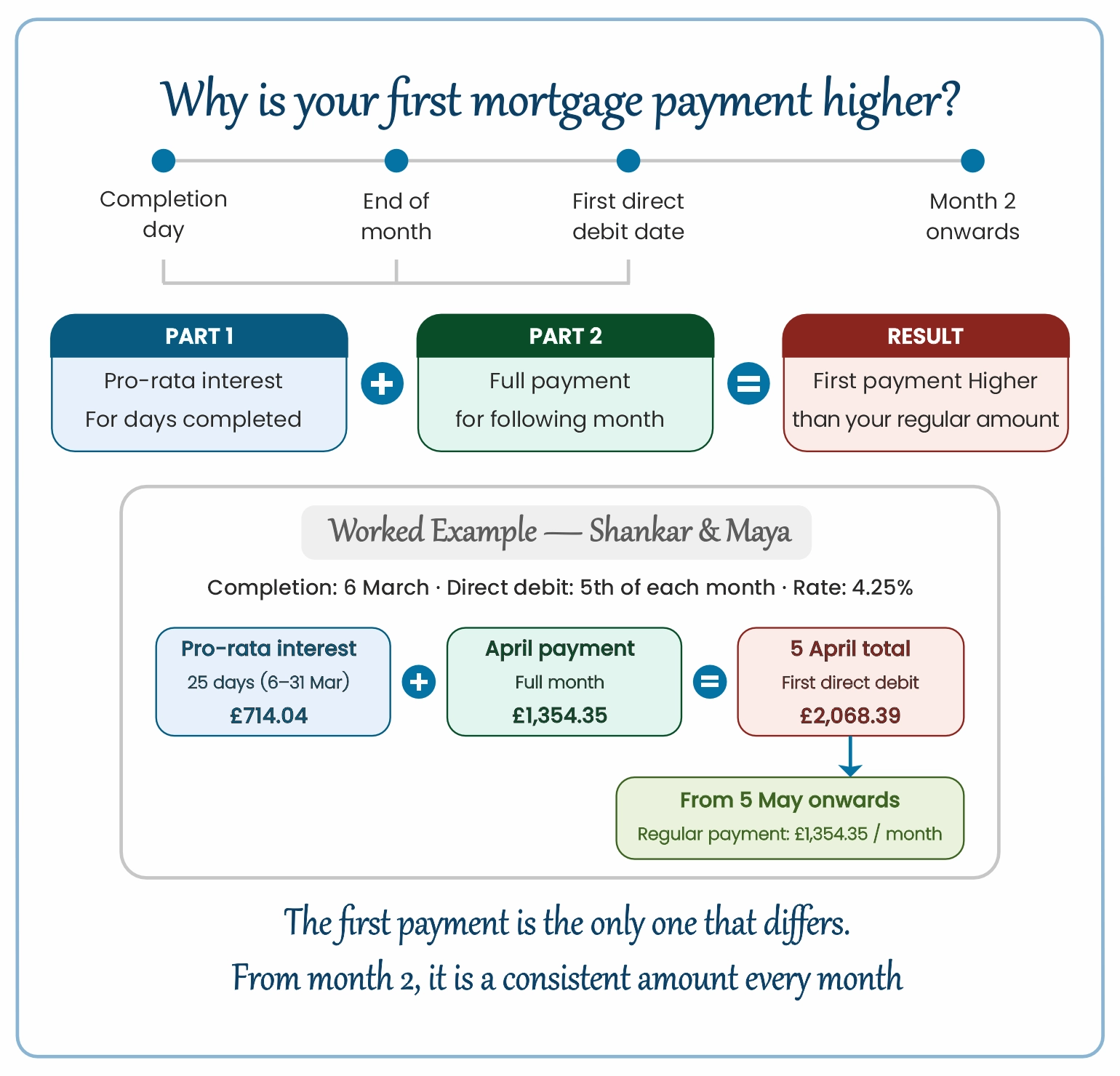
One of the most common questions new homeowners ask is about their first mortgage payment-specifically, why it appears higher than the regular monthly payment. At first glance, this can seem confusing or even concerning. Here’s a clear explanation to help you understand why this happens and what to expect.

Continue reading