Testmonials
Enquiry Form
Get in Touch with Us for Personalized Finance Assistance
Why Married Couples Should Purchase Their Home in Joint Names
- Date Published : Feb 26, 2025
- Date Last Modified:
Most couples don’t realise that how you own your home can affect your tax, your estate, and even your legal rights if your relationship breaks down. Getting this right from the start can save you significant time, money, and stress.

Many clients wonder whether they should purchase a property in joint names, especially if they can afford it in a single name or if one partner does not have an earned income. Some mistakenly believe there are advantages to purchasing a property in a single name.
This article explores why joint ownership is almost always the better choice and debunks some of the most common myths along the way.
Why Joint Ownership Is Usually the Right Approach
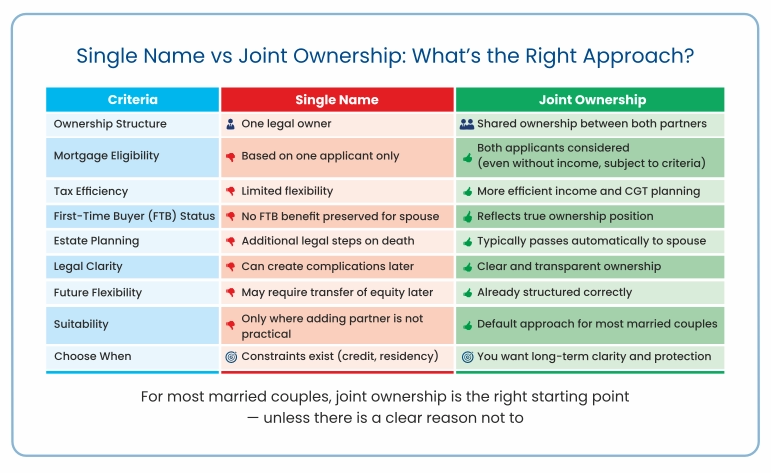
For married couples purchasing a residential home, joint ownership is usually the best option. As a mortgage adviser and estate planner, I recommend starting with this as the default position.
All individuals listed on the property title must also be on the mortgage. If a couple decides to purchase the property jointly, both must be named on the mortgage. If there are challenges in adding a partner to the mortgage — such as a poor credit history or visa restrictions — we explore alternatives together.
Only in cases where it is truly impractical to add a partner should purchasing in a single name be considered. Even then, we advise creating a clear action plan to add the partner to the mortgage when their circumstances improve.
A Lack of Income Is Not a Barrier
Some clients mistakenly believe that if their partner is a homemaker or currently without an income, they cannot be added to the mortgage. This is incorrect.
It is possible to add an applicant without an income, provided they meet other criteria such as age, credit profile, and the right to live in the UK. Do not assume income is a barrier without first speaking to an adviser.
The First-Time Buyer (FTB) Misconception
A common misbelief is that purchasing a home in one partner’s name preserves the other’s First-Time Buyer status for future property purchases. This is not correct.
Under UK homeownership rules and HMRC’s stamp duty regulations, if one spouse owns a property, the other is automatically considered a homeowner. This means they would not qualify for First-Time Buyer Stamp Duty Relief, and any future property purchase made without selling the first home would be treated as an additional property, incurring higher stamp duty rates.
Married couples should not assume they can benefit from First-Time Buyer advantages by purchasing in a single name. HMRC does not allow it.
Estate Planning and Taxation Considerations
If a married couple purchases a property in a single name, additional legal steps are required in the event of the owner’s death. As estate planners, we have encountered cases where a deceased homeowner — despite being married with dependent children — held the property solely in their name due to poor or absent advice. This created unnecessary complications for the surviving spouse.
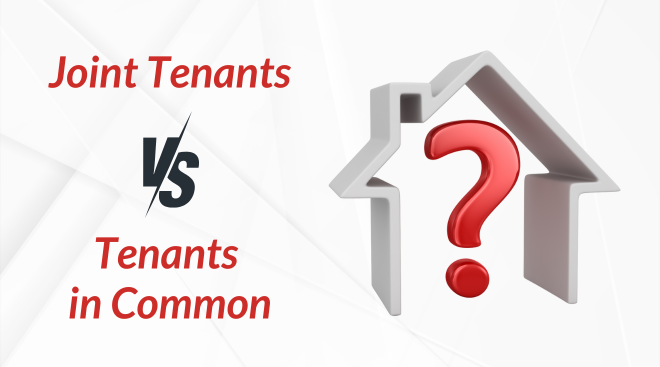
Had the property been purchased in joint names, it would have automatically transferred to the surviving spouse under survivorship rules, provided the property is owned as joint tenants (the default for married couples owning joint properties).
From a tax perspective, joint ownership also offers greater flexibility:
- Income tax: Rental income can be split between both owners if the property is later converted to a buy-to-let, potentially reducing the overall liability.
- Capital Gains Tax (CGT): If the property is sold after a period as a buy-to-let, both partners can utilise their individual CGT allowances, offering more efficient tax planning.
What If the Relationship Ends?
Unfortunately, relationships sometimes break down. In such cases, the courts assess various factors when dividing assets. A marital home registered in one spouse’s name does not necessarily grant them greater rights over the property — the other partner may still have a legal claim.
Joint ownership simply makes this process cleaner and more transparent from the outset.
Non-Matrimonial Assets: An Exception Worth Noting
This guidance applies to a residential home purchased by a married couple as their primary residence. If one partner owned a property before the marriage and it is not used as the couple’s primary residence, joint ownership is not necessarily the best option.
Each case should be assessed individually with professional guidance.
Already Own Your Home in a Single Name? Here’s What to Do Next
If you have already purchased your home in a single name, it is not too late to put this right. Adding your partner’s name to both the title and the mortgage is achievable, and doing so sooner rather than later is strongly advisable.
The most practical opportunity to make this change is at the point of remortgage — typically when your current fixed rate is coming to an end. This allows you to review your mortgage and update the ownership at the same time.
There are two common routes:
- At the end of your fixed-rate period:
This is the ideal time to apply for a joint mortgage and update ownership through a Transfer of Equity. You can explore this in more detail in our Remortgage Advice guide.
- During an existing mortgage term:
If you are mid-term, it is still possible to add your partner. This requires lender consent alongside a Transfer of Equity completed by a solicitor — explained further in our Transfer of Equity guide.
Our recommendation: do not wait for the “perfect moment”. The best time to correct ownership is your next remortgage review.
Making the Right Choice
While some may believe there are advantages to purchasing a property in a single name, the reality is that joint ownership offers significant benefits across estate planning, taxation, and legal clarity.
Purchasing a property is one of the most important financial decisions you will make, and poor advice at this stage can be costly for years to come.
At Nachu Finance, we take pride in offering transparent and holistic advice, built on nearly two decades of client experience. Whether you are buying now or looking to correct an existing ownership structure, we are here to guide you every step of the way.

About the Author
Sekkappan Alagu is the Founder of Nachu Finance Ltd, established in 2006. With an early career in journalism and publishing, he brings clarity and structured thinking to complex financial topics. Through the Nachu Finance Blog and Knowledge Hub, he shares insights drawn from nearly two decades of client advisory experience, helping readers make informed decisions and understand best practices in mortgages, protection and long-term financial planning.

Business Profile
Nachu Finance Ltd is a directly authorised FCA-regulated firm providing mortgage, insurance and estate planning advice to clients across the UK. The firm takes a holistic approach — considering protection, tax efficiency and long-term planning alongside property finance — maintaining high regulatory standards while keeping advice clear and easy to follow. To learn more about the firm's background and story, visit the About Nachu Finance page.
Continue Improving Your Mortgage Strategy