
Testmonials
Enquiry Form
Get in Touch with Us for Personalized Finance Assistance
Tax Calculations (SA302): What They Are and Why They Matter for Your Mortgage
You’re applying for a mortgage. You’re self-employed, a company director, or you own a buy-to-let property. In many respects, that is a proud position to be in — you’ve taken the initiative, accepted the risk, and gone further than most. But when it comes to evidencing your income for a mortgage, this is also where things can get complicated. We believe knowledge is power. If you know exactly what documents are needed and why, the process becomes far less daunting. This article is written for people who are going the extra mile — and want to make sure their mortgage application reflects that.
What Is a Tax Calculation (SA302)?
A Tax Calculation is a summary document produced once your Self Assessment tax return has been submitted to HMRC.
It pulls together all your income sources — from employment, property, dividends, and more — calculates the tax due, and sets out the payment schedule. The result is a concise, standardised document, usually one or two pages long, that gives lenders a clear and consistent view of your financial position.
This standardisation is precisely why lenders rely on it. Whatever your income mix, the format stays the same.
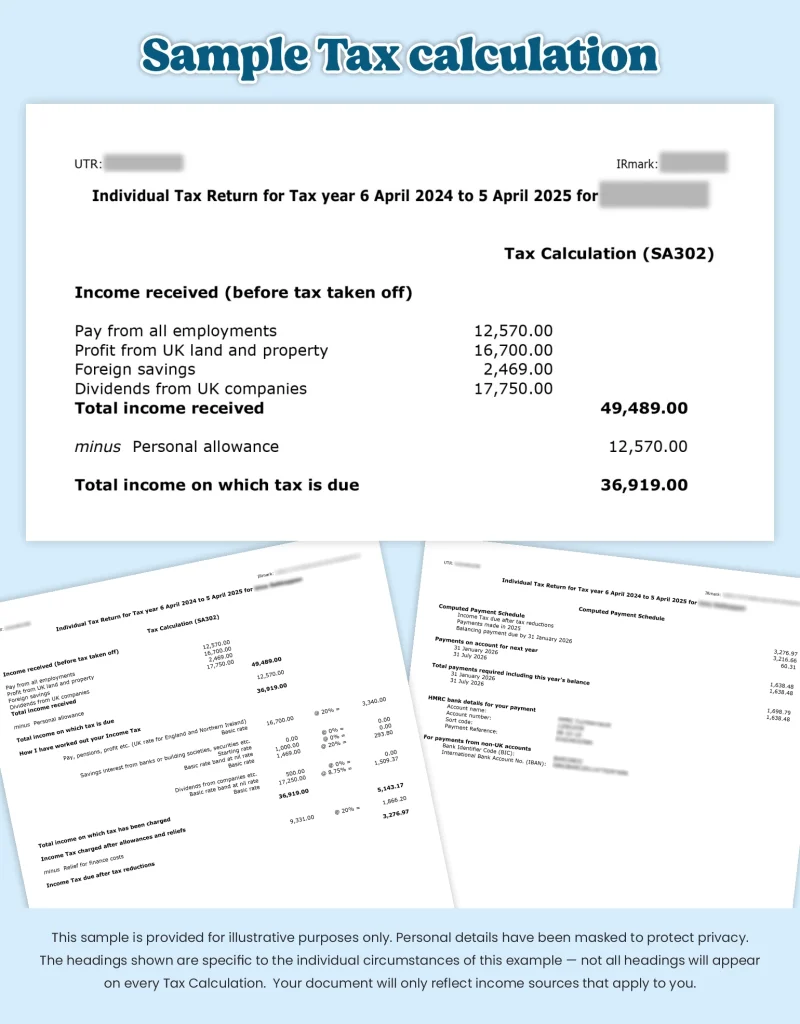
Please refer to the sample Tax Calculation image in this article to help you identify what the document looks like before you begin gathering your paperwork.
When and Why Is It Required?
A Tax Calculation becomes essential whenever your income is not purely from PAYE employment. This includes:
- Self-employed individuals — sole traders and partners
- Limited company directors receiving salary and dividends
- Landlords with property held in their personal name
Even in cases where rental income isn’t being used to support your borrowing, there is a compliance dimension that matters. As regulated mortgage advisers, we have a professional responsibility to confirm that income has been correctly declared to HMRC — not just that it exists. If you receive rental income from a property held in your personal name, you are required to declare it under the heading “profit from UK land and property” on your Self Assessment. We will need to see the Tax Calculation confirming this, regardless of whether that income is being used in your affordability assessment.
You can read more about this in our article on declaring rental income correctly, which explains both the reporting requirements and the consequences of non-disclosure.
Understanding the Dates — Where Most Applicants Get Caught Out
Timing is one of the most important — and most misunderstood — aspects of Tax Calculations.
The UK tax year runs from 6 April to 5 April the following year. HMRC allows you until 31 January to submit your tax return for the year just ended. That sounds generous. But lenders apply a different rule.
Most lenders expect your Tax Calculation to be no more than 18 months old.
This creates a gap that regularly catches applicants off guard. Here’s how it plays out in practice:
| Tax Year | HMRC Submission Deadline | Lender 18-Month Cut-Off |
|---|---|---|
| 6 Apr 2024 – 5 Apr 2025 | 31 January 2026 | October 2026 |
| 6 Apr 2025 – 5 Apr 2026 | 31 January 2027 | October 2027 |
| 6 Apr 2026 – 5 Apr 2027 | 31 January 2028 | October 2028 |
The years above are used to illustrate the pattern — the same principle applies to every tax year going forward.
Here is the practical problem: if you are applying for a mortgage in, say, October 2027, most lenders will expect to see the Tax Calculation for the year ending 5 April 2027. But under HMRC rules, you have until 31 January 2028 to submit that return. You could be fully compliant with HMRC and still fall outside what lenders will accept.
The practical takeaway: if a mortgage is on the horizon, submit your tax return well ahead of the January deadline. It keeps your options open across a wider range of lenders and avoids a situation where your documents are technically current but commercially too old.
Tax Calculation vs Tax Return — A Common Misunderstanding
It is very common for clients to arrive with their tax return, assuming this is what lenders need. In practice, lenders do not accept tax returns as proof of income — and there is a clear reason for that.
| Document | Purpose | Typical Length |
|---|---|---|
| Tax Return | Detailed submission to HMRC for reporting purposes | 15–20 pages |
| Tax Calculation (SA302) | Concise summary of income sources and tax due | 1–2 pages |
The tax return contains the detail. The Tax Calculation provides the standardised summary lenders can work with. Submitting the wrong document is one of the most common causes of avoidable delays — and something easily avoided with a little preparation.
Sample Tax Calculation
This is an example of what a Tax Calculation looks like when produced following submission of a Self Assessment tax return.
As you can see, the document runs to two pages and sets out the income sources, the tax due, and the payment schedule. Personal details have been removed for privacy.
The headings shown reflect the circumstances of the individual in this example. Your own Tax Calculation will only display income sources relevant to you — your document may look slightly different.
The Role of the Tax Year Overview
Alongside the Tax Calculation, lenders will also request a Tax Year Overview (TYO).
Where the Tax Calculation shows how much tax is due, the Tax Year Overview confirms whether that tax has actually been paid — and whether any balance remains outstanding. Lenders use both documents together to ensure consistency. The figures must align, and any outstanding liabilities need to be resolved before a mortgage application can progress.
For a full explanation of what the Tax Year Overview is, how to download it correctly, and the common mistakes to avoid, please see our dedicated guide: Tax Year Overview: What It Is and Why It Matters for Your Mortgage.
How Many Years Are Needed?
Most lenders will ask for two years of Tax Calculations and matching Tax Year Overviews, with the most recent year falling within the 18-month rule.
In some cases, where the previous year’s documents are not available, lenders may accept the most recent year alone by exception — but this is not standard and will depend on individual lender policy.
As a matter of best practice, we routinely ask clients for three years where they are available. If your income in one of the last two years was lower than usual — perhaps due to a difficult trading period, a gap in contracts, or a change in how you drew income from your company — having a third year allows us to put a business case to the lender on your behalf. It gives us the evidence to show the broader picture and argue your corner where a straight two-year view might not tell the full story.
If you are going to the effort of gathering these documents and three years are available to you, we would always recommend collecting all three. It costs nothing extra and may prove valuable.
A Tax Calculation will only display headings that are relevant to your personal circumstances. Not every applicant will see every heading — the document is tailored to your income sources for that year.
The sample Tax Calculation in this article shows a combination of employment income, rental income, foreign savings, and dividends — along with a relief for finance costs. This is a good illustration of how multiple income streams appear on a single document.
Below is an overview of the most common headings and how lenders typically treat each one:
| HMRC Heading | What It Represents | Mortgage Relevance |
|---|---|---|
| Pay from all employments | Salary from an employer, or director’s salary from your own limited company | Used alongside payslips and P60. For limited company directors, lenders use the figure shown here rather than payslips. |
| Profit from UK land and property | Gross rental income from personally held property | Required for compliance and, where used for affordability, assessed after the relief for finance costs has been deducted. |
| Foreign savings | Interest received from overseas savings or accounts | Treatment varies by lender — most lenders will not consider this. |
| Dividends from UK companies | Dividends received from shares in a UK limited company | Used alongside employment income for director/shareholder applicants. Most lenders combine salary and dividends to calculate total income. |
| Relief for finance costs | Mortgage interest and allowable financial costs on rental properties | This is not income — it is a tax relief applied as a deduction. Lenders will reduce the rental income figure accordingly. |
| Total income received | Combined figure across all income sources before allowances | The starting point lenders work from before applying their own income calculations. |
| Total income on which tax is due | Income remaining after the personal allowance has been deducted | Confirms the taxable position — lenders cross-reference this against the Tax Year Overview. |
Your Tax Calculation will only show the headings that apply to you. The table above reflects the headings shown on the sample document and is illustrative of what a Tax Calculation may include — your own document may show different headings depending on your circumstances.
In most cases, obtaining your Tax Calculation is straightforward once you know where to look.
- From your accountantIf you use an accountant, they will usually provide this aftersubmitting your return. It is often included in the year-end documents sent to you as standard — check any emails, portal communications, or post received when your accounts were finalised. The Tax Calculation is most likely to be there.
- From your HMRC online accountIf yousubmit your own returns, you can access your Tax Calculation directly through your HMRC Personal Tax Account. It may require some navigation, but the document will be available there.
A common trap: the Tax Year Summary When navigating your HMRC online account, you may come across a document called a Tax Year Summary. This is not the same as a Tax Calculation and is not accepted by mortgage lenders as proof of income. The Tax Year Summary is a general overview of taxes paid — it does not show the breakdown of income sources in the format lenders require. Please refer to the sample Tax Calculation image in this article to confirm you have the correct document before submitting it.
An important note for those whose returns were filed through commercial software If your tax return was submitted by an accountant using their own commercial software — rather than directly through the HMRC website — you will not be able to download your Tax Calculation from the HMRC portal, even if you have full access to your HMRC online account. This is one of the most common points of confusion we encounter. In this situation, go directly to your accountant as the first step — not HMRC.
- Directly from HMRCIf neither of the above options is available, you can request your Tax Calculation directly from HMRC by telephone. This will take longer and may involve a wait, but itremains a reliable fallback.
If you request by telephone: keep the covering letter When HMRC sends your Tax Calculation following a phone request, it will be accompanied by a covering letter confirming your name, address, and date of issue. Lenders will require both the Tax Calculation and the covering letter together — do not submit one without the other. And if you are calling HMRC for your Tax Calculation, use the same call to request your Tax Year Overviews at the same time. It will save you a second wait.
Key Takeaways
A Tax Calculation is not just another form to track down. It is central to how lenders understand your income when you are self-employed, a director, or a landlord.
- Know which document you need — the Tax Calculation (SA302), not the tax return or tax summary
- Be aware of the 18-month lender rule and how it interacts with HMRC’s January deadline
- Collect two years as standard, three where available
- Always pair your Tax Calculation with the matching Tax Year Overview
- If in doubt about what you are looking at, refer to the sample image in this article
The earlier you prepare, the fewer surprises you will encounter later.
This article forms part of our Knowledge Hub series on mortgage documentation. You may also find our guide on Tax Year Overviews useful — it covers the companion document lenders always request alongside the Tax Calculation.
Frequently Asked Questions
If your income includes any element of self-employment, dividends, or rental income — or if we need to confirm that rental income has been correctly declared to HMRC — then a Tax Calculation is unavoidable. We cannot substitute it with a tax return, a tax summary, or a Tax Year Overview alone. We need the Tax Calculation and the corresponding Tax Year Overview together.
Yes — in almost all cases, lenders require both documents together. The Tax Calculation shows your income and tax liability; the Tax Year Overview confirms whether that tax has been paid. Lenders cross-reference the two and the figures must match exactly. Providing one without the other will result in follow-up requests, so it is best to have both ready from the outset.
Some lenders may consider documents up to around 21 months old, but your options will be more limited. If your latest Tax Calculation and Tax Year Overview fall between 18 and 21 months old, it is still worth speaking to us — there are lenders who will consider this by exception. But if you are planning ahead, filing early is always the better approach.
Whoever submitted your tax return — whether that is your accountant or a commercial software provider — should be able to produce it. If you are struggling to locate it, you can request it directly from HMRC. This takes time, but it is an important document and worth pursuing. When you do call, ask for your Tax Year Overviews at the same time so you are not waiting twice.
If you are simply switching to a new rate with your existing lender at the end of your initial period, and not borrowing any additional funds, a full income assessment is usually not required at that stage. However, for remortgages to a new lender or for any additional borrowing, income documents will be needed.
Yes. If you own a buy-to-let property in your personal name, you are required to declare the rental income to HMRC under the heading “profit from UK land and property.” As mortgage advisers, we have a professional obligation to confirm this has been done correctly — even where that income is not being used to support your affordability assessment. Where rental income is being used as part of your application, lenders will assess it after the relief for finance costs has been applied, which is why how it appears on your Tax Calculation matters. Please see our article on declaring rental income correctly for a full explanation of the reporting requirements.
About the Author
Sekkappan Alagu is the Founder of Nachu Finance Ltd, established in 2006. With an early career in journalism and publishing, he brings clarity and structured thinking to complex financial topics. Through the Nachu Finance Blog and Knowledge Hub, he shares insights drawn from nearly two decades of client advisory experience, helping readers make informed decisions and understand best practices in mortgages, protection and long-term financial planning.

Business Profile
Nachu Finance Ltd is a directly authorised FCA-regulated firm providing mortgage, insurance and estate planning advice to clients across the UK. The firm takes a holistic approach — considering protection, tax efficiency and long-term planning alongside property finance — maintaining high regulatory standards while keeping advice clear and easy to follow. To learn more about the firm's background and story, visit the About Nachu Finance page.