
EPC rating A to G for property mortgage approval UK - energy efficiency impact on mortgage eligibility

Testmonials

Enquiry Form

Get in Touch with Us for Personalized Finance Assistance

Please enable JavaScript in your browser to complete this form.
=

EPC Ratings and Mortgages: What Buyers and Landlords Need to Know

EPC rating A to G for property mortgage approval UK - energy efficiency impact on mortgage eligibility

When buying or letting out a property  the EPC rating can have a larger impact than expected as it is not just legal compliance. It can influence your mortgage options, ongoing energy costs, and even your long-term returns. Whether you are a first-time buyer, a home mover, or a landlord, understanding how EPC ratings fit into the bigger picture is essential.

When applying for a mortgage, particularly for buy-to-let or investment properties, the Energy Performance Certificate (EPC) is NOT just a formality. It carries financial, regulatory, and environmental importance.

At Nachu Finance, we are not energy advisers, but we do take a holistic approach to mortgage planning, and EPC considerations are an important part of the advice we provide.

What Is an EPC and Why It Matters

An Energy Performance Certificate (EPC) provides an energy efficiency rating for a property on a scale from A (most efficient) to G (least efficient). It is a legal requirement in the UK when:

  • Selling a property
  • Letting out a property

The EPC is valid for 10 years and can be easily checked and downloaded via the government portal: https://www.gov.uk/find-energy-certificate. All you will need is the postcode and door number. There is no cost involved in downloading the EPC certificate.

Minimum EPC Requirements for Buy-to-Let Mortgages

To let out a property, it must have a minimum EPC rating of E. Properties rated F or G cannot legally be rented, and mortgage lenders will typically reject applications for such properties until the EPC is improved.

So, if you’re looking to mortgage a property without a valid or acceptable EPC, this must be addressed before proceeding with the mortgage application.

Confirmed: EPC C Required for All Rentals by October 2030

In January 2026, alongside the Warm Homes Plan, the UK Government confirmed its final policy position on minimum energy standards for the private rented sector. All rental properties in England and Wales must achieve a minimum EPC rating of C from 1 October 2030.

Key points for landlords:

  • Single deadline – the earlier proposal of 2028 for new tenancies has been dropped. One deadline of 1 October 2030 now applies to all tenancies, new and existing. 
  • Cost cap – landlords will be required to spend up to £10,000 per property (or 10% of the property value, if lower) towards reaching EPC C, with exemptions available where the standard still cannot be met. 
  • Early compliance protected – properties achieving an EPC C before 1 October 2029 under the current methodology will remain compliant until that certificate expires.

With the deadline now confirmed, landlords should not wait. Planning improvements early will help spread costs, avoid rushed decisions, and prevent non-compliance penalties down the line.

Green Mortgage Incentives

Many mortgage lenders offer special ‘green’ mortgage products for energy-efficient homes:

  • Properties with an EPC rating of A or B often qualify
  • Some lenders also accept properties with a C rating

These green products may include lower interest rates or cashback offers.  As a part of our process, we always check your property’s EPC rating to see if you’re eligible for these incentives.

How to Obtain or Renew an EPC

Getting a new EPC is straightforward:

  • Cost: Typically, between £40 – £120
  • Timeframe: Surveyor visit required; reports usually available in 1–3 working days
  • Finding a provider: A quick Google search for “EPC assessor near me” or “get an EPC certificate” will give you a list of local accredited providers who can carry out the assessment and issue the certificate.

Improving Your Property’s EPC Rating

Each EPC includes recommendations for energy improvements, including:

  • Insulation upgrades
  • Boiler or heating system improvements
  • Double glazing
  • Renewable energy installations

These improvements not only bring your property in line with regulatory requirements, but also:

  • Reduce tenants’ energy bills
  • Attract environmentally conscious renters
  • Contribute to long-term property value

We actively encourage energy efficiency and can help direct you to trusted resources and professionals, though we don’t directly provide EPC improvement advice.

Our Approach: Mortgage Advice That Looks at the Bigger Picture

While many focus solely on rates and repayments, at Nachu Finance we take a holistic view of your property journey—from suitability and compliance, to long-term value and tenant appeal.

If the property you are considering does not have an EPC or falls short of the requirements, this is an important discussion to have before applying for a mortgage.

Frequently Asked Questions

If an EPC already exists for your property, downloading a copy is free and straightforward. Visit the government portal at https://www.gov.uk/find-energy-certificate, select the property using your postcode and door number, and confirm it is a residential property. The certificate can be viewed and downloaded instantly.

An EPC is valid for 10 years from the date of inspection. The certificate itself carries both the inspection date and the expiry date, so you can check its validity at a glance.

It depends on the type of application:

  • Buy-to-let — yes. All let properties must currently hold a minimum EPC rating of E, rising to a minimum of C from 1 October 2030. Lenders will expect to see a current, valid EPC that meets the letting requirement before approving the application.
  • Residential purchase — the seller or estate agent is legally required to provide a valid EPC, so you should expect to see one at the point of purchase.
  • Residential remortgage — there is no mandatory requirement for a valid EPC. However, we normally ask for a copy to check whether the property qualifies for a green mortgage, available for energy-efficient homes.

Yes — green mortgages are designed to encourage energy-efficient homes, typically offering lower rates or cashback. Depending on the lender, they are available for properties rated A–B, and in some cases A–C. If your property holds one of these ratings, we always check whether the lender we are recommending offers a green product you could benefit from.

Getting a new one is simple. A new EPC typically costs £40–£120, requires a short assessor visit, and the report is usually issued within 1–3 working days. A quick search for “EPC assessor near me” will list local accredited providers who can carry out the assessment and issue the certificate.

Mortgage Planning That Goes Beyond the Basics

If you’re buying or refinancing a property and want mortgage advice that factors in more than just numbers—you’re in the right place. At Nachu Finance, we’ll help ensure every aspect of your mortgage journey is well thought through, including EPC compliance and opportunities for green incentives.

Contact us today to benefit from whole-of-market advice, experience-driven insights, and a tech-savvy, transparent approach.

Picture of About the Author

About the Author

Sekkappan Alagu is the Founder of Nachu Finance Ltd, established in 2006. With an early career in journalism and publishing, he brings clarity and structured thinking to complex financial topics. Through the Nachu Finance Blog and Knowledge Hub, he shares insights drawn from nearly two decades of client advisory experience, helping readers make informed decisions and understand best practices in mortgages, protection and long-term financial planning.

Picture of Business Profile

Business Profile

Nachu Finance Ltd is a directly authorised FCA-regulated firm providing mortgage, insurance and estate planning advice to clients across the UK. The firm takes a holistic approach — considering protection, tax efficiency and long-term planning alongside property finance — maintaining high regulatory standards while keeping advice clear and easy to follow. To learn more about the firm's background and story, visit the About Nachu Finance page.

Continue Building Your Landlord Best Practices

Person holding a British passport with text saying valid only with your signature

Testmonials

Enquiry Form

Get in Touch with Us for Personalized Finance Assistance

Please enable JavaScript in your browser to complete this form.
=

Why You Must Sign Your British Passport Immediately

Person holding a British passport with text saying valid only with your signature

Your British passport is more than just a travel document-it’s a key form of identification. However, it is not valid until signed. Ensuring your passport is signed as soon as you receive it is essential for its validity, not just for travel but also for everyday identification purposes.

Why Signing Is Crucial

HM Passport Office specifies that an unsigned passport cannot be used for any purpose, including travel or official ID checks. Whether you’re opening a bank account, completing ID checks for a mortgage, or working with solicitors, your passport must have a signature to be considered valid.
As financial advisers, we can only accept signed passports when verifying your identity. The same applies to solicitors and mortgage lenders who will require a signed passport to complete ID checks. Without your signature, your passport will be rejected during these crucial processes.

Your Signature: The Official ID

The signature in your passport isn’t just a formality—it’s the official record of your signature. It will be referenced in numerous legal and financial situations, from signing contracts to verifying your identity. Ensuring it’s signed correctly is a simple step to avoid complications later.

How to Sign Your Passport

The process is straightforward but must be done carefully. Follow the official guidance from HM Passport Office to ensure your signature is valid and correctly positioned.

Your signature must be placed in the correct section of the passport. Refer to the example below to ensure it is properly completed.

UK passport identity page showing where to sign with X sign here highlighted

Best Practice

To avoid any inconvenience:

Taking a few moments to sign your passport now can save you significant hassle later. Don’t let an unsigned passport delay important processes like securing your dream home or completing financial transactions.

Let us know if you need expert guidance on financial matters or mortgage advice-Nachu Finance is here to support you every step of the way!

Picture of About the Author

About the Author

Sekkappan Alagu is the Founder of Nachu Finance Ltd, established in 2006. With an early career in journalism and publishing, he brings clarity and structured thinking to complex financial topics. Through the Nachu Finance Blog and Knowledge Hub, he shares insights drawn from nearly two decades of client advisory experience, helping readers make informed decisions and understand best practices in mortgages, protection and long-term financial planning.

Picture of Business Profile

Business Profile

Nachu Finance Ltd is a directly authorised FCA-regulated firm providing mortgage, insurance and estate planning advice to clients across the UK. The firm takes a holistic approach — considering protection, tax efficiency and long-term planning alongside property finance — maintaining high regulatory standards while keeping advice clear and easy to follow. To learn more about the firm's background and story, visit the About Nachu Finance page.

Other Useful Best Practices

Life Insurance Review: Why You Should Revisit Your Existing Policies

Life insurance review meeting with advisor showing policy document – ensuring family cover is current and financially secure.

Life insurance, critical illness cover, and income protection are essential pillars of family protection. Yet, once policies are in place, many people rarely revisit them.
At Nachu Finance, we believe a periodic review of your existing life insurance can make all the difference — ensuring your cover remains relevant, accessible, and effective when your family needs it most.

Make Sure the Policy Is Accessible

Before anything else, ensure that your family knows what policies you hold, who the providers are, and where to find the documents.

It is surprisingly common for families to be unaware of the details of existing policies. If you find it difficult to locate your documents while everything is going well, imagine how challenging this could be during a crisis.
Keep your policies accessible — ideally in both digital and physical form — and make sure immediate family members or adult children know where to find them.

Place Your Policy Under a Trust

Placing a life insurance policy under a trust ensures that proceeds are paid quickly and tax-efficiently to your chosen beneficiaries.
If your policy isn’t already under a trust, we strongly recommend setting this up.

If it is already under a trust, ensure the trustees’ details are up to date — especially if children have now become adults or if any trustee is no longer suitable to act.

Read more in our related article: Why Your Life Insurance Policy Should Be Placed Under a Trust

Older Policies: Hidden Gems Worth Keeping
 
Life Insurance Review: Why You Should Revisit Your Existing Policies, Nachu Finance
 

Older life insurance plans can often be genuine hidden gems.
Premiums are based on your age and health at the time you apply, which means policies taken out years ago often benefit from significantly lower, locked-in premiums and medical terms that may no longer be available today.

Before cancelling, altering, or replacing an existing policy, it is essential to seek professional advice. At Nachu Finance, we review older policies with care to ensure they remain relevant to your current needs, and we rarely recommend cancelling them unless there is a clear and meaningful benefit.

Because premiums rise sharply with age, older plans can offer outstanding long-term value compared to arranging cover later in life. Our premium comparison chart by age clearly shows how starting early keeps costs lower for the entire duration of the policy — you can view it Don’t Just Buy a Home-Protect It Too for a clearer picture.

Extending or Increasing an Existing Policy

It is natural to wonder whether an existing policy can simply be extended to cover a longer term or increased to a higher amount.
In most cases, insurers will not allow an increase in cover or extension of the term without full medical reassessment, as this changes the original risk profile.

Our approach is to:

  • Keep your existing policy as it is.
  • Add a “top-up” policy for additional cover or a longer term if needed.

This way, you retain the advantages of your older policy while ensuring your family remains fully protected.

Ensuring Your Cover Is Still Relevant
 
Life Insurance Review - Life Events call for Review
 

Life evolves — so should your insurance.
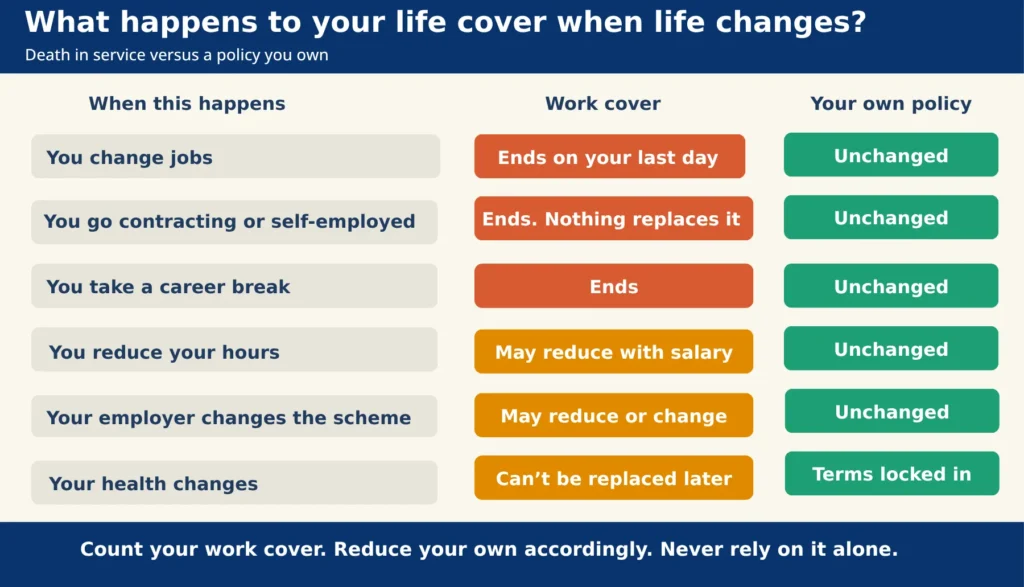
Events such as marriage, buying a new home, having children, or changes in employment (for instance, moving from employed to self-employed) all affect your protection needs.

A periodic review helps you check whether:

  • The level of cover matches your mortgage balance and family needs.
  • Your term still aligns with your working years.
  • Any employer benefits or other cover overlap with your personal policies.

Life Insurance Review - Do's & Dont's


Real life Case Studies

Here are three real-life examples that show how a life insurance review can make a meaningful difference at different stages of life. Each case has a different outcome, but in every situation the review still proved to be the right and sensible step.

Ishan & Sitara

Ishan bought his first property in 2017 for £320,000 with a £250,000 mortgage. At the time, he took out £250,000 of life cover and £100,000 of critical illness cover in his sole name.

When he returned in 2023, he was now married to Sitara and the couple were buying a new family home for £610,000. During our review, we found that Ishan’s historic policies offered excellent terms and very competitive premiums, which would be hard to replicate today.

We therefore kept both existing policies in place, placed his life cover under a trust, and recommended top-up life cover to match his new financial responsibilities. Since Sitara had no protection at all, we also arranged suitable life and critical illness cover for her.

This is a textbook example of why older plans should not be cancelled automatically. With a review, the couple were able to:

  • retain valuable historic cover
  • place the policy under trust
  • top up protection to match their new life stage
  • ensure both partners were fully covered

Felix & Amy

Felix and Amy came to us in 2021 for a remortgage. They had originally purchased their home in 2015 and arranged their life insurance directly with the insurer at the time.

When we asked for their policy documents, they initially struggled to locate them — a common issue that becomes critical during a claim. After some effort, they shared a copy with us and also made sure their family knew where the documents were safely stored.

Following a full review, we concluded that their existing life and critical illness policies were still appropriate for their current circumstances. No top-up cover was needed, but we placed their existing plans under trust and securely stored copies of their documents in their client folder.

Although no new insurance was taken, the review still delivered meaningful benefits:

  • policy documents were located and securely stored
  • the family now knows exactly where to find them
  • the plans were placed under trust for efficient payout
  • reassurance that their existing cover remains fit for purpose

This case shows how valuable a review can be even when no policy changes are required.

Vivan & Rebecca

Vivan and Rebecca approached us around 11 months after their original life insurance was set up at the time of their property purchase. Both were employed when the policies were first taken out.

Within a year, Vivan had moved from employment into a day-rate contracting role through his own limited company. This meant he no longer received the death-in-service benefit he previously enjoyed from his employer.

During the review, we kept Rebecca’s policies unchanged, as her circumstances remained the same. For Vivan, we recommended restructuring his protection by:

  • cancelling his new-but-still-young personal life cover
  • replacing it with a Relevant Life Plan to benefit from significant tax efficiencies
  • increasing the level of life cover to reflect his new responsibilities and lack of workplace benefits

We also reviewed critical illness cover. Although a higher amount would have been sensible, Vivan decided not to increase it for now due to cost considerations.

This case highlights how a review can help align protection with changing employment circumstances — especially when moving to self-employment or contracting.

The Nachu Finance Way
 
Review & Top-Up Approach
 

At Nachu Finance, we appreciate that older policies can hold immense value.
When we review your existing cover, we:

  • Check if it remains suitable for your current family and financial circumstances.
  • Help optimise it — including setting up or updating the trust.
  • Securely store copies of your policies in your client file, so your family can easily access them in the event of a claim.
  • Review both policies arranged by us and those you arranged elsewhere.

Even if no changes are needed, the reassurance that your policy is still fit for purpose is a valuable outcome in itself.

Frequently Asked Questions

No. The insurer bases its terms on your health and lifestyle at the time of application.
Once the policy is live, there is no obligation to update them about later changes.

Yes. You can replace or add trustees at any time.
We always recommend reviewing the trustees during your periodic insurance review to ensure they are still appropriate and willing to act.

Yes. You can hold multiple policies with different providers.
At application, you must declare any existing cover so the insurer can assess your total cover amount correctly.

Absolutely.
For clients whose policies were arranged through us, claim support is fee-free.
We believe compassionate, expert help at such a crucial time is an essential part of our service.

Yes. Many people keep their older policies because they offer lower premiums and favourable terms, and simply add a top-up policy when their protection needs increase. This is completely normal, and it allows you to retain the benefits of your historic cover while ensuring your overall protection keeps pace with life changes.

Our Transparency Promise

Full Disclosure, Complete Peace of Mind

At Nachu Finance, we insist that all applications are made with full and honest disclosure of health, lifestyle, and smoking status.

We review every detail with you before submission, so the insurer receives accurate information.

We would rather an insurer take extra time to verify your details now than risk a claim being declined later for non-disclosure.
This careful approach protects your family’s peace of mind and ensures that your policy pays out when it matters most.

Let Us Review Your Policy

As holistic advisers, we see life insurance as a core part of family financial planning.
Our transparent, no-pressure approach means we’ll only recommend action when it’s genuinely in your favour.

Reach out to Nachu Finance for a free, transparent review of your existing life insurance.
We’ll give you an honest assessment and, if needed, help you:

  • Place the policy under a trust
  • Adjust or top-up your cover
  • Optimise your family’s protection for today and the years ahead
Picture of About the Author

About the Author

Sekkappan Alagu is the Founder of Nachu Finance Ltd, established in 2006. With an early career in journalism and publishing, he brings clarity and structured thinking to complex financial topics. Through the Nachu Finance Blog and Knowledge Hub, he shares insights drawn from nearly two decades of client advisory experience, helping readers make informed decisions and understand best practices in mortgages, protection and long-term financial planning.

Picture of Business Profile

Business Profile

Nachu Finance Ltd is a directly authorised FCA-regulated firm providing mortgage, insurance and estate planning advice to clients across the UK. The firm takes a holistic approach — considering protection, tax efficiency and long-term planning alongside property finance — maintaining high regulatory standards while keeping advice clear and easy to follow. To learn more about the firm's background and story, visit the About Nachu Finance page.

Why Professional Opinion Matters More Than a Google Search

Google Search Vs Expert Opinion
General Search – The Starting Point

It is quite common for clients to begin their research by checking Google, using AI tools, or speaking to friends who have gone through a similar process. These are all good starting points to understand what is generally possible in the mortgage or property market and to familiarise yourself with key terms and concepts.

However, while Google searches, AI responses, and friendly discussions can help build general awareness, they cannot replace case-specific professional advice that takes into account your personal and financial circumstances.

If you are specifically interested in how advice-driven product selection differs from comparison websites, see our related article:

Why Personalised Mortgage Advice Goes Beyond Comparision Website

The Limits of Generic Information

The information found through a Google search or a general discussion with friends is, by nature, generic.
It does not take into account:

  • Your income type or employment structure.
  • The property’s ownership model or intended use.
  • The lender’s current criteria.
  • Your residency or credit profile.

Mortgage lending, taxation, and property law all have layers of detail that differ from one case to another. What works well for one individual may not be suitable or even possible for another.

Why Professional Opinion Matters More Than a Google Search, Nachu Finance     

Consider the use of a gifted deposit.
A quick online search might state that lenders are happy to accept gifted deposits as long as the source of funds is evidenced and supported by a donor declaration.

While this is true in many standard residential purchases, the outcome changes significantly when the purchase:

  • Is made through a limited company,
  • Involves multiple shareholders, or
  • Relates to a non-standard property such as a multi-unit block under a single title.

In such cases, the number of lenders available is very limited. Those who accept gifted deposits often do not accept multi-unit properties, and vice versa. The difference between what appears acceptable online and what is actually possible in your case can therefore be substantial.

Why Professional Advice Holds Greater Weight
Professional opinion is built on understanding not just what the rules say, but how they are applied in practice.
It involves:
  • Interpreting lender and solicitor criteria within the context of your case.
  • Balancing compliance, affordability, and timing.
  • Ensuring that what appears possible in theory is achievable in reality.

A professional adviser also carries regulatory accountability — meaning the guidance you receive must be suitable, compliant, and in your best interests. That level of responsibility does not exist in a Google search, an AI response, or a conversation with friends.

Research Is Useful – Validation Is Essential
Doing your own research is helpful and can make conversations more meaningful. But before proceeding with decisions or forming expectations, it is vital to validate that research with a qualified professional.
 
A generic Google answer or AI response can inform you of what is common, but professional advice ensures that what you are planning is achievable and acceptable for your specific situation.
 
The key takeaway: general searches are a good place to start — professional advice ensures you finish right.

Picture of About the Author

About the Author

Sekkappan Alagu is the Founder of Nachu Finance Ltd, established in 2006. With an early career in journalism and publishing, he brings clarity and structured thinking to complex financial topics. Through the Nachu Finance Blog and Knowledge Hub, he shares insights drawn from nearly two decades of client advisory experience, helping readers make informed decisions and understand best practices in mortgages, protection and long-term financial planning.

Picture of Business Profile

Business Profile

Nachu Finance Ltd is a directly authorised FCA-regulated firm providing mortgage, insurance and estate planning advice to clients across the UK. The firm takes a holistic approach — considering protection, tax efficiency and long-term planning alongside property finance — maintaining high regulatory standards while keeping advice clear and easy to follow. To learn more about the firm's background and story, visit the About Nachu Finance page.

Why Personalised Mortgage Advice Goes Beyond Comparison Websites

Headline mortgage rate vs personal advice comparison – personalised mortgage advice versus comparison websites.

In today’s digital world, it’s natural to turn to comparison websites to check mortgage rates.
They’re easy to use and give a quick overview of what’s available in the market.
But when it comes to actually getting a mortgage — and making sure it’s suitable, affordable, and achievable — what you see on a comparison site is only half the story.
That’s where the value of personalised advice comes in.

Comparison Websites – A Good Starting Point, But That’s All

Comparison websites are a great starting point for research. They help you understand the general range of rates in the market.
However, what they show are generic products, often filtered only by loan amount, property value, and type of mortgage.

What they don’t take into account are your personal details that actually determine whether you can access that rate, such as:

     ⦁ How you earn your income – employed, self-employed, or on a contract
     ⦁ The stability and type of your income – salary, dividends, day rates, or multiple income sources
     ⦁ Your credit profile and existing commitments
     ⦁ Source of deposit – personal savings, gift, or from overseas
     ⦁ Your residency status or visa type
     ⦁ Type and condition of the property
     ⦁ Whether you are buying in personal name or through a Ltd company

Each of these factors can significantly alter which lenders are willing to offer you a mortgage — and at what rate.

What Personalised Advice Brings to the Table

With personalised advice, the focus shifts from finding a rate to understanding your situation in full.

An adviser takes time to understand your circumstances and objectives before recommending any product

They review the entire market (not just one lender panel or an online list) and select options that are:

     ⦁ Available to you, based on your profile
     ⦁ Suitable for your needs and plans
     ⦁ Compliant with lender and regulatory requirements
     ⦁ Timed correctly, reflecting how long each rate is valid and when you plan to complete

Every rate shared through personalised advice is one that the adviser is confident you are both eligible for and comfortable with — taking into account your affordability, goals, and any foreseeable changes ahead
commitment.

Rates Move Fast – Timing and Monitoring Matter

Mortgage rates in the UK can be volatile and may change even within a single day.
A rate displayed online might already be withdrawn or replaced by the time you apply.
With personalised advice, an adviser will typically:

     ⦁ Track market movements daily
     ⦁ Re-check rates right up to the point of exchange or completion for purchases
     ⦁ Revisit options close to your renewal date in remortgages or product transfers
     ⦁ Recommend switching to a lower rate, if one becomes available before completion and it suits your circumstances

This level of monitoring helps ensure that the mortgage product you proceed with remains competitive and appropriate right up to the point you lock it in.

Accountability and Responsibility in Advice

One of the most important distinctions between taking personalised advice and using a comparison website lies in accountability.

When you rely on online listings, no one takes responsibility for whether the information shown is accurate, up to date, or suitable for your circumstances. The choice — and any resulting outcome — rests entirely with you.

By contrast, when you receive regulated mortgage advice, the adviser takes full responsibility for the recommendation made. This includes assessing your income, commitments, and future plans to ensure the advice is both appropriate and compliant.

Every recommendation is backed by professional due diligence, regulatory oversight, and the adviser’s Professional Indemnity Insurance, which provides an additional layer of protection and reassurance for clients.

This accountability — combined with ongoing rate monitoring and suitability checks — is what truly differentiates advice from comparison.

The Value of Trust and Expertise

Personalised mortgage advice is not about selling a rate; it is about guiding someone towards the right mortgage solution for their circumstances.There is no incentive for an adviser to withhold a cheaper rate if it is truly suitable — the entire purpose of regulated advice is to find the option that best fits the client’s needs.

The advice process goes far beyond comparing numbers. It involves making sure the application is positioned correctly, the product aligns with future plans, and the overall journey remains clear and manageable.

Securing a mortgage is a journey rather than a single-step process, and understanding how the various stages fit together can make the experience far smoother. You can read more about the typical steps in the process The First-Time Buyer’s Mortgage Journey: A Complete, Practical Guide

In Summary

Comparison vs Advice-The Real Difference

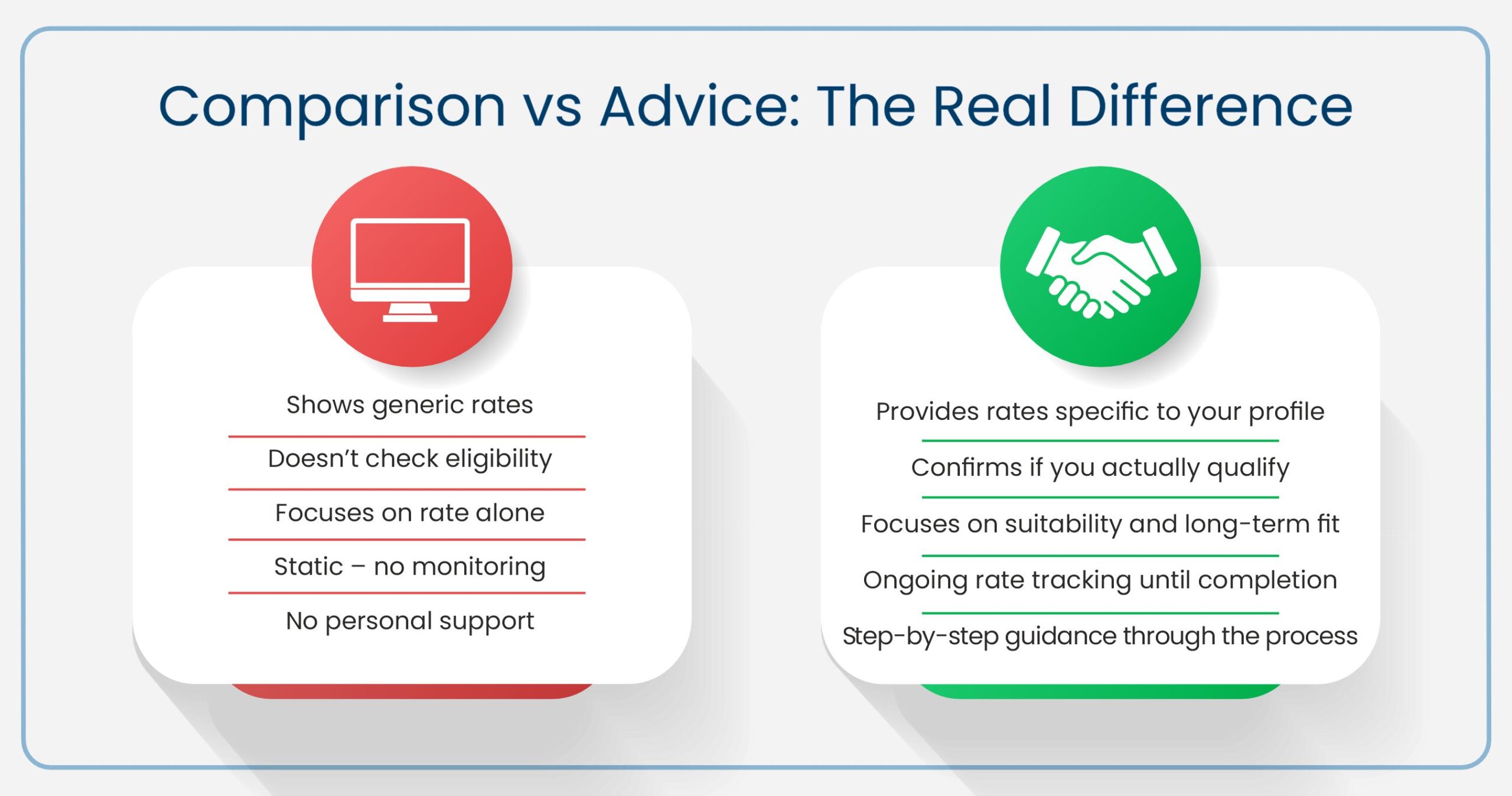
While comparison websites provide a quick snapshot of available mortgage rates, they rarely show the full picture. Personal advice goes several steps further — checking eligibility, assessing suitability, and guiding you through the entire process until completion. The difference isn’t just in the rate, but in the reliability and responsibility behind it.

A Balanced Perspective

There’s nothing wrong with browsing comparison websites — they can be a useful way to familiarise yourself with the market and get a sense of the available options.
However, it’s important to remember that what appears online is a general snapshot, not a tailored recommendation.

When you work with an experienced, independent mortgage adviser, the focus is not just on the rate itself but on eligibility, suitability, timing, and long-term implications.The process involves careful assessment, documentation, and monitoring — ensuring that the final mortgage solution genuinely fits your individual circumstances and future plans.

Good decisions rely on clarity and context, not on headline rates alone.

Picture of About the Author

About the Author

Sekkappan Alagu is the Founder of Nachu Finance Ltd, established in 2006. With an early career in journalism and publishing, he brings clarity and structured thinking to complex financial topics. Through the Nachu Finance Blog and Knowledge Hub, he shares insights drawn from nearly two decades of client advisory experience, helping readers make informed decisions and understand best practices in mortgages, protection and long-term financial planning.

Picture of Business Profile

Business Profile

Nachu Finance Ltd is a directly authorised FCA-regulated firm providing mortgage, insurance and estate planning advice to clients across the UK. The firm takes a holistic approach — considering protection, tax efficiency and long-term planning alongside property finance — maintaining high regulatory standards while keeping advice clear and easy to follow. To learn more about the firm's background and story, visit the About Nachu Finance page.

When and Why to Get a Property Survey – Beyond the Mortgage Valuation

Know the Real Condition of your future home

Would you spend £500 to avoid a £10,000 mistake?


That’s the kind of risk property surveys are designed to manage. While a mortgage valuation checks if a home is suitable for lending, a survey digs deeper into the property itself — helping buyers make confident, informed decisions.

This article explains the difference between a mortgage valuation and an independent survey, outlines the options available, and explores when it makes most sense to get one. We also look at how surveys can affect real purchase decisions, including two case studies from our clients.

Continue reading

Why Specialist Advice Matters in Property and Tax Planning

Specialist Guidance Real Peace of Mind

When it comes to properties, mortgages, and taxes, even a small mistake can have serious consequences. A recent high-profile example was the resignation of Angela Rayner, the UK’s Deputy Prime Minister and Secretary of State for Housing, Communities and Local Government, after an error with her own stamp duty bill.

Had she taken specialist tax advice at the right time, the story might have been very different. This is exactly why at Nachu Finance, we believe in seeking specialist opinion whenever circumstances move beyond the standard and straightforward.

Continue reading

Transfer of Equity: Mortgage Implications, Costs, Tax & Legal Process Explained

Add or remove a name from property ownership illustration with family under house – property title change and joint ownership guidance.

Transfer of Equity (TofE)is the legal process of changing the ownership of a property by adding or removing names from the title. Unlike a sale and purchase transaction, at least one of the existing owners continues to remain on the title. While the actual legal work is carried out by a solicitor, mortgage advisers like us often get involved—because the names on the mortgage must reflect the updated ownership. This article explores the key aspects of a Transfer of Equity and when it might be relevant.

Continue reading

Mortgage Deposit Source & Evidence – What Lenders Expect

Is Your Deposit

When buying a property with a mortgage, it’s easy to focus on rates, monthly payments, or loan sizes—but your deposit source and the evidence behind it can make or break your application. This often-overlooked detail has become increasingly important with tighter anti-money laundering checks and lender scrutiny. In this article, we explain what lenders and solicitors need to see, which sources are acceptable, and how you can avoid delays by getting it right from the start.

Acceptable Sources of Deposit

This is the most straightforward and widely accepted source. Whether saved in the UK or in your personal accounts abroad, lenders will assess the plausibility of your savings by reviewing your income, outgoings, dependants, and duration of savings.

For example:

Money held in ISAs, investment portfolios, individual company shares, or from company share save schemes can all be used as a deposit source, provided you can show ownership and sale proceeds. Lenders may request valuation reports, sale transaction records, or account statements showing the transfer of funds into your account.

If you already own a property and are raising funds through a remortgage, this is usually acceptable, especially for buy-to-let purchases or onward residential moves. You’ll need to provide the remortgage offer, completion statement, and proof that the funds are available or have been transferred.

Gifts from close family—typically parents, grandparents, or siblings—are widely accepted. However, each lender has their own criteria. Gifts from extended family (like uncles, aunts, or cousins) are accepted by some lenders but not all, so lender selection becomes key.

Lenders will check:

A common source, particularly for home movers. If the sale and purchase are simultaneous, evidence is straightforward. But if the sale occurred earlier, lenders will require full documentation—such as the solicitor’s completion statement and bank statements showing the deposit funds received from the sale.

Funds generated from the sale of cars, jewellery, businesses, or similar are accepted with appropriate evidence. You will need to show:

If you have previously loaned money to someone and they’re now repaying you, this can be accepted as part of your deposit—provided you have clear documentation showing the original transfer and the repayment. Lenders will typically look to verify key details such as the names involved, the amount originally loaned, and the amount being returned to ensure the funds are genuinely yours. Id documents, proof of funds and a loan repayment letter will be required.

Some property developers offer financial incentives, such as cash contributions towards your deposit. These are generally acceptable, subject to each lender’s specific criteria. However, it’s important to note that most lenders cap the allowable developer contribution at a maximum of 5% of the purchase price. Anything beyond this may be deducted from the purchase price for lending purposes or may not be accepted at all.

Lenders will also assess how the incentive is structured—whether it’s a straightforward cash contribution, a discount on price, or a package (e.g. paying stamp duty or legal fees)—and treat each case accordingly.

Sources That Are Typically Not Accepted


While some sources may occasionally be accepted under special circumstances, the following are generally not viewed favourably:

Lenders typically do not accept borrowed money as a deposit, as this affects affordability and introduces repayment risk. Some exceptions exist (e.g. inter-family loans on specific terms), but these are rare and require full disclosure.

Most lenders do not accept gifts from friends, viewing them as potential undisclosed loans rather than true gifts.

Large cash deposits raise red flags for anti-money laundering checks. These are scrutinised heavily, and unless there’s a verifiable paper trail, they are best avoided during your deposit-building phase.

Due to the difficulty in verifying the origin and movement of funds in crypto wallets, most lenders do not accept deposits that were held or generated through cryptocurrency—even if the money has since been converted into a standard bank account.

Even if the deposit source is normally acceptable, it may be rejected without appropriate documentation to support it. It’s not just the lender who needs to be satisfied—the solicitor handling the purchase is also responsible for verifying the legitimacy of the funds under anti-money laundering regulations. If the evidence is incomplete or unclear, the solicitor may refuse to proceed, even if the lender has initially accepted the deposit in principle.

Understanding Your Deposit

Myth: “If It’s Been in My Account for a Long Time, I Don’t Need to Prove It”

A common misconception is that if funds have been sitting in your bank account for a long time, you don’t need to show the source. This is not true. Regardless of how long the money has been in your account, lenders and solicitors will still ask for evidence of its origin.

Our Recommended Approach: Be Upfront and Honest

At Nachu Finance, we strongly recommend a transparent approach when it comes to your deposit. If the source is genuine—even if slightly unusual—it’s often easier to present it honestly than attempt to frame it as something more ‘standard’.

Our role is to:

This may mean a bit more admin early on, but it ensures fewer delays and surprises later.

Why Lenders and Solicitors Require Deposit Evidence

Lenders and solicitors are bound by anti-money laundering (AML) regulations. Often, solicitors request even more detailed documentation than lenders to fulfil their legal obligations. This is standard and should not be a cause for concern.

Use of Technology in Evidence Collection

Some solicitors now use third-party apps and digital tools to collect and verify documents more efficiently. This doesn’t change the need for documentation—it just streamlines the process for both parties.

Estate Agents May Ask Too

Increasingly, estate agents also request evidence of deposit before taking a property off the market. This is to ensure buyers are credible and to meet their own AML compliance obligations.

Best to Avoid Multiple Transfers

We often see cases where clients move money between their own bank accounts multiple times before the funds settle in the final deposit account. While this isn’t necessarily a problem for lenders or solicitors, it does mean more paperwork.

If your deposit has passed through several accounts—for example, from Account A to B, then C, then D, before ending up in Account E—be prepared to provide bank statements for all five accounts. Each transfer must be clearly documented to establish a full trail of funds.

To make things simpler:

This helps reduce delays and makes it easier for everyone involved in the mortgage and legal process to verify your deposit source.

Common Documents Required to Prove Your Deposit

The documents required will depend on the source of the funds, but here’s a general guide based on what lenders and solicitors typically ask for:

Mortgage deposit checklist showing acceptable sources, gifted deposits, sale of assets, and loan repayment requirements with supporting documents and tips.

How Nachu Finance Can Help

We can’t make an unacceptable source of deposit magically become acceptable—but we can help you find a lender who will work with your circumstances.

Over the years, we’ve built long-standing relationships with a wide range of mortgage lenders. This allows us to understand which lenders are more likely to accept specific deposit sources that others may decline.

Our client-first approach means we always deal with this important aspect of the mortgage process upfront. By understanding your deposit position early and matching you with the right lender, we help avoid unnecessary delays or disappointments later.

Back in 2013, Rishi, a first-time buyer earning a basic salary of £74,000 plus an annual bonus of over £10,000, was keen to purchase his first home priced at £250,000. While affordability for the mortgage wasn’t an issue, the main challenge was the deposit—he didn’t have enough saved.

To bridge the shortfall, Rishi was willing to take out a personal loan. However, using a loan as a source of deposit is typically not accepted by most mortgage lenders, as it impacts both affordability and risk perception.

At Nachu Finance, we reviewed the case carefully. Given that the overall affordability remained strong even after accounting for the personal loan repayments, we approached one of our trusted high street lenders—known to consider such scenarios on a case-by-case basis. After discussing the application directly with our relationship manager at the bank and presenting the full picture transparently, the mortgage offer was issued without delay.

We also advised the solicitors upfront about the arrangement and confirmed that the lender had approved the use of a personal loan for the deposit. The purchase completed smoothly, without any last-minute hurdles.

Since then, we’ve successfully supported many clients in similar situations—where the source of deposit may not be straightforward, but the case is genuine, and the affordability checks out. With the right guidance and lender selection, even cases that don’t fit the standard mould can be placed confidently.

Our Transparency Promise

At Nachu Finance, our transparency promise means we leave no stone unturned at the outset. This includes a thorough due diligence process—where reviewing your deposit source and ensuring the evidence stands up to scrutiny is a central part.

Yes, we are on your side. But we are also realistic about what lenders and solicitors will require. That’s why we prefer to examine the deposit documentation in detail at the beginning, so we’re ready with the right explanations or supporting documents if queries arise.

So please don’t take it the wrong way if we request detailed paperwork early on—it’s all in your best interest and helps avoid issues further down the line.

Ready to Secure the Right Mortgage for Your Situation?

If there’s a way to place your case, we will find it.

At Nachu Finance, we pride ourselves on understanding each client’s unique situation. If your deposit source is acceptable to even a small number of lenders, we’ll identify them and present your case in the best possible light.

Whether your deposit is coming from multiple sources, overseas accounts, or less common routes, we’ll help you gather the right documentation and guide you every step of the way.

Contact us today for honest, experienced, and lender-aware mortgage advice that doesn’t shy away from the details.

Picture of About the Author

About the Author

Sekkappan Alagu is the Founder of Nachu Finance Ltd, established in 2006. With an early career in journalism and publishing, he brings clarity and structured thinking to complex financial topics. Through the Nachu Finance Blog and Knowledge Hub, he shares insights drawn from nearly two decades of client advisory experience, helping readers make informed decisions and understand best practices in mortgages, protection and long-term financial planning.

Picture of Business Profile

Business Profile

Nachu Finance Ltd is a directly authorised FCA-regulated firm providing mortgage, insurance and estate planning advice to clients across the UK. The firm takes a holistic approach — considering protection, tax efficiency and long-term planning alongside property finance — maintaining high regulatory standards while keeping advice clear and easy to follow. To learn more about the firm's background and story, visit the About Nachu Finance page.

Overpaying into a Mortgage – Residential or Buy-to-Let?

Residential vs buy-to-let mortgage overpayments sign on brick houses – comparing overpayment strategies for property investors and homeowners.

When clients ask about overpaying their buy-to-let mortgage, I often challenge them to consider whether overpaying the residential mortgage might be a better financial move.

If you have both types of mortgages, it’s important to look beyond the surface. While reducing any debt is a positive step, I firmly believe that – in most cases – overpaying the residential mortgage should be prioritised. Here’s why.

Continue reading

Why Upfront Rates Don’t Tell the Whole Story

Step-by-step mortgage advice concept with value blocks rising upward – product transfer mortgage guidance and ongoing rate monitoring.

It’s common for clients to ask about the mortgage rates we can secure for them even before sharing their details. While understandable, this approach might not lead to the best outcome for you.

No adviser can responsibly quote rates without assessing your unique circumstances. Advisers who share rates upfront are often using generic figures to win your business, which may not apply to your situation. This can lead to disappointment or unexpected costs later.

Continue reading

Why You Should Consider Placing Your Life Insurance Under a Trust

Life insurance policy document and trust concept illustration – placing life insurance in a trust to protect assets, reduce inheritance tax and control beneficiary payouts.

Let’s talk about life insurance. You’ve probably already taken the important step of getting a policy to protect your loved ones, but have you thought about the benefits of placing it under a trust? If not, don’t worry—you’re not alone! Many people aren’t aware of this option, but it can make a world of difference when it comes to ensuring your family gets the most out of your policy. Here’s why you might want to consider it:

Makes Claiming a Breeze

We all know life insurance is there to support your family after you’re gone, but wouldn’t it be great if they could get that support quickly and without hassle? By putting your policy under a trust, you’ve already sorted out ownership details ahead of time. This means that when the time comes, your loved ones only need to provide proof of your passing to claim the proceeds—no drawn-out legal processes required. This could mean your family gets the funds they need much faster, sometimes months sooner! Quick access to these funds can help cover immediate costs, like funeral expenses, or simply provide a financial cushion during a tough time.

Keep More Money in Your Family’s Pocket (And Out of the Taxman’s!)

Let’s face it—nobody likes taxes, especially when they reduce the inheritance you’ve worked hard to build for your loved ones. In the UK, for example, estates valued over a certain threshold can face an inheritance tax of up to 40%! Normally, life insurance payouts would be counted as part of your estate and could be subject to this hefty tax. But here’s the good news: if your policy is under a trust, the payout is usually kept outside your estate, which can save your family a big chunk of money.

And even if your estate still has to pay some inheritance tax, the payout from the trust can be a helpful way to cover that bill upfront—giving your family one less thing to worry about during an already difficult time.

You Decide Who Gets What—No Surprises!

One of the best things about setting up a trust for your life insurance is the control it gives you. You get to decide exactly who benefits from your policy and can even choose trusted individuals (called trustees) to make sure everything is managed according to your wishes. This means there’s no room for misunderstandings or disputes—just peace of mind knowing that your intentions will be honoured.

Simple, Straightforward, and Usually Free

If the word “trust” makes you think of complicated legal processes and high costs, think again! Setting up a trust for your life insurance policy is often much simpler than people expect. Most insurance companies offer a variety of trusts tailored to different needs, and setting one up typically involves just a few straightforward steps—selecting the trust type, naming your beneficiaries and trustees, and getting the necessary signatures. Best of all, this process is usually free and can be done for both new and existing policies.

The Bottom Line

Taking out life insurance is a smart move for anyone looking to provide financial security for their loved ones. But why not take it a step further? By placing your life insurance under a trust, you’re not just protecting your family—you’re making sure they have easy access to the funds, keeping more of your money in their pockets, and ensuring your wishes are followed to the letter. It’s a simple step that can make a big difference, so why not consider it?

Picture of About the Author

About the Author

Sekkappan Alagu is the Founder of Nachu Finance Ltd, established in 2006. With an early career in journalism and publishing, he brings clarity and structured thinking to complex financial topics. Through the Nachu Finance Blog and Knowledge Hub, he shares insights drawn from nearly two decades of client advisory experience, helping readers make informed decisions and understand best practices in mortgages, protection and long-term financial planning.

Picture of Business Profile

Business Profile

Nachu Finance Ltd is a directly authorised FCA-regulated firm providing mortgage, insurance and estate planning advice to clients across the UK. The firm takes a holistic approach — considering protection, tax efficiency and long-term planning alongside property finance — maintaining high regulatory standards while keeping advice clear and easy to follow. To learn more about the firm's background and story, visit the About Nachu Finance page.