


Testmonials
Enquiry Form
Get in Touch with Us for Personalized Finance Assistance
First Mortgage Payment: What to Expect and How to Prepare
- Date Published : March 10, 2025
- Date Last Modified : May 8, 2026
Receiving the keys to your first home is one of life’s most rewarding milestones. But in the weeks that follow completion, many new homeowners are caught off guard when they see the amount of their first mortgage payment — it is almost always higher than the monthly figure shown in their mortgage illustration. This is not an error, and it is not your lender charging you extra. It is simply the way mortgage interest works around your completion date. This article explains exactly why your first mortgage payment is higher than expected, walks through a real-life example, and tells you what to do to prepare.

Why Your First Mortgage Payment Is Higher
When you review your mortgage illustration or mortgage offer, you may notice that the first month’s payment is higher than the standard monthly amount. This is not because lenders charge extra in the first month. It is because you may be paying for more than one full month of interest.
Mortgage offers are prepared before completion takes place, so they are based on an assumed start date. Once your mortgage completes, the lender calculates your first payment based on the actual date funds were released — and this often means you are charged interest for the remaining days of your completion month in addition to a full month’s payment for the month that follows.
How the First Payment Is Calculated
Once your mortgage completes, your lender will send you a welcome letter confirming the exact details of your first payment. The calculation works as follows:
- Pro-rated interest for the month of completion — If your mortgage completes part way through the month, you will be charged interest from the day the lender releases the funds until the end of that month.
- Your full mortgage payment for the following month — This is the standard monthly payment that will continue from the second month onward.
Because the calculation is based on your actual completion date, the amount will differ from the figure originally shown in your mortgage offer. However, from the second month onward, your payments will normalise and you will pay for one full calendar month at a time.
It is also worth noting that the date of your first mortgage payment may differ from the direct debit date you originally selected. This too will regularise from the second month onwards.
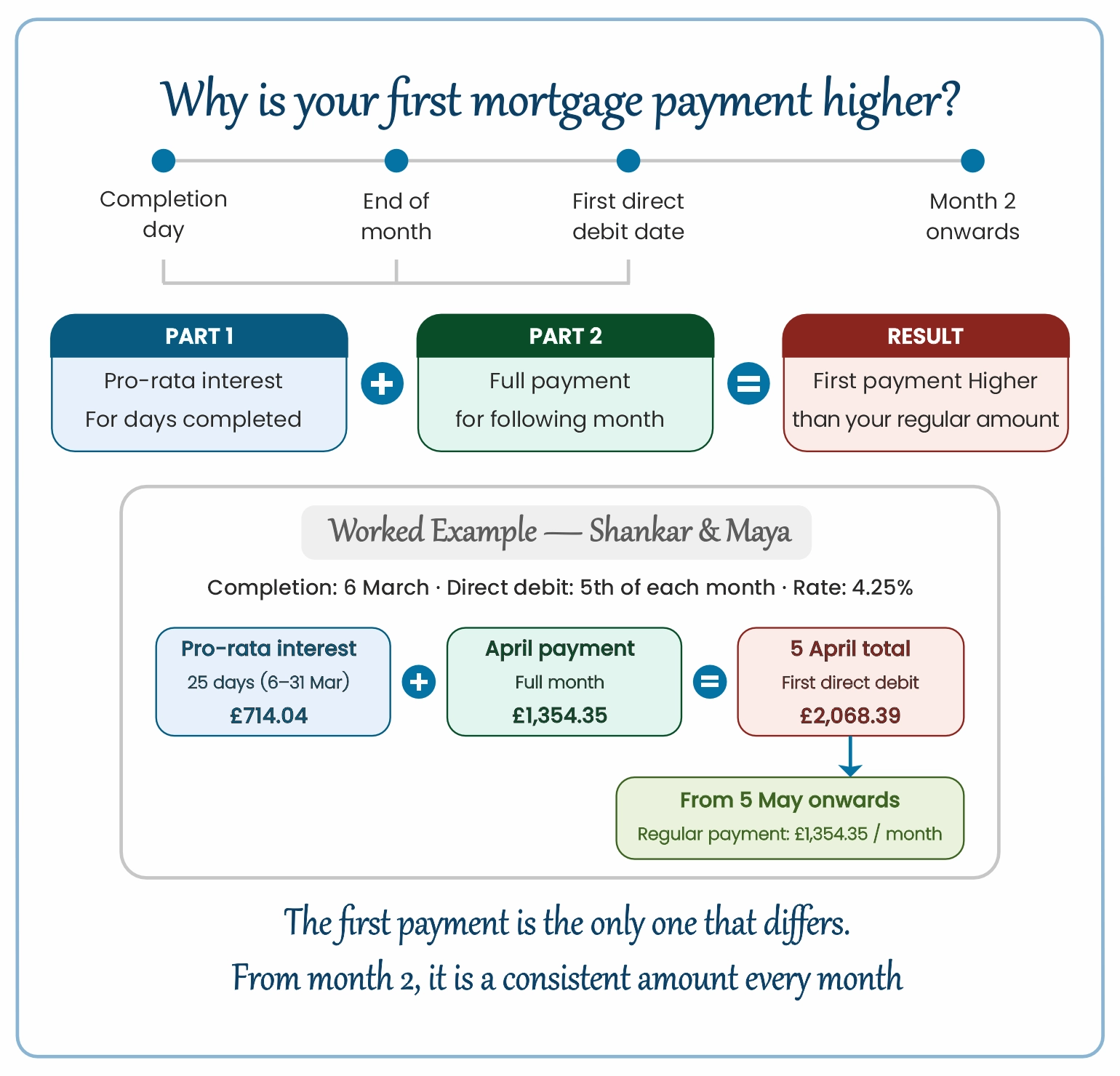
Worked Example — Shankar & Maya
To bring this to life, let’s look at a real scenario.
Shankar & Maya complete the purchase of their first home on Friday, 7th March. Their mortgage lender, Halifax, releases the funds on 6th March.
- Regular monthly payment: £1,354.35 per month
- Interest rate: 4.25% for the initial two-year fixed period
- Preferred direct debit date: 5th of each month
What Happens Next?
On 5th April, Halifax is likely to collect the following:- Interest-only payment for 25 days (6th–31st March) at 4.25% = £714.04
- Full mortgage payment for April = £1,354.35
- Total first payment collected on 5th April = £2,068.39
A Slightly Different Scenario
If Halifax had released the funds on 29th March instead, there would not have been enough time to collect the first direct debit on 5th April. In this case, Halifax would notify Shankar & Maya that their first payment would be collected on 10th April. The first payment would still be slightly higher than usual — but not significantly so. Only two extra days of interest (30th–31st March) would be added, amounting to an additional £57.12 on top of their regular monthly payment.What You Can Do to Prepare
Since each lender has its own procedure for calculating the first mortgage payment, it is difficult to guarantee that it will align exactly with a standard full month’s charge. However, there are clear steps you can take as a soon-to-be homeowner:
- Ensure sufficient funds — Keep extra funds in your designated bank account to cover any variation in the first payment.
- Monitor your payment date and amount — Watch for communication from your lender, which will confirm the exact amount and date of your first direct debit.
- Double-check your direct debit details — At Nachu Finance, we always advise clients to verify their direct debit setup before and after completion to avoid any administrative errors that could cause payment issues.
How Nachu Finance Can Help
At Nachu Finance, we support clients at every stage of the property ownership journey — from securing the right mortgage to planning the long-term management and transfer of property assets. Understanding how your mortgage works from day one is part of the foundation we help you build. If you have questions about mortgage options, protection, or want to explore how estate planning can safeguard your property for future generations, our team is here to help. Get in touch today and we will be delighted to find the right solution for your needs.
Frequently Asked Questions
Mortgage offers are prepared before completion takes place and are based on an assumed start date. The higher figure shown covers pro-rata interest from that assumed date to the end of the month, plus a full month’s payment. Once your mortgage completes on the actual date, your lender will recalculate and confirm the precise first payment amount in your welcome letter.
Your first payment is higher because it covers two things — interest charged from the day your mortgage completes to the end of that month, plus a full month’s payment for the month that follows. From month two onwards your payment returns to the regular amount shown in your mortgage illustration.
Not always. Depending on when your mortgage completes, there may not be enough time for your lender to set up the direct debit for your chosen date. Your lender will notify you of the exact date and amount of your first collection. From the second month onwards your direct debit will run on your selected date as normal.
If your mortgage completes late in the month, the pro-rata interest element will be small — covering only the final few days. However, your lender may not have enough time to collect the first direct debit on your chosen date and may take it a few days later instead. In the example of a 29th March completion with a 5th April direct debit date, only two additional days of interest applied — adding just £57.12 to the regular monthly payment.

About the Author
Sekkappan Alagu is the Founder of Nachu Finance Ltd, established in 2006. With an early career in journalism and publishing, he brings clarity and structured thinking to complex financial topics. Through the Nachu Finance Blog and Knowledge Hub, he shares insights drawn from nearly two decades of client advisory experience, helping readers make informed decisions and understand best practices in mortgages, protection and long-term financial planning.

Business Profile
Nachu Finance Ltd is a directly authorised FCA-regulated firm providing mortgage, insurance and estate planning advice to clients across the UK. The firm takes a holistic approach — considering protection, tax efficiency and long-term planning alongside property finance — maintaining high regulatory standards while keeping advice clear and easy to follow. To learn more about the firm's background and story, visit the About Nachu Finance page.
Best Practices for Every Homeowner



Moving into your new home – What next & a checklist of good practices.
- 09 Sep 2024
- Sekkappan Alagu
- Residential Mortgage
- Comments Off on Moving into your new home – What next & a checklist of good practices.

Settling into Your New Home
First off, congratulations again on your new home! Wishing you nothing but happiness as you settle into this exciting chapter. I hope your new house becomes a place where all your dreams come true, filled with countless wonderful memories. Moving into a new home can feel like a whirlwind, but it’s also the start of something special. May it bring you everything you’ve hoped for and more.
While you’re getting comfortable, I’d like to remind you of a few next steps and good practices. Apologies if any of it is a repeat of what you already knew but wanted to give you a check list of some sort.
What Next?
Now that the purchase is complete, the Land Registry will update the name of the new owners, which includes your mortgage lender. Your solicitors will handle this process, typically submitting the necessary updates shortly after completion. However, it’s important to note that the Land Registry can take anywhere from 8 weeks to 4 months to process these changes. (Correct as of Sep 2024)
Once the update is completed, your solicitors should send you a copy of the updated Land Registry document. If you don’t hear anything within 4 months, it’s a good idea to reach out to your solicitor to follow up. Alternatively, you can also download the updated document directly from the Land Registry’s website here
Register for Land Registry Property Alerts
The Land Registry offers a useful service that allows you to receive email updates on any applications submitted for your property. It’s a simple process to register, and you can monitor up to 10 properties with one account. This service helps to safeguard your property from fraud and keeps you informed of any changes. You can register for it here.
Setting Up the New Bills
It’s important to set up all your utility bills, including gas, water, electricity, and council tax. I recommend reaching out to the providers as soon as possible to confirm the date you took responsibility for the property and provide any meter readings. As a best practice, try to have this sorted within the first two weeks of moving in to avoid any surprises later on.
Updating Address Everywhere
Ensuring that your address is updated across all important records is key for maintaining a good credit score. Any prospective lender will expect to see that all your address is registered to one address, including banks, credit cards, the electoral roll, your employer, HMRC, insurance providers (which would include your life insurance, health insurance, car insurance, home insurance etc) , and any other financial institutions.
Don’t forget to update your details with the DVLA if you own a car or need to change the address on your driving licence. Failing to notify the DVLA can result in hefty fines, so it’s important to make this a priority. Similarly, your TV license needs to be updated to reflect your new address, as failing to do so can also result in fines.
Postal Redirection
Even with the most thorough effort, it’s hard to avoid some post still going to your old address. This is where the Royal Mail redirection service can be incredibly helpful. I highly recommend using this service to catch any stray mail during your transition. You can easily set it up here
Changing the Lock Barrels
As a best practice, it’s recommended to change the lock barrels on all security doors in a pre-owned home. Since the property was previously owned and used by someone else, there’s always a chance that more keys exist beyond the set you’ve received. By changing the barrels, you ensure that no one else has access to your home. The good news is that you don’t need to change the entire lock; barrels can easily be purchased online or in stores like B&Q, Wickes, and Selco.
Overpayments to Your Mortgage
Most lender will normally allow you to make overpayments on your mortgage without incurring early repayment charges. You can usually overpay up to 10% of the mortgage each year / calendar year. Since your mortgage interest is calculated daily, any overpayment will immediately reduce the interest charged from the next day onward.
Overpayments can be made at your convenience, typically through online or phone banking. Before making your first overpayment, I suggest contacting your lender to fully understand their process. Once you make an overpayment, you’ll normally have the option to either reduce your monthly payments or shorten your mortgage term. If your goal is to pay off the mortgage sooner, you may want to opt for reducing the term. During your call, you can request that this preference applies to both your first and future overpayments.
Contact your lender to understand how their overpayment works.
What to Expect at the End of the Current Mortgage Fixed Rate
Although securing a mortgage is often the most time-consuming part of buying a home, it’s important to revisit your mortgage closer to the end of your fixed term—usually 3 to 6 months before it expires. At that point, we can review your options based on your current circumstances, requirements, and the state of the mortgage market, comparing deals from both your existing lender and potential new ones.
A remortgage is significantly easier than securing a mortgage for a new purchase. If staying with your current lender turns out to be the best option, the process can be quite fast and simple. At Nachu Finance, we don’t charge any fees for a product transfer with the same lender, making the transition even smoother.
Reviewing your options no later than 3 months before your fixed term ends will give you ample time for a thorough evaluation. At Nachu Finance, we aim to send you a reminder email 6 months before your fixed rate ends to ensure you’re prepared.
About the Author
Sekkappan Alagu is the Founder of Nachu Finance Ltd, established in 2006. With an early career in journalism and publishing, he brings clarity and structured thinking to complex financial topics. Through the Nachu Finance Blog and Knowledge Hub, he shares insights drawn from nearly two decades of client advisory experience, helping readers make informed decisions and understand best practices in mortgages, protection and long-term financial planning.
Business Profile
Nachu Finance Ltd is a directly authorised FCA-regulated firm providing mortgage, insurance and estate planning advice to clients across the UK. The firm takes a holistic approach — considering protection, tax efficiency and long-term planning alongside property finance — maintaining high regulatory standards while keeping advice clear and easy to follow. To learn more about the firm's background and story, visit the About Nachu Finance page.