

Renting Out a Spare Room: How to Do It the Right Way

Renting Out a Spare Room: How to Do It the Right Way, Nachu Finance

Renting out a spare room is a practical way for homeowners to improve their monthly cash flow while continuing to live in their main residence. It is fully legal and increasingly common in areas where both property values and rental demand are high.
However, it is important to understand the rules around mortgage consent, tax obligations, insurance conditions and the type of agreement you must use before taking in a lodger.

To bring this to life, consider the example of Manjula, a young accounting professional who purchased a two bedroom flat early in her career. Once she completed the purchase and moved in, she began thinking about the potential of renting out her spare room. Although she did not rely on this income for day to day expenses, she recognised it as an opportunity to enhance her cash flow. Being from a financial background, she wanted to ensure she did everything correctly and complied with all legal and regulatory requirements.
This article outlines the key steps she needed to take and what every homeowner should consider.

Can You Rent Out a Spare Room in the UK?

Yes, you can. Renting out a furnished room in your own home is allowed, provided you continue living in the property as your main residence. When done correctly, it is a simple and effective way to earn additional income.

Mortgage Lender Consent

Most mortgage lenders, including major high street names, are typically comfortable with a homeowner taking in a lodger.
Some lenders require notification, while others require formal consent. The requirement usually appears in the mortgage offer or the lending criteria.

From our experience advising clients, we have not encountered a case where a lender refused permission for a lodger. If you are planning to rely on lodger income before you complete your purchase, it is best to tell us early so we can place you with a lender who is fully supportive of this arrangement.
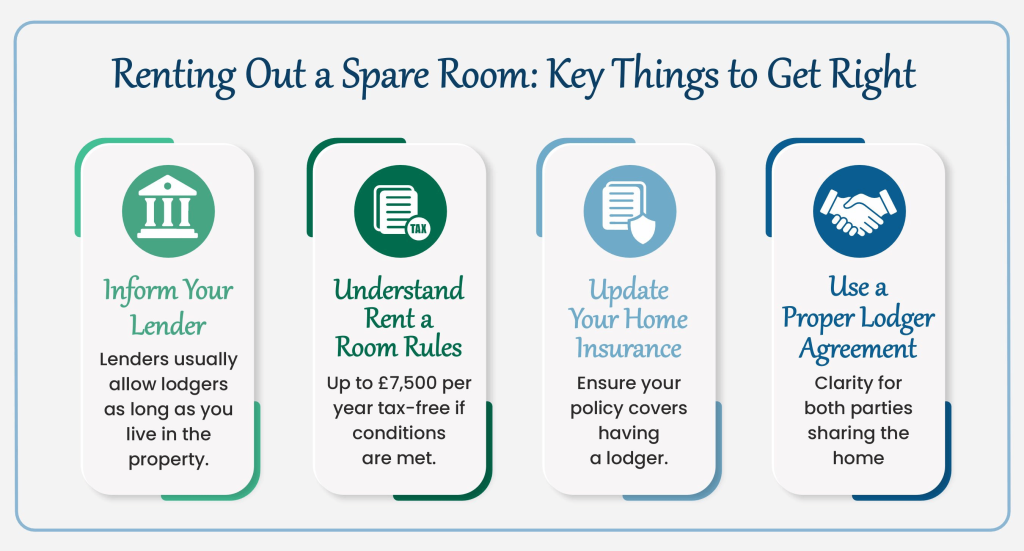
Renting out a spare room key steps infographic

HMRC Rent a Room Scheme

If you take in a lodger, the Rent a Room Scheme may apply to you. This is HMRC’s specific tax allowance for homeowners who let out furnished accommodation in their main home.

The scheme allows you to earn up to £7,500 per year tax-free. If the income is shared with someone else, the threshold is £3,750.

If your income from the lodger is below your threshold, the exemption is automatic and you do not need to do anything.
If you earn above the threshold, you must complete a tax return and can either opt into the scheme to claim the allowance, or opt out and record your income and expenses in the usual way.

For full details, HMRC guidance is available at:
https://www.gov.uk/rent-room-in-your-home/the-rent-a-room-scheme

Lodger Agreement

Because you will continue living in the property and sharing accommodation with the lodger, a lodger agreement is required rather than a standard tenancy agreement.
This agreement provides clarity for both parties on expectations, access, notice periods and house rules. Although less formal than a tenancy, documenting the arrangement properly helps prevent misunderstandings.

Home Insurance Considerations

Your home insurance provider must be informed before a lodger moves in.
If you own a freehold house, both your buildings and contents insurer need to be notified.
If you own a leasehold flat, buildings insurance is usually arranged by the freeholder or management company, but you must still update your contents insurer.

Failing to disclose a lodger could invalidate future claims, so it is essential to check this before renting out the room.


In Summary

Renting out a spare room can be a straightforward and rewarding way to supplement your income, provided it is done correctly. Ensuring lender consent, meeting HMRC requirements, updating your insurance and using the right agreement will help you stay compliant and avoid future issues. With a little preparation, taking in a lodger can be a simple and efficient way to make the most of your home while maintaining full control and peace of mind.

Frequently Asked Questions

Generally, mortgage lenders will not use lodger income for affordability assessments.
It is not considered stable enough from a lender’s perspective, so it cannot be relied upon to support borrowing.

A lender may ask questions during a remortgage to satisfy themselves that everything is in order, but in our experience it is very unlikely to lead to a decline. The lodger’s income will not be used for affordability, but lenders are usually comfortable as long as the arrangement is compliant and correctly disclosed.

Yes, you can rent out more than one room, and all the rules mentioned in this guide continue to apply, including lender notification, HMRC obligations and updating your home insurance.
However, you must be careful not to fall into the House in Multiple Occupation (HMO) category. If you have three or more unrelated lodgers, the property may be classed as an HMO. In that case, additional legal and safety requirements apply, including fire safety standards, gas safety compliance and, in many areas, the need for an HMO licence from the local council.

This article applies only to situations where you continue living in the property and rent out a spare room while it remains your main residence.
If you intend to move out completely and let the whole property, the rules are very different. You may need consent to let from your lender or a full buy to let mortgage.
For this scenario, please refer to our detailed blog on renting out a former residential property, where we explain the steps involved, lender requirements and compliance points.

Picture of About the Author

About the Author

Sekkappan Alagu is the Founder of Nachu Finance Ltd, established in 2006. With an early career in journalism and publishing, he brings clarity and structured thinking to complex financial topics. Through the Nachu Finance Blog and Knowledge Hub, he shares insights drawn from nearly two decades of client advisory experience, helping readers make informed decisions and understand best practices in mortgages, protection and long-term financial planning.

Picture of Business Profile

Business Profile

Nachu Finance Ltd is a directly authorised FCA-regulated firm providing mortgage, insurance and estate planning advice to clients across the UK. The firm takes a holistic approach — considering protection, tax efficiency and long-term planning alongside property finance — maintaining high regulatory standards while keeping advice clear and easy to follow. To learn more about the firm's background and story, visit the About Nachu Finance page.

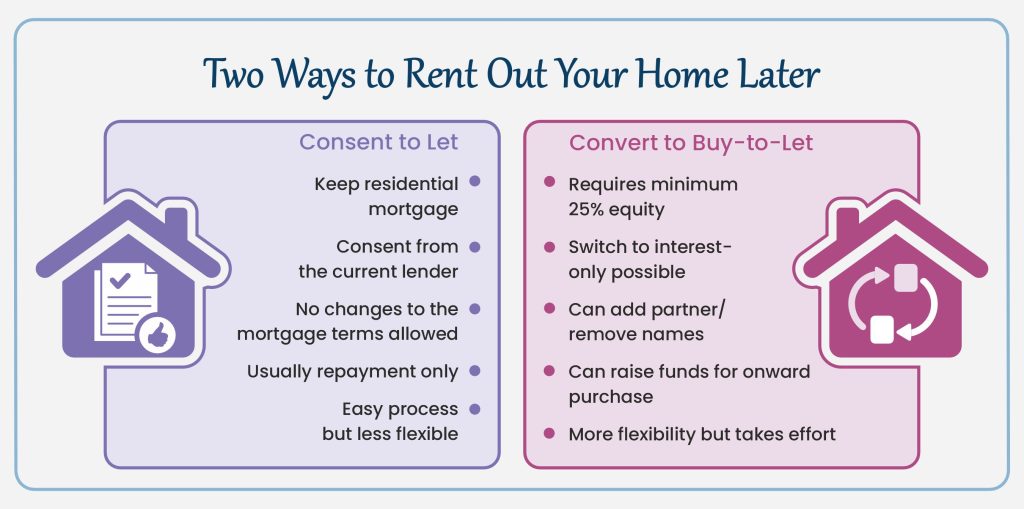
Buying a Home Today With the Intention to Letting It Out in the Future

Resi Home Today B2L Tomorrow

A Financial Insight for First-Time Buyers Planning Ahead

Many first-time buyers choose a property that meets their current needs, knowing that life will evolve in the years ahead. It is quite common for young professionals like Arjun, an IT consultant working in Central London, to buy a one-bed flat close to work today and then, as their family grows, keep this first home as an investment property while moving into a larger place.

If this is something you are considering, it helps to understand what to think about now, at the point of purchase, so that you are well-placed to rent out the property later without unnecessary complications.

Two Ways to Let Out Your Home in the Future

Two Ways to Let Out Your Home in the Future

When the time comes to let out your current home, there are two broad routes.
Both are commonly used and each has its own advantages depending on your long-term plans.

Understanding Rental Demand

Some properties make excellent homes but less successful rental investments.
Areas with strong local employment, transport links, and amenities typically see steady rental demand, while certain high-end or larger properties may attract fewer tenants.

If you are buying with the intention to let out later, it is worth spending a little time assessing the area’s rental activity. This can save you surprises in the future.

Things to Check Before Buying If You Plan - Resi to B2L Later Info 2

Staying With Your Residential Mortgage and Requesting “Consent to Let”

This option keeps things simple. You continue with your existing residential mortgage and inform the lender that your circumstances have changed. You ask for permission to let out the property, and if the lender agrees, you receive what is known as consent to let.

You do not change the mortgage type.
You do not remortgage.
You do not alter any other aspect of the mortgage apart from the usage.

Some lenders such as NatWest and Santander are known for being flexible and may allow consent to let on an ongoing basis, even when your fixed rate ends. They may also allow you to choose new products while keeping that permission active.

Other lenders, including Halifax and Virgin Money, tend to grant consent for a much shorter period, often one to two years. Once this period ends, they may expect you to formally convert the mortgage to a buy-to-let product or move to another lender.

Why this approach appeals:
It avoids the hassle of remortgaging and allows you to rent out the property without breaching any contract terms.

What to keep in mind:
Since you are technically still on a residential mortgage, you usually cannot:

Consent to let is ideal if you want a simple and temporary arrangement.

Converting the Mortgage to a Buy-to-Let

The second route is to formally convert the residential mortgage into a buy-to-let mortgage. This tends to offer more flexibility and is usually preferred if you want a long-term investment setup.

A key requirement for buy-to-let mortgages is having at least 25% equity.
This means the mortgage must be no more than 75% of the property value.
Even if you bought with a 10% deposit, you may naturally reach this level over time due to capital repayments and property price growth.

If you fall short of the 75% loan-to-value threshold, lenders may ask you to reduce the mortgage balance when converting. This can be done by contributing additional funds.

You can read further about Loan to values here

Thinking Ahead: Will the Rental Income Work?

Buy-to-let lenders assess affordability based mainly on rental income.
It helps to look up the likely rental value of similar properties in the area.

The rental yield gives a useful early indication.
It is calculated as:

Annual rent ÷ property value × 100.

A stronger yield (for instance a 6% yield) makes it easier to borrow the amount you need on a buy-to-let mortgage.
A weaker yield (for instance a 4% yield) may mean the loan amount has to be lower or supported by your personal income.
There are ways to structure this, especially for basic-rate taxpayers or applicants with surplus income, but it is good to be aware of this early on.

You can understand further about rental yield here

Considering Lender Appetite from the Start

If you already know there is a good chance you may let out your home one day, the choice of lender for your initial residential mortgage can make a real difference.

Some lenders:

Others may be more restrictive or may expect a formal conversion sooner.

Selecting a lender that naturally aligns with future rental plans helps keep your options open.

When Your Move Involves Buying a New Home at the Same Time

If you decide to let out your current home and buy your next home in one go, this becomes something known as a let-to-buy arrangement.

This is slightly different from a straightforward buy-to-let remortgage because it is designed specifically to support your onward residential purchase. You can read more about Let to buy mortgages here

Conclusion

For first-time buyers like Arjun, planning a few steps ahead can make the future transition from homeowner to landlord much smoother.
If you intend to keep your first home as an investment later, it is worth considering:

With the right preparation, your first home can become a stepping stone to longer-term financial planning and investment.

Frequently Asked Questions

Yes. Every residential mortgage includes a clause requiring you to seek consent before letting out the property. Renting without permission would breach the mortgage contract.

Most lenders will consider it, but each has their own criteria, conditions, and limits. They must also be satisfied that the property was genuinely purchased to live in, not as a disguised buy-to-let.

Once the lender has granted consent and the property is actually rented out, most lenders will assess it similarly to a buy-to-let. The rental income can usually offset the mortgage payments, though each lender’s affordability method differs slightly.

The above blog is more to do with letting out the property entirely and you moving to a different accommodation. If you would like to understand more about continuing to live in the property but rent out a spare room then refer to our separate blog article titled Renting Out a Spare Room: How to Do It the Right Way

Picture of About the Author

About the Author

Sekkappan Alagu is the Founder of Nachu Finance Ltd, established in 2006. With an early career in journalism and publishing, he brings clarity and structured thinking to complex financial topics. Through the Nachu Finance Blog and Knowledge Hub, he shares insights drawn from nearly two decades of client advisory experience, helping readers make informed decisions and understand best practices in mortgages, protection and long-term financial planning.

Picture of Business Profile

Business Profile

Nachu Finance Ltd is a directly authorised FCA-regulated firm providing mortgage, insurance and estate planning advice to clients across the UK. The firm takes a holistic approach — considering protection, tax efficiency and long-term planning alongside property finance — maintaining high regulatory standards while keeping advice clear and easy to follow. To learn more about the firm's background and story, visit the About Nachu Finance page.

BoE Base Rate Decision Dates: Important But Not The Whole Story

Why Bank of England Base Rate Isn’t Key to Mortgage Rates

It’s common for clients to ask if they should wait for the next Bank of England’s Monetary Policy Committee (MPC) meeting before deciding on the mortgage rates available to them. The idea behind waiting is understandable, as many assume that the Bank of England’s base rate has a direct and immediate impact on mortgage rates. However, in most cases, the answer is no, and here’s why.

While the Bank of England’s MPC meets approximately every six weeks to review and decide what should happen to the base rate, this does not directly determine the mortgage rates that lenders offer for purchases, remortgages, or product transfers. Let’s explore why this is the case.

Base Rate vs Mortgage Rates

The base rate, set by the Bank of England, is a tool used to control inflation and manage economic stability. It influences the interest rates that banks pay to borrow money, but it’s just one of many factors that affect mortgage rates. Mortgage lenders set their rates based on several other considerations, with SWAP rates being one of the most critical factors.

Understanding SWAP Rates

SWAP rates are essentially contracts that banks and mortgage lenders use to manage the risk of future interest rate changes. When a lender offers a fixed-rate mortgage, they rely on SWAP rates to hedge against future changes in the cost of borrowing. In simple terms, a SWAP rate is a type of contract where two parties agree to exchange interest rate payments, usually switching from a variable rate to a fixed rate.

The important point here is that SWAP rates are not directly tied to the Bank of England’s base rate. Instead, they are influenced by the broader financial markets, which consider future economic expectations. SWAP rates can fluctuate independently of the base rate, driven by factors like market sentiment, inflation forecasts, and global economic conditions.

What Affects SWAP Rates?

Unlike the more predictable base rate, SWAP rates are dynamic and can fluctuate daily. Here are some of the factors that influence SWAP rates:

  1. Market Sentiment: If investors expect interest rates to rise in the future, SWAP rates may increase even if the current base rate stays the same. This can result in higher fixed-rate mortgages.
  2. Inflation Forecasts: When inflation expectations rise, so do SWAP rates. Since fixed-rate mortgages are based on long-term borrowing costs, an anticipated rise in inflation will push SWAP rates higher, even if the base rate remains unchanged.
  3. Global Economic Conditions: Economic events in other countries, such as changes in US Federal Reserve policies or geopolitical developments, can influence SWAP rates in the UK. This adds further volatility that is not directly linked to the Bank of England’s base rate.
What Does This Mean for Homeowners and Buyers?

Because mortgage rates are more closely linked to SWAP rates than the base rate, waiting for the next Bank of England decision is often unnecessary. By the time the MPC makes its announcement, lenders have usually already adjusted their mortgage rates based on broader economic forecasts. In many cases, the impact of the base rate change may be far less significant than expected.

What Action Can You Take?

The best approach is to secure the best available rate now, and if rates decrease before your mortgage completes, you can often switch to a lower rate without penalty. Here’s how it works:

  • For Purchases or Remortgages: You can secure a rate and make changes up until one week before completion. This gives you flexibility in case better rates appear after you’ve locked in your deal.
  • For Product Transfers: If you’re staying with your current lender and switching to a new product, you have the option to change rates up to two weeks before your fixed-rate mortgage expires.

If you don’t secure a rate now and rates increase, you could miss out on today’s lower rates. Once your application is submitted, most lenders will allow you to benefit from any rate reductions that happen before completion, without penalizing you if rates go up.

Many lenders also allow multiple changes during this period, including switching between products. For example, you could move from a two-year tracker to a five-year fixed-rate mortgage for more stability.

Why This Works in Your Favour?

By securing the rate now, you protect yourself against potential rate increases while retaining the flexibility to benefit from rate reductions or product changes. In short, there’s no downside to locking in a rate today, and it ensures you don’t miss out on more competitive deals later.

If you choose to select a mortgage lender and product yourself, then comparison websites are useful for getting an overview of available mortgage rates on any given day. However, if you select a lender and product based solely on these results and apply for the mortgage directly, the responsibility of tracking rate changes falls entirely on you.

On the other hand, if you engage a mortgage adviser, you gain more than just a snapshot of the market.

Working with a mortgage adviser offers a proactive approach, ongoing market monitoring, and personalised advice—making sure you don’t miss out on better deals or make decisions based solely on the numbers at one point in time. This hands-on support helps ensure that your mortgage choice is optimal for your specific needs and future-proofed against changes in the market.

Picture of About the Author

About the Author

Sekkappan Alagu is the Founder of Nachu Finance Ltd, established in 2006. With an early career in journalism and publishing, he brings clarity and structured thinking to complex financial topics. Through the Nachu Finance Blog and Knowledge Hub, he shares insights drawn from nearly two decades of client advisory experience, helping readers make informed decisions and understand best practices in mortgages, protection and long-term financial planning.

Picture of Business Profile

Business Profile

Nachu Finance Ltd is a directly authorised FCA-regulated firm providing mortgage, insurance and estate planning advice to clients across the UK. The firm takes a holistic approach — considering protection, tax efficiency and long-term planning alongside property finance — maintaining high regulatory standards while keeping advice clear and easy to follow. To learn more about the firm's background and story, visit the About Nachu Finance page.

Redeeming Your Help to Buy Equity Loan

Redeeming your H2B
Redeeming Your Help to Buy Equity Loan

Help to Buy, while it lasted, was an effective scheme that enabled many homebuyers to get a foot on the property ladder, particularly in securing a new build home. It provided much-needed support by bridging the gap between savings and the actual cost of purchasing a property. However, now that the scheme has effectively closed, it’s time for many homeowners to consider their next steps.

Why Redeeming Your H2B Equity loan is the Smart Move

While the Help to Buy equity loan acted as a good catalyst in helping homebuyers, it’s in the homeowners’ best interest to redeem this loan as soon as possible. Here are four key reasons why:

  1. Redemption is Based on the Market Value of the Property The repayment of your Help to Buy loan is tied to the current market value of your home, not the original purchase price. If your property has appreciated in value, you could end up paying back significantly more than what you initially borrowed. Redeeming the loan earlier can potentially save you thousands of pounds.
  2. Restriction to Rent Out the Property Homeowners with a Help to Buy loan are not permitted to let out their property unless the loan is fully repaid. This restriction can pose a problem if you’re considering becoming a landlord or need to temporarily rent out your home due to personal circumstances.
  3. Restriction to Purchase Another Property The Help to Buy loan must be repaid before you can purchase another property. This can limit your options if you’re looking to move up the property ladder or invest in additional properties.
  4. Interest is Payable from Year 6 Onwards While the Help to Buy loan is interest-free for the first five years, from year six onwards, interest becomes payable at a rate of 1.75%, which then rises each year in line with inflation. This added cost can quickly mount up, making early repayment a smart financial move.
Is There an Advantage in Delaying the Redemption of Your H2B Equity Loan?

Some homeowners may argue that it’s beneficial to take advantage of the interest-free initial five-year period and delay redeeming the Help to Buy loan. There are even clients who have suggested waiting to see if property prices drop, which could theoretically justify paying interest on the loan after the six-year mark, as the lower property value would result in a reduced redemption amount.

However, this strategy comes with significant risks. As a homeowner, you typically own the majority share of the property, given that Help to Buy equity loans represent 20% of the property value (up to 40% in London). Naturally, you would want your property value to appreciate over time, rather than decrease. Relying on property prices to fall in the future is speculative and could backfire, especially in a generally rising market.

The sooner you can repay the Help to Buy loan, the sooner you’ll own 100% of the property’s equity and enjoy more flexibility without the restrictions imposed by the loan. Redeeming it early helps you avoid the uncertainty of property price fluctuations and eliminates the burden of interest payments after the five-year interest-free period.

How to Repay the Help to Buy Equity Loan

You can repay the Help to Buy equity loan whenever you’re prepared, but there are specific rules about how repayments can be made. Unfortunately, you can’t make overpayments of your choice. Instead, you have two options: you can either redeem the loan in full or in part. For example, if you took a 20% equity loan, you can either repay the entire 20% or make a partial repayment of 10%.

Given the cost and time involved in redeeming the loan, it’s generally advisable to aim for full redemption where possible, as it simplifies the process and removes future financial obligations.

Step 1: Get a RICS Valuation

When you’re ready to redeem the loan, the first step is to get a property valuation from a local valuer with the relevant RICS (Royal Institution of Chartered Surveyors) qualification. You can search for a qualified surveyor near you by visiting the RICS Find a Surveyor website, where you can compare quotes from local professionals.

It’s important to make the valuer aware that the purpose of the valuation is to redeem your Help to Buy loan, as this ensures they understand the specific requirements. Also, remember that the valuation report is only valid for 3 months. Timing the valuation carefully is crucial to avoid the need for an additional valuation, which could add unnecessary costs.

Step 2: Engage a Solicitor

The next step is to engage a solicitor to handle the legal aspects of redeeming your Help to Buy loan. Your solicitor will liaise with the Help to Buy agency to ensure the loan is repaid and the agency’s charge is released from the Land Registry. They will also manage all the compliance requirements involved in the process.

This should be a straightforward process, and your solicitor will guide you through each step, ensuring everything is handled correctly and in a timely manner

Step 3: Complete the Repayment Application Form

Once you have your valuation report and have appointed a solicitor, the next step is to apply to the Help to Buy agency to get your redemption value. This application requires you to submit the valuation report, and there is typically a fee associated with this process.

The agency will calculate the amount you need to repay based on the current market value of your home, as determined by your RICS valuation. Once you receive the redemption figure, your solicitor will proceed with finalizing the repayment.

Funding the Loan Repayment

You have several options to fund the repayment of your Help to Buy loan:

  1. Using Personal Savings or a Gift from Family If you have sufficient savings or receive a gift from family, you can repay the loan yourself. This option allows you the flexibility to redeem the Help to Buy loan at a time that best suits you without needing to involve any additional borrowing.
  2. Remortgaging Another option is to remortgage with a new lender and include the funds needed to pay off the Help to Buy loan in the new mortgage.
  3. Taking a Further Advance from Your Current Lender You may also be able to take a further advance from your existing lender to cover the Help to Buy loan repayment. Timing the redemption and ensuring that the advance is processed efficiently is essential to avoid delays.
  4. Selling the property. If you’re planning to sell your home, you can use the proceeds from the sale to redeem the Help to Buy equity loan. This can simplify the process, as the solicitor handling the sale can also manage the repayment of the Help to Buy loan using the sale proceeds. Logistically, this tends to be a smoother process, as the loan is redeemed directly during the property transaction, ensuring that everything is settled at once
Differences in Property Valuations for Redemption and Remortgage

Properties usually have a valuation range, and it’s important to note that the redemption of the Help to Buy loan is typically based on the lower end of this range. However, if you’re applying for a remortgage or further advance, the lender may use the higher end of the valuation range. This can result in more attractive mortgage rates, as a higher property valuation improves your loan-to-value ratio, giving you better borrowing options.

Case Study 1 – Fully Funded via Remortgage

A client purchased a home in 2020 for £370,000 with a 5% deposit and a 20% Help to Buy equity loan (£74,000), secured on a 2-year fixed mortgage product.

In 2022, when the fixed term ended, the property’s value had increased to £440,000. As a result, the client’s redemption figure for the Help to Buy loan increased to £82,000. The client did not have personal savings to cover the redemption, so we helped them raise the necessary funds through a remortgage.

The client incurred costs of £450 for the RICS valuation and £1,360 in solicitor fees (including disbursements). Despite these costs, the entire Help to Buy equity loan was successfully redeemed through the remortgage.

While the client had to repay a higher amount than they originally borrowed, they were able to fully redeem the loan and now own the property outright without any of the restrictions associated with the Help to Buy scheme.

Case Study 2 – Different Valuation for Mortgage and Redemption of Loan

Clients who purchased their first home in 2017 using a Help to Buy equity loan decided to redeem the loan in 2023, a year after they began paying interest on the equity loan.

Their mortgage was with Halifax, and in 2023, the indexed valuation used by Halifax stood at £630,000. We were able to use this higher valuation to raise the necessary funds for the mortgage, securing better rates for the client.

At the same time, the RICS valuation for the purpose of redeeming the Help to Buy loan came back at £590,000. The clients paid 20% of this lower valuation to redeem the equity loan, which worked in their favor.

Through this approach, we helped the clients achieve better mortgage rates based on the higher valuation while ensuring that the lower valuation was used to minimize the cost of redeeming the Help to Buy loan.

At Nachu Finance, we are committed to making the Help to Buy loan redemption process as simple and stress-free as possible. Whether you’re an existing client looking to repay your loan using your own savings or with the help of a mortgage, or a new client seeking to raise funds for loan redemption, we’re here to guide you every step of the way.

We can provide you with solicitor quotes from trusted legal firms we closely work with to ensure a smooth legal process. Additionally, we can offer advice on selecting the right local valuers to carry out your RICS valuation, ensuring you have the best professionals on your side.

With our experience and dedication, redeeming your Help to Buy loan is easier and more manageable with Nachu Finance.

Picture of About the Author

About the Author

Sekkappan Alagu is the Founder of Nachu Finance Ltd, established in 2006. With an early career in journalism and publishing, he brings clarity and structured thinking to complex financial topics. Through the Nachu Finance Blog and Knowledge Hub, he shares insights drawn from nearly two decades of client advisory experience, helping readers make informed decisions and understand best practices in mortgages, protection and long-term financial planning.

Picture of Business Profile

Business Profile

Nachu Finance Ltd is a directly authorised FCA-regulated firm providing mortgage, insurance and estate planning advice to clients across the UK. The firm takes a holistic approach — considering protection, tax efficiency and long-term planning alongside property finance — maintaining high regulatory standards while keeping advice clear and easy to follow. To learn more about the firm's background and story, visit the About Nachu Finance page.

Why You Should Consider Placing Your Life Insurance Under a Trust

Life insurance policy document and trust concept illustration – placing life insurance in a trust to protect assets, reduce inheritance tax and control beneficiary payouts.

Let’s talk about life insurance. You’ve probably already taken the important step of getting a policy to protect your loved ones, but have you thought about the benefits of placing it under a trust? If not, don’t worry—you’re not alone! Many people aren’t aware of this option, but it can make a world of difference when it comes to ensuring your family gets the most out of your policy. Here’s why you might want to consider it:

Makes Claiming a Breeze

We all know life insurance is there to support your family after you’re gone, but wouldn’t it be great if they could get that support quickly and without hassle? By putting your policy under a trust, you’ve already sorted out ownership details ahead of time. This means that when the time comes, your loved ones only need to provide proof of your passing to claim the proceeds—no drawn-out legal processes required. This could mean your family gets the funds they need much faster, sometimes months sooner! Quick access to these funds can help cover immediate costs, like funeral expenses, or simply provide a financial cushion during a tough time.

Keep More Money in Your Family’s Pocket (And Out of the Taxman’s!)

Let’s face it—nobody likes taxes, especially when they reduce the inheritance you’ve worked hard to build for your loved ones. In the UK, for example, estates valued over a certain threshold can face an inheritance tax of up to 40%! Normally, life insurance payouts would be counted as part of your estate and could be subject to this hefty tax. But here’s the good news: if your policy is under a trust, the payout is usually kept outside your estate, which can save your family a big chunk of money.

And even if your estate still has to pay some inheritance tax, the payout from the trust can be a helpful way to cover that bill upfront—giving your family one less thing to worry about during an already difficult time.

You Decide Who Gets What—No Surprises!

One of the best things about setting up a trust for your life insurance is the control it gives you. You get to decide exactly who benefits from your policy and can even choose trusted individuals (called trustees) to make sure everything is managed according to your wishes. This means there’s no room for misunderstandings or disputes—just peace of mind knowing that your intentions will be honoured.

Simple, Straightforward, and Usually Free

If the word “trust” makes you think of complicated legal processes and high costs, think again! Setting up a trust for your life insurance policy is often much simpler than people expect. Most insurance companies offer a variety of trusts tailored to different needs, and setting one up typically involves just a few straightforward steps—selecting the trust type, naming your beneficiaries and trustees, and getting the necessary signatures. Best of all, this process is usually free and can be done for both new and existing policies.

The Bottom Line

Taking out life insurance is a smart move for anyone looking to provide financial security for their loved ones. But why not take it a step further? By placing your life insurance under a trust, you’re not just protecting your family—you’re making sure they have easy access to the funds, keeping more of your money in their pockets, and ensuring your wishes are followed to the letter. It’s a simple step that can make a big difference, so why not consider it?

Picture of About the Author

About the Author

Sekkappan Alagu is the Founder of Nachu Finance Ltd, established in 2006. With an early career in journalism and publishing, he brings clarity and structured thinking to complex financial topics. Through the Nachu Finance Blog and Knowledge Hub, he shares insights drawn from nearly two decades of client advisory experience, helping readers make informed decisions and understand best practices in mortgages, protection and long-term financial planning.

Picture of Business Profile

Business Profile

Nachu Finance Ltd is a directly authorised FCA-regulated firm providing mortgage, insurance and estate planning advice to clients across the UK. The firm takes a holistic approach — considering protection, tax efficiency and long-term planning alongside property finance — maintaining high regulatory standards while keeping advice clear and easy to follow. To learn more about the firm's background and story, visit the About Nachu Finance page.

The Realities of Buy-to-Let: Why Staying Compliant is Crucial for UK Landlords

Buy-to-let property investment with houses on coins – rental income, costs and returns for UK landlords.

Key Requirements for UK Landlords

To help you stay on the right track, here’s a handy list of the key requirements every UK landlord should be aware of:

  1. Annual Gas Safety Checks
    • Every year, you need to have a Gas Safe registered engineer check all gas appliances, fittings, and flues in your rental property.
    • This is to ensure everything is safe and up to standard. Once the check is complete, provide your tenants with a copy of the gas safety certificate within 28 days.
    • It’s a simple step that keeps everyone safe and sound!

  2. Electrical Installation Condition Report (EICR)
    • To ensure electrical safety, an EICR must be carried out by a qualified electrician every five years.
    • The report checks that all electrical installations are safe, and any issues found must be fixed promptly.
    • Don’t forget to share the report with your tenants and the local council if they ask for it.

  3. Energy Performance Certificate (EPC)
    • Your property needs a valid EPC with a minimum rating of ‘E’ before you can rent it out.
    • The EPC, which is valid for ten years, provides an energy efficiency rating for the property.
    • Make sure to give a copy to prospective tenants at the start of their tenancy.

  4. ‘Right to Rent’ Checks
    • Before renting to new tenants, you must check their immigration status to ensure they have the right to live in the UK.
    • This involves reviewing and copying documents that prove their right to rent.
    • Keep these records for the duration of the tenancy and for at least one year afterward to stay compliant.

  5. Landlord Licensing
    • Some local councils in the UK have Selective Licensing Schemes, meaning you may need to get a license before renting out your property.
    • Licensing conditions can vary, so check with your local council to see what’s required in your area.
    • Failure to obtain a license can lead to fines, so it’s worth getting this sorted.

  6. Maintaining a Habitable Property
    • Under the Homes (Fitness for Human Habitation) Act, your property must be fit for living, which includes proper heating, ventilation, sanitation, and structural integrity.
    • Keeping your property in good shape not only keeps your tenants happy but also prevents potential legal issues.

  7. Fire Safety Regulations
    • Fire safety is a top priority! Make sure you have working smoke alarms on each floor and carbon monoxide alarms in any room with a solid fuel-burning appliance.
    • Regularly check and maintain these alarms to keep everyone safe and compliant with the Smoke and Carbon Monoxide Alarm Regulations.

  8. Overcrowding and HMO Rules
    • If your property is rented to three or more people who aren’t from the same household (forming a ‘House in Multiple Occupation’ or HMO), there are additional regulations to follow.
    • HMOs require a specific license, and there are strict rules regarding room sizes, fire safety measures, and facilities.
    • Overcrowding is also a concern; make sure your property has enough space for the number of occupants to avoid fines and ensure tenant safety.

  9. Providing a Written Tenancy Agreement
    • Always provide a clear, written tenancy agreement that outlines the terms of the rental, including rent, payment schedules, and tenancy length.
    • This helps prevent misunderstandings and provides a solid foundation for resolving any disputes.

  10. Deposit Protection
    • If you take a deposit from your tenants, it must be protected in a government-approved Tenancy Deposit Protection (TDP) scheme.
    • Provide your tenants with information about how their deposit is protected within 30 days of receiving it.
    • This step is crucial to avoid disputes and maintain good relationships with your tenants.

The Role of Letting Agents: Who’s Really Responsible?

Many landlords hire letting agents to help manage their properties, which can be a great way to lighten the load. Letting agents can handle tasks like tenant screening, rent collection, and property maintenance. However, it’s essential to remember that even if you use a letting agent, you, as the landlord, are ultimately responsible for ensuring that all legal obligations are met. If a letting agent fails to comply with regulations, it’s still the landlord who could face fines or legal action. So, make sure to stay involved and keep an eye on compliance to protect your investment.

Staying Proactive and Informed

Given the complexities and constant changes in rental regulations, landlords should adopt a proactive approach to property management. This means regularly reviewing legal requirements, staying updated with any new legislation, and conducting routine property inspections. Engaging with professionals, like property managers, solicitors, or letting agents, can provide valuable support in navigating the regulatory landscape. By doing so, you can ensure your property complies with all requirements, protect your investment, and maintain positive relationships with your tenants.

In Summary

While buy-to-let investments can be financially rewarding, they come with a set of responsibilities that cannot be ignored. By staying on top of the legal requirements and maintaining high standards of property management, landlords can avoid pitfalls like fines, legal trouble, and reputational damage. Remember, being a landlord is more than just a financial investment—it’s about creating a safe and welcoming home for your tenants. So, take a proactive approach, keep up with regulations, and you’ll be well on your way to a successful and hassle-free experience in the rental market.


Transparent Communication

We maintain open, honest communication throughout the entire process, ensuring you’re informed and involved every step of the way.

Picture of About the Author

About the Author

Sekkappan Alagu is the Founder of Nachu Finance Ltd, established in 2006. With an early career in journalism and publishing, he brings clarity and structured thinking to complex financial topics. Through the Nachu Finance Blog and Knowledge Hub, he shares insights drawn from nearly two decades of client advisory experience, helping readers make informed decisions and understand best practices in mortgages, protection and long-term financial planning.

Picture of Business Profile

Business Profile

Nachu Finance Ltd is a directly authorised FCA-regulated firm providing mortgage, insurance and estate planning advice to clients across the UK. The firm takes a holistic approach — considering protection, tax efficiency and long-term planning alongside property finance — maintaining high regulatory standards while keeping advice clear and easy to follow. To learn more about the firm's background and story, visit the About Nachu Finance page.

Moving into your new home – What next & a checklist of good practices.

Moving into your new home – What next & a checklist of good practices., Nachu Finance

Settling into Your New Home

First off, congratulations again on your new home! Wishing you nothing but happiness as you settle into this exciting chapter. I hope your new house becomes a place where all your dreams come true, filled with countless wonderful memories. Moving into a new home can feel like a whirlwind, but it’s also the start of something special. May it bring you everything you’ve hoped for and more.

While you’re getting comfortable, I’d like to remind you of a few next steps and good practices.  Apologies if any of it is a repeat of what you already knew but wanted to give you a check list of some sort.

What Next?

Now that the purchase is complete, the Land Registry will update the name of the new owners, which includes your mortgage lender. Your solicitors will handle this process, typically submitting the necessary updates shortly after completion. However, it’s important to note that the Land Registry can take anywhere from 8 weeks to 4 months to process these changes. (Correct as of Sep 2024)

Once the update is completed, your solicitors should send you a copy of the updated Land Registry document. If you don’t hear anything within 4 months, it’s a good idea to reach out to your solicitor to follow up. Alternatively, you can also download the updated document directly from the Land Registry’s website here

Register for Land Registry Property Alerts

The Land Registry offers a useful service that allows you to receive email updates on any applications submitted for your property. It’s a simple process to register, and you can monitor up to 10 properties with one account. This service helps to safeguard your property from fraud and keeps you informed of any changes. You can register for it here.

Setting Up the New Bills

It’s important to set up all your utility bills, including gas, water, electricity, and council tax. I recommend reaching out to the providers as soon as possible to confirm the date you took responsibility for the property and provide any meter readings. As a best practice, try to have this sorted within the first two weeks of moving in to avoid any surprises later on.

Updating Address Everywhere

Ensuring that your address is updated across all important records is key for maintaining a good credit score. Any prospective lender will expect to see that all your address is registered to one address, including banks, credit cards, the electoral roll, your employer, HMRC, insurance providers (which would include your life insurance, health insurance, car insurance, home insurance etc) , and any other financial institutions.

Don’t forget to update your details with the DVLA if you own a car or need to change the address on your driving licence. Failing to notify the DVLA can result in hefty fines, so it’s important to make this a priority. Similarly, your TV license needs to be updated to reflect your new address, as failing to do so can also result in fines.

Postal Redirection

Even with the most thorough effort, it’s hard to avoid some post still going to your old address. This is where the Royal Mail redirection service can be incredibly helpful. I highly recommend using this service to catch any stray mail during your transition. You can easily set it up here

Changing the Lock Barrels

As a best practice, it’s recommended to change the lock barrels on all security doors in a pre-owned home. Since the property was previously owned and used by someone else, there’s always a chance that more keys exist beyond the set you’ve received. By changing the barrels, you ensure that no one else has access to your home. The good news is that you don’t need to change the entire lock; barrels can easily be purchased online or in stores like B&Q, Wickes, and Selco.

Overpayments to Your Mortgage

Most lender will normally allow you to make overpayments on your mortgage without incurring early repayment charges. You can usually overpay up to 10% of the mortgage each year / calendar year.  Since your mortgage interest is calculated daily, any overpayment will immediately reduce the interest charged from the next day onward.

Overpayments can be made at your convenience, typically through online or phone banking. Before making your first overpayment, I suggest contacting your lender to fully understand their process. Once you make an overpayment, you’ll normally have the option to either reduce your monthly payments or shorten your mortgage term. If your goal is to pay off the mortgage sooner, you may want to opt for reducing the term. During your call, you can request that this preference applies to both your first and future overpayments.

Contact your lender to understand how their overpayment works.

What to Expect at the End of the Current Mortgage Fixed Rate

Although securing a mortgage is often the most time-consuming part of buying a home, it’s important to revisit your mortgage closer to the end of your fixed term—usually 3 to 6 months before it expires. At that point, we can review your options based on your current circumstances, requirements, and the state of the mortgage market, comparing deals from both your existing lender and potential new ones.

A remortgage is significantly easier than securing a mortgage for a new purchase. If staying with your current lender turns out to be the best option, the process can be quite fast and simple. At Nachu Finance, we don’t charge any fees for a product transfer with the same lender, making the transition even smoother.

Reviewing your options no later than 3 months before your fixed term ends will give you ample time for a thorough evaluation. At Nachu Finance, we aim to send you a reminder email 6 months before your fixed rate ends to ensure you’re prepared.

Picture of About the Author

About the Author

Sekkappan Alagu is the Founder of Nachu Finance Ltd, established in 2006. With an early career in journalism and publishing, he brings clarity and structured thinking to complex financial topics. Through the Nachu Finance Blog and Knowledge Hub, he shares insights drawn from nearly two decades of client advisory experience, helping readers make informed decisions and understand best practices in mortgages, protection and long-term financial planning.

Picture of Business Profile

Business Profile

Nachu Finance Ltd is a directly authorised FCA-regulated firm providing mortgage, insurance and estate planning advice to clients across the UK. The firm takes a holistic approach — considering protection, tax efficiency and long-term planning alongside property finance — maintaining high regulatory standards while keeping advice clear and easy to follow. To learn more about the firm's background and story, visit the About Nachu Finance page.