
Testmonials
Enquiry Form
Get in Touch with Us for Personalized Finance Assistance
Base Rate vs Your Mortgage Rate: Should You Wait for the Bank of England?
- Date Published : October 14, 2024
- Date Last Modified : October 21, 2026

We are often asked whether you should wait for the next Bank of England decision before choosing a mortgage rate. It is an understandable question, because the base rate sounds like the number that sets everything. The answer depends on the type of mortgage you want. For a fixed rate, the Bank of England base rate has no direct impact on the rate you are offered, so waiting for the meeting is rarely worthwhile. If you are on a tracker, or on a discount or standard variable rate product, the base rate matters more. This guide explains the difference, with the upcoming meeting dates and the history of the base rate.
What the Bank of England Base Rate Does and Doesn't Affect
The base rate is the Bank of England’s main tool for keeping inflation under control. It influences what banks pay to borrow, but it is only one input into mortgage pricing.
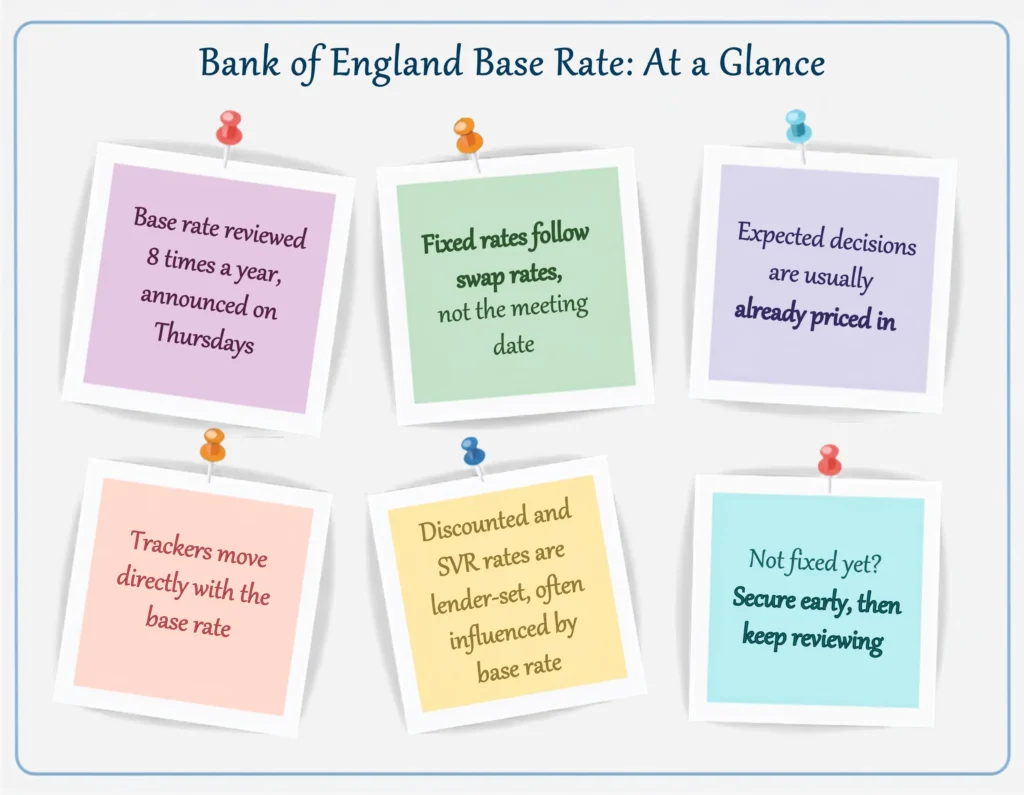
- Fixed rates: no direct impact. Lenders price these from swap rates, not from the base rate itself.
- Trackers: a direct link. Your rate moves with the base rate, usually at a set margin above it.
- Discount and standard variable rate (SVR) products: the base rate can have an impact, but it is not guaranteed. These rates are set by the lender, who may or may not follow a change, and may not pass on a cut in full.
If you are on a tracker, or may move to one, the meeting dates matter. If you are choosing a fixed initial rate, the next meeting is rarely the right trigger.
Why Fixed Rates Follow Swap Rates, Not the Meeting
Lenders fund fixed-rate mortgages using swap rates, which reflect the wholesale cost of fixed-rate money for banks. A swap rate follows market sentiment and the outlook for the wider economy, so it can move before, or independently of, a Bank of England decision. By the time a decision is announced, the expected outcome has usually already been priced in. A surprise can still move fixed rates, but that cannot be predicted, so timing your decision around the date rarely helps.
For the full explanation, read Swap Rates Explained: What They Are and How They Influence Your Fixed Rate.
Historic Bank of England Rates in Our Experience
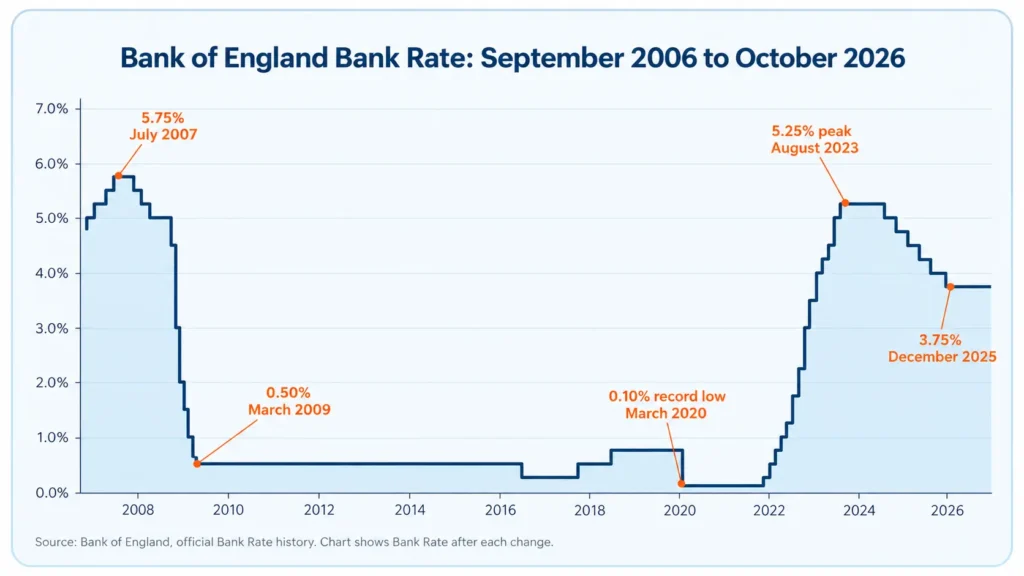
Since 26 September 2006, when Nachu Finance began advising, Bank Rate has moved through several very different phases:
- 2006 to 2007: rose from 4.75% to 5.75% (July 2007).
- 2008 to 2009: cut sharply to 0.50% by March 2009 during the financial crisis.
- 2009 to 2016: held at 0.50% for over seven years, then cut to 0.25% in August 2016.
- 2017 to 2020: small rises to 0.75%, then cut to a record low of 0.10% in March 2020.
- 2021 to 2023: rapid rises from 0.25% in December 2021 to 5.25% in August 2023.
- 2024 to 2025: gradual cuts to 3.75% in December 2025.
- 2026: held at 3.75%.
Bank of England Meetings
The Bank of England’s Monetary Policy Committee (MPC) meets eight times a year. Decisions are announced on a Thursday at 12 noon UK time, alongside the minutes.
Current Bank Rate: 3.75%
Upcoming Meetings
| Announcement date | Day |
|---|---|
| 5 November 2026 | Thursday |
| 17 December 2026 | Thursday |
| 4 February 2027 | Thursday |
| 18 March 2027 | Thursday |
| 29 April 2027 | Thursday |
| 17 June 2027 | Thursday |
Source: Bank of England, upcoming MPC dates. Dates are as published and may change.
What You Can Do: Secure Early and Keep Reviewing
For most people choosing a fixed rate, the better approach is to secure a rate early and keep reviewing it until it goes live. Many lenders let you secure a new rate three to six months before your current rate ends, depending on the lender.
- Purchases and remortgages: in most cases you can switch to a better product if one appears, up until shortly before the new rate goes live. The cut-off varies by lender.
- Product transfers: the same principle applies with your current lender, again with a lender-specific cut-off.
- Many lenders allow more than one change, including switching between products, for example from a two-year tracker to a five-year fixed rate.
- If you wait and rates rise, you could miss today’s rates. Securing a rate and reviewing it limits that risk, though it depends on the lender’s terms.
To see how this works in practice, read our product transfer case study, where a client’s rate was reviewed and switched several times before it went live. By doing just this, the client moved from 4.83% to 4.08% and saved £4,770 in interest over the two-year fixed term.
Don't Leave Your Rate Unwatched
Waiting for the meeting won’t change your fixed rate. Watching the market will. We track rates for you from the day you secure yours until it goes live, and only switch when it works in your favour. Contact us today.
Frequently Asked Questions
Eight times a year, announced on a Thursday at 12 noon. The upcoming dates are usually published in advance by the Bank of England.
Not directly. Fixed rates follow swap rates, which already reflect expected changes. If you are already fixed, nothing changes until your deal ends.
Usually not. Expected outcomes are normally priced in, and waiting risks missing today’s rates.
Your rate moves with the base rate, so your payments change after a rise or a cut. There is usually a lead time before tracker rates are adjusted, and your lender will normally notify you to confirm the change and the effective date.
No. Each lender decides whether and how to adjust its own SVR, so a change is not automatic. In many cases, though, a base rate move may have some impact.
In most cases, up to shortly before the new rate goes live, depending on the lender. But once the new rate has gone live, this may no longer be possible, as Early Repayment Charges (ERCs) will usually apply.

About the Author
Sekkappan Alagu is the Founder of Nachu Finance Ltd, established in 2006. With an early career in journalism and publishing, he brings clarity and structured thinking to complex financial topics. Through the Nachu Finance Blog and Knowledge Hub, he shares insights drawn from nearly two decades of client advisory experience, helping readers make informed decisions and understand best practices in mortgages, protection and long-term financial planning.

Business Profile
Nachu Finance Ltd is a directly authorised FCA-regulated firm providing mortgage, insurance and estate planning advice to clients across the UK. The firm takes a holistic approach — considering protection, tax efficiency and long-term planning alongside property finance — maintaining high regulatory standards while keeping advice clear and easy to follow. To learn more about the firm's background and story, visit the About Nachu Finance page.
Useful Next Reads