
Life Insurance Review: Why You Should Revisit Your Existing Policies

Life Insurance Review

Life insurance, critical illness cover, and income protection are essential pillars of family protection. Yet, once policies are in place, many people rarely revisit them.
At Nachu Finance, we believe a periodic review of your existing life insurance can make all the difference — ensuring your cover remains relevant, accessible, and effective when your family needs it most.

Make Sure the Policy Is Accessible

Before anything else, ensure that your family knows what policies you hold, who the providers are, and where to find the documents.

It is surprisingly common for families to be unaware of the details of existing policies. If you find it difficult to locate your documents while everything is going well, imagine how challenging this could be during a crisis.
Keep your policies accessible — ideally in both digital and physical form — and make sure immediate family members or adult children know where to find them.

Place Your Policy Under a Trust

Placing a life insurance policy under a trust ensures that proceeds are paid quickly and tax-efficiently to your chosen beneficiaries.
If your policy isn’t already under a trust, we strongly recommend setting this up.

If it is already under a trust, ensure the trustees’ details are up to date — especially if children have now become adults or if any trustee is no longer suitable to act.

Read more in our related article: Why Your Life Insurance Policy Should Be Placed Under a Trust

Older Policies: Hidden Gems Worth Keeping


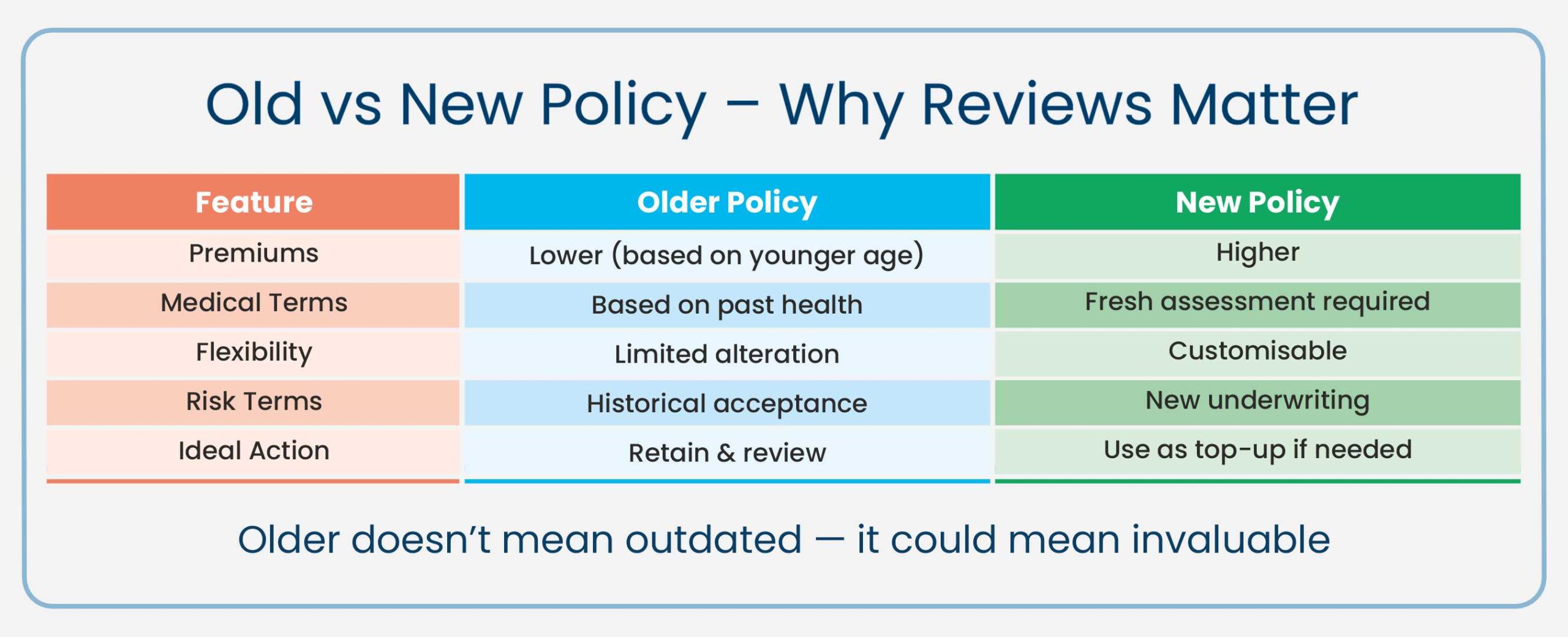
Older life insurance plans can often be genuine hidden gems.
Premiums are based on your age and health at the time you apply, which means policies taken out years ago often benefit from significantly lower, locked-in premiums and medical terms that may no longer be available today.

Before cancelling, altering, or replacing an existing policy, it is essential to seek professional advice. At Nachu Finance, we review older policies with care to ensure they remain relevant to your current needs, and we rarely recommend cancelling them unless there is a clear and meaningful benefit.

Because premiums rise sharply with age, older plans can offer outstanding long-term value compared to arranging cover later in life. Our premium comparison chart by age clearly shows how starting early keeps costs lower for the entire duration of the policy — you can view it Don’t Just Buy a Home-Protect It Too for a clearer picture.
Extending or Increasing an Existing Policy

It is natural to wonder whether an existing policy can simply be extended to cover a longer term or increased to a higher amount.
In most cases, insurers will not allow an increase in cover or extension of the term without full medical reassessment, as this changes the original risk profile.

Our approach is to:

  • Keep your existing policy as it is.
  • Add a “top-up” policy for additional cover or a longer term if needed.

This way, you retain the advantages of your older policy while ensuring your family remains fully protected.

Ensuring Your Cover Is Still Relevant
 
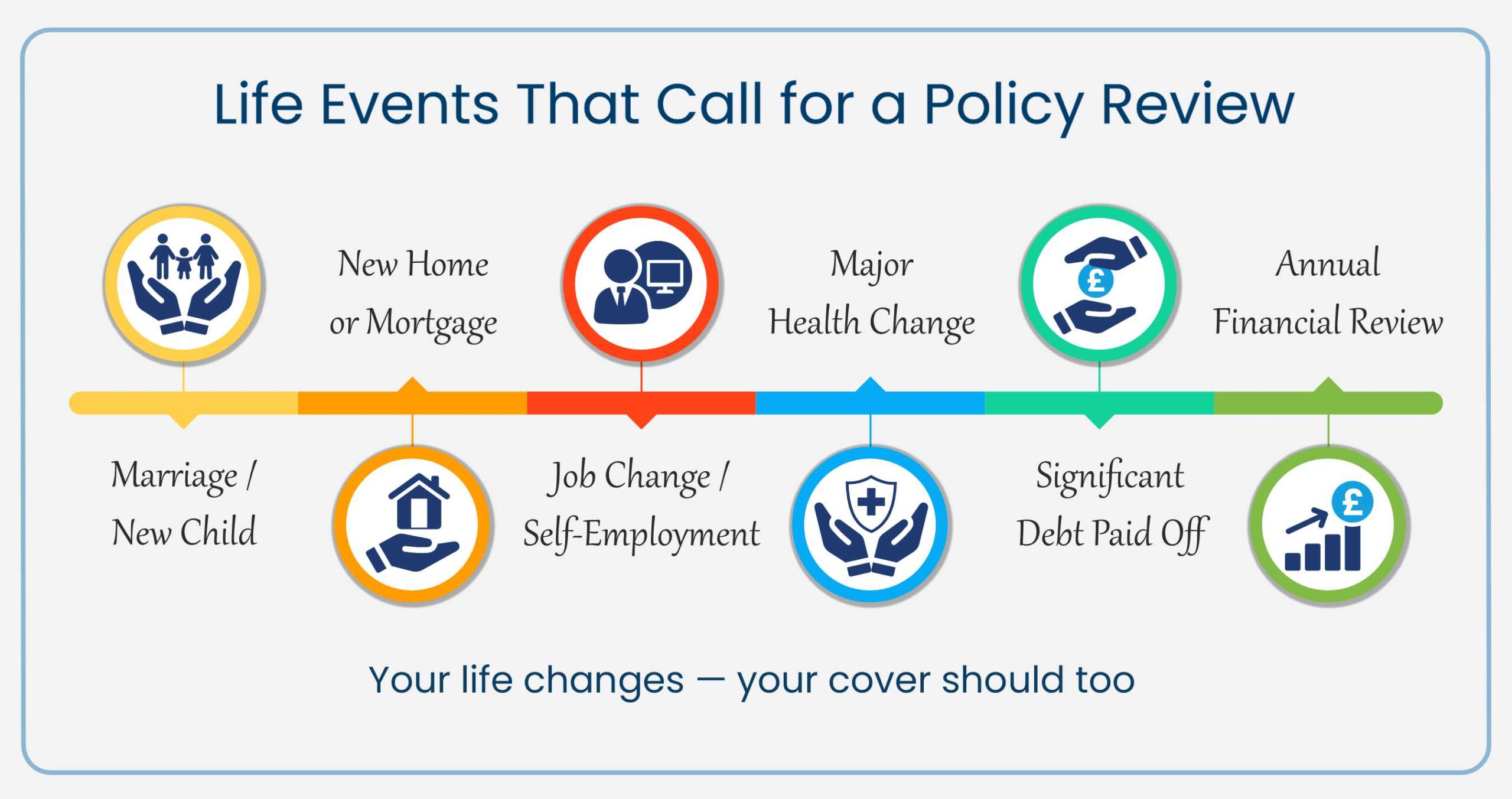
Life Insurance Review - Life Events call for Review
 

Life evolves — so should your insurance.
Events such as marriage, buying a new home, having children, or changes in employment (for instance, moving from employed to self-employed) all affect your protection needs.

A periodic review helps you check whether:

  • The level of cover matches your mortgage balance and family needs.
  • Your term still aligns with your working years.
  • Any employer benefits or other cover overlap with your personal policies.
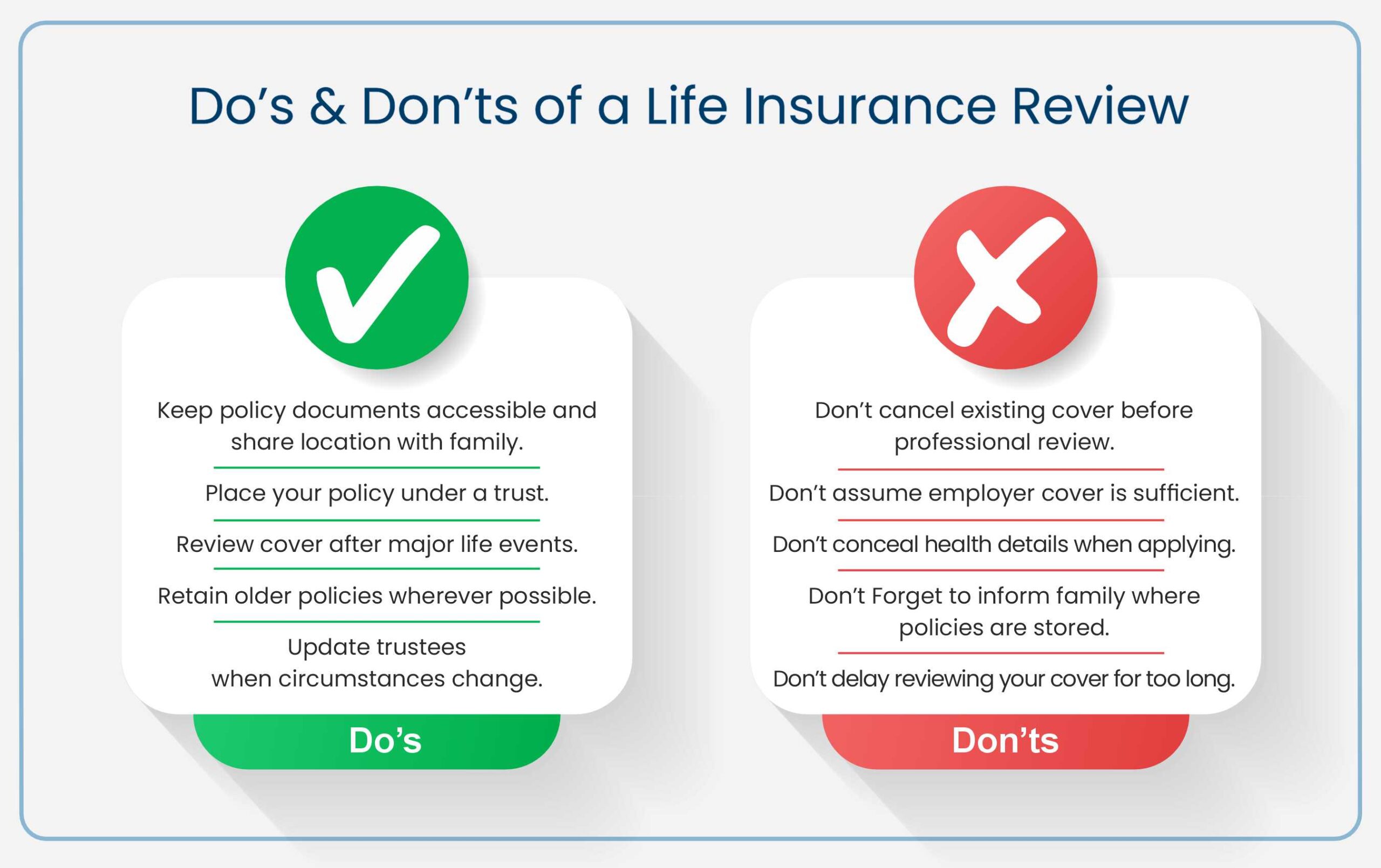
Life Insurance Review - Do's & Dont's


Real life Case Studies

Here are three real-life examples that show how a life insurance review can make a meaningful difference at different stages of life. Each case has a different outcome, but in every situation the review still proved to be the right and sensible step.

Ishan & Sitara

Ishan bought his first property in 2017 for £320,000 with a £250,000 mortgage. At the time, he took out £250,000 of life cover and £100,000 of critical illness cover in his sole name.

When he returned in 2023, he was now married to Sitara and the couple were buying a new family home for £610,000. During our review, we found that Ishan’s historic policies offered excellent terms and very competitive premiums, which would be hard to replicate today.

We therefore kept both existing policies in place, placed his life cover under a trust, and recommended top-up life cover to match his new financial responsibilities. Since Sitara had no protection at all, we also arranged suitable life and critical illness cover for her.

This is a textbook example of why older plans should not be cancelled automatically. With a review, the couple were able to:

  • retain valuable historic cover
  • place the policy under trust
  • top up protection to match their new life stage
  • ensure both partners were fully covered

Felix & Amy

Felix and Amy came to us in 2021 for a remortgage. They had originally purchased their home in 2015 and arranged their life insurance directly with the insurer at the time.

When we asked for their policy documents, they initially struggled to locate them — a common issue that becomes critical during a claim. After some effort, they shared a copy with us and also made sure their family knew where the documents were safely stored.

Following a full review, we concluded that their existing life and critical illness policies were still appropriate for their current circumstances. No top-up cover was needed, but we placed their existing plans under trust and securely stored copies of their documents in their client folder.

Although no new insurance was taken, the review still delivered meaningful benefits:

  • policy documents were located and securely stored
  • the family now knows exactly where to find them
  • the plans were placed under trust for efficient payout
  • reassurance that their existing cover remains fit for purpose

This case shows how valuable a review can be even when no policy changes are required.

Vivan & Rebecca

Vivan and Rebecca approached us around 11 months after their original life insurance was set up at the time of their property purchase. Both were employed when the policies were first taken out.

Within a year, Vivan had moved from employment into a day-rate contracting role through his own limited company. This meant he no longer received the death-in-service benefit he previously enjoyed from his employer.

During the review, we kept Rebecca’s policies unchanged, as her circumstances remained the same. For Vivan, we recommended restructuring his protection by:

  • cancelling his new-but-still-young personal life cover
  • replacing it with a Relevant Life Plan to benefit from significant tax efficiencies
  • increasing the level of life cover to reflect his new responsibilities and lack of workplace benefits

We also reviewed critical illness cover. Although a higher amount would have been sensible, Vivan decided not to increase it for now due to cost considerations.

This case highlights how a review can help align protection with changing employment circumstances — especially when moving to self-employment or contracting.

The Nachu Finance Way
 
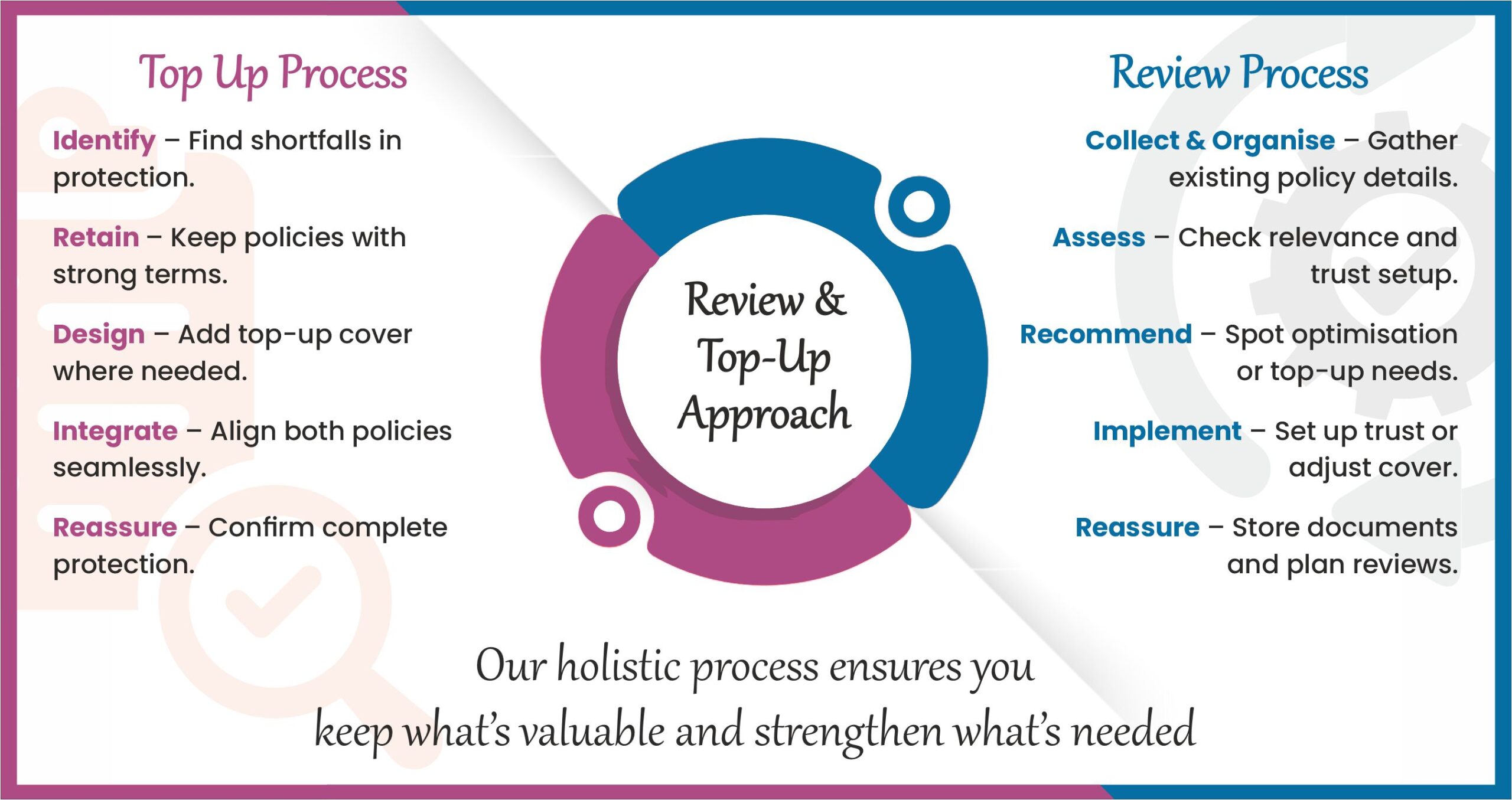
Review & Top-Up Approach
 

At Nachu Finance, we appreciate that older policies can hold immense value.
When we review your existing cover, we:

  • Check if it remains suitable for your current family and financial circumstances.
  • Help optimise it — including setting up or updating the trust.
  • Securely store copies of your policies in your client file, so your family can easily access them in the event of a claim.
  • Review both policies arranged by us and those you arranged elsewhere.

Even if no changes are needed, the reassurance that your policy is still fit for purpose is a valuable outcome in itself.

Frequently Asked Questions

No. The insurer bases its terms on your health and lifestyle at the time of application.
Once the policy is live, there is no obligation to update them about later changes.

Yes. You can replace or add trustees at any time.
We always recommend reviewing the trustees during your periodic insurance review to ensure they are still appropriate and willing to act.

Yes. You can hold multiple policies with different providers.
At application, you must declare any existing cover so the insurer can assess your total cover amount correctly.

Absolutely.
For clients whose policies were arranged through us, claim support is fee-free.
We believe compassionate, expert help at such a crucial time is an essential part of our service.

Yes. Many people keep their older policies because they offer lower premiums and favourable terms, and simply add a top-up policy when their protection needs increase. This is completely normal, and it allows you to retain the benefits of your historic cover while ensuring your overall protection keeps pace with life changes.

Our Transparency Promise

Full Disclosure, Complete Peace of Mind

At Nachu Finance, we insist that all applications are made with full and honest disclosure of health, lifestyle, and smoking status.

We review every detail with you before submission, so the insurer receives accurate information.

We would rather an insurer take extra time to verify your details now than risk a claim being declined later for non-disclosure.
This careful approach protects your family’s peace of mind and ensures that your policy pays out when it matters most.

Let Us Review Your Policy

As holistic advisers, we see life insurance as a core part of family financial planning.
Our transparent, no-pressure approach means we’ll only recommend action when it’s genuinely in your favour.

Reach out to Nachu Finance for a free, transparent review of your existing life insurance.
We’ll give you an honest assessment and, if needed, help you:

  • Place the policy under a trust
  • Adjust or top-up your cover
  • Optimise your family’s protection for today and the years ahead

Why Professional Opinion Matters More Than a Google Search

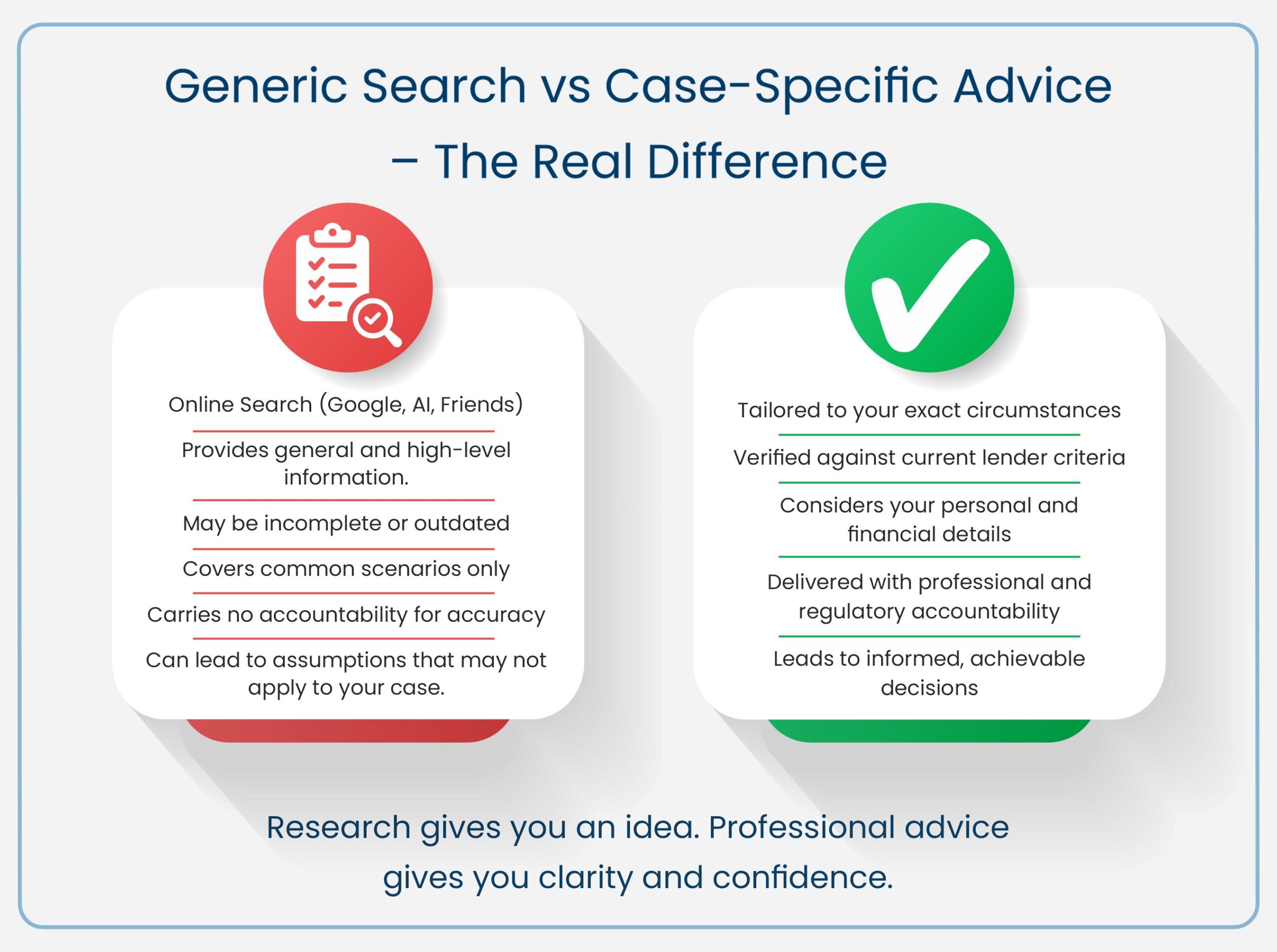
Google Search Vs Expert Opinion
General Search – The Starting Point

It is quite common for clients to begin their research by checking Google, using AI tools, or speaking to friends who have gone through a similar process. These are all good starting points to understand what is generally possible in the mortgage or property market and to familiarise yourself with key terms and concepts.

However, while Google searches, AI responses, and friendly discussions can help build general awareness, they cannot replace case-specific professional advice that takes into account your personal and financial circumstances.

If you are specifically interested in how advice-driven product selection differs from comparison websites, see our related article:

Why Personalised Mortgage Advice Goes Beyond Comparision Website

The Limits of Generic Information

The information found through a Google search or a general discussion with friends is, by nature, generic.
It does not take into account:

  • Your income type or employment structure.
  • The property’s ownership model or intended use.
  • The lender’s current criteria.
  • Your residency or credit profile.

Mortgage lending, taxation, and property law all have layers of detail that differ from one case to another. What works well for one individual may not be suitable or even possible for another.


Consider the use of a gifted deposit.
A quick online search might state that lenders are happy to accept gifted deposits as long as the source of funds is evidenced and supported by a donor declaration.

While this is true in many standard residential purchases, the outcome changes significantly when the purchase:

  • Is made through a limited company,
  • Involves multiple shareholders, or
  • Relates to a non-standard property such as a multi-unit block under a single title.

In such cases, the number of lenders available is very limited. Those who accept gifted deposits often do not accept multi-unit properties, and vice versa. The difference between what appears acceptable online and what is actually possible in your case can therefore be substantial.

Why Professional Advice Holds Greater Weight
Professional opinion is built on understanding not just what the rules say, but how they are applied in practice.
It involves:
  • Interpreting lender and solicitor criteria within the context of your case.
  • Balancing compliance, affordability, and timing.
  • Ensuring that what appears possible in theory is achievable in reality.

A professional adviser also carries regulatory accountability — meaning the guidance you receive must be suitable, compliant, and in your best interests. That level of responsibility does not exist in a Google search, an AI response, or a conversation with friends.

Research Is Useful – Validation Is Essential
Doing your own research is helpful and can make conversations more meaningful. But before proceeding with decisions or forming expectations, it is vital to validate that research with a qualified professional.
 
A generic Google answer or AI response can inform you of what is common, but professional advice ensures that what you are planning is achievable and acceptable for your specific situation.
 
The key takeaway: general searches are a good place to start — professional advice ensures you finish right.

Why Personalised Mortgage Advice Goes Beyond Comparison Websites

Why Personalised Mortgage Advice Goes Beyond Comparison Websites

In today’s digital world, it’s natural to turn to comparison websites to check mortgage rates.
They’re easy to use and give a quick overview of what’s available in the market.
But when it comes to actually getting a mortgage — and making sure it’s suitable, affordable, and achievable — what you see on a comparison site is only half the story.
That’s where the value of personalised advice comes in.

Comparison Websites – A Good Starting Point, But That’s All

Comparison websites are a great starting point for research. They help you understand the general range of rates in the market.
However, what they show are generic products, often filtered only by loan amount, property value, and type of mortgage.

What they don’t take into account are your personal details that actually determine whether you can access that rate, such as:

     ⦁ How you earn your income – employed, self-employed, or on a contract
     ⦁ The stability and type of your income – salary, dividends, day rates, or multiple income sources
     ⦁ Your credit profile and existing commitments
     ⦁ Source of deposit – personal savings, gift, or from overseas
     ⦁ Your residency status or visa type
     ⦁ Type and condition of the property
     ⦁ Whether you are buying in personal name or through a Ltd company

Each of these factors can significantly alter which lenders are willing to offer you a mortgage — and at what rate.

What Personalised Advice Brings to the Table

With personalised advice, the focus shifts from finding a rate to understanding your situation in full.

An adviser takes time to understand your circumstances and objectives before recommending any product

They review the entire market (not just one lender panel or an online list) and select options that are:

     ⦁ Available to you, based on your profile
     ⦁ Suitable for your needs and plans
     ⦁ Compliant with lender and regulatory requirements
     ⦁ Timed correctly, reflecting how long each rate is valid and when you plan to complete

Every rate shared through personalised advice is one that the adviser is confident you are both eligible for and comfortable with — taking into account your affordability, goals, and any foreseeable changes ahead
commitment.

Rates Move Fast – Timing and Monitoring Matter

Mortgage rates in the UK can be volatile and may change even within a single day.
A rate displayed online might already be withdrawn or replaced by the time you apply.
With personalised advice, an adviser will typically:

     ⦁ Track market movements daily
     ⦁ Re-check rates right up to the point of exchange or completion for purchases
     ⦁ Revisit options close to your renewal date in remortgages or product transfers
     ⦁ Recommend switching to a lower rate, if one becomes available before completion and it suits your circumstances

This level of monitoring helps ensure that the mortgage product you proceed with remains competitive and appropriate right up to the point you lock it in.

Accountability and Responsibility in Advice

One of the most important distinctions between taking personalised advice and using a comparison website lies in accountability.

When you rely on online listings, no one takes responsibility for whether the information shown is accurate, up to date, or suitable for your circumstances. The choice — and any resulting outcome — rests entirely with you.

By contrast, when you receive regulated mortgage advice, the adviser takes full responsibility for the recommendation made. This includes assessing your income, commitments, and future plans to ensure the advice is both appropriate and compliant.

Every recommendation is backed by professional due diligence, regulatory oversight, and the adviser’s Professional Indemnity Insurance, which provides an additional layer of protection and reassurance for clients.

This accountability — combined with ongoing rate monitoring and suitability checks — is what truly differentiates advice from comparison.

The Value of Trust and Expertise

Personalised mortgage advice is not about selling a rate; it is about guiding someone towards the right mortgage solution for their circumstances.There is no incentive for an adviser to withhold a cheaper rate if it is truly suitable — the entire purpose of regulated advice is to find the option that best fits the client’s needs.

The advice process goes far beyond comparing numbers. It involves making sure the application is positioned correctly, the product aligns with future plans, and the overall journey remains clear and manageable.

Securing a mortgage is a journey rather than a single-step process, and understanding how the various stages fit together can make the experience far smoother. You can read more about the typical steps in the process The First-Time Buyer’s Mortgage Journey: A Complete, Practical Guide

In Summary

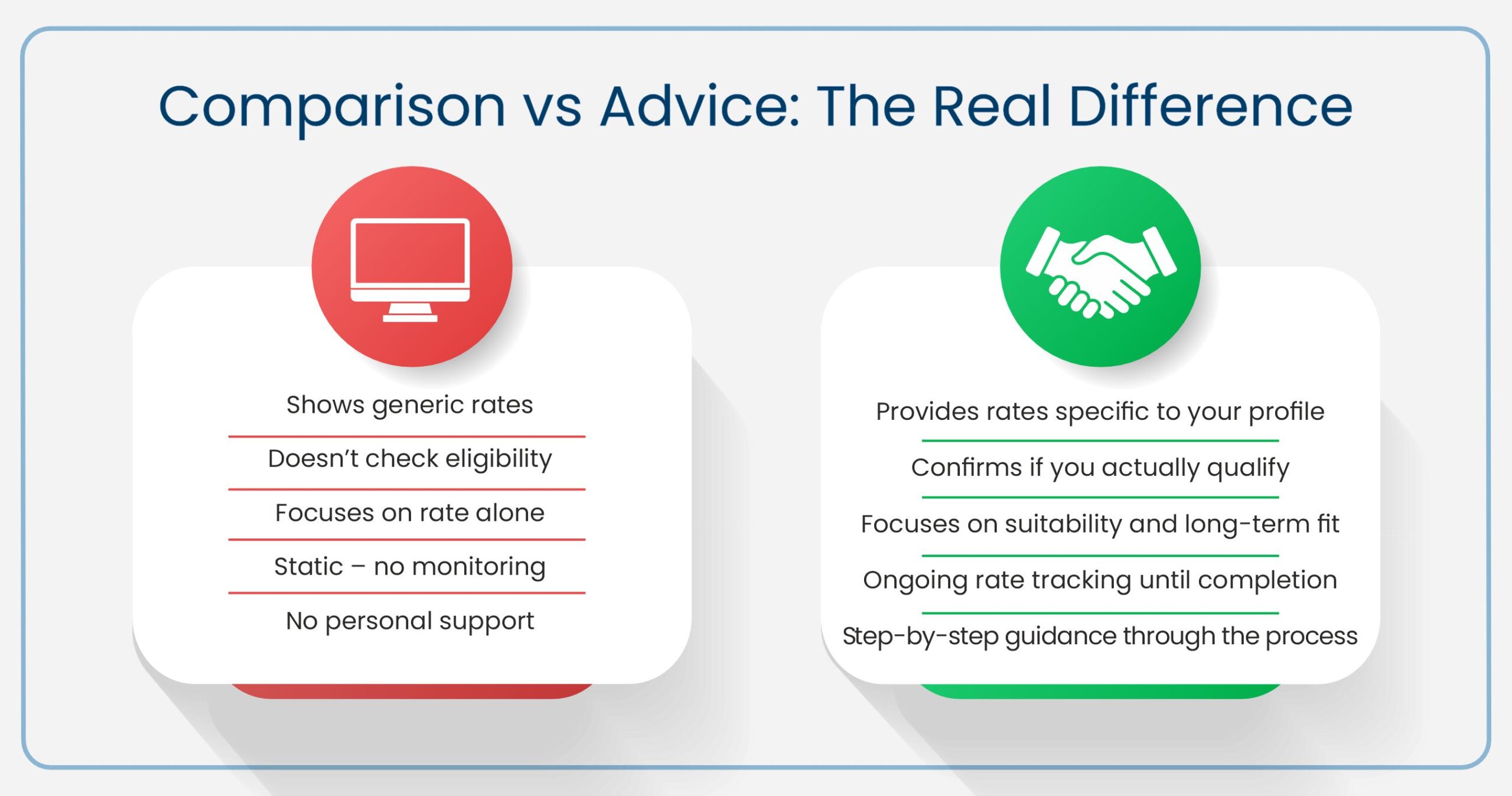
Comparison vs Advice-The Real Difference

While comparison websites provide a quick snapshot of available mortgage rates, they rarely show the full picture. Personal advice goes several steps further — checking eligibility, assessing suitability, and guiding you through the entire process until completion. The difference isn’t just in the rate, but in the reliability and responsibility behind it.

A Balanced Perspective

There’s nothing wrong with browsing comparison websites — they can be a useful way to familiarise yourself with the market and get a sense of the available options.
However, it’s important to remember that what appears online is a general snapshot, not a tailored recommendation.

When you work with an experienced, independent mortgage adviser, the focus is not just on the rate itself but on eligibility, suitability, timing, and long-term implications.The process involves careful assessment, documentation, and monitoring — ensuring that the final mortgage solution genuinely fits your individual circumstances and future plans.

Good decisions rely on clarity and context, not on headline rates alone.

When and Why to Get a Property Survey – Beyond the Mortgage Valuation

Know the Real Condition of your future home

Would you spend £500 to avoid a £10,000 mistake?


That’s the kind of risk property surveys are designed to manage. While a mortgage valuation checks if a home is suitable for lending, a survey digs deeper into the property itself — helping buyers make confident, informed decisions.

This article explains the difference between a mortgage valuation and an independent survey, outlines the options available, and explores when it makes most sense to get one. We also look at how surveys can affect real purchase decisions, including two case studies from our clients.

Continue reading

Why Specialist Advice Matters in Property and Tax Planning

Specialist Guidance Real Peace of Mind

When it comes to properties, mortgages, and taxes, even a small mistake can have serious consequences. A recent high-profile example was the resignation of Angela Rayner, the UK’s Deputy Prime Minister and Secretary of State for Housing, Communities and Local Government, after an error with her own stamp duty bill.

Had she taken specialist tax advice at the right time, the story might have been very different. This is exactly why at Nachu Finance, we believe in seeking specialist opinion whenever circumstances move beyond the standard and straightforward.

Continue reading

Transfer of Equity: Mortgage Implications, Costs, Tax & Legal Process Explained

Residential Mortgage

Transfer of Equity (TofE)is the legal process of changing the ownership of a property by adding or removing names from the title. Unlike a sale and purchase transaction, at least one of the existing owners continues to remain on the title. While the actual legal work is carried out by a solicitor, mortgage advisers like us often get involved—because the names on the mortgage must reflect the updated ownership. This article explores the key aspects of a Transfer of Equity and when it might be relevant.

Continue reading

Mortgage Deposit Source & Evidence – What Lenders Expect

Is Your Deposit

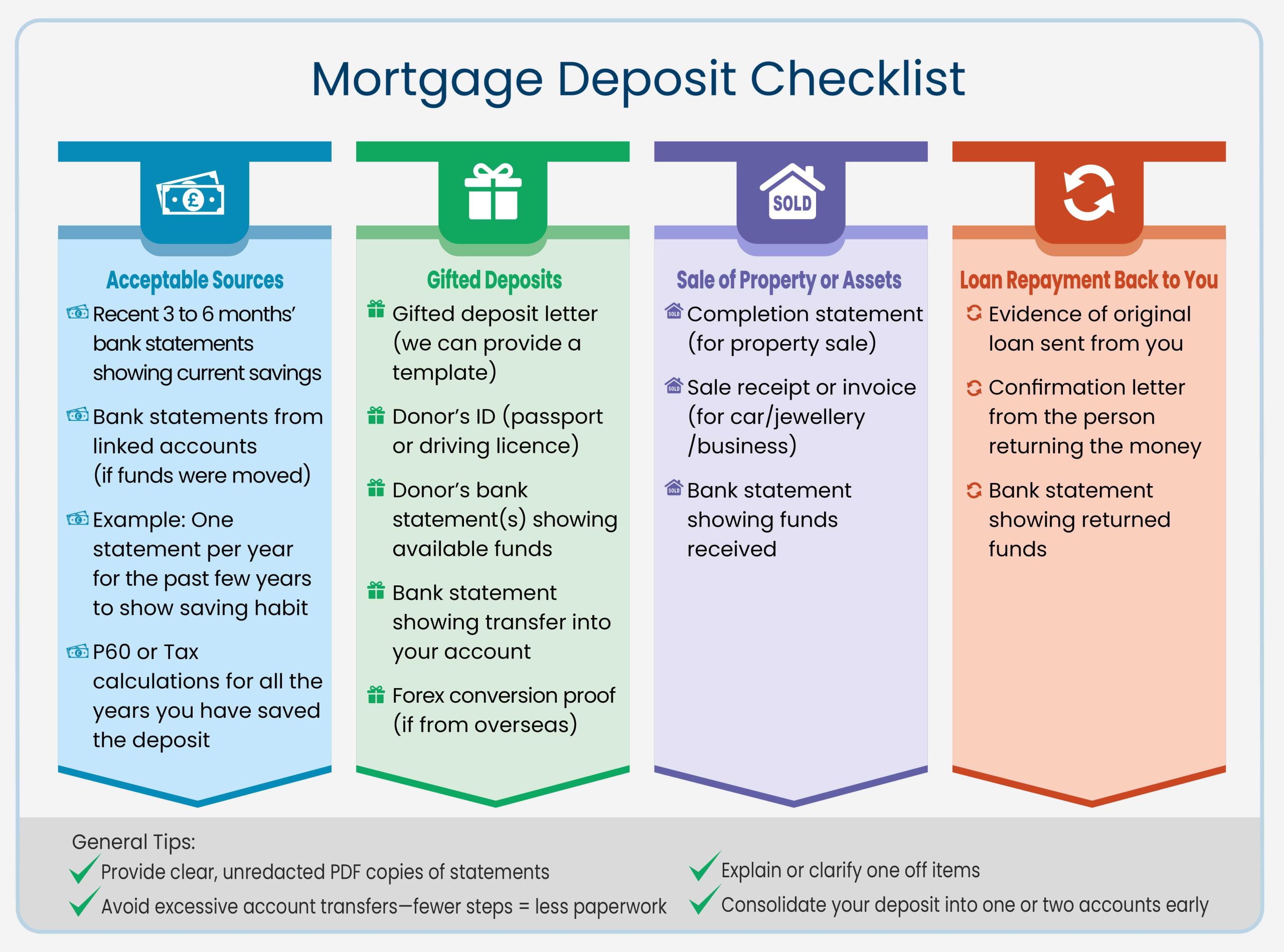
When buying a property with a mortgage, it’s easy to focus on rates, monthly payments, or loan sizes—but your deposit source and the evidence behind it can make or break your application. This often-overlooked detail has become increasingly important with tighter anti-money laundering checks and lender scrutiny. In this article, we explain what lenders and solicitors need to see, which sources are acceptable, and how you can avoid delays by getting it right from the start.

Continue reading

EPC Ratings and Mortgages: What Buyers and Landlords Need to Know

EPC Ratings and Mortgages

When buying or letting out a property the EPC rating can have a larger impact than expected as it is not just legal compliance. It can influence your mortgage options, ongoing energy costs, and even your long-term returns. Whether you are a first-time buyer, a home mover, or a landlord, understanding how EPC ratings fit into the bigger picture is essential.

When applying for a mortgage, particularly for buy-to-let or investment properties, the Energy Performance Certificate (EPC) is NOT just a formality. It carries financial, regulatory, and environmental importance.

At Nachu Finance, we are not energy advisers, but we do take a holistic approach to mortgage planning, and EPC considerations are an important part of the advice we provide.

Continue reading

Overpaying into a Mortgage – Residential or Buy-to-Let?

MORTGAGE FREE HOME

When clients ask about overpaying their buy-to-let mortgage, I often challenge them to consider whether overpaying the residential mortgage might be a better financial move.

If you have both types of mortgages, it’s important to look beyond the surface. While reducing any debt is a positive step, I firmly believe that – in most cases – overpaying the residential mortgage should be prioritised. Here’s why.

Continue reading

Stay One Step Ahead: Register for Free Land Registry Property Alerts

Land Registry Property Alerts

When it comes to property-related fraud, the stakes are high-after all, the bigger the asset, the greater the motivation for fraudsters. However, a simple yet effective step to protect yourself is registering for Land Registry Property Alerts, a free service that helps you monitor activity related to your property title.

Continue reading

Why Married Couples Should Purchase Their Home in Joint Names

joint-names-in-home

Many clients wonder whether they should purchase a property in joint names, especially if they can afford it in a single name or if one partner does not have an earned income. Some mistakenly believe there are advantages to purchasing a property in a single name. Let’s explore why joint ownership is often the better choice and debunk some common myths along the way.

Continue reading