
Buying a Buy-to-Let Property – Personal Name vs Limited Company Ownership

Personal Name Vs Ltd Co - Main Image

A very common question from clients looking to invest in a buy-to-let property is whether it is better to purchase in a personal name or through a limited company.

The short answer is: there is no one-size-fits-all solution. The best structure depends on your individual circumstances, tax position, and long-term objectives. In this article, we’ll explore the broad considerations for each route – but before diving into the comparison, there are a couple of important points to clarify.

Before Anything Else – Understand the Responsibilities of Being a Landlord

Owning property as an investment is not the same as investing in stocks, bonds, or commodities. A buy-to-let comes with legal, financial, and moral responsibilities. These include ensuring the property is safe, compliant with regulations, and that tenants are treated fairly.

Before weighing up ownership structures, make sure you fully understand what being a landlord entails. Otherwise, you risk facing unwelcome surprises after completing your purchase.

We’ve written a detailed article on this topic: The Realities of Buy-to-Let – What Every Landlord Needs to Know.

Personal Name Ownership – The Simpler Option

Buying a buy-to-let in your personal name is generally:

  • Simpler to set up and manage – no need to create and maintain a company structure.
  • Lower cost – ongoing compliance, accounting, and administration are minimal compared with a company.
  • Access to cheaper mortgage rates – lenders usually offer more competitive rates for personally owned properties.

The downside: personal ownership is often less tax efficient. Rental profits are taxed at your marginal income tax rate, and high earners can feel the impact of reduced mortgage interest tax relief.

Limited Company Ownership – The Tax-Efficient Route

Using a limited company (commonly set up as a Special Purpose Vehicle or “SPV”) has its advantages:

  • Tax efficiency – profits are subject to corporation tax, which may be more favourable depending on your income bracket.
  • Flexibility for reinvestment – easier to reinvest profits into future property purchases without incurring personal tax first.
  • Long-term planning – can allow for more efficient inheritance and capital gains planning.

The trade-offs include:

  • Setup and running costs – accountancy fees, compliance charges, bank fees, and Companies House filing obligations.
  • Mortgage considerations – limited company mortgage rates are usually higher than personal ones.
  • Director responsibilities – you will need to act as a director and comply with company law.
  • Personal guarantees – lenders typically require directors to give personal guarantees when borrowing through a limited company.

At a Glance – How Personal Name and Limited Company Ownership Compare

To help summarise the key differences, the infographic below provides a quick visual comparison of both routes.
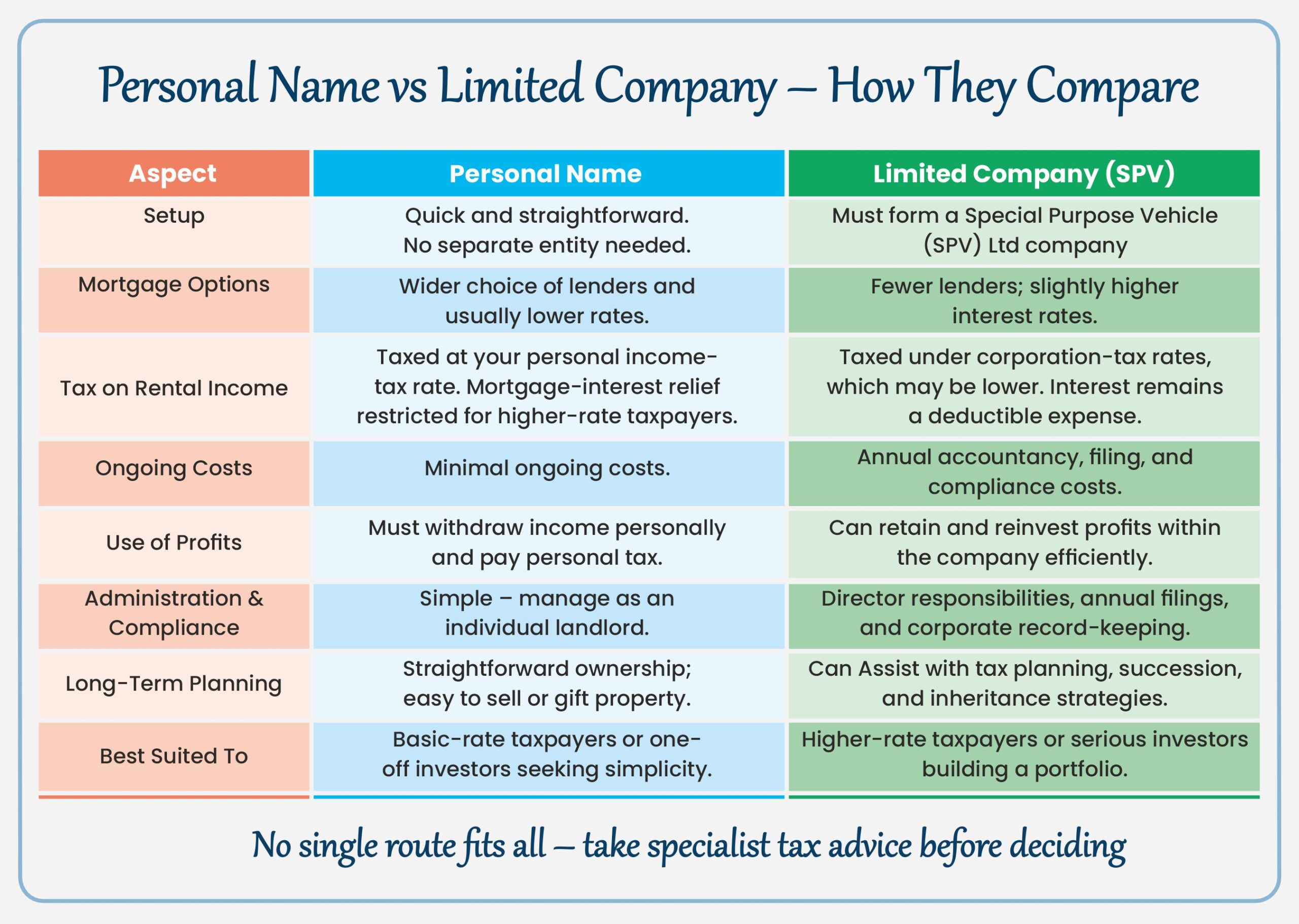
 

Personal Name vs Limited Company – How They Compare - Info 1

Important Distinction – Buying New vs Transferring Existing

This article focuses on the decision when purchasing a new buy-to-let property.

Transferring an existing personally owned property into a limited company is a separate subject. Such transfers often trigger stamp duty and capital gains tax, and can be expensive unless there is a strong reason.

For more detail on this specific scenario, see: Transferring Property into a Limited Company.

When Might a Personal Name Make More Sense?
  • You are a basic rate taxpayer or have no other income.
  • You are buying a one-off buy-to-let rather than building a portfolio.
  • You want a simpler, lower-cost route with less paperwork and compliance.
  • You prefer access to lower mortgage interest rates.

When Might a Limited Company Make More Sense?
  • You are a higher rate or additional rate taxpayer.
  • You already run a trading limited company and have significant retained profits you wish to reinvest.
  • You are building a portfolio of buy-to-lets and plan to treat property as a serious long-term business.
  • You want more flexibility for tax planning and inheritance planning.

Additional responsibilities with a limited company include:
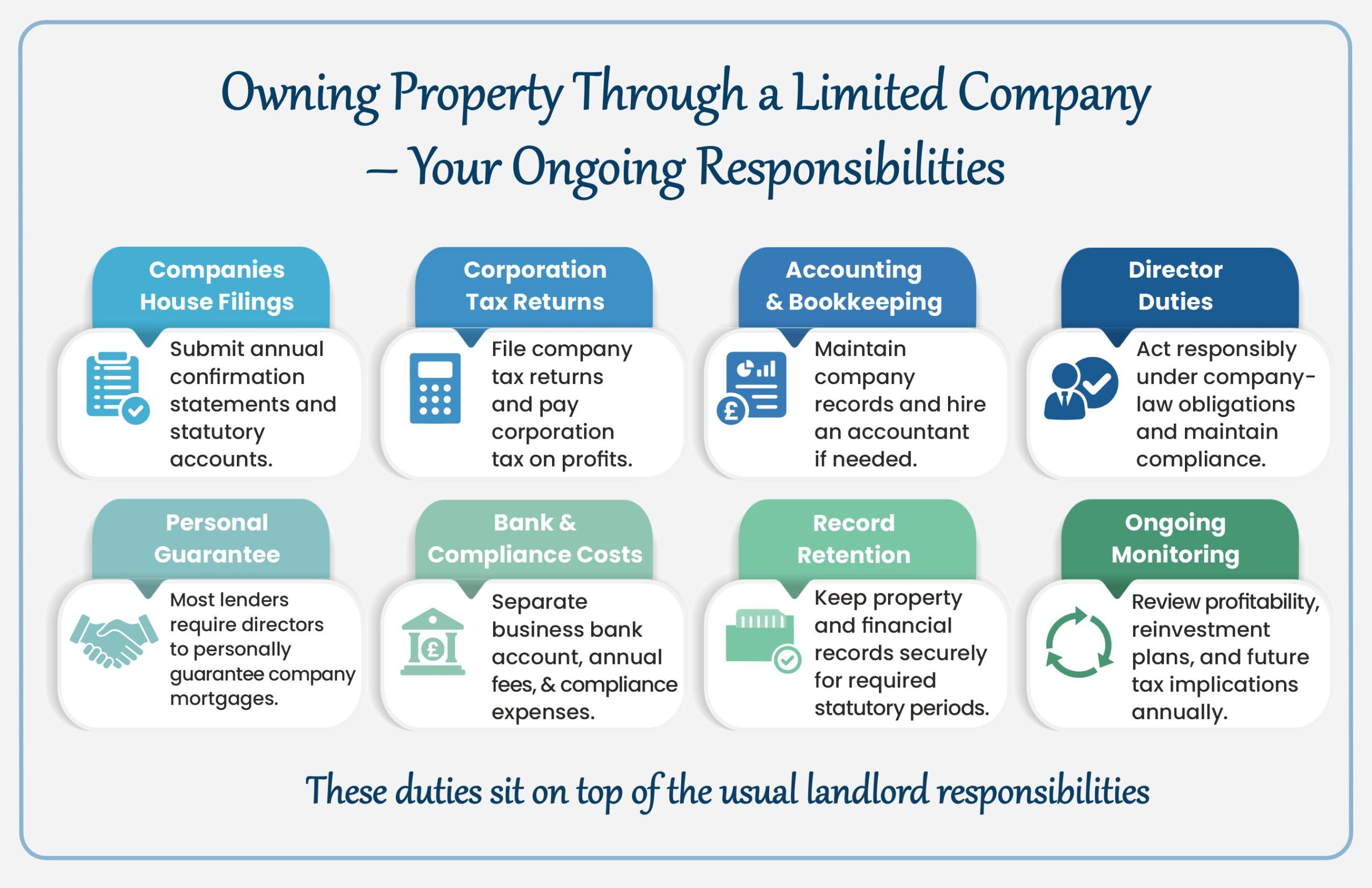
Below is a summary of the additional responsibilities landlords must meet when using a limited company structure.
 
Owning Property Through a Limited Company - Info 3
 
  • Annual filings with Companies House (confirmation statements, statutory accounts).
  • Corporation tax returns and ongoing accountancy costs.
  • Acting as a director/shareholder and ensuring compliance with company law.

Personal guarantees: even if the mortgage is in the limited company’s name, most lenders will require the directors to personally guarantee the loan. This means that if the company defaults, your personal assets may still be at risk.

Long-Term Objectives and Exit Strategy

Your end goal should influence the decision. For example:

  • If you plan to sell the property and cash out the gains, your tax route may look different in personal names versus a company.
  • If your plan is to retain and pass on the property, limited companies can sometimes help with inheritance planning and structuring shares.
  • If your plan is simply to earn rental income during retirement, personal names may be simpler and more cost-effective.

Choosing the right structure depends on a combination of factors. The infographic below outlines the key elements that typically influence what works best for each client
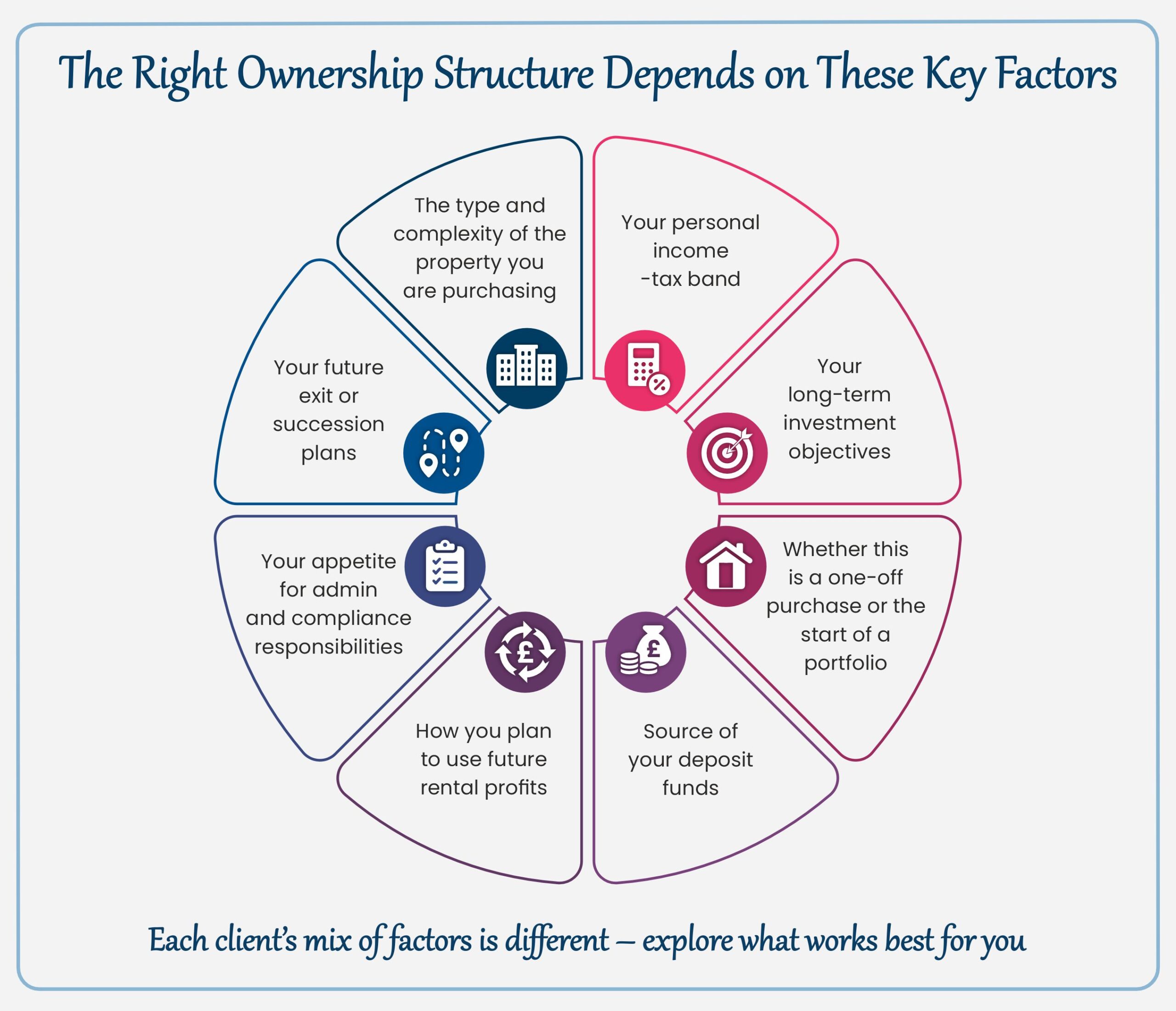
The Right Ownership Structure Depends on These Key Factors - Info 4

Real-Life Case Studies

The decision between purchasing a buy-to-let property in personal names or through a limited company depends heavily on each client’s individual circumstances.
Below are two real examples that highlight how different factors can lead to entirely different ownership structures, yet both outcomes were appropriate and efficient for the clients involved.

Balaji is a full-time NHS doctor and a higher-rate taxpayer. Nila is a homemaker with no personal income, and her long-term plan is to continue in this role. The couple received an inheritance from Nila’s parents and wanted to invest part of it into a single buy-to-let property located close to their main home. Their intention was simply to hold one additional property for future family needs, rather than building a wider portfolio or running a property business.

Given their objectives, their tax positions and the source of deposit, the couple sought tax advice and considered both ownership routes.
The outcome was clear: purchasing in personal names suited their circumstances best.

To reflect the origin of the deposit and to ensure the rental income was taxed more efficiently, they chose to own the property as tenants in common with unequal shares — 90 percent for Nila and 10 percent for Balaji.

This structure aligned with their financial objectives, long-term plans and family considerations.

For readers who wish to understand the difference between joint tenancy and tenants in common, we have explained this in detail here : Joint Tenancy vs. Tenants in Common

Sai and Devi are married, both higher-rate taxpayers and both expecting to remain in well-paid full-time roles. Sai is an IT contractor operating through his own trading limited company, which had accumulated around £140,000 in retained profits. Their long-term aim was to build a small property portfolio over the years.

Because they were already higher-rate taxpayers and the deposit was coming from retained profits within a trading company, purchasing in personal names would have meant drawing funds as dividends and incurring additional personal tax.

After discussing their situation with their accountant and taking specialist tax advice, they decided that purchasing through a new limited company (SPV) was the more efficient and future-proof structure.
This allowed them to deploy the retained profits more effectively and positioned them better for expanding their property portfolio over time.

The two examples above demonstrate situations where one structure clearly made more sense than the other.
However, in many real-life scenarios, clients present a mix of factors — some favouring personal ownership and others favouring a limited-company route.

In such cases, the decision is not straightforward.
It often requires weighing up long-term objectives, tax considerations, deposit sources, income levels, portfolio intentions and administrative responsibilities before arriving at an informed and balanced choice.

Every client’s circumstances are different, and the most suitable structure is the one that aligns with their overall financial picture and future plans.

Our Transparency Promise

Multiple Professionals Are Involved in Getting This Right

Choosing whether to hold a buy-to-let property in your personal name or through a limited company is not a decision made in isolation.
Before finalising your route, you will usually need input from more than one professional:

  • A mortgage adviser to explain lending rules, interest-rate differences, and structuring requirements.
  • A qualified tax adviser to confirm how each option affects your personal tax position, long-term plans, and future liabilities.

While we can guide you on how each structure works from a property-finance perspective, we are not tax advisers, and tax planning sits outside the scope of mortgage advice.
Given the long-term consequences of choosing the wrong structure, we strongly recommend seeking independent, specialist tax advice before arriving at a final decision.

For more details on why specialist advice is crucial in these scenarios, see our article on Why Specialist Advice Matters in Property and Tax Planning

Our goal is to ensure you make a well-informed decision, and that all relevant professionals are involved where needed.

How Nachu Finance Supports Your Buy-to-Let Journey
 
How Nachu Finance Supports Your Buy-to-Let Journey - Info 3
 

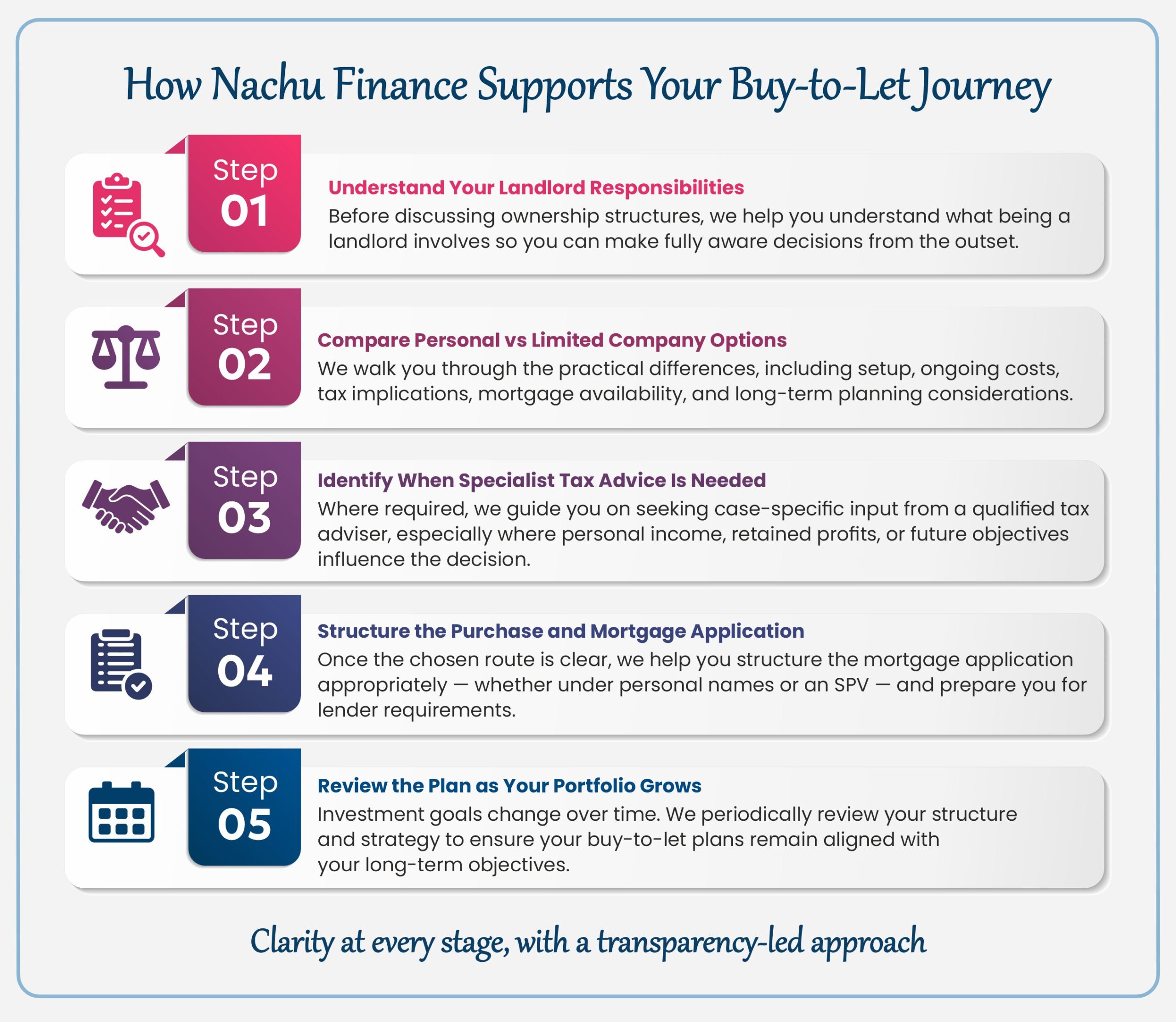
At Nachu Finance, our role is to guide you through every stage of your buy-to-let planning with clarity and structure.

We start by ensuring you fully understand what it means to be a landlord, then help you compare the practical differences between personal ownership and using a limited company.

Where a tax specialist’s input is needed, we point you in the right direction so your decision is made with complete confidence.

Once the structure is clear, we help you position the mortgage application correctly and follow through with the paperwork, lender requirements and timelines. As your plans evolve, we continue to review your approach so your strategy remains aligned with your long-term goals.


Ready to Explore Which Structure Works Best for You?

At Nachu Finance, we understand that buying an investment property is a long-term commitment, and getting the structure right at the outset can make a meaningful difference over time. We are always happy to have an initial conversation, understand your goals and personal circumstances, and outline the available options in a clear and transparent way.

Where required, we can also refer you to experienced tax specialists so you receive the right guidance from all relevant professionals.

If you are planning a purchase, weighing up your options, or would simply like to talk through the considerations, feel free to reach out. We will be glad to guide you and support you at every stage.

Frequently Asked Questions

No, not all lenders offer mortgages to limited companies. However, more and more lenders—including well-known high-street names such as Birmingham Midshires, Coventry Building Society and The Mortgage Works—are now active in this space.
It is fair to say the choice is still more limited compared with personal-name mortgages, but as limited-company structures become more popular with landlords, the number of lenders willing to lend to SPVs continues to grow.
Criteria and flexibility vary significantly between lenders, so understanding who supports what structure is important before finalising your route.

Generally speaking, yes.
Limited-company mortgage rates tend to be slightly higher than equivalent products in personal names.
However, the interest rate should not be looked at in isolation.
A limited company can offer potential tax advantages and reinvestment benefits which, depending on your circumstances, may outweigh the slightly higher cost of borrowing.
The decision should therefore be based on the overall position and long-term outcomes, not the rate alone.

Yes, you can.
The limited company simply acts as the legal “envelope” for the mortgage. All due diligence—identity checks, credit checks, income verification, deposit evidence and background assessments—is still performed on you as the applicants.
Because of this, lenders are generally comfortable with:

  • a newly incorporated SPV, or
  • a company that will be set up shortly before the mortgage application is submitted.

A new company is not a negative point and does not reduce your chances of obtaining a mortgage.

In most cases, yes.
Although the property is owned by the limited company, lenders usually require all directors and shareholders to provide a personal guarantee.
This means you remain personally responsible if the limited company fails to meet the mortgage obligations.
Additionally, lenders often require you to take independent legal advice before signing the personal-guarantee documents, because the guarantee creates obligations separate from the company.

Often yes, but the way you structure this makes a significant difference.
If the property is purchased in your personal name, you would first need to withdraw the funds from the trading company and pay any tax due on the withdrawal (for example, dividend tax). Only then can the funds be used as your personal deposit.
However, if the property is purchased through a limited company SPV, there may be more efficient options, such as:

  • inter-company loans, or
  • structuring the SPV as a subsidiary of your trading company.

These options can avoid unnecessary tax leakage and allow efficient use of retained profits. Because the tax implications vary widely, this is an area where specialist tax advice is strongly recommended.

Generally speaking, no. Only a small number of lenders accept gifted deposits under a limited-company structure

Most lenders do not permit gifted deposits when buying through a limited company.
Gifted deposits are far more commonly accepted for:

  • residential property purchases, and
  • buy-to-let purchases in personal names.

If using a gifted deposit forms part of your plan, it is essential to confirm lender acceptance before progressing too far.

In theory, yes — but in practice, most lenders prefer not to lend to active trading companies.
Only a handful of lenders will consider a mortgage where the borrowing entity is a trading business, and the choice of products is very limited.
Setting up a separate Special Purpose Vehicle (SPV) specifically for property investment generally:

  • keeps borrowing cleaner,
  • simplifies lender due diligence,
  • avoids mixing trading activity with property assets, and
  • ensures a wider choice of lenders and mortgage products.

Yes, it is possible and you should consider.
Whether you are a first-time landlord or an experienced investor, the considerations remain the same:

  • your tax position,
  • your long-term investment plans,
  • the source of your deposit,
  • your comfort with administrative responsibility, and
  • whether you intend to build a portfolio.

Being a first-time landlord does not restrict you from using a limited company; it simply means the need to understand both options clearly is even more important.

In many cases, yes.
Some lenders do allow both adult and minor children to hold shares in a property SPV.
However, every lender applies its own criteria regarding:

  • acceptable ages,
  • maximum shareholding percentages, and
  • any responsibilities or limitations placed on younger shareholders.

If involving your children forms part of your long-term strategy, this should be discussed at the outset so that a suitable lender can be identified.

A limited company, on its own, is not an inheritance-tax or succession-planning solution.
While shareholding allows some flexibility in how interests are held or transferred, this does not automatically reduce inheritance tax or solve estate-planning needs.

Inheritance Tax planning is a separate and specialist area, and decisions about property ownership should be reviewed together to get the full picture.

If you buy a buy-to-let in your personal name, then when you go on to buy your residential property, it will be treated as an additional property, and the 5% additional stamp duty will apply. You will not be considered a first-time buyer.
If you buy the buy-to-let through a limited company, your personal first-time buyer status is not affected, provided you do not personally own any property.

Yes.
Regardless of whether this is the company’s first property or whether the company has only just been formed, the 5% additional stamp duty surcharge automatically applies to all limited-company residential property purchases.

In practice, no.
The tax rules — including ATED (Annual Tax on Enveloped Dwellings) — and higher stamp duty make it uneconomical for an individual to buy their own home through a limited company.

In addition, mortgage lenders do not offer residential mortgages to limited companies for owner-occupied properties.
For these reasons, a limited-company structure is used only for buy-to-let properties, not residential homes for personal occupation.

Life Insurance Review: Why You Should Revisit Your Existing Policies

Life Insurance Review

Life insurance, critical illness cover, and income protection are essential pillars of family protection. Yet, once policies are in place, many people rarely revisit them.
At Nachu Finance, we believe a periodic review of your existing life insurance can make all the difference — ensuring your cover remains relevant, accessible, and effective when your family needs it most.

Make Sure the Policy Is Accessible

Before anything else, ensure that your family knows what policies you hold, who the providers are, and where to find the documents.

It is surprisingly common for families to be unaware of the details of existing policies. If you find it difficult to locate your documents while everything is going well, imagine how challenging this could be during a crisis.
Keep your policies accessible — ideally in both digital and physical form — and make sure immediate family members or adult children know where to find them.

Place Your Policy Under a Trust

Placing a life insurance policy under a trust ensures that proceeds are paid quickly and tax-efficiently to your chosen beneficiaries.
If your policy isn’t already under a trust, we strongly recommend setting this up.

If it is already under a trust, ensure the trustees’ details are up to date — especially if children have now become adults or if any trustee is no longer suitable to act.

Read more in our related article: Why Your Life Insurance Policy Should Be Placed Under a Trust

Older Policies: Hidden Gems Worth Keeping


Older life insurance plans can often be genuine hidden gems.
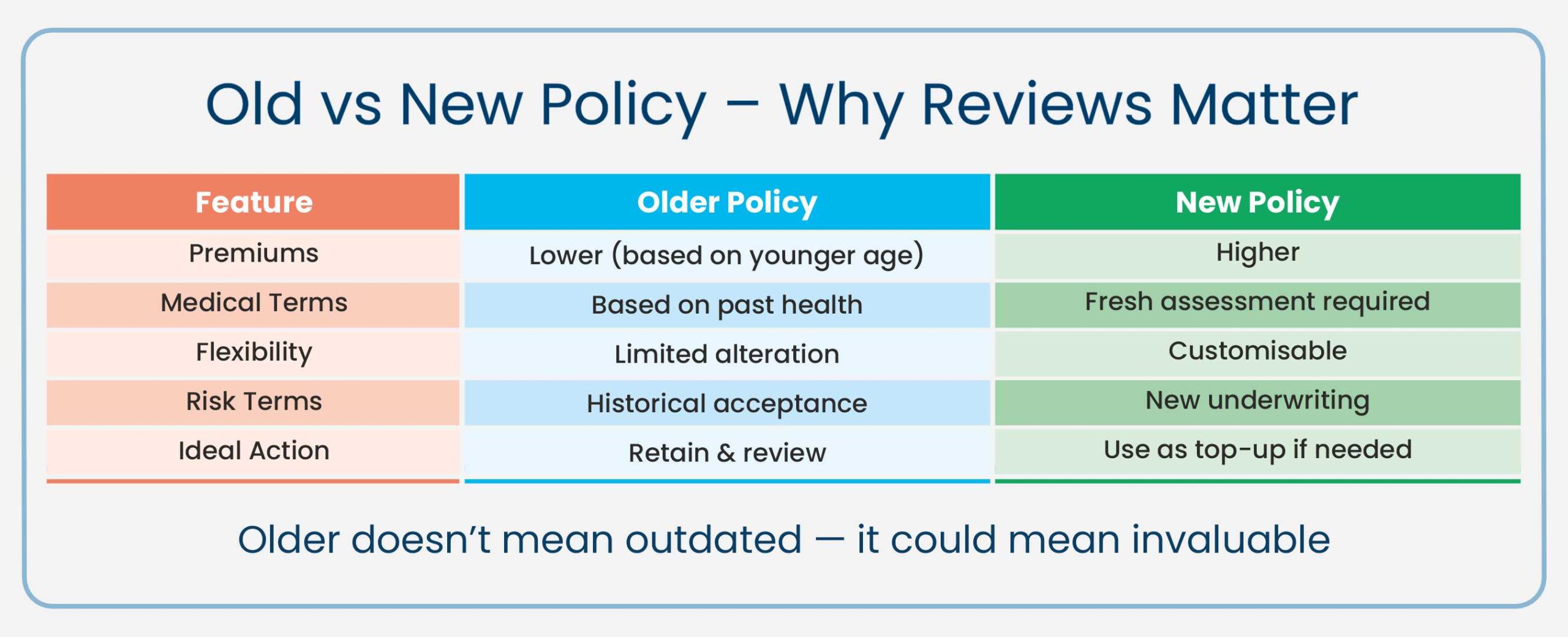
Premiums are based on your age and health at the time you apply, which means policies taken out years ago often benefit from significantly lower, locked-in premiums and medical terms that may no longer be available today.

Before cancelling, altering, or replacing an existing policy, it is essential to seek professional advice. At Nachu Finance, we review older policies with care to ensure they remain relevant to your current needs, and we rarely recommend cancelling them unless there is a clear and meaningful benefit.

Because premiums rise sharply with age, older plans can offer outstanding long-term value compared to arranging cover later in life. Our premium comparison chart by age clearly shows how starting early keeps costs lower for the entire duration of the policy — you can view it Don’t Just Buy a Home-Protect It Too for a clearer picture.

Extending or Increasing an Existing Policy

It is natural to wonder whether an existing policy can simply be extended to cover a longer term or increased to a higher amount.
In most cases, insurers will not allow an increase in cover or extension of the term without full medical reassessment, as this changes the original risk profile.

Our approach is to:

  • Keep your existing policy as it is.
  • Add a “top-up” policy for additional cover or a longer term if needed.

This way, you retain the advantages of your older policy while ensuring your family remains fully protected.

Ensuring Your Cover Is Still Relevant
 
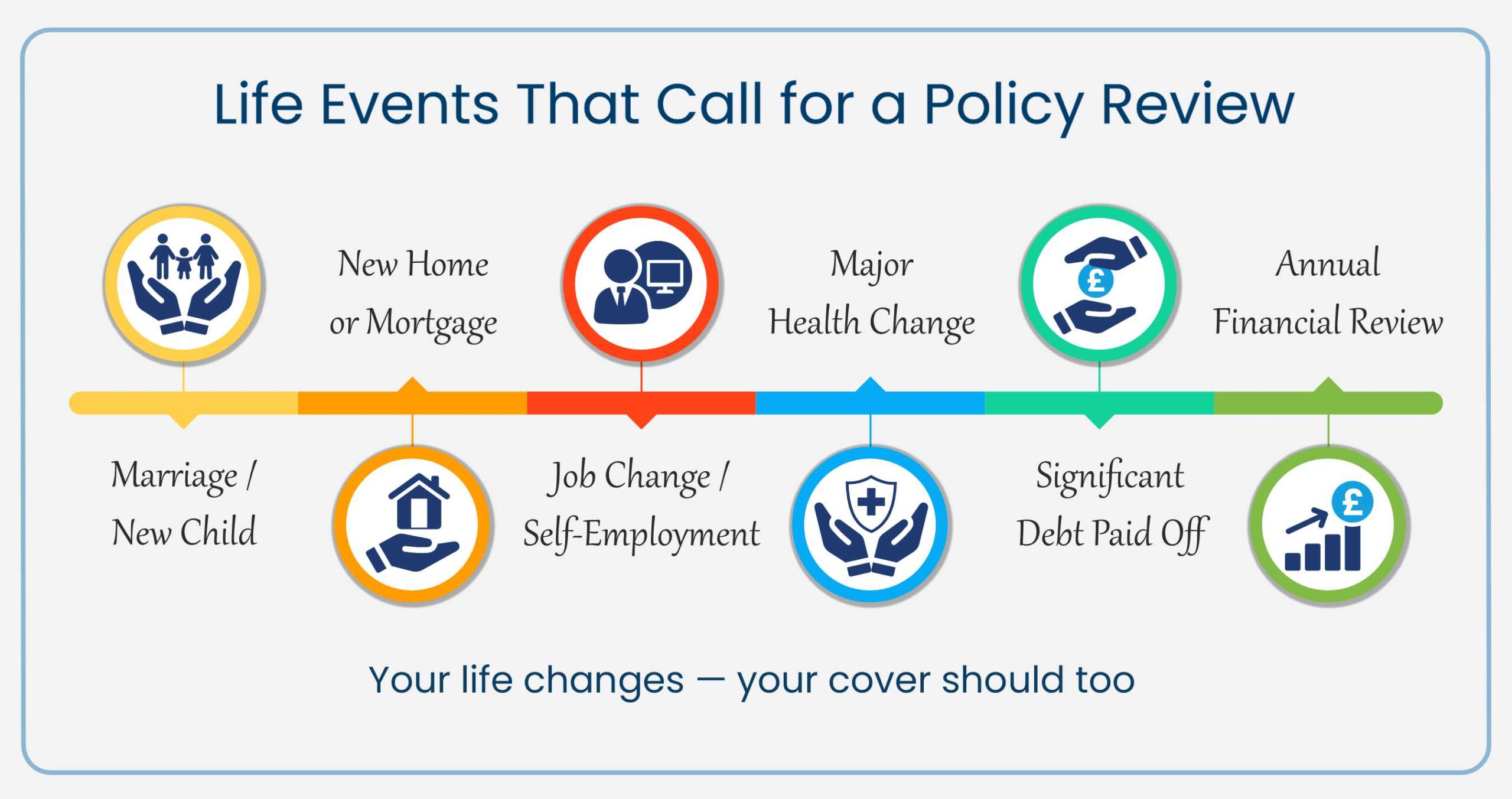
Life Insurance Review - Life Events call for Review
 

Life evolves — so should your insurance.
Events such as marriage, buying a new home, having children, or changes in employment (for instance, moving from employed to self-employed) all affect your protection needs.

A periodic review helps you check whether:

  • The level of cover matches your mortgage balance and family needs.
  • Your term still aligns with your working years.
  • Any employer benefits or other cover overlap with your personal policies.

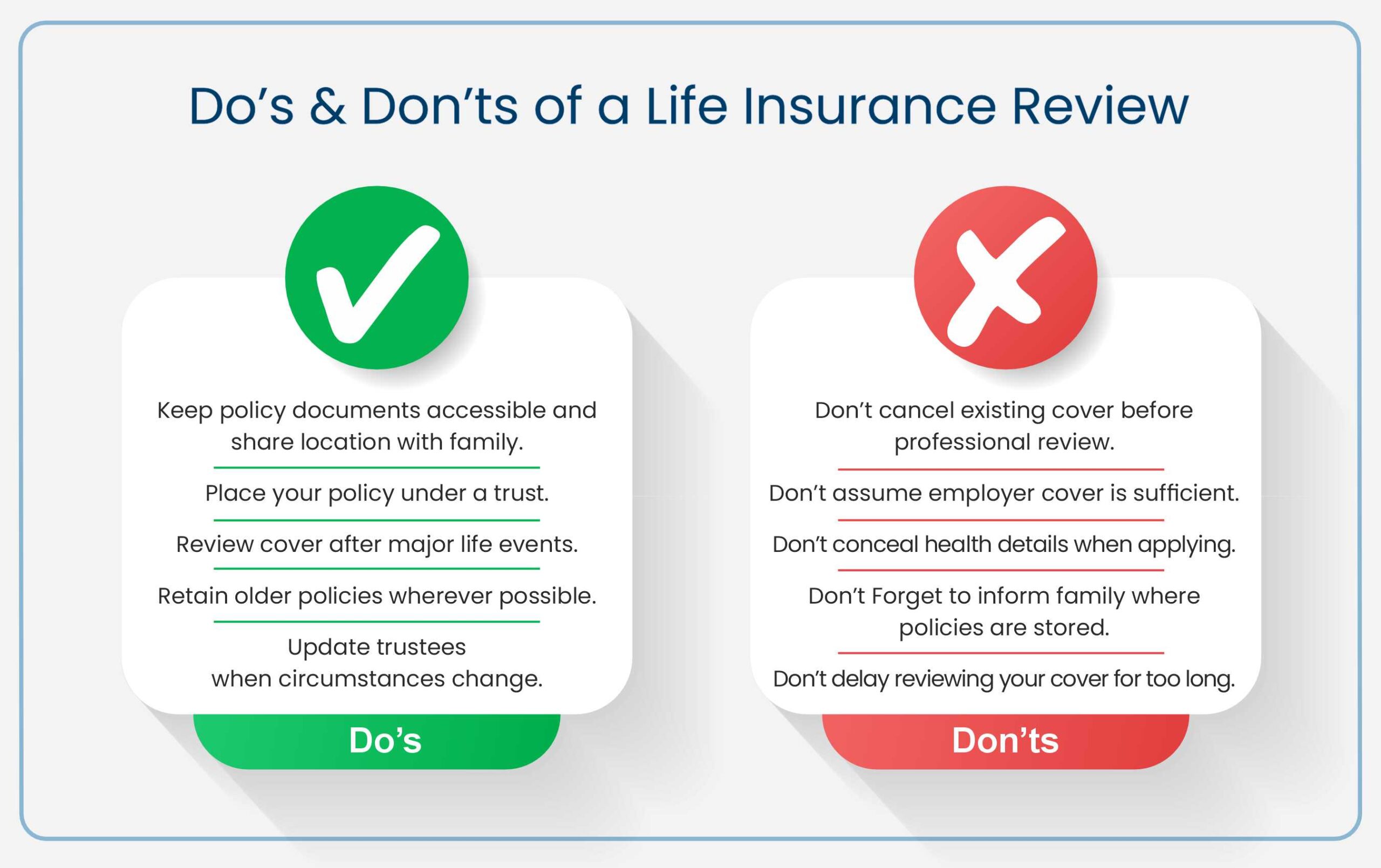
Life Insurance Review - Do's & Dont's


Real life Case Studies

Here are three real-life examples that show how a life insurance review can make a meaningful difference at different stages of life. Each case has a different outcome, but in every situation the review still proved to be the right and sensible step.

Ishan & Sitara

Ishan bought his first property in 2017 for £320,000 with a £250,000 mortgage. At the time, he took out £250,000 of life cover and £100,000 of critical illness cover in his sole name.

When he returned in 2023, he was now married to Sitara and the couple were buying a new family home for £610,000. During our review, we found that Ishan’s historic policies offered excellent terms and very competitive premiums, which would be hard to replicate today.

We therefore kept both existing policies in place, placed his life cover under a trust, and recommended top-up life cover to match his new financial responsibilities. Since Sitara had no protection at all, we also arranged suitable life and critical illness cover for her.

This is a textbook example of why older plans should not be cancelled automatically. With a review, the couple were able to:

  • retain valuable historic cover
  • place the policy under trust
  • top up protection to match their new life stage
  • ensure both partners were fully covered

Felix & Amy

Felix and Amy came to us in 2021 for a remortgage. They had originally purchased their home in 2015 and arranged their life insurance directly with the insurer at the time.

When we asked for their policy documents, they initially struggled to locate them — a common issue that becomes critical during a claim. After some effort, they shared a copy with us and also made sure their family knew where the documents were safely stored.

Following a full review, we concluded that their existing life and critical illness policies were still appropriate for their current circumstances. No top-up cover was needed, but we placed their existing plans under trust and securely stored copies of their documents in their client folder.

Although no new insurance was taken, the review still delivered meaningful benefits:

  • policy documents were located and securely stored
  • the family now knows exactly where to find them
  • the plans were placed under trust for efficient payout
  • reassurance that their existing cover remains fit for purpose

This case shows how valuable a review can be even when no policy changes are required.

Vivan & Rebecca

Vivan and Rebecca approached us around 11 months after their original life insurance was set up at the time of their property purchase. Both were employed when the policies were first taken out.

Within a year, Vivan had moved from employment into a day-rate contracting role through his own limited company. This meant he no longer received the death-in-service benefit he previously enjoyed from his employer.

During the review, we kept Rebecca’s policies unchanged, as her circumstances remained the same. For Vivan, we recommended restructuring his protection by:

  • cancelling his new-but-still-young personal life cover
  • replacing it with a Relevant Life Plan to benefit from significant tax efficiencies
  • increasing the level of life cover to reflect his new responsibilities and lack of workplace benefits

We also reviewed critical illness cover. Although a higher amount would have been sensible, Vivan decided not to increase it for now due to cost considerations.

This case highlights how a review can help align protection with changing employment circumstances — especially when moving to self-employment or contracting.

The Nachu Finance Way
 
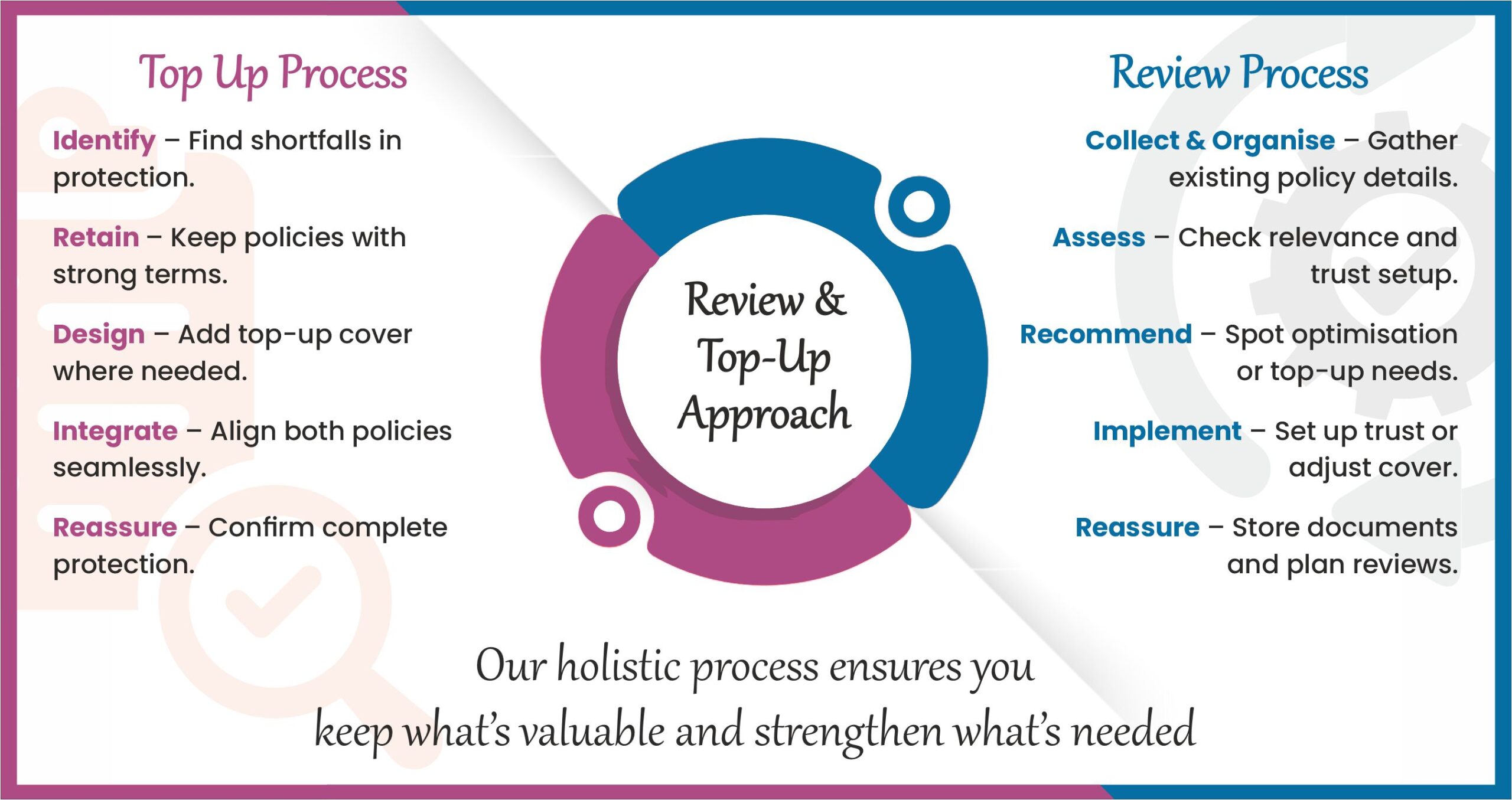
Review & Top-Up Approach
 

At Nachu Finance, we appreciate that older policies can hold immense value.
When we review your existing cover, we:

  • Check if it remains suitable for your current family and financial circumstances.
  • Help optimise it — including setting up or updating the trust.
  • Securely store copies of your policies in your client file, so your family can easily access them in the event of a claim.
  • Review both policies arranged by us and those you arranged elsewhere.

Even if no changes are needed, the reassurance that your policy is still fit for purpose is a valuable outcome in itself.

Frequently Asked Questions

No. The insurer bases its terms on your health and lifestyle at the time of application.
Once the policy is live, there is no obligation to update them about later changes.

Yes. You can replace or add trustees at any time.
We always recommend reviewing the trustees during your periodic insurance review to ensure they are still appropriate and willing to act.

Yes. You can hold multiple policies with different providers.
At application, you must declare any existing cover so the insurer can assess your total cover amount correctly.

Absolutely.
For clients whose policies were arranged through us, claim support is fee-free.
We believe compassionate, expert help at such a crucial time is an essential part of our service.

Yes. Many people keep their older policies because they offer lower premiums and favourable terms, and simply add a top-up policy when their protection needs increase. This is completely normal, and it allows you to retain the benefits of your historic cover while ensuring your overall protection keeps pace with life changes.

Our Transparency Promise

Full Disclosure, Complete Peace of Mind

At Nachu Finance, we insist that all applications are made with full and honest disclosure of health, lifestyle, and smoking status.

We review every detail with you before submission, so the insurer receives accurate information.

We would rather an insurer take extra time to verify your details now than risk a claim being declined later for non-disclosure.
This careful approach protects your family’s peace of mind and ensures that your policy pays out when it matters most.

Let Us Review Your Policy

As holistic advisers, we see life insurance as a core part of family financial planning.
Our transparent, no-pressure approach means we’ll only recommend action when it’s genuinely in your favour.

Reach out to Nachu Finance for a free, transparent review of your existing life insurance.
We’ll give you an honest assessment and, if needed, help you:

  • Place the policy under a trust
  • Adjust or top-up your cover
  • Optimise your family’s protection for today and the years ahead

Why Professional Opinion Matters More Than a Google Search

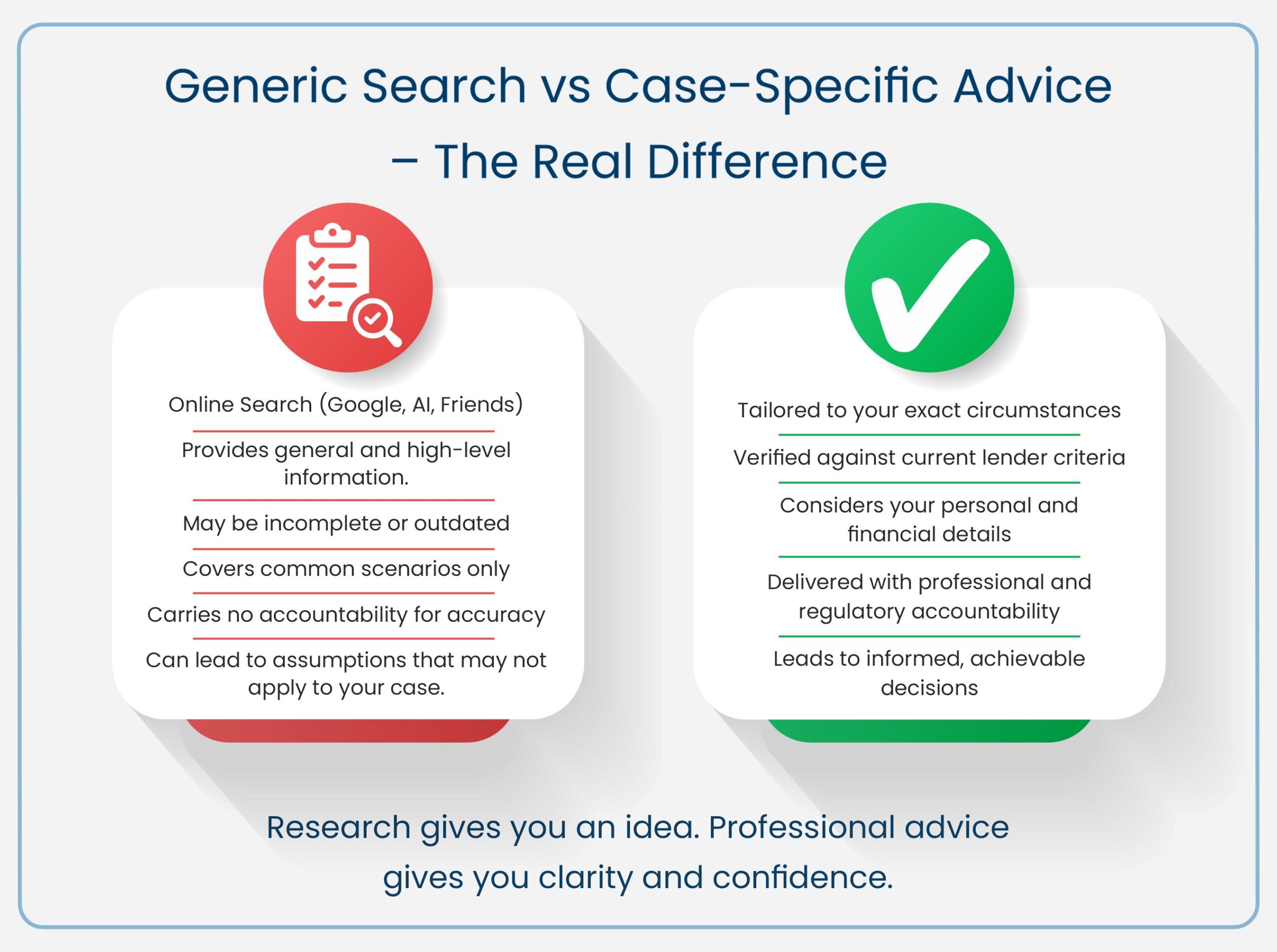
Google Search Vs Expert Opinion
General Search – The Starting Point

It is quite common for clients to begin their research by checking Google, using AI tools, or speaking to friends who have gone through a similar process. These are all good starting points to understand what is generally possible in the mortgage or property market and to familiarise yourself with key terms and concepts.

However, while Google searches, AI responses, and friendly discussions can help build general awareness, they cannot replace case-specific professional advice that takes into account your personal and financial circumstances.

If you are specifically interested in how advice-driven product selection differs from comparison websites, see our related article:

Why Personalised Mortgage Advice Goes Beyond Comparision Website

The Limits of Generic Information

The information found through a Google search or a general discussion with friends is, by nature, generic.
It does not take into account:

  • Your income type or employment structure.
  • The property’s ownership model or intended use.
  • The lender’s current criteria.
  • Your residency or credit profile.

Mortgage lending, taxation, and property law all have layers of detail that differ from one case to another. What works well for one individual may not be suitable or even possible for another.


Consider the use of a gifted deposit.
A quick online search might state that lenders are happy to accept gifted deposits as long as the source of funds is evidenced and supported by a donor declaration.

While this is true in many standard residential purchases, the outcome changes significantly when the purchase:

  • Is made through a limited company,
  • Involves multiple shareholders, or
  • Relates to a non-standard property such as a multi-unit block under a single title.

In such cases, the number of lenders available is very limited. Those who accept gifted deposits often do not accept multi-unit properties, and vice versa. The difference between what appears acceptable online and what is actually possible in your case can therefore be substantial.

Why Professional Advice Holds Greater Weight
Professional opinion is built on understanding not just what the rules say, but how they are applied in practice.
It involves:
  • Interpreting lender and solicitor criteria within the context of your case.
  • Balancing compliance, affordability, and timing.
  • Ensuring that what appears possible in theory is achievable in reality.

A professional adviser also carries regulatory accountability — meaning the guidance you receive must be suitable, compliant, and in your best interests. That level of responsibility does not exist in a Google search, an AI response, or a conversation with friends.

Research Is Useful – Validation Is Essential
Doing your own research is helpful and can make conversations more meaningful. But before proceeding with decisions or forming expectations, it is vital to validate that research with a qualified professional.
 
A generic Google answer or AI response can inform you of what is common, but professional advice ensures that what you are planning is achievable and acceptable for your specific situation.
 
The key takeaway: general searches are a good place to start — professional advice ensures you finish right.

Why Personalised Mortgage Advice Goes Beyond Comparison Websites

Why Personalised Mortgage Advice Goes Beyond Comparison Websites

In today’s digital world, it’s natural to turn to comparison websites to check mortgage rates.
They’re easy to use and give a quick overview of what’s available in the market.
But when it comes to actually getting a mortgage — and making sure it’s suitable, affordable, and achievable — what you see on a comparison site is only half the story.
That’s where the value of personalised advice comes in.

Comparison Websites – A Good Starting Point, But That’s All

Comparison websites are a great starting point for research. They help you understand the general range of rates in the market.
However, what they show are generic products, often filtered only by loan amount, property value, and type of mortgage.

What they don’t take into account are your personal details that actually determine whether you can access that rate, such as:

     ⦁ How you earn your income – employed, self-employed, or on a contract
     ⦁ The stability and type of your income – salary, dividends, day rates, or multiple income sources
     ⦁ Your credit profile and existing commitments
     ⦁ Source of deposit – personal savings, gift, or from overseas
     ⦁ Your residency status or visa type
     ⦁ Type and condition of the property
     ⦁ Whether you are buying in personal name or through a Ltd company

Each of these factors can significantly alter which lenders are willing to offer you a mortgage — and at what rate.

What Personalised Advice Brings to the Table

With personalised advice, the focus shifts from finding a rate to understanding your situation in full.

An adviser takes time to understand your circumstances and objectives before recommending any product

They review the entire market (not just one lender panel or an online list) and select options that are:

     ⦁ Available to you, based on your profile
     ⦁ Suitable for your needs and plans
     ⦁ Compliant with lender and regulatory requirements
     ⦁ Timed correctly, reflecting how long each rate is valid and when you plan to complete

Every rate shared through personalised advice is one that the adviser is confident you are both eligible for and comfortable with — taking into account your affordability, goals, and any foreseeable changes ahead
commitment.

Rates Move Fast – Timing and Monitoring Matter

Mortgage rates in the UK can be volatile and may change even within a single day.
A rate displayed online might already be withdrawn or replaced by the time you apply.
With personalised advice, an adviser will typically:

     ⦁ Track market movements daily
     ⦁ Re-check rates right up to the point of exchange or completion for purchases
     ⦁ Revisit options close to your renewal date in remortgages or product transfers
     ⦁ Recommend switching to a lower rate, if one becomes available before completion and it suits your circumstances

This level of monitoring helps ensure that the mortgage product you proceed with remains competitive and appropriate right up to the point you lock it in.

Accountability and Responsibility in Advice

One of the most important distinctions between taking personalised advice and using a comparison website lies in accountability.

When you rely on online listings, no one takes responsibility for whether the information shown is accurate, up to date, or suitable for your circumstances. The choice — and any resulting outcome — rests entirely with you.

By contrast, when you receive regulated mortgage advice, the adviser takes full responsibility for the recommendation made. This includes assessing your income, commitments, and future plans to ensure the advice is both appropriate and compliant.

Every recommendation is backed by professional due diligence, regulatory oversight, and the adviser’s Professional Indemnity Insurance, which provides an additional layer of protection and reassurance for clients.

This accountability — combined with ongoing rate monitoring and suitability checks — is what truly differentiates advice from comparison.

The Value of Trust and Expertise

Personalised mortgage advice is not about selling a rate; it is about guiding someone towards the right mortgage solution for their circumstances.There is no incentive for an adviser to withhold a cheaper rate if it is truly suitable — the entire purpose of regulated advice is to find the option that best fits the client’s needs.

The advice process goes far beyond comparing numbers. It involves making sure the application is positioned correctly, the product aligns with future plans, and the overall journey remains clear and manageable.

Securing a mortgage is a journey rather than a single-step process, and understanding how the various stages fit together can make the experience far smoother. You can read more about the typical steps in the process The First-Time Buyer’s Mortgage Journey: A Complete, Practical Guide

In Summary

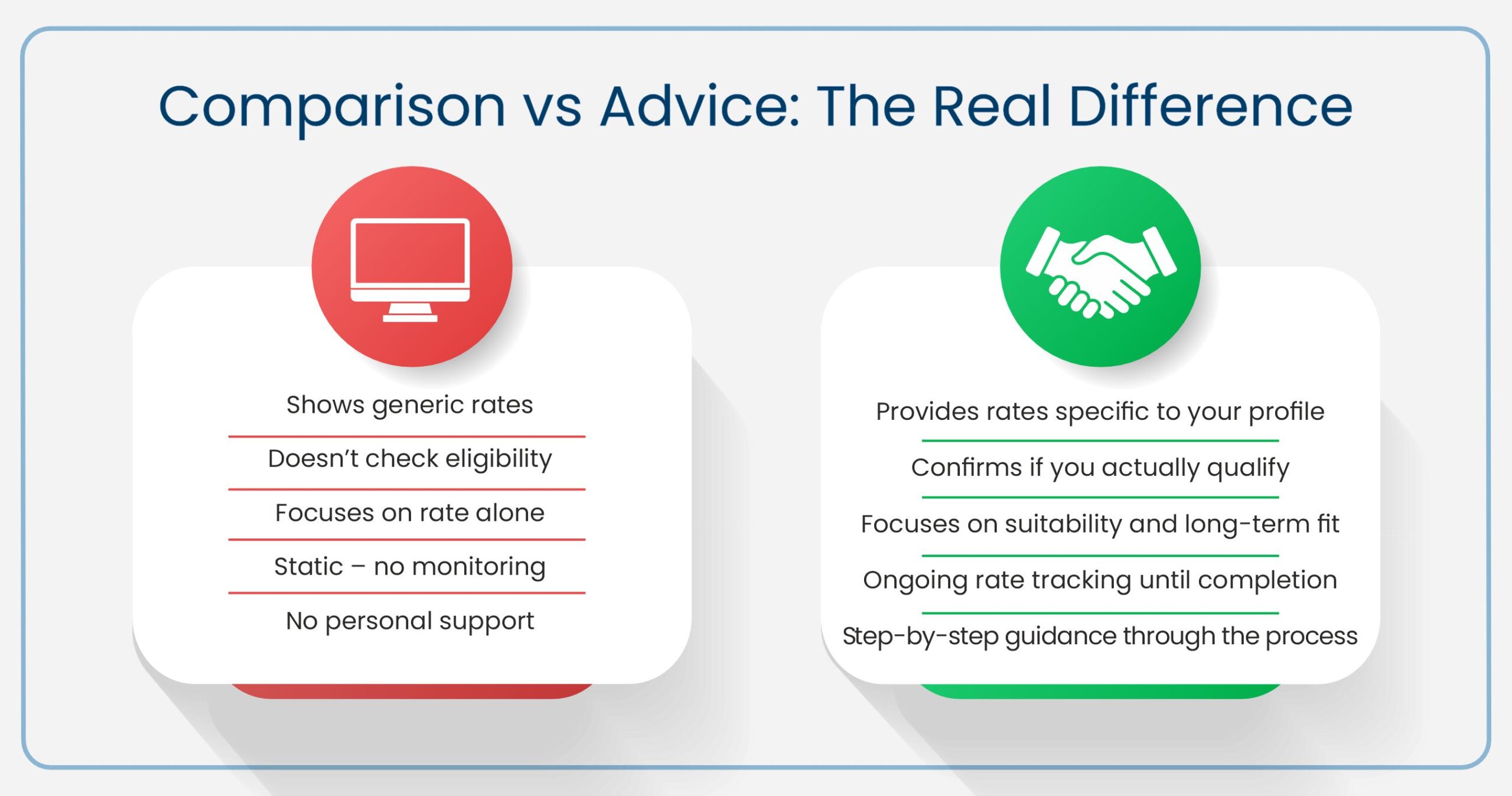
Comparison vs Advice-The Real Difference

While comparison websites provide a quick snapshot of available mortgage rates, they rarely show the full picture. Personal advice goes several steps further — checking eligibility, assessing suitability, and guiding you through the entire process until completion. The difference isn’t just in the rate, but in the reliability and responsibility behind it.

A Balanced Perspective

There’s nothing wrong with browsing comparison websites — they can be a useful way to familiarise yourself with the market and get a sense of the available options.
However, it’s important to remember that what appears online is a general snapshot, not a tailored recommendation.

When you work with an experienced, independent mortgage adviser, the focus is not just on the rate itself but on eligibility, suitability, timing, and long-term implications.The process involves careful assessment, documentation, and monitoring — ensuring that the final mortgage solution genuinely fits your individual circumstances and future plans.

Good decisions rely on clarity and context, not on headline rates alone.