

Transfer of Equity (TofE)is the legal process of changing the ownership of a property by adding or removing names from the title. Unlike a sale and purchase transaction, at least one of the existing owners continues to remain on the title. While the actual legal work is carried out by a solicitor, mortgage advisers like us often get involved—because the names on the mortgage must reflect the updated ownership. This article explores the key aspects of a Transfer of Equity and when it might be relevant.
Overpaying into a Mortgage – Residential or Buy-to-Let?
- 10 May 2025
- Sekkappan Alagu
- Residential Mortgage
- Comments Off on Overpaying into a Mortgage – Residential or Buy-to-Let?

When clients ask about overpaying their buy-to-let mortgage, I often challenge them to consider whether overpaying the residential mortgage might be a better financial move.
If you have both types of mortgages, it’s important to look beyond the surface. While reducing any debt is a positive step, I firmly believe that – in most cases – overpaying the residential mortgage should be prioritised. Here’s why.

Testmonials
Enquiry Form
Get in Touch with Us for Personalized Finance Assistance
First Mortgage Payment: What to Expect and How to Prepare
- Date Published : March 10, 2025
- Date Last Modified : May 8, 2026
Receiving the keys to your first home is one of life’s most rewarding milestones. But in the weeks that follow completion, many new homeowners are caught off guard when they see the amount of their first mortgage payment — it is almost always higher than the monthly figure shown in their mortgage illustration. This is not an error, and it is not your lender charging you extra. It is simply the way mortgage interest works around your completion date. This article explains exactly why your first mortgage payment is higher than expected, walks through a real-life example, and tells you what to do to prepare.

Why Your First Mortgage Payment Is Higher
When you review your mortgage illustration or mortgage offer, you may notice that the first month’s payment is higher than the standard monthly amount. This is not because lenders charge extra in the first month. It is because you may be paying for more than one full month of interest.
Mortgage offers are prepared before completion takes place, so they are based on an assumed start date. Once your mortgage completes, the lender calculates your first payment based on the actual date funds were released — and this often means you are charged interest for the remaining days of your completion month in addition to a full month’s payment for the month that follows.
How the First Payment Is Calculated
Once your mortgage completes, your lender will send you a welcome letter confirming the exact details of your first payment. The calculation works as follows:
- Pro-rated interest for the month of completion — If your mortgage completes part way through the month, you will be charged interest from the day the lender releases the funds until the end of that month.
- Your full mortgage payment for the following month — This is the standard monthly payment that will continue from the second month onward.
Because the calculation is based on your actual completion date, the amount will differ from the figure originally shown in your mortgage offer. However, from the second month onward, your payments will normalise and you will pay for one full calendar month at a time.
It is also worth noting that the date of your first mortgage payment may differ from the direct debit date you originally selected. This too will regularise from the second month onwards.
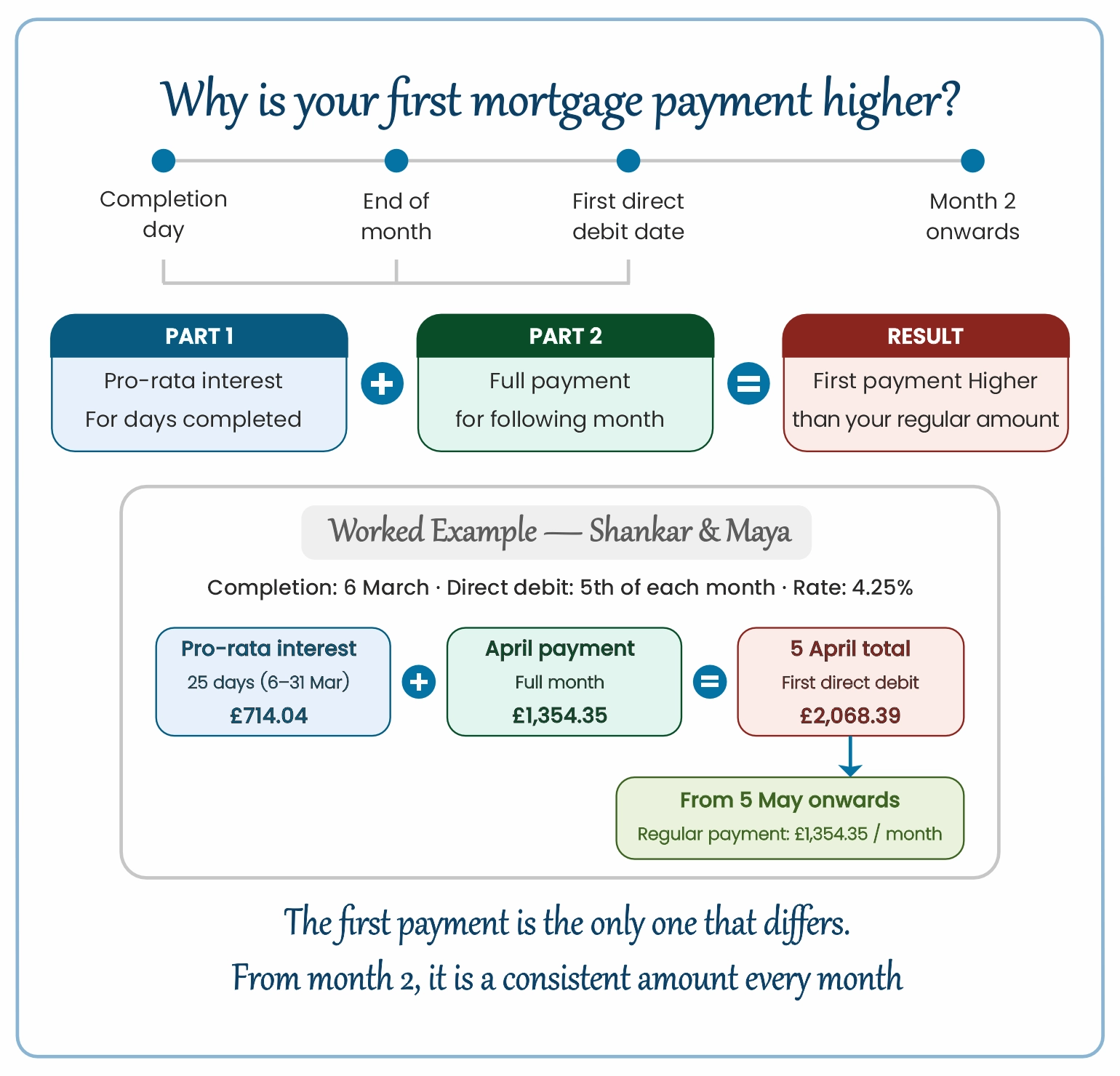
Worked Example — Shankar & Maya
To bring this to life, let’s look at a real scenario.
Shankar & Maya complete the purchase of their first home on Friday, 7th March. Their mortgage lender, Halifax, releases the funds on 6th March.
- Regular monthly payment: £1,354.35 per month
- Interest rate: 4.25% for the initial two-year fixed period
- Preferred direct debit date: 5th of each month
What Happens Next?
On 5th April, Halifax is likely to collect the following:- Interest-only payment for 25 days (6th–31st March) at 4.25% = £714.04
- Full mortgage payment for April = £1,354.35
- Total first payment collected on 5th April = £2,068.39
A Slightly Different Scenario
If Halifax had released the funds on 29th March instead, there would not have been enough time to collect the first direct debit on 5th April. In this case, Halifax would notify Shankar & Maya that their first payment would be collected on 10th April. The first payment would still be slightly higher than usual — but not significantly so. Only two extra days of interest (30th–31st March) would be added, amounting to an additional £57.12 on top of their regular monthly payment.What You Can Do to Prepare
Since each lender has its own procedure for calculating the first mortgage payment, it is difficult to guarantee that it will align exactly with a standard full month’s charge. However, there are clear steps you can take as a soon-to-be homeowner:
- Ensure sufficient funds — Keep extra funds in your designated bank account to cover any variation in the first payment.
- Monitor your payment date and amount — Watch for communication from your lender, which will confirm the exact amount and date of your first direct debit.
- Double-check your direct debit details — At Nachu Finance, we always advise clients to verify their direct debit setup before and after completion to avoid any administrative errors that could cause payment issues.
How Nachu Finance Can Help
At Nachu Finance, we support clients at every stage of the property ownership journey — from securing the right mortgage to planning the long-term management and transfer of property assets. Understanding how your mortgage works from day one is part of the foundation we help you build. If you have questions about mortgage options, protection, or want to explore how estate planning can safeguard your property for future generations, our team is here to help. Get in touch today and we will be delighted to find the right solution for your needs.
Frequently Asked Questions
Mortgage offers are prepared before completion takes place and are based on an assumed start date. The higher figure shown covers pro-rata interest from that assumed date to the end of the month, plus a full month’s payment. Once your mortgage completes on the actual date, your lender will recalculate and confirm the precise first payment amount in your welcome letter.
Your first payment is higher because it covers two things — interest charged from the day your mortgage completes to the end of that month, plus a full month’s payment for the month that follows. From month two onwards your payment returns to the regular amount shown in your mortgage illustration.
Not always. Depending on when your mortgage completes, there may not be enough time for your lender to set up the direct debit for your chosen date. Your lender will notify you of the exact date and amount of your first collection. From the second month onwards your direct debit will run on your selected date as normal.
If your mortgage completes late in the month, the pro-rata interest element will be small — covering only the final few days. However, your lender may not have enough time to collect the first direct debit on your chosen date and may take it a few days later instead. In the example of a 29th March completion with a 5th April direct debit date, only two additional days of interest applied — adding just £57.12 to the regular monthly payment.

About the Author
Sekkappan Alagu is the Founder of Nachu Finance Ltd, established in 2006. With an early career in journalism and publishing, he brings clarity and structured thinking to complex financial topics. Through the Nachu Finance Blog and Knowledge Hub, he shares insights drawn from nearly two decades of client advisory experience, helping readers make informed decisions and understand best practices in mortgages, protection and long-term financial planning.

Business Profile
Nachu Finance Ltd is a directly authorised FCA-regulated firm providing mortgage, insurance and estate planning advice to clients across the UK. The firm takes a holistic approach — considering protection, tax efficiency and long-term planning alongside property finance — maintaining high regulatory standards while keeping advice clear and easy to follow. To learn more about the firm's background and story, visit the About Nachu Finance page.
Best Practices for Every Homeowner



Joint Tenancy vs. Tenants in Common
- 05 Mar 2025
- Sekkappan Alagu
- Residential Mortgage
- Comments Off on Joint Tenancy vs. Tenants in Common

When purchasing a property jointly in personal names, there are two ways to structure ownership: Joint Tenancy or Tenants in Common. The choice between these options plays a significant role in inheritance, estate planning, and financial arrangements. Understanding the key differences ensures you make an informed decision that aligns with your long-term goals.
2025 Mortgage Interest Rates Outlook: What Homebuyers and Landlords Need to Know
- 17 Jan 2025
- Sekkappan Alagu
- Residential Mortgage
- Comments Off on 2025 Mortgage Interest Rates Outlook: What Homebuyers and Landlords Need to Know

As we step into 2025, the mortgage market is brimming with questions. How will interest rates evolve? Will property prices stabilise? And what can homeowners and landlords expect? Let’s explore the key trends and actionable insights for the year ahead.
Why Upfront Rates Don’t Tell the Whole Story
- 02 Dec 2024
- Sekkappan Alagu
- Residential Mortgage
- Comments Off on Why Upfront Rates Don’t Tell the Whole Story

It’s common for clients to ask about the mortgage rates we can secure for them even before sharing their details. While understandable, this approach might not lead to the best outcome for you.
No adviser can responsibly quote rates without assessing your unique circumstances. Advisers who share rates upfront are often using generic figures to win your business, which may not apply to your situation. This can lead to disappointment or unexpected costs later.
Volatile Market: Why Acting on Your Mortgage Now is Crucial
- 22 Nov 2024
- Sekkappan Alagu
- Residential Mortgage
- Comments Off on Volatile Market: Why Acting on Your Mortgage Now is Crucial

The way lenders price the fixed rates they offer for new business is based on SWAP rates, which are driven by market conditions and sentiment. This makes mortgage rates inherently volatile, especially when SWAP rates change drastically.
Volatility in mortgage rates is not uncommon in the UK. While neither clients nor advisers can control the market, understanding what you can do in such a market is key to protecting yourself from rate fluctuations.
Timing is Everything: Why First-Time Buyers Should Make Their Move
- 07 Nov 2024
- Sekkappan Alagu
- Residential Mortgage
- Comments Off on Timing is Everything: Why First-Time Buyers Should Make Their Move

In today’s housing market, recent policy shifts and economic trends are creating unique opportunities for first-time buyers. From increased loan-to-income ratios to reduced investor competition, here are the key reasons why now might be the ideal moment to secure your first home.
BoE Base Rate Decision Dates: Important But Not The Whole Story
- 14 Oct 2024
- Sekkappan Alagu
- Residential Mortgage
- Comments Off on BoE Base Rate Decision Dates: Important But Not The Whole Story

It’s common for clients to ask if they should wait for the next Bank of England’s Monetary Policy Committee (MPC) meeting before deciding on the mortgage rates available to them. The idea behind waiting is understandable, as many assume that the Bank of England’s base rate has a direct and immediate impact on mortgage rates. However, in most cases, the answer is no, and here’s why.
While the Bank of England’s MPC meets approximately every six weeks to review and decide what should happen to the base rate, this does not directly determine the mortgage rates that lenders offer for purchases, remortgages, or product transfers. Let’s explore why this is the case.
Base Rate vs Mortgage Rates
The base rate, set by the Bank of England, is a tool used to control inflation and manage economic stability. It influences the interest rates that banks pay to borrow money, but it’s just one of many factors that affect mortgage rates. Mortgage lenders set their rates based on several other considerations, with SWAP rates being one of the most critical factors.
Understanding SWAP Rates
SWAP rates are essentially contracts that banks and mortgage lenders use to manage the risk of future interest rate changes. When a lender offers a fixed-rate mortgage, they rely on SWAP rates to hedge against future changes in the cost of borrowing. In simple terms, a SWAP rate is a type of contract where two parties agree to exchange interest rate payments, usually switching from a variable rate to a fixed rate.
The important point here is that SWAP rates are not directly tied to the Bank of England’s base rate. Instead, they are influenced by the broader financial markets, which consider future economic expectations. SWAP rates can fluctuate independently of the base rate, driven by factors like market sentiment, inflation forecasts, and global economic conditions.
What Affects SWAP Rates?
Unlike the more predictable base rate, SWAP rates are dynamic and can fluctuate daily. Here are some of the factors that influence SWAP rates:
- Market Sentiment: If investors expect interest rates to rise in the future, SWAP rates may increase even if the current base rate stays the same. This can result in higher fixed-rate mortgages.
- Inflation Forecasts: When inflation expectations rise, so do SWAP rates. Since fixed-rate mortgages are based on long-term borrowing costs, an anticipated rise in inflation will push SWAP rates higher, even if the base rate remains unchanged.
- Global Economic Conditions: Economic events in other countries, such as changes in US Federal Reserve policies or geopolitical developments, can influence SWAP rates in the UK. This adds further volatility that is not directly linked to the Bank of England’s base rate.
What Does This Mean for Homeowners and Buyers?
Because mortgage rates are more closely linked to SWAP rates than the base rate, waiting for the next Bank of England decision is often unnecessary. By the time the MPC makes its announcement, lenders have usually already adjusted their mortgage rates based on broader economic forecasts. In many cases, the impact of the base rate change may be far less significant than expected.
What Action Can You Take?
The best approach is to secure the best available rate now, and if rates decrease before your mortgage completes, you can often switch to a lower rate without penalty. Here’s how it works:
- For Purchases or Remortgages: You can secure a rate and make changes up until one week before completion. This gives you flexibility in case better rates appear after you’ve locked in your deal.
- For Product Transfers: If you’re staying with your current lender and switching to a new product, you have the option to change rates up to two weeks before your fixed-rate mortgage expires.
If you don’t secure a rate now and rates increase, you could miss out on today’s lower rates. Once your application is submitted, most lenders will allow you to benefit from any rate reductions that happen before completion, without penalizing you if rates go up.
Many lenders also allow multiple changes during this period, including switching between products. For example, you could move from a two-year tracker to a five-year fixed-rate mortgage for more stability.
Why This Works in Your Favour?
By securing the rate now, you protect yourself against potential rate increases while retaining the flexibility to benefit from rate reductions or product changes. In short, there’s no downside to locking in a rate today, and it ensures you don’t miss out on more competitive deals later.
If you choose to select a mortgage lender and product yourself, then comparison websites are useful for getting an overview of available mortgage rates on any given day. However, if you select a lender and product based solely on these results and apply for the mortgage directly, the responsibility of tracking rate changes falls entirely on you.
On the other hand, if you engage a mortgage adviser, you gain more than just a snapshot of the market.
Working with a mortgage adviser offers a proactive approach, ongoing market monitoring, and personalised advice—making sure you don’t miss out on better deals or make decisions based solely on the numbers at one point in time. This hands-on support helps ensure that your mortgage choice is optimal for your specific needs and future-proofed against changes in the market.
About the Author
Sekkappan Alagu is the Founder of Nachu Finance Ltd, established in 2006. With an early career in journalism and publishing, he brings clarity and structured thinking to complex financial topics. Through the Nachu Finance Blog and Knowledge Hub, he shares insights drawn from nearly two decades of client advisory experience, helping readers make informed decisions and understand best practices in mortgages, protection and long-term financial planning.
Business Profile
Nachu Finance Ltd is a directly authorised FCA-regulated firm providing mortgage, insurance and estate planning advice to clients across the UK. The firm takes a holistic approach — considering protection, tax efficiency and long-term planning alongside property finance — maintaining high regulatory standards while keeping advice clear and easy to follow. To learn more about the firm's background and story, visit the About Nachu Finance page.
Redeeming Your Help to Buy Equity Loan
- 08 Oct 2024
- Sekkappan Alagu
- Residential Mortgage
- Comments Off on Redeeming Your Help to Buy Equity Loan

Redeeming Your Help to Buy Equity Loan
Help to Buy, while it lasted, was an effective scheme that enabled many homebuyers to get a foot on the property ladder, particularly in securing a new build home. It provided much-needed support by bridging the gap between savings and the actual cost of purchasing a property. However, now that the scheme has effectively closed, it’s time for many homeowners to consider their next steps.
Why Redeeming Your H2B Equity loan is the Smart Move
While the Help to Buy equity loan acted as a good catalyst in helping homebuyers, it’s in the homeowners’ best interest to redeem this loan as soon as possible. Here are four key reasons why:
- Redemption is Based on the Market Value of the Property The repayment of your Help to Buy loan is tied to the current market value of your home, not the original purchase price. If your property has appreciated in value, you could end up paying back significantly more than what you initially borrowed. Redeeming the loan earlier can potentially save you thousands of pounds.
- Restriction to Rent Out the Property Homeowners with a Help to Buy loan are not permitted to let out their property unless the loan is fully repaid. This restriction can pose a problem if you’re considering becoming a landlord or need to temporarily rent out your home due to personal circumstances.
- Restriction to Purchase Another Property The Help to Buy loan must be repaid before you can purchase another property. This can limit your options if you’re looking to move up the property ladder or invest in additional properties.
- Interest is Payable from Year 6 Onwards While the Help to Buy loan is interest-free for the first five years, from year six onwards, interest becomes payable at a rate of 1.75%, which then rises each year in line with inflation. This added cost can quickly mount up, making early repayment a smart financial move.
Is There an Advantage in Delaying the Redemption of Your H2B Equity Loan?
Some homeowners may argue that it’s beneficial to take advantage of the interest-free initial five-year period and delay redeeming the Help to Buy loan. There are even clients who have suggested waiting to see if property prices drop, which could theoretically justify paying interest on the loan after the six-year mark, as the lower property value would result in a reduced redemption amount.
However, this strategy comes with significant risks. As a homeowner, you typically own the majority share of the property, given that Help to Buy equity loans represent 20% of the property value (up to 40% in London). Naturally, you would want your property value to appreciate over time, rather than decrease. Relying on property prices to fall in the future is speculative and could backfire, especially in a generally rising market.
The sooner you can repay the Help to Buy loan, the sooner you’ll own 100% of the property’s equity and enjoy more flexibility without the restrictions imposed by the loan. Redeeming it early helps you avoid the uncertainty of property price fluctuations and eliminates the burden of interest payments after the five-year interest-free period.
How to Repay the Help to Buy Equity Loan
You can repay the Help to Buy equity loan whenever you’re prepared, but there are specific rules about how repayments can be made. Unfortunately, you can’t make overpayments of your choice. Instead, you have two options: you can either redeem the loan in full or in part. For example, if you took a 20% equity loan, you can either repay the entire 20% or make a partial repayment of 10%.
Given the cost and time involved in redeeming the loan, it’s generally advisable to aim for full redemption where possible, as it simplifies the process and removes future financial obligations.
Step 1: Get a RICS Valuation
When you’re ready to redeem the loan, the first step is to get a property valuation from a local valuer with the relevant RICS (Royal Institution of Chartered Surveyors) qualification. You can search for a qualified surveyor near you by visiting the RICS Find a Surveyor website, where you can compare quotes from local professionals.
It’s important to make the valuer aware that the purpose of the valuation is to redeem your Help to Buy loan, as this ensures they understand the specific requirements. Also, remember that the valuation report is only valid for 3 months. Timing the valuation carefully is crucial to avoid the need for an additional valuation, which could add unnecessary costs.
Step 2: Engage a Solicitor
The next step is to engage a solicitor to handle the legal aspects of redeeming your Help to Buy loan. Your solicitor will liaise with the Help to Buy agency to ensure the loan is repaid and the agency’s charge is released from the Land Registry. They will also manage all the compliance requirements involved in the process.
This should be a straightforward process, and your solicitor will guide you through each step, ensuring everything is handled correctly and in a timely manner
Step 3: Complete the Repayment Application Form
Once you have your valuation report and have appointed a solicitor, the next step is to apply to the Help to Buy agency to get your redemption value. This application requires you to submit the valuation report, and there is typically a fee associated with this process.
The agency will calculate the amount you need to repay based on the current market value of your home, as determined by your RICS valuation. Once you receive the redemption figure, your solicitor will proceed with finalizing the repayment.
Funding the Loan Repayment
You have several options to fund the repayment of your Help to Buy loan:
- Using Personal Savings or a Gift from Family If you have sufficient savings or receive a gift from family, you can repay the loan yourself. This option allows you the flexibility to redeem the Help to Buy loan at a time that best suits you without needing to involve any additional borrowing.
- Remortgaging Another option is to remortgage with a new lender and include the funds needed to pay off the Help to Buy loan in the new mortgage.
- Taking a Further Advance from Your Current Lender You may also be able to take a further advance from your existing lender to cover the Help to Buy loan repayment. Timing the redemption and ensuring that the advance is processed efficiently is essential to avoid delays.
- Selling the property. If you’re planning to sell your home, you can use the proceeds from the sale to redeem the Help to Buy equity loan. This can simplify the process, as the solicitor handling the sale can also manage the repayment of the Help to Buy loan using the sale proceeds. Logistically, this tends to be a smoother process, as the loan is redeemed directly during the property transaction, ensuring that everything is settled at once
Differences in Property Valuations for Redemption and Remortgage
Properties usually have a valuation range, and it’s important to note that the redemption of the Help to Buy loan is typically based on the lower end of this range. However, if you’re applying for a remortgage or further advance, the lender may use the higher end of the valuation range. This can result in more attractive mortgage rates, as a higher property valuation improves your loan-to-value ratio, giving you better borrowing options.
Case Study 1 – Fully Funded via Remortgage
A client purchased a home in 2020 for £370,000 with a 5% deposit and a 20% Help to Buy equity loan (£74,000), secured on a 2-year fixed mortgage product.
In 2022, when the fixed term ended, the property’s value had increased to £440,000. As a result, the client’s redemption figure for the Help to Buy loan increased to £82,000. The client did not have personal savings to cover the redemption, so we helped them raise the necessary funds through a remortgage.
The client incurred costs of £450 for the RICS valuation and £1,360 in solicitor fees (including disbursements). Despite these costs, the entire Help to Buy equity loan was successfully redeemed through the remortgage.
While the client had to repay a higher amount than they originally borrowed, they were able to fully redeem the loan and now own the property outright without any of the restrictions associated with the Help to Buy scheme.
Case Study 2 – Different Valuation for Mortgage and Redemption of Loan
Clients who purchased their first home in 2017 using a Help to Buy equity loan decided to redeem the loan in 2023, a year after they began paying interest on the equity loan.
Their mortgage was with Halifax, and in 2023, the indexed valuation used by Halifax stood at £630,000. We were able to use this higher valuation to raise the necessary funds for the mortgage, securing better rates for the client.
At the same time, the RICS valuation for the purpose of redeeming the Help to Buy loan came back at £590,000. The clients paid 20% of this lower valuation to redeem the equity loan, which worked in their favor.
Through this approach, we helped the clients achieve better mortgage rates based on the higher valuation while ensuring that the lower valuation was used to minimize the cost of redeeming the Help to Buy loan.
At Nachu Finance, we are committed to making the Help to Buy loan redemption process as simple and stress-free as possible. Whether you’re an existing client looking to repay your loan using your own savings or with the help of a mortgage, or a new client seeking to raise funds for loan redemption, we’re here to guide you every step of the way.
We can provide you with solicitor quotes from trusted legal firms we closely work with to ensure a smooth legal process. Additionally, we can offer advice on selecting the right local valuers to carry out your RICS valuation, ensuring you have the best professionals on your side.
With our experience and dedication, redeeming your Help to Buy loan is easier and more manageable with Nachu Finance.
About the Author
Sekkappan Alagu is the Founder of Nachu Finance Ltd, established in 2006. With an early career in journalism and publishing, he brings clarity and structured thinking to complex financial topics. Through the Nachu Finance Blog and Knowledge Hub, he shares insights drawn from nearly two decades of client advisory experience, helping readers make informed decisions and understand best practices in mortgages, protection and long-term financial planning.
Business Profile
Nachu Finance Ltd is a directly authorised FCA-regulated firm providing mortgage, insurance and estate planning advice to clients across the UK. The firm takes a holistic approach — considering protection, tax efficiency and long-term planning alongside property finance — maintaining high regulatory standards while keeping advice clear and easy to follow. To learn more about the firm's background and story, visit the About Nachu Finance page.
Moving into your new home – What next & a checklist of good practices.
- 09 Sep 2024
- Sekkappan Alagu
- Residential Mortgage
- Comments Off on Moving into your new home – What next & a checklist of good practices.

Settling into Your New Home
First off, congratulations again on your new home! Wishing you nothing but happiness as you settle into this exciting chapter. I hope your new house becomes a place where all your dreams come true, filled with countless wonderful memories. Moving into a new home can feel like a whirlwind, but it’s also the start of something special. May it bring you everything you’ve hoped for and more.
While you’re getting comfortable, I’d like to remind you of a few next steps and good practices. Apologies if any of it is a repeat of what you already knew but wanted to give you a check list of some sort.
What Next?
Now that the purchase is complete, the Land Registry will update the name of the new owners, which includes your mortgage lender. Your solicitors will handle this process, typically submitting the necessary updates shortly after completion. However, it’s important to note that the Land Registry can take anywhere from 8 weeks to 4 months to process these changes. (Correct as of Sep 2024)
Once the update is completed, your solicitors should send you a copy of the updated Land Registry document. If you don’t hear anything within 4 months, it’s a good idea to reach out to your solicitor to follow up. Alternatively, you can also download the updated document directly from the Land Registry’s website here
Register for Land Registry Property Alerts
The Land Registry offers a useful service that allows you to receive email updates on any applications submitted for your property. It’s a simple process to register, and you can monitor up to 10 properties with one account. This service helps to safeguard your property from fraud and keeps you informed of any changes. You can register for it here.
Setting Up the New Bills
It’s important to set up all your utility bills, including gas, water, electricity, and council tax. I recommend reaching out to the providers as soon as possible to confirm the date you took responsibility for the property and provide any meter readings. As a best practice, try to have this sorted within the first two weeks of moving in to avoid any surprises later on.
Updating Address Everywhere
Ensuring that your address is updated across all important records is key for maintaining a good credit score. Any prospective lender will expect to see that all your address is registered to one address, including banks, credit cards, the electoral roll, your employer, HMRC, insurance providers (which would include your life insurance, health insurance, car insurance, home insurance etc) , and any other financial institutions.
Don’t forget to update your details with the DVLA if you own a car or need to change the address on your driving licence. Failing to notify the DVLA can result in hefty fines, so it’s important to make this a priority. Similarly, your TV license needs to be updated to reflect your new address, as failing to do so can also result in fines.
Postal Redirection
Even with the most thorough effort, it’s hard to avoid some post still going to your old address. This is where the Royal Mail redirection service can be incredibly helpful. I highly recommend using this service to catch any stray mail during your transition. You can easily set it up here
Changing the Lock Barrels
As a best practice, it’s recommended to change the lock barrels on all security doors in a pre-owned home. Since the property was previously owned and used by someone else, there’s always a chance that more keys exist beyond the set you’ve received. By changing the barrels, you ensure that no one else has access to your home. The good news is that you don’t need to change the entire lock; barrels can easily be purchased online or in stores like B&Q, Wickes, and Selco.
Overpayments to Your Mortgage
Most lender will normally allow you to make overpayments on your mortgage without incurring early repayment charges. You can usually overpay up to 10% of the mortgage each year / calendar year. Since your mortgage interest is calculated daily, any overpayment will immediately reduce the interest charged from the next day onward.
Overpayments can be made at your convenience, typically through online or phone banking. Before making your first overpayment, I suggest contacting your lender to fully understand their process. Once you make an overpayment, you’ll normally have the option to either reduce your monthly payments or shorten your mortgage term. If your goal is to pay off the mortgage sooner, you may want to opt for reducing the term. During your call, you can request that this preference applies to both your first and future overpayments.
Contact your lender to understand how their overpayment works.
What to Expect at the End of the Current Mortgage Fixed Rate
Although securing a mortgage is often the most time-consuming part of buying a home, it’s important to revisit your mortgage closer to the end of your fixed term—usually 3 to 6 months before it expires. At that point, we can review your options based on your current circumstances, requirements, and the state of the mortgage market, comparing deals from both your existing lender and potential new ones.
A remortgage is significantly easier than securing a mortgage for a new purchase. If staying with your current lender turns out to be the best option, the process can be quite fast and simple. At Nachu Finance, we don’t charge any fees for a product transfer with the same lender, making the transition even smoother.
Reviewing your options no later than 3 months before your fixed term ends will give you ample time for a thorough evaluation. At Nachu Finance, we aim to send you a reminder email 6 months before your fixed rate ends to ensure you’re prepared.
About the Author
Sekkappan Alagu is the Founder of Nachu Finance Ltd, established in 2006. With an early career in journalism and publishing, he brings clarity and structured thinking to complex financial topics. Through the Nachu Finance Blog and Knowledge Hub, he shares insights drawn from nearly two decades of client advisory experience, helping readers make informed decisions and understand best practices in mortgages, protection and long-term financial planning.
Business Profile
Nachu Finance Ltd is a directly authorised FCA-regulated firm providing mortgage, insurance and estate planning advice to clients across the UK. The firm takes a holistic approach — considering protection, tax efficiency and long-term planning alongside property finance — maintaining high regulatory standards while keeping advice clear and easy to follow. To learn more about the firm's background and story, visit the About Nachu Finance page.