Testmonials
Enquiry Form
Get in Touch with Us for Personalized Finance Assistance
Consent to Let: Getting Your Lender's Permission Before You Rent Out Your Home
- Date Published : November 20, 2026
Most residential mortgages come with a clear condition: you buy the property to live in, and you do not let it out. But life changes. A new job, a family move or a change in circumstances can leave you needing to rent out a home you bought to live in. When that happens, the right step is to ask your current mortgage lender for consent to let, before a tenant moves in. This guide explains what consent to let is, how the process works, what lenders look at, what it can cost, what happens if the lender says no, what to do once consent is granted, and what happens when the consent or your initial mortgage period comes to an end.

What Is Consent to Let?
Consent to let is your mortgage lender’s formal permission to rent out a property that was bought on a residential mortgage. You may also see it called permission to let or consent to lease. The name varies between lenders, but the idea is the same.
A residential mortgage contract does not allow you to let the property out. Consent to let is you officially asking the lender to agree to something the contract currently prohibits. If the lender agrees, the mortgage generally stays the same residential mortgage. It does not turn into a buy to let mortgage. The lender simply allows you to let the property under agreed conditions.
Why Your Lender's Permission Matters
A residential mortgage is assessed, priced and approved on the basis that you will live in the property. Letting it out changes that basis, which is why the lender needs to know and agree.
Letting the property without consent is a breach of your mortgage terms. If the lender finds out, they can ask for the entire mortgage to be repaid. For that reason, consent should always be agreed before the property is rented out, not afterwards.
How to Get Consent to Let
The process is between you and your current lender. In most cases it follows these steps:
- Decide you need to let. As soon as you know your circumstances are changing, start the process. Do not wait until a tenant is lined up.
- Contact your lender. Many lenders have a section on their website explaining what to do if you need permission to let. Read it first, then speak to the relevant team to put your situation into perspective.
- Explain your reason. Lenders usually want to understand why you now need to let the property.
- Complete the application. Many lenders ask you to fill in a short form with the relevant details.
- Wait for the lender’s decision. The lender assesses your request and, if they agree, gives you their consent. Make sure you receive an official consent to let agreement.
- Let only once consent is in place. The agreement, not a conversation or a verbal assurance, is what protects you.
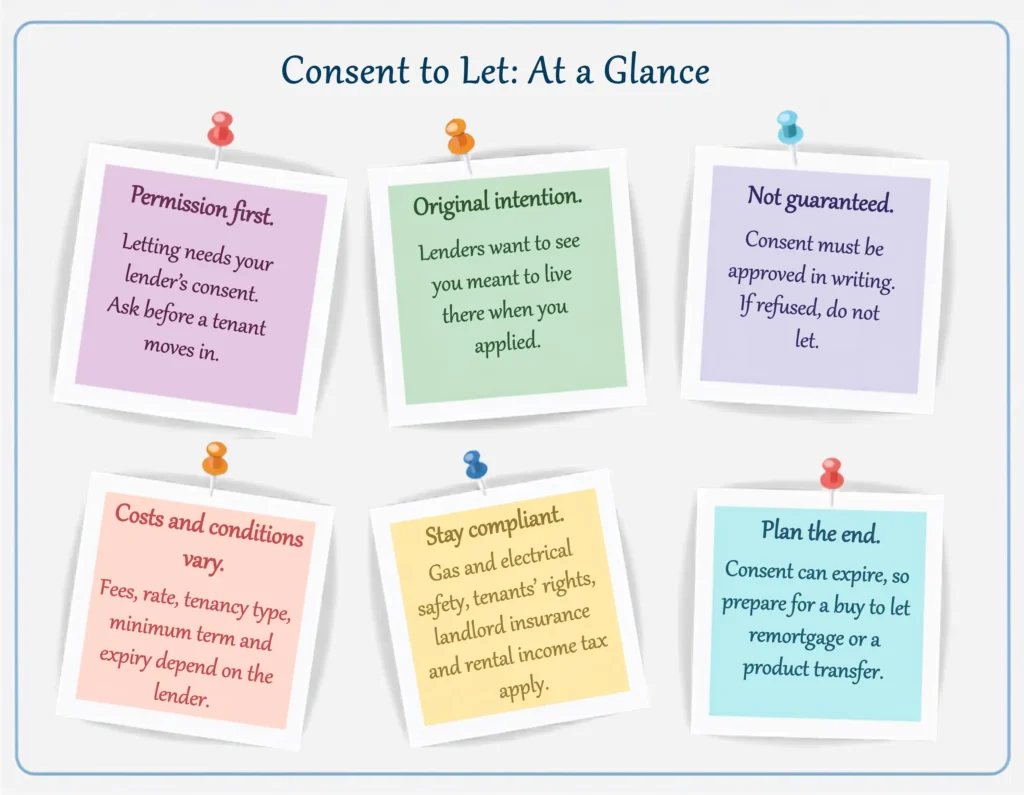
Consent to let is available in most scenarios, but it is never guaranteed or to be assumed. It must be properly approved.
How Lenders Assess a Consent to Let Request
Each request is assessed on its own merits. The central question for the lender is simple: when you took out the mortgage, did you genuinely intend to live in the property? They want reasonable comfort that your circumstances changed after you bought, rather than that letting was the plan all along.
There is no fixed rule on how long you must have held the mortgage before you can apply. What matters is whether the lender is convinced that your original intention was genuine. Clear explanations and evidence of what changed, such as a work-related relocation that happened after you bought, help the lender reach that conclusion.
Scheme Abuse: Why Lenders Are So Careful
Lenders and regulators are very strict about what is known as scheme abuse. It helps to understand why.
- A residential mortgage is designed for people who use their earned income to buy a home to live in. It can be available with a lower deposit and a higher loan to value, and the earned income must show the mortgage is affordable.
- A buy to let mortgage is designed for people investing in property. It needs a higher deposit, and the rental income, including the potential rent on the property being bought, can help support the mortgage and its affordability.
Each scheme has its own advantages. A residential mortgage allows a smaller deposit. A buy to let can allow someone with a lower income to borrow more by using the rental income. Scheme abuse is when someone uses the wrong scheme for their own benefit, for example taking a residential mortgage when the real plan is to let the property out.
For consent to let, this means the lender wants to be satisfied that there was no scheme abuse at the point you applied. Be open and accurate when you explain your circumstances.
When Consent Can Be Harder to Get
Consent can be more challenging in situations such as:
- The lender doubts your original intention. If it looks as though the plan was always to let the property rather than live in it, the lender may be reluctant.
- The deposit was low and the loan to value is high. Lenders may look more closely at your intention to live in the property when there is less equity behind the loan, because they want to establish all the more carefully that you originally intended to live there.
In both cases, a clear account of your circumstances when you applied, and of what has changed since, matters.
What If the Lender Says No?
A lender can refuse consent to let. If they do, you must not go ahead and let the property. Letting without consent is a breach of your mortgage contract, and a refusal does not change that.
Instead, look at the alternatives:
- Convert to a buy to let mortgage. This may be possible if there is enough equity in the property. Check whether an early repayment charge would apply if you leave your current mortgage.
- Sell the property. If letting is no longer realistic, selling may be the right route.
- Review the other options available. Depending on your circumstances, there may be other solutions that do not involve letting without consent.
What Consent to Let Can Mean for Your Mortgage
The impact differs from lender to lender, and the exact answer is only known by asking yours. Broadly, you may see:
- No change at all. Some lenders simply grant consent without altering your rate or monthly payment.
- A one-off fee. Some lenders charge to process the consent, often around £100 to £200.
- An annual fee. Some lenders charge each year to keep the consent in place.
- A higher interest rate. Some lenders increase the rate, often by around 0.5% to 1%.
This is very lender specific. Some lenders charge nothing, while others increase the interest rate, so check the full cost before you commit to letting.
How Long Does Consent to Let Last?
This also varies by lender and by circumstance. Common arrangements include:
- One year at a time. Consent is given for a year and you must renew it each year.
- A set period that cannot be renewed. When it expires, you need to make alternative arrangements.
- Until your initial term ends. Consent runs until your current fixed or initial rate period expires. At that point you can remortgage onto a buy to let, or move back into the property.
Ask your lender at the start how long consent lasts and what happens when it ends.
Consent to Let vs Buy to Let
Consent to let and a buy to let mortgage are different routes to the same outcome of letting a property.
| Consent to let | Buy to let mortgage | |
|---|---|---|
| Mortgage | Your existing residential mortgage, with permission to let added | A new mortgage designed for letting |
| Affordability | Based on earned income when the mortgage was taken | Based on the rental income, within the lender’s rules |
| Deposit or equity | The original arrangement stays in place, which may be a higher loan to value | A higher deposit or equity is needed; loan to value is commonly capped around 75% |
| Terms | Normally unchanged, though some lenders add a fee or a higher rate | Set by the buy to let product |
Moving from a residential mortgage to a buy to let can be possible at the right time, but it needs higher equity, and the rental income must justify the borrowing.
Get Consent First, Before You Rent Out the Property
If there is one point to take from this guide, it is the order of events. Agree consent to let with your lender first, then rent out the property. Do not advertise the property, sign a tenancy agreement or let a tenant move in until you have the lender’s permission in writing.
Read the Consent Carefully Once You Have It
Consent is often granted with conditions attached. These can cover the type of tenancy, who can be the tenants and the minimum term. When your consent arrives, review it carefully and make sure you can keep to everything in it:
- Check each condition and adhere to it.
- Note the expiry date, and whether the consent needs to be renewed.
- Keep the written consent safe.
Letting outside the terms of the consent could leave you in breach of it.
After Consent: Stay Compliant as a Landlord
Your lender’s consent deals with your mortgage only. The rules that come with becoming a landlord apply to you whether you have a buy to let mortgage, a consent to let mortgage or no mortgage at all, so the letting must be done in a compliant way.
- Letting rules. Make sure you meet the landlord requirements, including gas safety and electrical safety, and that your tenants’ rights are protected. To understand more about the Renters’ Rights Act and what it means for landlords, refer to How Landlords Can Cope with the Renters’ Rights Act.
- Landlord insurance. Home insurance (buildings and contents) set up for an owner occupied home needs to be converted to landlord insurance. Make sure you have the right cover in place before the tenancy starts.
- Tax on rental income. Rental income is subject to income tax and must be declared to HMRC. You may want to speak to a tax specialist to make sure this is done correctly.
Tax and legal matters are specialist areas. We recommend taking tax adviser and solicitor advice first; see why specialist advice matters.
Planning What Comes Next?
We cannot apply for consent to let for you with your current lender, as it has to be obtained directly. But you may need to think about what happens when the consent expires or your initial period ends and it is time to remortgage or arrange a product transfer. If you would like to understand your options, including how a buy to let remortgage would work, feel free to reach out to us and we will be happy to help.
Frequently Asked Questions About Consent to Let
Only with your lender’s permission. A residential mortgage does not allow you to let the property, so you need to ask your lender for consent to let first.
No. Many lenders will grant it in many circumstances, but it cannot be guaranteed and should never be assumed. Go through the lender’s process, make sure they are satisfied with your circumstances, and obtain an official consent to let agreement.
You must not let the property, as that would be a breach of your mortgage contract. Look at the alternatives instead: converting to a buy to let mortgage if there is enough equity (checking for any early repayment charge), selling the property, or other options that fit your circumstances.
Yes. Under the terms of a residential mortgage you cannot let the property without your lender’s consent. Letting without prior consent is a breach of contract, which should be avoided.
Letting without consent is a breach of your mortgage contract. If the lender discovers it, they may ask for the entire mortgage to be repaid. If you have let the property without meaning to breach the terms, contact your lender as a matter of urgency and ask for consent, even though the property is already let. This gives you the chance to put right what was done. Whether the lender agrees is up to them.
It depends on the lender. Some charge nothing, some charge a one-off fee, often around £100 to £200, some charge an annual fee, and some increase the interest rate, often by around 0.5% to 1%.
There is no hard and fast rule. The lender reviews each case on its merits. What matters is whether they are convinced that you genuinely intended to live in the property when you applied, and that your circumstances changed afterwards. It is not about how long the mortgage has been live.
Take a five year fixed rate as an example. If you have been letting under consent to let for part of that term, the ideal position at the end is usually to remortgage to a buy to let, if you do not plan to move back in. Some lenders still allow consent to let to continue and will offer product transfer options, so you may not need to move lender. The lender will bear in mind that the property is no longer owner occupied. Many lenders do not offer a product transfer where consent to let is in place, so prepare early and be ready to remortgage to a buy to let with a new lender. In both cases, equity and rental income need to be considered.
Not as part of consent to let. Residential mortgages are generally repayment mortgages, while interest only is more common with buy to let. Consent to let does not change the terms of your mortgage. Switching to interest only is a separate request to your lender. Some lenders allow it, many do not, and it may be harder to obtain than consent to let itself, so check with your lender.
No. Consent to let is not a new mortgage. It is a matter between you and your current lender, and the permission has to come directly from them. Advisers cannot submit the application on your behalf. We can explain the general process and what to think about, but the consent itself has to be obtained by you from the lender.
No. Consent to let keeps your residential mortgage and adds the lender’s permission to let. A buy to let mortgage is a different product, assessed on rental income and normally needing a higher deposit or equity.
Read the consent carefully and keep to its conditions, which can cover the type of tenancy, who the tenants can be and the minimum term. Note the expiry date and whether it needs renewing. Then meet your landlord obligations: gas and electrical safety, tenants’ rights under the Renters’ Rights Act, landlord insurance in place of your owner occupied home insurance, and declaring the rental income to HMRC. These apply whatever type of mortgage you have.

About the Author
Sekkappan Alagu is the Founder of Nachu Finance Ltd, established in 2006. With an early career in journalism and publishing, he brings clarity and structured thinking to complex financial topics. Through the Nachu Finance Blog and Knowledge Hub, he shares insights drawn from nearly two decades of client advisory experience, helping readers make informed decisions and understand best practices in mortgages, protection and long-term financial planning.

Business Profile
Nachu Finance Ltd is a directly authorised FCA-regulated firm providing mortgage, insurance and estate planning advice to clients across the UK. The firm takes a holistic approach — considering protection, tax efficiency and long-term planning alongside property finance — maintaining high regulatory standards while keeping advice clear and easy to follow. To learn more about the firm's background and story, visit the About Nachu Finance page.
Understanding Your Mortgage, Rental and Landlord Responsibilities