
Testmonials
Enquiry Form
Get in Touch with Us for Personalized Finance Assistance
Can I Buy the Property I Rent from My Landlord?
- Date Published : November 27, 2026
Why it can make sense for tenants to buy, and for landlords to consider selling to the person already living in the property.
With the Renters’ Rights Act making life harder for landlords, more of them are asking whether it is time to consolidate. More compliance, more paperwork and more responsibility are pushing some to sell one or more properties. At the same time, many tenants who want to step onto the property ladder are looking for a home they already know.
These two situations can meet. In a small number of cases we have come across, the tenant buys the property from the landlord, and the sale works well for both sides. It will not suit every landlord or every tenant, but it is worth a conversation.

If you are a tenant: am I able to buy my rented property from my landlord?
Yes, if your landlord is willing to sell and the numbers work, you can buy it with a mortgage like any other purchase. Not every rented property is one you would want to own, so start by asking yourself whether this is a home you would be happy to buy. If it is, there are real advantages:
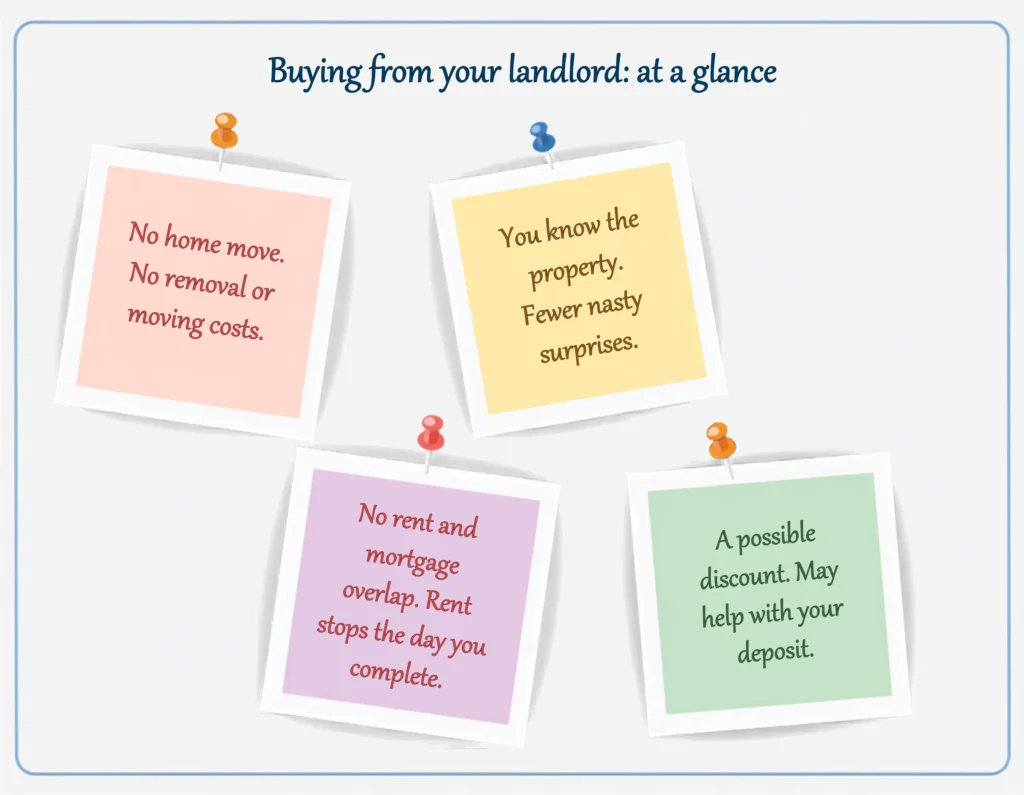
- No home move. You are already living there, so there are no removal or moving costs.
- No nasty surprises. You have lived in the property and know its condition, its neighbours and its quirks.
- No overlap of rent and mortgage. You pay rent until the day you complete. From that day the rent stops and your mortgage begins.
- A possible discount. A landlord who values a quick, reliable sale may agree a reduction, which can help with your deposit (more on this below).
If you are thinking of buying, it costs nothing to ask your landlord whether they have any plans to sell, and to let them know you would be interested if they ever do.
If you are a landlord: why consider selling to your tenant?
If you are thinking about reducing the number of properties you hold, your tenant is one of the first people worth asking. The advantages include:
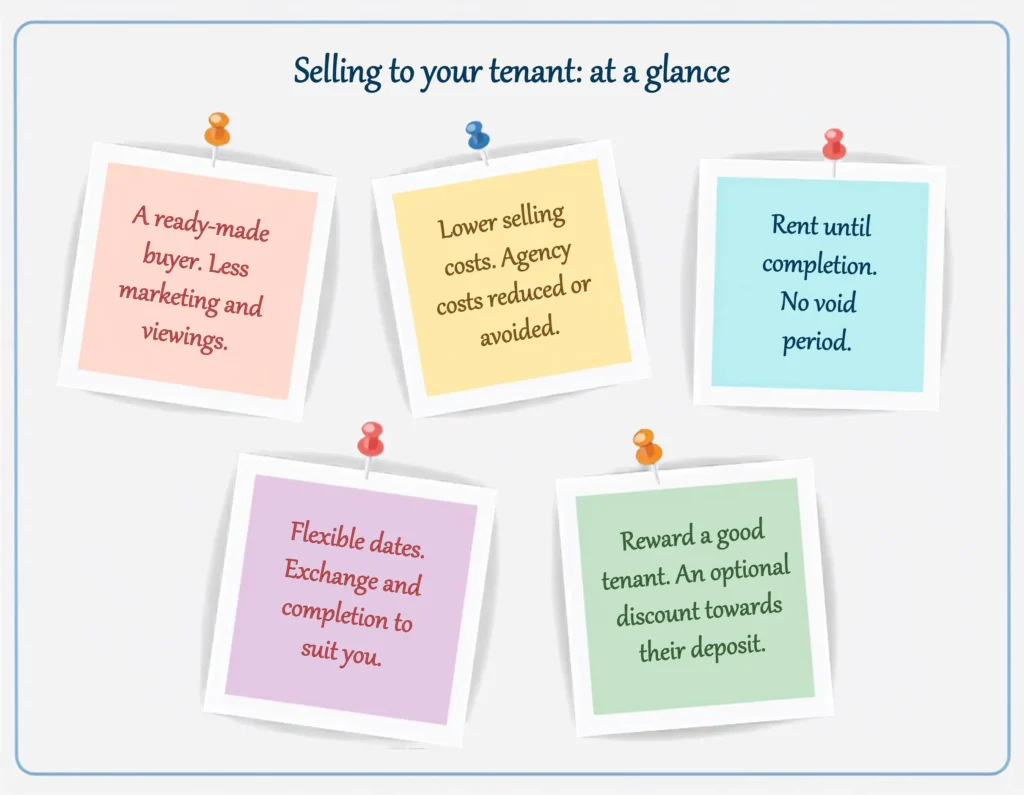
- A ready-made buyer. The cost and effort of marketing the property, arranging viewings and handling an estate agent can be reduced or avoided.
- Rent until the day of completion. There is no void period while the property is prepared and marketed.
- A smoother transition. The buyer already knows the property and is less likely to pull out over what a survey finds.
- Flexible dates. Exchange and completion can be timed around your own plans, such as an early repayment charge on your mortgage.
- Reward for a good tenant. With a long-standing tenant, you may choose to agree a modest discount that supports their deposit.
To be clear, as advisers we generally encourage landlords to build their portfolios, and we have done so for years. But if you are considering selling or consolidating, this is an option to check before going to market.
What lenders think
Some lenders increasingly recognise this kind of purchase. A few will accept a genuine discount agreed by the landlord as a contribution towards the buyer’s deposit. The property is valued at its full market price, and the discount is treated as part of the deposit.
Lender policies differ, and it is the lender’s own criteria that decide whether this is accepted. This is something we check at the start, before anything is agreed.
Two cases we have seen
These are real cases with names changed. Both worked well, for different reasons.
Arjun works as a chef and Meera (names changed) as an administrator in an office, with a combined income of around £53,000. They had rented the property from their landlord since 2022. When the landlord decided to sell, they agreed to buy it.
The landlord wanted full market value, so the agreed price was £215,000 with no discount. The mortgage offer was issued in December 2025 and contracts were exchanged in January 2026. Completion was set for March 2026, which suited the landlord’s own plans.
The landlord received rent right up to completion, with no gap in income. Arjun and Meera had no move to organise. Once contracts were exchanged, they could order furniture and plan small improvements, confident the property would be theirs within weeks.
Vikram (name changed), a lawyer earning about £75,000 a year and the son of one of our long-standing clients, had rented his property for five years. He decided to buy and asked his landlord whether they would consider selling. They were already thinking about it.
The true market value was £250,000. The landlord agreed to sell to Vikram at a 10% discount, so the agreed price was £225,000, a reduction of £25,000. When we submitted the mortgage application, the valuation came back at £250,000 against the agreed price of £225,000. The lender was able to treat the £25,000 discount as a contribution towards Vikram’s deposit. Together with his own 5% deposit, this took his total deposit to 15%, so he borrowed at 85% loan to value and qualified for better rates.
The sale was smooth and reliable. The landlord had a committed buyer, and Vikram bought a home he knew well on better rates than his own 5% deposit alone would have given him.
Before you sell
Selling a rental property can have tax consequences for the landlord, and the sale itself involves legal steps for both sides. Please take advice from a tax adviser and a solicitor first.Please refer the articles
Why specialist advice matters for property tax
A word on whether this will work for you
We are not suggesting this works for every landlord or every tenant. Cases like these are few, but where they exist, the advantages for both sides are real. When it is handled properly, it can be a genuine win-win. At the very least, it is worth asking the question.
If you are a landlord looking to consolidate your portfolio or manage your mortgages better, or a first-time buyer looking to buy, we are happy to advise.
Frequently Asked Questions
In some cases, yes. The discount needs to be genuine, with the property valued at the full price including the discount. Some lenders will then treat it as part of your deposit. Not all lenders do, so this needs to be checked before you agree terms.
It is usually seamless. You pay rent up to the day you complete. From that day the rent stops and your mortgage begins, so you avoid paying both at the same time, and you avoid moving costs.

About the Author
Sekkappan Alagu is the Founder of Nachu Finance Ltd, established in 2006. With an early career in journalism and publishing, he brings clarity and structured thinking to complex financial topics. Through the Nachu Finance Blog and Knowledge Hub, he shares insights drawn from nearly two decades of client advisory experience, helping readers make informed decisions and understand best practices in mortgages, protection and long-term financial planning.

Business Profile
Nachu Finance Ltd is a directly authorised FCA-regulated firm providing mortgage, insurance and estate planning advice to clients across the UK. The firm takes a holistic approach — considering protection, tax efficiency and long-term planning alongside property finance — maintaining high regulatory standards while keeping advice clear and easy to follow. To learn more about the firm's background and story, visit the About Nachu Finance page.
If you are thinking of buying


If you are thinking of selling