Testmonials
Enquiry Form
Get in Touch with Us for Personalized Finance Assistance
Swap Rates Explained: What They Are and How They Influence Your Fixed Rate
- Date Published : October 15, 2026

When you take out a fixed-rate mortgage, one figure matters more than most people realise: the swap rate. The Bank of England base rate is far better known, but swap rates, which are rarely talked about, have a big impact on the fixed rate you are offered.
This article takes a closer look at swap rates: what they are, how lenders use them to price fixed rates, how they move with the wider economy, and what you can do about it.
What is a swap rate?
A swap rate is the price at which banks can lock in their borrowing costs for a fixed period. Lenders fund mortgages from sources whose cost moves over time. When they offer you a rate that is fixed for two or five years, they need certainty on their own costs for the same period. They get it through a “swap”, a contract with another institution that exchanges a variable cost for a fixed one.
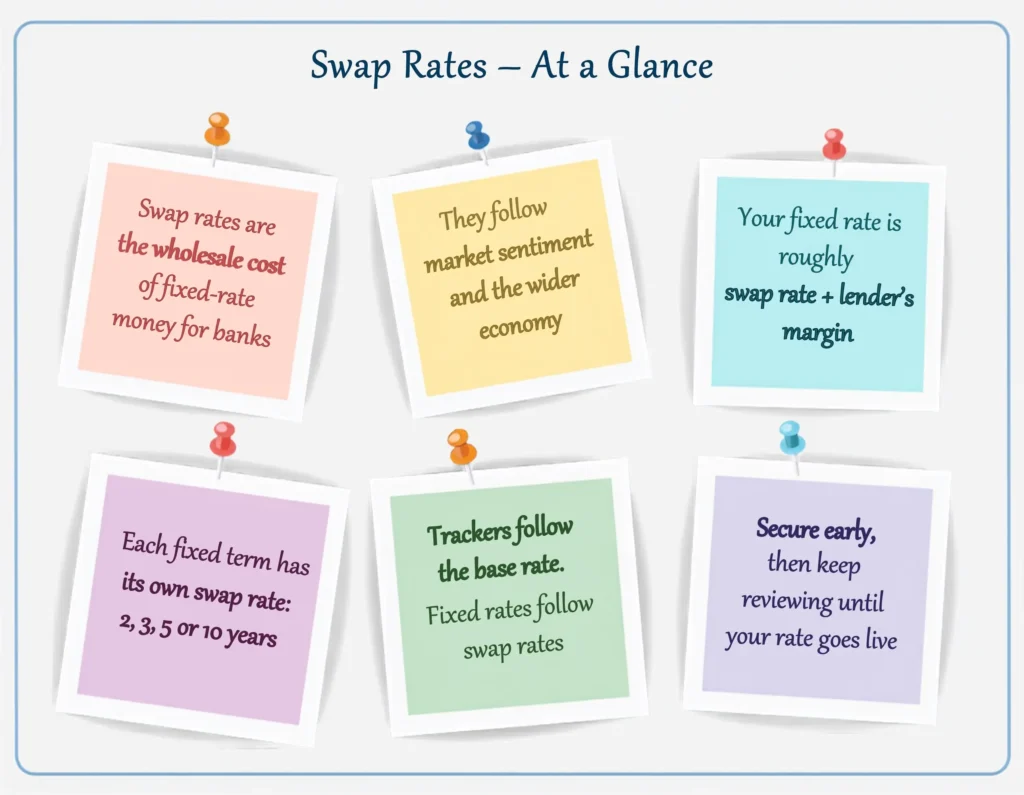
The fixed rate on that contract is the swap rate. In effect, it is the wholesale cost price of fixed-rate money for the bank.
There is a swap rate for each term: one year, two years, three years, five years, ten years and so on. A two-year fixed mortgage is priced off the two-year swap rate, a five-year fixed off the five-year swap rate.
How lenders turn a swap rate into your mortgage rate
Lenders start with the swap rate for the term and then add their own costs and margin. The rate you see on a product is broadly
Swap rate + lender’s margin = fixed mortgage rate
The first step is the swap rate, which is driven by the market. The lender then adds its own margin. That margin is a complex decision in itself: each lender sets it based on the risk of the individual proposition, the type of mortgage, the loan-to-value, the level of competition and other factors. It is beyond the scope of this article. It is also why two lenders can price the same product differently on the same day.
A simple illustration. The 1.25% margin below is purely an example, as margins vary by lender and by mortgage. The figures are for explanation only, not current market rates:
- Five-year swap rate: 3.50%
- Lender’s margin: 1.25%
- Resulting five-year fixed rate: 4.75%
If the five-year swap rate rises by 0.30%, lenders will typically raise their five-year fixed rates by a similar amount, often within days. If swap rates fall, rates tend to follow down, though lenders may reprice more slowly on the way down than on the way up.
Swap rates are not a household statistic. They are published in only a few places, mainly used by banks and the wider financial industry, which is why most borrowers never see them.
Swap rates vs the Bank of England base rate
The two are often mixed up, but they work very differently.
| Bank of England base rate | Swap rate | |
|---|---|---|
| Who sets it | The Bank of England’s Monetary Policy Committee | The financial markets, through trading |
| What it reflects | The Bank’s decision on today’s policy rate | What the market expects rates, inflation and the economy to do over the coming years |
| How often it changes | At scheduled meetings, roughly every six weeks | Daily, sometimes within the day |
| Mortgages it affects most | Tracker mortgages, and to a degree discount and standard variable rate products | Fixed-rate mortgages |
| How visible it is | Widely reported | Rarely published outside the industry |
If you are on a tracker, your rate moves with the base rate, so base rate decisions matter to you directly. If you are on a discount or standard variable rate, your lender sets the rate, but base rate moves often influence it. For a fixed rate, the base rate matters indirectly, because market expectations of future base rate moves are already built into swap rates.
That last point is why a base rate announcement often changes little. By the decision date, the market has usually priced in what is expected, and lenders have already adjusted their fixed rates. Our article on why the base rate decision date is not as important as it seems covers this from the borrower’s side.
What moves swap rates, and why they are hard to predict
Swap rates reflect the market’s collective view of where the economy is heading. The main influences are:
- Interest rate expectations: if investors expect the base rate to stay higher for longer, swap rates rise, even if the base rate itself has not changed.
- Inflation outlook: higher expected inflation generally pushes swap rates up.
- Economic data and sentiment: growth, employment and government finances all shift expectations.
- Global events: decisions by other central banks and international developments can move UK swap rates.
No single institution, or group of institutions, controls this. Swap rates behave much like the stock market, moving with the market’s view, which can change quickly. That is why even professionals cannot reliably predict where they will go next, and why trying to time a mortgage decision around them is a gamble.
How swap rates move with the wider economy
Swap rates as at 14 October 2026
| Term | Swap rate |
|---|---|
| 2-year | 4.65% |
| 3-year | 4.79% |
| 5-year | 4.81% |
Swap rates are set by the market, so they respond to what is happening in the wider economy. The five-year swap rate, the benchmark for five-year fixed mortgages, shows how far and how fast they can move.
How the five-year swap rate has moved
| Period | 5-year swap rate | What was happening |
|---|---|---|
| 2021 | 1.03% | Historically low rates |
| Autumn 2022 | 4.81% | After the September 2022 “mini-budget”, a level similar to today’s |
| October 2025 | 3.82% | This time last year |
| February 2026 | 3.55% | Before the conflict in the Middle East, the lowest level since mid-2022 |
| October 2026 | 4.81% | After the war in Iran began on 28 February 2026 |
These moves came from how markets reacted to wider events: a fiscal announcement at home in 2022 and a conflict overseas in 2026. Lenders adjusted their fixed rates in response. Over the past year alone, the five-year swap rate has risen from 3.82% to 4.81%. That is why swap rates, and therefore fixed rates, can change quickly and without warning.
What you can do in volatile times
If swap rates cannot be predicted, and they feed straight into fixed rates, the practical answer is to secure a rate as early as you are able to, rather than wait for a better one.
When you can secure a rate
- Remortgage or product transfer: usually three to six months before your current rate ends, depending on the lender and whether you are staying or moving.
- Purchase: once you have found a property and can submit a full mortgage application with your chosen rate.
Why this works
Securing early protects you if swap rates, and therefore fixed rates, rise. And you do not give up the chance of a better deal: in most cases you can keep monitoring rates and switch to a lower one, or a different product.
The point of no return
You can keep monitoring rates, and move to a lower rate if one appears, for a limited time:
- Remortgage or product transfer: usually up to two weeks before your current rate ends.
- Purchase: until you are close to completing the mortgage.
Once the new rate starts, it is locked in and that flexibility ends. Until then, you can keep reviewing it.
In practice, that means:
- Start the process early rather than in the final weeks of your current deal.
- Secure the best available rate when you can.
- Keep checking rates until the cut-off, and switch if a better option appears.
- Review your choice of term (two, three or five years) with the bigger picture in mind, not just today’s headline rate.
This is also where ongoing monitoring helps. A comparison website shows a snapshot on one day. Someone has to keep watching after you apply, and with an adviser that is part of the service.
See it in action: a real product transfer
One of our product transfer clients secured a 2-year fixed rate of 4.83% in May 2024. Over the following months, as rates fluctuated, we tracked the lender’s rate changes on their behalf. Each time a better deal became available, we switched them, and each switch needed only a quick confirmation from the client. They moved five times, from 4.83% down to 4.08%.
On a mortgage of £318,000, that saved the client £4,770 in interest over the 2-year fixed term. Had they gone direct to the lender, they would have been locked in at the initial rate. If you would like to see the full story, read the case study.
Swap rates at a glance
Securing a rate in an uncertain market
Swap rates are set by the market, and no adviser can change what they do. We can’t promise to overcome the impact of a difficult market, but we will help you find the best options available in the conditions at the time. That includes when to secure a rate and how to keep reviewing it until your new deal starts.
If your initial rate ends in the next six months, or you are planning a purchase, it is worth starting the conversation now. We offer a free initial consultation to talk through your options and timing.
Frequently Asked Questions
The wholesale cost of fixed-rate money for a bank over a set period. Lenders add their margin to it to arrive at the fixed rate they offer you.
No. The base rate is set by the Bank of England. Swap rates are set by the market and reflect expectations of where rates, inflation and the economy are heading.
Because swap rates move daily with market expectations, and lenders adjust fixed rates in response, whether or not the base rate has changed.
They are published in a few places, but they are mainly used by banks and are not easy for borrowers to interpret. Lender rate changes are a more practical signal, and an adviser monitors these for you.
Nobody can reliably predict swap rates. Securing a rate early protects you against rises, and in most cases you can still switch to a lower rate before the new deal starts.
Not directly. A tracker follows the Bank of England base rate.

About the Author
Sekkappan Alagu is the Founder of Nachu Finance Ltd, established in 2006. With an early career in journalism and publishing, he brings clarity and structured thinking to complex financial topics. Through the Nachu Finance Blog and Knowledge Hub, he shares insights drawn from nearly two decades of client advisory experience, helping readers make informed decisions and understand best practices in mortgages, protection and long-term financial planning.

Business Profile
Nachu Finance Ltd is a directly authorised FCA-regulated firm providing mortgage, insurance and estate planning advice to clients across the UK. The firm takes a holistic approach — considering protection, tax efficiency and long-term planning alongside property finance — maintaining high regulatory standards while keeping advice clear and easy to follow. To learn more about the firm's background and story, visit the About Nachu Finance page.
Useful Next Reads.