
Testmonials
Enquiry Form
Get in Touch with Us for Personalized Finance Assistance
Low Deposit Mortgage: What to Know Before You Buy With Less
- Date Published : November 19, 2026
Buying a home is a dream for many people and families. For most, the biggest hurdle is saving the deposit, so it helps a great deal when the deposit needed for a first residential purchase is not very high.
This article is a deep dive into low deposit mortgages. It looks at what counts as a standard deposit, what changes when you put down less, the care and caution needed, and what lenders expect before they agree to lend on a lower deposit. It is the first article in a four-part series on the subject, with the other parts following shortly.
Meet Sam and Anita (names changed). Throughout this article we follow a real case. Sam and Anita were first-time buyers who wanted to buy a three-bedroom house for £400,000. Sam is an IT project manager and Anita is an assistant teacher at a school, with a combined income of £102,000. They had moved to the UK a few years earlier and did not yet have indefinite leave to remain. Their deposit came from savings built up in the UK and overseas.
What Counts as a Standard Deposit?
For a residential purchase, a deposit of 10% or more is generally seen as a standard deposit, and it opens the door to a wide choice of lenders and products. The higher the deposit, the stronger your negotiating position and the more options you have on lenders and products. A 40% deposit will naturally give you more choice than 25%, and 25% more than 10%.
This is because of loan to value (LTV). The larger your deposit, the lower your LTV, and lenders generally price and assess lower LTV borrowing more favourably.
To understand more about loan to value, refer to Loan to Value and Equity Explained.
Can You Buy With Less Than a 10% Deposit?
Many lenders offer 5% deposit, 95% LTV mortgages for residential purchases. From time to time, some lenders also launch their own schemes or innovative products for deposits even lower than 5%, and occasionally the government introduces a scheme that allows a purchase with a very small deposit.
This article looks at low deposit mortgages in general: what to expect, and what to prepare for.
The Catch: Lenders Expect Everything Else to Be Right
It is possible to buy with a lower deposit, but it comes with a trade-off. When a lender agrees to a higher LTV, which technically increases its risk, it is generally less tolerant on other aspects of the application and expects the rest of the picture to be clean.
Ideally, a low deposit purchase should not carry other complications, such as an unusual property type, a credit profile with issues, or a visa situation that is not yet settled. The sections below cover the areas where lenders typically look harder.
Higher Income Needed: Lenders Lend Less on a Low Deposit
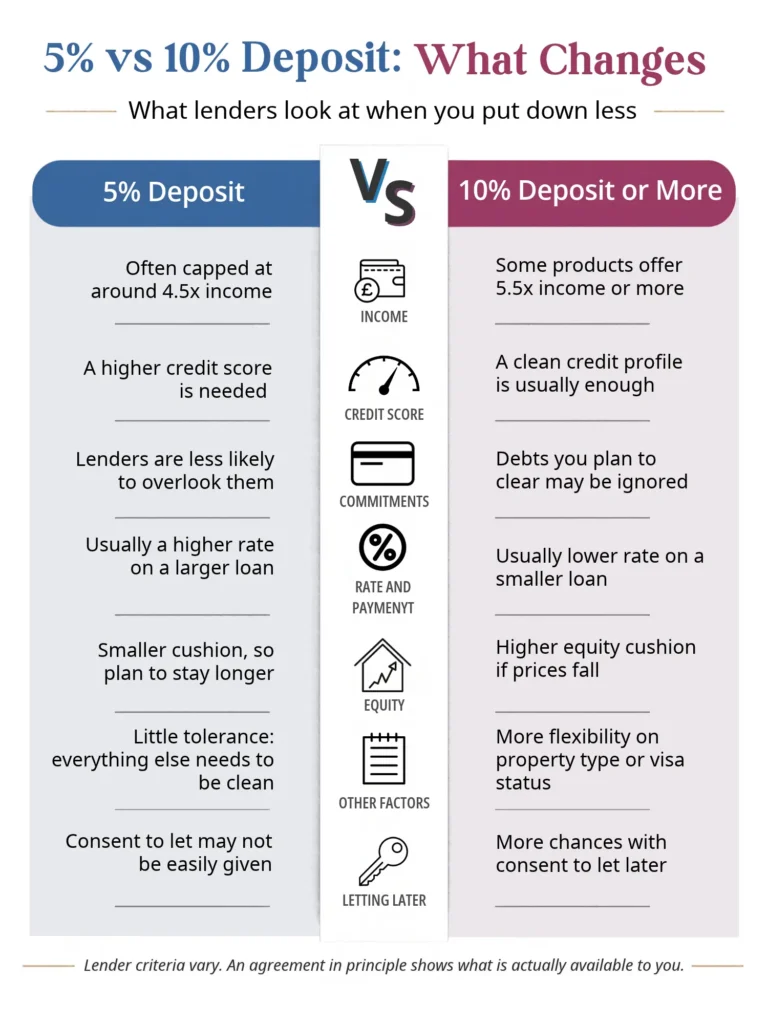
With a lower deposit, lenders are generally stricter on affordability and will lend less against the same income. Some lenders offer innovative products with higher income multiples, such as 5.5 or 6 times income, and occasionally even 6.5 times, but these tend to come with a larger deposit. At a 5% deposit, lenders generally cap lending at around 4.5 times income.
In practice, you need a higher income to borrow the same amount on a lower deposit.
| 5% deposit (95% LTV) | 10% deposit (90% LTV) | |
|---|---|---|
| Maximum loan | c. £458,000 | c. £561,000 |
| As a multiple of income | about 4.5x | 5.5x |
Credit Score: The Bar Is Higher
A clean credit report, with no missed payments, defaults or CCJs, is not always enough for a low deposit mortgage. We have seen lenders accept a clean credit profile that does not carry a very high score, but only subject to a minimum 10% deposit.
A question we hear often is: what Experian or Equifax score do I need to get a low deposit mortgage? There is no single number to give. Lenders use their own scorecards and weigh several factors, so a score from a credit reference agency cannot tell you whether a lender will say yes.
Only an agreement in principle can confirm whether a low deposit mortgage is available to you. That is why we always advise clients who are buying with a smaller deposit to get one done first, and never to assume that one is available.
Existing Credit Commitments: Clear Them Before You Apply
On a standard mortgage, lenders are sometimes willing to ignore credit commitments that you plan to pay off on or before completion, which improves your affordability. With a low deposit, lenders are less likely to do this. They tend to expect your existing credit commitments to count in full.
If you have credit commitments and do not want them to reduce your maximum loan, the best approach is to pay them off first, wait for your credit file to update with the payments made, and only then apply for an agreement in principle.
Once an agreement in principle is in place, we also advise clients not to take on any new credit, such as credit cards, loans, or car or furniture finance, until completion.
Property Type: Some Properties Need a Higher Deposit
- A property with a short lease
- A flat above commercial premises, such as a coffee shop, restaurant or pub
- A property of non-standard construction, such as a concrete build
The Risk of Negative Equity: Plan to Stay Longer
Negative equity is when the value of your property falls and the mortgage ends up larger than the property is worth. The risk of negative equity is higher when you buy with a low deposit, because you start with a smaller cushion of equity if prices move down.
If you are buying on a low deposit, be prepared to stay committed to the property for the longer term. This is also why lenders are sometimes willing to offer a higher loan amount on a longer fixed period, such as five years, than on a shorter initial period of two or three years.
You cannot rule out the risk of being in negative equity at some point if the property market falls, so it is worth planning with that in mind.
What Happens Over Time: Your Equity Can Grow
A low deposit does not stay low forever. Two things can build your equity the longer you stay. Property values may rise, although this is never guaranteed, and, if you are on a repayment mortgage, you reduce your mortgage balance every month. Both lower your loan to value.
A lower loan to value means more equity, and when your fixed rate ends it may help you remortgage on better terms than you were offered when you bought. That is why we say to be prepared to stay invested for the longer term, so that you can build equity in the property.
Higher Interest Rate and Monthly Payment: What to Expect
The lower the deposit, the higher the interest rate tends to be, because the lender takes on more risk. The difference between a 5% and a 10% deposit can be significant. A lower deposit also means a larger loan, so the monthly payment can be considerably higher.
This is not necessarily a problem, since a lower deposit lets you buy sooner without waiting to build up a larger one. It is simply worth knowing that the interest rate and monthly payment on a low deposit mortgage are likely to be higher.
| 5% deposit | 10% deposit | |
|---|---|---|
| Money needed upfront | ||
| Deposit | £20,000 | £40,000 |
| Stamp duty | £5,000 | £5,000 |
| Other costs (budget) | c. £4,000 | c. £4,000 |
| Total needed upfront | c. £29,000 | c. £49,000 |
| Interest rate and monthly cost (5-year fix) | ||
| Mortgage amount | £380,999 | £360,999 |
| Interest rate | 5.87% | 5.39% |
| Mortgage payment | £2,252.54 | £2,024.87 |
| Protection budget | £100 | £100 |
| Total monthly cost | £2,352.54 | £2,124.87 |
When we advise on a low deposit purchase, we always show the workings side by side with a standard deposit mortgage, as we did for Sam and Anita above. That lets you see what a larger deposit would save each month and decide whether it is worth increasing yours. Our job is to set out all the options so that you can make an informed choice.
Other Sources That Can Count Towards Your Deposit
- Builder or developer contribution. When buying a new build, some developers offer a contribution towards your deposit. Lenders have their own rules on this, and most cap it at 5% of the purchase price.
- A discount from your landlord. If you are buying the property you currently rent from your landlord, some lenders will treat a discount on the price as a gifted deposit, subject to their terms and conditions.
Foreign nationals who do not yet have indefinite leave to remain or permanent right to reside
A common scenario is a buyer who wants to purchase with a low deposit but does not yet have indefinite leave to remain (ILR), or permanent right to reside in the UK. As we have seen, lenders expect everything else to be very clean when the deposit is low, so for foreign nationals without ILR the options are quite restrictive.
That is not to say no lender will consider it. It is the exception rather than the rule. Most lenders expect a minimum 10% deposit where the applicant does not have ILR. It can be done where the income is higher and the credit profile is clean, and we have placed clients without ILR on a 95% LTV mortgage on that basis, subject to finding a lender whose criteria fit.
Sam and Anita’s case is an example. They did not yet have ILR, but a lender with a minimum joint income criterion of £75,000 was willing to lend to them at 95% loan to value, because their combined income of £102,000 was above that level.
Planning to Let Out Later? Check This Before You Buy
If you think you may want to let out your first home in the future, this is worth planning for before you buy. In that case you would usually ask your lender for consent to let, and where you have a low deposit, and therefore a higher LTV, that consent may not be easily given.
If this is part of your plan, take advice early and have a plan in place before the time comes to let the property out.
To understand more about letting out a home you have bought, refer to Buying a Home Today With the Intention to Letting It Out in the Future.
Is a Low Deposit Mortgage Right for You?
A low deposit mortgage tends to suit you if you:
- Have a higher income and can comfortably show that the monthly payments are affordable under the lender’s assessment
- Have a clean credit profile, with no CCJs, defaults or late payments
- Do not have excessive credit commitments, such as large personal loans, car loans, credit cards or hire purchase
- Are buying a standard property
- Can clearly evidence your deposit, either from your own savings or from a gift that has been verified
- Are happy to stay invested for the longer term, rather than looking for short-term gains or planning to move or let out within a short time
If that does not describe you yet, we can talk through what to change before you apply.
Our Transparency Promise
A Balanced View, Not False Hope
We deal with a good number of low deposit mortgages, and it would be easy to say that buying with a small deposit is very much possible. We prefer a balanced view. As this article shows, a lower deposit comes with restrictions and limitations.
So rather than give you false hope, we will give you a balanced picture and do our best to help you complete a purchase on a lower deposit where one is available.
Planning to Buy With a Smaller Deposit? Let’s Look at Your Options
If you have a good income, a clean credit profile and a standard property in mind, and the deposit is the one thing you are still building, it is worth talking to us to see whether now is a good time to buy with a minimal deposit.
At your free first meeting, we will:
- Assess your income, credit profile and credit commitments
- Work out the maximum loan available and the minimum deposit needed
- Give you initial workings: the maximum property value you could buy, the money you need upfront including deposit and other costs, and your expected monthly payment
That way you can see whether it makes sense. Sometimes the next step is an agreement in principle. Sometimes it is a plan for your credit commitments and what to correct before you buy. We will also look at the various schemes and lender criteria to find the best option available to you.
Sam and Anita went on to complete their purchase within about two months.
Frequently Asked Questions
Yes, many lenders offer 95% loan to value mortgages. They are stricter on income, credit and property type, so only an agreement in principle can confirm whether one is available to you.
There is no single score. Lenders use their own scorecards and weigh several factors, so a score from Experian or Equifax cannot tell you whether a lender will say yes.
On a 5% deposit, lenders often cap lending at around 4.5 times income. In the case above, a joint income of £102,000 supported about £458,000 at 5% and £561,000 at 10%.
Generally, yes, because the lender takes on more risk. In the case above, the 5-year fix was 5.87% at a 5% deposit against 5.39% at 10%, which came to around £228 more a month.
A gift from family is an acceptable source, but on a low deposit some lenders prefer the deposit to come from your own earnings and savings. Check the lender’s criteria before you apply.
It is possible but the exception. Most lenders expect at least a 10% deposit without ILR, and a higher income can open up a few options.
You would usually need your lender’s consent to let, and with a higher loan to value that consent may not be easily given. Plan for it before you buy.
It depends on your plans. A low deposit lets you buy sooner but costs more each month, and you should be prepared to stay longer to build equity. We can show both options side by side so you can decide.

About the Author
Sekkappan Alagu is the Founder of Nachu Finance Ltd, established in 2006. With an early career in journalism and publishing, he brings clarity and structured thinking to complex financial topics. Through the Nachu Finance Blog and Knowledge Hub, he shares insights drawn from nearly two decades of client advisory experience, helping readers make informed decisions and understand best practices in mortgages, protection and long-term financial planning.

Business Profile
Nachu Finance Ltd is a directly authorised FCA-regulated firm providing mortgage, insurance and estate planning advice to clients across the UK. The firm takes a holistic approach — considering protection, tax efficiency and long-term planning alongside property finance — maintaining high regulatory standards while keeping advice clear and easy to follow. To learn more about the firm's background and story, visit the About Nachu Finance page.
Planning Your Mortgage and Future Property Decisions