

Testmonials
Enquiry Form
Get in Touch with Us for Personalized Finance Assistance
Struggling to Get a Mortgage as a CIS Worker?
Many construction professionals find that traditional lenders don’t recognise their true earning potential, leading to lower borrowing limits and rejected applications. At Nachu Finance, we specialise in helping CIS workers secure mortgages, ensuring that your hard-earned income is presented in the best possible way to lenders.
Understanding the Construction Industry Scheme (CIS)
In 1971, HMRC introduced the Construction Industry Scheme (CIS), a unique tax framework for workers in the construction sector, including site engineers, carpenters, plumbers, bricklayers, electricians, roofers, kitchen fitters, traffic managers, and other tradespeople involved in construction, from site preparation to final decoration and installation.
Subcontracted tradespeople provide specialised services to contractors and are typically paid on a weekly or monthly basis, depending on the hours or days worked. Payments are made against invoices, with 20% deducted at source for tax and the remaining 80% deposited into the subcontractor’s bank account. CIS workers can operate as sole traders or under a limited (Ltd) company structure.
In many cases, invoices are self-generated by contractors, eliminating the need for subcontractors to manually prepare and submit invoices.
HMRC has strict definitions for who qualifies as a CIS worker, which contractors can employ them, and the types of projects they can work on. If you are classified as a CIS worker and paid under this scheme, there are unique mortgage options available to you.
Why CIS Workers Face Challenges with Mortgages
-
Do not have
two-year self-employment history
Have had gaps in their self-employment.
Have optimised their tax calculations using legal tax strategies.
Have recently upskilled and significantly increased their income.
These factors often result in lower declared income, which means traditional lenders may offer a lower mortgage amount that may not align with your actual earning potential–making it harder to secure the home you want.
Helping CIS Workers Secure the Right Mortgage
At Nachu Finance, we have extensive experience in securing CIS mortgages and have helped numerous CIS workers navigate the mortgage process with ease.
Many of our early CIS clients have remained loyal over the years, referring colleagues and friends, which has deepened our expertise in this area. We understand the specific challenges CIS workers face and know how to present your income in the most favourable way to mortgage lenders.
The Best of Both Worlds - Mortgage Affordability vs. Tax Efficiency
The CIS mortgage scheme bridges this gap, allowing CIS workers to:
Optimise their tax position
Secure a higher mortgage amount than what traditional self-employed mortgage calculations would allow
This “best of both worlds” approach enables CIS workers to benefit from tax-efficient earnings without compromising their mortgage affordability.
How Lenders Calculate CIS Worker Income
Here’s how it works:
The gross invoice values (before the 20% tax deduction) from the most recent three months (or 13 weekly invoices) are added up.
The weekly average income is calculated.
This weekly figure is then multiplied by 46 weeks to estimate annual earnings (lenders assume 46 working weeks instead of 52 to account for holidays and time off).
If not for the CIS mortgage scheme, lenders would only consider taxable income based on the most recent two years’ tax calculations-which often results in a significantly lower assessed income for CIS workers.
From our experience, many CIS workers have higher annualised income under the CIS calculation method compared to traditional self-employed assessments. Refer to the case studies below to see real-world examples of how this works.
Within the CIS mortgage scheme, the last three months’ average income plays a crucial role in determining mortgage affordability. Lenders already assume that CIS workers can only work 46 weeks per year, meaning they multiply the weekly average by 46 rather than 52.
If the last three months’ gross earnings (as evidenced by invoices) do not accurately reflect a CIS worker’s full earning potential, the calculated income may be lower, directly impacting the maximum loan available.
Overcoming the Common Challenges with the Last Three Months’ Income
From our experience, two key issues frequently arise when CIS workers apply for mortgages:
Festive Breaks – If applying for a mortgage in January or February, the last three months’ income may be lower due to the December holiday period, as many CIS workers take time off in the later part of the year.
Property Viewings & Time Off Work – We often see cases where the initial income snapshot looks strong, but by the time clients have viewed properties, made offers, and had an offer accepted, their income has dropped. If time off work for property viewings reduces invoice values, it can affect the loan amount available.
To maximise borrowing potential under the CIS scheme, it’s important to ensure that the three months leading up to the mortgage application accurately reflect full earning capacity.
To apply for a mortgage under the CIS scheme, lenders require the following:
For Income Assessment
- Last three months (13 weeks) of CIS invoices
- Last three months’ bank statements, showing net CIS payments from the employer to the subcontractor
Important: The CIS invoices and bank statements must cover the same period to allow the lender to verify and corroborate the income accurately. This ensures that the lender can match invoiced earnings with actual payments received, strengthening the mortgage application.
For Compliance Requirements
Self-employed accounts (for sole traders or Ltd companies) may also be required.
While this is not used for affordability calculations, it is needed for compliance purposes.
If the document is unavailable for a valid reason, we may still proceed, but lenders will require either the document itself or an explanation for its absence.
To illustrate how income is assessed under the CIS mortgage scheme, here’s a sample calculation based on 13 weeks of invoices.
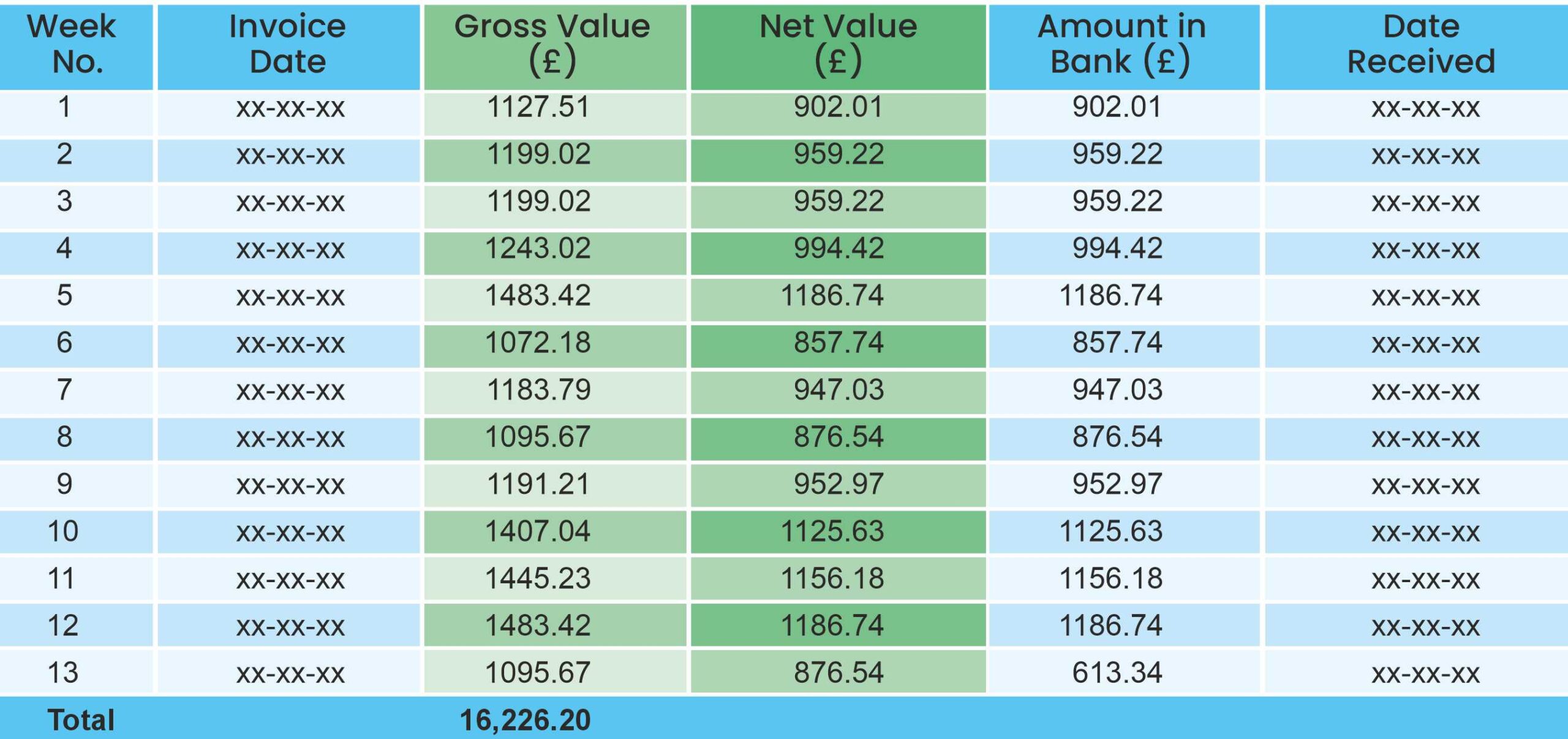
Calculation Breakdown:
Total Gross Income (A) over 13 weeks: £16,226.20
Weekly Average Income: £1,248.17 (A ÷ 13 weeks)
Annualised Income: £57,415.80 (A ÷ 13 × 46 weeks)
This approach allows lenders to assess CIS workers’ true earning potential without relying on traditional self-employed tax returns, which may understate their actual income.
A 30 & 29-year-old couple were looking to purchase their first home.
Mrs: A newly qualified professional earning £42,000 per year (PAYE).
Mr: A CIS worker employed as a site engineer with a daily rate of £275 and working 5.75 days per week.
Mr operates via a Ltd company and receives net CIS income from his employer.
Income Comparison

Key takeaway: The self-employed income of £44,360 was insufficient for their mortgage, but the CIS-calculated income of £71,318 enabled them to secure the loan needed for their dream home. Without the CIS mortgage scheme, they would not have been able to proceed with their property purchase.
A couple wanted to remortgage their residential property and release £75,000 for home improvements.
Mrs: Works in retail, earning £23,000 per year (PAYE).
Mr: A carpenter who moved into the CIS scheme nine months ago, using a sole trader structure to receive net CIS income.
Challenges & Solution
Before CIS: As Mr was previously employed (PAYE) and had less than a year of self-employed accounts, traditional mortgage lenders would not have considered his income.
With CIS: We leveraged his last three months’ CIS income since he had over five years of experience as a carpenter, which met the lender’s minimum requirement of two years in the trade.
Outcome: The remortgage was successfully completed, and the couple secured the £75,000 needed for home improvements. Without the CIS mortgage scheme, they would have needed at least one (or ideally two) years of self-employed accounts before lenders would consider their income.
A steel fixer was recently promoted to a supervisor, increasing his day rate by 24%.
Challenges & Solution
Before CIS: Despite having two years of self-employed accounts, these accounts did not reflect his recent salary increase.
With CIS: Instead of using outdated accounts, we applied for a mortgage using his last three months’ CIS invoices, which accurately reflected his new earning capacity.
Outcome: The CIS income assessment played a vital role in securing a mortgage amount that matched his true earnings, allowing him to move forward with his property purchase.

Our Transparency Promise
Eligibility considerations
While we have extensive experience in securing mortgages for Construction Industry Scheme (CIS) workers, eligibility depends on meeting specific criteria under the CIS scheme.
In some cases, building trade professionals operate under CIS alongside other forms of self-employment or may not fully meet the scheme’s requirements. Unfortunately, such cases may not qualify for a CIS-based mortgage.
Only after an initial discussion and assessment can we determine whether you are eligible for this scheme. If CIS is not the right fit, we will explore alternative mortgage options tailored to your circumstances.
Why Choose Nachu Finance as your mortgage adviser
At Nachu Finance, we believe securing a mortgage or financial protection shouldn’t feel overwhelming. Whether you’re a CIS worker, self-employed professional, or someone navigating complex financial situations, our expertise ensures you get the right solution tailored to your circumstances.
As highly experienced, transparent, whole-of-market advisers with outstanding client reviews and a commitment to going the extra mile, we believe we are well-placed to be your trusted advisers.
Our tech-driven, client-centric, and flexible approach ensures that getting in touch with us is effortless. Let us support you through your property journey with clarity and confidence.
Don’t just take our word for it, take a look at what our clients have to say about our service.