Testmonials
Enquiry Form
Get in Touch with Us for Personalized Finance Assistance
Porting a Mortgage: Your Options When Moving Home During the Initial Period
- Date Published :
Life doesn’t always wait for your mortgage deal to end.
A job offer in a different city. A school catchment area that changes everything. A growing family that’s outgrown your current home. Sometimes the decision to move is years in the making — and sometimes it arrives with very little notice.
When a move happens during your mortgage’s initial period, the stakes are higher than simply finding a new property. If you’re tied into a fixed rate, a tracker, or a discounted product, moving without a plan could mean facing early repayment charges that run into thousands of pounds.
This article takes a close look at what your options actually are — whether you’re planning ahead or navigating a move that wasn’t on the cards when you originally chose your mortgage deal.

The Starting Point: Understanding What You're Working With
Before weighing up your options, it helps to understand the mechanics behind why moving mid-deal creates a financial consideration in the first place.
Most competitive mortgage deals — particularly fixed rates — come with an initial period during which the lender offers you a preferential rate in exchange for a degree of commitment. Exit that deal early, and an early repayment charge typically applies.
How significant that charge is depends on your lender, your loan size, and how far through the initial period you are. For some borrowers, it’s manageable. For others, it’s a number that fundamentally changes the decision.
If you’re unfamiliar with early repayment charges work, it’s worth reading article titled Early Repayment Charges (ERC) – Explained Simply.
Option One: Port Your Mortgage
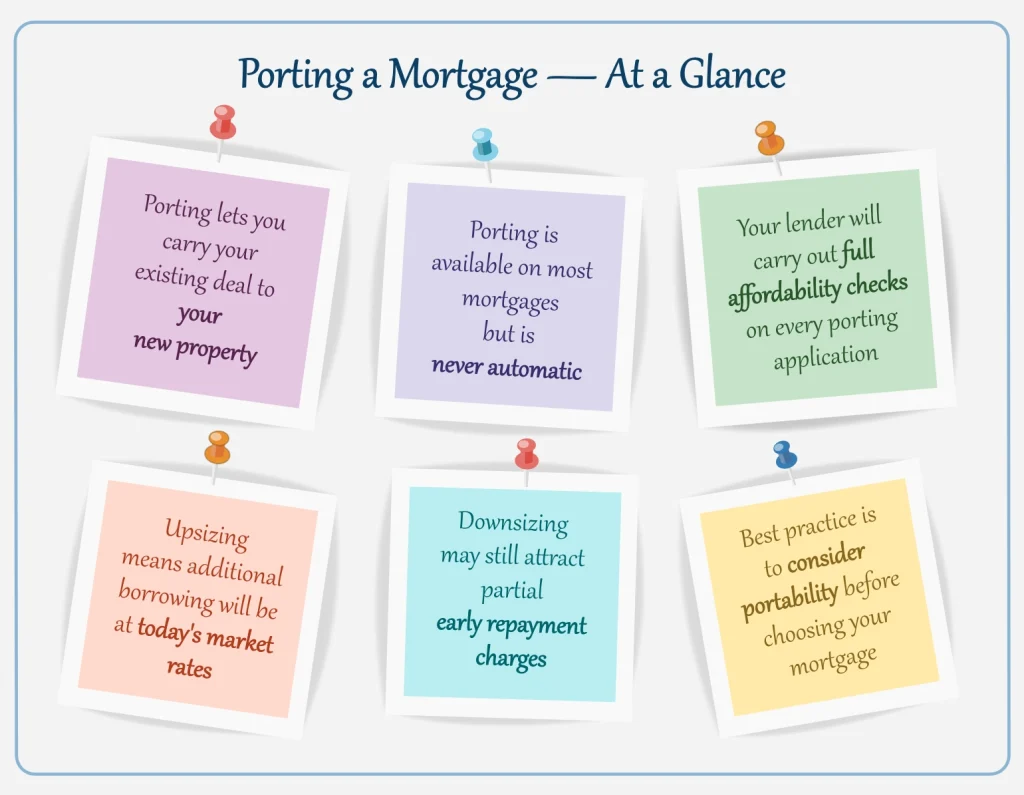
Porting allows you to carry your existing mortgage deal — your rate, your remaining deal period — across to your new property rather than ending it early.
This is the route that avoids the early repayment charge and allows continuity. For homeowners sitting on a low fixed rate, particularly in a higher-rate environment, it can preserve a genuine financial advantage that would be lost if they started again from scratch.
But porting is not automatic.
Even where a mortgage is described as portable, the lender treats it as a new application. Your income, outgoings, credit profile, and the new property must all meet current affordability and eligibility criteria. If your circumstances have changed since you originally took out the mortgage, approval is not guaranteed.
Porting retains your rate. It does not bypass the lending process.
When You're Borrowing More
If your new property requires a larger mortgage than your current balance, the lender will typically port your existing balance at your current rate and provide additional borrowing on a new product at today’s rates. You end up with one mortgage made up of two parts — each carrying a different rate and ending at a different time.
Day-to-day, this is straightforward: one monthly payment, one lender. The complexity emerges later, when the two deal periods end at different points and you face remortgaging decisions on each separately. Managing multiple products within the same mortgage is something we’ll cover in a dedicated guide — for now, the key point is to go in aware that the structure will need planning.
When You're Borrowing Less
If you’re downsizing and your new mortgage requirement is lower than your current balance, you’ll port the portion you need and repay the rest. The important detail here is that early repayment charges may still apply to the amount you’re repaying — because from the lender’s perspective, you’re exiting that portion of the deal early.
Some lenders offer allowances or flexibility on this, but it varies and should never be assumed. Check your specific mortgage terms before making decisions.
Option Two: Start Fresh With a New Mortgage
If your mortgage has no early repayment charges, or if you’re close enough to the end of your initial period that the charges are negligible, a clean break is often the simpler and more flexible route.
This gives you full access to the market, freedom to choose a new lender, and the ability to structure your mortgage entirely around your current circumstances and needs — rather than working around a deal that was designed for a different point in your life.
For those currently on a rate that’s no longer competitive, a clean break may also make more financial sense even after accounting for any exit charges. The maths is worth doing.
Option Three: It's Not Always Essential to Sell
Keeping Your Current Property Rather Than Selling
Selling your current home before buying your next one is the default assumption — but it isn’t always the only route.
Let to Buy
If you want to hold on to your current property, it’s possible to convert your existing residential mortgage to a let-to-buy mortgage, freeing up your equity to use as a deposit on your next purchase. Your current home becomes an investment property; you move on. This approach suits those who want to retain a property asset, either because the numbers make sense as a rental or because they’re not yet ready to crystallise a sale.
Transfer to a Limited Company
For those with a broader property strategy in mind, transferring your current property into a limited company structure is another possibility. This is a more complex route with its own tax and legal considerations, but for some homeowners — particularly those building a portfolio — it’s worth understanding. Considering transferring the current residential property to a ltd company? You would find our article Transferring a Property to a Ltd Company: Does It Really Make Financial Sense? useful.
Stamp Duty Considerations
Whether you’re selling or retaining your current property, the stamp duty position on your next purchase can look different depending on which route you take. Home mover stamp duty rates and the rules around additional dwellings are worth understanding before you commit to an approach.
We have covered the stamp duty considerations for home movers in detail in our article titled Stamp Duty for Home Movers: How It Works and What to Consider
Planning Ahead: Choosing the Right Mortgage for a Move You Can See Coming
Not every move is a surprise. If there’s a realistic chance you’ll want to move within the next few years — because of a school transition, a career plan, or a property that simply won’t work long-term — the mortgage you choose today can either help or hinder you later.
Opting for a product with greater flexibility, or one with no early repayment charges, can allow you to make a clean break when the time comes. You’ll likely pay a marginally higher rate for that flexibility, but it can be the more cost-effective choice over the full horizon of the plan.
Not every move can be anticipated. But where it can, building your mortgage strategy around it is almost always worthwhile.
In Summary
Moving home during a mortgage’s initial period requires more thought than a straightforward purchase — but the options are broader than many homeowners realise.
Porting can preserve a competitive rate and avoid unnecessary charges. A clean break gives you flexibility and market access. And for those who don’t want to sell, there are legitimate routes to retain the current property while moving forward.
The right answer depends on your mortgage terms, your circumstances, and your plans. Where there’s any uncertainty, taking advice before committing to a course of action is always the clearer path.
Frequently Asked Questions
Not necessarily. The new property must meet your lender’s criteria — certain property types, construction methods, or conditions may not be acceptable security. The lender assesses the new property as part of the porting application.
The lender will reassess your full affordability position. If your income has reduced, your outgoings have increased, or your credit profile has changed, porting may not be approved even if your mortgage is technically portable. It’s worth understanding your current position before assuming it will go through.
Most lenders expect the sale and purchase to complete simultaneously. Some will allow a short window between transactions, but this varies significantly. If your chain is complex or a gap looks likely, speak to a broker early — the options available to you depend on your lender’s specific policy.
In most cases, porting avoids the charge on the balance you’re carrying forward. However, if you’re downsizing and repaying part of your mortgage, that portion may still attract a charge. Check your mortgage terms specifically.
You would then need to consider repaying your mortgage and taking out a new one, which would trigger the early repayment charge unless you’re outside the initial period. Understanding this risk in advance is part of why early planning matters.
Yes — if you’re happy to pay any applicable early repayment charge, or if no charges apply, you can take out a new mortgage with any lender. Porting specifically means staying with your current lender and carrying your existing deal forward.
Yes — this is covered section Option 3 it is not always essential to sell. Let to buy is one route; it involves converting your existing mortgage and retaining the property as a rental. Each option has its own implications and is worth exploring with an adviser.

About the Author
Sekkappan Alagu is the Founder of Nachu Finance Ltd, established in 2006. With an early career in journalism and publishing, he brings clarity and structured thinking to complex financial topics. Through the Nachu Finance Blog and Knowledge Hub, he shares insights drawn from nearly two decades of client advisory experience, helping readers make informed decisions and understand best practices in mortgages, protection and long-term financial planning.

Business Profile
Nachu Finance Ltd is a directly authorised FCA-regulated firm providing mortgage, insurance and estate planning advice to clients across the UK. The firm takes a holistic approach — considering protection, tax efficiency and long-term planning alongside property finance — maintaining high regulatory standards while keeping advice clear and easy to follow. To learn more about the firm's background and story, visit the About Nachu Finance page.
Explore Your Options When Moving or Switching Mortgages