
Testmonials
Enquiry Form
Get in Touch with Us for Personalized Finance Assistance
Are You Reporting Rental Income Correctly? A Common HMRC Mistake Explained
- Date Published :
If you deduct your mortgage interest from your rental income before declaring your profit, you are not alone — but you are not compliant. And depending on your income level, the difference can be thousands of pounds.
This article explains what the rule is, how the mistake happens, and what the correct approach looks like. We are not providing tax advice — we are sharing something we see regularly, because awareness is the first step to getting it right.
Many landlords unknowingly submit their tax returns incorrectly
Declaring rental income to HMRC is not optional — it is a legal requirement.
However, one of the most common issues we come across is how rental income is calculated and reported, particularly where landlords submit their own tax returns.
At Nachu Finance, while we do not provide tax advice, we are required to ensure that rental income is being disclosed correctly under “Profit from Land and Property.”
This article explains a common but important mistake, how it happens, what the correct approach looks like, and why it matters more than many landlords realise.
A Note Before You Read On
At Nachu Finance, we are a mortgage broker — not tax advisers. We do not provide tax advice, and nothing in this article should be taken as such.
What we can tell you is what we observe in practice. As part of our compliance process, we are required to ensure that rental income is correctly disclosed when landlords apply for mortgages. Reviewing tax calculations is part of that process — and this particular issue is one we come across more often than you might expect.
We are sharing it here because we believe informed landlords make better decisions. But awareness of a common mistake is not a substitute for professional, specialist advice tailored to your circumstances.
Property tax is a specialist area. The rules are detailed, they interact with your wider income position in ways that are not always obvious, and they change. An accountant who specialises in property tax will not only ensure your returns are correct — they will often identify planning opportunities that a general filing approach misses entirely. We have written separately about why specialist advice matters in property tax and what to look for when choosing the right professional.
If you are unsure whether your tax returns have been structured correctly, speaking with a qualified property tax specialist is always the right first step.
Before April 2017, landlords could deduct mortgage interest directly from rental income and declare the net profit. It was simple and intuitive.
This changed with the introduction of Section 24 of the Finance Act 2015, which was phased in from 2017 and fully implemented by April 2020.
Under these rules:
- Mortgage interest can no longer be deducted when calculating rental profit
- Instead, it must be declared separately as a finance cost
- Tax relief is restricted to the basic rate of 20%, regardless of your tax band
This is the rule that continues to catch landlords out.
The Mistake: How It Typically Happens
A common way this is incorrectly reported is:
- Rental income received
- Minus allowable expenses
- Minus mortgage interest
- Net figure declared as property profit
While this may reflect the actual cash position, it does not comply with HMRC rules.
Mortgage interest should not reduce your property profit.
What Happens If You Get This Wrong
Incorrect reporting can lead to:
- Incorrect tax calculations
- Underpayment of tax
- HMRC queries or corrections
- A distorted view of your total income
For higher-rate taxpayers, the impact can be particularly significant.
The Correct Approach: Two Separate Calculations
HMRC requires rental income to be structured in two parts.
Part 1 — Profit from Land and Property
- Rental income
- Minus allowable expenses (excluding finance costs)
- This gives the property profit
Part 2 — Finance Costs
- Mortgage interest declared separately
- Relief applied as a 20% tax credit against your tax bill
These two components serve different purposes and must not be combined.
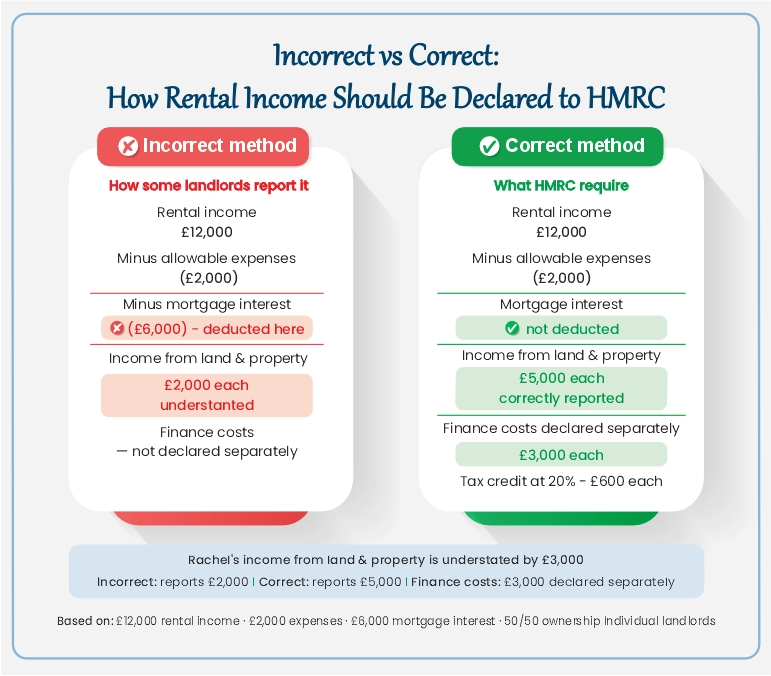
A Worked Example: Krishna and Rachel
To illustrate the difference, consider the following:
- Rental income: £12,000
- Allowable expenses: £2,000
- Mortgage interest: £6,000
- Ownership split: 50/50
Incorrect Method
Rental income: £12,000
Expenses: £2,000
Mortgage interest: £6,000
Declared profit: £4,000 (£2,000 each)
Correct Method
Rental income: £12,000
Expenses: £2,000
Property profit: £10,000 (£5,000 each)
Finance costs: £3,000 each
Tax credit: £600 each (20%)
A visual representation of the worked example can be found in the infographic below
Key Difference
Under the incorrect method, Rachel reports £2,000 of property income.
Under the correct method, she reports £5,000.
Her taxable income is understated by £3,000 under the incorrect approach.
Impact on Tax Position
Higher-Rate Taxpayer (Rachel)
Salary: £100,000
Incorrect reporting: total income approximately £102,000
Correct reporting: total income approximately £105,000
This difference affects:
- Personal allowance tapering above £100,000
- Overall taxable income
- Effective tax rate
Mortgage interest relief remains capped at 20%, regardless of tax band.
Basic-Rate Taxpayer (Krishna)
For lower-rate taxpayers, the immediate tax impact may be limited.
However, the reporting is still incorrect and may create issues if reviewed by HMRC.
Quick Summary
- Mortgage interest should not be deducted from rental income
- Rental profit must be calculated before finance costs
- Finance costs are declared separately
- Tax relief is limited to 20%
- Incorrect reporting can understate income and affect tax position
Buy-to-let can be a strong long-term investment, but it is not passive.
Landlords must manage tax reporting, regulatory compliance, and ongoing obligations.
These responsibilities have increased significantly over time. You can explore this further in our guide on Responsibilities of a Buy-to-Let Landlord, which outlines the practical and regulatory expectations landlords should be aware of.
Regulatory standards — including energy efficiency requirements — also play an increasingly important role. Our article on EPC Requirements and Mortgages explains what landlords need to consider in this area.
What We See in Practice
At Nachu Finance, we do not provide tax advice, but we do ensure rental income is properly disclosed as part of our compliance process.
This typically involves reviewing tax calculations.
In our experience, this specific issue is far more common where returns are self-submitted, and rarely seen where a qualified accountant has prepared the return.
Final Thought
A reporting method that feels intuitive can quietly understate your income by thousands of pounds.
At higher income levels, the knock-on effects can be significant.
Getting this right is not just about compliance. It is about understanding your true financial position and avoiding issues that become far more complex to resolve later.
Frequently Asked Questions
Yes. All rental income must be declared to HMRC, regardless of profit level.
No. Only allowable expenses can be deducted. Mortgage interest must be declared separately as a finance cost.
No. These rules apply to individual landlords. Limited companies follow different tax rules, including how mortgage interest is treated. You can read more in our guide on Personal Name vs Limited Company Buy-to-Let.
This is a different scenario entirely and the buy-to-let rules covered in this article do not apply in the same way.
When you rent out a furnished room in your own home while continuing to live there, HMRC’s Rent a Room Scheme may apply. This allows you to earn up to £7,500 per year from a lodger completely tax-free — and if your income stays below that threshold, there is nothing you need to do at all. You also need to consider mortgage lender consent, the right type of lodger agreement, and updating your home insurance before anyone moves in.
We have covered all of this in detail — including a worked example and the key steps to do it correctly — in our guide to renting out a spare room in the UK.
Rental income is usually taxed based on ownership share, which may not always be 50/50. If you own property jointly, the structure matters — our guide on Joint Tenants vs Tenants in Common explains how income is allocated between owners.
You should speak to a qualified accountant. It may be possible to correct previous submissions, and acting early is always advisable.

About the Author
Sekkappan Alagu is the Founder of Nachu Finance Ltd, established in 2006. With an early career in journalism and publishing, he brings clarity and structured thinking to complex financial topics. Through the Nachu Finance Blog and Knowledge Hub, he shares insights drawn from nearly two decades of client advisory experience, helping readers make informed decisions and understand best practices in mortgages, protection and long-term financial planning.

Business Profile
Nachu Finance Ltd is a directly authorised FCA-regulated firm providing mortgage, insurance and estate planning advice to clients across the UK. The firm takes a holistic approach — considering protection, tax efficiency and long-term planning alongside property finance — maintaining high regulatory standards while keeping advice clear and easy to follow. To learn more about the firm's background and story, visit the About Nachu Finance page.
Strengthen Your Buy-to-Let Strategy