Testmonials
Enquiry Form
Get in Touch with Us for Personalized Finance Assistance
Stamp Duty Explained: The Three Categories That Change Everything
- Date Published :
Stamp Duty Land Tax (SDLT) is one of the most important costs to consider when buying a property — yet it is one of the most frequently misunderstood.
While many buyers focus on property price and mortgage affordability, what often gets overlooked is that stamp duty is not a fixed cost. Two buyers purchasing the identical property at the same price can face a difference of £20,000 or more in stamp duty depending on their circumstances. The reason for that difference almost always comes down to one thing: the category of buyer they fall into.
In most residential purchases, buyers fall into one of three categories:
- First-time buyer
- Home mover
- Additional property buyer
Understanding which category applies to you — and why — can make a significant financial difference at a point in the process when accurate planning matters most.
The Three Main Stamp Duty Categories
1. First-Time Buyers
First-time buyers benefit from the most favourable stamp duty treatment available.
To qualify as a first-time buyer for stamp duty purposes, you must never have owned property or land anywhere in the world — including property owned in the past or overseas. It is worth noting that owning property abroad before moving to the UK will disqualify you from first-time buyer status, even if you have never owned property in the UK.
If eligible, first-time buyer relief provides:
- 0% on the first £300,000
- 5% on the portion between £300,001 and £500,000
This relief only applies where the purchase price is £500,000 or less. If the price exceeds £500,000 — even by £1 — no relief applies at all and standard rates are used for the entire purchase.
Married couples and joint purchases
For stamp duty purposes, married couples are generally treated as a single unit. If either party has previously owned property anywhere in the world, the purchase will not qualify for first-time buyer relief. This is a point that catches many buyers off guard and is worth clarifying early in the process.
Ownership through other structures
Certain types of indirect ownership do not usually affect first-time buyer status, including property owned in a parent’s name, being a shareholder or director of a company that owns property, or being a beneficiary of a discretionary trust. However, if you are an absolute beneficiary of a trust that owns property, your status may be affected and professional advice should be taken.
2. Home Movers
A home mover is someone who already owns a property and is replacing their current main residence.
This is the standard stamp duty position — standard residential rates apply, with no first-time buyer relief and no additional surcharge.
Replacing your main residence can happen in several ways:
- You sell your existing home before buying a new one
- You complete both transactions simultaneously
- You buy first and sell your existing home within three years
If you purchase a new property before your existing home has sold, you may be required to pay the higher additional property rate initially. Provided you sell your previous main residence within three years, you can claim a refund of the additional amount paid. For a full explanation of what completion involves and how the conveyancing process works, see our guide to the conveyancing process.
The key concept is replacing your main residence — not simply selling any property you own. If you own multiple properties and sell an investment property rather than your main home, you may still be treated as purchasing an additional property
3. Additional Property Buyers
If you already own property and are not replacing your main residence, the purchase will usually be classed as an additional property purchase.
In this case, you pay:
- Standard residential stamp duty rates
- Plus an additional surcharge on the full purchase price (currently 5%)
This category commonly applies to:
- Buy-to-let investors
- Second homes
- Holiday homes
- Let-to-buy — where you retain your existing home as a rental property and purchase a new residence
- Purchases made through limited companies
Purchases through limited companies
All residential property purchases made through a limited company are generally treated as additional property purchases, regardless of whether it is the company’s first property. The higher rate applies from the outset.
About the surcharge
The additional property surcharge was introduced in April 2016, originally set at 3% above standard rates. From 31 October 2024 this increased to 5%. It is formally known as Higher Rates of Stamp Duty Land Tax on Purchases of Additional Residential Properties — throughout this article referred to as the SDLT Additional Property Surcharge. Both terms refer to the same charge.
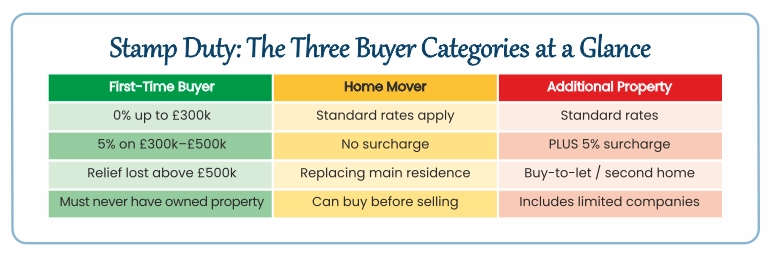
Buyer Categories at a Glance
The infographic below provides a simple side-by-side summary of the three categories, helping you quickly identify how they differ.
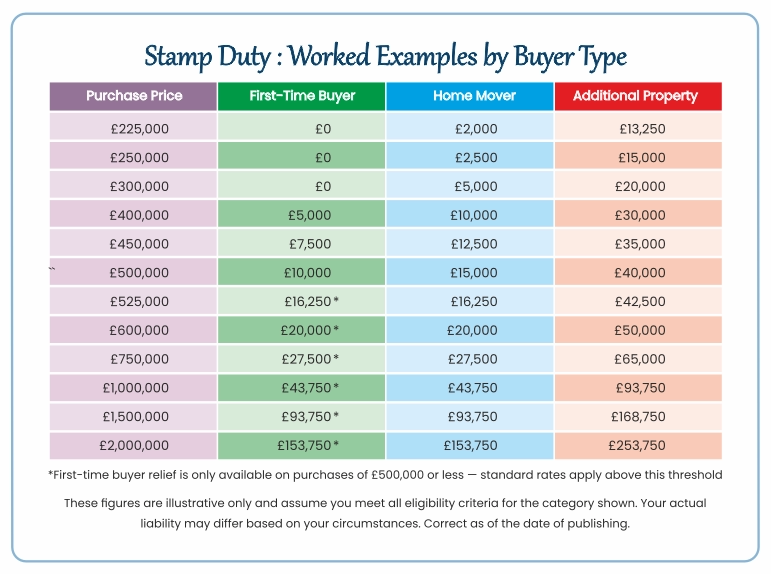
Stamp Duty: Worked Examples by Buyer Type
Stamp duty can vary significantly depending on both the purchase price and the buyer category. The table below illustrates exactly how much difference your category can make across a range of common purchase prices.
For a quicker visual comparison, see the summary below.
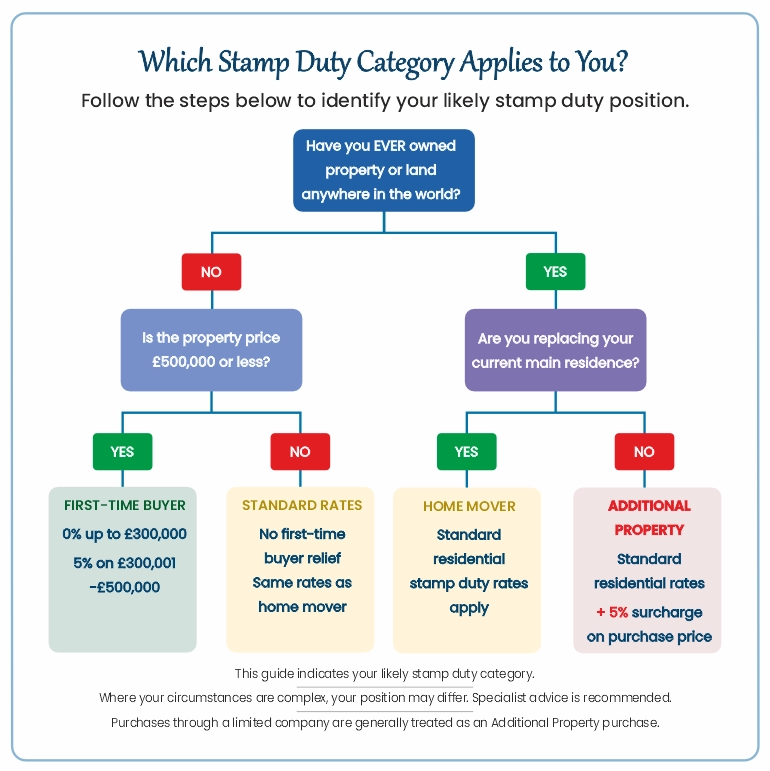
Which Category Applies to You?
If you are unsure which category you fall into, the step-by-step guide below will help you identify your likely position based on your circumstances. Answer each question in order.
Understanding Your Position Early Makes a Difference
Stamp duty is shaped by your personal circumstances and ownership history, not just the price you pay. The category you fall into is fixed by your situation at the point of purchase — which is why it is worth understanding where you stand before you are deep into the buying process, not after.
If you are unsure which category applies to you, or if your circumstances involve any of the complexities covered in this guide, speaking with a specialist adviser early can save both time and money.
Frequently Asked Questions
No. Stamp duty cannot be added to a mortgage.
Mortgage lenders expect buyers to fund the deposit, stamp duty, and all other upfront purchase costs — such as solicitor fees and valuation fees — from their own resources. These costs must be covered independently of the mortgage itself.
Stamp duty is payable at completion — the point at which the purchase legally completes and ownership transfers to you. You do not need to physically pay the stamp duty before this stage. For more on what completion involves and when it happens in the buying process, see our guide to the conveyancing process.
However, at mortgage application stage your lender will require clarity on where your stamp duty funds are coming from. Lenders will not accept a general assurance that funds will be arranged in due course. The source of your stamp duty funds must be declared at application, and evidence provided where available. If evidence is not yet available, this must be explained to your adviser and provided as soon as it becomes available.
Stamp duty is paid through your solicitor or conveyancer. They will collect the funds from you, complete the relevant HMRC forms, and submit payment to HMRC on your behalf.
It is important to understand that your solicitor’s role here is administrative — they collect and submit the payment. Solicitors are not in a position to advise on whether the correct category has been applied or whether the right amount of stamp duty is due. That responsibility rests with the buyer.
Stamp duty is a personal tax matter. The legal responsibility for ensuring the correct amount is paid lies with the buyer, not the solicitor. This is particularly relevant where your circumstances involve overseas property ownership, trust arrangements, company structures, or multiple properties. In such cases, taking specialist advice before completing your purchase is strongly recommended.
Where a home mover is unable to achieve simultaneous completion of sale and purchase, they may be required to pay the additional property surcharge on the new purchase upfront. Provided the previous main residence is sold within three years, the additional surcharge paid can be reclaimed.
This is a topic we will be covering in more detail in a dedicated follow-up article. In the meantime, if this applies to your situation, speak to your adviser before proceeding.
While the basic structure is straightforward, complexity can arise where circumstances involve:
- Multiple properties
- Overseas property ownership
- Trust arrangements
- Company purchases
- Joint ownership where parties have different ownership histories
In situations like these, the correct category may not be immediately obvious. Taking specialist advice before completing your purchase can help ensure the correct amount is declared and paid.

About the Author
Sekkappan Alagu is the Founder of Nachu Finance Ltd, established in 2006. With an early career in journalism and publishing, he brings clarity and structured thinking to complex financial topics. Through the Nachu Finance Blog and Knowledge Hub, he shares insights drawn from nearly two decades of client advisory experience, helping readers make informed decisions and understand best practices in mortgages, protection and long-term financial planning.

Business Profile
Nachu Finance Ltd is a directly authorised FCA-regulated firm providing mortgage, insurance and estate planning advice to clients across the UK. The firm takes a holistic approach — considering protection, tax efficiency and long-term planning alongside property finance — maintaining high regulatory standards while keeping advice clear and easy to follow. To learn more about the firm's background and story, visit the About Nachu Finance page.
Continue Strengthening Your Financial Understanding