
Testmonials
Enquiry Form
Get in Touch with Us for Personalized Finance Assistance
Overpaying Your Mortgage: A Simple Habit with Long-Term Rewards
- Date Published :

A Practical Guide for UK Homeowners
A £100 monthly overpayment on a typical UK mortgage can cut over two years off the term and save around £19,000 in interest. No lump sum required, no complex strategy — just a modest, consistent habit applied to a balance that charges interest every single day.
Most homeowners know overpaying is a good idea. Fewer understand exactly how it works, what their lender actually allows, and what to watch out for before they start. This guide covers all of it — from how daily interest makes every overpayment count immediately, to the rules around lender allowances, rate types, and when overpaying may not be the right move at all.
Save on Interest
In the UK, most residential mortgages are daily interest mortgages. This means interest is calculated on the outstanding balance each day. If you make an overpayment today, the balance reduces today and you start saving interest from tomorrow.
This single feature is what makes overpayments powerful, even in small amounts. Every reduction in balance, however modest, begins to work in your favour immediately.
Understanding Overpayment Allowances
Most lenders allow borrowers to make overpayments during a fixed-rate period without incurring early repayment charges. However, lenders set clear limits, and the rules differ.
Typical allowances include
- 10% of the outstanding balance each year
- Some lenders permit up to 20%
The definition of a year varies:
- Some lenders operate on a 12-month rolling basis. For example, if you use your full allowance today, the next allowance becomes available exactly 12 months later.
- Others follow a calendar year or financial year.
Some lenders calculate the overpayment allowance as a percentage of the outstanding balance at the start of the year, while others base it on the original loan amount. This difference can affect how much you are permitted to overpay, so it is important to check how your lender applies the allowance.
You can do this by reviewing your mortgage offer, checking the lender’s website or calling them directly. Doing this ensures you do not accidentally exceed the allowance and trigger early repayment charges.
It is equally important to understand whether early repayment charges (ERCs) apply to your mortgage product. Exceeding your permitted overpayment allowance during a fixed or tie-in period can trigger a percentage-based charge on the amount repaid. We have explained how early repayment charges work in more detail here: Early Repayment Charges Explained
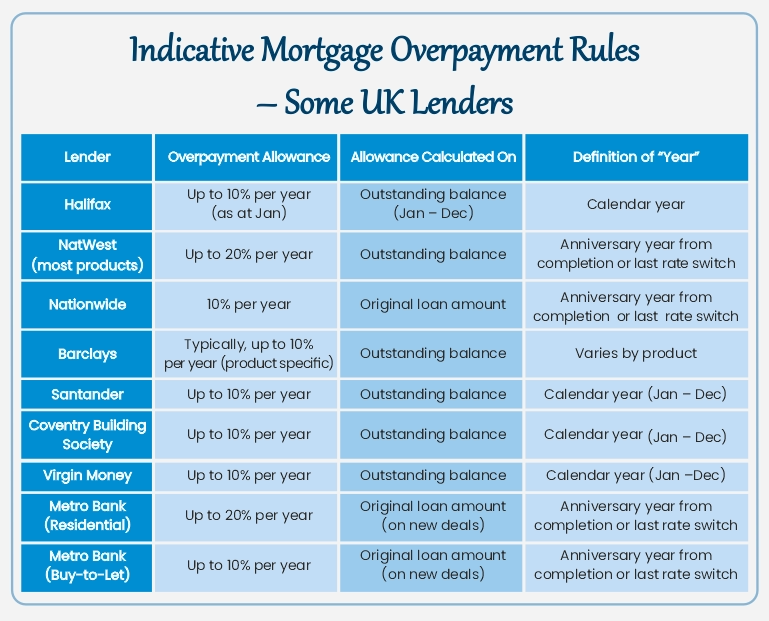
Mortgage overpayments with Some UK Lenders
The information below is provided as indicative guidance based on commonly applied lender policies at the time of writing. Overpayment rules can vary by product and may change over time. Borrowers should always refer to their mortgage offer or confirm directly with their lender before making an overpayment. The table below is intended to give you an idea of overpayment allowances can vary from lender to lender
Overpayments on Non-Fixed Rate Mortgages
Overpayment rules are often discussed in the context of fixed-rate mortgages, where annual allowances and early repayment charges (ERCs) are common.
However, not all borrowers are on fixed rates.
Some homeowners may be on:
- Tracker rates
- Discounted variable rates
- Standard Variable Rates (SVR)
Each of these can have different overpayment implications.
Tracker and Discounted Rates
It is a common misconception that tracker mortgages never carry early repayment charges. While some tracker products do not have ERCs, others may include a charge — particularly during an initial deal period.
Where ERCs do apply, they are often lower than those attached to fixed-rate mortgages, but this is product-specific and must always be verified.
Before making a large overpayment on a tracker or discounted rate, you should check:
- Whether an ERC applies
- The percentage of the charge
- The duration of the charge period
Standard Variable Rate (SVR)
Mortgages on a lender’s Standard Variable Rate typically do not carry early repayment charges. This means borrowers can often overpay any amount without restriction.
However, SVR rates are usually higher than fixed or tracker rates. Therefore, while flexibility may be greater, the cost of remaining on SVR should be weighed carefully against other available options.
The key takeaway is that overpayment flexibility varies significantly depending on the type of rate you are on. The first step should always be to confirm whether early repayment charges apply before making any substantial payment.
Reduce the Monthly Payment or Reduce the Term
Lenders will typically offer you a choice: reduce your monthly payment to reflect the lower balance, or keep paying the same amount and shorten the mortgage term instead.
Unless you specifically want to lower your monthly outgoings, most borrowers prefer reducing the term so they become mortgage free sooner and save more interest over the life of the loan.
However, some lenders apply minimum thresholds before they recalculate payments or reset the term. Again, it is worth checking these details with the lender so you know exactly how your overpayment will be applied.
In addition to reducing interest and shortening the term, overpayments can also improve your loan-to-value (LTV) position over time. As the outstanding balance reduces, your mortgage may move into a lower LTV band, which can be particularly helpful at your next product transfer or remortgage. Lower LTV brackets often provide access to more competitive interest rates. You can read more about how LTV works and why it matters here: Loan to Value (LTV) Explained
One Off Lump Sum or Regular Overpayments
You can overpay as a regular standing order, a one-off lump sum from a bonus or savings windfall, or a hybrid approach — quarterly, half-yearly or annual payments. The mechanics differ, but the effect is the same: every reduction in your balance lowers the interest charged from the following day. Choose whichever method fits your cash flow and you are most likely to sustain.
Why Even Small Overpayments Can Make a Big Difference
Many homeowners assume that mortgage overpayments only make sense if large lump sums are available. In reality, even modest overpayments can significantly shorten the mortgage term and reduce the total interest paid.
To illustrate this, let us use a realistic and representative example, based on clients we have advised over the last couple of years.
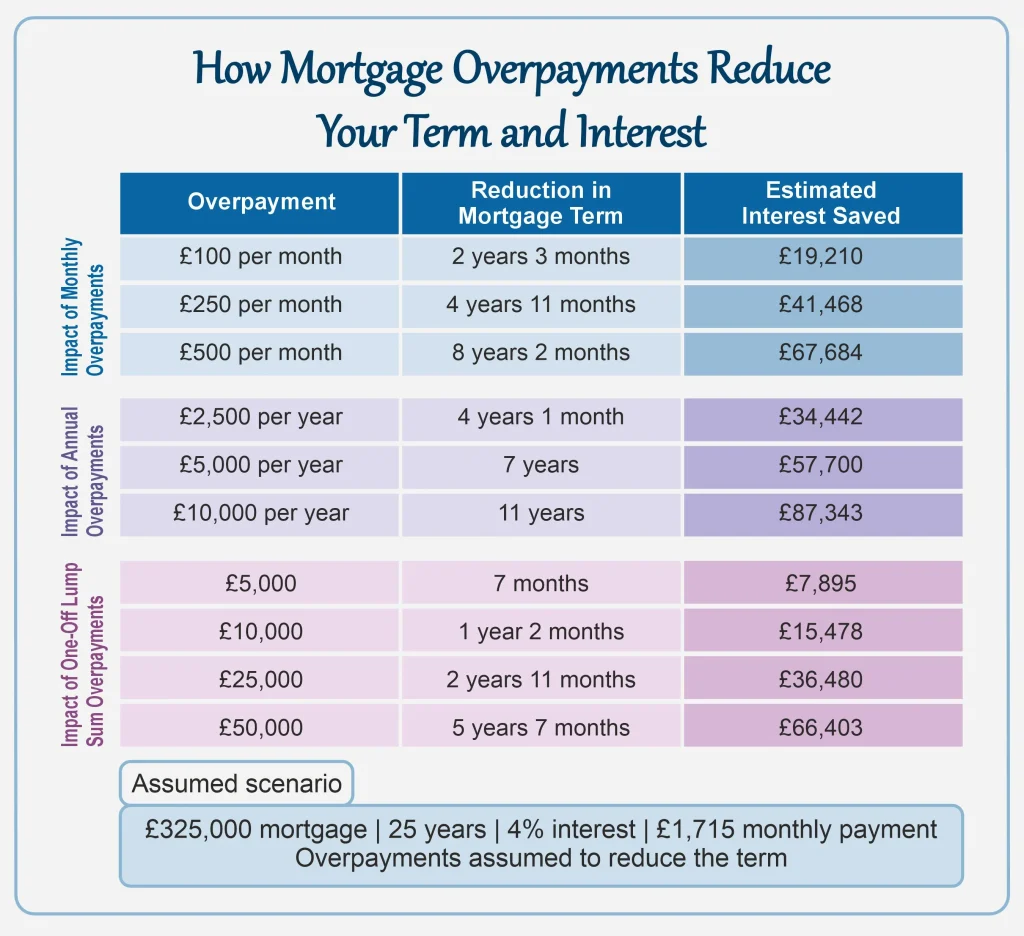
Assumptions Used
- Mortgage amount: £325,000
- Interest rate: 4%
- Mortgage term: 25 years
- Monthly payment: £1,715
- Overpayments are assumed to reduce the term, not the monthly payment
The table below summarises the estimated impact of different overpayment approaches, based on a representative mortgage example and assuming the overpayment is used to reduce the mortgage term rather than the monthly payment.
Monthly, Annual or One-Off Overpayments?
Monthly overpayments are often the easiest way for homeowners to begin reducing their mortgage. Regular monthly overpayments create steady, compounding reductions in the outstanding balance, allowing interest savings to build consistently over time.
For example, a £100 per month overpayment can reduce a typical 25-year mortgage by over two years and save around £19,000 in interest. Increasing the monthly amount accelerates this effect further, but the key takeaway is that even a relatively small monthly commitment can significantly shorten the mortgage term.
Even a £100 per month overpayment can cut over two years from a 25-year term and save around £19,000 in interest — and increasing the amount accelerates the saving proportionally.
Annual overpayments are commonly funded from bonuses or surplus savings and allow borrowers to make progress without increasing monthly commitments.
Even a £2,500 annual overpayment can reduce the mortgage term by over four years and save more than £34,000 in interest over the life of the loan. The impact accelerates as the annual contribution increases, but even structured yearly payments alone can materially reduce both term and total interest.
A £2,500 annual overpayment can reduce the term by over four years and save more than £34,000 in total interest — making a once-a-year contribution from a bonus a surprisingly powerful habit.
One-off overpayments are typically made when a borrower receives a windfall or chooses to deploy savings strategically.
A £5,000 one-off overpayment can shorten the mortgage term by around seven months and save nearly £8,000 in interest. This demonstrates how a one-off capital reduction, even without ongoing overpayments, can meaningfully reduce the total cost of borrowing.
A single £5,000 lump sum can shorten the term by around seven months and save nearly £8,000 in interest, demonstrating that even a one-off capital reduction has lasting impact.
The Key Takeaway
Every overpayment — however small — reduces your balance the day it lands, and interest stops accruing on that amount from the following day. The method matters less than the consistency.
What the numbers show is that you do not need a windfall to make meaningful progress. A £100 monthly habit, a bonus redirected once a year, or a single lump sum when circumstances allow — each approach moves the dial. The most effective strategy is simply the one you can sustain.
Before you begin, confirm your lender’s overpayment allowance, make sure your emergency fund is intact, and decide whether you want to reduce the term or the monthly payment. Those three steps take minutes and ensure your overpayment works exactly as intended.
When Overpaying May Not Be the Right Option
Overpaying your mortgage can be a powerful step towards financial freedom. However, it is important to understand that, in practical terms, mortgage overpayments are largely a one-way decision.
Most lenders will ask very few questions when you make an overpayment. As long as the payment falls within the permitted allowance, it is usually processed quickly and without complication.
However, if your circumstances change and you later wish to access the money you have overpaid, there is no simple “undo” option.
Mortgage overpayments reduce your outstanding balance permanently. If you require those funds back, the only way to access them is typically through:
- A further advance (additional borrowing), or
- A remortgage to a new lender.
Both routes involve a full assessment of your:
- Income and affordability
- Credit profile
- Property value
- Existing commitments
The lender is under no obligation to approve additional borrowing, even if you previously overpaid.
For this reason, care should be taken before making significant overpayments. It is important to ensure that:
- You have an adequate emergency fund in place
- Your short- to medium-term liquidity needs are covered
- You are comfortable that the funds will not be required elsewhere
Overpaying works best when it forms part of a wider financial plan rather than being an impulsive decision. Once the balance is reduced, accessing that capital again is neither automatic nor guaranteed.
For some homeowners, overpaying the mortgage is not automatically the most efficient use of surplus funds.
If you are financially disciplined and comfortable with investment risk, it may be worth considering whether investing the surplus capital separately could offer greater long-term benefit.
For example, funds could be directed towards:
- Stocks and Shares ISAs
- Cash ISAs (where interest rates are attractive)
- Pension contributions
- Other diversified investment platforms aligned with your risk appetite
ISAs in particular offer tax-efficient growth, which may make them attractive compared to reducing a mortgage that carries a relatively low interest rate.
The decision often depends on several factors, including:
- Your mortgage interest rate
- Your investment risk tolerance
- Your liquidity requirements
- Your time horizon
- Your lender’s overpayment allowances
If your mortgage rate is modest and investment returns over the long term are expected to exceed that rate (acknowledging risk), retaining flexibility by investing separately may be a reasonable strategy.
However, investments carry risk and returns are not guaranteed, whereas overpaying a mortgage delivers a certain, interest-equivalent return equal to your mortgage rate.
There is no universal right answer. The appropriate choice depends on your broader financial objectives, risk appetite and need for flexibility.
Before transferring any overpayment, always double-check the bank account details with the lender. Once the payment is made, allow a few working days and then call the lender or check your online mortgage account to confirm the payment has been allocated correctly.
This avoids confusion and ensures the overpayment starts working for you immediately.
For clients who hold both a residential and a buy-to-let mortgage, a common question is which one should be prioritised for overpayment.
In many cases, it is more beneficial to focus on the residential mortgage first.
This is primarily because residential mortgage interest is not tax deductible. Every pound of interest paid on your home loan is paid from post-tax income. Reducing that balance directly lowers your personal financial outgoings.
By contrast, buy-to-let mortgage interest may receive tax relief, depending on whether the property is held personally or within a limited company structure. Although tax treatment has changed in recent years, there is still a form of relief available, which can make overpaying a buy-to-let mortgage less immediately impactful from a net cost perspective.
There are also strategic considerations:
- Reducing residential debt improves household financial security
- It may lower personal financial risk in uncertain economic periodsIt can improve flexibility if future remortgaging is required
However, this is not a universal rule. The appropriate approach depends on tax position, ownership structure, cash flow requirements and long-term objectives.
We have covered this topic in greater detail in a dedicated article:
Should You Overpay Your Residential or Buy-to-Let Mortgage First?
This explores the tax, structural and strategic considerations in more depth.
Summary
Overpaying your mortgage can be one of the most effective ways to reduce long-term interest costs and shorten the journey towards a mortgage-free home.
The benefits may include:
- Immediate interest savings due to daily interest calculation
- The opportunity to reduce the mortgage term
- Greater long-term financial security
- Improved household balance sheet strength
However, overpayments should be approached thoughtfully. Once made, they are not easily reversible, and accessing those funds again would usually require further borrowing subject to full lender assessment.
For some homeowners, alternative strategies such as investing surplus funds separately may also merit consideration, depending on risk appetite, liquidity needs and financial objectives.
The most appropriate course of action is rarely universal. Understanding your lender’s rules, your wider financial position and your long-term plans is key before committing to significant overpayments.
Making progress towards financial freedom is not about rushing decisions, but about making informed and sustainable ones.
Frequently Asked Questions
Most lenders allow up to 10% of your outstanding balance each year without an early repayment charge. Some lenders offer 20%. Check your specific lender’s rules, as these vary.
Yes. Most UK mortgages calculate interest daily. Any amount you overpay reduces the balance straight away and lowers the interest charged from the next day.
If your goal is to become mortgage free sooner, reducing the term typically offers greater long-term savings. Reducing the monthly payment is more suitable if you prefer to improve monthly cash flow.
Yes. A standing order is often preferable because you can amend, pause or stop it without affecting your main mortgage direct debit.
Only if you exceed your lender’s annual allowance during a fixed or tie-in period. This is why checking allowances before making payments is essential.

About the Author
Sekkappan Alagu is the Founder of Nachu Finance Ltd, established in 2006. With an early career in journalism and publishing, he brings clarity and structured thinking to complex financial topics. Through the Nachu Finance Blog and Knowledge Hub, he shares insights drawn from nearly two decades of client advisory experience, helping readers make informed decisions and understand best practices in mortgages, protection and long-term financial planning.

Business Profile
Nachu Finance Ltd is a directly authorised FCA-regulated firm providing mortgage, insurance and estate planning advice to clients across the UK. The firm takes a holistic approach — considering protection, tax efficiency and long-term planning alongside property finance — maintaining high regulatory standards while keeping advice clear and easy to follow. To learn more about the firm's background and story, visit the About Nachu Finance page.
Continue Improving Your Mortgage Strategy