
Testmonials
Enquiry Form
Get in Touch with Us for Personalized Finance Assistance
Basic Will vs Will with Trusts
Which One Is Right for You?
If you’ve landed on this page, you’re already moving in the right direction-taking steps to ensure that the wealth you’ve worked hard to build is passed on smoothly and in line with your wishes. With so many options and technical terms, it’s easy to feel overwhelmed. Some people take no action at all-don’t let that be you. This guide will help you understand your choices clearly and make an informed decision.
A Basic Will Is Better Than No Will
Let’s be clear: having a basic Will-commonly called a Mirror Will for married couples-is far better than having no Will at all.
Typically, a mirror Will ensures that:
If one partner passes away, all assets go to the surviving spouse.
Upon the second death, the assets are passed equally to the children.
For single parents, assets are usually left equally to their children upon their death.
However, with a basic Will, the assets are transferred absolutely-meaning full ownership moves to the beneficiaries without any restrictions or safeguards. Once this happens, the assets are no longer protected from external risks.
Even though it offers no long-term protection, a basic Will is still an important first step. It’s certainly preferable to dying intestate, where standard government rules apply-regardless of your personal circumstances or wishes.
A Basic Will Is Just That-Basic
While a basic Will fulfils the minimum requirement of specifying who inherits your estate, it doesn’t do much more. It leaves your assets unprotected and vulnerable to a range of risks once they are inherited.
To safeguard your legacy and ensure your assets are protected even after you’re gone, a Will with Trusts is a far more robust option.
Who Should Consider a Will with Trusts?
A Will with Trusts is especially useful if:
You have young children or vulnerable beneficiaries
You’re part of a blended family and want to ensure fairness
You wish to protect assets from divorce or creditors
You want to reduce generational inheritance tax
You own multiple properties or run a business
If any of the above applies to you, it’s worth considering this option more seriously.
Common Misconceptions
“Trusts are only for the wealthy” – In fact, they’re just as relevant for families of all sizes and background looking to protect what they’ve built.
“Trusts are complicated to set up and manage” – With the right guidance, it can be a simple and well-supported process.
“Setting up a Trust means I lose control of my assets” – Not true. You can remain a trustee and keep full control during your lifetime.
Trust = Protection
Solving the ‘MAD’ Problem
A major concern for couples is what happens if the surviving partner remarries after the first death-a situation sometimes referred to as “Marriage After Death” (MAD). In such cases, there’s a risk that:
Assets intended for your children may end up with a new partner or their children.
Your own children could be unintentionally disinherited.
A Will with Trusts can ensure your children’s inheritance is protected-even if your partner remarries.
Protection from Future Risks
A Will with Trusts also offers protection against various life events that can threaten inherited assets:
Divorce: If your children divorce in future, the inherited assets can be subject to divorce settlements. With Trusts, these assets are better insulated.
Claims & Liabilities: Assets passed absolutely may be exposed to claims from bankruptcy, failed businesses, or professional liabilities. Trusts can reduce this exposure.
Care Costs: If a beneficiary later requires long-term care, assets held in a Trust may not be considered as part of their means-tested contribution. Properly structured Trusts that serve broader estate planning objectives are more likely to be respected by local authorities during financial assessments (Trust that were not solely setup for the purpose of avoiding care fees)
Insulation from Other Financial Claims
Trusts also provide an additional layer of protection against unexpected events like financial claims, disputes, or business failures that might otherwise compromise the inheritance.
Leave a Legacy That Lasts
Using a Trust allows you to pass on not just wealth, but a protected legacy. It ensures that what you’ve built benefits your loved ones in the long term-safely and meaningfully.
What About Inheritance Tax (IHT)?
Let’s be transparent:
A Will with Trusts does not reduce your own Inheritance Tax liability.
IHT is calculated based on the value of the assets in your name at the time of death. A Trust comes into effect only after death and therefore doesn’t reduce the estate’s value during your lifetime.
However, passing assets to your children via a Trust can significantly help with generational inheritance tax (IHT) planning. While it may not reduce the IHT liability on your own estate, it can prevent your children from facing a second round of IHT on the same assets when they, in turn, pass them on to your grandchildren.
This is known as generational IHT – where the same assets are taxed again in the next generation’s estate. By keeping those assets within a trust structure, you can ensure they are not counted as part of your children’s personal estate, thus helping to reduce or even avoid a future IHT bill when your grandchildren inherit.
In this way, a Will with Trust not only protects your wealth from immediate threats like divorce or creditors but also helps preserve more of it for your future generations – making it a powerful long-term estate planning tool.
Want to Understand How a Trust Actually Works?
In our article Trusts Made Simple, we explain how trusts provide a smart and proven way to protect your assets from risks like divorce, creditor claims, or care fees-by separating legal and beneficial ownership.
With this structure, assets are legally owned by the trust but can still be enjoyed by the beneficiaries, offering both control and protection. The article also covers the flexibility trusts offer through trustee appointments, real-life case studies showing how families benefited from using trusts in their Wills or for lifetime planning, and how they help with inheritance tax efficiency over generations.
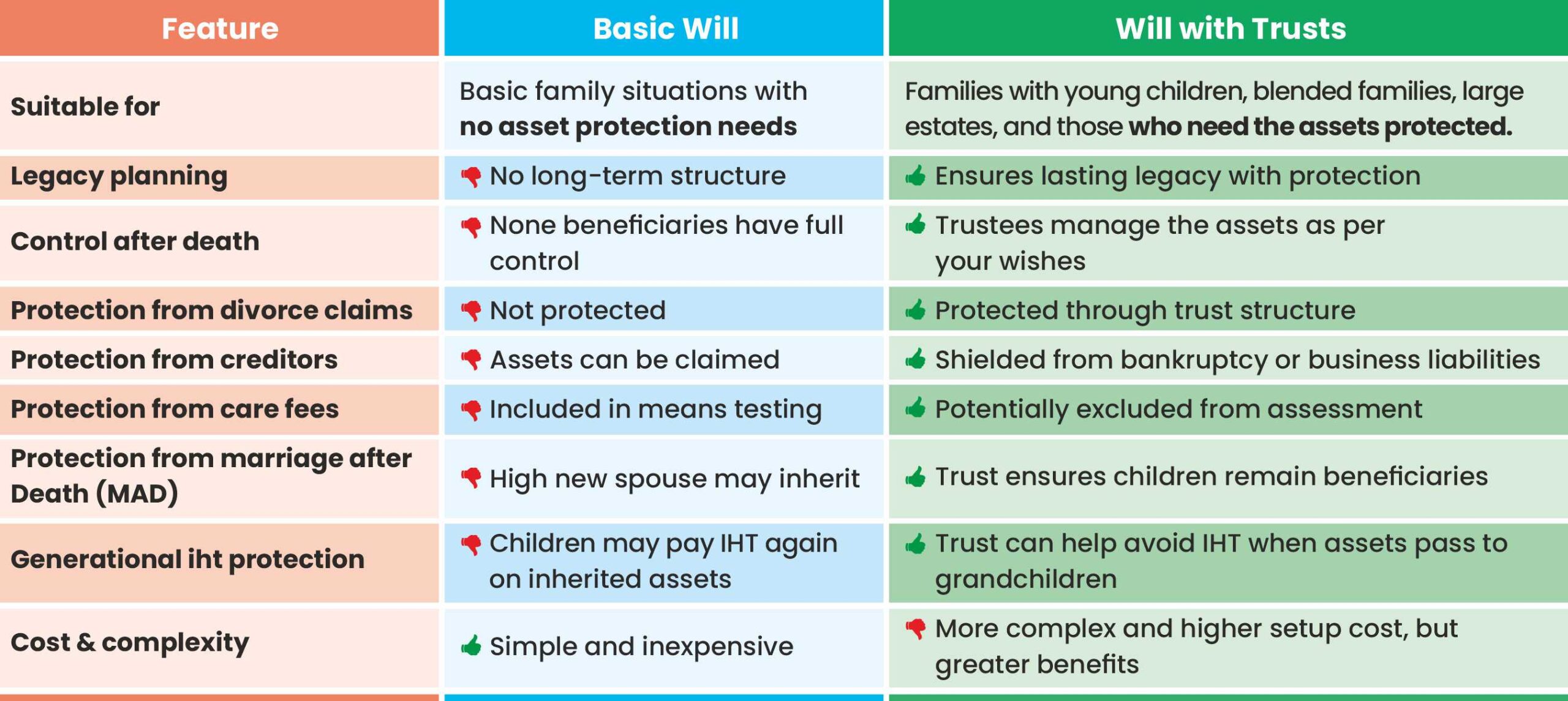
A side-by-side comparison to help you choose the right option for your legacy
Final Thoughts
If your goal is to transfer wealth securely and ensure your loved ones are truly protected, then a Will with Trusts is a powerful tool worth considering.
At Nachu Finance, we believe that those who have worked hard to build assets will appreciate the importance of ensuring they’re passed on effectively-with care, foresight, and the right safeguards in place.
Our Transparency Promise
Are Will Trusts Expensive or Too Complex?
It’s true-setting up a Will with Trusts is more involved and may cost more than a basic Will. But the benefits far outweigh the effort and cost.
With professional guidance, the complexities can be easily navigated. Support is available not just for you, but for your trustees and beneficiaries as well-now and in the future.
When you consider the long-term protection and peace of mind a Trust offers, the cost becomes a small price to pay for a more effective estate plan.
Ready to Secure Your Legacy?
Whether you’re just getting started with a simple Will or are considering a more protective approach through Trusts, we’re here to guide you every step of the way. Your estate planning decisions today can make a meaningful difference for your loved ones tomorrow-ensuring peace of mind, clarity, and lasting protection.
At Nachu Finance, we offer clear, practical advice tailored to your unique circumstances. No jargon. No pressure. Just experienced guidance to help you make the right choices with confidence.
Book a Free Consultation or get in touch today and take the first step toward safeguarding your family’s future.