Testmonials
Enquiry Form
Get in Touch with Us for Personalized Finance Assistance
Can I Use a Personal Loan or Credit Card to Fund My Mortgage Deposit?
- Date Published : November 06, 2026
Buying a first home is rarely just about the mortgage. For many buyers the harder part is finding the deposit, and a question we hear often is whether a personal loan or a credit card can help close the gap.
It is a reasonable thing to ask, and plenty of people assume it is allowed. In short, most lenders will not accept a borrowed deposit, but there are exceptions, and how you time things makes a real difference. This article explains how it works.

Can I use a personal loan or credit card for my deposit?
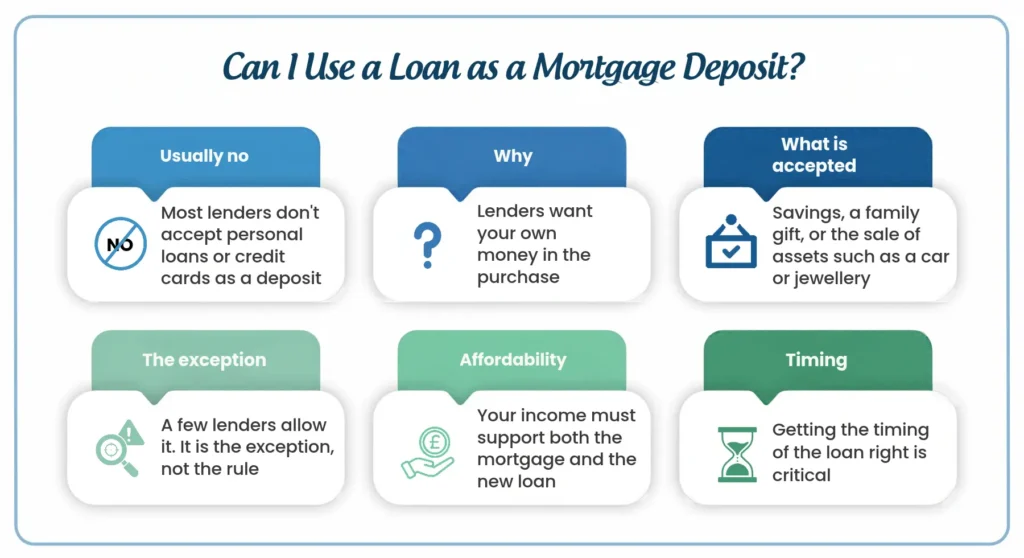
Generally, no. Most lenders will not accept a personal loan or a credit card balance as your deposit. They expect it to come from your own money: savings, a gift from family, or the sale of assets.
There are exceptions. A small number of lenders will consider it, but it is the exception rather than the rule, and it only works where your income can support both the mortgage and the new loan.
Why don't lenders accept a borrowed deposit?
Lenders want to see your own money going into the purchase. A deposit shows commitment and means you share the risk. If the deposit is itself borrowed, you are relying on another loan to buy the property.
It also affects affordability. A loan or credit card balance adds a monthly commitment, which reduces what a lender is willing to lend you for the mortgage. For these reasons, almost all lenders do not allow it as standard.
What do lenders accept as a deposit?
The usual sources are:
- Savings from your regular earnings
- A gift from close family, supported by a gifted deposit letter
- The sale of assets, such as investments, a car or jewellery
Whichever source you use, you will need to evidence it. To understand more about acceptable deposit sources and the paperwork lenders and solicitors ask for, refer to Mortgage Deposit Source & Evidence – What Lenders Expect.
Is there any exception?
Yes, but a narrow one. A very small number of lenders allow a personal loan or other credit commitment to be used towards the deposit, and for them it is part of what makes their offer different. Even then, certain conditions apply:
- The new loan is counted in the affordability assessment, alongside the mortgage.
- Your income needs to be adequate to support both.
- The arrangement is fully disclosed to the lender and the solicitor, never hidden.
This is where lender choice matters. The lender’s criteria should be checked before you apply for anything.
Why does the timing of the loan matter?
If this route is right for you, the order of events is important. You do not want to take out the loan first and then start the mortgage. Instead, the sequence we advise is:
- Speak to your adviser first, so the likely cost of the loan can be built into the affordability assessment.
- Obtain the agreement in principle.
- Secure the property and submit the full mortgage application.
- While the mortgage and conveyancing are under way, apply for the personal loan.
- Draw down the loan before completion.
This is the planned exception to a rule we normally give clients: do not take on new credit between agreement in principle and completion. A loan arranged this way only works because it was discussed and assessed from the start. To understand more about why new credit is best avoided during a mortgage application, refer to Can I Apply for Credit During a Mortgage Application?
Real-life Case Studies
Harrison and Indu were first-time buyers purchasing a home for £400,000. Their combined income was around £120,000 (£69,000 and £51,000). They had £20,000 of their own savings but needed a further £20,000 to reach a 10% deposit, and they wanted to borrow it as a personal loan.
Before any application, we reviewed the personal loan market, without applying for anything. Given their circumstances, we were reasonably confident they could borrow £20,000 over six years, with payments of around £346 a month. We then assessed the mortgage with that £346 included, and checked the plan against the lender’s criteria.
The steps then followed in this order:
- We obtained the agreement in principle, with the loan payment built in.
- Harrison and Indu secured the property, and we submitted the full mortgage application.
- While the mortgage and conveyancing were in progress, they applied for the personal loan. It came back at the monthly payment we expected.
- Before completion, they drew down the £20,000.
Because the loan had been planned, assessed and checked against the lender’s criteria from the start, there were no surprises, and the purchase completed smoothly.
The names in these examples have been changed.
Our Transparency Promise
More an exception than the rule
We have helped clients buy a property using a loan towards the deposit, as in the example above. But it is more an exception than the rule. It only works when your income is adequate to support both the new mortgage and the loan, and it depends on your individual circumstances and affordability. We will not tell you this is easy or that it can happen for everyone. For the right client, it may still be an option.
Nachu Finance does not advise on personal loans. We advise on the mortgage, and any loan is arranged separately by you. Only borrow what you can comfortably afford to repay.
Planning to buy with an unusual deposit?
Buying a home can feel complicated and daunting, and lenders differ in what they accept as a deposit. Every deposit situation is different. If yours is slightly unusual, we are happy to explore the options with you from the very early stages, starting with a free first meeting.

About the Author
Sekkappan Alagu is the Founder of Nachu Finance Ltd, established in 2006. With an early career in journalism and publishing, he brings clarity and structured thinking to complex financial topics. Through the Nachu Finance Blog and Knowledge Hub, he shares insights drawn from nearly two decades of client advisory experience, helping readers make informed decisions and understand best practices in mortgages, protection and long-term financial planning.

Business Profile
Nachu Finance Ltd is a directly authorised FCA-regulated firm providing mortgage, insurance and estate planning advice to clients across the UK. The firm takes a holistic approach — considering protection, tax efficiency and long-term planning alongside property finance — maintaining high regulatory standards while keeping advice clear and easy to follow. To learn more about the firm's background and story, visit the About Nachu Finance page.
Essential Guides to Mortgage Deposits and Applications