
Testmonials
Enquiry Form
Get in Touch with Us for Personalized Finance Assistance
Arrangement Fees: What They Are and How They Really Work
- Date Published : October 23, 2026
Is 4% with a £1,000 arrangement fee better than 4.10% with no fee?
It is a question we are asked often, and the honest answer is: it depends. Depending on the loan, the difference between two deals like these can be hundreds or even thousands of pounds, and the cheaper one is not always the one you would expect.
This article explains how arrangement fees work, how much they can be and how to work out which deal is cheaper, using four real cases. It also covers adding the fee to the loan and why we usually do.
What is an arrangement fee?
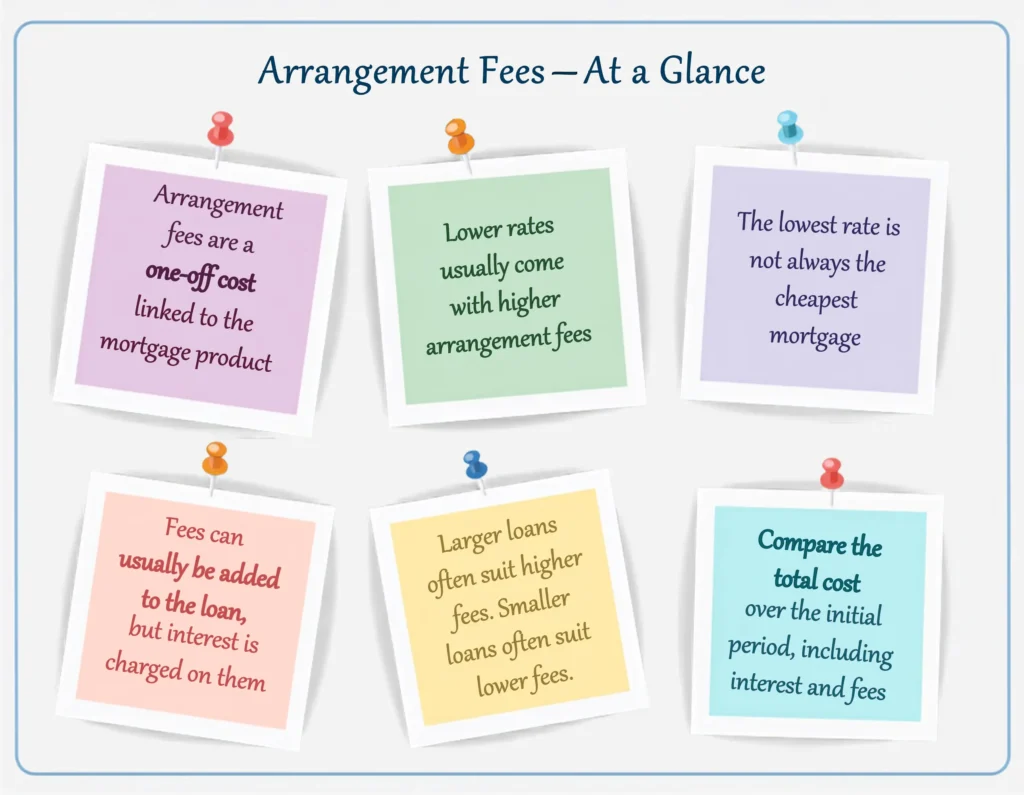
An arrangement fee, sometimes called a product fee, is a one-off charge made by the lender for a particular mortgage product. It is attached to the specific interest rate and product you choose, so the same lender can charge different fees on different rates.
Lenders use the fee to balance their profit against the interest rate they offer. A higher arrangement fee usually allows a lower interest rate, while a lower or zero fee usually comes with a higher rate. This is why lenders very commonly offer several versions of the same product, for example a 2-year fixed rate, each with a different fee and rate.
That makes comparing them less obvious than picking the lowest fee or the lowest rate. The sections below explain how arrangement fees vary, how to work out the cheapest deal and how the fee can be added to the loan.
How much can an arrangement fee be?
Arrangement fees vary widely. The ones we see most often are:
- No arrangement fee: some lenders have products with no fee at all.
- Around £500: often £495 or £499.
- Around £1,000: often £995 or £999.
- Other fixed fees: such as £1,499 or £1,999.
- A percentage of the loan: such as 1% or 2%.
Percentage fees are more common on buy-to-let mortgages, where up to 3% is common. Some specialist buy-to-let products carry much higher fees of 5% or 7%, which on a £300,000 loan would be £15,000 or £21,000.
These products are usually used where a client needs a higher loan and a lower interest rate helps the loan pass the lender’s rental stress test. The lender cannot give up its margin on the rate, so it takes a higher fee instead. Such a product can have a role to play, as Case 4 below shows, but care should be taken to be fully aware of what is being agreed.
Understanding the cheapest deal: total to pay
When you compare products, either within one lender or between lenders, the best way to find the cheaper deal is to work out the total to pay over the period you are comparing, usually the initial fixed period.
Total to pay is the interest paid over that period plus the arrangement fee. If the fee is added to the loan, the interest charged on the fee is included too. The product with the lowest total to pay is the cheaper deal over that period.
This is why the lowest fee, or the lowest rate, is not always the cheapest option. A flat fee costs the same whatever the loan size, but a rate saving is worth more on a larger loan. A 0.25% lower rate saves about £1,035 a year on £414,000, but only about £294 a year on £117,682.
Generally speaking:
- Larger loans are often better off with a higher arrangement fee and a lower interest rate.
- Smaller loans are often better off with a lower or no arrangement fee.
The worked examples below show how this plays out.
Worked examples
These four examples are based on real cases, with the details anonymised. Rates are those that were available at the time and are for illustration only. In each case the fee was added to the loan, so interest on it is included.
Total to pay is calculated on an interest-only basis: the interest on the full loan over the period, plus the arrangement fee. We compare on this basis because the true cost of borrowing is the interest and the fees. On a repayment mortgage, part of each payment repays capital, which reduces what you owe rather than costing you anything, so a higher monthly payment is a cashflow matter, not an extra cost. The interest actually charged will be a little lower as the balance falls, but every product is compared on the same basis.
Case 1: Residential purchase, £414,000. The higher fee was cheaper
| Option 1: no fee | Option 2: £999 fee | |
|---|---|---|
| Rate | 5.35% | 5.10% |
| Arrangement fee | £0 | £999 (added to loan) |
| Interest over 2 years | £44,298 | £42,330 |
| Arrangement fee | £0 | £999 |
| Total to pay over 2 years | £44,298 ✕ | £43,329 ✓ |
| Saving compared to Option 1 | — | £969 |
Case 2: Residential product transfer, £117,682. Almost no difference
| Option 1: £999 fee | Option 2: no fee | |
|---|---|---|
| Rate | 5.14% | 5.35% |
| Arrangement fee | £999 (added to loan) | £0 |
| Monthly payment | £738.18 | £746.20 |
| Interest over 5 years | £30,501 | £31,480 |
| Arrangement fee | £999 | £0 |
| Total to pay over 5 years | £31,500 | £31,480 |
| Difference | — | £20 cheaper |
Case 3: Buy-to-let product transfer, £140,769. No fee was cheaper
| Option 1: £1,999 fee | Option 2: no fee | |
|---|---|---|
| Rate | 5.23% | 5.38% |
| Arrangement fee | £1,999 (added to loan) | £0 |
| Monthly payment (interest only) | £622.23 | £631.11 |
| Interest over 5 years | £37,334 | £37,867 |
| Arrangement fee | £1,999 | £0 |
| Total to pay over 5 years | £39,333 ✕ | £37,867 ✓ |
| Saving compared to Option 1 | — | £1,466 |
Case 4: Buy-to-let remortgage, £308,000. The cheapest was not the one that worked
| Option 1: £1,499 fee | Option 2: 3% fee | |
|---|---|---|
| Rate | 5.39% | 4.94% |
| Arrangement fee | £1,499 (added to loan) | £9,240 (added to loan) |
| Monthly payment (interest only) | £1,390.17 | £1,305.97 |
| Interest over 5 years | £83,410 | £78,358 |
| Arrangement fee | £1,499 | £9,240 |
| Total to pay over 5 years | £84,909 ✓ | £87,598 ✕ |
| Cheaper by | £2,689 | — |
| Rent needed to meet the lender’s affordability test | £2,015.74 | £1,893.66 |
| Loan affordable on rent of £1,900 | ✕ | ✓ |
The four cases at a glance
| Case | Loan | Products compared | Cheapest on total to pay | Difference | What decided it |
|---|---|---|---|---|---|
| Residential purchase | £414,000 | No fee (5.35%) v £999 fee (5.10%) | £999 fee | £969 | Rate saving outweighed the fee on a larger loan |
| Residential product transfer | £117,682 | £999 fee (5.14%) v no fee (5.35%) | No fee, by a small margin | £20 | Almost level, so a lower monthly payment and convenience decided it |
| Buy-to-let product transfer | £140,769 | £1,999 fee (5.23%) v no fee (5.38%) | No fee | £1,466 | On a smaller loan the fee outweighed the rate saving |
| Buy-to-let remortgage | £308,000 | £1,499 fee (5.39%) v 3% fee (4.94%) | £1,499 fee | £2,689 | Only the 3% fee product made the loan affordable |
Adding the arrangement fee to the loan
In most cases the arrangement fee can be added to the loan, but this is not guaranteed. Two things can prevent it:
- Affordability: if the maximum loan the lender will offer does not leave room for the fee, it cannot be added.
- Loan to value: some lenders do not allow the loan, including the fee, to go above their loan-to-value limit.
In practice we see the fee added very often, but it should not be assumed.
When the fee is added to the loan, interest is charged on it as well, at the rate you have chosen. It is not interest-free, which is why the interest on the fee is included in the total to pay figures above.
Why adding the fee to the loan is logistically easier
Our approach is to add the arrangement fee to the loan and, if needed, pay it off after completion.
Adding the fee to the loan is the practical, logistically easier route. There is no fee to pay upfront. If the loan does not go ahead, or the product has to change to one with a different arrangement fee, nothing has been paid that needs sorting out, and the change is simpler to make.
The fee still attracts interest while it sits in the loan. If you would rather avoid that, you can pay the fee off once the loan has gone live, subject to the lender’s overpayment terms. At that point the loan is live and there can be no further change to the product, so the fee can be paid off with certainty. Even if you would rather not carry the fee in the loan, this is often the easier way to handle it.
Frequently Asked Questions
No. Clients have asked us whether the arrangement fee a lender charges has anything to do with the procuration fee the lender pays to advisers. There is no link. Whether a product has an arrangement fee or not, the procuration fee paid to the adviser usually remains unchanged.
No. A product with no arrangement fee is not always the cheapest. It depends on the loan amount and on the other options available. In Case 1 and Case 4 the product with the higher fee was cheaper over the period, while in Case 3 the product with no fee was. Working out the total cost over the period you are comparing is the way to tell.

About the Author
Sekkappan Alagu is the Founder of Nachu Finance Ltd, established in 2006. With an early career in journalism and publishing, he brings clarity and structured thinking to complex financial topics. Through the Nachu Finance Blog and Knowledge Hub, he shares insights drawn from nearly two decades of client advisory experience, helping readers make informed decisions and understand best practices in mortgages, protection and long-term financial planning.

Business Profile
Nachu Finance Ltd is a directly authorised FCA-regulated firm providing mortgage, insurance and estate planning advice to clients across the UK. The firm takes a holistic approach — considering protection, tax efficiency and long-term planning alongside property finance — maintaining high regulatory standards while keeping advice clear and easy to follow. To learn more about the firm's background and story, visit the About Nachu Finance page.
Understanding the True Cost of Your Mortgage