
Testmonials
Enquiry Form
Get in Touch with Us for Personalized Finance Assistance
Mortgage Deposit Source & Evidence – What Lenders Expect
- Date First Published: 10 June 2025
- Date Last Modified: 26 August 2026
When preparing to buy a home, many clients wrongly assume that as long as their deposit money is sitting safely in a bank account, lenders will not question it. Whereas in reality, a significant part of professional mortgage advice involves ensuring that your deposit source is fully acceptable and that your evidence trail satisfies strict lender and compliance requirements. With tighter anti-money laundering checks and intense lender scrutiny, this often-overlooked detail can make or break your application. In this guide, we explain exactly what lenders and solicitors need to see so you can get your paperwork right from the start.

Why Lenders and Solicitors Require Deposit Evidence
Lenders and solicitors are bound by anti-money laundering (AML) regulations. Often, solicitors request even more detailed documentation than lenders to fulfil their legal obligations. This is standard and should not be a cause of concern.
A common misconception among homebuyers is the myth: “If it’s been in my bank account for a long time, I don’t need to prove it.”In reality, UK financial institutions and solicitors have a legal and regulatory obligation to establish the original source of funds. This is not a case of lenders being unnecessarily difficult or distrustful of applicants; rather, it is a strict legal requirement designed to combat financial crime, tax evasion, and money laundering.
- Use of Technology in Evidence Collection
Some solicitors now use third-party apps and digital tools to collect and verify documents more efficiently. This doesn’t change the need for documentation—it just streamlines the process for both parties.
- Estate Agents May Ask Too
Increasingly, estate agents also request evidence of deposit before taking a property off the market. This is to ensure buyers are credible and to meet their own AML compliance obligations.
With that in mind, let’s look at the most commonly accepted deposit sources.
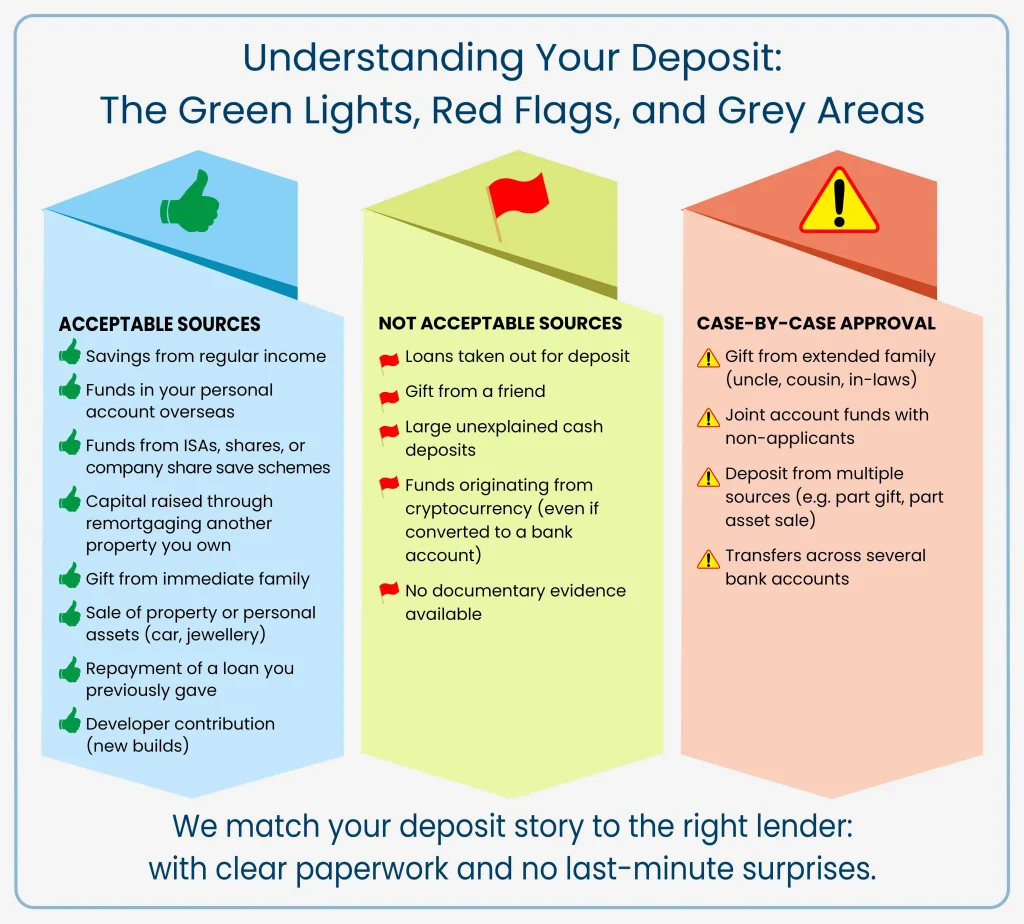
A quick breakdown of green lights, red flags, and case-by-case scenarios for your mortgage funds. Use it to check your deposit type before applying.
Acceptable Sources of Deposit
Savings from Regular Earnings
This is the most straightforward and widely accepted source. Whether saved in the UK or in your personal accounts abroad, lenders will assess the plausibility of your savings by reviewing your income, outgoings, dependants, and duration of savings.
For example: A couple earning £80,000 jointly with two dependants and a consistent earning history over six years declaring £150,000 in savings is more credible than a single applicant earning £40,000 over three years with a similar family setup.
Funds from investments
Money held in ISAs, investment portfolios, individual company shares, or from company share save schemes can all be used as a deposit source, provided you can show ownership and sale proceeds. Lenders may request valuation reports, sale transaction records, or account statements showing the transfer of funds into your account.
Capital raised from a remortgage of another property
If you already own a property and are raising funds through a remortgage, this is usually acceptable, especially for buy-to-let purchases or onward residential moves. You’ll need to provide the remortgage offer, completion statement, and proof that the funds are available or have been transferred.
Gifted Deposit from Family
Gifts from close family—typically parents, grandparents, or siblings—are widely accepted. However, each lender has their own criteria. Gifts from extended family (like uncles, aunts, or cousins) are accepted by some lenders but not all, so lender selection becomes key.
Lenders will check:
- That the gift is non-refundable.
- That the donor has no legal or beneficial interest in the property.
- That the donor has the funds and is not borrowing them.
Proceeds from the Sale of a Property
A common source, particularly for home movers. If the sale and purchase are simultaneous, evidence is straightforward. But if the sale occurred earlier, lenders will require full documentation—such as the solicitor’s completion statement and bank statements showing the deposit funds received from the sale.
Sale of Other Assets
Funds generated from the sale of cars, jewellery, businesses, or similar are accepted with appropriate evidence. You will need to show:
- Proof of ownership
- Sale agreement or receipt
- Bank trail of money entering your account
Repayment of a Previous Loan
If you have previously loaned money to someone and they’re now repaying you, this can be accepted as part of your deposit—provided you have clear documentation showing the original transfer and the repayment. Lenders will typically look to verify key details such as the names involved, the amount originally loaned, and the amount being returned to ensure the funds are genuinely yours. ID documents, proof of funds and a loan repayment letter will be required.
Incentives from a New Build Developer
Some property developers offer financial incentives, such as cash contributions towards your deposit. These are generally acceptable, subject to each lender’s specific criteria. However, it’s important to note that most lenders cap the allowable developer contribution at a maximum of 5% of the purchase price. Anything beyond this may be deducted from the purchase price for lending purposes or may not be accepted at all.
Lenders will also assess how the incentive is structured—whether it’s a straightforward cash contribution, a discount on price, or a package (e.g. paying stamp duty or legal fees)—and treat each case accordingly
Sources That Are Typically Not Accepted
While some sources may occasionally be accepted under special circumstances, the following are generally not viewed favourably:
Loans Used as Deposit
Lenders typically do not accept borrowed money as a deposit, as this affects affordability and introduces repayment risk. Some exceptions exist (e.g. inter-family loans on specific terms), but these are rare and require full disclosure.
Gifts from Friends
Most lenders do not accept gifts from friends, viewing them as potential undisclosed loans rather than true gifts.
Unexplained Cash Deposits
Large cash deposits raise red flags for anti-money laundering checks. These are scrutinised heavily, and unless there’s a verifiable paper trail, they are best avoided during your deposit-building phase.
Savings or funds originating from cryptocurrency
Due to the difficulty in verifying the origin and movement of funds in crypto wallets, most lenders do not accept deposits that were held or generated through cryptocurrency—even if the money has since been converted into a standard bank account.
Lack of Evidence for a Valid Source
Even if the deposit source is normally acceptable, it may be rejected without appropriate documentation to support it. It’s not just the lender who needs to be satisfied—the solicitor handling the purchase is also responsible for verifying the legitimacy of the funds under anti-money laundering regulations. If the evidence is incomplete or unclear, the solicitor may refuse to proceed, even if the lender has initially accepted the deposit in principle.
Best to Avoid Multiple Transfers
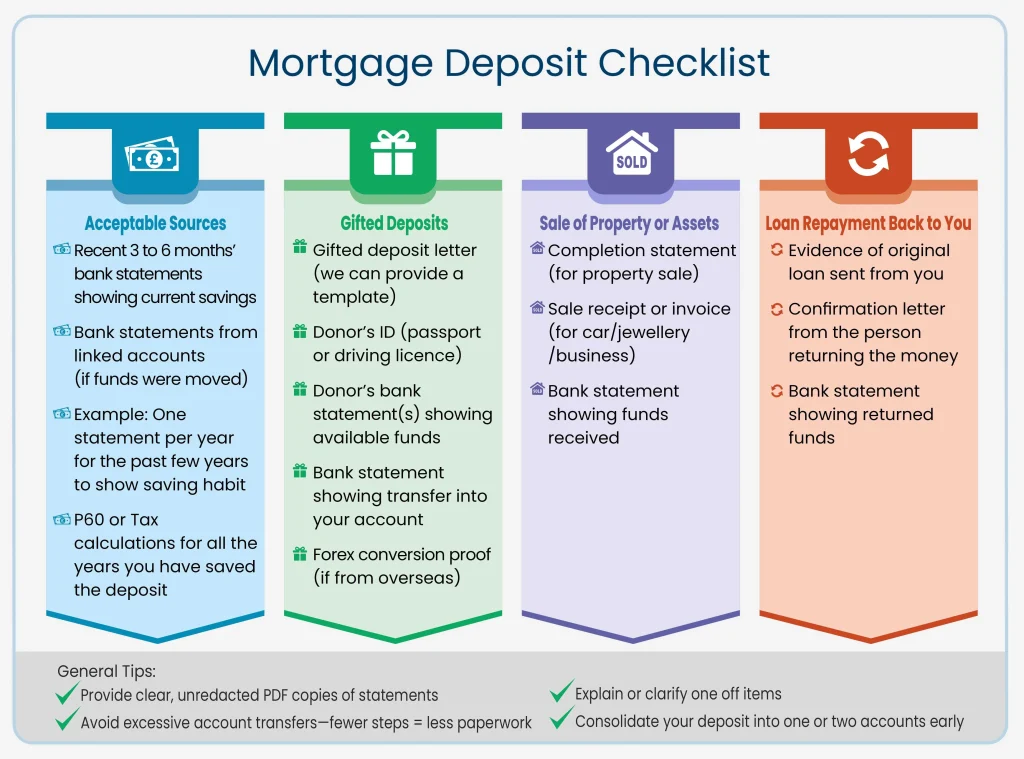
A visual guide to the exact paperwork required by lenders and solicitors based on your source of funds. Use it to ensure your evidence trail is completely unbroken before you apply.
We often see cases where clients move money between their own bank accounts multiple times before the funds settle in the final deposit account. While this isn’t necessarily a problem for lenders or solicitors, it does mean more paperwork.
If your deposit has passed through several accounts—for example, from Account A to B, then C, then D, before ending up in Account E—be prepared to provide bank statements for all five accounts. Each transfer must be clearly documented to establish a full trail of funds.
To make things simpler:
- Try to consolidate funds early in one or two accounts.
- Avoid unnecessary back-and-forth transfers between accounts.
- Provide full, unredacted bank statements for any accounts involved in the deposit trail.
Taking these steps early can help reduce delays and make it easier for lenders and solicitors to verify your deposit source.
Common Documents Required to Verify Your Deposit
The documents required will depend on the source of the funds, but here’s a general guide based on what lenders and solicitors typically ask for:
Savings from Income
- Bank statements showing where the money is currently held.
- Supporting statements from any linked or feeder accounts.
- Savings build-up evidence: While “five years” is often cited, the actual duration depends on how long you’ve been saving. Lenders will want to see a pattern that aligns with your income and expenses. For example, one month’s bank statement per year (e.g. every June) helps illustrate this.
Sale of Property or Other Assets
- Completion statement from solicitor (for property sale)
- Sale invoice/receipt (for other assets like a car or jewellery).
- Bank statement showing proceeds credited to your account.
Gifted Deposits (from Family)
- Donor’s ID (valid photo ID, ideally passport or driving licence).
- Proof of donor’s funds (bank statements showing how they built or held the gift amount).
- A Gifted Deposit Letter – confirming it’s a gift, not a loan, with no interest in the property (we can help you draft this).
- Bank statement showing the gift transfer into your account.
- Forex conversion documentation if gifted from abroad.
Repayment of a Previous Loan Given by You
- Proof the original loan transfer from you to the borrower.
- A letter from the borrower confirming it is a repayment, not a new gift or loan.
- Bank statement showing the returned funds entering your account.
General Best Practices
Regardless of the sources of your deposit, the following steps can help make the verification process smoother:
- Provide clear copies of all bank statements (PDFs, not screenshots, with no redactions).
- Highlight relevant transactions where needed to help the case handler or underwriter.
- Be proactive—gather all relevant documents early and keep them in one place.
Our Recommended Approach: Be Upfront and Honest
At Nachu Finance, we strongly recommend a transparent approach when it comes to your deposit. If the source is genuine—even if slightly unusual—it’s often easier to present it honestly than attempt to frame it as something more ‘standard’.
Our role is to:
- Understand your deposit source from the start.
- Anticipate the lender’s stance.
- Recommend a lender most likely to accept it.
- Support you with all the documentation needed.
This may mean a bit more admin early on, but it ensures fewer delays and surprises later.
To see exactly how this upfront approach works in the real world, look at how we supported one of our clients when standard rules said “no”:
The Situation: Back in 2023, Rishi, a first-time buyer earning a basic salary of £74,000 plus an annual bonus of over £10,000, was keen to purchase his first home priced at £250,000. While affordability for the mortgage wasn’t an issue, the main challenge was the deposit—he didn’t have enough saved.
To bridge the shortfall, Rishi was willing to take out a personal loan. However, using a loan as a source of deposit is typically not accepted by most mortgage lenders, as it impacts both affordability and risk perception.
Our Strategy: At Nachu Finance, we reviewed the case carefully. Given that the overall affordability remained strong even after accounting for the personal loan repayments, we approached one of our trusted high street lenders—known to consider such scenarios on a case-by-case basis. After discussing the application directly with our relationship manager at the bank and presenting the full picture transparently, the mortgage offer was issued without delay.
The Outcome: We also advised the solicitors upfront about the arrangement and confirmed that the lender had approved the use of a personal loan for the deposit. The purchase completed smoothly, without any last-minute hurdles.
Since then, we’ve successfully supported many clients in similar situations—where the source of deposit may not be straightforward, but the case is genuine, and the affordability checks out. With the right guidance and lender selection, even cases that don’t fit the standard mould can be placed confidently.
Our Transparency Promise
At Nachu Finance, our transparency promise means we leave no stone unturned at the outset. This includes a thorough due diligence process—where reviewing your deposit source and ensuring the evidence stands up to scrutiny is a central part.
Yes, we are on your side. But we are also realistic about what lenders and solicitors will require. That’s why we prefer to examine the deposit documentation in detail at the beginning, so we’re ready with the right explanations or supporting documents if queries arise.
Please don’t take it the wrong way if we request detailed paperwork early on—it’s all in your best interest and helps avoid issues further down the line.
Ready to Secure the Right Mortgage for Your Situation?
If there is a way to place your case, we will work to find it.
At Nachu Finance, we understand that deposit sources are not always straightforward. Whether your funds come from multiple accounts, overseas assets, gifted deposits, investment proceeds, or other less common sources, we can help identify lenders whose criteria are best suited to your circumstances.
We’ll also help you understand the documentation and evidence required, ensuring your deposit is presented clearly from the outset. By reviewing your deposit position early, we help minimise delays and avoid unnecessary surprises later in the mortgage process.
If you would like guidance on your deposit source or help finding the right lender, we’re always happy to help.
Frequently Asked Questions
To explain a large deposit, you must provide an unbroken paper trail—called an audit trail—that shows exactly where the money originated. It is not enough to just show the money in your current account. If it came from savings, you provide regular bank logs; if it was a family gift, you provide a signed Gifted Deposit Letter and the donor’s ID; and if it came from an asset sale, you provide the official completion statement or receipt.
If you are unable to fully evidence part of your deposit, it is important to discuss this with your mortgage adviser as early as possible. Depending on the circumstances, alternative documentation may be available to help support your case.
However, where the source of funds cannot be satisfactorily verified, both lenders and solicitors may have concerns. Addressing any potential issues upfront can help identify the most suitable way forward and reduce the risk of delays during the mortgage process.
While standard anti-money laundering checks usually focus closely on the last 3 to 6 months of bank activity, lenders and solicitors have a legal right to look back as far as necessary to find the original source of the money. For long-term savings, you don’t need to provide hundreds of pages of statements; instead, providing just one statement per year (e.g., every June for the last few years) is a highly effective way to cleanly illustrate the gradual, legitimate growth of your funds.
In most cases, mortgage lenders do not accept personal loans as a source of deposit because they increase your overall borrowing and affect affordability. However, it is not impossible, some lenders may consider this on a case-by-case basis where affordability remains strong, and the arrangement is fully disclosed.
You will usually need to provide a solicitor’s completion statement from the property sale, along with bank statements showing the sale proceeds being received into your account. This helps lenders and solicitors verify the source of the funds being used as your deposit.
A decline does not necessarily mean a gifted deposit is unacceptable. It may indicate concerns about the donor, the supporting documentation or the source of funds. The next step is to identify the reason for the decline, gather any missing evidence and seek professional advice before making another application. At Nachu Finance, we regularly help clients review declined cases and identify lenders whose criteria may be better suited to their circumstances.
You will typically need a gifted deposit letter confirming the funds are a gift rather than a loan, proof of the donor’s identity, evidence of the donor’s source of funds, and bank statements showing the transfer into your account. Requirements can vary between lenders and solicitors, so it is important to gather the documentation early in the process.

About the Author
Sekkappan Alagu is the Founder of Nachu Finance Ltd, established in 2006. With an early career in journalism and publishing, he brings clarity and structured thinking to complex financial topics. Through the Nachu Finance Blog and Knowledge Hub, he shares insights drawn from nearly two decades of client advisory experience, helping readers make informed decisions and understand best practices in mortgages, protection and long-term financial planning.

Business Profile
Nachu Finance Ltd is a directly authorised FCA-regulated firm providing mortgage, insurance and estate planning advice to clients across the UK. The firm takes a holistic approach — considering protection, tax efficiency and long-term planning alongside property finance — maintaining high regulatory standards while keeping advice clear and easy to follow. To learn more about the firm's background and story, visit the About Nachu Finance page.
Preparing for a Successful Mortgage Application