Testmonials
Enquiry Form
Get in Touch with Us for Personalized Finance Assistance
Personal Guarantee for Limited Company Mortgages
- Date Published :
When buying a buy-to-let property through a limited company, there are a few additional steps compared to purchasing your personal name.
One of the most important — and often least understood — is the personal guarantee, which we deal with regularly as part of Setting Up and Navigating Limited Company Mortgages .

If you’ve already read our guide on limited company mortgages, you’ll know that a limited company is treated as a separate legal entity from the individuals behind it — its directors and shareholders. This separation is one of the key reasons investors choose this structure, particularly for tax efficiency and long-term planning. If you are still deciding whether a limited company is the right structure for you, you may find our guide helpful.
However, this same principle creates a challenge for mortgage lenders.
The mortgage is issued to the limited company, but the lender’s assessment is based on the individuals behind it — their credit profile, income, and overall financial position. In practice, the company is the borrower, but the strength of the application comes from the people running it.
From the lender’s perspective, this creates a gap. If the company is a separate legal entity, how can they ensure that the individuals they have assessed remain accountable if the mortgage is not repaid?
This is where the personal guarantee comes in.
What is a Personal Guarantee?
In simple terms, a personal guarantee is a legal commitment made by the directors and, in some cases, shareholders of a limited company to the mortgage lender.
It confirms that if the company is unable to repay the mortgage, those individuals will step in and take personal responsibility for the debt.
Although the mortgage is in the company’s name, the personal guarantee ensures that the lender ultimately has recourse to the individuals behind it. This requirement applies whether you are purchasing a new asset or transferring an existing property into a limited company .This is why it forms a standard part of almost all limited company buy-to-let mortgages.
Why Lenders Require a Personal Guarantee
In most cases, limited company buy-to-let mortgages are taken out through newly set up Special Purpose Vehicles (SPVs). While this is perfectly acceptable to lenders, a new company will not have any financial track record of its own.
As a result, lenders are not relying on the company’s history when deciding. Instead, they are lending primarily based on the strength of the individuals behind it.
However, because the mortgage is in the name of the limited company, the lender cannot automatically pursue the directors personally if the mortgage is not repaid — unless a personal guarantee is in place.
Without a personal guarantee, the lender’s only recourse in a default would be against the company itself and the property securing the loan.
The personal guarantee provides the additional security of being able to pursue the directors and relevant shareholders personally if required. It ensures that the individuals who were assessed at application stage remain accountable for the borrowing.
It is important to understand that this is standard practice. Personal guarantees are a normal and expected part of limited company buy-to-let mortgages, particularly where the company is newly established.
Getting the structure right from the outset is important, which is why specialist professional advice on property tax decisions matters from the start. This helps ensure the balance between liability protection and long-term tax efficiency is considered before any property purchases are made.
Independent Legal Advice: What It Is and Why It Is Required
Independent legal advice — often referred to as ILA — is a mandatory part of the personal guarantee process.
For a personal guarantee to be legally valid, and for the lender to be protected from any future challenge, each director and relevant shareholder who is signing the guarantee must receive independent legal advice from a qualified solicitor.
The solicitor’s role is to ensure that the individual fully understands what they are signing and the legal implications.
The key word here is independent.
The solicitor providing this advice must be separate from the firm acting on the property purchase. This is because the solicitors handling the purchase are acting for the limited company, whereas the personal guarantee is being given by the individuals behind it. Legally, there are two different parties.
From the lender’s perspective, it is important that this advice is given independently, confirming that the personal guarantee has been properly explained and understood.
As part of this process, the solicitor will talk through the personal guarantee in detail and confirm that the individual understands they are giving a personal commitment for a loan taken out by the company, against a property that is owned in the company’s name — not in their personal name.
They will also verify the identity of the individual signing and will need to review the mortgage offer and the personal guarantee documentation.
Once the advice has been given, the solicitor will witness and countersign the relevant documents and forward the completed set to the solicitors acting on the purchase, so that the transaction can proceed.
It’s worth noting that most firms acting on the purchase will not provide independent legal advice themselves, even if asked. This is because doing so would create a conflict of interest, given that they are acting for the company in the transaction.
It is important to understand that independent legal advice is not a formality. It is a proper legal appointment with real accountability for the solicitor. The individual signing the guarantee is expected to engage with the advice and confirm their understanding, so that there can be no uncertainty about what has been agreed.
The Process Step by Step
The personal guarantee and independent legal advice process follows a clear sequence. While there are a few steps involved, it is generally straightforward when planned in advance.
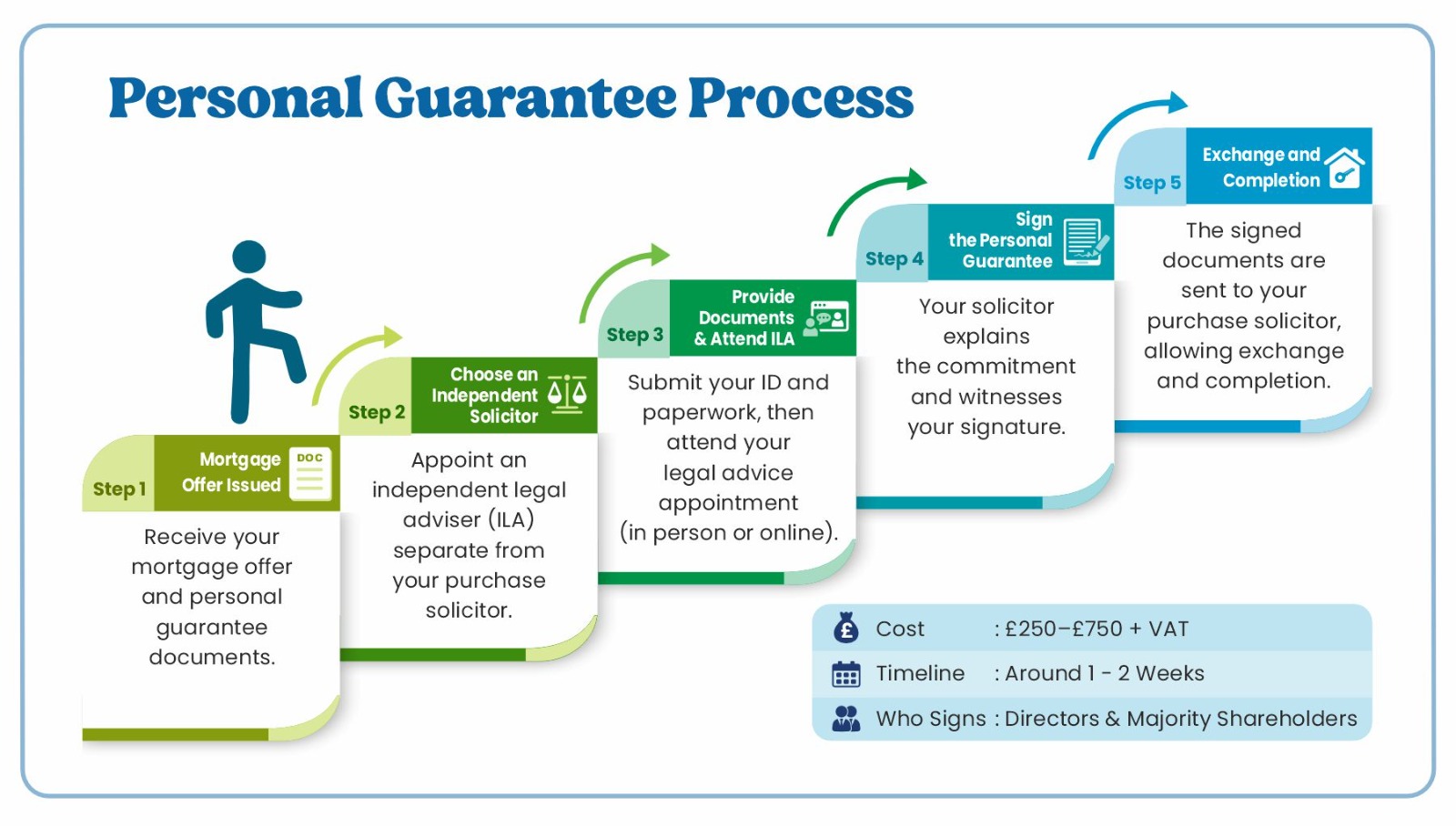
The above infographic outlines the five key stages of the personal guarantee process, from receiving a mortgage offer to completing a limited company property purchase.
Step 1 — Identify your ILA solicitor in advance
Not all legal firms offer independent legal advice for personal guarantees, so it is important to identify a solicitor who provides this service before you need them urgently.
We have worked with clients who have successfully used specific firms for this, and we are happy to share those details if helpful. At this stage, it is also sensible to obtain a fee quote so that you know what to expect.
Step 2 — Wait for the mortgage offer
The process cannot begin until the mortgage offer has been issued.
This is because the mortgage offer contains the specific loan details and the personal guarantee documentation. Without these, the solicitor cannot complete the advice or the signing.
While you can identify your solicitor and agree on fees in advance, the formal process can only begin once the offer is in hand.
Step 3 — Provide documents to your ILA solicitor
Once the mortgage offer is issued, you will need to provide your ILA solicitor with the required documents.
This will typically include proof of identity (such as a passport or driving licence), the mortgage offer, the personal guarantee document, and the independent legal advice certificate. The solicitor will confirm exactly what is needed.
Step 4 — Attend the ILA appointment
The appointment itself can be carried out either face to face or virtually, depending on the solicitor and lender (covered in the next section).
During the appointment, the solicitor will talk through the personal guarantee and its implications, confirm that you understand what you are signing, and then complete the signing and witnessing of the documents.
Once completed, the solicitor will forward the countersigned documents to the solicitors acting on the purchase.
Step 5 — Completion
The solicitors handling the purchase will not be able to proceed to exchange and completion until the signed personal guarantee and independent legal advice documents have been received.
This is a hard requirement. Exchange and completion cannot take place without it, so it is important to plan this step in a good time.
Face – to- Face vs Virtual Appointments
Historically, independent legal advice appointments were conducted face to face. In recent years, many solicitors now offer virtual appointments via platforms such as Teams or Zoom, and many lenders are comfortable with this approach.
However, there are a few important points to be aware of.
Before proceeding with a virtual appointment, it is important to confirm that both your ILA solicitor and your mortgage lender will accept a virtually signed personal guarantee and ILA certificate. This should not be assumed, as requirements can vary.
With virtual appointments, documents will typically need to be posted between parties for signing and witnessing. This can add time to the process, particularly where original documents are required.
That said, virtual appointments are now common, and, with the right combination of lender and solicitor, can be both time and cost efficient.
If there is any uncertainty, a face-to-face appointment remains the more straightforward option.
Who Needs to Provide a Personal Guarantee?
In most cases, the mortgage lender will require a personal guarantee from all directors of the limited company.
In addition, majority shareholders who are named on the mortgage application will usually also be required to provide a personal guarantee and receive independent legal advice.
Generally, anyone who is an applicant on the mortgage should expect to provide a personal guarantee. In practice, this typically ranges from one to four individuals.
Minority shareholders who are not part of the mortgage application will generally not be required to sign. However, this can vary depending on the lender, so it is important to confirm this at the application stage.
It is also important to understand that it is not sufficient for just one director to sign on behalf of others. Mortgage lenders require each relevant individual — directors and applicable shareholders — to provide a personal guarantee in their own name. This cannot be combined or delegated.
Does Signing a Personal Guarantee Affect Personal Borrowing Capacity?
This is a question client often have, even if they do not always ask it directly.
The short answer is that a personal guarantee does not typically impact your personal borrowing capacity in a direct way. Most personal credit decisions — including loans, credit cards, and residential mortgages — are based on your individual
credit profile. A personal guarantee on a limited company mortgage does not usually appear as a direct liability in that assessment.
However, there is an indirect point to be aware of.
When applying for further buy-to-let borrowing — whether personally or through a limited company — lenders will take into account the properties held within the limited company as part of your overall portfolio. This is the case regardless of the personal guarantee itself.
In practice, as buy-to-let mortgages are generally structured to be self-funding through rental income, this is usually manageable. However, it is important to understand that the limited company portfolio will be visible to lenders when assessing any future applications.
Cost and Timeframe
Two of the most common questions around personal guarantees and independent legal advice are cost and timing. It is important to understand both, as they form a key part of planning your purchase.
Cost
The cost of independent legal advice varies between solicitors and will depend on whether the appointment is carried out face to face or virtually.
As a guide, fees typically range from £250 to £750 plus VAT per director.
While the process may appear relatively straightforward, the fee reflects the level of responsibility the solicitor is taking on. They are required to verify identity, review documentation, provide formal advice, and retain records of the meeting, and the advice given.
They also carry ongoing legal accountability for this work and may be held liable if the process is later challenged. This is why the cost is charged at this level, even though the appointment itself may be relatively short.
If helpful, you can search for solicitors who offer independent legal advice for personal guarantees. We have also worked with firms that clients have used successfully and are happy to share details on request.
Timeframe
In theory, the process can be completed in a single day once the mortgage offer has been issued and the solicitor has all the required documents.
In practice, it is sensible to allow around two weeks from the date the mortgage offer is received.
This allows time to instruct the solicitor, complete anti-money laundering checks, gather documents, arrange the appointment, and allow for any postal time where documents need to be physically signed.
Recommendation
Plan for around two weeks between receiving the mortgage offer and having the completed personal guarantee and ILA documents with your purchase solicitors. Do not leave this to the last minute. Exchange and completion cannot proceed without it.
Buying a Second Property in the Same Limited Company
A question that often comes up, particularly from more experienced landlords, is whether a personal guarantee needs to be provided again when purchasing an additional property through the same limited company.
In most cases, the answer is yes.
Even where the same directors are buying a second property through the same company, lenders will typically require a fresh personal guarantee for each mortgage they issue.
This is because the personal guarantee is both lender-specific and property-specific. It is tied to that particular lender mortgage on that specific property and does not carry over automatically to any new borrowing.
In practice, it is very rarely possible to avoid providing a personal guarantee for a limited company mortgage. As a general rule, you should expect a personal guarantee to be required for each property purchase made through the limited company.
What Happens if a Director Leaves or is Replaced?
In a limited company mortgage, the directors are effectively the applicants. It is their income, credit profile, and deposit that the lender has assessed when approving the mortgage.
Because of this, changing the directorship of the company mid-term is not straightforward. It is not possible to simply add or remove a director without involving the mortgage lender.
If the directorship or shareholding structure needs to change, the lender must be informed and their consent obtained. In many cases, this may require moving the mortgage to a new lender entirely. The new directors would then go through the full application process, including underwriting, personal guarantees, and independent legal advice.
A helpful way to think about this is to compare it to a standard buy-to-let mortgage. Just as you cannot replace a named applicant in mid-term without going back to the lender, the same principle applies here. The lender’s decision is based on the specific individuals assessed at the time of application.
If a change in directorship is being considered for any reason, it is important to speak to your mortgage broker first to understand the lender’s position before making any changes at Companies House.
Remortgages and Changing Lenders
Personal guarantees are lender specific.
The guarantee provided to one lender when the property is purchased does not transfer to another lender if the mortgage is later remortgaged.
If the mortgage remains with the same lender, a fresh personal guarantee will not usually be required.
However, if the remortgage involves moving to a new lender, the directors will need to provide a new personal guarantee to that lender. This will also require a fresh round of independent legal advice.
This is worth factoring into both the cost and timeline when planning a remortgage to a new lender.
Happy to Help You Navigate Ltd Company Mortgages
Buying through a limited company involves more moving parts than a standard buy-to- let purchase, and the personal guarantee process is just one part of that.
From identifying the right lender, to managing the mortgage offer, to guiding clients through the independent legal advice and personal guarantee requirements, we support the process end to end.
If you are planning a limited company buy-to-let purchase and would like guidance through the process, we are always happy to help.
Frequently Asked Questions
While it can be completed in a single day once all documents are available, we recommend allowing around two weeks from the date the mortgage offer is issued.
If the appointment is virtual, additional time may be required for documents to be posted between parties.
Fees typically range from £250 to £750 plus VAT per director, depending on the solicitor and whether the appointment is face to face or virtual.
The formal process can only begin once the mortgage offer has been issued.
However, you can — and should — identify your ILA solicitor, agree fees, and understand the process in advance. The personal guarantee must be completed before exchange of contracts.
All directors of the limited company, and majority shareholders who are named on the mortgage application.
It is not possible for just one director to sign on behalf of others.
No. The personal guarantee and independent legal advice documents are a condition of the mortgage offer.
The solicitors acting on the purchase cannot proceed to exchange or completion until these have been received in full.
No. Mortgage lenders require the ILA to be provided by a completely separate firm of solicitors.
Most firms acting on a purchase will not provide ILA themselves due to the conflict of interest this creates.
A personal guarantee is lender-specific and property-specific.
You will typically need to provide a fresh personal guarantee for each property purchased through the limited company.
If you remortgage and remain with the same lender, a new guarantee is not usually required. If you move to a new lender, a fresh guarantee will be needed.
Many solicitors now offer virtual ILA appointments via Teams or Zoom, and many lenders will accept this.
However, it is important to confirm with both your ILA solicitor and your mortgage lender before proceeding, as not all lenders accept virtually signed documents.

About the Author
Sekkappan Alagu is the Founder of Nachu Finance Ltd, established in 2006. With an early career in journalism and publishing, he brings clarity and structured thinking to complex financial topics. Through the Nachu Finance Blog and Knowledge Hub, he shares insights drawn from nearly two decades of client advisory experience, helping readers make informed decisions and understand best practices in mortgages, protection and long-term financial planning.

Business Profile
Nachu Finance Ltd is a directly authorised FCA-regulated firm providing mortgage, insurance and estate planning advice to clients across the UK. The firm takes a holistic approach — considering protection, tax efficiency and long-term planning alongside property finance — maintaining high regulatory standards while keeping advice clear and easy to follow. To learn more about the firm's background and story, visit the About Nachu Finance page.
Continue Building Your Limited Company Property Strategy